Showing posts with label Pseudosuchians. Show all posts

Tuesday, 15 February 2022

Mambawakale ruhuhu: A new species of Pseudosuchian Archosaur from the Middle Triassic Manda Beds of Tanzania.

The Archosaurs, the group which includes modern Birds and Crocodiles, as well as the extinct non-Avian Dinosaurs and Pterosaurs, appeared in the Early Triassic and underwent a major evolutionary radiation in the Middle Triassic, becoming the dominant group of terrestrial Vertebrates. One of the most important sources of Middle Triassic Archosaur fossils is the Manda Beds of the Ruhuhu Basin, in southwest Tanzania, which is thought to be Anisian in age (247.2-242 million years old), and therefore documents the early stages of the Archosaur radiation.

The first recorded collections of material from the Manda Beds were made in the 1930s by Gordon Murray Stockley of the Tanganyika Geological Survey and Francis Rex Parrington of the University of Cambridge, followed later in the same decade by the Austrian geologist Ernst Nowack, who were all involved in surveying the Ruhuhu Basin for mineral resources, with the fossils they collected being sent to museums in South Africa, the UK, and Germany. Most of the material collected by Parrington was brought back to the UK, where it was described by Alan Charig as part of his PhD dissertation in the 1950s, but this dissertation was not published, and no descriptions of this material was published until after Charig's death in 1997. 

Tanganyika gained independence from Britain in 1961, and in 1964 merged with another former colony, Zanzibar, to form the modern Republic of Tanzania. In 1963 Charig took place in another expedition to the region, organised by the British Museum (Natural History) (now the Natural History Museum) and including researchers from South Africa, Uganda, and the UK, as well as large numbers of unnamed Tanzanian and Zambian workers, who identified many of the sites from which fossils were extracted, as well as excavating the fossils, and building the roads upon which they were transported away, with the fossils once again being brought back to the UK and deposited in the collection of the Natural History Museum.

This expedition collected a number of important specimens, including the material from which the Pseudosuchian Archosaur Hypselorhachis mirabilis was described, and another specimen which Charig referred to as Pallisteria angustimentum in a number of publications, but appears never to have described; he referred to the specimen being described as being ‘in press’ at the journal Palaeontology, but no record of this paper appears to exist, suggesting it was never submitted, making the name invalid under the terms of the International Code of Zoological Nomenclature.

In a paper published in the journal Royal Society Open Science on 9 February 2022, Richard Butler of the School of Geography, Earth and Environmental Sciences at the University of Birmingham, Vincent Fernandez of the Imaging and Analysis Centre at the Natural History Museum, Sterling Nesbitt of the  Department of Geosciences at Virginia Tech, João Vasco Leite of the Department of Earth Sciences at the Natural History Museum, and David Gower of the Department of Life Sciences at the Natural History Museum, formally describe the material identified as Pallisteria angustimentum by Alan Charig under the name Mambawakale ruhuhu.

Renaming a specimen to which a name has previously been applied is an unusual step even where the name is not now considered valid; it would have been possible for Butler et al. to simply describe the specimen under Charig's nominated name, thereby legitimising it, but they chose to rename it in Kiswahili, in honour of the unnamed Tanzanian workers, who located, extracted, and transported the specimen, and who would have spoken Kiswahili. Charig's original name, Pallisteria angustimentum, comprised a genus name, Pallisteria, intended to honour John Weaver Pallister, who was Commissioner of Mineral Resources of Tanganyika at the time of the 1963 expedition, and provided some support for it, although he was in no way directly involved in the collection of the specimen, and a specific name, angustimentum, which means 'narrow chin' in Latin. The new name proposed by Butler et al. comprises the genus name Mambawakale, meaning 'ancient Crocodile' in Kiswahili, and the specific name ruhuhu, in reference to the Ruhuhu Basin, where the specimen was collected. As none of the team working on the project came from Tanzania or spoke Kiswahili, the name was chosen with the help of Tanzanian herpetologist John Lyakurwa of the University of Dar es Salaam. An audio recording of the pronunciation of this name is provided on the Natural History Museum's Data Portal.

 
Photographs showing the collection of NHMUK R36620, holotype of Mambawakale ruhuhu, in 1963. Alan Charig is sat in the bottom right of the frame in the top left image, and is accompanied by Alfred ‘Fuzz’ Crompton. The top left and bottom right images also show Tanzanians (names unfortunately not recorded in archival material) who were employed by the 1963 expedition team and were critical to its success, discovering many of the fossil sites, constructing roads and carrying excavated fossils out of the field. Butler et al. (2022).

The specimen from which Mambawakale ruhuhu is described comprises a partial skull including the premaxillae, maxillae, vomers, palatines, pterygoids, ectopterygoids and fragments of the jugals and basipterygoid, with associated hemimandibles, hyoids and isolated maxillary or dentary teeth, found in association with an incomplete postcranium, including an atlantal intercentrum, partial axis and partial third cervical vertebra, a mostly complete left manus, and additional poorly preserved fragments.

 
Photographs of the skull of NHMUK R36620, holotype of Mambawakale ruhuhu, in right lateral (a) and left lateral (b) views, with a close-up of the left premaxilla in lateral view (c). Butler et al. (2022).

The skull was found exposed on an eroded surface. It was in occlusion with the mandibles when found, but apparently separated from them during preparation, during which process several of the teeth were also broken. Both premaxila are present, as are the maxila; the join between these bones is hard to detect visually, but can be seen in CT scans. The region of this join is toothless, creating a gap between the premaxilary and maxilary teeth. Only the lower part of the external naris (nose bone) is preserved, attached to the upper part of the premaxila and surviving part of the maxila, though this is enough to suggest that it was a large structure, extending backwards over at least the first two maxilary teeth; something seen in other Pseudosuchian Archosaurs.  

 
Segmentation based on CT data of the skull of NHMUK R36620, holotype of Mambawakale ruhuhu, in right lateral (a), left lateral (b), anterior (c) and posterior (d ) views, with a medial view of the left side of the skull (e). Abbreviations: afos, antorbital fossa; apmx, ascending process of the maxilla; cut, small part of the fossil that was cut off and not included in the CT scan; en, external naris; fill, area of artificial repair; for, foramen; gr, groove on the lateral surface of the posterodorsal process of the premaxilla; lbpt, left basipterygoid process of the basisphenoid; ljg-lect, left jugal and left ectopterygoid; lmx, left maxilla; lpal, left palatine; lpmx, left premaxilla; lpt, left pterygoid; lv, left vomer; nf, narial fossa; pdp, posterodorsal process of the premaxilla; rbpt, right basipterygoid process of the basisphenoid; rjg-rect, right jugal and right ectopterygoid; rmx, right maxilla; rpmx, right premaxilla; rpt, right pterygoid. Butler et al. (2022).

Small parts of the jugals are preserved, although these are hard to define, even in CT images.The palate is fairly complete, with substantial parts of the vomers, palatines, pterygoids and ectopterygoids all preserved.

 
Photographs of the skull of NHMUK R36620, holotype of Mambawakale ruhuhu, in dorsal (a) and ventral (b) views. Butler et al. (2022).

Both hemimandibles (separately articulated halves of the lower jaw) are preserved, but poorly, and their articulating surfaces are damaged. The dentaries (forward parts of the lower jaw, which bear the teeth) is largely intact. There are fifteen or sixteen teeth on each dentary (the exact count is unclear because of damage to the posterior ends of the tooth rows), although only the roots and a few broken crowns of the teeth are present. 

 
Photographs of the left and right hemimandibles of NHMUK R36620, holotype of Mambawakale ruhuhu. (a)–(d) The left hemimandible and (e)–(h) the right hemimandible in lateral (a), (e), medial (b), (f), dorsal (c), (g) and ventral (d), (h) views. Butler et al. (2022).

The post cranial remains comprise two parts of the hyoid apparatus, three partial cervical vertebrae, and a fairly complete left manus (hand), comprising metacarpals I to IV, the proximal portion of metacarpal V, phalanges of the first digit including an ungual, the first two phalanges of digits II and III, and phalanges 1–4 of digit IV as well as a potential ungual.

 
Left manus of NHMUK R36620, holotype of Mambawakale ruhuhu. Metacarpals in articulation in proximal view (a), dorsal surface directed to the bottom of the image. Manus in dorsal view (b). Digits ordered from I (left) to V (right) in both (a) and (b). Butler et al. (2022).

Resolving the phylogenetic position of Mambawakale ruhuhu proved to be difficult, due to the fragmentary nature of the remains from which the specimen is described, but it appears to be a basal member of the Paracrocodylomorpha. Mambawakale ruhuhu is the largest Archosaur from the Manda Beds described on the basis of cranial remains; a number of similar-sized species have been described from post-cranial remains, but only one Paracrocodylomorph, Mandasuchus tanyauchen, and that is a much smaller Animal, leaving Butler et al. confident that the remains assigned to Mambawakale ruhuhu do indeed represent a new species.
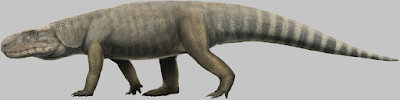
 
Life reconstruction of Mambawakale ruhuhu. Only the skull, mandible and a few postcranial elements are known for Mambawakale ruhuhu, so the rest of the body, tail and limbs are reconstructed based on the anatomy of hypothesised close relatives of similar size. Gabriel Ugueto in Butler et al. (2022).

See also...


Online courses in Palaeontology. 

Follow Sciency Thoughts on Facebook.

Follow Sciency Thoughts on Twitter.


Monday, 23 March 2020

Dynamosuchus collisensis: A new species of Ornithosuchid Pseudosuchian from the Late Triassic Santa Maria Formation of Rio Grande do Sul, Brazil.

The radiation of Pseudosuchian Archosaurs during the Triassic Period is characterized by the origin and extinction of several peculiar and disparate clades, such as Aetosauria, Erpetosuchidae, Gracilisuchidae, and Ornithosuchidae. The latter is one of the most enigmatic clades. Coined by Friedrich von Huene in 1908, the Ornithosuchidae have a long and controversial taxonomic history. The clade has been placed in different phylogenetic positions across the Archosauria. Nevertheless, most hypotheses have converged on a position near the base of Pseudosuchia. Three species form the clade: Ornithosuchus woodwardi, from the late Carnian–early Norian Lossiemouth Sandstone Formation of Scotland, Venaticosuchus rusconii, from the late Carnian Ischigualasto Formation of Argentina, and Riojasuchus tenuisceps, from the Norian Los Colorados Formation of Argentina. All members of this group are interpreted to have been carnivorous, putatively scavengers and facultatively bipedal during fast movement. Nevertheless, the fossil record of the group is geographically limited and so far, no remains outside Ischigualasto-Villa Union Basin pf Argentina or the Lossiemouth Sandstone Formation of Scotland have been identified, thus leaving a large gap in their potential biogeographic distribution.

In a paper published in the journal Acta Palaeontologica Polonica on 31 January 2020, Rodrigo Müller of the Centro de Apoio à Pesquisa Paleontológica da Quarta Colônia at the Universidade Federal de Santa Maria, Maria Belén Von Baczko and Julia Desojo of the División Paleontología de Vertebrados at the Museo de La Plata, and Sterling Nesbitt of the Department of Geosciences at Virginia Tech describe the first partial skeleton of an Ornithosuchid from the Late Triassic sediments of Brazil and explore its phylogenetic affinities and implications for the evolution of the group.

(A) Location map of the Janner site and the surface distribution of the geologic units in the area. (B) Stratigraphic column of the Janner site depicting its fossiliferous content: (1) Exaeretodon; (2) Hyperodapedon; (3) Pampadromaeus; (4) Trucidocynodon; (5) Bagualosaurus; and (6) the new Ornithosuchid. Müller et al. (2020).

The specimen comes from the Santa Maria Formation at the the Janner site, which is located at the base of the Agudo Hill in the Paraná Basin of Rio Grande do Sul State, Brazil. The location is considered to be Carnian in age (237 to 227 million years old), based upon the presence of Hyperodapedon and Exaeretodon, which are also known from sites elsewhere in Brazil and Argentina with well constrained dates.

The specimen is a partial skeleton including the premaxillae, the left maxilla, both frontals, the right postfrontal, the right parietal, both squamosals, both quadratojugals, both quadrates, the parabasisphenoid, both hemimandibles, some cervical, dorsal, sacral and caudal vertebrae, several ribs, gastralia, and osteoderms, the left scapula, both forelimbs, the left ilium, the right pubis, left femur, the right tibia, and the left fibula. It is named Dynamosuchus collisensis, where 'Dynamosuchus' means 'power-Crocodile' and 'collisensis' means 'from the hill'.

Representative skeletal elements of the Ornithosuchid Archosaur Dynamosuchus collisensis (CAPPA/UFSM 0248) from Janner outcrop, Carnian, Late Triassic. (A) Selected skull bones in left lateral view. (B) Reconstruction of the skull. (C) Skull in ventral view. (D) Left quadrate and quadratojugal in posterodorsal view. (E) Parabasisphenoid in left lateral view. (F) Neural arch of an anterior cervical vertebra in anterior view. (G) Centrum of a cervical vertebra in left lateral view. (H) Right osteoderm in dorsal view. (I) Neural arch of an anterior dorsal vertebra in left lateral view. (J) Left ilium in lateral view. (K) Reconstruction of the skeleton of CAPPA/UFSM 0248 (preserved elements indicated in orange) (L) Right humerus in anterior view. (M) Right forearm in medial view. (N) Left manus in dorsal view. (O) Right (reversed) pubis in lateral view. (P) Left femur in anterior view. (Q) Left fibula in lateral view.  Scale bars 20 mm. Müller et al. (2020).

A phylogenetic analysis recovered 18 most parsimonious trees of 3356 steps each. In all the most parsimonious trees, Dynamosuchus collisensis nests within Ornithosuchidae. Ornithosuchus woodwardi lies as the basal-most member of Ornithosuchidae. The clade is supported by 19 synapomorphies, such as the alveolar margin of the premaxilla not reaching the contact with the maxilla, three premaxillary teeth, mandibular symphysis present along one-third of the lower jaw, three sacral vertebrae, a perforated acetabulum, and the presence of the anterior trochanter on the femur. Dynamosuchus collisensis was found as the sister taxon of Venaticosuchus rusconii and this is supported by the semilunar depression on the posterolateral surface of the parabasisphenoid and ascending process of the quadratojugal moderately anterodorsally to posteroventrally oriented in an angle higher than 40°. The clade including both taxa is the sister group of Riojasuchus tenuisceps. This arrangement relies in the strongly downturned main body of the premaxilla and the strongly anteroposteriorly expanded distal end of the radius. The Ornithosuchidae is found as the sister taxon of the Erpetosuchidae, whereas the clade comprising both these groups is found as the sister taxon of the Aetosauria.

Macroevolutionary patterns of Ornithosuchidae. (A) Time-calibrated reduced strict consensus tree depicting the phylogenetic position of Dynamosuchus collisensis. Numbers on nodes represent Bremer support values higher than one. Numbers associated with the Ornithosuchid branch represent the characters and states that support the clade. (B) Geographical distribution of Ornithosuchids across the time. (C) Life reconstruction of Dynamosuchus collisensis. Müller et al. (2020).

Ornithosuchids, first described at the end of the 19th century, were important for deciphering the relationships among basal Archosaurs because of their controversial anatomical features. However, no other Ornithosuchids have been found since Venaticosuchus rusconii was discovered in Argentina almost a half century ago. Furthermore, Dynamosuchus collisensis is the first unambiguous Ornithosuchid from Brazil.

The presence of Ornithosuchids in Upper Triassic beds from Brazil is not a surprise, as the group is recorded in coeval strata of Argentina (i.e. Venaticosuchus rusconii). The age of the strata that yielded Dynamosuchus collisensis is similar to that of the levels in which Ornithosuchus woodwardi from Scotland and Venaticosuchus rusconii from Argentina were found, as these strata have also yielded remains of the Rhynchosaur Hyperodapedon, which is extensively adopted as index fossil of Carnian age.The other known Ornithosuchid, Riojasuchus tenuisceps, was exhumed from the Los Colorados Formation, Argentina, which is Norian in age ( 227 to 208.5 million years old). Therefore, Dynamosuchus collisensis falls within the stratigraphic range of the oldest known Ornithosuchids.

The close relationship between Venaticosuchus rusconii and Dynamosuchus collisensis reinforces the previous proposed biostratigraphic hypotheses, indicating a similar faunal assemblage in both contemporaneous Paraná and Ischigualasto-Villa Unión basins. Moreover, the sister taxon affinity between Venaticosuchus rusconii and Dynamosuchus collisensis rejects a potential endemic radiation of ornithosuchids from the Ischigualasto-Villa Unión Basin and would better support multiple diversification events, at least at the Carnian. Indeed, the phylogenetic affinities of Proterochampsid Archosauriforms and Erpetosuchids would also suggest multiple dispersal events between the Ischigualasto-Villa Unión and the Paraná basins with the simultaneous appearance of several closely-related species in both basins (i.e. the Argentinean Proterochampsids Proterochampsa barrionuevoi and Pseudochampsa ischigualastensis, and the Brazilian Rhadinosuchus gracilis and Proterochampsa nodosa; the Brazilian Erpetosuchids Archeopelta arborensis and Pagosvenator candelariensis and the Argentinean Tarjadia ruthae). In addition, the presence of an Ornithosuchid in Brazil expands the longitudinal distribution of the group, suggesting that Ornithosuchids were more widespread than previously thought in the southern hemisphere. No records of the group have been found in lower latitudes close to the Paleo-Equator, however, age equivalent formations or localities are very scarce. Therefore, Ornithosuchids are still restricted to higher latitudes of northern and southern Pangea.

The discovery of Dynamosuchus collisensis in the Paraná Basin also provides novel paleoecological implications for this type locality (the Janner site). Strictly carnivorous Reptiles were previously absent from this site, as the early Sauropodomorph Pampadromaeus barberenai was more likely to be an omnivorous animal according to a recent ecomorphological analysis. On the other hand, Bagualosaurus agudoensis is more related to post-Carnian Sauropodomorphs, which are considered herbivorous or omnivorous. Therefore, strictly carnivorous animals are solely represented in the site through the record of Ecteniniid Cynodonts. Indeed, Ornithosuchids have been considered as top tier predators. However, recently the feeding behavior of these animals have been explored through more rigorous techniques (i.e., quantitative approaches), indicating that Ornithosuchids likely adopted scavenging feeding habits or preyed only on small Vertebrates. Such statement relies on the elevated bite force together with the low bite speed and the morphology of their constricted snouts. Therefore, the discovery of Dynamosuchus collisensis provides the first clue of a putative necrophagous vertebrate from the Janner site and expands our knowledge regarding the trophic chain of Late Triassic of Brazil. This is particularly interesting because necrophagous animals are an important part of the extant terrestrial ecosystems, interacting with the carcasses before its incorporation within the lithosphere. Therefore, identifying the animals that played such role in ancient environments is crucial for the reconstruction of reliable pictures of these. Indeed, the Janner site has yielded evidences of osteophagic behavior by Insects and the putative action of necrophagous animals that produced an accumulation with predominance of cranial elements.

Dynamosuchus collisensis is the first unambiguous member of Ornithosuchidae from Brazil, and was recovered as sister taxa of the Argentinean taxon Venaticosuchus rusconii. This sister taxon relationship would support multiple radiation events between Paraná and Ischigualasto-Villa Unión basins in agreement with previous hypothesis based on other Archosauriforms that are shared across these basins. The discovery of an Ornithosuchid in Carnian continental outcrops of Brazil provides a new shared faunal component between the basins. The Carnian Archosauromorph communities of Argentina and Brazil would therefore consist of Rhynchosaurs, Proterochampsids, Ornithosuchids, Aetosaurs, Rauisuchians, Erpetosuchids, Sauropodomorphs, and Theropods. In addition, the discovery of Dynamosuchus collisensis provides the first clue of a putative necrophagous Vertebrate from the oldest Dinosaur-bearing beds and expands our knowledge regarding the trophic structure of the Late Triassic of Brazil.

See also...

https://sciencythoughts.blogspot.com/2019/10/pseudotherium-argentinus-possible.htmlhttps://sciencythoughts.blogspot.com/2019/08/clevosaurus-hadroprodon-new-species-of.html
https://sciencythoughts.blogspot.com/2018/11/macrocollum-itaquii-new-species-of.htmlhttps://sciencythoughts.blogspot.com/2017/08/cappaufsm-0179-dinosaur-axis-from-one.html
https://sciencythoughts.blogspot.com/2016/11/ixalerpeton-polesinensis-buriolestes.htmlhttps://sciencythoughts.blogspot.com/2012/12/an-immature-temnospondyl-amphibian-from.html
Follow Sciency Thoughts on Facebook.