Showing posts with label Pterosaurs. Show all posts

Saturday, 10 February 2024

Ceoptera evansae: A new species of Darwinopteran Pterosaur from the Middle Jurassic of the Isle of Skye.

Pterosaurs first appear in the fossil record in the Late Triassic, and persist till the end of the Cretaceous. During this time three basic morphotypes are found. The Rhamphorhynchoids are present from the Late Triassic till the Late Jurassic, and are considered to be a paraphyletic group from which all non-Rhamphorhynchoid Pterosaurs are descended. The highly derived Late Jurassic-End Cretaceous Pterodactyloids, are assumed to be a monophyletic group. Between these lie the Late Jurassic Darwinopterans; the Darwinopterans and Pterodactyloids are thought to comprise a single monophyletic clade, the Monofenestrata, although it is unclear if the Darwinopterans are a polyphyletic group of basal Monofenestratans from which the Pterodactyloids are descended, or whether they are a monophyletic group forming a separate branch of the Monofenestratan family tree.

Pterosaurs had delicate skeletons, made up of numerous elongate, thin bones. This is an excellent morphology for a flying Animal, but hampers the chances of that Animal's remains from being fossilised. Thus, the majority of known Pterosaur fossils come from a small number of Konservat Lagerstätten. The excellent preservation found at these sites has given us a good understanding of Pterosaur anatomy, functional morphology, and reproduction, but because their distribution in time is rather uneven, give us a rather limited perspective on the group's evolution and history. The majority of Konservat Lagerstätten date from two periods, the Late Jurassic and Middle Cretaceous, leaving us with some large gaps in which little is known about the diversity of Pterosaurs. This includes the late Early and Middle Jurassic, an interval of about 20 million years on which almost no Pterosaurs are known. The most abundant deposit from this period is the Taynton Limestone Formation of Oxfordshire, England, but the remains extracted from this deposit comprise almost exclusively isolated, and often fragmentary, bones, telling us little more than that Pterosaurs were present. Isolated Pterosaur bones are also known from the Oxford Clay, albeit in lower abundance. Fragmentary remains are also known from Kyrgyzstan, Mongolia, and China during this interval, though deposits from Argentina and China previously thought to have been of Middle Jurassic origin, from which a number of Pterosaur have been described. have recently been re-evaluated as being younger or older. 

In 2022 a Middle Jurassic Rhamphorhynchine Pterosaur, Dearc sgiathanach, was described from the Isle of Skye, Scotland, and in 2023 a partial non-Pterodactyloid Pterosaur was described from the same location. These, along with a possible Aurognathid from Mongolia, are currently the only known articulated Pterosaur skeletons from the Middle Jurassic.

In a paper published in the Journal of Vertebrate Paleontology on 5 February 2024, Elizabeth Martin-Silverstone of the Palaeobiology Research Group at the University of Bristol, David Unwin of the Centre for Palaeobiology and Biosphere Evolution and School of Museum Studies at the University of Leicester, Andrew Cuff of the Human Anatomy Resource Centre at the University of LiverpoolEmily Brown of the Fossil Reptiles, Amphibians, and Birds Section at the Natural History Museum and the School of Geography, Earth & Environmental Sciences at the University of Birmingham, Lu Allington-Jones of the Conservation Centre  at the Natural History Museum, and Paul Barrett, also of the Fossil Reptiles, Amphibians, and Birds Section at the Natural History Museum, describe a new species of Darwinopteran Pterosaur from the Middle Jurassic of the Isle of Skye.

The new species is named Ceoptera evansae, where 'Ceoptera' derives from 'cheò' or 'ceò' (pronounced ‘ki-yo’) the Gaelic word for 'mist', in reference to the Gaelic name for the Isle of Skye, Eilean a’Cheò, or Isle of Mist, and '-ptera' the Greek for 'wing', and 'evansae' honours Susan Evans of University College London, 'for her many years of anatomical and paleontological research, in particular on Skye', and for introducing Martin-Silverstone et al. to the locality where the specimen from which the species is described was found.

HMUK PV R37110, the holotype of Ceoptera evansae, approximately as it was found (top) and by CT reconstruction with elements (bottom). Abbreviations: c, coracoid; cv, caudal vertebra; dsc, distal syncarpal; dv,  dorsal  vertebra; fe,  femur; m,  manual-phalanx; mc,  metacarpal; mt,  metatarsal; p, pedal-phalanx; pe, pelvis; ph, phalanx; psc, proximal syncarpal; r, rib; ra, radius; s, scapula; st, sternum; tf, tibia +fibula; ul, ulna; v, vertebra; w, wing-phalanx. Martin-Silverstone et al. (2024).

Ceoptera evansae can be distinguished from all other Pterosaurs by two features: (1) the presence on the distal (sternal) portion of the coracoid shaft of a well-developed, elongate, narrow, sub-rectangular bony flange (probably a site for insertion of the sternocoracoideus muscle) with an irregular ‘wavy’ free margin, which extends proximally for almost one-quarter of the length of the coracoid; and (2) the lateral surface of the posterior, dorsally expanded, portion of the post-acetabular process of the ilium bears a prominent depression divided in two by a low, rounded vertical ridge.

Reconstruction of the right scapulocoracoid of Ceoptera evansae (NHMUK PV R37110), made from CT scans in (A) lateral and (B) medial views. (C) Reveals a close-up of the expanded sub-triangular brachial flange of the coracoid, one of the diagnostic characters of this taxon. Abbreviations: acc, acrocoracoid process; afs, articular facet for sternum; bf, brachial flange; c, coracoid; cf, coracoid flange; gl, glenoid; s, scapula; sde, distal expansion of scapula. The top scale bar is for (A) and (B). Martin-Silverstone et al. (2024).

Ceoptera evansae is calculated to have had a wingspan of about 1.6 m. Determining the maturity of Pterosaurs can be difficult, as the order in which the fusion of bones occurred seems to have been highly individualistic, often not following the same pattern in members of the same species. Nevertheless, the pelvic plates, syncarpals, and tibia-fibula of Ceoptera evansae are fully fused, probably indicating that this was a mature individual.

Skeletal  of Ceoptera  evansae (NHMUK PV R37110), showing the material that is present (top, with greyed bones indicating partially preserved elements) and an artist’s  impression of what the entire skeleton would have looked like if complete. Mark Witton in Martin-Silverstone et al. (2024).

A phylogenetic analysis was carried out including Ceoptera evansae along with previously described Pterosaurs. This recovered the Darwinoptera as a monophyletic clade, forming a sister group to the Pterodactyloids, although this is not yet sufficiently statistically strong to assume that later discoveries will not change this reconstruction.

Reduced strict consensus tree of 2890 most parsimonious trees (tree lengths = 553; Retention Index = 0.779, Consistency Index = 0.360, with bootstrap/Bremer support values for each node) showing Ceoptera evansae as a basally branching Monofenestratan (M) Pterosaur within Darwinoptera (D). Silhouettes from top to bottom of: Preondactylus; Jeholopterus; Rhamphorhynchus; Darwinopterus; Ctenochasma; Nyctosaurus; Germanodactylus; and Quetzalcoatlus. Martin-Silverstone et al. (2024).

Ceoptera evansae is the fourth known articulate Pterosaur from the Middle Jurassic, and the second described species. The interpretation of Ceoptera evansae as a member of the Darwinoptera shows that this group was not, as was implied by the previously available evidence, restricted to the Late Jurassic of East Asia, but had a much wider distribution both geographically and chronologically. Furthermore, the addition of Ceoptera evansae to the Pterosaur phylogenetic tree implies that the Darwinoptera are not simply a polyphyletic basal group of Monofenestratans, but rather a distinct clade forming a sister taxon to the Pterodactyoidea.

Life reconstruction of Ceoptera evansae. Mark Witton in Martin-Silverstone et al. (2024).

See also...

Saturday, 22 July 2023

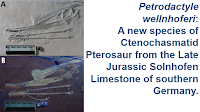
Petrodactyle wellnhoferi: A new species of Ctenochasmatid Pterosaur from the Late Jurassic Solnhofen Limestone of southern Germany.

The Pterosaurs were the first group of Vertebrates to master powered flight, going on to become a highly diverse and successful group throughout the Mesozoic, with the largest species approaching the size of light aircraft. The earliest Pterosaur fossils  studied by scientists came from the Solnhofen Limestone deposits of southern Germany in the eighteenth century, an area which has produced a huge number of Pterosaur specimens, from a wide range of species. The vast majority of Pterosaur fossils are isolated and often fragmentary bones, typically preserved in two dimensions. However, Solnhofen also produces complete specimens on a fairly regular basis, with the best-preserved specimens being in three dimensions, and often retain traces of soft tissue.

The Solhofen Limestone beds yield some of the last known non-Pterodactyloid ‘Rhamphorhynchoid’ Pterosaurs (which had disappeared by the Cretaceous), as well as early Pterodactyloid Pterosaurs (the group which survived into the Cretaceous), and the more enigmatic non-Pterodactyloid Monofenestratans, from which the Pterodactyloid Pterosaurs (probably) derived. The most diverse Pterosaur group in the Solho1fn Limestone are the Ctenochasmatid Pterodactyloids, long legged Pterosaurs many of which appear to have been specialist filter feeders anf hunters of small aquatic prey. 

In a paper published in the journal Palaeontologica Electronica In June 2023, David Hone of the School of Biological and Behavioural Sciences at Queen Mary University of LondonRené and Bruce Lauer of the Lauer Foundation for Paleontology, Science and Education, and Frederik Spindler of the Dinosaurier Museum Altmühltal, describe a new species of Ctenochasmatid Pterosaur from the Solnhofen Limestime.

The new species is named Petrodactyle wellnhoferi, where 'Petrodactyle' means 'stone-finger' and 'wellnhoferi' honours palaeontologist Peter Wellnhofer, who spent most of his career working on pterosaurs from the Solnhofen. The name 'Petrodactyle' appeared on the cover of Cuvier's first description of a Pterosaur in 1809, although the name he used within the publication was 'Pterodactyle' (since modified to 'Pterodactylus').

The species is described from a single specimen, LF 2809, found in the summer of 2010 in the visitor’s section of the Schaudiberg Quarry near Mülheim, Bavaria, by an unknown collector within the Dritte Rosa Layer of the Mörnsheim Formation, which has been dated to the Lower Tithonian, making it 149.2-147.5 million years old. It was excavated by Ulrich Leonhardt and Roland Pöschl, prepared by Ulrich Leonhardt, and acquired by the Lauer Foundation in March 2015, where it is permanently housed.

The specimen comprises an incomplete subadult individual consisting of the cranium and mandible, seven cervical and 12 dorsal vertebrae, shoulder girdles, a partial pelvis, numerous ribs and gastralia, both wings and one hindlimb. It was almost entirely disarticulated, although many elements remain close to their anatomical neighbours and the specimen is mostly complete. This is an unusual state of affairs, with most Pterosaur specimens from Solnhofen either being articulated or completely disarticulated, with the former presumably indicating rapid burial, while the later suggests the body of the Animal was left exposed to the actions of scavengers, probably while hanging in the water column. Hone et al. suggest that this specimen sank rapidly into deep water, where it lay exposed on the sediment surface for some time, undisturbed by currents or large scavengers.

Photo of specimen LF 2809, a new large Ctenochasmatid Pterosaur. Scale bar is 10 cm. Hone et al. (2023).

The specimen appears to be almost fully grown, based on its large size, smooth bone texture, presence of an extensive cranial crest, complete fusion of the sacral vertebrae, the proximal and distal carpals into units, and complete fusion of the extensor tendon process on the first wing phalanx; it only lacks the complete fusion of bones that would be required to consider it fully adult, with the cranial elements being incompletely fused, and the synsacral vertebrae being incompletely fused to the sacrum.

The skull has been partially crushed, and its posterior is less well preserved than the rest, but is on the whole in good condition. It is 258 mm long and 50 mm tall, with a triangular profile. The naso-antorbital fenestra is small, with a maximum length of 67 mm, and positioned unusually far back, with its anteriormost point on the midline of the skull. The orbits are subcircular and large, measuring 25 mm by 26 mm, the upper temporal fenestra is small, about 10 mm wide, while the lower temporal fenestra is narrow and elongate, approximately 29 mm by up to 9 mm. The rostrum is slightly elevated, possibly implying an upturned snout, although the mandible does not show this, possibly indicating this elevation is a product of the skull's crushing. A bony premaxillary crest is present; this is tall and extensive, as much as 32 mm high, and 104 mm long, striated and anteriorly swept.

Close up of skull of Petrodactyle in (A) natural light and (B) ultraviolet light. Scale bar is 10 cm. Hone et al. (2023).

The teeth of Petrodactyle wellnhoferi are small, up to 5 mm tall, conical, and inward curving. Isolated teeth show a root longer than the crown, and a general 'Banana-shape'. The foremost teeth are the largest, with the teeth becoming progressively smaller further backward in the mouth. Several of the teeth are worn, exposing their dentine layer, and showing that the enamel was quite thick. Combined with the length of the jaw, this would have given Petrodactyle wellnhoferi a strong grip, but not the ability to crush hard prey, suggesting it fed on small Fish, Cephalopods, Crustaceans, and possibly very young Tetrapods.

Tracing of the skull of Petrodactyle. Many sutures are uncertain and these labels are for general guidance. Abbreviations are as follows: an, angular; ar, articular; fpc, frontoparietal crest; j, jugal; lc, lacrimal; m, maxilla; n, nasal; naof, nasoantorbital fenestra; o, orbit; p, palate; po, postorbital; ppf, postpalatine fenestra; pm, premaxilla; pmc, premaxillary crest; q, quadrate; qj, quadratojugal; sa, surangular; t, tooth. Scale bar is 100 mm. Hone et al. (2023).

Petrodactyle wellnhoferi appears to have been a large animal, with a wingspan of slightly over 2 m, making it one of the largest known fossil Pterosaurs from Solnhofen, despite not being fully grown. As such it is possible that it is a representative of a species already described, from a smaller, more immature specimen. However, Hone et al. reject this hypothesis, on the basis that most Pterosaurs retained much the same structure as they grew, with the exception of features such as crests, which are assumed to have been sexual signalling devices, and typically did not appear until the Animal was close to mature. Thus, the presence of a large crest in Petrodactyle wellnhoferi may be another sign of it being close to maturity. Some Pterosaur species appear to have shown sexual dimorphism, with two morphs, only one of which (presumably the male) developed large crests. However, this does not appear to have been the case in all species, with some species having crests on all known specimens, and sufficient specimens known to make it unlikely all were male. Therefore, the sex of Petrodactyle wellnhoferi cannot be determined.

Reconstruction of the complete skeleton of Petrodactyle wellnhoferi in a standing pose. Scale bar is 200 mm. Missing parts based on Cycnorhamphus. Hone et al. (2023).

See also...

Follow Sciency Thoughts on Facebook.

Follow Sciency Thoughts on Twitter