Showing posts with label Ray-fiined Fish. Show all posts

Sunday, 28 October 2018

Piranhamesodon pinnatomus: A Piranha-like Pycnodont Fish from the Late Jurassic Solnhofen Limestone.

Pycnodont Fish were a highly successful group of Ray-finned Fish, Actinopterygii, that tended to be highly laterally compressed, with deep bodies, and lacked the evertable jaws of modern Teleosts, but often had specialised dentition, with many species apparently being durophagous (adapted to crush the shells of organisms such as Molluscs). They first appeared in the Late Triassic of Europe, and became a dominant group of Fish in many ecosystems in the Late Jurassic and Cretaceous, finally going extinct around the end of the Eocene. However Pycnodont Fish from the Early and Middle Jurassic are very rare, with only about twelve species known, suggesting that this group was very badly affected by the End Triassic Extinction.

In a paper published in the journal Current Biology on 18 October 2018, Martina Kölbl-Ebert and Martin Ebert of the Jura-Museum Eichstätt of the Staatliche Naturwissenschaftliche Sammlungen Bayerns, David Bellwood of the College of Science and Engineering and ARC Centre of Excellence for Coral Reef Studies at James Cook University, and Christian Schulbert of the GeoZentrum Nordbayern at the Friedrich-Alexander Universität Erlangen-Nürnberg, describe a remarkable new Pycnodont Fish from the Solnhofen Limestone of Bavaria.

The new species is described from a single, almost complete specimen on a split limestone block. It is 7.1 cm in length, and has the usual Pycnodont shape, with a deep but strongly compressed body, but differs from all over known Pycnodonts in its dentition, having triangular, dagger-shaped teeth, reminiscent of a modern Piranha. The new species is named Piranhamesodon pinnatomus, where 'Piranhamesodon' is a combination of 'Piranha' and 'Mesodon' a previously described species of Pycnodont, and 'pinnatomus' means 'fin-cutter'.

The Pycnodontiform Piranhamesodon pinnatomus, 7.1 cm standard length, from the Late Jurassic of Ettling, Solnhofen Archipelago, Germany, the earliest fin-cutting Piranha-like Ray Finned Fish. Martin Ebert in Kölbl-Ebert et al. (2018).

A number of other species of Fish described from the Solnhoffen Limestone have been observed to have had what appear to be bite-marks on their fins, consistent with having been attacked by some unknown predator, though no likely candidate has been available to date; numerous Fish species have previously been described from these deposits, but none has had appropriate dentition to do this sort of damage. Kölbl-Ebert et al. suggest that Piranhamesodon pinnatomus would be a very good candidate for causing such damage, as it has both Piranha-like dentition, and a morphology which, like that of other Pcynodonts, is suggestive of a very hard biting-capacity. Coming from the Late Jurassic, Piranhamesodon pinnatomus is not only an example of convergent evolution with modern Piranhas, but is the oldest known example of a Ray-finned Fish with specialist cutting teeth.

See also...

https://sciencythoughts.blogspot.com/2018/01/vadasaurus-herzogi-new-species-of.htmlhttps://sciencythoughts.blogspot.com/2017/12/ostromia-crassipes-second-species-of.html
https://sciencythoughts.blogspot.com/2017/09/grimmenodon-aureum-new-species-of.htmlhttps://sciencythoughts.blogspot.com/2017/08/scalacurvichthys-naishi-new-species-of.html
https://sciencythoughts.blogspot.com/2016/07/gladiopycnodus-byrnei-new-species-of.htmlhttps://sciencythoughts.blogspot.com/2013/06/the-bite-of-megapiranha.html
Follow Sciency Thoughts on Facebook.

Sunday, 17 July 2016

Gladiopycnodus byrnei: A new species of Pycnodont Fish from the Late Cretaceous Hjoûla Lagarstätte of Lebanon.

The Pycnodonts are an extinct group of Ray-finned Fish known from the Triassic to the Eocene. They are thought to have been more closely related to the Teleosts (the most abundant and diverse group of Fish today, characterized by an unfolding jaw that creates a vacuum as the Fish opens its mouth, sucking in food) and Holosts (Birchirs and Gars) than to the Acipenceriforms (Sturgeons and Paddlefish). The earlier forms of Pycnodonts were flattened and disk-shaped in profile, though from the Late Cretaceous onwards families such as the Coccodontidae, Gebrayelichthyidae, Gladiopycnodontidae and Trewavasiidae produced members with a more diverse range of shapes. Pycnodonts appear to have been restricted to warm, shallow shelf seas, and may have become extinct due to cooling climates in the later Cainozoic, or possibly because of competition with the more successful Teleosts.

In a paper published in the journal Cretaceous Research in June 2016, Giuseppe Marramà and Boris Villier of the Dipartimento di Scienze della Terra at the Universit a degli Studi Torino, Fabio Dalla Vecchia of the Soprintendenza per i Beni Archeologici del Friuli Venezia Giulia, and Giorgio Carnevale, also of the Dipartimento di Scienze della Terra at the Universit a degli Studi Torino, describe a new species of Pycnodont Fish from the Late Cretaceous Hjoûla Lagarstätte of Lebanon.

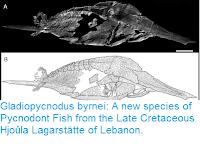
The new species is placed in the genus Gladiopycnodus, which previously contained a single species, also from the Late Cretaceous of Lebanon, and given the specific name byrnei, in honour of the American musician and composer David Byrne. The species is described from a single articulated and almost complete specimen from the Sannine Limestone at Hjoûla, dated to about 94 million years ago. The specimen is 50.8 mm in length, and is elongate, with a body depth only about a quarter of its length. Gladiopycnodus byrnei has an elongate snout and a sword-shaped anal plate which extends whell beyond the caudal fin (tail), and is covered with stronly overlapping scales.

Gladiopycnodus byrnei, from the Cenomanian of Hjoûla, Lebanon. (A) Specimen; (B) Interpretative reconstruction. Scale bar is 5 mm. Marramà et al. (2016).

See also...

http://sciencythoughts.blogspot.co.uk/2016/01/preserved-gastrointestinal-tracts-in.htmlPreserved gastrointestinal tracts in Actinopterygian Fish from the Middle Triassic Monte San Giorgio Lagerstätte of Switzerland.                                                   In Fish as in other animals an increased gut length  is associated with an increased amount of vegetable...
http://sciencythoughts.blogspot.co.uk/2015/04/ionoscopiform-fish-from-middle-triassic.htmlIonoscopiform Fish from the Middle Triassic of Guizhou Province, China.            Halecomorphs are Neopterygid Fish (Ray-finned Fish) related to Ginglymodians (Gars) and Teleosts (almost all modern Ray-finned Fish). They are split into three groups, the extant Amiiformes, which contain a single living species, the Bowfin, Amia calva...
http://sciencythoughts.blogspot.co.uk/2014/04/a-freshwater-coccolepidid-fish-from.htmlA freshwater Coccolepidid Fish from the Late Jurassic of Patagonia.                                     In 1943 palaeontologist Alejandro Bordas described a number of fossil freshwater Fish from a location in the Río Chubut area of Argentine Patagonia, which...
Follow Sciency Thoughts on Facebook.