Showing posts with label Convergent Evolution. Show all posts

Sunday, 28 October 2018

Piranhamesodon pinnatomus: A Piranha-like Pycnodont Fish from the Late Jurassic Solnhofen Limestone.

Pycnodont Fish were a highly successful group of Ray-finned Fish, Actinopterygii, that tended to be highly laterally compressed, with deep bodies, and lacked the evertable jaws of modern Teleosts, but often had specialised dentition, with many species apparently being durophagous (adapted to crush the shells of organisms such as Molluscs). They first appeared in the Late Triassic of Europe, and became a dominant group of Fish in many ecosystems in the Late Jurassic and Cretaceous, finally going extinct around the end of the Eocene. However Pycnodont Fish from the Early and Middle Jurassic are very rare, with only about twelve species known, suggesting that this group was very badly affected by the End Triassic Extinction.

In a paper published in the journal Current Biology on 18 October 2018, Martina Kölbl-Ebert and Martin Ebert of the Jura-Museum Eichstätt of the Staatliche Naturwissenschaftliche Sammlungen Bayerns, David Bellwood of the College of Science and Engineering and ARC Centre of Excellence for Coral Reef Studies at James Cook University, and Christian Schulbert of the GeoZentrum Nordbayern at the Friedrich-Alexander Universität Erlangen-Nürnberg, describe a remarkable new Pycnodont Fish from the Solnhofen Limestone of Bavaria.

The new species is described from a single, almost complete specimen on a split limestone block. It is 7.1 cm in length, and has the usual Pycnodont shape, with a deep but strongly compressed body, but differs from all over known Pycnodonts in its dentition, having triangular, dagger-shaped teeth, reminiscent of a modern Piranha. The new species is named Piranhamesodon pinnatomus, where 'Piranhamesodon' is a combination of 'Piranha' and 'Mesodon' a previously described species of Pycnodont, and 'pinnatomus' means 'fin-cutter'.

The Pycnodontiform Piranhamesodon pinnatomus, 7.1 cm standard length, from the Late Jurassic of Ettling, Solnhofen Archipelago, Germany, the earliest fin-cutting Piranha-like Ray Finned Fish. Martin Ebert in Kölbl-Ebert et al. (2018).

A number of other species of Fish described from the Solnhoffen Limestone have been observed to have had what appear to be bite-marks on their fins, consistent with having been attacked by some unknown predator, though no likely candidate has been available to date; numerous Fish species have previously been described from these deposits, but none has had appropriate dentition to do this sort of damage. Kölbl-Ebert et al. suggest that Piranhamesodon pinnatomus would be a very good candidate for causing such damage, as it has both Piranha-like dentition, and a morphology which, like that of other Pcynodonts, is suggestive of a very hard biting-capacity. Coming from the Late Jurassic, Piranhamesodon pinnatomus is not only an example of convergent evolution with modern Piranhas, but is the oldest known example of a Ray-finned Fish with specialist cutting teeth.

See also...

https://sciencythoughts.blogspot.com/2018/01/vadasaurus-herzogi-new-species-of.htmlhttps://sciencythoughts.blogspot.com/2017/12/ostromia-crassipes-second-species-of.html
https://sciencythoughts.blogspot.com/2017/09/grimmenodon-aureum-new-species-of.htmlhttps://sciencythoughts.blogspot.com/2017/08/scalacurvichthys-naishi-new-species-of.html
https://sciencythoughts.blogspot.com/2016/07/gladiopycnodus-byrnei-new-species-of.htmlhttps://sciencythoughts.blogspot.com/2013/06/the-bite-of-megapiranha.html
Follow Sciency Thoughts on Facebook.

Friday, 20 January 2017

Magnitude 5.7 Earthquake triggers deadly avalanche in Rieti Province, Italy.

The United States Geological Survey recorded a Magnitude 5.7 Earthquake at a depth of 10 km, roughly 5 km to the southwest of the town of Amatrice in Rieti Provice in Lazzio, Central Italy, at about 10.25 pm local time (about 9.25 pm GMT) on Wednesday 18 January 2017. The event has been followed by several serious aftershocks, which are reported to have caused damage to a large number of buildings, and in addition has been linked to an avalanche that stuck a hotel near Pescara in the Abruzzo Region, an event which is known to have killed at least four people, with about twenty still missing.

 
Rescue workers searching the scene of an avalanche in the Abruzzu Region of Italy on 18 January 2017. Vigili del Fuoco.

Historically Italy has suffered a number of devastating Earthquakes that lead to large numbers of casualties, though in recent decades the country has made serious attempts to prevent this, with better warning systems and tighter building regulations, though the large number of historic buildings in Italy, which cannot easily be replaced (and any attempt to do so would be unlikely to succeed due to their high cultural value), meaning that the country is unlikely to be completely risk free any time soon.
 

 Earthquake damage in a mountain village in central Italy following the 18 January 2017 event, AP.

Italy is in an unusual tectonic setting, with the west of the country lying on the Eurasian Plate, but the east of the country lying on the Adriatic Plate, a microplate which broke away from North Africa some time in the past and which is now wedged into the southern margin of Europe, underlying eastern Italy, the Adriatic Sea and the west of the Balkan Peninsula. This, combined with the northward movement of the African Plate into Italy from the south, leads to uplift in the Apennine Mountains that run the length of the country, and makes Italy extremely prone to Earthquakes. 

Map showing the tectonic plates underlying Italy and southern Europe, and the location of the l'Aquila Earthquake. Napoli Unplugged.

Witness accounts of Earthquakes can help geologists to understand these events, and the structures that cause them. The international non-profit organisation Earthquake Report is interested in hearing from people who may have felt this event; if you felt this quake then you can report it to Earthquake Report here.

See also...

http://sciencythoughts.blogspot.co.uk/2016/10/central-italy-shaken-by-pair-of.html
 
http://sciencythoughts.blogspot.co.uk/2015/12/spectacular-eruption-on-mount-etna.html
http://sciencythoughts.blogspot.co.uk/2016/05/dozens-of-cars-swallowed-by-sinkhole-in.html
http://sciencythoughts.blogspot.co.uk/2015/02/380-people-evacuated-from-homes-after.html
http://sciencythoughts.blogspot.co.uk/2015/05/volcanic-activity-on-mount-etna.html

Follow Sciency Thoughts on Facebook.

Sunday, 28 August 2016

Anolis landestoyi: A Chameleon-Like Anole Lizard from Hispaniola.

The Anole Lizards of the Greater Antilles islands are considered a classic example of island biogeography. Easch Island has its own set of Lizards, which tend to be most closely related to other Lizards on the same island, but a series of similar morphotypes, each adapted to a different ecological role, has appeared repeatedly on different islands. Larger islands support a greater number of species and morphotypes, with the largest island, Cuba, supporting a number of morphotypes not seen on any of the smaller islands, such as the semi-aquatic stream-dwelling Anolis vermiculatus, the long-legged karst-dwelling Anolis bartschi and several large, slow-moving, Chameleon-like species.

In a paper published in The American Naturalist on 17 June 2016, Luke Mahler of the Department of Ecology and Evolutionary Biology at the University of Toronto, Shea Lambert of the Department of Ecology and Evolutionary Biology at the University of Arizona, Anthony Geneva of the Department of Organismic and Evolutionary Biology and Museum of Comparative Zoology at Harvard University, Julienne Ng of the Department of Ecology and Evolutionary Biology at the University of Colorado–Boulder, Blair Hedges of the Center for Biodiversity at Temple University, Jonathan Losos, also of the Department of Organismic and Evolutionary Biology and Museum of Comparative Zoology at Harvard University and Richard Glor of the Herpetology Division at the Biodiversity Institute and Department of Ecology and Evolutionary Biology at the University of Kansas, describe a new species of Chameleon-like Anole from Hispaniola Island in the Greater Antilles.

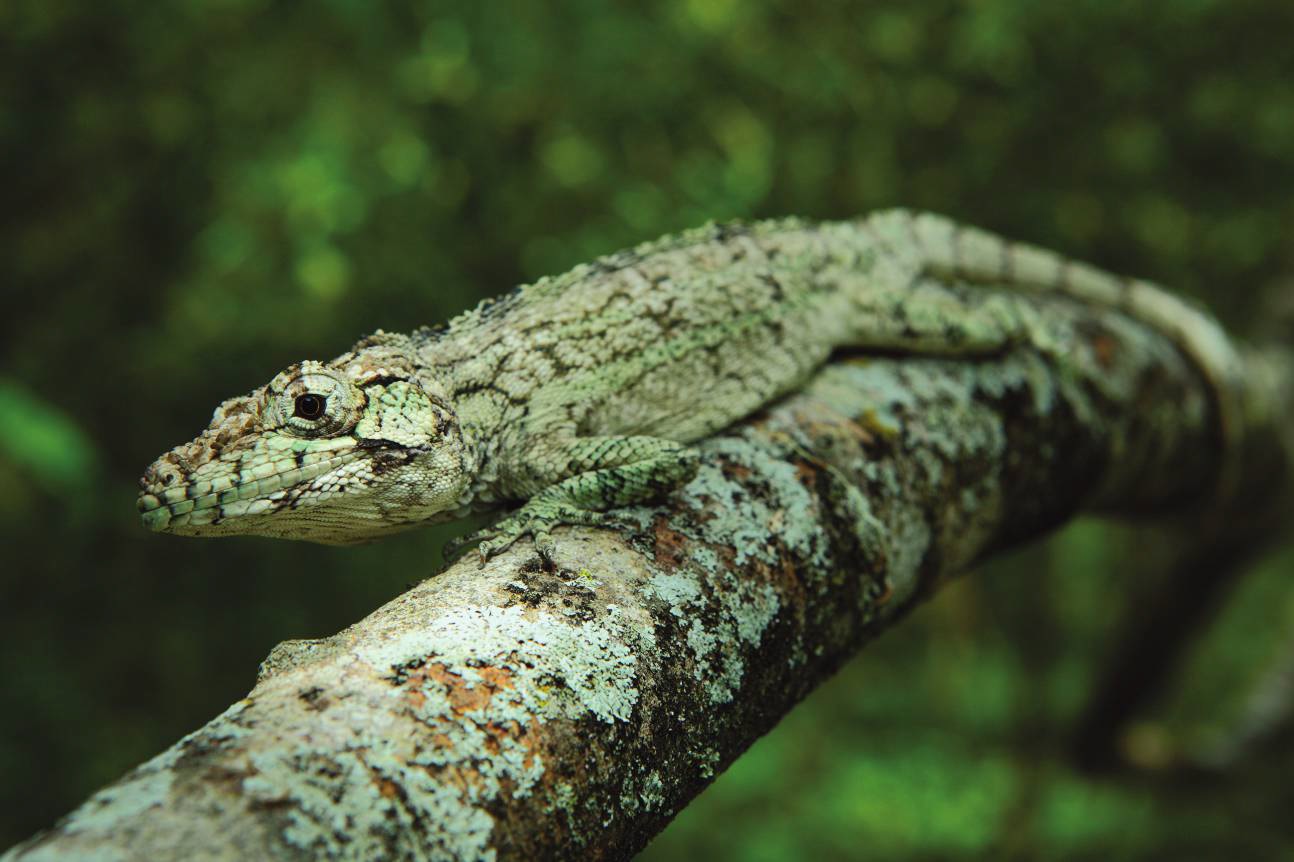
The new species is named Anolis landestoy, in honour of the honoring Dominican naturalist Miguel Landestoy, who first observed the species and realized its significance. Anolis landestoy is a large (up to 135 mm) Anole Lizard wth green lichenate markings, short limbs and tail and a and large bluish dewlap with dark reticulations. It appears similar to the Chameleon-like Anoles of Cuba, though a genetic analysis revealed it to be more closely related to other Anoles on Hispaniola.

Anolis landestoyi in natural habitat. Miguel Landestoy in Mahler et al. (2016).

The discovery of Anolis landestoy lends further weight to the idea that similar morphotypes of Anole Lizards have repeatedly evolved on different islands in response to similar evolutionary pressures. Cuba, the largest of the Greater Antilles islands is home to several, closely related, Chameleon-like Anole Lizards, and now Hispaniola, the second largest island in the group, has been shown to be home to a single, unrelated, Chameleon-like Anole.

See also...

http://sciencythoughts.blogspot.co.uk/2016/04/tropidurus-sertanejo-new-species-of.htmlTropidurus sertanejo: A new species of Ground Lizard from Bahia State, Brazil. Ground Lizards of the genus Tropidurus are found across tropical and subtropical South America. They are ground dwelling Iguanas, favouring open habitats, closely related to the Marine Iguanas of the...
http://sciencythoughts.blogspot.co.uk/2015/01/a-new-species-of-twig-anole-from-panama.htmlA new species of Twig Anole from Panama. Anoles are small Iguanid Lizards found in the Southern United States, Mexico, Central America and the Caribbean. Twig Anoles, Norops spp., form a distinct cluster of medium sized Anole Lizard species within the genus Norops. There are currently eight...
http://sciencythoughts.blogspot.co.uk/2014/11/four-new-species-of-treerunner-from.htmlFour new species of Treerunner from northern South America.                               Treerunners of the genus Plicaare Iguanid Lizards found in South America east of the Andes. They are medium sized, conspicuous Lizards that are active in the daytime, living in small colonies on rock outcrops or trees, and therefore are well represented in museum collections, as they tend to attract the attention of...
Follow Sciency Thoughts on Facebook.

Friday, 5 February 2016

Butterflies of the Jurassic: Convergent evolution between Mesozoic Kalligrammatid Lacewings and modern Butterflies.

Kalligrammatid Lacewings first appeared in the fossil record in the Middle Jurassic, about 160 million years ago, and disappeared in the Early Cretaceous about 115 million years ago. They were found more-or-less exclusively in Eurasia, and are thought to have been closely related to Neuropteran groups such as Antlions, Owlflies, Silky-winged Lacewings, and Spoon and Thread-winged Lacewings. However they show a suite of features unlike any other Neuropteran group, including large conspicuous wings (with the largest species reaching 160 mm in wingspan), scales on the wings, eyespots, and siphoning mouthparts, features which have led many to compare them to modern Butterflies, a group which appeared in the fossil record during the Early Eocene about 56 million years ago, but which are estimated from molecular studies to have appeared between 70 and 80 million years ago in the Late Cretaceous. Neuropterans (Lacewings) and Lepidopterans (Butterflies and Moths) are related, but are thought to have diverged in the Middle Carboniferous, about 320 million years ago, so any similarities between Kalligrammatid Lacewings and Butterflies must have evolved convergently in the two groups in response to similar ecological pressures. 

In a paper published in the Proceedings of the Royal Society Series B: Biological Sciences on 3 February 2016, a team of scientists led by Conrad Labandeira of the College of Life Sciences at Capital Normal University and the departments of Paleobiology and Mineral Sciences at the National Museum of Natural History examine a series of Kalligrammatid Lacewings from three Mesozic Insect-bearing deposits.

The three localities examined are all fine-grained lake deposits in Asia. The oldest is the Jiulongshan Formation of Inner Mongolia, dated to 164-165 million years ago (late Middle Jurassic), the middle deposit is the Karabastau Formation of eastern Kazakhstan, thought to be about 155 million years old (Late Jurassic), while the youngest locality is the Yixian Formation of Liaoning Province, which produces Insects ranging in age from about 128.2 to 121.6 million years, with the majority of the specimens dated to about 125 million years ago (Early Cretaceous).

Kalligrammatid structural diversity. Specimens are from the late-Middle Jurassic Jiulongshan Formation (JIU), China; Late Jurassic Karabastau Formation (KAR), Kazakhstan; and mid-Early Cretaceous Yixian Formation (YIX), China. At (a–i) are nine species showing general habitus. Arrows indicate proboscis tips. (a) Kalligramma circularia (JIU); (b) Affinigramma myrioneura (JIU); (c) Affinigramma myrioneura (JIU); (d) Kallihemerobius feroculus (JIU); (e) Oregramma aureolusa (YIX); (f) Ithigramma multinervia (YIX); (g) Abrigramma calophleba (JIU); (h) Kalligramma brachyrhyncha (JIU); and (i) Oregramma illecebrosa (YIX). (i–k) Lateral views of ovipositor structure in Oregramma illecebrosa above: (i) intact specimen; (j) complete ovipositor and posteriormost abdominal segments; and (k) lateral valve pairs. (l–q): five Kalligrammatid wing eyespot and spot types. (l ) Type 1 wing eyespot with two outer rings and ca 15 contiguous ocules surrounding a central pigmented disc (Oregramma illecebrosa, YIX); (m) Type 2 wing eyespot with a single outer ring, light-hued inner area, and uninterrupted, pigmented central disc with surrounding, non-contiguous ocules (Kallihemerobius almacellus, JIU); (n) Type 2 eyespot similar to (M) (Kallihemerobius feroculus, JIU); (o) Type 3 wing eyespot with a light-hued circular area and a few, variably sized ocules in a darkly pigmented central disc (Ithigramma multinervia, YIX); (p) Type 4 wing eyespot contains a few ocules and others surrounding a pigmented central disc, a light-hued inner area and surrounding, dark outermost ring (Kalligramma circularia, JIU); and (q) Type 5 wing spot of a circular, pigmented central disc (Kallihemerobius aciedentatus, JIU). Scale bars: solid, 10 mm; striped, 1 mm. Labandeira et al. (2016).

Labandeira et al. began by examining the distribution of Butterfly-like features among different Kalligrammatid groups. The earliest and most primitive group to appear were the Sophogrammatinae. These retain mandibles similar to those seen in other Lacewings, and lack any of the other Butterfly-like features seen in more derived members of the group, but are apparently the group from which other, more advanced Kalligrammatids are derived.

Four more derived groups of Kalligrammatids have been identified; the Kalligrammatinae, comprising five genera including the specious Kalligramma, which retain small mandibles as well as having siphon-like proboscises. These mandibles are thought to have been used for pollen handling, in a similar way to those of the modern Spoon and Thread-winged Lacewings and Micropterigid Moths. The more derived Kallihemerobiinae comprises six genera, while the Meioneurinae comprises the single genus Meioneurites, and the Oregrammatinae comprises three genera including the highly derived Oregramma.

Eyespots are found in all the Kalligrammatid groups except the Sophogrammatinae. In modern Butterflies these are a defensive mechanism used against predators such as Mantises and Birds, which can be used to either startle a would-be predator or deflect an attack away from the body (Butterflies can lose fairly large proportions of their wings and still fly). Labandeira et al. divided these into six levels of complexity, ranging from simple dark patches to more complex forms with central disks surrounded by rings of pigment and whitish, oval-shaped ocules and rings. However these different spot patterns appeared to have no particular distribution within the derived Kalligrammatid groups, suggesting that once spots had appeared, gaining and losing complexity was accomplished numerous times within different lineages. This at first seems a non-useful result, as it does not allow the tracing of developing complexity within the group, however this is also the pattern seen within Butterflies, strongly supporting the idea that Kalligrammatids shared a similar ecology to Butterflies.

Phylogenetic context of wing spots and eyespots in mid-Mesozoic Kalligrammatids, with comparisons to modern Lepidopterans. The best preserved fossil material was used for this analysis. (a) Most parsimonious tree of Kalligrammatidae phylogeny, with right forewing eyespot/spot condition mapped onto terminal clades and likely wing spot and eyespot origins. Wing eyespot and spot type symbols are at upper-left; crosses are eyespot/spot absences. (b–g) Examples of right forewings with wing eyespots or spots from mid-Mesozoic Kalligrammatidae (b–f ), and modern Psychopsidae (g). These taxa correspond to a Type 1 eyespot (b), Type 2 eyespot (c), Type 3 eyespot (d ), Type 4 eyespot (e) and two Type 5 double spots (f ) matched by two spots in modern Psychopsid (red arrows) in (g). Kalligrammatid wing eyespots and spots are compared to modern Lepidoptera in (h–k), of butterfly species with Type 6 eyespots (h) and multiple Type 5 spots (i); moth lacking wing spots or eyespots ( j ); and modern Owl Butterfly eyespot (k), showing pigmentation similar to Type 2 and 3 eyespots (b), indicated by arrow pointing to an ocule series and longitudinal wing vein. Scale bars: solid, 10 mm; striped, 1 mm. Labandeira et al. (2016).

Wing scales were absent in the Sophogrammatinae but present in all the derived Kalligrammatid groups, as well as in all Lepidoptera (Butterflies and Moths). Scales seem to have appeared early in the history of the Kalligrammatinae and are present in all later members of derived groups. These scales take two forms, larger elongate scales on the major wing veins, and smaller flatter scales between the veins. This is different to the pattern seen in modern Lepidoptera, where scales are absent from the major veins.

Proboscises are found in many Insect groups, but those of Kalligrammatids are notably similar to those of Butterflies in a number of ways; they were long (8-20 mm) and appear to have been flexible and lacked stylets or other piercing structures, with some specimens being hair covered and others smooth. This similarity to the range of shapes found in Butterflies is taken as evidence of a similar lifestyle, sucking nectar or a similar substance from flowers or another plant organ. Kalligrammatids even appear to have had pump-like sucking organs in the frontal part of the head, similar to those of Butterflies.

Gross mouthpart diversity and proboscis variation in Kalligrammatid Lacewings from the Middle Mesozoic of Eastern Asia. Drawings and digital images of Kalligrammatid taxa from the late Middle Jurassic (Jiulongshan Formation, 165 Ma, JIU) of northeastern China (c, d, f, h, m, o–t, v–x), middle Late Jurassic (Karabastau Formation, 155 Ma, KAR) of Kazakhstan (l), and middle Early Cretaceous (Yixian Formation, 125 Ma, YIX) of northeastern China (a, b, e, g, i–k, n). All overlay drawings are standardized to a scale of 5 mm (double diamond scale bar) to show size relationships; head and mouthpart elements are color identified to legend at upper left. (a, g) Abrigramma calophleba (YIX, dorsal view); (b, e) Oregramma illecebrosa (YIX, dorsal view), with food canal and subterminal constriction (arrow); (c, q) Kallihemerobius aciedentatus (JIU, dorsal view); (d, m) Kallihemerobius almacellus (JIU, dorsal view); (f, s) Affinigramma myrioneura (Jiulongshan, dorsal view); (h, w) Kalligramma brachyrhyncha (Jiulongshan, dorsal view); (i) Oregramma aureolusa (YIX, ventral view), with prominent maxillary stipites (mxst); (j) Oregramma sp. (YIX, oblique lateral view); (k) Ithigramma sp. (YIX, lateral view); (l) Meioneurites spectabilis (KAR, left lateral view); (n) Ithigramma multinervia (YIX, right oblique view); (o) Kalligramma circularia (JIU, right lateral view); (p) Kallihemerobiinae gen. et sp. indet. (JIU, dorsal view); (r) Affinigramma myrioneura (JIU, left lateral view); (s) Affinigramma myrioneura (JIU, frontal view); (t) Kallihemerobius feroculus (JIU, ventral view), with modified mandibles (md) adjacent the labial plate (la) and associated bisaccate pollen, probably Pinaceae, near the left mandible; (u) Ventral view of mandibles and labial plate of an extant, pollinating South African species of Nemopteridae, for comparison to (T); (v) Another specimen of Kalligramma circularia (JIU, dorsal view); (x) Kalligramma sp. (JIU, dorsal view). Scale bars: striped, 1 mm; dotted, 10 mm. Labandeira et al. (2016).

Angiosperms (Flowering Plants) have a long symbiotic relationship with Butterflies (and some other Insect groups), but are unlikely to have been ecological partners with Kalligrammatids, a group which appeared in the Middle Jurassic and disappeared as the Angiosperms came to prominence in the Cretaceous. Of the three formations examined in the study only the youngest, the Yixian Formation, has produced Angiosperm fossils at all, and these were small aquatic plants without tubular flowers that would require probing proboscises. However a number of other Plants with flower-like structures were present in the Mesozoic, including the extant Cycads and the extinct Bennettitaleans (Cycadoids) and Caytonialeans (Seed Ferns), all of which produced tube-like structures.

Of these groups the Bennettitaleans seem the most likely partners for the Kalligrammatids, with species known from all the Kalligrammatid-producing deposits and many specimens known from Eurasia within the Kalligrammatid time range that had tubular structures through which the ovules could be reached by an organ of similar size to a Kalligrammatid proboscis, and apparent secretary glands, tentatively identified as nectaries, positioned bellow the pollen sacs.

Plant associations of Kalligrammatids. (a–f) are palynomorphs associated with Kalligrammatid taxa; (a) cf. Chasmatosporites of possible Cycadales affiliation; (b) tetrad of Classopollis cf. Classopollis annulatus of the extinct conifer Cheirolepidaceae; (c) Cycadopites nitidus attributable to Bennettitales, Cycadales, Czekanowskiales, Ginkgoales or Pentoxylales; (d) Vitreisporites pallidus of Caytoniales; (e) epifluorescence image of a Classopollis cf. Classopollis annulatus on a foreleg tarsus of Meioneurites spectabilis (KAR); and (f) Gleicheniaceous Fern spore. (a–e) Are pollen macerated from sedimentary matrix adjacent to Kallihemerobius feroculus (JIU). (g) The Bennettitalean male strobilus Weltrichia sp. (h) The earlier occurring Bennettitalean female strobilus Williamsonia sp. (i) Reconstruction of specimen on a Bennettitalean host and probing a Williamsonia. Scale bars: solid, 10 mm; striped, 1 mm; dotted, 10 µm. Labandeira et al. (2016).

See also...

http://sciencythoughts.blogspot.co.uk/2014/05/a-new-species-of-osmylid-from-middle.htmlA new species of Osmylid from the Middle Jurassic Daohugou Biota of Inner Mongolia. Osmylids (Osmylidae) are a group of Neuropteran Insects with a fossil record dating back to the Early Jurassic and are still in existence today. They appear to have been at their most numerous and diverse in the Middle-Late Jurassic, with a number of lineages apparently disappearing at the...
http://sciencythoughts.blogspot.co.uk/2014/05/a-new-species-of-snakefly-from-middle.htmlA new species of Snakefly from the Middle Jurassic of Inner Mongolia.                    Snakeflies (Raphidioptera) are a group of carnivorous flying insects related to the Lacewings, Antlions and Alderflies. They have long life cycles, with a number of larval stages, but still feed as adults. Modern Snakeflies are found throughout Europe and Temperate Asia...
http://sciencythoughts.blogspot.co.uk/2013/11/a-new-species-of-split-foot-lacewing.htmlA new species of Split-foot Lacewing from the Middle Jurassic of Inner Mongolia.                 The Split-foot Lacewings (Nymphidae) are the oldest group of...
Follow Sciency Thoughts on Facebook.
 

Thursday, 6 August 2015

Cryptic diversity: A new species of Wolf from Africa.


Cryptic species are species which closely resemble other species and which can only be separated by careful anatomical examination or even genetic analysis. In recent years the widespread application of DNA analysis to populations of wild animals  has led to the discovery that many well-known species are in fact clusters of cryptic species, with profound implications for the conservation of these species; a single large widespread population suddenly becoming a number of smaller more localized populations. 

Golden Jackals, Canis aureus, from North Africa have long been noted for being larger and more robust than Jackals from either Sub-Saharan Africa or Eurasia, leading to speculation that they may represent a separate species or sub-species. A study published in 2011 in the journal PLoS One based upon analysis of mitochondrial DNA found that Jackals from Egypt and Ethiopia were in fact not Jackals at all, but were more closely related to the Grey Wolf, Canis lupus, and suggested that these should be described as a separate subspecies of Wolf, the African Wolf, Canis lupus lupaster. A follow-up study published in the same journal in 2012 found that the mitochondrial lineage ascribed to Canis lupus lupaster was also present in Canids in West Africa, among animals considered to be more typically Jackal-like.

In a paper published in the journal Current Biology on 17 August 2015, a team of biologists led by Klaus-Peter Koepfli of the Smithsonian Conservation Biology Institute and the Theodosius Dobzhansky Center for Genome Bioinformatics at St. Petersburg State University and John Pollinger of the Department of Ecology and Evolutionary Biology at the University of California, Los Angeles publish the results of a much wider study of mitochondrial and nuclear DNA from populations of Golden Jackals from across Southern Europe and the Middle East, as well as Israel, Morocco, Algeria, Mauritania, Senegal and Kenya, and discusses these results and their implications for the classification of African Jackals.

All of the African Jackals were found to be a separate species from the Eurasian Jackals, and more closely related to the Eurasian Grey Wolf. However these African Wolves appear to have separated from their Eurasian cousins over a million years ago, and were judges sufficiently genetically distinct to be placed in a separate species. Examination of taxonomic records for Canids revealed that the French biologist Cuvier had described a ‘Jackal’ from Senegal as a separate species, Canis anthus, in 1820, an analysis that was rejected by subsequent biologists who failed to spot any significant morphological difference between African and Eurasian Jackals. For this reason Koepfli & Pollinger et al. suggest that African Golden Jackals henceforth be referred to as African Golden Wolves, Canis anthus, rejecting Canis lupus lupaster as a valid name.

Phylogenetic Tree Based on Mitochondrial Cytochrome b Sequences and Sampling Localities of Golden Jackals Used in This Study (A) Maximum-likelihood phylogram of 104 cytochrome b sequences (1,140 bp). Haplotype number is shown next to taxon name and locality. Accession numbers indicate sequences downloaded from GenBank. Haplotypes without accession numbers are novel sequences generated for the present study. Asterisks at nodes indicate bootstrap support R80% based on maximum-likelihood analyses (500 pseudoreplicates) and R0.95 posterior probability from Bayesian inference. Canis spp. from Egypt are indicated by thick arrows. Haplotypes labeled as Canis lupus lupaster refer to the African wolf. The tree was rooted using Sechuran Fox (Lycalopex sechurae) as outgroup. Scale bar indicates the number of substitutions per site. Photo credits: left, Golden Jackal from Senegal (CIBIO/Monia Nakamura); centre, Mexican Gray Wolf (Tom and Pat Leeson); right, Golden Jackal from Israel (Eyal Cohen). (B) Map of geographic localities showing where Golden Jackals were sampled. Relative number of animals sampled from each locality is shown. Hatched lines indicates geographic range of Golden Jackal based on International Union for the Conservation of Nature distribution. Koepfli & Pollinger et al. (2015).

Morphologically the African Golden Wolf and Eurasian Golden Jackal are very hard to tell apart, other than the distinct largeness of the North African specimens; the African Wolf was, on average slightly broader in the snout than the Eurasian Jackal, but not distinctively enough for this to be used as a reliable feature to distinguish the species.

The Golden Jackal samples from Israel were found to be mostly hybrid animals, containing DNA from Eurasian Golden Jackals, Grey Wolves, African Golden Wolves and Dogs. Two Golden Wolves from Egypt were found to have mitochondrial DNA (which is passed through the female line without recombination) from Eurasian Jackals and Grey Wolves, suggesting that hybridization was occurring here too, though whole genome analysis of Egyptian samples was not carried out.

Comparison of the genomes of African Golden Wolves and Dogs suggest that a small amount of Dog DNA derives from African, rather than Grey Wolves; this is roughly comparable to the amount of Neanderthal DNA found in modern Humans, with two groups of Dogs, the Basanji (African Laughing Dog) and Dingo, having higher levels of Golden Wolf DNA than other groups.

This scenario suggests that Africa has repeatedly been invaded by different Canid lineages from Eurasia. Koepfli & Pollinger et al. suggest that this relates to the changeable climate of the Pleistocene Era, with warmer wetter periods when it was possible for Canids to move between Eurasia and Africa, and cooler dryer periods when these populations became reproductively isolated.

See also…

Morphometric analysis is a method used by palaeontologists to sort bones and shells into taxonomic and ecological groups. It relies...


Foxes (Vulpini) are a subgroup of the Dog Family, Canidae, found in North America, Eurasia and Africa (South American Foxes are a separate group, more closely related to True Dogs than to other Foxes). The...


Dogs are our oldest domestic animal, and the only one which predates the adoption of agriculture. This has led to a great deal of study of the origin of domestic dogs over the years. Despite this we are still not entirely sure where dogs were first domesticated. We are now confident that domestic dogs are descended from a...


Follow Sciency Thoughts on Facebook.

Tuesday, 21 October 2014

A giant agglutinated Foraminiferan from the Western Mediterranean.


Foraminiferans are Amoeba-like single-celled organisms found either free-floating or attached to surfaces in marine ecosystems. Many build ornate tests (shells) from calcium carbonate, and planktonic forms are widely used in biostratigraphy (the use of small fossils to date sedimentary rocks), but others lack the ability to produce their own biominerals, and instead construct protective coverings by cementing together other items.

In a paper published in the journal Zootaxa on 10 June 2013, a team of scientists led by Manuel Maldonado of the Centro de Estudios Avanzados deBlanes describe a new species of agglutinated Foraminiferan from the Seco de Palos seamount in the Western Mediterranean.

The new species is placed in the genus Spiculosiphon, and given the specific name oceana, in honour of the non-profit organization for ocean conservation OCEANA, which was responsible for the collection of the samples from which the species is described. Spiculosiphonoceana lives attached to a substrate by a long stalk, both the stalk and the main body being covered by agglutinated Sponge spicules, though these are arranged laterally in a slight spiral around the stalk but radiate out from the body.

(A) General view of the Spiculosiphon oceana. (B) Detail of capitate region of the holotype, showing the globelike, central structure and the radiating tracts of spicules. Maldonado et al. (2013).

Spiculosiphon oceana is a giant by Foraminiferan standards, reaching in excess of 4 cm in length. It is only the second species assigned to the genus Spiculosiphon; the first species, Spiculosiphon radiata is also large, but less so than Spiculosiphon oceana, reaching only about 2 cm. This species was described from specimens collected off the coast of Norway in 1964.

Maldonado et al. note that both species of Spiculosiphon show remarkable convergent evolution with some small species of Carnivorous Sponge, using scavenged Sponge spicules to build a body very similar in form to the Sponge; both organisms then trapping relatively large prey and dissolving it externally.

(A) View of the carnivorous sponge Asbestopluma hypogea soon after trapping a small Copepod. The sponge isdisplaying the spiny-headed morphology, which is typical after a period of starvation in order to maximize the chances of new prey capture. (B) View of the capitate region of Spiculosiphon oceana for a comparison with the body shape of the Carnivorous Sponge. Maldonado et al. (2013).

Maldonado et al. further observe that many agglutinated Foraminiferans appear to have a preference for Sponge spicules when incorporating material into their tests, while tending to reject other sources of biogenic silica such as Diatom shells. They suggest that this may be linked to the ancient nature of the group; the earliest Foraminiferans are thought to have appeared about 770 million years ago, in the Middle Cryogenian Period (about the same time as the earliest Sponges), while the Agglutinated Foraminiferans are thought to have arisen in the late Ediacaran or early Cambrian, about the same time as the earliest Siliceous Sponges (Sponges producing spicules made of silica). The earliest Diatoms appeared in the Early Jurassic, about 199 million years ago, by which time Agglutinated Foraminiferans had evolved to use Sponge spicules wherever possible.

That said, they also acknowledge that while Sponge spicules and Diatom tests are generally considered to be chemically identical, Sponge spicules do persist for much longer in seawater without dissolving (which clearly has advantages when using recycled material as a construction material), leading Maldonado et al. to suggest their may be different trace elements or compounds in the two materials, which both contributes to the more durable nature of the Sponge spicules and is detectable to the Foraminiferans.

SEM micrograph of stalk. (Tightly packed needle-like spicule fragments, with no obvious cement betweenthem. Some debris (d) has flocculated on the spicules. Note that the silica of some of the oldest spicules started dissolving, asindicated by the occurrence of tiny cavities and pits (p) at their surface. Dissolution cavities are to be distinguished fromaccidental breakages (b) caused to the stalk during collection or laboratory manipulation. Maldonado et al. (2013).

Maldonado et al. also record patches of colour on the stalk of Spiculosiphon oceana which appear to derive neither from the mineralogy of the spicules nor any fouling organism living external to the stalk. Instead they suggest this may be caused by photosynthetic symbionts growing inside the stalk (beneath the translucent spicules). Other species of Agglutinated Foraminiferans have been recorded to host a variety of Dinoflagellates, Diatoms, unicellular Chlorophytes (Green Algae), unicellular Rhodophytes  (Red Algae) and Cyanobacteria; the colour of the markings on the Spiculosiphon oceana stalks tending to suggest Dinoflagellates, Rhodophytes, or Cyanobacteria might be present, though they were unable to confirm this.

The stalk in showing a region in which the translucent spicule wall gets a brownish to purplish coloration. Maldonado et al. (2013).

Finally Maldonado et al. report the presence of a Calcareous Foramiferan test attached to the stem of one of the specimens (presumably the remains of a past meal) and not that both this test and the adjacent area of the stem show raised levels of the element tellurium. This is a very rare element, and has never been reported in any Foraminiferan before (nor many other organisms). It is unclear whether the source of this tellurium is the Calcareous or the Agglutinated Foraminiferan, nor exactly what biological process it could have been used in.

(C) Detail of a calcareous foraminifer (f) externally attached to the wall of one ofthe collected stalks. Note that a triaene (t) has been incorporated into the test and that some debris (d) hasflocculated on the stalk. Maldonado et al. (2013).

See also…

Golden Algae (Chrysophyceae) are photosynthetic eukaryotic microbes (i.e. single celled organisms that posses cell nuclei similar to those found in the cells of animals and plants, but unlike bacteria which do not), found throughout the world, predominantly in fresh water. The group is mostly poorly studied, with the exception of a few species which are toxic to Fish.


http://sciencythoughts.blogspot.co.uk/2013/09/four-new-species-of-fossil-diatom-from.html Four new species of fossil Diatom from the western United States.                                              Diatoms are single celled algae related to Kelp and Water Moulds. They are encased in silica shells with two valves. During reproduction the cells divide in two, each of which retains one valve of the shell, growing a new opposing valve, which is slightly smaller and fits flush within the older valve. This means that the Diatoms grow smaller with each new generation, until they...
http://sciencythoughts.blogspot.co.uk/2012/02/oldest-animals-pre-ediacaran-sponges.html The oldest animals - Pre-Ediacaran Sponges from Namibia(?)                                                             Sponges are curious creatures. They are considered to be animals as they are multicellular and some of them have fixed body shapes, however they show no cell differentiation, and can be broken down into individual cells (by, for example, forcing them through a sieve) and they will re-assemble themselves without apparent ill-effect. In some ways they are more like colonial protists than true animals. Biologists have long regarded them as the most primitive animal...

Follow Sciency Thoughts on Facebook.

Friday, 4 July 2014

A new species of Water Rat from Sulawesi, Indonesia.

Water Rats are large Rodents that have adopted a semi-aquatic lifestyle and carnivorous diet, consuming Insects and other small invertebrates rather than plant matter. They are a polyphyletic group, having arisen separately in New Guinea, Africa and South America. This is apparently a successful lifestyle, as Rodents from all three areas show convergent evolution with both one-another and also species of Shrew and Tenrec (African Tree-hedgehogs) that have adopted the same lifestyle.

In a paper published in the journal Zootaxa on 17 June 2014, Kevin Rowe of the Sciences Department at Museum Victoria, Anang Achmadi of the Museum Zoologicum Bogoriense at the Research Center for Biology and Jacob Esselstyn of the Museum of Natural Science and Department of Biological Sciences at Louisiana State University, describe a new species of Water Rat from lower montane rainforest on the high plateau of Mount Gandangdewata on Sulawesi, Indonesia. 

The new species is named Waiomys mamasae, where ‘Waiomys’ is a combination of ‘wai’ the word for water in the local Mamasa Toraja language and ‘mys’, which is Greek for ‘mouse’, and ‘mamasae’ refers to the town of Mamasa, which is close to the site where the new species was discovered, and to the Mamasan people of the area, who collected the specimen from which the species is described, and who have long been aware of the species.

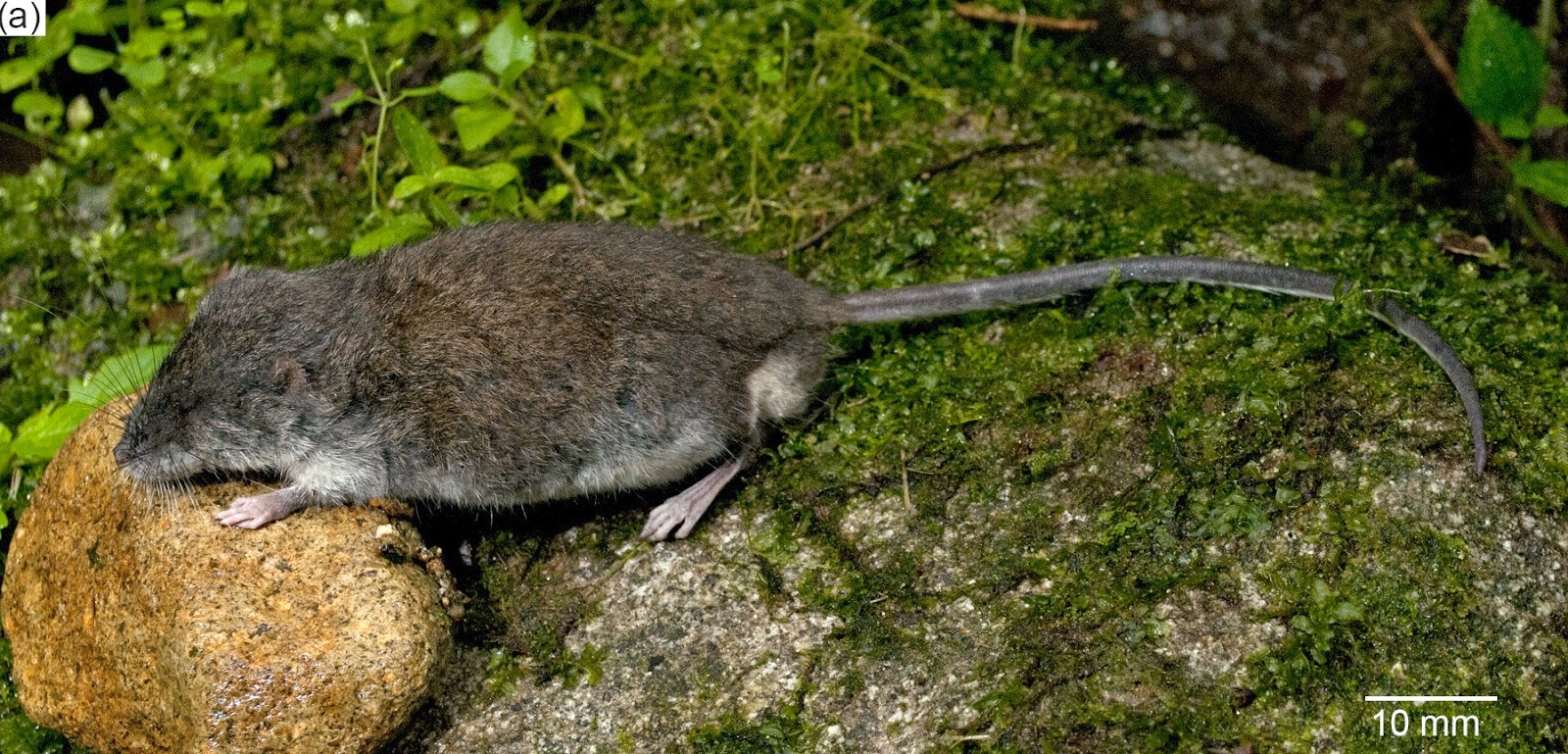
Waiomys mamasae in life. Kevin Rowe in Rowe et al. (2014).

Waiomys mamasae is a small, dark grey Rat with a body about 25% longer than its body. It has dense underfur, but only sparse guard hairs emerging from this, these being brown on the dorsal surface (back) and white on the ventral surface (belly). Its eyes are small and almost hidden in its fur.

Waiomys mamasae is a member of the family Muridae (True Mice), as are the Water Rats of New Guinea, however it is only distantly related to them, and appears to have evolved an aquatic carnivorous lifestyle separately and convergently.

Stream on Mount Gandangdewata where type specimen was collected. Specimen was collected within 20 meters where the photo was taken. Shallow riffles shown in photo are consistent with the description of the site by locals who caught the animal. Kevin Rowe in Rowe et al. (2014).

Sulawesi is a volcanic island not thought to have been connected to any other land-mass in the last 10 million years. It is surrounded by Sunda Islands, which are part of the Eurasian continental shelf, the Sahul Islands, which are part of the Australian continental shelf, as well as the Philippines and islands of Wallacea, which are oceanic in origin. As such it has been colonized by relatively few groups of organisms, and those have often undergone dramatic evolutionary radiations into new niches. Murid Rodents are one of these groups, and comprise about 30% of the Mammalian fauna of the island, filling a number of ecological niches that are filled by animals from different groups elsewhere.

Mount Gandangdewata lies in the west-central highlands of Sulawesi, an area of old-growth tropical rainforest that has been poorly studies by biologists. Rowe et al. visited the area in 2011 and 2012, finding 22 different species of Murid Rodents, at altitudes of between 200 and 2600 m, mostly above 1500 m. Organisms living at higher altitudes tend to be more endemic (restricted in range) than organisms at lower altitudes, as high altitude mountains and plateaus effectively form islands, cut from similar environments by areas of lowlands.

Maps of (a) Southeast Asia, showing the position of Sulawesi Island and (b) Sulawesi, showing the type locality of Waiomys mamasae (Mt. Gandangdewata [diamond]). Rowe et al. (2014).

See also…


All South American Rodents are classified as members of a single monophyletic group, the Caviomorpha. This appears to be most closely related to Rodents with African and Asian distributions; a single fossil from the Early Oligocene of Egypt has been described as a possible Caviomorph. This suggests the Caviomorphs colonized...


Shrews (Soricidae) are small insectivorous or omnivorous Mammals found across much of the world, the only major landmasses from which they are absent being Australia, New Zealand and New...


All South American Rodents are classified as members of a single monophyletic group, the Caviomorpha. This appears to be most closely related to Rodents with African and Asian distributions; a...


Follow Sciency Thoughts on Facebook.