Showing posts with label Reasi District. Show all posts

Sunday, 4 November 2018

Landslide kills nine-year-old girl in Jammu and Kashmir, India.

A nine-year-old-girl has died and three of her relatives have been injured in the Rajouri District of Jammu and Kashmir, India, on Saturday 3 November 2018. Shabina Kousar was a member of a group of nomadic Bakarwal people, who had set up a tent encampment close to a shrine in the village of Chatyar, as part of an annual migration between summer grazing grounds in the high mountains of the region and winter grazing grounds in the lowlands.

The approximate location of the 3 November 2018 Rajouri District landslide. Google Maps.

The incident occurred during a series of thunderstorms which swept across Jammu and Kashmir over the past three days. Thunderstorms occur when warm, moist bodies of air encounter cooler, drier air packages. The warm air rises over the cooler air until it rises above its dew point (the point where it cools to far to retain its water content as vapour), and the water precipitates out, falling as rain, sleet or hail. 

In a separate incident a villager was killed and two relatives injured by a lightning strike in Reasi District. Warm moist air passing over the surface of the Earth acts as an electrical generator, creating a negative charge in the cloud tops and a positive charge at the ground (or occasionally in a second cloud layer). The atmosphere acts as an electrical insulator, allowing this potential to build up, until water begins to precipitate out. This allows a channel of ionised air to form, carrying a current between the clouds and the ground, which we perceive as lightning.

See also...

https://sciencythoughts.blogspot.com/2018/07/landslide-kills-five-pilgrims-in.htmlhttps://sciencythoughts.blogspot.com/2018/01/swedish-tourist-killed-by-avalanche-in.html
http://sciencythoughts.blogspot.co.uk/2018/01/seven-missing-after-avalanche-in-jammu.htmlhttp://sciencythoughts.blogspot.co.uk/2017/09/magnitude-46-earthquake-in-jammu-and.html
http://sciencythoughts.blogspot.co.uk/2017/04/seven-conformed-deaths-as-heavy-rains.htmlhttp://sciencythoughts.blogspot.co.uk/2016/08/landslide-at-hindu-shrine-kills-at.html
Follow Sciency Thoughts on Facebook.

Thursday, 25 August 2016

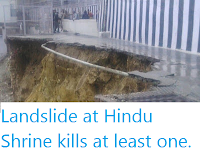
Landslide at Hindu Shrine kills at least one.

One person has died and it is feared more are trapped under debris after a landslide at the Vaishno Devi cave shrine in the Trikuta Mountains in Reasi District of Jammu and Kashmir State, India, on Wednesday 24 August 2016. The dead man has been identified as Harbinder Singh, a member of the 6th Battalion of the Central Reserve Police Force from Hoshiarpur in Punjab.

The scene of the 24 August 2016 Vaishno Devi Shrine landslide. Times of India.

The Jammu and Kashmir region is extremely prone to landslides, due to a number of active faults in the area, these being driven by the northward movement of the Indian Plate, which is pushing into Eurasia at a rate of 40 mm a year. This causes earthquakes on both plates, as well as the folding and uplift that has created the Himalayas and the Tibetan Plateau. Typically this is more of a problem in the monsoon season in July and August, when rainfall often exceeds 650 mm per month in many areas.

Monsoons are tropical sea breezes triggered by heating of the land during the warmer part of the year (summer). Both the land and sea are warmed by the Sun, but the land has a lower ability to absorb heat, radiating it back so that the air above landmasses becomes significantly warmer than that over the sea, causing the air above the land to rise and drawing in water from over the sea; since this has also been warmed it carries a high evaporated water content, and brings with it heavy rainfall. In the tropical dry season the situation is reversed, as the air over the land cools more rapidly with the seasons, leading to warmer air over the sea, and thus breezes moving from the shore to the sea (where air is rising more rapidly) and a drying of the climate. This situation is particularly intense in South Asia, due to the presence of the Himalayas. High mountain ranges tend to force winds hitting them upwards, which amplifies the South Asian Summer Monsoon, with higher winds leading to more upward air movement, thus drawing in further air from the sea. 

Diagrammatic representation of wind and rainfall patterns in a tropical monsoon climate. Geosciences/University of Arizona.

See also...

Landslide kills four in Jammu in Kashmir.   Four people have died and another seven have recieved hospital treatment after a landslide hit a shelter occupied by a group of pilgrims and their guides on the Banganga-Ardhkuwari Road close to the cave shrine...
Kashmir landslide kills two.                          Two men have died in a landslide hit the hamlet of Baba Ghale in Baramulla District, Jammu and Kashmir, on Friday 3 April 2015. Two other people were reported to have been injured in the event. All four were...

Seven people, including at least one child are known to have died following a landslide which destroyed four houses at Laldan in the Budgam District of Jammu and Kashmir on Monday 30  March 2015. It is feared at...

Follow Sciency Thoughts on Facebook.

Saturday, 6 August 2016

Landslide kills four in Jammu in Kashmir.

Four people have died and another seven have recieved hospital treatment after a landslide hit a shelter occupied by a group of pilgrims and their guides on the Banganga-Ardhkuwari Road close to the cave shrine of Mata Vaishnodevi in Reasi District, Jammu  and Kashmir early on the morning of morning of Saturday 6 August 2016. The deceased have been identified as Shashidhar Kumar (29) of Banglore, Bindu Sahni (30) and her son Vishal (5) of Chhattisgarh and local guide Sadik (32).

A victim of the 6 August 2016 Reasi landslide being treated for injuries. dna India.

The incident is reported to have been brought about by heavy rains; landslides are a common problem after severe weather events, as excess pore water pressure can overcome cohesion in soil and sediments, allowing them to flow like liquids. Raeasi Distrct has a Monsoon Season that typically lasts from July to September, with peak rains occuring in August, when around 350 mm of rain tends to fall in the month.

Monsoons are tropical sea breezes triggered by heating of the land during the warmer part of the year (summer). Both the land and sea are warmed by the Sun, but the land has a lower ability to absorb heat, radiating it back so that the air above landmasses becomes significantly warmer than that over the sea, causing the air above the land to rise and drawing in water from over the sea; since this has also been warmed it carries a high evaporated water content, and brings with it heavy rainfall. In the tropical dry season the situation is reversed, as the air over the land cools more rapidly with the seasons, leading to warmer air over the sea, and thus breezes moving from the shore to the sea (where air is rising more rapidly) and a drying of the climate. This situation is particularly intense in South Asia, due to the presence of the Himalayas. High mountain ranges tend to force winds hitting them upwards, which amplifies the South Asian Summer Monsoon, with higher winds leading to more upward air movement, thus drawing in further air from the sea. 

Diagrammatic representation of wind and rainfall patterns in a tropical monsoon climate. Geosciences/University of Arizona.

The Jammu and Kashmir region is extremely prone to landslides, due to a number of active faults in the area, these being driven by the northward movement of the Indian Plate, which is pushing into Eurasia at a rate of 40 mm a year. This causes earthquakes on both plates, as well as the folding and uplift that has created the Himalayas and the Tibetan Plateau. Typically this is more of a problem in the monsoon season in July and August, when rainfall often exceeds 650 mm per month in many areas, but the state has a fairly wet climate year round and rainfall in excess of 40-50 mm per month in January-March is not unusual, while about 85 mm is typical for April.

See also...

http://sciencythoughts.blogspot.co.uk/2015/04/kashmir-landslide-kills-two.htmlKashmir landslide kills two.                             Two men have died in a landslide hit the hamlet of Baba Ghale in Baramulla District, Jammu and Kashmir, on Friday 3 April 2015. Two other people were reported to have been injured in the event. All four were...
http://sciencythoughts.blogspot.co.uk/2015/03/seven-confirmed-deaths-following.htmlSeven confirmed deaths following landslide in Jammu and Kashmir.                             Seven people, including at least one child are known to have died following a landslide which destroyed four houses at Laldan in the Budgam District of Jammu and Kashmir on Monday 30  March 2015. It is feared at...

At least 19 people have been killed in landslides and flooding along the border between the Indian state of Jammu and Kashmir and the Pakistan State of Azad Jammu and Kashmir, associated with the monsoon rains this week. On the Pakistani side

Follow Sciency Thoughts on Facebook.