Showing posts with label Sivik Formation. Show all posts

Saturday, 4 September 2021

A fossil Jewel Beetle from the Middle Miocene of the Satovcha Basin, Bulgaria.

The Satovcha Basin, located in the southwestern Rhodope Mountains of Bulgaria, records a sequence of sedimentary and volcanic deposits laid down in a deep freshwater palaeolake that formed in an extensive graben (a structure formed when extensional activity draws rock structures apart, causing them to thin and sag, thereby creating a depression in the middle). The deep waters of the lake were eutrophic (lacking in oxygen), leading to excellent preservational conditions. The rocks of the basin are divided into two units, the Satovcha Formation, which comprises Oligocene volcanic and sedimentary deposits, and the Middle Miocene Sivik Formation, which overlies the Satovcha Formation unconformably includes a range of lake sediments, including a diatomite clay layer which has produced numerous Insect fossils, including a number of Dragonflies and March Flies which have previously been described.

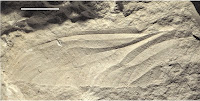
In a paper published in the journal Historia naturalis bulgarica on 17 March 2021, Nikolay Simov and Mario Langourov of the Bulgarian National Museum of Natural History, and Vladimir Sakalian and Vladimir Bozukov of the Institute of Biodiversity and Ecosystem Research of the Bulgarian Academy of Sciences, describe a Jewel Beetle from the Middle Miocene Sivik Formation.

The specimen is placed in the Family Dicercini, but nor assigned to genus or species level as in is incomplete, lacking a head, and preserved as a compression fossil in dorsal view with its elytra (wing cases) covering much of its body. The specimen is about 22 mm in length and 10.5 mm in width, and brownish in colour with some darker markings. The pronotum (section of the body behind the head and in front of the elytra is 8.6 mm in length and 10.5 mm in width. The elytra are about 15.5 mm long and 5.5 mm wide, with roughly parallel sides for most of their length, but narrowing at both the front and rear. The wing tips, tip of the abdomen and some legs are also visible.

 
Jewel Beetle from the Middle Miocene Sivik Formation of Bulgaria. Simov et al. (2021).

The Middle Eocene deposits of the Satovcha Basin record a warm broadleafed or mixed evergreen forest in an environment that probably had temperatures permanently above 15°C and no winter frosts, similar to the forests of Southeast Asia today, an environment where Jewel Beetles are particularly successful and diverse.

See also...


Online courses in Palaeontology.  

Follow Sciency Thoughts on Facebook.

Follow Sciency Thoughts on Twitter


Thursday, 6 October 2016

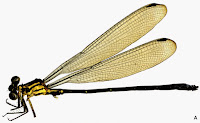
Dragonflies and Damselflies from the Middle Miocene Satovcha Palaeolake of southwest Bulgaria.

The Satovcha Graben (depression formed by extension, as two geological blocks draw apart causing the ground between to thin and slump) forms a basin roughly 7 km in length and 1.5 km in width in the western Rhodopes Mountains of southwest Bulgaria. During the Miocene-Oligocene this depression was filled by a lake, and surrounded by subtropical evergreen forests similar to those found in Southeast Asia today. These deposits have produced a diverse range of Plant fossils preserved in freshwater diatomites (sedimentary rocks made up of the tests, or shells, of tiny planktonic Algae called Diatoms). The site is also known to produce Insect fossils, including Beetles, Coleoptera, Bugs, Hemiptera, Caddisflies, Trichoptera, Earwigs, Dermaptera, Ants and Bees, Hymenoptera, Flies including Mosquitoes, Gnats and Midges, Diptera, Cockroaches and Termites, Dictyoptera, a Grasshopper and Crickets, Orthoptera, and Dragonflies and Damselflies, Odonata; though to date these Insects have never been formally described or studied in any organized way.

In a paper published in the journal Palaeontologica Electronica in September 2016, Andre Nel of thr Institut de Systématique,Évolution, Biodiversité at the Muséum national d’Histoirenaturelle, Nikolay Simov of the National Museum of Natural History in Sofia, Vladimir Bozukov of the Institute of Biodiversity andEcosystem Research at the Bulgarian Academy of Sciences, and Milen Marinov of the Plant Health & Environment Laboratory of the Ministry for Primary Industries in Auckland, New Zealand, describe two new species of Dragonfly and a species of Damselfly from the Middle Miocene Sivik Formation of the Satovcha Graben.

The first Dragonfly species described is placed in the genus Oligaeschna, which has previously been described from other locations of similar age, and given the specific name bulgariensis, meaning 'from Bulgaria'. The species is described from two specimens, though both of these comprise the forewing only, one specimen preserved as part and counterpart on s split block, the second as part only. Insects in most groups can be identified to species level using the venation on the their forewings, so it is not unusual to describe new fossil species using isolated forewings.

Oligaeschna bulgariensis. (1) First specimen (part); (2) Second specimen (counterpart); (3) Second specimen. Scale bars represent 5 mm in all figures. Nel et al. (2016).

The second new Dragonfly species described is placed in the genus Stenolestes, which has previously been described from the Middle Oligocene to Early Miocene of Europe and Siberia, making this potentially the youngest example of the genus, and given the specific name rhodopensis, meaning 'from Rhodopes'; in reference both to the Rhodopes Mountains and the mythical Thracian queen Rhodope. The species is described from an isolated forewing preserved as part and counterpart, plus a largely intact insect compressed in lateral (side) view.

Stenolestes rhodopensis, whole Insect. Scale bar is 1 cm. Nel et al. (2016).

The new Damselfly species is placed in the genus Primorilestes, which has previously been used to describe species from the Early Oligocene of Primorye Territory in Russia and Early Eocene of Denmark, and is given the specific name magnificus, in reference to the quality of preservation on the frst specimen. The species is described from two specimens, a forewing preserved as part and counterpart, and an isolated wing-tip.

Primorilestes magnificus, first specimen (part). Scale bar is 5 mm. Nel et al. (2016).

See also...

http://sciencythoughts.blogspot.co.uk/2015/03/a-new-species-of-clubtail-dragonfly.htmlA new species of Clubtail Dragonfly from Malaysian Borneo.                                                    Clubtail Dragonflies, Gomphidae, are a group of small-to-medium-sized Dragonflies related to Damselflies which get their name from a widening the end...

http://sciencythoughts.blogspot.co.uk/2014/05/a-new-species-of-damselfly-from-la.htmlA new species of Damselfly from the La Montaña de Corazal Cloud Forest of Honduras.                                         Damselflies (Zygoptera) are members of the Dragonfly order (Odonta), though generally smaller...
http://sciencythoughts.blogspot.co.uk/2013/06/a-dragonfly-from-late-jurassic-of.html#comment-formA Dragonfly from the Late Jurassic of Central Poland.                                                 Dragonflies are one of the oldest groups of insects with a fossil record that dates back to the...
Follow Sciency Thoughts on Facebook.