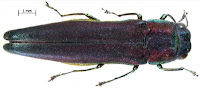
Showing posts with label Jewel Beetles. Show all posts

Saturday, 4 September 2021

A fossil Jewel Beetle from the Middle Miocene of the Satovcha Basin, Bulgaria.

The Satovcha Basin, located in the southwestern Rhodope Mountains of Bulgaria, records a sequence of sedimentary and volcanic deposits laid down in a deep freshwater palaeolake that formed in an extensive graben (a structure formed when extensional activity draws rock structures apart, causing them to thin and sag, thereby creating a depression in the middle). The deep waters of the lake were eutrophic (lacking in oxygen), leading to excellent preservational conditions. The rocks of the basin are divided into two units, the Satovcha Formation, which comprises Oligocene volcanic and sedimentary deposits, and the Middle Miocene Sivik Formation, which overlies the Satovcha Formation unconformably includes a range of lake sediments, including a diatomite clay layer which has produced numerous Insect fossils, including a number of Dragonflies and March Flies which have previously been described.

In a paper published in the journal Historia naturalis bulgarica on 17 March 2021, Nikolay Simov and Mario Langourov of the Bulgarian National Museum of Natural History, and Vladimir Sakalian and Vladimir Bozukov of the Institute of Biodiversity and Ecosystem Research of the Bulgarian Academy of Sciences, describe a Jewel Beetle from the Middle Miocene Sivik Formation.

The specimen is placed in the Family Dicercini, but nor assigned to genus or species level as in is incomplete, lacking a head, and preserved as a compression fossil in dorsal view with its elytra (wing cases) covering much of its body. The specimen is about 22 mm in length and 10.5 mm in width, and brownish in colour with some darker markings. The pronotum (section of the body behind the head and in front of the elytra is 8.6 mm in length and 10.5 mm in width. The elytra are about 15.5 mm long and 5.5 mm wide, with roughly parallel sides for most of their length, but narrowing at both the front and rear. The wing tips, tip of the abdomen and some legs are also visible.

 
Jewel Beetle from the Middle Miocene Sivik Formation of Bulgaria. Simov et al. (2021).

The Middle Eocene deposits of the Satovcha Basin record a warm broadleafed or mixed evergreen forest in an environment that probably had temperatures permanently above 15°C and no winter frosts, similar to the forests of Southeast Asia today, an environment where Jewel Beetles are particularly successful and diverse.

See also...


Online courses in Palaeontology.  

Follow Sciency Thoughts on Facebook.

Follow Sciency Thoughts on Twitter


Tuesday, 27 September 2016

Brachycoraebus aeneus & Metasambus circularis: Two new species of Jewel Beetles from Singapore and Sumatra.

The Tribe Coraebini is the largest subgroup within the Buprestidae (Jewel Beetles). These are small Beetles found within the forest canopy in both temperate and tropical regions, though both their biology and true diversity is poorly understood, due to the inaccessible nature of their prefered habitats.

In a paper published in the Raffles Bulletin of Zoology on 31 August 2016, Loong-Fah Cheong of the Lee Kong Chian Natural History Museum, describes two new Beetles from the Tribe Coraebini, both of which were found in Singapore, and one also on Sumatra.

The first new Beetle described is placed in the genus Brachycoraebus and given the specific name aeneus, in reference to its brassy colouration. This species is described from two specimens, a female collected from the Nee Soon Swamp Forest on Singapore in September 2013, and a male collected from an unknown location on the island in April 1923. These are small Beetles, the male measuring 3.6 mm in length and 1.5 mm in width and the female 4.2 mm in length and 1.9 mm in width. They are dark brown in colour, and covered with short golden hairs, which gives them a brassy appearance; their undersides are black.

Brachycoraebus aeneus, female specimen in life. Loong-Fah Cheong (2016).

The second new species described is placed in the genus Metasambus, and given the specific name circularis, in reference to the circular pattern on the elytra (wing case) of the Beetles. The species is described from seven specimens, two from the Riffle Range Forest of Singapore and five from an unknown location on Sumatra. These are also small Beetles, measuring 3.8 mm in length and 1.3 mm in width, and are black in colour with a purplish tinge, and a covering of white hair on the elytra which forms two distinct bands, each with a circular pattern on each wing-case.

 Metasambus circularis, male specimen. Loong-Fah Cheong (2016).

 See also...

http://sciencythoughts.blogspot.co.uk/2014/01/two-new-species-of-jewel-beetle-from.htmlTwo new species of Jewel Beetle from Central America.                                                      Jewel Beetles (Buprestidae) are wood-boring Insects with distinctive bright, metallic elytra...
http://sciencythoughts.blogspot.co.uk/2012/12/six-new-species-of-jewel-beetle-from.htmlSix new species of Jewel Beetle from Southeast Asia.                                             Jewel Beetles (Buprestidae) are wood-boring Insects with distinctive bright, metallic elytra...
Follow Sciency Thoughts on Facebook.
 

Saturday, 11 January 2014

Two new species of Jewel Beetle from Central America.

Jewel Beetles (Buprestidae) are wood-boring Insects with distinctive bright, metallic elytra (wing-cases). They have been used to make traditional Beetle-wing jewelry in parts of Asia and are prized by insect collectors for their bright colouration, but despite this they are not considered to be threatened by man, in fact they are widely held to be serious economic pests, since some species are capable of killing large trees through the activity of their larvae, which are wood or leaf borers. Their colours are not caused by pigmentation, but rather by physical iridescence; the microscopic structure of the cuticle preferentially reflects light at specific frequencies; this creates bright, distinctive colours that serve as a warning to predators, the Beetles will swarm when threatened and can deliver a painful bite. This structural colouration allows the Beetles to be preserved in the fossil record with their pigments intact (rare with pigment-based colouration), with colours preserved in Beetles as old as the Jurassic.

In a paper published in the journal Zootaxa on 27 March 2013, Henry Hespenheide of the Department of Ecology and Evolutionary Biology at the University of California, Los Angeles, describes two new species of Jewel Beetle from Panama and Costa Rica. Both new species are placed in the genus Callimicra, which is known from Mexico and Central America.

The first new species is named Callimicra timmonsae, in honour of Bess Spiva Timmons. The species is described from nine male specimens from Panama and Costa Rica, and one female specimen from Costa Rica. The males are 3.30–3.75 mm long, the female 4.40 mm. Both are brightly coloured with blue, iridescent green and black patterning.

Callimicra timmonsae, male specimen in dorsal view. Hespenheide (2013).

The second new species is named Callimicra prenai, in honour of Jens Prena, an entomologist and Weevil expert who collected the specimens from which the species is described. The species is described from one male and two female specimens, all from Costa Rica. The male is 4.2 mm long, the females 4.7 & 5.0 mm. Both are brightly coloured, with a black, green, gold and red pattern.

Callimicra prenai, female specimen in dorsal view. Hespenheide (2013).


Follow Sciency Thoughts on Facebook.


Wednesday, 26 December 2012

Six new species of Jewel Beetle from Southeast Asia.

Jewel Beetles (Buprestidae) are wood-boring Insects with distinctive bright, metallic elytra (wing-cases). They have been used to make traditional Beetle-wing jewelry in parts of Asia and are prized by insect collectors for their bright colouration, but despite this they are not considered to be threatened by man, in fact they are widely held to be serious economic pests, since some species are capable of killing large trees through their activity. Their colours are not caused by pigmentation, but rather by physical iridescence; the microscopic structure of the cuticle preferentially reflects light at specific frequencies; this creates bright, distinctive colours that serve as a warning to predators, the Beetles will swarm when threatened and can deliver a painful bite. This structural colouration allows the Beetles to be preserved in the fossil record with their pigments intact (rare with pigment-based colouration), with colours preserved in Beetles as old as the Jurassic.

In a paper published in the journal ZooKeys on 8 November 2012, Eduard Jendek of the Ottawa Plant Laboratory of the Canadian Food Inspection Agency and Maria Lourdes Chamorro of the Systematic Entomology Laboratory of the United States Department of Agriculture and the National Museum of Natural History, describe six new species of Jewel Beetle from Southeast Asia, discovered as part of a wider search for relatives of the Emerald Ash Borer, Agrilus planipennis, an Asian species that has proved to be a highly destructive invasive pest in North America.

The first new species is named Agrilus crepuscularis, from the Latin crepusculum, meaning twilight. It is a 10 mm, slender, wedge-shaped, purplish-green Beetle with large, protruding eyes. The species is described from a single male specimen discovered in the Endau Rompin State Park in Malaysia.

Agrilus crepuscularis in dorsal (top) and lateral (bottom) views. Jendek & Chamorro (2012).

The second new species is named Agrilus pseudolubopetri, meaning false-lubopetri, due to the male of the species' close resemblance to the males of the previously described Agrilus lubopetri. It is a 14-18 mm, slender, wedge-shaped, Beetle with large, non-protruding eyes. The males are greenish in colour, the females purple. The Beetles were found at a number of locations in Laos.

Agrilus pseudolubopetri, male (top) and female (bottom). Jendek & Chamorro (2012).

The third new species described is named Agrilus sapphirinus, due to its distinctive sapphire colouration. It is a 10.5 mm, slender, wedge-shaped Beetle with large, protruding eyes. The species is named from a single female specimen found in Louang Namtha Province in northern Laos.

Agrilus sapphirinus, in dorsal (top) and lateral (bottom) views. Jendek & Chamorro (2012).

The fourth new species is named Agrilus seramensis, after Seram Island in Indonesia, where the species was found living. The species is described from seven specimens, all female. It is a 8-11.5 mm, slender, wedge-shaped, green-and-yellow Beetle with large, protruding eyes.

Agrilus seramensisin dorsal (top) and lateral (bottom) views. Jendek & Chamorro (2012).

The fifth new species described is named Agrilus spineus, for the spines on the tips of its wing-cases. It is a 9 mm, robust, wedge-shaped green Beetle with large, protruding eyes, described from a single female specimen found in the Bako National Park in Sarawak State in Malaysian Borneo. 

Agrilus spineusin dorsal (top) and lateral (bottom) views. Jendek & Chamorro (2012).

The final new species described is named Agrilus tomentipennis, meaning 'wooly-hairs on the wingcase'. It is a 14.0-14.3 mm robust, wedge-shaped yellow-green Beetle with large, protruding eyes. The species is named from three female specimens found at different locations in Xieng Khouang Province in Laos.

Agrilus tomentipennisin dorsal view. Jendek & Chamorro (2012).


Follow Sciency Thoughts on Facebook.