Showing posts with label Socotra Islands. Show all posts

Friday, 21 February 2025

Boswellia hesperia: A new species of Dwarf Frankincense from Socotraa Island.

Frankincenses, Boswellia spp., are trees and small shrubs noted for the aromatic resin they produce, found in East Africa, Arabia, and parts of South Asia. In 1971 Frank Nigel Hepper of Kew Royal Botanic Gardens described a Dwarf Frnakincense, Boswellia nana, from the Yemeni island of Socotra in the Indian Ocean (a noted hotspot for botanical endemism). In 2004, botanists Anthony Miller and Miranda Morris reported a second species of Dwarf Frankincense from Socotra, something which several subsequent studies have also recorded, but which has not, to date, been formally described.

In a paper published in the Nordic Journal of Botany on 20 February 2025, Mats Thulin of the Department of Organismal Biology at Uppsala University, Michael Weber from Bad Berka in Germany, Sami Ali Mohammed Mubarak from Socotra Island, and Alain Rzepecky from São Brás de Alportel in Portugal, formally describe the second species of Socotran Dwarf Frankincense.

The new species is named Boswellia hesperia, where 'hesperia' means 'west', the species having been found exclusively at the western end of the Island of Socotra; this is in contrast to Boswellia nana, which is found exclusively at the eastern end of the island. Boswellia hesperia is an entirely prostrate dwarf species, found growing within holes and crevasses in limestone rock. This habit is also seen in Boswellia nana, although that species sometimes also produces dwarf shrubs up to 2 m high. Boswellia hesperiai also differs from Boswellia nana in its leaves, which are waxy above, but covered in white fur below, whereas those of Boswellia nana are waxy on both sides.

Boswellia hesperia from mountain ridge above Neet, 5–6 km from the coast, Socotra, 18 May 2021. (A) plant filling out crevice in limestone rock, leafless, showing reddish white flowers and fruits, (B) leafless plant with flowers and fruits. Alain Rzepecky in Thulm et al. (2025).

The total area over which Boswellia hesperia is found is about 63 km², however, the distribution of the species is patchy, and it probably is only found over an area of about 20 km². This limited distribution, along with the apparent risk of the species being overgrazed by Goats, leads Thulm et al. to recommend that Boswellia hesperia be classified as Critically Endangered under the terms of the International Union for Conservation of Nature's Red List of Threatened Species.

Boswellia hesperia, seedling flowering after about one and a half year in cultivation. Alain Rzepecky in Thulm et al. (2025).

See also...

Tuesday, 29 May 2018

Landslides kill at least 32 in the Oromia Region of Ethiopia, as Cyclones batter the Horn of Africa and the Arabian Peninsula.

At least 32 people have died in a series of landslides in the Oromia Region of Ethiopia this weekend, with the worst incidents occurring in Gamo Gofa, where a landslide killed nine people and injured seventeen, and Sidama, where a landslide killed 23 people and injured six. The events happened amid heavy rains that have brought widespread flooding and related problems to East Africa, associated with cylones Sagar, which has been attributed with the deaths of 49 people in Somalia (where an ongoing civil conflict has hampered relief efforts) and two in Djibouti (where as much rain fell in 24 hours as usually falls in a year) and Mekunu, which is attributed with seven deaths in the Socotra Islands (Yemen) and six in Oman, with eight sailors still missing on two vessels in the region. Landslides are are a common problem after severe weather events, as excess pore water pressure can overcome cohesion in soil and sediments, allowing them to flow like liquids. Approximately 90% of all landslides are caused by heavy rainfall.

 The aftermath of a landslide at Sidama in the Oromia Region of Ethiopia, which killed 23 people on Saturday 27 May 2018. Atnaf Brhane/Twitter.

Tropical storms are caused by solar energy heating the air above the oceans, which causes the air to rise leading to an inrush of air. If this happens over a large enough area the inrushing air will start to circulate, as the rotation of the Earth causes the winds closer to the equator to move eastwards compared to those further away (the Coriolis Effect). This leads to tropical storms rotating clockwise in the southern hemisphere and anticlockwise in the northern hemisphere.These storms tend to grow in strength as they move across the ocean and lose it as they pass over land (this is not completely true: many tropical storms peter out without reaching land due to wider atmospheric patterns), since the land tends to absorb solar energy while the sea reflects it.

The low pressure above tropical storms causes water to rise there by ~1 cm for every millibar drop in pressure, leading to a storm surge that can overwhelm low-lying coastal areas, while at the same time the heat leads to high levels of evaporation from the sea - and subsequently high levels of rainfall. This can cause additional flooding on land, as well as landslides.

See also...

http://sciencythoughts.blogspot.co.uk/2018/05/seventeen-missing-after-cyclone-mekunu.htmlhttp://sciencythoughts.blogspot.co.uk/2018/03/magnitude-52-earthquake-in-afar-region.html
http://sciencythoughts.blogspot.co.uk/2017/12/german-tourist-killed-on-erte-ale.htmlhttp://sciencythoughts.blogspot.co.uk/2017/04/pair-of-earthquakes-off-coast-of.html
http://sciencythoughts.blogspot.co.uk/2017/03/pirates-release-oil-tanker-seized-off.htmlhttp://sciencythoughts.blogspot.co.uk/2017/03/dozens-dead-following-landlside-at.html


Follow Sciency Thoughts on Facebook.

Thursday, 24 May 2018

Seventeen missing after Cyclone Mekunu sweeps across the Socotra Islands.

Seventeen people are still missing after Cyclone Mekunu swept across the Yemeni Socotra Island group on Wednesday 23-Thursday 24 May 2018. Full details of the missing persons have not been released, but it is understood that four were members of the crew of one of two vessels that sank during the strom, while another three were in a car that was swept away by floodwaters. The storm is expected to make landfall on the southern part of the Arabian Peninsula this weekend, either in eastern Yemen or southern Oman.

Receding floodwaters on Socotra Island (the largest island of the Socotra group) on 24 May 2018. Abdullah Morgan/AP.

Tropical storms are caused by solar energy heating the air above the oceans, which causes the air to rise leading to an inrush of air. If this happens over a large enough area the inrushing air will start to circulate, as the rotation of the Earth causes the winds closer to the equator to move eastwards compared to those further away (the Coriolis Effect). This leads to tropical storms rotating clockwise in the southern hemisphere and anticlockwise in the northern hemisphere.These storms tend to grow in strength as they move across the ocean and lose it as they pass over land (this is not completely true: many tropical storms peter out without reaching land due to wider atmospheric patterns), since the land tends to absorb solar energy while the sea reflects it.

The passage of Cyclone Mekunu till 12.00 GMT on Thursday 24 May 2018 (thick line) with its predicted future path (thin line, circles represent the margin of error on the predictions). Colours indicate the strength of the storm. Tropical Storm Risk.

The low pressure above tropical storms causes water to rise there by ~1 cm for every millibar drop in pressure, leading to a storm surge that can overwhelm low-lying coastal areas, while at the same time the heat leads to high levels of evaporation from the sea - and subsequently high levels of rainfall. This can cause additional flooding on land, as well as landslides, which are are a common problem after severe weather events, as excess pore water pressure can overcome cohesion in soil and sediments, allowing them to flow like liquids. Approximately 90% of all landslides are caused by heavy rainfall.

See also...

http://sciencythoughts.blogspot.co.uk/2017/10/cholera-outbreak-kills-over-2000-in.htmlhttp://sciencythoughts.blogspot.co.uk/2017/04/pair-of-earthquakes-off-coast-of.html
http://sciencythoughts.blogspot.co.uk/2015/11/flooding-in-saudi-arabia-and-qatar.htmlhttp://sciencythoughts.blogspot.co.uk/2015/11/cyclone-chapala-makes-landdall-in-yemen.html
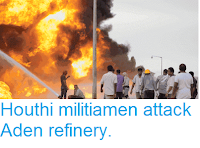
http://sciencythoughts.blogspot.co.uk/2015/06/houthi-militiamen-attack-aden-refinery.htmlhttp://sciencythoughts.blogspot.co.uk/2015/05/magnitude-47-earthquake-in-gulf-of.html
Follow Sciency Thoughts on Facebook.

Thursday, 5 November 2015

Cyclone Chapala makes landdall in Yemen.

Cyclone Chapala made landfall in the close to the city of Al Mukalla in the Hadhramaut region of Yemen early on Tuesday 3 November 2015.This is the first tropical cyclone to have hit the coast of Yemen since modern meteorological recording began, and it is thought likely that the local population, which typically only receives tens of millimeters of per year may have been largely unprepared for the flooding that accompanied the storm. Al Mukalla is currently held by Al-Qaeda in the Arabian Peninsula, one of several competing groups currently fighting in a civil war in Yemen, and an organization particularly opposed to outside interference, making it hard to assess the level of damage caused by the storm and unlikely that outside help will be able to reach the area.

Flooding in Al Mukalla following the landfall of Cyclone Chapala. Saeed Al-Batati/Twitter.

Cyclone Chapala was a Category 1 storm, defined as a storm having sustained winds of between 119 and 153 kilometers per hour (a sustained wind is a windspeed recorded for at least 1 minute), but is was a Category 3 storm, defined as a storm having sustained winds of between 178 and 208 kilometers per hour, when it swept over the Yemeni island of Socotra on Monday 2 November. Here it is known to have killed at least three people, destroyed around 450 homes and displaced around 40 000 people (out of a total population of about 50 000), though most should be able to return to their homes promptly. While Socotra is no more used to tropical storms than the Yemeni mainland, it has been little affected by the country's civil war, and aid efforts have been dispensed from several countries in the region to help with recovery after the storm.

A man calls for help after his vehicle is swept away in a flash flood caused by Cyclone Chapala on the island of Socotra. Reuters.

Tropical cyclones are caused by solar energy heating the air above the oceans, which causes the air to rise leading to an inrush of air. If this happens over a large enough area the inrushing air will start to circulate, as the rotation of the Earth causes the winds closer to the equator to move eastwards compared to those further away (the Coriolis Effect). This leads to tropical storms rotating clockwise in the southern hemisphere and anticlockwise in the northern hemisphere.These storms tend to grow in strength as they move across the ocean and lose it as they pass over land (this is not completely true: many tropical storms peter out without reaching land due to wider atmospheric patterns), since the land tends to absorb solar energy while the sea reflects it.

The passage of Cyclone Chapala as of 3 November 2015. Tropical Storm Risk.

The low pressure above tropical storms causes water to rise there by ~1 cm for every millibar drop in pressure, leading to a storm surge that can overwhelm low-lying coastal areas, while at the same time the heat leads to high levels of evaporation from the sea - and subsequently high levels of rainfall. This can cause additional flooding on land, as well as landslides.

See also...

Fifteen injured as Cyclone Bejisa batters Réunion.
Fifteen people have been injured, two seriously, as Cyclone Bejisa moved past the island of Réunion (an overseas department of...


At least four dead in Ridyadh flooding.
Four people including one child are known to have died and at least five more are missing in flooding in the Saudi capital Riyadh. Heavy rain began to fall in the desert city on Saturday 16 November 2013, and is predicted to continue till at least the middle of the week, leading to floodwaters 4-5 m deep in the worst hit...


Around 300 believed to have died in flooding after Tropical Cyclone Three hits Somalia.
Around 300 people are believed to have died after Tropical Cyclone Three hit the semiautonomous Puntland region of northeast...


Follow Sciency Thoughts on Facebook.

Wednesday, 28 October 2015

Symphysanodon andersoni: A second specimen of the Bucktoothed Slopefish from the south coast of Oman.

Slopefish, Symphysanodontidae, are deepwate Perciform Fish known from the Atlantic, Indian and Pacific Oceans. Like many deepwater orgnanisms the biology and diversity of the group is poorly understood, with most species being known from only a very few number of specimens captured in deep sea trawls. To date only twelve species have been described, all of which are placed in a single genus, Symphysanodon, with another undescribed species known from a single specimen recovered from the stomach of a Coelacanth captured in the Comoros Islands. The Bucktoothed Slopefish, Symphysanodon andersoni, is known only from a single specimen caught at a depth of 190-290 m to the southwest of the Socotra Islands in the Guf of Aden in 1974 (three further specimens assigned to this species reported from the Gulf of Kutch, an inlet in the northeastern quadrant of the Arabian Sea on the west coast of India in 2003 have now been re-assigned to another species).

In a paper published in the journal Zootaxa on 28 September 2015, William Anderson of the Grice Marine Biological Laboratory at the College of Charleston, Mikhail Chesalin of the Fisheries Research Center-Salalah of the Ministry of Agriculture and Fisheries Wealth of the Sultanate of Oman, Laith Jawad of Flat Bush, New Zealand and Said Al Shajibi, also of the Fisheries Research Center-Salalah of the Ministry of Agriculture and Fisheries Wealth of the Sultanate of Oman, describe a second specimen of Symphysanodon andersoni from a Fish trap at a depth of about 80 m off Raysut Port on the south cast of Oman.

This specimen is identified as belonging to the same species as the original by the number of tubed scales along the lateral line, which is larger in this species than in other members of the genus, plus the number of gillrakers and depth of the body at the origin of the dorsal fin. It is 204 mm in length, larger than the original specimen (157 mm), and a dark orange-red in colour.

Freshly collected specimen of Symphysanodon andersoni caught in a fish trap off the south coast of Oman. Mikhail Chesalin in Anderson et al. (2015).

See also...

http://sciencythoughts.blogspot.co.uk/2015/04/philometrid-nematodes-from-perciform.htmlPhilometrid Nematodes from Perciform Fish off the north Australian coast.                   Philometrids are large Nematodes parasitizing Fish . They show a high degree of sexual dimorphism, with males typically only a few mm in length, while...

http://sciencythoughts.blogspot.co.uk/2015/02/a-new-species-of-serranineperchlet-from.htmlA new species of Serranine Perchlet from the Philippines.                                                   The Philippines form a major component of the...


http://sciencythoughts.blogspot.co.uk/2014/06/a-new-species-of-rabbitfish-from.htmlA new species of Rabbitfish from southern India, Sri Lanka and the Maldives.           Rabbitfish (Siganidae) are morphologically conservative Perciforme Fish found on Coral reefs in the Indo-Pacific Region. They get their name from their prominent...


Follow Sciency Thoughts on Facebook.