Showing posts with label Theraspids. Show all posts

Saturday, 14 April 2018

Lystrosaurus murrayi & Lystrosaurus declivis: One species or two?

Dicynodonts of the genus Lystrosaurus are one of the few large terrestrial animals to have made it through the End Permian Extinction. The genus was quite diverse in the Late Permian of Southern Africa, and is also known from the Late Permian of Russia. In the Triassic two species are known from South Africa, with other specimens recorded from China, India and Antarctica. The first of the Triassic South African species, Lystrosaurus murrayi, was first described by Thomas Henry Huxley in 1859, the second Lystrosaurus declivis, was described by Richard Owen in 1860. It was later suggested by the prominent South African palaeontologist Robert Broom that these were likely to be the same species, though most recent studies of the group have still regarded them as separate species.

A specimen of Lystrosaurus murrayi in the Musee d'Histoire Naturelle in Paris. Wikimedia Commons.

In a paper published in the South African Journal of Science on 27 March 2018, Francis Thackeray of the Evolutionary Studies Institute at the University of the Witwatersrand challenges the assumption that the two Triassic South African Lystrosaurus species are separate, on the basis of morphometric analysis. 

Morphometric analysis is a tool used by palaeontologists, archaeologists, anthropologists and forensic pathologists to analyse and compare specimens. It relies on taking numerous measurements of an object such as a bone or shell, and comparing both these measurements and ratios between measurements to those obtained from other specimens in order to establish relationships between them. Traditionally these measurements have been obtained using tape measures and callipers, but modern scientists often use more sophisticated tools such as structured light scanners, which are capable of building highly detailed three dimensional models of specimens. 

 Specimen of Lystrosaurus declivis in the Musee des Confluences in Lyon. Wikimedia Commons.

Thackeray bases his analysis upon data previously published by Jennifer Botha-Brink, Daryl Codron, Adam Huttenlocker, Kenneth Angielczyk and Marcello Ruta in a paper published in the journal Scientific Reports in April 2016. This paper did not challenge the assumption that the two species were separate, but rather concentrated on the apparent breeding strategy of these species, noting that both had populations in which the largest specimens were rare, something often indicative of being able to breed before they reached full size, and suggests that this may have been a key adaptive trait that enabled these species to survive the End Permian Extinction.

Using the data provided by Botha-Brink et al., Thackeray takes this reasoning a step further and argues that the small difference in average size between the two species (with skulls averaging 0106.7 and 118.1 mm in length respectively) combined with the fact that most, if not all, specimens had not reached their maximum size, rules out any differentiation of the two species on the basis of size. He therefore suggests that all of these specimens should be referred to as Lystrosaurus murrayi, which was the first described and therefore has precedence.


See also...

http://sciencythoughts.blogspot.co.uk/2017/03/vertebrate-remains-from-late-permian-of.htmlhttp://sciencythoughts.blogspot.co.uk/2017/02/odontoma-found-in-late-permian.html
http://sciencythoughts.blogspot.co.uk/2016/09/unidentified-burnetiamorph-specimens.htmlhttp://sciencythoughts.blogspot.co.uk/2015/03/dinocephalian-therapsids-from-middle.html
http://sciencythoughts.blogspot.co.uk/2015/03/kannemeyeriiforme-dicynodonts-from.htmlhttp://sciencythoughts.blogspot.co.uk/2014/04/scavenging-on-body-of-dicynodont.html
Follow Sciency Thoughts on Facebook.

Saturday, 12 August 2017

Moschops capensis: Synchrotron scanning sheds light on the behaviour of a Middle Permian Dinocephalian Therapsid.

The Dinocephalian were a group of large-bodied Therapsids (the wider group which also includes the Cynodonts, the group that gave rise to, and includes the Mammals) known from the Middle Permian of Russia, China, Brazil, South Africa, Zimbabwe, and Tanzania. They had exceptionally thick skulls, with the braincase often entirely enclosed by other elements of the skull. The purpose of this bone is unclear; it may have been used in intra-specific head-butting contests, as in modern ungulates, but ungulates have a thick keratinous (horn) boss that absorbs impact, rather than greatly thickened bone, so the biomechanics of conflict in the two groups would not be the same. This thick layer of dense bone makes it hard for palaeontologists to examine the structure of the skull without recourse to destructive methods, further hampering efforts to understand the biology of these animals.

In a paper published in the journal PeerJ on 10 August 2017, Julien Benoit of the Evolutionary Institute and School of Anatomical Sciences at the University of the Witwatersrand, Paul Manger, also of the School of Anatomical Sciences at the University of the Witwatersrand, Luke Norton, also of the Evolutionary Institute at the University of the Witwatersrand, Vincent Fernandez of the European Synchrotron Radiation Facility, and Bruce Rubidge, again of the Evolutionary Institute at the University of the Witwatersrand, describe the results of a study in which a specimen of the Dinocephalian Moschops capensis was scanned at the European Synchrotron Radiation Facility in Grenoble, France, providing information on the internal anatomy of the skull of this species that had not previously been available.

The specimen, AM4950, was discovered at The Grant 39 site, to the north of Grahamstown in Eastern Cape Province, and is housed in the Albany Museum in Grahamstown. The specimen is estimated to be 265 million years old, and is a subadult, weathered on the left side, but well preserved on the right. It is slightly over 34 cm in length, with the largest adult skulls reaching about 38 cm.

The skull of Moschops capensis AM4950 in lateral view. (A) Photograph of the skull. (B) Reconstruction of the skull (right side, bone transparent) to reveal the neural structures discussed in this paper. (C) Reconstruction of the skull (left side, bone transparent) showing the endocast, bony labyrinth and the angle between the plane of the lateral semicircular canal and the main axis of the skull. Numbers indicate the position of the cross sections in the subsequent figures. EmV, emissary veins; End, endocranial cast; Hyp, hypophyseal fossa; Lab, bony labyrinths; Pin, pineal tube. Luke Norton in Benoit et al. (2017).

Benoit et al. estimate that AM4950 would have had a total body length of about 187 cm and would have weighed about 327 kg. It's braincase has a volume of 61 cm³ (though this will be considerably larger than the actual brain volume as the brain is surrounded by layers of soft tissue and fluid) giving it a braincase-volume to total mass ratio (encephalization quotient) similar to the lowest values found among living animals. The skull above the brain is about 6 cm thick, with the outer 2 cm being dense, osteosclerotic, bone and the lower 4 cm being less dense cancellous bone.

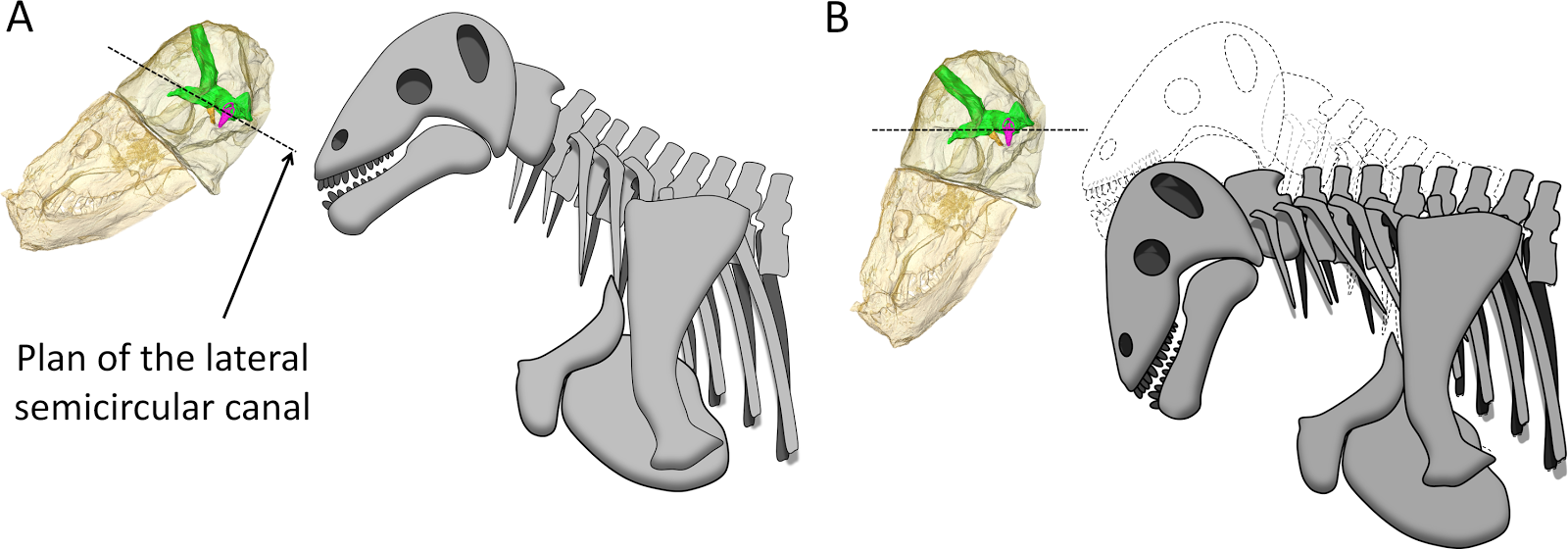
Previous reconstructions of Moschops capensis have suggested that its snout was carried before it, like that of a modern Mammal such as a Horse or Dog, and it has even been suggested that these animals may have been semi-aquatic, but the position of the labyrinth, the organ in the inner ear which is used to tell which way up the head is (and therefore enable us to balance), in AM4950 makes this highly unlikely. Benoit et al. reconstruct Moschops capensis with its head held at an angle of 60 -65° to the horizontal.

Hypothesized reconstructions of the natural head posture in Moschops capensis. (A) Redrawn after the mounted skeleton at the American Museum of Natural History. (B) Based on the position of the plane of the lateral (horizontal) canal. Julien Benoit in Benoit et al. (2017).

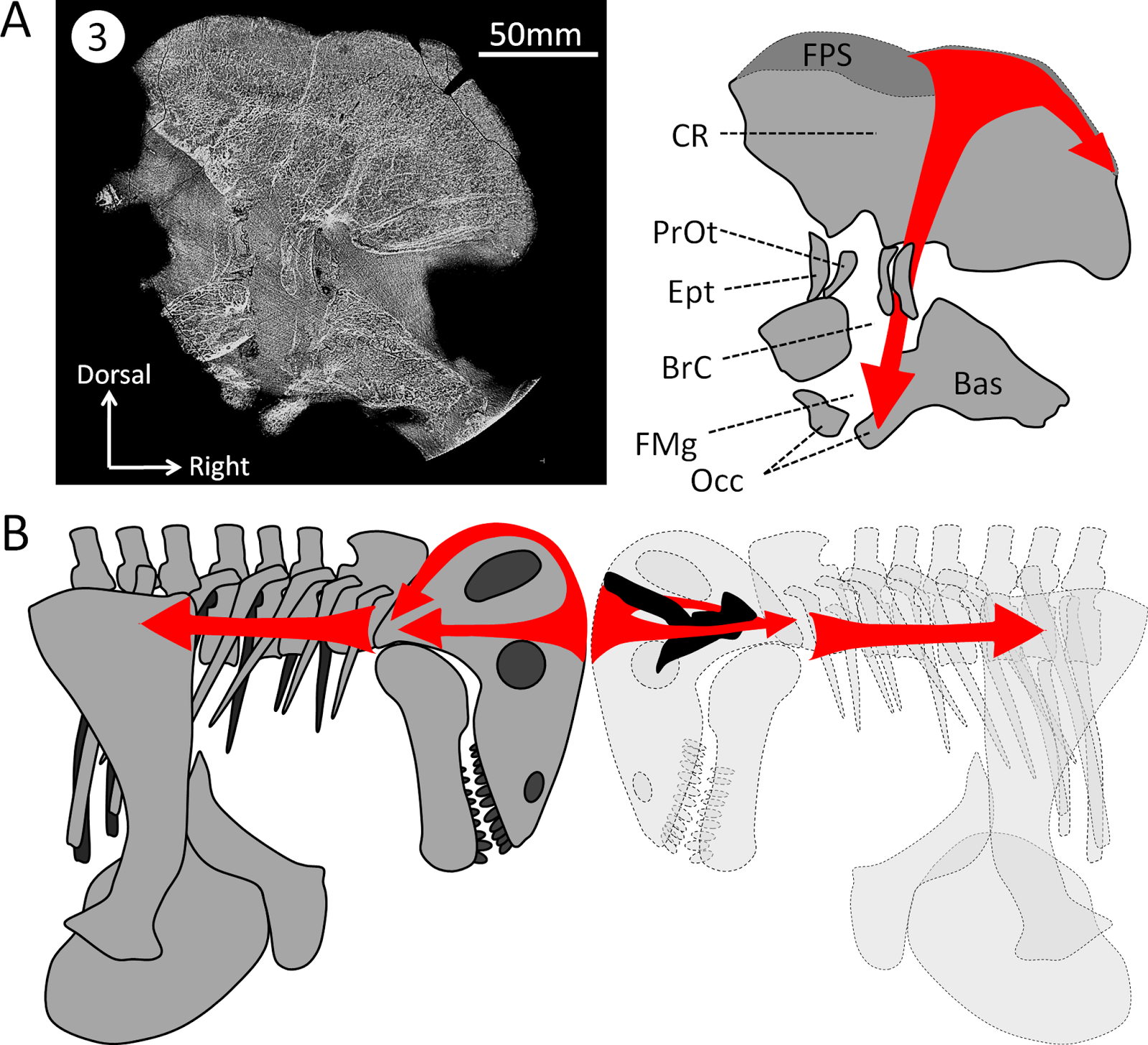
In this position the thickened bone above the braincase would be pointed directly forward, and also directly in line with the straightened spine, an ideal position for fighting by head-butting, strongly supporting the idea that these animals exhibited this behaviour. While to us head-butting does seem a particularly advanced behaviour, it actually implies a degree of social behaviour not generally attributed to early Therapsids In modern species that exhibit such behaviour it is usually associated either with ritualized display fights, observed by females who in turn engage in a degree of mate choice, or with the establishment of territories, which requires a degree of spatial awareness and the ability to understand a simple set of social rules.

Hypothesized dissipation of the energy during head butting in the skull of Moschops capensis. Arrows indicate the direction of energy transfer. (A) CT section of the skull of Moschops capensis AM4950. (B) The proposed route of the dissipation of energy through the dermatocranium (left) and the braincase (right) in two fighting Moschops. Abbreviations: Bas, basicranium; BrC, braincase; CR, cranial roof; Ept, epipterygoid; FMg, foramen magnum; FPS, frontoparietal shield; Occ, occipital condyles; PrOt; prootic. Julien Benoit in Benoit et al. (2017).

See also...

http://sciencythoughts.blogspot.co.uk/2016/09/unidentified-burnetiamorph-specimens.htmlhttp://sciencythoughts.blogspot.co.uk/2015/03/dinocephalian-therapsids-from-middle.html
http://sciencythoughts.blogspot.co.uk/2015/03/kannemeyeriiforme-dicynodonts-from.htmlhttp://sciencythoughts.blogspot.co.uk/2014/04/scavenging-on-body-of-dicynodont.html
http://sciencythoughts.blogspot.co.uk/2014/04/a-caseid-synapsid-from-late.htmlhttp://sciencythoughts.blogspot.co.uk/2013/07/strange-bedfellows-in-early-triassic.html
Follow Sciency Thoughts on Facebook.

Thursday, 22 September 2016

Previously unidentified Burnetiamorph specimens from the Permian Karoo Basin of South Africa,

The Burnetiamorphs are a poorly understood group of Permian Theraspids (Theraspids are the group which gave rise to and and include the living Mammals, though Burnetiamorphs are not thought to be particularly closely related to the earliest Mammals or their direct ancestors) known from Southern and East Africa and Russia. The group has a somewhat limited fossil record; by the end of the twentieth century only two species had been described, one from South Africa and one from Russia, though since then the number has risen to ten species. The most commonly preserved part of Burnetiamorphs is a heavy bone boss, made up of the fused and thickened bones of the occipital region and the upper part of the braincase, though it is often hard to identify the different bone components in these dense structures, making them of limited use for understanding relationships within the group.
  
In a paper published in the journal Palaeontologia Africana on 23 March 2016, Christian Kammerer of the Museum für Naturkunde at the Leibniz-Institut für Evolutions- und Biodiversitätsforschung and the Evolutionary Studies Institute at the University of theWitwatersrand, records two previously undescribed Burnetiamorph specimens from museum collections. Both specimens originate in the Karoo Basin of South Africa, and both are considered by Kammerer to be too fragmentary to assign to a species, but they nevertheless provide insights into this little known group.

The first specimen described, TM 4305, comes from the collection of the Ditsong National Museum of Natural History in Pretoria. It comprises a weathered and only particularly prepared skull fragment, including the interorbital region, temporal region and dorsal occiput. Any details of where or when, or by whom this specimen was collected appear to have been lost, though it does have a label attached, identifying it as coming from the Tapinocephalus Assemblage Zone, making it Middle Permian in age.

TM 4305 in (A) right lateral, (B) left lateral, (C) anterior, (D) ventral and (E) posterior views. nb, Nasal boss; or, orbit; po, postorbital bar; sb, supraorbital boss; sp, sphenoid element; tf, temporal fenestra. Kammerer (2016).

The second specimen described, NHMUK R871, comes from the collection of the Natural History Museum in London. This specimen comes with more detailed location information, having been collected by palaeontologist Thomas Bain (1797-1864) at a site in Tafelberg, Beaufort West, which produced a number of other, more complete and more studied, vertebrate fossils, all of which were assigned to the genus Tropidostoma; the location is therefore considered to be part of the Tropidostoma Assemblage Zone, making it Late Permian in age.

This specimen comprises a fragment of skull roof preserving the interorbital region and temporal roof to the anterior edge of the pineal foramen. It was originally identified as a 'Theriodont? Reptile' and subsequently as a 'Deinocephalian', but both a Deinocephalian in the Tropidostoma Assemblage Zone and a Theriodont with the extent of bone fusion and thickening seen in the specimen are highly unlikely. The pattern of bone fusion is, however, consistent with a Burnetiamorph, and Kammerer feels confident in assigning the specimen to this group.

NHMUK R871 in (A) right lateral, (B) left lateral, (C) anterior and (D) posterior views. mb, Median boss; sb, supraorbital boss. Kammerer (2016).

See also...

http://sciencythoughts.blogspot.co.uk/2015/03/dinocephalian-therapsids-from-middle.htmlDinocephalian Therapsids from the Middle Permian of the Karoo Basin, South Africa.       The Dinocephalians were a group of mostly large, herbivorous Therapsids (the group that also includes Dicnodonts and Mammals) known from the Middle Permian of Russia, Central Asia, China...
http://sciencythoughts.blogspot.co.uk/2014/04/scavenging-on-body-of-dicynodont.htmlScavenging on the body of a Dicynodont Therapsid in the Late Permian of the Karoo Basin.                                                     Therapsids were a group of Synapsid Amniotes (the group of terrestrial vertebrates that include the...
http://sciencythoughts.blogspot.co.uk/2013/07/strange-bedfellows-in-early-triassic.htmlStrange bedfellows in an Early Triassic burrow from the Karoo.                                              The Early Triassic Karoo Basin contain numerous preserved burrows of small Tetrapods, interpreted as adaptations to a harsh, seasonally dry, climate...
Follow Sciency Thoughts on Facebook.