
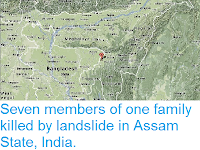
Twenty three people have died in flooding in northeastern India since the Southwest Monsoon arrived in the area five days ago. Twelve of the deaths occurred in the state of Assam, where five people died on Sunday 17 June alone, with the remaining deaths occurring in Manipur, and severe flooding also reported in Tripura, and Mizoram. Thousands of people across the region have been forced to abandon homes and farms in the region, and it in addition to the Human casualties, large numbers of livestock have died.

Floodwaters in Assam this week. Anuwar Hazarika/Reuters.
Monsoons
are tropical sea breezes triggered by heating of the land during the
warmer part of the year (summer). Both the land and sea are warmed by
the Sun, but the land has a lower ability to absorb heat, radiating it
back so that the air above landmasses becomes significantly warmer than
that over the sea, causing the air above the land to rise and drawing in
water from over the sea; since this has also been warmed it carries a
high evaporated water content, and brings with it heavy rainfall. In the
tropical dry season the situation is reversed, as the air over the land
cools more rapidly with the seasons, leading to warmer air over the
sea, and thus breezes moving from the shore to the sea (where air is
rising more rapidly) and a drying of the climate.

Diagrammatic representation of wind and rainfall patterns in a tropical monsoon climate. Geosciences/University of Arizona.
Much of Southeast Asia has two distinct Monsoon Seasons, with a Northeast Monsoon driven
by winds from the South China Sea that lasts from November to February
and a Southwest Monsoon driven by winds from the southern Indian Ocean from March to October. Such a double Monsoon Season is common
close
to the equator, where the Sun is highest overhead around the equinoxes
and lowest on the horizons around the solstices, making the solstices
the coolest part of the year and the equinoxes the hottest. However northeast India is largely protected from the Northeast Monsoon by the mountains to its north and east, though these can also add to the severity of flooding in the region, with melting snow in the Himalayas swelling the rivers that flow through these states,

The winds that drive the Northeast and Southwest Monsoons in Southeast Asia. Mynewshub.
See also...


Follow Sciency Thoughts on Facebook.


