Showing posts with label Mites. Show all posts

Saturday, 24 August 2024

Using microfossils and pollen to determine the origin of a set of stocks in the collection of the Rijksmuseum, Amsterdam.

In 2019 a man donated a set of stocks to the Rijksmuseum in Amsterdam, which he claimed his  grandfather had acquired in the  1970s from a farm in Zeeland Province.  The museum put the stocks on display in 2021, as part of an exhibition about the Dutch colony in Brazil between 1630 and 1654. In 2023, the stocks were loaned to the United Nations in New York, where they formed part of an exhibition about slavery in Dutch colonies. However, during the New York exhibition, questions were raised as to whether the stocks had ever actually been to South America. A radiocarbon analysis suggested that the tree from which the stocks had been made was probably felled in about 1800, with the stocks probably being made in the first quarter of the nineteenth century. Furthermore, DNA testing established that the wood came from a lineage of Oak trees, which today is found growing in Europe between northern Spain in in the south and southern Scandinavia in the north. 

In a paper published in the journal Review of Palaeobotany and Palynology on 10 August 2024, Hans Piena of the Vrije Universiteit Amsterdam, the Dutch Open Air Museum, and the Royal Netherlands Historical Society, Bas van Geel of the University of Amsterdam, Tom Hakbijl of the Naturalis Biodiversity Center, Arie Kalis of Goethe University, Pim van der Knaap and Jacqueline van Leeuwen, also of the University of Amsterdam, and Kees Nooren of Utrecht University, describe the results of a study which looked at palynological evidence (preserved pollen and spores) to develop a forensic picture of the environment in which the stocks had been used.

Oak stocks in the collection of the Rijksmuseum in Amsterdam (Inv.nr. NG.2019–502). Measurements: 265 × 37.5 × 23 cm. Piena et al. (2024).

Sediment was extracted from holes and cracks in the stocks, and analysed for palynomorphs (pollen, algae and spores), and the surface of the stocks were analysed for surface wear and other traces of use.

The stocks comprise two oak beams resting on a pair of cross-braces. Each beam has nine semicircular openings, which correspond to similar openings on the other beam, with the pair making a hole. on the other beam. At one end of the beams is an iron hinge, at the other an obliquely worn padlock eye. The insides of the holes have been smoothed to a shiny surface, suggesting that the stocks were used frequently. The upper surface of the beams are also smooth, having apparently been rubbed frequently with sand; cracks and small holes on this surface were filled with sediment. There are also a large number of chopping and cutting marks on the upper surface, in places forming a chequerboard pattern. The underside shows no signs of similar wear or sanding, and is largely free of sediment. 

The two cross-braces yielded traces of attacks by Fungi and Woodworm, which are not seen on the beams, and are interpreted by Piena et al. as feet upon which the stocks sat. They were previously interpreted as side braces in the two slavery exhibitions, which would have led to the stocks being horizontal, holding prisoners seated on the floor. Under Piena et al.'s interpretation, the holes would have been vertical, forcing anyone  trapped in the stocks to stand.

The number '22' has been written on the upper surface of the stocks in blue chalk. The fact that this has not been rubbed of strongly suggests that it was written after the stocks ceased being used, possibly as part of an inventory process or auction sale. Before the twentieth century, chalk could be produced in few colours other than white, but blue is one of those colours, making it possible the number was written in the nineteenth century. 

The contents of a sediment-filled hole on the upper surface of the stocks were analysed for siliceous microfossils. This produced about 500 000 Diatoms per gram of sediment, with fifty different species identified. These were largely indicative of a mesotrophic freshwater environment, such as a slow-flowing stream or ditch.  This included the epiphytic Diatom Cocconeis placentula, which grows on the surface of aquatic Plants or Macroalgae. No marine or brackish water species were found. Phytoliths (opaline silica crystals which build up in the leaves of Plants as dissolved monosillicic acid taken up with groundwater and precipitated out as water is lost from the leaves via transpiration) associated with Grasses were found, but none associated with Palms. Also present in great numbers were the stomatocysts of Chrysophytes (Golden-brown Algae), which are also typical of freshwater environments, with about 460 000 stomatocysts per gram of sediment. Also present were samples of the freshwater Alga Spirogyra and pollen of the freshwater Plant Myriophyllum alterniflorum. All of these species are indicative of freshwater ecosystems, but otherwise fairly cosmopolitan, and can be found in tropical and temperate environments.

Samples of pollen and spores were extracted from eight different cracks and holes on the surface of the stocks, with five samples being extracted from one large hole. A total of 7106 individual specimens were found, including 142 taxa of spores and pollen, from 18 trees, 21 shrubs, 91 herbs, 5 Ferns, and 7 types of Fungi, Algae, and Moss. This high proportion of herb pollen is likely to be indicative of an open agricultural environment, probably with low nutrient levels. This contained only a small proportion of Chenopodiaceaetype and Plantago maritima-type pollen, making a salt marsh environment unlikely. Many of the pollen types are cosmopolitan in distribution, but others, including Armeria, Cistaceae, Erica arborea, Lavandula, Nerium oleander, Olea, Pinus pinaster, Quercus ilex, Urtica pilulifera, Eryngium tenue, Corrigiola telephiifolia, and Vitis vinifera, are typical of the Mediterranean region, while others, including Erica australis, Erica umbellata, Cistus albidus, Cistus populifolius, Cistus ladanifer, and Halimium halimifolium, are found only on the western Iberian Peninsula and in western North Africa. Notably, the pollen of Cedrus and Chamaerops, which are more-or-less ubiquitous in recent North African sediments, were absent. 

Many pollen samples from cereal species showed signs of heat-deformation, something which has previously been observed in samples from medieval cesspits, and which is thought to be associated with bread or porridge-making.

The stocks also show signs of Insect damage in places, and yielded some Insect samples. The Insect damage comes in two forms. The first of these is wide flat tunnelling in the cambium layer, which would have underlain the bark, and which is caused by the larvae of Buprestid or Cerambycid Beetles. The second form of damage is a series of small boreholes likely to have been caused by Anobium punctatum, a small boring Beetle commonly associated with wooden beams and objects in Europe, which favours humid indoor environments. The Insect remains found belong to Ptinus fur or Ptinus clavipes, Adistemia watsoni, Latridius minutus, and two unidentified members of the Corticariinae. Adistemia watsoni is a species native to South America, but which had spread to Europe by the nineteenth century. The Spider Beetles, Ptinus fur and Ptinus clavipes, are typically found in indoor settings, feeding on Human food or other Pland and Animal remains. A small Mite belonging to the family Macrochelidae was also found. This assemblage has been found in other archaeological settings, and is considered typical of an indoor environment with mouldy food, litter and/or hay, and possibly excrement. 

The underside of one of the cross-braces, which is worn and shows traces of Fungal and Woodworm attack. Piena et al. (2024).

Artefacts will typically begin to assemble traces and small microparticles of biological origin from the moment when they are made, enabling researchers to build up a life history of  objects of interest. Examination of the assemblage associated with the Rijksmuseum stocks showed no evidence of these ever having visited South America, despite earlier interpretations.

A prior DNA analysis of the wood suggests that the stocks were made from a tree which probably grew somewhere between northern Spain and southern Scandinavia, and it seems unlikely that it was transported for any great distance before being worked. This is because only wood with a high market value is typically shipped for any great distance, which effectively means wood with a straight grain and few knots. The wood from which the stocks are made has an irregular grain pattern and is somewhat knotty, which would generally only be used if the desired task required wood to be sourced locally. The stocks also show signs of having been worked using techniques typical for green wood usage, which again makes it highly unlikely that the wood was transported any distance before being used.

The style of the stocks, with holes on top forcing the prisoner(s) to stand is unusual, but is known to have been used widely on the Iberian Peninsula during the early nineteenth century, leading Piena et al. to conclude that the stocks are likely to be of Iberian origin.

The samples collected can be expected to have started to accumulate as soon as the stocks were  made, and to have continued to accumulate throughout their existence. Samples were taken from locations all over the stocks, and in one in one location, a hole, a succession of samples were taken from different depths. Despite this, other than samples from the lower side being dusty and samples from the upper side being sandy, there was remarkably little difference in the samples, suggesting that the stocks spent much of their lives in a single environment. 

The pollen samples collected from the stocks suggest that this environment was in western Iberia, while the DNA collected from the wood suggests that it grew no  further south than northern Iberia, which is at least a neighbouring region. 

The Insects collected from the stocks suggest a humid, indoor environment, while the presence of cereal pollen, and good preservation of the Diatoms and pollen suggest that the sediment in which they were preserved did was not exposed to moisture for long periods.

Based upon this evidence, Piena et al. consider two separate scenarios, which could account for the accumulation of microfossils seen on the stocks. 

It is possible that the entire assemblage is post-use, representing a time when the stocks had been abandoned in a slow-moving stream or ditch, in an open agricultural environment with poor soils and intensive Rye cultivation, an environment typical of the Iberian Peninsula in the nineteenth century. This scenario is supported by the good preservation of pollen and Diatoms, the type of sediment found, and the low number of Fungal spores, but contradicted by the presence of sediment only on the upper side of the stocks, not on the underside or in the cavities between the beams and cross-braces. 

Alternatively, the large amount of pollen from wild Grasses and Cereals, particularly Rye, makes it possible that the stocks were used in an indoor environment where Grass and Rye straw were used as litter. This is supported by the types of spores present, which are all from species associated with decaying Plant matter or Animal dung (including Human). This is consistent with the idea that the stocks were used in a humid, indoor environment. The presence of Fungal and Woodworm damage to the underside of the stocks would be consistent with them sitting on a moist floor covered with a litter of straw and hay, possibly in a stable or dungeon (with the latter being more likely, given the presumed purpose of the stocks). Thus the deformed Cereal pollen could have come from bread or porridge fed to prisoners, or their faeces if they were forced to produce this while trapped in the stocks, and the sand in the cracks on the upper surface would be consistent with frequent scrubbing of this surface. 

Historically, most stocks around the world were positioned on their sides, with prisoners thus able to lie down. The Rijksmuseum stocks, however, are of a far rarer design, which held the prisoner in an upright position, forcing them to stand upright. Such stocks were often ued in conjunction with a neck brace on a wall, so that prisoners could be held upright and restrained. This was once common in Spanish prisons, providing a likely origin for the stocks. Notably, such stocks were particularly common during the Peninsula War of 1807-1814 and the Spanish War of Independence of 1814-1823, both wars which were noted for numerous attocities. In other settings, however, stocks of this type were combined with a latrine bench with holes, with prisoners being held in a sitting position.

Por liberal?, 1814–1823, by Francisco de Goya y Lucientes, showing a  woman trapped in a horizontal type of stocks. Piena et al. (2024).

When obtained, little was known about the set of stocks present in the collection of the Rijksmuseum. They were identified as having (recently) come from Zeeland, and were considered appropriate for an exhibition about the Dutch colony in Brazil between 1630 and 1658. Subsequent investigations have suggested that they were most likely made in Europe around 1800, and never taken to South America. Subsequent investigations by Piena et al. have narrowed the likely point of origin to the western Iberian Peninsula, and suggest that they were used in a moist indoor environment, most likely a dungeon.

See also...

Saturday, 4 June 2022

Ameronothrus retweet: A second species of Japanese Marine-associated Oribatid Mite discovered on Twitter.

Most Arachnids are associated with terrestrial or freshwater ecosystems (Sea Spiders, Pycnogonida, and Horseshoe Crabs, Xiphosura, are generally viewed as Chelicerate Arthropods closely related to, but outside the Arachnida), although some species have colonised inter-tidal zones, notably the Marine Spider, Desis marina, of New Zealand, and a variety of Oribatid Mites from the Superfamily Ameronothriodae. 

Four separate families of Ameronothriod Mites are considered to have colonised the inter-tidal zones, the Fortuyniidae and Selenoribatidae, which are found in tropical and subtropical zones, the Podacaridae, found in the southern temperate and polar zones, and the Ameronothridae, found in northern temperate and polar zones, although some experts consider the Ameronothridae and Podacaridae should be treated as a single family.

The Ameronothridae as it is currently defined comprises a single genus, Ameronothrus, which currently contains 14 valid species, the most recently identified of which Ameronothrus twitter, was described in 2021 after pictures of an unknown Mite from the inter-tidal zone of the Chiba Peninsula on Honshu Island, Japan, were posted on the social media platform Twitter.

In a paper published in the International Journal of Aracology on 19 May 2022, Tobias Pfingstl of the Department for Biodiversity and Evolution at the University of Graz, Shimpei Hiruta of the Center for Molecular Biodiversity Research at the National Museum of Nature and Science, Iris Bardel-Kahr, also of the Department for Biodiversity and Evolution at the University of Graz, Yuito Obae of the Graduate School of Sustainability Science at Tottori University, and Satoshi Shimano of the Science Research Center at Hosei University, describe a new species of Ameronothrus discovered as a result of the discovery of Ameronothrus twitter being discussed on the social media platform after which it was named.

The new species is named Ameronothrus retweet, due to the way in which it was discovered, on the basis of photographs posted in response to a tweet (Twitter post) announcing the discovery of Ameronothrus twitter. The photographs were taken by Yuito Obae of of some mites he discovered on Iwado Rock Beach on the Japan Sea (north) coast of Honshu, which he thought might be another population of Ameronothrus twitter, but were subsequently recognised as another new species.

Specimens of Ameronothrus retweet range from 641 to 859 µm in length, and are dark brown or black in colour, with a densely granulated cuticle, the granules being larger on the lateral sides of the body. As with other Ameronothriod Mites, Ameronothrus retweet appears to feed on Algae, Fungi, or Lichen found in the inter-tidal zone.

Photographs of male (upper row) and female (lower row) Ameronothrus retweet specimens in dorsal (left side) and ventral view (right side). Pfingstl et al. (2022).

Unusually for an Oribatid Mite, Ameronothrus retweet shows sexual dimorphism, with the females showing strongly folded gastronotic integument and considerably shorter epimeral, genital, and aggenital setae than seen in the males. While sexual dimorphism has not previously been recorded in an Ameronothriod Mite, it has been recorded in a number of other Oribatid Mite species associated with aquatic or intermittently wet environments, so the presence of such a trait in a species of Ameronothrus should not be seen as a complete surprise. The purpose of sexual dimorphism in Oribatid Mites found in aquatic environments remains unknown, although increasing the number of species in which this is known may help to solve this mystery.

See also...

Follow Sciency Thoughts on Facebook.

Follow Sciency Thoughts on Twitter. 


Wednesday, 26 January 2022

Ivoria alourouai: A new species of Uropodinid Mite from Côte d'Ivoire.

Uropodinid Mites are small, soil-dwelling Arachnids which predate Nematodes and other small Invertebrates. They are global in distribution, and play a major role in many soil ecosystems. These Mites are thought to be particularly important in the soils of tropical rainforests, but little work has been dedicated to the study of tropical Uropodinids, for example only nine species have been described from Côte d'Ivoire in the forest belt of West Africa.

In a paper published in the journal ZooKeys on 18 January 2022, Jenő Kontschán of the Plant Protection Institute at the Hungarian Centre for Agricultural Research, and Sergey Ermilov of the Institute of Environmental and Agricultural Biology at Tyumen State University, describe a new species of Uropodinid Mite from the Taï National Park of Côte d'Ivoire.

The new species is placed within the genus Ivoria, which currently contains only a single species, Ivoria taiensis, which itself was desctibed by Jenő Kontschán in 2019, and given the specific name alourouai, in reference to Alouroua the mythical creator of the Akan (Baoule) people who are the largest cultural group of the Ivory Coast. Both species are described upon the basis of single female specimens found within soil samples collected from the Taï National Park, and stored at the Natural History Museum of Geneva.

 
Ivoria alourouas, female, holotype, dorsal view. Kontschán & Ermilov (2022).

Both species of Ivoria share a number of features, notably a domed Idiosoma (region that bears the legs, the genital and anal openings, and an assortment of tactile and sensory structures), fusion of the marginal and dorsal shields at the anterior (front), five pairs of sternal setae (hairs), a subtriangular female genital plate, a tritosternum (bristle-like sensory organ just behind the gnathosoma) with a vase-like base, and a laciniae (narrow lobe on the maxila) subdivided into two pairs of short lateral and one pair of long central branches.

 
Photographs of Ivoria alouroua, female, holotype. (a) dorsal view (b) latero-dorsal view (c) ventral view (d) latero-ventral view. Kontschán & Ermilov (2022).

Ivoria alourouai differs from Ivoria taiensis in that the elevated areas on the dorsal surface are surrounded by soft fur-like setae, whereas in Ivoria taiensis these areas are more leaf-shaped and have serrated areas. In Ivoria alourouai the middle-back part of the marginal shield is separated and quadrangular, whereas that of Ivoria taiensis is more integrated with the whole, but has two distinct incisions not seen in Ivoria alourouai. The setae on the dorsal surface of Ivoria alourouai are long and soft, those of Ivoria taiensis shorter and smoother. Ivoria taiensis also has needle-like setae on its underside, which are absent in Ivoria alourouai. Ivoria alourouai has oval pits on its ventral shield, which are absent in Ivoria taiensis,

See also...


Follow Sciency Thoughts on Facebook.

Follow Sciency Thoughts on Twitter.


Friday, 10 May 2019

Mesoshieldophyes varecae: A new species of Eriophyoid Mite from Darjeeling.

Mites (Acari) are small Arachnids related to Harvestmen (Opilones). They are one of the most numerous and diverse Arthropod groups, with over 48 000 known species, but are often overlooked due to their small size. Many Mites are parasitic, with species targeting Insects, Vertebrates, Plants and even Fungi. The earliest known fossil Mites are found in the Early Devonian Rhynie Chert of Scotland, making them about 410 million years old. The Eriophyoidea are a group of herbivorous mites, many Eriophyoid Mites cause plants to form galls (tissue growths which cover and protect the parasite), but others are free living. All Eriophyoid Mites show reduced leg numbers, with free living species having at most two pairs of legs, and gall-forming species only one. Like Mites as a whole, the Eriophyoidea is an ancient group, with the oldest known example coming from Late Triassic amber from Italy.

In a paper published in the journal ZooKeys on 9 May 2019, Samiran Chakrabarti of the Post-Graduate Department of Zoology at Vidyasagar College, Ramkrishna Pandit of the Department of Zoology at Mahadevananda Mahavidyalaya, and Surajit Sur, also of the Post-Graduate Department of Zoology at Vidyasagar College, describe a new species of Eriophyoid Mite from West Bengal State, India.

The new species is named Mesoshieldophyes varecae, where 'Mesoshieldophyes' meaning 'medium-shield-wool-grower' and 'varecae' refers to the host, the Asamese Honey-plant, Casearia vareca, a fruiting shrub in the Willow Family, widely distributed in eastern India, Bangladeah, Bhutan, and Myanmar. The species is described from 12 female mites, 120–145 μm in length, with a flattened spindle shape and two pairs of legs. The mites are yellow in colour and were found on the underside of leaves, where they caused no visible damage. The specimens were collected from a plant in the Bengdubi Forest in the Darjeeling District of West Bengal.

Mesoshieldophyes varecae, dorsal view. Chakrabarti et al. (2019).

See also...

https://sciencythoughts.blogspot.com/2018/06/macrocheles-kekensis-new-species-of.htmlhttps://sciencythoughts.blogspot.com/2018/01/yoshiobodes-camerunensis-rugocepheus.html
https://sciencythoughts.blogspot.com/2016/11/porttrombidium-gedanense-mite-from.htmlhttps://sciencythoughts.blogspot.com/2016/08/aulonastus-similis-new-species-of-quill.html
https://sciencythoughts.blogspot.com/2016/05/laelaspis-natanziensis-new-species-of.htmlhttps://sciencythoughts.blogspot.com/2015/01/a-new-species-of-ixodid-tick-from.html
Follow Sciency Thoughts on Facebook.

Saturday, 30 June 2018

Macrocheles kekensis: A new species of Macrochelid Mite from Hungary.

Macrochelid Mites are large, soil dwelling Mites in the Order Parasitiformes, which are usually predatory rather than parasitic in nature, feeding on Insects or other Mites, though some species are found in association with Beetles or Flies.

In a paper published in the journal ZooKeys on 19 June 2018, Jenő Kontschán of the Plant Protection Institute of the Hungarian Academy of Sciences describes a new species of Macrochelid Mite from Szabolcs-Szatmár-Bereg County in eastern Hungary.

The new species is placed in the genus Macrocheles and given the specific name kekensis, meaning 'from Kék' the village where the specimens from which the species is described were discovered. The species is described from three female specimens, collected from a Scarab Beetle, Hoplia hungarica. These range from 440 μm to 460 μm in length and from 280 μm to 310 μm in width, and are oblong in shape with a reticulate pattern (pattern resembling a network) on their carapaces and a covering of fine hairs.

Macrocheles kekensis, female. (1) Dorsal view of body. (2) Ventral view of body (without legs and gnathosoma, only the coxae illustrated). Kontschán (2018).

See also...

http://sciencythoughts.blogspot.com/2018/01/yoshiobodes-camerunensis-rugocepheus.htmlhttp://sciencythoughts.blogspot.co.uk/2016/11/porttrombidium-gedanense-mite-from.html
http://sciencythoughts.blogspot.co.uk/2016/08/aulonastus-similis-new-species-of-quill.htmlhttp://sciencythoughts.blogspot.co.uk/2016/05/laelaspis-natanziensis-new-species-of.html
http://sciencythoughts.blogspot.co.uk/2015/01/a-new-species-of-ixodid-tick-from.htmlhttp://sciencythoughts.blogspot.com/2018/01/yoshiobodes-camerunensis-rugocepheus.html
Follow Sciency Thoughts on Facebook.

Saturday, 6 January 2018

Yoshiobodes camerunensis & Rugocepheus costaricensis: Two new species of Moss Mites from Cameroon and Costa Rica.

Moss Mites, Oribatida, are tiny (0.2 to 1.4) Chewing Mites, with slow growth,  long adult lives and low reproductive rate. They van be herbivores, fungivores, detritivores or carnivores, but there are no know parasitic species.

In a paper published in the journal ZooKeys on 4 October 2017, Nestor Fernandez of the Subtropical Biological Research Institute of the National Council of Scientific and Technological Research of Argentina and the Research Unit for Environmental Sciences and Management at North-West University, Pieter Theron, also of the Research Unit for Environmental Sciences and Management at North-West University, Sergio Leiva of the Experimental Rural Agency of the National Institute of Agricultural Technology in Argentina, and Louwrens Tiedt of the Laboratory for Electron-Microscopy at North-West University, describe two new species of Moss Mites, from Cameroon and Costa Rica.

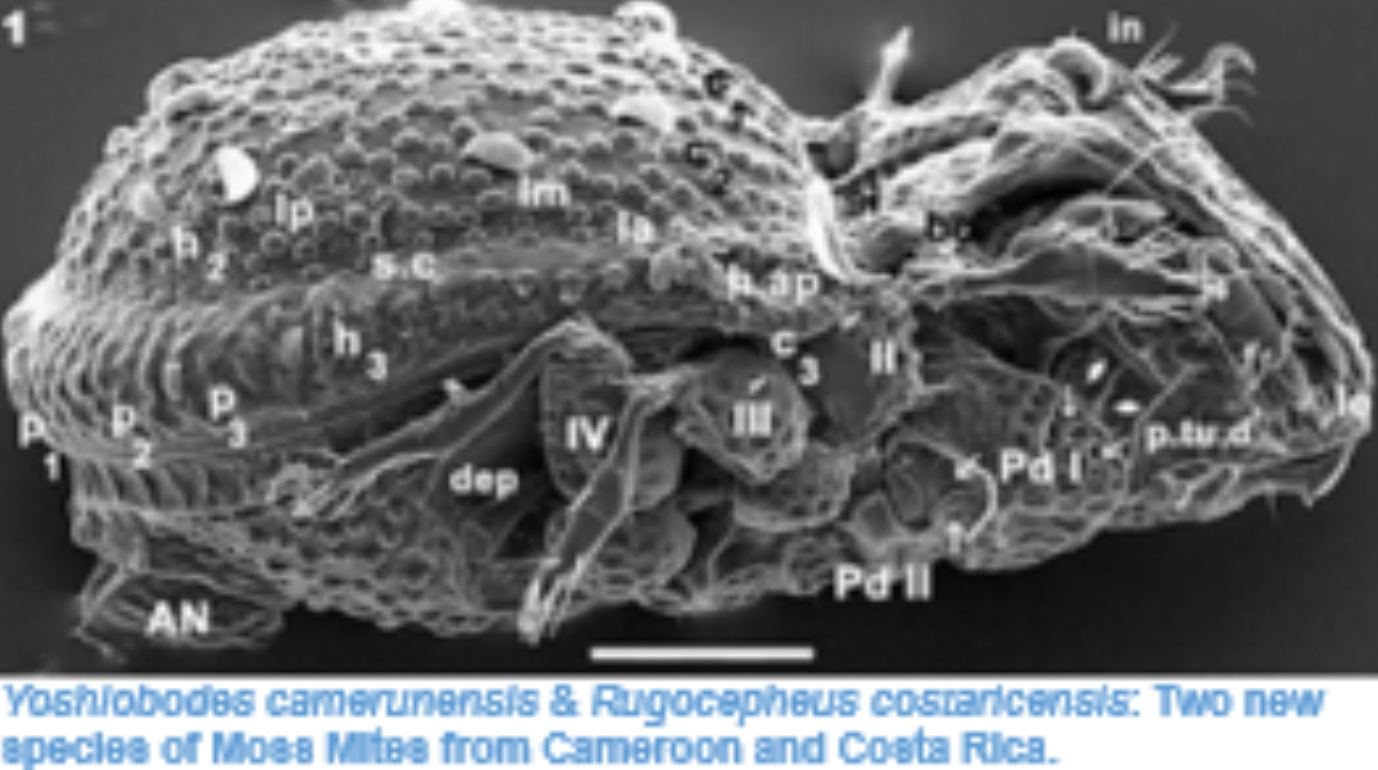
The first new species is placed in the genus Yoshiobodes, which is known from tropical regions around the world but has not previously been recorded in Africa, and given the specific name camerunensis, meaning 'from Cameroon'. The species is described from three female specimens collected from rotten wood and litter on Mount Kala in Central Province, Cameroon, at an altitude of between 800 and 850 m. These are between 296 and 312 μm in length, and light brown in colour, with a surface microsculpture of irregular polygons.

Yoshiobodes camerunensis. Adult female, with cerotegumental layer. Scale bars is 50 μm. Fernandez et al. (2017).

The second new species is placed in the genus Rugocepheus, which has previously only been described from Africa, and given the specific name costaricensis, meaning 'from Costa Rica'. The species is described from three female specimens collected from soil beside an Ant's nest under a Panama Rubber Tree at an altitude of about 570 m on Mount Turrialba in Costa Rica. These range from 489 to 515 mm in length, and are brown in colour, with a microsculpture of tubercules covering the body.

Rugocepheus costaricensis. Adult female in dorsal view. Scale bar is 100 μm. Fernandez et al. (2017).

See also...
http://sciencythoughts.blogspot.co.uk/2016/11/porttrombidium-gedanense-mite-from.htmlhttp://sciencythoughts.blogspot.co.uk/2016/08/aulonastus-similis-new-species-of-quill.html
http://sciencythoughts.blogspot.co.uk/2016/05/laelaspis-natanziensis-new-species-of.htmlhttp://sciencythoughts.blogspot.co.uk/2015/01/a-new-species-of-ixodid-tick-from.html
http://sciencythoughts.blogspot.co.uk/2014/03/a-new-species-of-gall-mite-from-tripura.htmlhttp://sciencythoughts.blogspot.co.uk/2013/12/a-new-species-of-feather-mite-from.html
Follow Sciency Thoughts on Facebook.

Monday, 28 November 2016

Porttrombidium gedanense: A Mite from Baltic Amber.

Baltic amber is the preserved resin of Eocene coniferous trees that formed huge forests covering much of Scandinavia and Northern Europe. This amber is noted for the production of large numbers of Arthropod fossils, particularly Insects and Arachnids. After the True Flies (Diptera), Mites (Acari) are thought to be the second most abundant group in this amber, making up about 20% all preserved animals, though they are relatively understudied with many undescribed specimens residing in collections.

In a paper published in the journal PalZ on 30 May 2016, Marta Konikiewicz of the Department of Invertebrate Systematics and Ecology at Wroclaw University of Environmental and Life Sciences, Elżbieta Sontag of the Museum of Amber Inclusions at the University of Gdańsk and Joanna Mąkol, also of the Department of Invertebrate Systematics and Ecology at Wroclaw University of Environmental and Life Sciences, describe a new species of Mite from Baltic amber from the Gulf of Gdańsk.

The new species is placed in the genus Porttrombidium, and given the specific name gedanense, meaning 'from Gdańsk'. It is described from a single, juvenile specimen.

Porttrombidium gedanense, juvenile specimen. Konikiewicz et al. (2016).

See also...

http://sciencythoughts.blogspot.co.uk/2016/05/laelaspis-natanziensis-new-species-of.html
http://sciencythoughts.blogspot.co.uk/2016/08/aulonastus-similis-new-species-of-quill.html

http://sciencythoughts.blogspot.co.uk/2014/03/a-new-species-of-gall-mite-from-tripura.html
http://sciencythoughts.blogspot.co.uk/2015/01/a-new-species-of-ixodid-tick-from.html
http://sciencythoughts.blogspot.co.uk/2013/12/a-new-species-of-feather-mite-from.html

Follow Sciency Thoughts on Facebook.