
Pangolins, Pholidota, are hunted across their ranges in African and Asian countries. African Pangolins are hunted and consumed in sub‐Saharan Africa, where they are harvested for meat and openly sold on wild meat markets, and their scales used in a variety of traditional medicines, and cultural and spiritual activities. In Asia, high hunting pressure has led to substantial declines in Asian Pangolin, Manis sp., species populations, such as the Chinese Pangolin, Manis pentadactyla, and Sunda Pangolin, Manis javanica. As such African Pangolins, Phataginus spp. and Smutsia spp., have been increasingly targeted and trafficked for their scales (and occasionally meat) to supply the markets in Asia over the past two decades. All four species of African Pangolins are listed on Appendix I of the Convention on International Trade in Endangered Species (CITES), banning the international, commercial trade of wild‐caught pangolins. All species of African pangolins are considered to be threatened with extinction on the International Union for the Conservation of Nature's Red List of Threatened Species based on past, current and future population declines largely due to hunting for the international market and local use. African Pangolins are known to have been trafficked through 27 countries in Africa to meet international demands, although the countries from which the Pangolins were originally taken are often difficult to ascertain. Information on Pangolins in South Sudan is scarce, despite three species, the Giant Pangolin, Smutsia gigantea, the White‐bellied Pangolin, Phataginus tricuspis, and Temminck's Ground Pangolin, Smutsia temminckii, being present. Pangolin seizures were reported from all countries bordering South Sudan (Central African Republic, Democratic Republic of Congo, Ethiopia, Kenya and Uganda), apart from Sudan, between 2010 and 2015, but not from South Sudan, although it was unclear if this was due to a lack of trafficking or a lack of reporting.
In a paper published in the African Journal of Ecology on 12 July 2019, Daniel Ingram of the Centre for Biodiversity and Environment Research at University College London, and the Pangolin Specialist Group at the Zoological Society of London, Paul Peter Awol of the Wildlife Conservation Society in South Sudan, Khamis Adieng Ding of the South Sudan National Wildlife Service, and Albert Schenk, also of the Wildlife Conservation Society in South Sudan, make the first formal report of Pangolin trafficking in South Sudan.
Research in South Sudan has been hampered by past and present conflicts and political instability, which have led to an environment ripe for wildlife crime. South Sudan ranks 1st in the world on the Fund For Peace's Fragile States Index 2018 and joint second‐from‐last on Transparency International's Corruption Perceptions Index 2018. The conflict and political instability have resulted in weak governance, and South Sudan has been identified as a hub for the illegal trade in ivory. Previous studies have shown that South Sudan is being used as a route to transport ivory out of adjoining Garamba National Park in neighbouring Democratic Republic of Congo, where organised poaching and trafficking by armed non‐State actors occurs. In 2017 the Wildlife Conservation Society reported that due to the conflict in South Sudan, 'poaching and commercial wildlife trafficking are increasing, as well as illegal mining, timber harvesting and charcoal production'.
Between June 2016 and December 2018, 11 seizures totalling 622 kg ivory were made at Juba International Airport which remains a transit point out of the country. No anti‐trafficking activities were conducted at Juba airport prior to 2016, in which time a Canine (Sniffer Dog) Wildlife Anti‐trafficking Unit was established between the Wildlife Conservation Society and the South Sudan National Wildlife Service. Together as part of broader anti‐trafficking activities, these activities are assumed to have a substantially disruptive influence on trafficking networks. The largest recent seizure was in June 2016 when 512 kg of largely ivory, reportedly from mostly Tanzanian Elephants, was seized at Juba International Airport en route from Uganda to Malaysia. Wildlife is also trafficked illegally across the border with Uganda by road, and into Ethiopia and Sudan. In early 2019, customs officers in Uganda across the border with South Sudan seized thousands of Pangolin scales, along with 750 pieces of ivory hidden in hollowed logs, which led to the arrest of two Vietnamese traffickers. Kenya has also been shown as a transit country for Pangolins and ivory, where ivory has reportedly come from South Sudan.
Ingram et al. report seven seizures of Pangolins and their parts within South Sudan between January 2014 and May 2019.
On 14 January 2014 rangers of the Lantoto National Park confiscated two live Temminck's Ground Pangolins from a suspected bushmeat trafficker. The two animals later died, and the skins and the scales remained with the South Sudan National Wildlife Service.
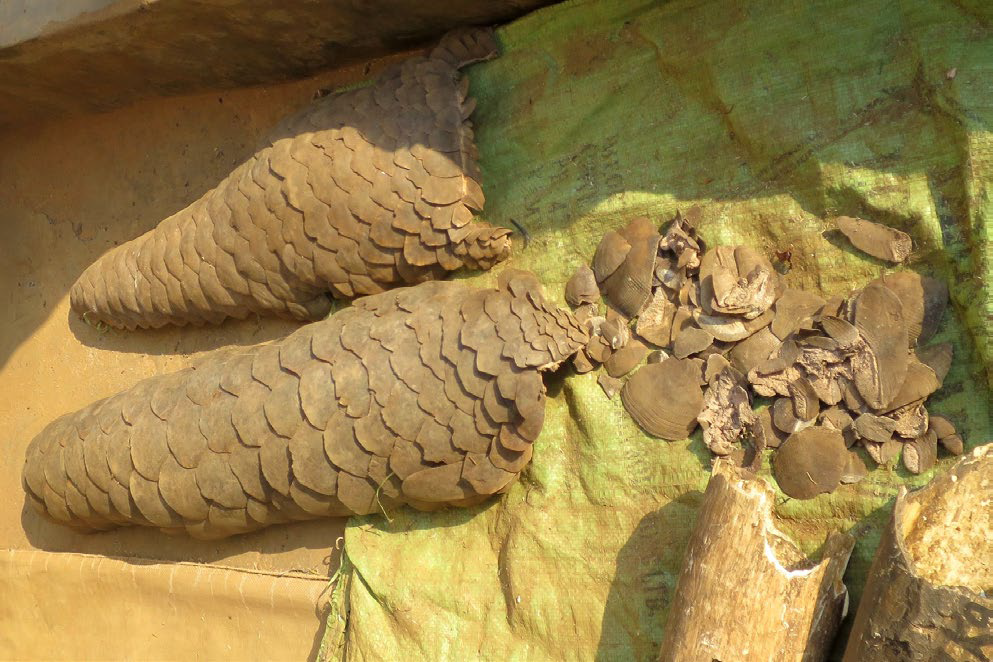
Skins and scales of two Temminck's Ground Pangolins, Smutsia temminckii, seized in the Lantoro National Park in January 2014. South Sudan National Wildlife Service and Wildlife Conservation Society in Ingram et al. (2019).
On the 25 May 2016, a sniffer dog unit detected 10 kg of frozen Pangolin meat in the luggage of a Chinese man at Juba International Airport. The Chinese man was travelling with the meat from Paloich Oil Field in northern South Sudan. where he was working as an oil engineer, to an unknown destination. The engineer only received a short detention period before he was released, highlighting that due to the 2013–2018 conflict in South Sudan, the judicial systems are extremely weak, and effective prosecution of suspects, including wildlife crime suspects, remains a big challenge. The signing of the peace agreement between the Government and warring groups in September 2018 provides a potential new opportunity towards the return of the rule of law and the re‐establishment of legal systems.

Ten kilograms of frozen pangolin meat (from two Pangolins, heads and claws removed) seized at Juba International Airport in May 2016. Species unknown. South Sudan National Wildlife Service and Wildlife Conservation Society in Ingram et al. (2019).
On 15 June 2016, the canine anti‐trafficking sniffer dog unit of the South Sudan Wildlife Service and the Wildlife Conservation Society led a joint operation that resulted in the confiscation of Pangolin meat at a hotel in Juba.
In March 2018, several rings made from Pangolin scales (together with rings made of Tortoise shell and Cow horn) were confiscated at a market in Juba, although it is not known from which species they come from or when the scales were harvested. In addition to widespread appreciation for the specific taste of Pangolin, in certain parts of South Sudan, Pangolin scales are also believed to bring luck and provide protection against poisons and witchcraft.

Rings made from Pangolin scales (dark colour) mixed with rings made from Tortoise scales and Cow horn confiscated at a market in Juba in June 2016. South Sudan National Wildlife Service and Wildlife Conservation Society in Ingram et al. (2019).
Three seizures involving pangolins have been made between January and May 2019. In January, information from community members in a refugee camp was used to successfully identify an individual at the Jebel checkpoint who was carrying a bag of Pangolin scales and was travelling to Juba. The individual ran away before authorities could arrest him and left behind the scales. In May 2019, one dead Pangolin was confiscated in Juba on the 5th, and three live Pangolins (two adults and one juvenile) were confiscated in Juba on the 8th, all are Temminck's Ground Pangolins coming from the Southern National Park area in western South Sudan.
In 2012, a licence was issued by the authorities of Central Equatoria State in South Sudan to a Chinese entity to start operating a Pangolin farm in Juba. Obtaining further details on the circumstances of the issuing of this licence was difficult; however, the licence is not endorsed by the current administration of the South Sudan Ministry of Wildlife Conservation and Tourism, given suspicions that the farm might be(come) a cover for trafficking wild Pangolins. The farm is not operational, and no export permits are given or will be given by the Ministry for the export of Pangolin products.
The 2013-18 conflict in South Sudan made effective monitoring of the enforcement of wildlife trafficking more-or-less impossible. Despite the national and international trade for commercial purposes being banned, illegal trade in Pangolins, and their parts and derivatives, continues to take place. Other than links into Juba, including to Juba International Airport, which show that trafficking of Pangolin parts is being attempted, Ingram et al. do not know the exact trade routes through South Sudan though it is reasonable to assume that Pangolin products are also trafficked, like other wildlife products, by road across the borders with Uganda, Democratic Republic of Congo, Ethiopia and other neighbouring countries due to limited and, at certain locations, nonexistent border control. Furthermore, the link to an Asian industry worker in South Sudan is the cause for concern and follows a similar finding in Gabon. It is likely that volumes of Pangolin trafficking in South Sudan are higher than currently known, which warrants monitoring of both the current state of trafficking and pangolin populations going forward. Ingram et al. that enforcement agencies, technical partners and funding partners work together on concerted efforts to monitor and address wildlife trafficking in South Sudan.
See also...
See also...

Follow Sciency Thoughts on Facebook.


