Showing posts with label Pangolins. Show all posts

Friday, 3 July 2026

Manis pentadactyla: The Chinese Pangolin confirmed to be living in Pakyong District, Sikkim.

Pangolins are solitary, nocturnal, and generally cryptic Mammals, found across Africa and Asia. They feed on Ants and Termites, and have a covering of scales, made from fused hairs, which are their main defence against predators, rolling into a ball with these forming the outer covering. There are eight recognised species of Pangolin, four in Africa and four in Asia, two of which are listed as Vulnerable under the terms of the International Union for the Conservation of Nature's Red List of Threatened Species, three as Endangered, and three as Critically Endangered. One of these Critically Endangered species is the Chinese Pangolin, Manis pentadactyla, which is found across parts of Nepal, Bhutan, northern India, Bangladesh, Myanmar, China, and Taiwan. In India it is known to be present in Arunachal Pradesh, Meghalaya, Nagaland, Manipur, Tripura, Mizoram, and Assam, with occasional reports of its presence in Sikkim and West Bengal, although none of these have been confirmed.

In a paper published in the Journal of Threatened Taxa on 26 June 2026, Prashanti Pradhan of the Sikkim Alpine University, and the Assam Downtown University, Jampal Dorjee Bhutia, also of the Sikkim Alpine University, and Prem Kumar Chhetri and Bharat Kumar Pradhan of the Forest & Environment Department of the Government of Sikkim, document the first confirmed sighting of the Chinese Pangolin in Pakyong District, Sikkim, and provide photographic evidence to support this.

Pradhan et al.'s report is based upon a Pangolin which was found in Barapathing Village in Pakyong District on 31 March 2024. Barapathing Village is located at an altitude of between 1150 and 1700 m in an area where subtropical to temperate broad-leaved forests are being encroached upon by agricultural land and Human settlements, with anthropogenic pressures increasing due to the construction of the 717B National Highway, and associated infrastructure. 

The Pangolin was found by a local villager wandering within their backyard, and apparently lost and looking for food. The villager, who was unfamiliar with the species, attempted to drive the Pangolin away, though it was unperturbed by this, and apparently tolerant of Humans, potentially indicating that it had been living in a Human-dominated environment for some time. The Pangolin was eventually allowed to settle in a room, while the resident called the Barapathing Territorial Range Forest & Environment Department, who collected the Animal and relocated it to a subtropical forest downstream of the village.

Chinese Pangolin, Manis pentadactyla, inside the home of a villager in Barapathing, where it remained until the arrival of the rescue unit of the Barapathing Territorial Range Forest & Environment Department. Sangita Ruchal in Pradhan et al. (2026).

The rescued Animal was identified as a Chinese Pangolin, Manis pentodactyla, on the basis of its distinct morphological characteristics, such as overlapping keratinous scales, an elongated snout, and robust body form. The photographic evidence collected by Pradhan et al. constitutes evidence that this species is present in the Pakyong District of Sikkim. Local people were able to identify the Animal as a Pangolin using the Nepali word 'Saalak', but reported that they had never seen one so close to a Human habitation before.

The photographs and a description of the Animal were later sent to Vikram Aditya, the principal scientist at the Centre for Wildlife Studies in Bengaluru, Karnataka State, and a member of the International Union for the Conservation of Nature's Pangolin Specialist Group, who confirmed the diagnosis of this being a Chinese Pangolin.

The Chinese Pangolin after being rehabilitated into the forest. Prem Kumar Chettri in Pradhan et al. (2026).

Pangolins are threatened by habitat loss and fragmentation, driven by deforestation, forest fires, and road development, across their range. Sikkim has had one of the greatest expansions of its road network of any state in India during the last decade, with a major road upgrading project close to the village of Barapathing, which is likely to have contributed to both habitat destruction and a greater rate of Human encounters for Pangolins in the area. 

Animals can sometimes survive in altered landscapes by adapting their behaviour, however, this can lead them vulnerable to additional hazards, such as increased hunting. The hunting and trafficking of Pangolins is known to be a hazard for Pangolins in Sikkim, in 2021 a group of five people was arrested trying to smuggle a dead Pangolin from Sikkim into Bhutan, and when questioned they confessed the Animal had been killed in a wildlife sactuary in Sikkim. They also hinted at there being an international wildlife trafficking network operating across the eastern Himalayan region. 

Pradhan et al. suggest that there is an urgent need for a baseline ecological study on Chinese Pangolins in Sikkim, in order to better understand the threats linked to development-related habitat fragmentation, illegal hunting and transboundary trafficking, and to enable the development of a conservation plan for the species in the state, 

See also...

Saturday, 12 December 2020

Investigating the ilicit trade in Pangolin scales.

Pangolins are reclusive nocturnal creatures and the only Mammal wholly covered in scales. They remain elusive, with researchers having limited knowledge of their ecology, yet they are now arguably the most heavily trafficked wild Mammal in the world. There has been a sustained increase in seizures of the species since 2014. Due largely to their exploitation in illegal trade, all species of Pangolin were transferred from CITES Appendix II to Appendix I at the CITES Conference of the Parties in 2016.
 
In a report published in the annual United Nations Office of Drugs and Crime World Wildlife Crime Report on Trafficking in protected species for 2020, independent wildlife trade consultant João Salgueiro, and Daniel Stiles of the World Wildlife Crime Report Scientific Advisory Group and the Species Survival Commission of the International Union for the Conservation of Nature, present a report on the ilicit trade in Pangolins and Pangolin body parts.
 
 
Number of whole Pangolin equivalents seized and number of seizures annually, 2007-2018. Salgueiro & Stiles (2020).
 
There are eight species of Pangolin: four found in Asia and four found in Africa. They have traditionally been consumed in both regions, but only recently have the two markets met. 

Today, demand for Pangolins in Asia is being supplied by Pangolins from Africa. In both regions, Pangolins are killed for their meat and their scales, which have been used medicinally. Pangolin products have been used in traditional Chinese medicine for thousands of years to treat a wide range of ailments. The scales are said to promote blood circulation and increase lactation in pregnant women, while the meat is used as a tonic. They are also used as medicine in Africa. In Nigeria, for example, Pangolin parts are used to treat a wide range of physical and psychological conditions.

All eight species of Pangolins are believed to be in decline, but since exact population counts are unavailable, it is difficult to determine the conservation impact of the illegal trade. The sheer volume of seizures, though, suggests unsustainable harvesting, a hypothesis corroborated by hunters interviewed by the United Nations Office on Drugs and Crime in Uganda and Cameroon in 2018, who reported that Pangolins are becoming harder to find. 
 
Since 2014, there has been a 10-fold increase in the number of whole Pangolin equivalents seized globally. The inclusion of all Pangolin species in Appendix I in 2016 likely had some role in this trend, especially as it increased awareness, but there are several reasons why the listing is unlikely to be solely responsible for the increase: The increase started in 2015, two years before the listing took effect; the size of individual seizures has increased, alongside the increase in overall seizure quantity; and before the Appendix I listing, the amount of Pangolins seized was much larger than the legal trade, implying that the industries where Pangolins are used have long drawn on illegal sources.

Sizable shipments of whole (often live) Pangolins have been seized in Asia, but most of the largest recent seizures have involved Pangolin scales sourced from Africa. Prior to 2009, the international trade involved mostly Pangolin meat and scales, sourced in Asia. The reasons for the shift to African sources is unclear, but may be due to declining Asian populations. There have been very few seizures of Pangolin meat from Africa. The reasons for this are also unclear, but almost all the World WISE database Pangolin seizures coming from Africa have been comprised of scales. Most of the large African scale shipments originated in West and Central Africa where three out of the four African Pangolin species are found. Four Pangolin species are also found in Southeast, South and East Asia. Most of the trade for all species is destined for East and Southeast Asian countries. Before 2016, the largest seizures intercepted amounted to less than 10 000 live Pangolin equivalents. In 2019, all the three major seizures made by Singapore were equivalent to more than twice that number.

 
Shares of whole pangolin live equivalents seized globally by product type, 2007-2018. Salguiero & Stiles (2020).

In 2000, CITES Parties adopted a zero-export quota for wild-caught Asian Pangolins traded for primarily commercial purposes. The legal trade in African Pangolin species was rare until about 2014. Between 2013 to 2017 (when all Pangolin species were up-listed to Appendix I), the amount of Pangolin scales legally imported went from almost zero to nearly 13 tons, with four countries being responsible for the bulk of the shipments: Burundi, Democratic Republic of the Congo, Republic of the Congo, and Uganda. China was the importer of 99 per cent of this volume.

 
Kilograms of Pangolin scales legally traded, 2013-2017 (importer reported quantities). Salguiero & Stiles (2020).

Demand for pangolin meat persists, but it appears to be satisfied regionally. For example, Malaysian authorities raided two high-volume Pangolin meat facilities in February 2019, confiscating 29.8 tons of Pangolins in the form of live and frozen Animals, including frozen meat. Intercontinental meat seizures, though, remain rare, and the short range of trafficking may be one reason why meat seizures are not detected at the same level as scale seizures in recent years. Based on World WISE data, meat seizures represented 15 per cent of Pangolin seizures in 2015, compared to only 1-2 per cent of Pangolin seizures from 2016 to 2018. There were 4355 live Pangolin equivalents’ worth of meat seized in 2018, out of 187 256 live Pangolin equivalents seized overall that year.

There is some debate as to how much of the large increase in scale trafficking could be coming from stockpiles that existed prior to Pangolins’ CITES Appendix I listing, and therefore, how much poaching is taking place. Nineteen countries have declared Pangolin scale stockpiles to CITES. China reports regularly releasing these stockpiled scales for domestic use by designated hospitals and manufacturers of patented Chinese medicines. The volume of declared stockpiles in source and destination countries is far smaller than the tens of thousands of whole Pangolin equivalents seized over the past decade. It is therefore unlikely that leakage from declared government stockpiles contributes significantly to the illegal trade; most sourcing is likely coming from the wild and most from African source countries, and not from stockpiles.

The magnitude of the illegal trade, based on seizure records, suggests that this wild sourcing is unsustainable. Breeding of Pangolins in captivity at commercial scale is currently not possible. Highly specialised diets combined with extreme sensitivity to capture-induced stress mean that Pangolins fare poorly in captivity. Pangolins generally give birth to one cub at a time with gestation periods that range from about 65 to 370 days. Only a few births have been reported in captivity, with high infant mortality rates. At present, sourcing from captive-bred populations does not seem to be possible to meet demand and/or replace the wild population of Pangolins harvested by poachers.

Given that the scales from one Pangolin weigh anywhere between 0.36 to 3.60 kg, multi-ton seizures of scales represent far larger numbers of Pangolins killed than meat shipments of a similar weight. Estimates of how many Pangolins have been illegally traded in recent years are difficult to calculate given that: Sseizures represent only a small fraction of the animals killed; size and weight of scales vary between species; and incomplete seizure records that make it difficult to know what species was seized.

According to Pangolin hunters and traders interviewed by the United Nations Office on Drugs and Crime in Cameroon and Uganda, Giant Pangolins, Manis gigantea, are relatively rare. If each Pangolin killed for illegal trade in Africa produced an average of 500 grams of scales, the 185 tons of scales seized between 2014 and 2018 would represent about 370 000 Pangolin equivalents.

 
An African Giant Pangolin, Manis gigantea. Biodatabases.

In 2000, zero export quotas were established for Asian Pangolin species whose populations were seriously depleted from the skin and meat trade. These zero quotas may have contributed to the decline in the skin trade, but despite population depletion, sourcing from Southeast Asia (primarily from Indonesia, Malaysia and Thailand) continued in large quantities until 2013, at which point it dropped off significantly. 

Based on seizure data, it appears that, starting in 2013, the source of seized Pangolins shifted to the African continent, primarily to West and Central Africa. Seizures were made first on shipments coming from Cameroon, then Nigeria, and then (in 2016) to the Democratic Republic of the Congo. Other source countries mentioned by Pangolin traders during fieldwork include the Central African Republic, Congo, Gabon and Uganda. Recent large seizures in Côte d’Ivoire involve Guinea and Liberia as additional source countries for trafficked Pangolins.

 
Shares of global pangolin scale seizures by reported source of shipment, 2015-2018. Salguiero & Stiles (2020).

Nigeria, Uganda and the Democratic Republic of the Congo act as transit countries and logistical hubs for Pangolin and wildlife trafficking more generally. Illegal Pangolin trade in Nigeria seems to have grown significantly in recent years, and the country was the reported provenance of at least 51 tons of Pangolin scales seized in 2019.

 
Pangolin scale shipments involving Nigeria as a source or destination, 2015-2019 (tons). Salguiero & Stiles (2020).

Based on United Nations Office on Drugs and Crime fieldwork in Cameroon and Uganda in 2018, it appears that the initial hunting of Pangolins for the trade is done by local community members. Wealthier local traders and intermediaries then consolidate their catch into bulk batches and transport them to urban centres where they are trafficked onward by Asian expatriates. In some locations, it is not unusual for a large number of members of a community to be involved in hunting Pangolins, often in addition to their main job as farmers. As a result, there are large numbers of suppliers dispersed throughout rural areas. These suppliers seem to be primarily part-timers.

Entering the illicit trade chain is easy. Without the need for the heavy guns and specialized equipment required for big game hunting, anyone can participate. United Nations Office on Drugs and Crime fieldwork in Cameroon found that prospective new entrants only need supplies costing US$3 to US$5, with hunters making anywhere from US$8 to US$13 for a small live Pangolin and US$25 to US$30 for a large one. In Uganda, hunters report being able to catch anywhere from one to 20 Pangolins per day.

Hunters in Uganda track the Animals and set traps while hunters in Cameroon use wire traps or hunting Dogs. Pangolins, once dead, are immersed in hot water or fire and descaled with a knife. The scales are then dried in the sun in centralised ‘drying camps’ set up by hunters in the forest. Some hunters reported keeping the meat to eat. In Cameroon, scales were also recovered from open bushmeat markets in the region or from restaurants selling the meat. According to United Nations Office on Drugs and Crime fieldwork, most people seem to understand that Pangolins can be sold for profit, which encourages local hunters to catch them whenever possible. Most hunters and even traders interviewed knew very little about the Animal itself and had radically different and often misguided ideas of what consumers used the Animals for, including making bullet-proof vests out of their scales. Local traders and intermediaries consolidate scales until at least 10 kg are ready for transit to urban centres. These operators, some of whom are women, tend to be local residents. They are in contact with international traffickers, who sometimes pay for their services by wire transfer.

The first buyers are often small business owners, local authorities or transportation workers that have enough cash to buy stock from local hunters and pay for transit to urban areas. In fieldwork in Cameroon and Uganda, it was reported that Congolese and Nigerian citizens act as traders and intermediaries. In the urban areas, the goods are sold to international traffickers, primarily Chinese, but also some Nigerians and Vietnamese.

International traffickers tend to be individuals with enough wealth and political connections to ensure protection from the authorities. These include high-level government officials and wealthy business people but can also be foreign workers based in the country for development projects. The number of actors involved in the trafficking from source to destination ranges from five to more than 15 people, with prices paid to each actor increasing the closer one gets to the consumer. For example, in Uganda, traders who consolidate scales are paid quadruple the price per kilogram than that paid to the hunters.

Traders order pangolin scales by the kilo, with a preference for the large scales from Giant Pangolins, Manis gigantea, which hunters report are harder to find. Several hunters described traders seeking them out and requesting they switch to hunting Pangolin rather than other species.

Trafficking is done by sea, air and land, and parcel post is also sometimes used. Shipments may not be well concealed, but they have been found under frozen meat and ice, hidden in logs using candle wax and stuffed inside steel barrels of other goods. Large illegal consignments of Pangolin scales in shipping containers are either misdeclared or concealed under ‘cover loads’ such as plastic waste. International seizures have shown that traffickers are using the same techniques repeatedly, including regular air shipments of relatively small amounts of scales. For example, authorities in the Netherlands have repeatedly seized similarly packaged consignments of about 20 kg of scales from Nigeria in parcel post. Malaysia also seized a series of similarly packed shipments in air cargo from Ghana in 2017. Some are even smuggled in luggage and sent via parcel post declared as wood chips or other commodities.

Traders reported that Pangolin traffickers often use the same routes to export and import Pangolin scales as they do ivory. A third of hunters and traders interviewed in Uganda reported that traffickers take advantage of the weak border controls and security challenges in northern Uganda, Democratic Republic of the Congo and South Sudan to offload the scales they collected, sometimes concealing themselves as impoverished locals to avoid detection at known checkpoints. Traders and traffickers also store stockpiles of scales in countries where the rule of law is weaker and wildlife crime enforcement limited before moving the scales for immediate sale to buyers in more high-risk locations.

The development of logging operations in previously wild areas, bringing with it an influx of people and infrastructure like roads, facilitates hunters’ access to wild pangolin populations, making areas near logging operations particularly vulnerable to Pangolin poaching. In fact, two-thirds of the interviewees in Cameroon noted that traders often transport scales to larger cities on logging trucks, with the scales concealed as wood chips or foodstuffs. A third of the traders interviewed in Uganda mentioned using motorbikes for local transport, although several choose 'fancier' vehicles that belong to official organisations when possible to limit the chances that they will be searched.

Very large individual seizures in 2019 show that Nigeria is the primary point of export of Pangolin shipments, while Viet Nam has emerged as the primary destination. In October 2019, the Chinese government announced having seized 23 tons of Pangolin scales in China in a series of operations. These shipments were coming from Nigeria via the Republic of Korea.

 
Main trafficking flows and reported origins/destinations of seized Pangolin scales (2007-2018). Salguiero & Stiles (2020).

Ivory traffickers appear to be involved in the Pangolin scale trade, often transporting shipments of ivory and Pangolin specimens together. Recent large seizures of Pangolin scales are often mixed shipments of both Pangolin scales and ivory. 

The interviewed poachers also seem to be of the view that authorities consider crimes associated with Pangolins as less serious than other forms of poaching, for example Elephant poaching. Fear of enforcement action did not appear to play much of a role in their decision-making.

Currently, the market for ivory appears to be in decline, while, according to interviews with hunters in Cameroon and Uganda, Pangolin prices have been going up since 2017. United Nations Office on Drugs and Crime fieldwork in Cameroon and Uganda suggests that some ivory traders may be entering the Pangolin scale trade in response to lower risk. For example, poachers interviewed in Uganda reported that while they used coded language to discuss transactions involving ivory and Rhino horn over the phone, they did not feel the need to take such measures when trading in Pangolin products and openly discussed the number of kilos of Pangolin scales that they wanted to buy or sell. If those involved in the ivory trade are now selling Pangolin scales, this would imply that the Pangolin trade can now build on the supply chain of the well-established ivory market.

Based on seizures, most Pangolin scales are destined for traditional medicine use in China, followed by other Southeast Asian countries. Some 71 per cent of seizures of whole Pangolin equivalents recorded in World WISE between 2007 and 2018, where the destination was known, were destined for China, with 19 per cent bound for Viet Nam. As noted above, this routing seems to have changed dramatically in 2019, where all the major seizures were destined for Viet Nam.

 
Destination of seizures in whole Pangolin equivalents, 2007-2018. Salguiero & Stiles (2020).

In China, the cities of Fangchengang, Guangzhou and Kunming are key nodes for Pangolin trafficking according to a 2016 study of 206 Chinese seizures. In a survey of five major Chinese cities in 2012, Guangzhou residents reported the highest rates of wildlife consumption for food and as ingredients for traditional medicine. Consumer surveys in 2018 of 1800 people living in Chinese cities with active markets for wildlife products (Beijing, Guangzhou, Harbin, Kunming, Nanning and Shanghai) support the increased demand argument, especially for scales. The number of people who reported they had bought Pangolin products in the last 12 months increased by 12 per cent from previous studies in both Beijing and Shanghai and remained stable in Kunming and Nanning while decreasing only slightly in Guangzhou and Harbin (4 and 3 per cent, respectively). Some 68 per cent of that group reported that they intended to rebuy Pangolin products in the future, suggesting that there is a stable base of buyers regardless of campaigns against the practice. The government announcement in August 2019 that Pangolin products would no longer be covered by China’s state insurance funds could reduce purchases overall.

A 2018 survey of 1500 wildlife product consumers in key Vietnamese cities (Can Tho, Da Nang, Hai Phong, Hanoi and Ho Chi Minh City) found similar results and consumer profiles for Pangolin scales and powder. About 60 per cent of the sampled buyers who bought Pangolin products in the last 12 months and 54 per cent of all buyers of Pangolin products surveyed indicated that they would purchase these again, suggesting a strong continuing consumer demand. In addition, 52 per cent of these buyers, who mostly buy from private sellers, reported making an unplanned purchase of Pangolin products influenced by the seller’s recommendation. This suggests that sales pressure drives about half of consumer purchases.

See also...


Follow Sciency Thoughts on Facebook.

Follow Sciency Thoughts on Twitter.
 

Saturday, 28 December 2019

The first records of pangolin trafficking in South Sudan.

Pangolins, Pholidota, are hunted across their ranges in African and Asian countries. African Pangolins are hunted and consumed in sub‐Saharan Africa, where they are harvested for meat and openly sold on wild meat markets, and their scales used in a variety of traditional medicines, and cultural and spiritual activities. In Asia, high hunting pressure has led to substantial declines in Asian Pangolin, Manis sp.,  species populations, such as the Chinese Pangolin, Manis pentadactyla, and Sunda Pangolin, Manis javanica. As such African Pangolins, Phataginus spp. and Smutsia spp., have been increasingly targeted and trafficked for their scales (and occasionally meat) to supply the markets in Asia over the past two decades. All four species of African Pangolins are listed on Appendix I of the Convention on International Trade in Endangered Species (CITES), banning the international, commercial trade of wild‐caught pangolins. All species of African pangolins are considered to be threatened with extinction on the International Union for the Conservation of Nature's Red List of Threatened Species based on past, current and future population declines largely due to hunting for the international market and local use. African Pangolins are known to have been trafficked through 27 countries in Africa to meet international demands, although the countries from which the Pangolins were originally taken are often difficult to ascertain. Information on Pangolins in South Sudan is scarce, despite three species, the Giant Pangolin, Smutsia gigantea, the White‐bellied Pangolin, Phataginus tricuspis, and Temminck's Ground Pangolin, Smutsia temminckii, being present. Pangolin seizures were reported from all countries bordering South Sudan (Central African Republic, Democratic Republic of Congo, Ethiopia, Kenya and Uganda), apart from Sudan, between 2010 and 2015, but not from South Sudan, although it was unclear if this was due to a lack of trafficking or a lack of reporting.

In a paper published in the African Journal of Ecology on 12 July 2019, Daniel Ingram of the Centre for Biodiversity and Environment Research at University College London, and the Pangolin Specialist Group at the Zoological Society of London, Paul Peter Awol of the Wildlife Conservation Society in South Sudan, Khamis Adieng Ding of the South Sudan National Wildlife Service, and Albert Schenk, also of the Wildlife Conservation Society in South Sudan, make the first formal report of Pangolin trafficking in South Sudan.

Research in South Sudan has been hampered by past and present conflicts and political instability, which have led to an environment ripe for wildlife crime. South Sudan ranks 1st in the world on the Fund For Peace's Fragile States Index 2018 and joint second‐from‐last on Transparency International's Corruption Perceptions Index 2018. The conflict and political instability have resulted in weak governance, and South Sudan has been identified as a hub for the illegal trade in ivory. Previous studies have shown that South Sudan is being used as a route to transport ivory out of adjoining Garamba National Park in neighbouring Democratic Republic of Congo, where organised poaching and trafficking by armed non‐State actors occurs. In 2017 the Wildlife Conservation Society reported that due to the conflict in South Sudan, 'poaching and commercial wildlife trafficking are increasing, as well as illegal mining, timber harvesting and charcoal production'.

Between June 2016 and December 2018, 11 seizures totalling 622 kg ivory were made at Juba International Airport which remains a transit point out of the country. No anti‐trafficking activities were conducted at Juba airport prior to 2016, in which time a Canine (Sniffer Dog) Wildlife Anti‐trafficking Unit was established between the Wildlife Conservation Society and the South Sudan National Wildlife Service. Together as part of broader anti‐trafficking activities, these activities are assumed to have a substantially disruptive influence on trafficking networks. The largest recent seizure was in June 2016 when 512 kg of largely ivory, reportedly from mostly Tanzanian Elephants, was seized at Juba International Airport en route from Uganda to Malaysia. Wildlife is also trafficked illegally across the border with Uganda by road, and into Ethiopia and Sudan. In early 2019, customs officers in Uganda across the border with South Sudan seized thousands of Pangolin scales, along with 750 pieces of ivory hidden in hollowed logs, which led to the arrest of two Vietnamese traffickers. Kenya has also been shown as a transit country for Pangolins and ivory, where ivory has reportedly come from South Sudan.

Ingram et al. report seven seizures of Pangolins and their parts within South Sudan between January 2014 and May 2019. 

On 14 January 2014 rangers of the Lantoto National Park confiscated two live Temminck's Ground Pangolins from a suspected bushmeat trafficker. The two animals later died, and the skins and the scales remained with the South Sudan National Wildlife Service.

Skins and scales of two Temminck's Ground Pangolins, Smutsia temminckii, seized in the Lantoro National Park in January 2014. South Sudan National Wildlife Service and Wildlife Conservation Society in Ingram et al. (2019).

On the 25 May 2016, a sniffer dog unit detected 10 kg of frozen Pangolin meat in the luggage of a Chinese man at Juba International Airport. The Chinese man was travelling with the meat from Paloich Oil Field in northern South Sudan. where he was working as an oil engineer, to an unknown destination. The engineer only received a short detention period before he was released, highlighting that due to the 2013–2018 conflict in South Sudan, the judicial systems are extremely weak, and effective prosecution of suspects, including wildlife crime suspects, remains a big challenge. The signing of the peace agreement between the Government and warring groups in September 2018 provides a potential new opportunity towards the return of the rule of law and the re‐establishment of legal systems.

Ten kilograms of frozen pangolin meat (from two Pangolins, heads and claws removed) seized at Juba International Airport in May 2016. Species unknown. South Sudan National Wildlife Service and Wildlife Conservation Society in Ingram et al. (2019).

On 15 June 2016, the canine anti‐trafficking sniffer dog unit of the South Sudan Wildlife Service and the Wildlife Conservation Society led a joint operation that resulted in the confiscation of Pangolin meat at a hotel in Juba.

In March 2018, several rings made from Pangolin scales (together with rings made of Tortoise shell and Cow horn) were confiscated at a market in Juba, although it is not known from which species they come from or when the scales were harvested. In addition to widespread appreciation for the specific taste of Pangolin, in certain parts of South Sudan, Pangolin scales are also believed to bring luck and provide protection against poisons and witchcraft.

Rings made from Pangolin scales (dark colour) mixed with rings made from Tortoise scales and Cow horn confiscated at a market in Juba in June 2016. South Sudan National Wildlife Service and Wildlife Conservation Society in Ingram et al. (2019).

Three seizures involving pangolins have been made between January and May 2019. In January, information from community members in a refugee camp was used to successfully identify an individual at the Jebel checkpoint who was carrying a bag of Pangolin scales and was travelling to Juba. The individual ran away before authorities could arrest him and left behind the scales. In May 2019, one dead Pangolin was confiscated in Juba on the 5th, and three live Pangolins (two adults and one juvenile) were confiscated in Juba on the 8th, all are Temminck's Ground Pangolins coming from the Southern National Park area in western South Sudan.

In 2012, a licence was issued by the authorities of Central Equatoria State in South Sudan to a Chinese entity to start operating a Pangolin farm in Juba. Obtaining further details on the circumstances of the issuing of this licence was difficult; however, the licence is not endorsed by the current administration of the South Sudan Ministry of Wildlife Conservation and Tourism, given suspicions that the farm might be(come) a cover for trafficking wild Pangolins. The farm is not operational, and no export permits are given or will be given by the Ministry for the export of Pangolin products.

The 2013-18 conflict in South Sudan made effective monitoring of the enforcement of wildlife trafficking more-or-less impossible. Despite the national and international trade for commercial purposes being banned, illegal trade in Pangolins, and their parts and derivatives, continues to take place. Other than links into Juba, including to Juba International Airport, which show that trafficking of Pangolin parts is being attempted, Ingram et al. do not know the exact trade routes through South Sudan though it is reasonable to assume that Pangolin products are also trafficked, like other wildlife products, by road across the borders with Uganda, Democratic Republic of Congo, Ethiopia and other neighbouring countries due to limited and, at certain locations, nonexistent border control. Furthermore, the link to an Asian industry worker in South Sudan is the cause for concern and follows a similar finding in Gabon. It is likely that volumes of Pangolin trafficking in South Sudan are higher than currently known, which warrants monitoring of both the current state of trafficking and pangolin populations going forward. Ingram et al. that enforcement agencies, technical partners and funding partners work together on concerted efforts to monitor and address wildlife trafficking in South Sudan.

See also...

https://sciencythoughts.blogspot.com/2018/10/sindh-wildlife-department-seizes.htmlhttps://sciencythoughts.blogspot.com/2018/04/poaching-in-kakum-conservation-area-of.html
https://sciencythoughts.blogspot.com/2016/01/pangolin-trading-in-mong-la-myanmar.htmlhttps://sciencythoughts.blogspot.com/2014/08/malayan-pangolin-classified-as.html
https://sciencythoughts.blogspot.com/2014/08/chinese-pangolin-classified-as.html
Follow Sciency Thoughts on Facebook.

Saturday, 27 October 2018

Sindh Wildlife Department seizes Pangolin and Turtle parts during raid in Karachi.

The Sindh Wildlife Department has seized about 200 kg of Pangolin scales and about 150 kg of Freshwater Turtle meat in a raid in the Khadda Market area of Karachi on Friday 26 October 2018. Neither of these products is generally used or consumed locally, and are thought to have been destined for (illegal) export to Southeast Asia. Both Pangolin and Turtle products are covered by the Convention on International Trade in Endangered Species (CITES), though Pakistan is known to be a source country for these materials, which are highly valued in parts of Southeast Asia, though it is keen to lose this reputation, and has been taking increasingly strong measures to combat the trade in recent years.

Officials from the Sindh Wildlife Department pose with Pangolin scales seized during a raid in Karachi on 26 October 2018. The Express Tribune.

The Indian Pangolin, Manis crassicaudata, which is the only species found in Pakistan, is listed as Endangered under the terms of the International Union for the Conservation of Nature's Red List of Threatened Species. The species was formerly found across much of Pakistan, India, Bangladesh, and Nepal, though they are now thought to be extinct in Bangladesh, and extinct outside protected areas in Nepal. With no clear information on the species available from India, the Pakistani population, known to be in sharp decline, has become of great interest to conservationists internationally.

An Indian Pangolin, Manis crassicaudata. Ajit Huilgol/US Fish and Wildlife Service/Wikimedia Commons.

Eight species of Freshwater Turtle are found in Pakistan, the Black Pond Turtle, Geoclemys hamiltonii, the Crowned River Turtle, Hardella thurjii, the Brown Roofed Turtle, Pangshura smithii, the Indian Roofed Turtle, Pangshura tectum, the Indian Narrow-headed Softshell Turtle, Chitra indica, the Ganges Softshell Turtle, Nilssonia gangeticus, the Indian Peacock Softshell Turtle, Nilssonia hurum, and the Indian Flapshell Turtle, Lissemys punctata andersonii, of which four are considered to be Vulnerable under the terms of the Red List of Threatened Species (the Black Pond Turtle, the Crowned River Turtle, the Ganges Softshell Turtle, and the Indian Peacock Softshell Turtle), while one is considered to be Endangered (the Indian Narrow-headed Softshell Turtle). All of these are traded as both foodstuffs and medicines in China and Southeast Asia, with Turtles from all over Pakistan being traded through Karachi. The methods used to catch Turtles in Pakistan are often harmful to the environment, with records of explosives, electricity and poison all being used.

An Indian Narrow-headed Softshell Turtle, Chitra indica. Krishna Kumar Mishra/Wikimedia Commons.

See also...

https://sciencythoughts.blogspot.com/2018/08/kinosternon-vogti-new-species-of-mud.htmlhttps://sciencythoughts.blogspot.com/2018/07/hundreds-of-sea-turtles-washing-up-dead.html
https://sciencythoughts.blogspot.com/2018/04/poaching-in-kakum-conservation-area-of.htmlhttps://sciencythoughts.blogspot.com/2018/03/lepidochelys-olivacea-olive-ridley.html
https://sciencythoughts.blogspot.com/2017/12/trachemys-medemi-new-species-of-slider.htmlhttps://sciencythoughts.blogspot.com/2017/11/hundreds-of-green-sea-turtles-found.html
Follow Sciency Thoughts on Facebook.

Sunday, 1 April 2018

Poaching in the Kakum Conservation Area of Ghana.

Tropical forests have come under unprecedented threat in recent decades, with wildlife populations threatened by both the felling of forests and hunting. To remedy this, many countries have introduced protected areas such as national parks within areas of tropical forests, within which the hunting or harvesting of wild animals and plants is strictly controlled or completely forbidden. Unfortunately, such schemes are typically imposed by central governments without any input from local communities that have lived in, and extracted resources from, these forests for centuries or more. This can mean that such communities suddenly find traditional sources of income and sustenance are suddenly forbidden, whereas any income from the new reserves typically goes into central government coffers, creating an sense of alienation, and a subsequent reluctance to cooperate with park schemes.

In a paper published in the Journal of Threatened Taxa on 26 February 2018, Edward Debrah Wiafe of the Department of Environmental and Natural Resources Management at the Presbyterian University College in Akropong-Akuapem, Ghana, presents the results of a 13 month study of poaching in the Kakum Conservation Area of southern Ghana.

The Kakum Conservation Area comprises the Kakum National Park, with an area of 210 square kilometres, and the Assin Attandanso Resource Reserve, covering 150 square kilometres. These were originally created during the colonial period (1931 and 1937 respectively), in order to protect the watershed that supplied the Cape Coast region, and to provide a source of timber. Establishing forest parks for the benefit of the timber industry might seem slightly contradictory, but in Britain, the colonial power in Ghana at the time, all natural forests vanished centuries ago, and with timber coming from managed and protected woodlands harvested on a rotational basis, with trees being left to grow for decades unmolested; unprotected areas tend to be rapidly converted to arable production, which produces a crop every year. The forests at Kakum were home to a number of local communities, which relied on the forests to provide them with resources through hunting and gathering, and occasionally some artisanal gold and clay mining, but little timber harvesting is thought to have occurred before the forest parks were created.

A raised walkway in the Kakum National Park; a popular attraction with tourists that provides a useful source of hard currency. Nicola Chiappi/Wikimedia Commons.

Today the area is protected by Wildlife Protection Rangers armed with G.P.S. units, compasses, grid maps and riffles, who enforce strict rules prohibiting anybody from hunting any animal or removing any plant from the reserve without express written permission, effectively making all hunting illegal. The reserve is home to a number of protected Mammals and Birds including African Elephant, Loxodonta africana, Maxwell’s Duiker, Philantomba maxwellii, Black Duiker, Cephalophus niger, Bongo, Tragelaphus eurycerus, Lowe’s Monkey, Cercopithecus lowei, Olive Colobus, Procolobus verus, Black and White Colobus, Colobus vellerosus, and Yellowbilled Turaco, Tauraco macrorhynchus. It is also home to 53 Human communities, who are now reliant on subsistance farming.

Wiafe collected data on arrests made by Wildlife Protection patrols between November 2012 and November 2013, including the number of arrests, the time of poaching equipment they were using and the numbers and types of animals they were caught with.

In November 2012 the patrols arrested two poachers, armed with snares and shotguns, and in possession of one Maxwell’s Duiker, 27 Rats and two live Pangolins. In December 2012 three poachers were arrested, armed with shotguns and in possession of ne Maxwell’s Duiker and two Pangolins.

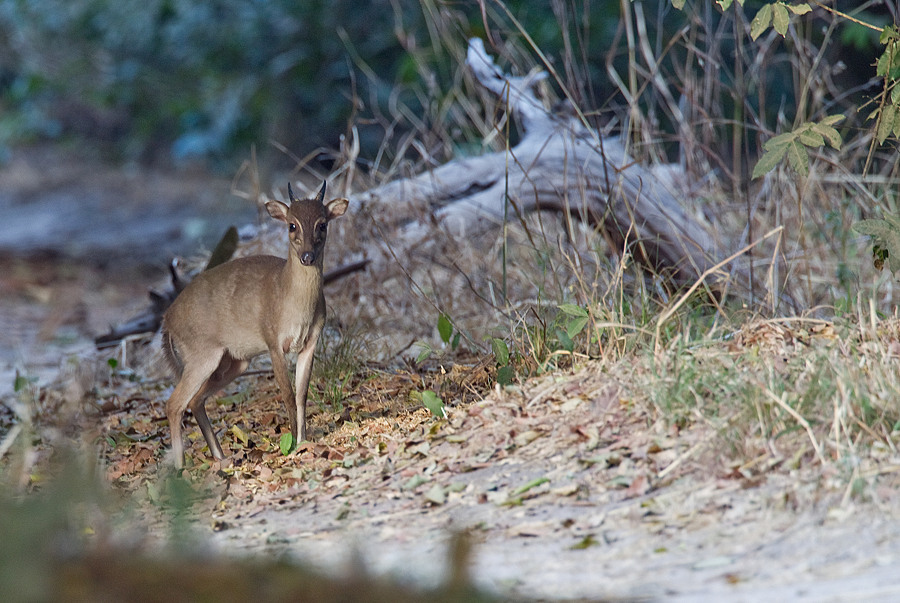
A Maxwell’s Duiker, Philantomba maxwellii, considered to be Least Concern under the terms of the International Union for the Conservation of Nature's Red List of Threatened Species and hunted by poachers in the Kakum Conservation Area of Ghana. Paul Cools/iNaturalist/ICUN Red List.

In January 2013 the patrols arrested one poacher, armed with a shotgun, and in possession of two Maxwell's Duiker, one Lowe's Monkey, and one Spot-nosed Monkey. In February one poacher was arrested, in possession of snares and two Maxwell's Duiker, one Royal Antelope, one Tree Squirrel and a Potto. In march 2013 a single poacher was apprehended, armed with a shotgun and in possession of one Maxwell's Duiker and one Lowe's Monkey. In April 2013 no poachers were arrested.

A Lowe's Monkey, Cercopithecus lowei, in the Mole Game Reserve in Ghana. This species is again considered to be of Least concern under the terms of the ICUN's Red List, and is hunted in the Kakum Conservation Area of Ghana. Peter Strong/Wikimedia Commons.

In May 2013 four poachers were arrested, armed with shotguns and in possession of five Maxwell's Duiker, two Royal Antelope, two Lowe's Monkeys, and one Spot Nosed Monkey. In June no poachers were apprehended again, while in July 2013 three poachers were arrested, in possession of shotguns and having killed two Maxwell's Duiker, one Lowe's Monkey and one Elephant.

African Elephant, Loxodonta africana, in the Kakum National Park. The species is considered to be Vulnerable under the terms of the ICUN's Red List. Kakum National Park.
 
In August 2013 the patrols arrested one poacher, armed with a shotgun and in possession of one Royal Antelope, one Flying Squirrel, one Lowe's Monkey, one Olive Colobus, and one live Pangolin. No poachers were apprehended in September or October 2013, while in November 2013 another single poacher was arrested, this time armed with a shotgun and and in possession of one Maxwell's Duiker, two Lowe's Monkeys and two live Pangolins.

A Long-tailed Pangolin, Uromanis tetradactyla, in the Kakum National Park. One of three Pangolin species in the area, all of which are considered to be Vulnerable under the terms of the ICUN's Red List. Lars Peterson.

During the time of the study 69 animals were recovered by Wildlife Protection Rangers in the Kakum National Park, including 29 Rodents, 19 Antelope, 13 Primates, seven Pangolins, and an Elephant. Of these eight belonged to species considered to be Vulnerable under the terms of the ICUN's Red List of Threatened Species (the Pangolins and the Elephant) one belonged to a species considered to be Near Threatened (the Olive Colebus), while the remainder belonged to species considered to be of Least Concern. This pattern did not vary notably from that in areas where hunting is not illegal.

The favoured weapon of the Poachers was clearly the shotgun, which Wiafe notes is the weapon most conservationists would prefer to see used, as it is a discriminating weapon which allows hunters to only take the animals they want, unlike snares which are more random. This is not always the case in protected reserves, as the sound of shotguns can attract the attention of patrols, however in this instance the hunters reported preferring shotguns as they enable them to target animals in the tree canopy. However the Wildlife Rangers also reported sometimes finding fencing around paths in the reserves, directing animals to snares outside the bounds of the protected area.

See also...

http://sciencythoughts.blogspot.co.uk/2018/03/cheirogaleus-grovesi-new-species-of.htmlhttp://sciencythoughts.blogspot.co.uk/2018/01/calculating-role-of-pleistocene-refugia.html
http://sciencythoughts.blogspot.co.uk/2017/11/image-of-elephant-human-conflict-wins.htmlhttp://sciencythoughts.blogspot.co.uk/2017/11/pongo-tapanuliensis-new-species-of.html
http://sciencythoughts.blogspot.co.uk/2017/10/elephants-kill-four-rohingya-refugees.htmlhttp://sciencythoughts.blogspot.co.uk/2017/10/unsustainable-chocolate-production.html
Follow Sciency Thoughts on Facebook.