Showing posts with label Anglerfish. Show all posts

Tuesday, 7 July 2020

Sympterichthys unipennis: Smooth Handfish declared extinct.

The Smooth Handfish, Sympterichthys unipennis, has officially been declared extinct by the International Union for Conservation of Nature, the first marine Fish to receive a formal determination of extinction. Determining the conservation statue of marine species is always difficult, making scientists reluctant to declare the extinction of modern species, but the highly endemic (localised) nature of Handfish populations, combined with the repeated failure of scientists to discover any survivors of the species over the past two decades, and the known environmental damage to the home range of the Smooth Handfish, has led to the conclusion that there are no surviving members of the species.

The only surviving specimen of the Smooth Handfish, Sympterichthys unipennis, in the collection of the Museum National d’Histoire Naturelle in Paris. Fishes of Australia.

Handfish, Brachionichthyidae, a form of Anglerfish, are highly unusual in that they are benthic (bottom-dwelling) for their entire life-cycle, moving over the seafloor by walking on leg-like fins. They lay their eggs on the seafloor, and the young, when they emerge are essentially miniature versions of the adults, with an identical form of locomotion. Individual species tend to have very specific habitat requirements and limited distributions, with most species having very few populations. All of this combines to make these Fish unusually vulnerable to extinction, and also to make such extinctions detectable to scientists.

The estimated original range of the Smooth Handfish, Sympterichthys unipennis. Fishes of Australia.

The only known specimen of the Smooth Handfish is in the collection of the Museum National d’Histoire Naturelle in Paris. It was collected by French zoologist François Péron during Nicolas Baudin's expedition to Australia from 1801-1804 aboard the ships Géographe and Naturaliste. The specimen was collected from the southeast coast of Tasmania, probably the D’Entrecasteaux Channel. The simple dip-net technology used by Péron suggests that the species was fairly numerous and therefore easily caught. Péron's specimen was formally described by the French zoologist Georges Cuvier in 1817, under the name Chironectes unipennis. The species has never been encountered again.

Illustration of 'Chironectes' unipennis from Cuvier's original 1817 description of the species. Fishes of Australia.

The D’Entrecasteaux Channel is known to have been the area of an extensive Scallop and Oyster fishery from the late nineteenth century until 1967, when the industry collapsed due to overfishing. During this period shellfish were dredged from the channel, a practice in which a bar is dragged across the sediment in order to disturb the target species, with a net behind to capture them. This practice is often highly destructive to the environment, and typically produces a significant amount of bycatch (species which are not targetted, and which are subsequently disgarded by the fishermen). It is thought that every part of the D’Entrecasteaux Channel was dredged in the nineteenth and twentieth centuries, and that this probably wiped out the Smooth Handfish.

An illustration of a shellfish dredge from 1873-4. Popular Science Monthly Volume 6/Wikimedia Commons.

During the past two decades extesive surveys of Handfish off the coast of Tasmania have been made by SCUBA divers, in order to monitor the populations of three other endemic species, the Red Handfish, Thymichthys politus, Ziebell's Handfish, Brachiopsilus ziebelli, and Spotted Handfish, Brachionichthys hirsutus, all of which are currently classed as Critically Endangered under the terms of the  International Union for the Conservation of Nature’s Red List of  Threatened Species. During this time no trace of the Smooth Handfish has been made, leading to the conclusion that the species has become extinct at some time since it was last encountered at the beginning of the nineteenth century.

A Critically Endangered Ziebell's Handfish, Brachiopsilus ziebelli, off the eoutheast coast of Australia. Red List of Threatened Species.

See also...

https://sciencythoughts.blogspot.com/2019/12/photolateralis-polyfenestrus-new.htmlhttps://sciencythoughts.blogspot.com/2019/10/channa-argus-northern-snakehead.html
https://sciencythoughts.blogspot.com/2018/10/tosanoides-aphrodite-new-species-of.htmlhttps://sciencythoughts.blogspot.com/2018/04/trematocranus-pachychilus-new-species.html
https://sciencythoughts.blogspot.com/2018/02/epinnula-pacifica-new-species-of-snake.htmlhttps://sciencythoughts.blogspot.com/2018/02/chrysiptera-burtjonesi-new-species-of.html
Follow Sciency Thoughts on Facebook.

Thursday, 11 July 2013

Two new species of Batfish from New Zealand.

Batfish of the Family Ogcocephalidae (slightly confusingly, several unrelated groups of Fish are known as Batfish) are specialized Anglerfish that have become flattened and benthic (bottom dwelling) in much the same way as Skates and Rays (to which they are not closely related). They are found living on the seafloor, typically at depths of between 200 m and 1000 m, though a few species live in shallower waters, across much of the worlds tropical and subtropical seas (thought they are absent from the Mediterranean). Batfish are poor swimmers, instead walking along the seafloor using modified pectoral and pelvic fins.

In a paper published in the journal Zootaxa on 12 March 2013, Hsuan-Ching Ho of the National Museum of Marine Biology & Aquarium at the Institute of Marine Biodiversity and Evolutionary Biology at the National Dong Hwa University, Clive Roberts of the Museum of New Zealand Te Papa Tongarewa and Kwang-Tsao Shao of the Biodiveristy Research Center at Academia Sinica in Taipei describe tow new species of Batfish from the waters around New Zealand, as part of a general review of Batfish of the genus Malthopsis in the area.

The first new species described is named Malthopsis asperata, where 'asperata' means 'rough-spine', in reference to the spines which cover the Fish. This is a smallish Batfish reaching 65 mm in length, and covered in spines. The Fish is described from specimens collected between 1974 and 1994 and preserved in museum collections; the original colouration of the fish is unknown.

Malthopsis asperata  in (A) dorsal view, (B) lateral view, (C) ventral view, and (D) drawing of dorsal view. Carl Struthers (photos) and E. Mackay (illustration) in Ho et al. (2013).

The second new species is named Malthopsis parva, meaning 'small'; the largest adult specimen of the Fish found was 51.1 mm in length. This is a greyish-to-brownish fish with red and yellow markings lacking conspicuous spines. It was found living on seamounts and oceanic ridges north of New Zealand and south of New Caledonia, at depths of 420–677 m.

Malthopsis parva in (A) dorsal view, (B) lateral view, (C) ventral view, (D) drawing of dorsal view, (E) second specimen in dorsal view. (A-C) Carl Struthers, (D) M. Freebone & (E) CSIRO in Ho et al. (2013).


Follow Sciency Thoughts on Facebook.

Saturday, 25 May 2013

Four new species of Angler Fish from New Zealand.

Anglerfish (Lophiiformes) are highly specialized Teleost Fish, related to Cod but with highly modified bodies due to their specialized lifestyle. Anglerfish are ambush predators, luring prey within reach with a special organ called the 'illicium', which is comprised of the three foremost spines of the dorsal fin, which have moved forward to between the Fish's eyes, and which can be moved freely, this bears a fleshy growth at its tip, which can be wiggled about to act as a lure to prey animals. In some species this lure is bioluminescent. Some Anglerfish are benthic, living on reefs and on the seafloor, others are pelagic, living in open water, particularly in the ocean deeps.

In a paper published in the journal Zootaxa on 5 March 2013, Hsuan-Ching Ho of the National Museum of Marine Biology & Aquarium at the Institute of Marine Biodiversity and Evolutionary Biology at National Dong Hwa University in Taiwan and Clive Roberts and Andrew Stewart of the Museum of New Zealand Te Papa Tongarewa, describe four new species of Anglerfish from the waters around New Zealand, during a review of Anglerfish of the genus Chaunax, which are members of the Chaunacidae, bottom-dwelling deepwater fish with bioluminescent lure, often called Sea Toads, Coffinfish or Frogmouths.

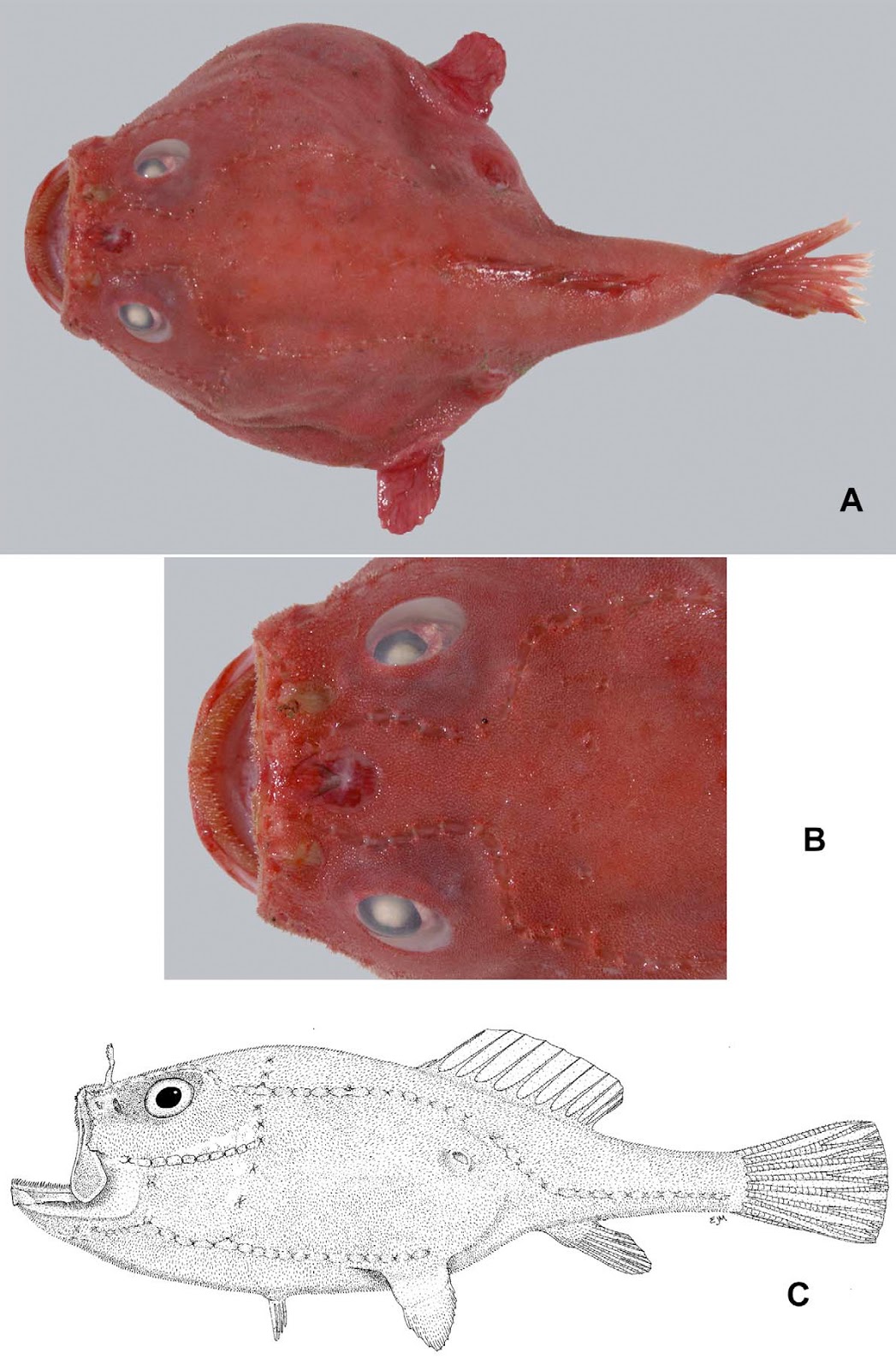
The first new species described is given the name Chaunax flavomaculatus, the Yellowspot Frogmouth. It is a 105-122 mm pinkish Anglerfish with yellow spots, found near Great Barrier Island and Moa Seamount, off the northeast coast of North Island, at depths of 353–375 m.

Chaunax flavomaculatus, the Yellowspot Frogmouth, photographed in (A) ventral and (B) dorsal views, with (C) line drawing in lateral view. Ho, Roberts & Stewart (2013).

The second new species is named Chaunax mulleus, the Redshoes Frogmouth. It is a 112-161 mm pink and white Anglerfish from depths of 720-1100 m found over a wide area centered on New Zealand.

Chaunax mulleus, the Redshoes Frogmouth, photographed in (A) dorsal, (B) lateral and (C) ventral views, with (D) a line drawing of the Fish in lateral view. Ho, Roberts & Stewart (2013).

Map showing the distribution of Chaunax flavomaculatus, the Yellowspot Frogmouth (circles), Chaunax mulleus, the Redshoes Frogmouth (triangles) and the previously described Chaunax nudviventer (squares). Ho, Roberts & Stewart (2013).

The third new species is given the name Chaunax reticulatus, the Netted Frogmouth. It is a 30-188 mm  yellow and pink Anglerfish found at depths of 360-398 m on Three Kings Ridge, Norfolk Ridge and off the northeast coast of North Island.

Chaunax reticulatus, the Netted Frogmouth. (A) Photograph in ventral view. (B) Line drawing in lateral view. (C) Photograph in dorsolateral view. Ho, Roberts & Stewart (2013).

The final new species is named Chaunax russatus, the Red Coffinfish. It is a 115-233 mm brick-red Anglerfish, found over a considerable area of seafloor around New Zealand, at depths of 512-1200 m.

Chaunax russatus, the Red Coffinfish. (A) Photographed in dorsal view. (B) Detail of head. (C) Line drawing in lateral view. Ho, Roberts & Stewart (2013).

Map showing the distribution of Chaunax reticulatus, or Netted Frogmouth (triangles), Chaunax russatus, or Red Coffinfish (squares) and the previously described Chaunax penicillatus, or Pencil Coffinfish (circles). Ho, Roberts & Stewart (2013).

See also A cryptic Sea Snake from Australia, Building an artificial Coral Reef on Pulau Weh, Indonesia, A new species of Pufferfish form French PolynesiaNew species of Grenadier from Japan, and Head-Butting in Giant Bumphead Parrotfish.

Follow Sciency Thoughts on Facebook.