Showing posts with label Aranea. Show all posts

Sunday, 15 October 2023

Idioctis parilarilao: A new species of Intertidal Trapdoor Spider from Taiwan.

Spiders are one of the most diverse groups of terrestrial Arthropods, but are only rarely found in aquatic environments. Species that live in freshwater environments include the Fishing or Raft Spiders, Dolomedes spp., and the Eurasian Water Spider, Argyroneta aquatica. Spiders able to inhabit marine environments are even rarer, with examples including several members of the Family Dictynidae, Several genera of Jumping Spiders, Salticidae, a single genus each of Anyphaenid Spiders and Desid Spiders, Amaurobioides and Cambridgea, respctively, as well as some populations of the Swollen Jaw Spider, Oedignatha scrobiculata

Among Mygalomorph Spiders, only a single genus is known to ever enter marine environments, the Intertidal Trapdoor Spiders, Idioctis spp., which construct burrows beneath the marine high tide line. These burrows are lined with a silk which apparently provides a reliable barrier against salt water, preventing the sea from entering the burrow when the tide is high. Members of this genus are known from island environments scattered across the Indian and Pacific oceans, apparently indicating an ability to occasionally disperse across wide areas of open ocean, although individual species tend to be restricted to single islands, or sometimes very close groups of islands, suggesting that such dispersals are rare.

In a paper published in the Journal of Arachnology on 6 October 2023, Kuang-Ping Yu of the Evolutionary Zoology Laboratory at the Slovenian National Institute of Biology, and the Department of Biology at the University of Ljubljana, Ying-Yuan Lo at the Department of Life Science at the National Taiwan Normal University, and the Zoology Division at the Taiwan Endemic Species Research InstituteRen-Chung Cheng of the Department of Life Sciences and Research Center for Global Change Biology at the National Chung Hsing University, Robert Raven of the Biodiversity and Geosciences Program at Queensland Museum, and Matjaž Kuntner, also of the Evolutionary Zoology Laboratory at the Slovenian National Institute of Biology, and of the Jovan Hadži Institute of Biology, the Department of Entomology at the Smithsonian National Museum of Natural History, and the State Key Laboratory of Biocatalysis and Enzyme Engineering and Centre for Behavioural Ecology and Evolution at Hubei University, describe a new species of Indertidal Trapdoor Spider from Taiwan.

The new species is named Idioctis parilarilao, where 'parilarilao' refers to both the name of the southernmost tip of Taiwan in the Paiwan language of the island, as well as to the indigenous people of the area. Specimens were discovered living both in Pingtung County on the southern tip of the Taiwanese mainland, and on Green Island, which lies off the east coast of that mainland. Female specimens ranged from 9.1 mm to 12.7 mm in length, the males were not observed. All specimens were light brown in colour, with a covering of thin, greyish hairs.

Idioctis parilarilao. (A)–(H) Female holotype (voucher code ASIZCH000106): (A) Dorsal view. (B) Lateral view. (C) Sternum and chelicera, ventral view. (D) Chelicera, ventral view showing the rastellum. (E) Eye mound, dorsal view. (F) Chelicera, ventral view showing the promarginal and basomesal teeth. (G) Spinnerets, ventral view. (H) Vulva, dorsal view. (I) Vulva of female paratype (ASIZCH000107), dorsal view. (J) Vulva of female from Green Island (TESRI-Ar5761), dorsal view. Scale bars: (A), (B) 3 mm; (C), (D), (G) 1 mm; (E), (F), (H), (I), (J) 0.5 mm. Yu et al. (2023).

Idioctis parilarilao was observed inhabiting tubular burrows dug into Coral rocks or cliffs within the intertidal zone, emerging at night when the tide was low to ambush small Arthropods. The trapdoors were covered by a camouflage incorporating Coral sand, debris, and Algae. The burrows were connected to natural chambers within the rock, which served as reserves of air at low tide. Breeding behaviour of the species is unclear, but large numbers of spiderlings were seen on rocks above the tideline in October.

Nest of Idioctis parilarilao sand its surrounding environment. Yu et al. (2023).

See also...


Follow Sciency Thoughts on Facebook.

Follow Sciency Thoughts on Twitter. 


Sunday, 17 September 2023

Megamonodontium mccluskyi: A new species of Brush-footed Trapdoor Spider from the Miocene of New South Wales.

Mygalomorph Spiders (Tarantulas and related species) are considered to be one of the most ancient groups of Spiders. They have two pairs of book lungs (many other Spiders have lost a pair) and downward pointing, rather than opposable fangs, again considered to be a primitive state in Spiders. Many species of Mygalomorph attain large sizes, all have flattened, disk-shaped bodies (rather than the more globular bodies of most other Spiders), and most are ambush predators.

These Spiders are known to have been present in Australia since before the break-up of Gondwana, with twelve families of Mygalomorphs found there today. Unfortunately, only a single fossil Mygalomorph has been described from Australia to date, Edwa maryae from the Triassic of Queensland, probably due to a combination of these Spiders both having fragile bodies unlikely to be preserved as fossils, and living in an environment unlikely to favour preservation (burrows, mostly in dry areas). Because of this, our understanding of the evolutionary history of Mygalomorph Spiders in Australia is based entirely upon phylogenetic analysis of extant species. By combining these phylogenetic studies with molecular clock analyses, it has been suggested that the group went through a significant evolutionary radiation during the Miocene, which coincides with a period of rapidly changing climate in Australia, with the rainforests which had covered much of the continent being replaced by the arid environment we see today. 

Within the Mygalomorphae as a whole, Brush-footed Trapdoor Spiders, Barychelidae, are considered to be the sister group to the True Tarantulas, Theraphosidae, differing from them in being smaller, having shorter spinnerets, and possessing tufts of setae on their feet which enable them to climb smooth surfaces. Brush-footed Trapdoor Spiders are found across all the major landmasses of the former Gondwana, with the exception of Antarctica and New Zealand, but are at their most diverse in Australia, which has led to the suggestion that they might have originated there. However, the most basal genus within the group, Monodontium, is not found in Australia, being found in Singapore, Borneo, and Papua New Guinea, where they inhabit Diptocarp rainforest environments. Members of the genus Monodontium are small for Mygalomorphs, and can be distinguished by the possession of biserial dentition of the paired claws in females, something only present in males in other genera.

In a paper published in the Zoological Journal of the Linnean Society on 15 September 2023, Matthew McCurry of the Australian Museum Research Institute, the Earth & Sustainability Science Research Centre at the University of New South Wales, and the Smithsonian National Museum of Natural HistoryMichael Frese, also of the Australian Museum Research Institute, and of the Commonwealth Scientific and Industrial Research Organisation, and the Faculty of Science and Technology at the University of Canberra, and Robert Raven of the Biodiversity and Geosciences Program at the Queensland Museum, describe a new species of Brush-footed Trapdoor Spider from the Miocene (16-11 million years old) McGraths Flat fossil sitet located  about 25 km north-east of Gulgong in New South Wales.

The new species is described from a single compressed specimen, AM F.145559, preserved as part and counterpart in a finely bedded goethite matrix. It is named Megamonodontium mccluskyi, where 'Megamonodontium' is a combination of the modern genus Monodontium, which it closely resembles, plus 'Mega', meaning 'very big', a reference to the specimen being five times the size of the largest known member of the genus Monodontium, while 'mccluskyi' honours Simon McClusky, who found the specimen.

Part (A) and counterpart (B) of Megamonodontium mccluskyi (AM F.145559). McCurry et al. (2023).

The specimen is split through the  carapace and abdomen, so that the chelicerae, eyes, fovea, sternum and spinnerets are unknown, while the e distal ends of the first, third and fourth legs are present only in it the part. This means that it was only realistic to examine the legs of the specimen when attempting to classify it, although this was certainly sufficient to place the specimen within the Barychelidae, based upon the legs being of similar thickness, an absence if strong spines on the first two pairs of legs, a reduced third, or middle, claw on all legs, and the presence of pads around the claws. The specimen lacks claw tufts, a distinguishing feature of the Brush-footed Trapdoor Spiders, but this has only ever been observed in fossil specimens preserved in amber, and therefore cannot be considered significant. 

While Megamonodontium mccluskyi superficially resembles some modern Australian Brush-footed Trapdoor Spiders, it retains a number of primitive features not seen in any of these, such as a long patella and teeth on the tarsal claw, making it most likely to be a close relative of the genus Monodontium. However, unlike the tiny MonodontiumMegamonodontium mccluskyi is a moderately large Spider with a carapace length of about 10 mm, making it the second largest fossil Spider ever discovered (behind the 24.6 mm Mongolarachne jurassica from the Jurassic of China).

Neither Megamonodontium nor Monodontium is found in Australia today, suggesting that if they do forma single clade, that clade has since become extinct in Australia. Moreover, the modern Monodontium lives in rainforest environments similar to those which would have been found around McGraths Flat when the fossil-bearing strata there were deposited. Since that time the Australian climate has changed, and the environment become dominated by dryland species such as Casuarina and Eucalyptus. The Miocene is known to have been a major interval for species turnover among Vertebrates, largely as a response to this changing climate, and molecular clock evidence has suggested that the same was true for Mygalomorph Spiders, but the absence of Spider fossils has made it impossible to determine if this was true from direct evidence until now.

See also...

Online courses in Palaeontology

Follow Sciency Thoughts on Facebook.

Follow Sciency Thoughts on Twitter.


Friday, 9 December 2022

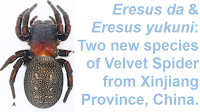
Eresus da & Eresus yukuni: Two new species of Velvet Spider from Xinjiang Province, China.

Velvet Spiders, Eresidae, are a group of highly distinctive Spiders with an almost exclusively Old World distribution (a single species is known from Brazil). They are often brightly coloured (some species are known as Ladybird Spiders for this reason) and typically live within underground tubes lined with silk, acting as ambush predators in areas with low vegetation, and well drained soil. Unusually for Spiders, some species are social, living in large colonies which co-operate in the raising of young. Parental care is a one of the distinguishing features of Velvet Spiders, with the females actively feeding their young for some time after hatching, liquefying their own internal organs in order to do so. The bright colours and distinctive behaviour of Velvet Spiders, combined with a preference for land also favoured by Human farmers, has led to many species having protected status.

In a paper published in the Biodiversity Data Journal on 6 December 2022, Yejie Lin of the Hebei Key Laboratory of Animal Diversity at Langfang Normal University, Shuqiang Li of the Institute of Zoology of the Chinese Academy of Sciences, Xin Zhao and Zhanqi Chen of the Key Laboratory of Tropical Forest Ecology at the Xishuangbanna Tropical Botanical Garden, and Haifeng Chen, also of the Hebei Key Laboratory of Animal Diversity at Langfang Normal University, describe two new species of Velvet Spider from Xinjiang Province, China.

Both new species are placed in the genus Eresus, which gives its name to the group and which contains 24 of the 102 currently described Velvet Spider species.

The first new species described is named Eresus da, where 'da' is a Chinese word meaning 'large', in reference to the large size of the species, the carapace of which can reach over 10 mm in length. Only a single female specimen of this species were observed, this being dark brown in colour, except for the carapace which is a lighter, reddish brown, and the white spots on the abdomen, the whole body being covered by short, white hairs.

Eresus da, holotype female. (A) Dorsal view. (B) lateral view. Lin et al. (2022).

The single known specimen of Eresus da was found living in a silk tunnel about 20 cm in length sheltered behind a clump of desert plants, and connected to an underground nest. The entrance to the tunnel was surrounded by the empty exoskeletons of desert Beetles, which appear to be the main prey of this species.

Eresus da, holotype female. (A) habitat; (B) microhabitat; (C) tunnel wrapped with Beetle exoskeletons; (D) Beetle skeletons (Pimeliinae sp.); (E) Spider with nest. Lin et al. (2022).

The second new species is named Ersus yukuni, in honour of Yu Kun, who collected the single known specimen of the species, a male. The specimen is black in colour, and covered by a dense layer of black and white hairs. 

Eresus kukuni, holotype male. (C) Dorsal view. (D) lateral view. Lin et al. (2022).

See also...

Follow Sciency Thoughts on Facebook.

Follow Sciency Thoughts on Twitter.


Thursday, 25 July 2019

Pionothele gobabeb: A new species of Funnel-web Tarantula from Namibia.

Trapdoor Spiders are Mygalomorph Spiders (Spiders that lack opposable fangs, the same group as the Tarantulas) noted for the habit of excavating a burrow which they cover with a circular trapdoor, emerging from this to seize prey. They were formerly assumed to be a single taxonomic group, but the advent of molecular phylogenetic methods has revealed that several different Mygalomorph groups have independently evolved this lifestyle. The Nemesiidae are a large group of Trapdoor Spiders sometimes known as Funnel-web Tarantulas. The are found on every continent, though they are more common on the continents of the Southern Hemisphere, and have a fossil record that dates back to the Cretaceous.

In a paper published in the journal ZooKeys on 3 June 2019, Jason Bond of the Department of Entomology & Nematology at the University of California Davis, and Trip Lamb of the Department of Biology at East Carolina University describe a new species of Funnel-web Tarantula from Namibia.

The new species is placed in the genus Pionothele, which has previously only been recorded in South Africa, and given the specific name gobabeb, in reference to the area where it was found, close to the Gobabeb Research & Training Center, about 120 km southeast of the Atlantic coastal city of Walvis Bay, where the ephemeral drainage of the Kuiseb River meets the northern terminus of the Namib Sand Sea and the gravel plains of the Central Namib. The species is described from fifteen male specimens collected from pit traps after a rain event (this is fairly typical for Trapdoor Spiders, with the males roaming in search of females, either at certain times of year or after certain weather events), plus one female collected from a burrow on a sandy slope.

Aerial photograph of type locality. Kuiseb River bed in foreground (tree line); the interdune pitfall trap transect lies beyond the dunes (middle right of image). Bond & Lamb (2019).

The males range from 6.18 to 7.59 cm in length and from 5.72 to 6.8 cm in width, the female is 8.13 cm long and 6.08 cm wide, and notably more robust. Both sexes are pale brown in colour with fine white hairs on the body and darker hairs on the limbs. The posterior lateral eyes are much reduced in size compared to the median eyes, something not seen in the other two species in the genus.

Pionothele gobabeb, specimens in dorsal view, (3) male, and (4) female. Bond & Lamb (2019).

See also...

https://sciencythoughts.blogspot.com/2019/02/ceratogyrus-attonitifer-new-species-of.htmlhttps://sciencythoughts.blogspot.com/2017/12/dolichothele-mottai-dolichothele.html
https://sciencythoughts.blogspot.com/2016/12/aptostichus-sabinae-new-species-of.htmlhttps://sciencythoughts.blogspot.com/2014/12/the-origin-of-canary-islands-trapdoor.html
https://sciencythoughts.blogspot.com/2013/08/a-mygalomorph-spider-from-late-triassic.htmlhttp://sciencythoughts.blogspot.com/2012/11/nine-new-species-of-tree-dwelling.html
Follow Sciency Thoughts on Facebook.

Sunday, 17 February 2019

Ceratogyrus attonitifer: A new species of Horned Baboon Spider from Angola.

Baboon Spiders, Harpactirinae, are large Mygalomorph Spiders (Tarantulas) found in Africa. They inhabit silk-lined burrows on the ground, from which they ambush prey, and which they will defend aggresively against any percieved threat with a painful venemous bite; this bite is reputed to be so painful that even Baboons will leave these Spiders alone. Members of the genus Ceratogyrus are widespread in Southern Africa, and are given the popular name Horned Baboon Spiders due to a large foveal horn found on the sternum of some species.

In a paper published in the jouranl African Invertebrates on 6 February 2019, John Midgley of the National Geographic Okavango Wilderness Project of the Wild Bird Trust, the Department of NaturalSciences at the KwaZulu-Natal Museum, and the Southern African Forensic Entomology Research Laboratory at Rhodes University, and Ian Engelbrecht of the South African National Biodiversity Institute and the Department of Zoology and Entomology at the University of Pretoria, describe a new species of Ceratogyrus from the Okavango catchment of Angola.

The Okavango wetland system is best known from Botswana, where it has been a major tourist attraction for decades, as well as being home to numerous scientific studies and television documentaries, but the system actually falls across three counries, Botswana, Namibia and Angola, with the majority in Angola. This Angolan part of the Okavango has recieved relatively little outside attention due ro a civil war that statrted shortly after the collapse of the Portuguese colonial empire in 1974, and lasted into the twenty first century. The National Geographic Okavango Wilderness Project has been working in the area since 2015, and aims to study the entire ecosystem across the three nations of the Okavango, and promote conservation in the area.

The new species is named Ceratogyrus attonitifer, which means 'bearer of astonishment' in reference to the surprise invoked by the discovery of this Spider. The species is described from six female specimens, collected from an undisclosed location within Moxico Province, Angola, during a National Geographic Okavango Wilderness Project in 2016. These are 20.8-40.5 mm in length and golden brown in colour, with the foveal horn much larger than seen in any previously seen member of the genus Ceratogyrus, and soft rather than rigid in nature.

Ceratogyrus attonitifer. (A) Retrolateral view, (B) dorsal view, (C) ventral view. Scale bars are 10 mm. Midgley & Engelbrecht (2019).

Ceratogyrus attonitifer is found in burrows in sandy soil in open Miombo woodland in southeastern Angola. These burrows are near vertical and about 40 cm deep, with a horizonal section at the base. The burrow has a silk colar with local materials such as twigs or grass incorporated. Any object inserted into the burrow was attacked enthusiastically. The Spiders principally feed on Insects, though local people report that the bites can be  serious, and even potenrially fatal if medical help is not available.

Habitat, burrow and live habitus of Ceratogyrus attonitifer in south-eastern Angola. (A) Aerial view of habitat at the type locality showing a dambo (wetland) amongst Miombo (Brachystegia) woodland. The expedition campsite is to the right of the dambo. Specimens were collected primarily along the margins of the wetland area. (B) Live habitus, dorsal, showing full size of the foveal protuberance in life. (C) Specimen in defensive posture typical for Baboon Spiders; background is white sand at the type locality. (D) Burrow entrance amongst grass tussocks; entrance approximately 2 cm wide. Midgley & Engelbrecht (2019).

See also...


https://sciencythoughts.blogspot.com/2017/12/dolichothele-mottai-dolichothele.htmlhttps://sciencythoughts.blogspot.com/2017/08/argyrella-richardsiae-new-species-of.html
https://sciencythoughts.blogspot.com/2016/12/aptostichus-sabinae-new-species-of.htmlhttp://sciencythoughts.blogspot.co.uk/2014/12/the-origin-of-canary-islands-trapdoor.html
http://sciencythoughts.blogspot.co.uk/2013/08/a-mygalomorph-spider-from-late-triassic.htmlhttp://sciencythoughts.blogspot.co.uk/2012/11/nine-new-species-of-tree-dwelling.html
Follow Sciency Thoughts on Facebook.

Saturday, 27 October 2018

Pahangone mirabilis: A new species of Dwarf Spider from Pahang State, Peninsula Malaysia.

Dwarf Spiders, Erigoninae, are one of the largest Spider groups, with over 2000 described species. As their name suggests, they tend to be very small, often less than a millimetre in length, and never longer than six, and are typically found in soil or leaf litter, where they produce sheat webs in which to catch their prey. The group are at their most diverse in cold regions of the Northern Hemisphere, with over 300 species in northern Europe and over 650 from North America, but are much less common in the Southern Hemisphere, being completely absent from Australia and New Zealand. The group is less studied in Southeast Asia, but the local fauna appears to be quite distinct from that of more northerly parts of Eurasia.

In a paper published in the journal Raffles Bulletin of Zoology on 23 July 2018, Andrei Tanasevitch of the A.N. Severtsov Institute of Ecology and Evolution of the Russian Academy of Sciences, describes a new species of Dwarf Spider from Pahang State in Malaysia.

The new species is named Pahangone mirabilis, where 'Pahangone' derives from 'Pahang', where the species was discovered and 'Erigone' the genus which gives its name to the Erigoninae, and 'mirabilis' means 'amazing'. The species is described from two specimens, one male and one female, both collected from Frazer’s Hill in Pehang State. The male is 2.25 mm in length and pale brown in colour, with enlarged eyes, the female 2.30 mm long, and pale brown with yellow legs.

 Pahangone mirabilis, male specimen in dorsal view. Tanasevitch (2018).

See also...

https://sciencythoughts.blogspot.com/2018/04/cangoderces-globosa-new-species-of.htmlhttp://sciencythoughts.blogspot.co.uk/2018/01/guhua-kakamegaensis-apneumonella.html
http://sciencythoughts.blogspot.co.uk/2017/12/dolichothele-mottai-dolichothele.htmlhttp://sciencythoughts.blogspot.co.uk/2017/11/ocyale-ghost-new-species-of-wolf-spider.html
http://sciencythoughts.blogspot.co.uk/2017/09/maevia-eureka-new-species-of-jumping.htmlhttp://sciencythoughts.blogspot.co.uk/2017/08/evarcha-dena-new-species-of-jumping.html
Follow Sciency Thoughts on Facebook.

Saturday, 21 April 2018

Cangoderces globosa: A new species of Telemid Spider from South Africa.

The Telemidae are a small group of web-building Spiders found in East and Southeast Asia, Australasia, North and Central Africa, southwest Europe and Africa. The group contains a high proportion of cave-dwelling species, but of the thirteen African species described only one is found in caves, Cangoderces lewisi from the Cango Caves of Western Cape Province, with all the remaining species found in tropial forests.

In a paper published in the journal African Invertebrates on 21 March 2018, Chunxia Wang and Shuqiang Li of the Institute of Zoology of the Chinese Academy of Sciences and Charles Haddad of the Department of Zoology & Entomology at the University of the Free State, describe a new species of Telemid Spider from Mpumalanga Province in South Africa.

The new species is placed in the genus Cangoderces, and given the specific name globosa, meaning 'sperical' in reference to the shape the female spermatheca (receptacle in which sperm is stored after mating). Males of this species reach 1.32 mm in length, with females being slightly smaller. The Spiders are yellow on colour with six eyes and a blue abdomen. They were found living in leaf-litter in an Afromontane forest.

Cangoderces globosa, female specimen in dorsal view. Wang et al. (2018).

See also...

http://sciencythoughts.blogspot.co.uk/2018/01/guhua-kakamegaensis-apneumonella.htmlhttp://sciencythoughts.blogspot.co.uk/2017/12/dolichothele-mottai-dolichothele.html
http://sciencythoughts.blogspot.co.uk/2017/11/ocyale-ghost-new-species-of-wolf-spider.htmlhttp://sciencythoughts.blogspot.co.uk/2017/09/maevia-eureka-new-species-of-jumping.html
http://sciencythoughts.blogspot.co.uk/2017/08/evarcha-dena-new-species-of-jumping.htmlhttp://sciencythoughts.blogspot.co.uk/2017/07/parachemmis-julioblancoi-new-species-of.html
Follow Sciency Thoughts on Facebook.