Showing posts with label Spiders. Show all posts

Monday, 4 March 2024

Promyrmekiaphila korematsui: A new species of Trapdoor Spider from California.

Cryptic species are species which resemble one-another physically yet are reproductively isolated from each other. While such species clusters can come about due to convergent evolution, the vast majority are closely related species which have become reproductively isolated, but which have not diverged morphologically, usually as a result of a physical barrier splitting a population, followed by genetic drift. This is particularly common among morphologically conservative groups with low distribution rates, such as Mygalomorphs (Tarantulas, Trapdoor Spiders etc.), which are large Spiders occupying silk-lined burrows, typically remaining at a single site for their entire lives. 

In a paper published in the journal Ecology and Evolution on 1 March 2024, James StarrettEmma JochimIris QuayleXavier Zahnle, and Jason Bond of the University of California, Davis, present the results of a genetic study of the Trapdoor Spider genus Promyrmekiaphila, which is known only from California, and describe a new species, the third within the genus.

The genus Promyrmekiaphila was first described in 1950 by the Swiss arachnologist and herpetologist Ehrenfried Schenkel to describe a morphotype of Trapdoor Spider found across California, which he named Promyrmekiaphila gertschi. This was later found to have previously been described by the French naturalist Eugène Simon as Aptostichus clathratus in 1891, though it was later recognised that the assignation of the species to the genus Aptostichus was wrong, and Schenkel's name Promyrmekiaphila was adopted, leading to the combination Promyrmekiaphila clathratus.

In 2007 and 2008 Amy Stockman and Jason Bond, then both at the Department of Biology at East Carolina University, carried out a study of the population of Promyrmekiaphila clathratus using mitochondrial DNA (mtDNA), coming to the conclusion that there were in fact two species within the genus, Promyrmekiaphila clathratus found throughout the coastal ranges in central and northern California, and a new species, which they named Promyrmekiaphila winnemem, which was found at the northern end of the Central Valley. 

However, Stockman and Bond recognised that a study based upon mtDNA alone had its limitations, and that there still remained the possibility of other, cryptic, species of Promyrmekiaphila being found in California. 

Starrett et al.'s new study is based upon a wider gene set. This identified a number of deeply separated lineages within the Promyrmekiaphila clathratus  population, although Starrett et al. decline to name these as new species at this time, reasoning that they are not yet sufficiently genetically different to be reproductively isolated. However, a small group of Spiders found close to the San Andreas Fault line, from mid-San Francisco Peninsula to the Diablo Range, east of Paicines, were found to comprise a sister group to the Promyrmekiaphila clathratus and Promyrmekiaphila winnemem pair, therefore clearly representing a new species.

This new species is named Promyrmekiaphila korematsui, in honour of Fred Toyosaburo Korematsu, who  was awarded the United States Presidential Medal of Freedom in 1998 in recognition of his lifelong dedication as a civil rights activist and his resistance to the  incarceration of Japanese Americans in concentration camps during World War II.

Promyrmekiaphila korematsui, male live habitus photographs, side and dorsal views. Starrett et al. (2024).

Promyrmekiaphila korematsui is found d in shaded ravines and along roadcuts in Oak woodland habitat. Its distribution overlaps with that of Promyrmekiaphila clathratus, which may have implications for evolution of the genus, although the small sample size available for the genus so far prevents any detailed  analysis at this time.

See also...

Sunday, 15 October 2023

Idioctis parilarilao: A new species of Intertidal Trapdoor Spider from Taiwan.

Spiders are one of the most diverse groups of terrestrial Arthropods, but are only rarely found in aquatic environments. Species that live in freshwater environments include the Fishing or Raft Spiders, Dolomedes spp., and the Eurasian Water Spider, Argyroneta aquatica. Spiders able to inhabit marine environments are even rarer, with examples including several members of the Family Dictynidae, Several genera of Jumping Spiders, Salticidae, a single genus each of Anyphaenid Spiders and Desid Spiders, Amaurobioides and Cambridgea, respctively, as well as some populations of the Swollen Jaw Spider, Oedignatha scrobiculata

Among Mygalomorph Spiders, only a single genus is known to ever enter marine environments, the Intertidal Trapdoor Spiders, Idioctis spp., which construct burrows beneath the marine high tide line. These burrows are lined with a silk which apparently provides a reliable barrier against salt water, preventing the sea from entering the burrow when the tide is high. Members of this genus are known from island environments scattered across the Indian and Pacific oceans, apparently indicating an ability to occasionally disperse across wide areas of open ocean, although individual species tend to be restricted to single islands, or sometimes very close groups of islands, suggesting that such dispersals are rare.

In a paper published in the Journal of Arachnology on 6 October 2023, Kuang-Ping Yu of the Evolutionary Zoology Laboratory at the Slovenian National Institute of Biology, and the Department of Biology at the University of Ljubljana, Ying-Yuan Lo at the Department of Life Science at the National Taiwan Normal University, and the Zoology Division at the Taiwan Endemic Species Research InstituteRen-Chung Cheng of the Department of Life Sciences and Research Center for Global Change Biology at the National Chung Hsing University, Robert Raven of the Biodiversity and Geosciences Program at Queensland Museum, and Matjaž Kuntner, also of the Evolutionary Zoology Laboratory at the Slovenian National Institute of Biology, and of the Jovan Hadži Institute of Biology, the Department of Entomology at the Smithsonian National Museum of Natural History, and the State Key Laboratory of Biocatalysis and Enzyme Engineering and Centre for Behavioural Ecology and Evolution at Hubei University, describe a new species of Indertidal Trapdoor Spider from Taiwan.

The new species is named Idioctis parilarilao, where 'parilarilao' refers to both the name of the southernmost tip of Taiwan in the Paiwan language of the island, as well as to the indigenous people of the area. Specimens were discovered living both in Pingtung County on the southern tip of the Taiwanese mainland, and on Green Island, which lies off the east coast of that mainland. Female specimens ranged from 9.1 mm to 12.7 mm in length, the males were not observed. All specimens were light brown in colour, with a covering of thin, greyish hairs.

Idioctis parilarilao. (A)–(H) Female holotype (voucher code ASIZCH000106): (A) Dorsal view. (B) Lateral view. (C) Sternum and chelicera, ventral view. (D) Chelicera, ventral view showing the rastellum. (E) Eye mound, dorsal view. (F) Chelicera, ventral view showing the promarginal and basomesal teeth. (G) Spinnerets, ventral view. (H) Vulva, dorsal view. (I) Vulva of female paratype (ASIZCH000107), dorsal view. (J) Vulva of female from Green Island (TESRI-Ar5761), dorsal view. Scale bars: (A), (B) 3 mm; (C), (D), (G) 1 mm; (E), (F), (H), (I), (J) 0.5 mm. Yu et al. (2023).

Idioctis parilarilao was observed inhabiting tubular burrows dug into Coral rocks or cliffs within the intertidal zone, emerging at night when the tide was low to ambush small Arthropods. The trapdoors were covered by a camouflage incorporating Coral sand, debris, and Algae. The burrows were connected to natural chambers within the rock, which served as reserves of air at low tide. Breeding behaviour of the species is unclear, but large numbers of spiderlings were seen on rocks above the tideline in October.

Nest of Idioctis parilarilao sand its surrounding environment. Yu et al. (2023).

See also...


Follow Sciency Thoughts on Facebook.

Follow Sciency Thoughts on Twitter. 


Sunday, 17 September 2023

Megamonodontium mccluskyi: A new species of Brush-footed Trapdoor Spider from the Miocene of New South Wales.

Mygalomorph Spiders (Tarantulas and related species) are considered to be one of the most ancient groups of Spiders. They have two pairs of book lungs (many other Spiders have lost a pair) and downward pointing, rather than opposable fangs, again considered to be a primitive state in Spiders. Many species of Mygalomorph attain large sizes, all have flattened, disk-shaped bodies (rather than the more globular bodies of most other Spiders), and most are ambush predators.

These Spiders are known to have been present in Australia since before the break-up of Gondwana, with twelve families of Mygalomorphs found there today. Unfortunately, only a single fossil Mygalomorph has been described from Australia to date, Edwa maryae from the Triassic of Queensland, probably due to a combination of these Spiders both having fragile bodies unlikely to be preserved as fossils, and living in an environment unlikely to favour preservation (burrows, mostly in dry areas). Because of this, our understanding of the evolutionary history of Mygalomorph Spiders in Australia is based entirely upon phylogenetic analysis of extant species. By combining these phylogenetic studies with molecular clock analyses, it has been suggested that the group went through a significant evolutionary radiation during the Miocene, which coincides with a period of rapidly changing climate in Australia, with the rainforests which had covered much of the continent being replaced by the arid environment we see today. 

Within the Mygalomorphae as a whole, Brush-footed Trapdoor Spiders, Barychelidae, are considered to be the sister group to the True Tarantulas, Theraphosidae, differing from them in being smaller, having shorter spinnerets, and possessing tufts of setae on their feet which enable them to climb smooth surfaces. Brush-footed Trapdoor Spiders are found across all the major landmasses of the former Gondwana, with the exception of Antarctica and New Zealand, but are at their most diverse in Australia, which has led to the suggestion that they might have originated there. However, the most basal genus within the group, Monodontium, is not found in Australia, being found in Singapore, Borneo, and Papua New Guinea, where they inhabit Diptocarp rainforest environments. Members of the genus Monodontium are small for Mygalomorphs, and can be distinguished by the possession of biserial dentition of the paired claws in females, something only present in males in other genera.

In a paper published in the Zoological Journal of the Linnean Society on 15 September 2023, Matthew McCurry of the Australian Museum Research Institute, the Earth & Sustainability Science Research Centre at the University of New South Wales, and the Smithsonian National Museum of Natural HistoryMichael Frese, also of the Australian Museum Research Institute, and of the Commonwealth Scientific and Industrial Research Organisation, and the Faculty of Science and Technology at the University of Canberra, and Robert Raven of the Biodiversity and Geosciences Program at the Queensland Museum, describe a new species of Brush-footed Trapdoor Spider from the Miocene (16-11 million years old) McGraths Flat fossil sitet located  about 25 km north-east of Gulgong in New South Wales.

The new species is described from a single compressed specimen, AM F.145559, preserved as part and counterpart in a finely bedded goethite matrix. It is named Megamonodontium mccluskyi, where 'Megamonodontium' is a combination of the modern genus Monodontium, which it closely resembles, plus 'Mega', meaning 'very big', a reference to the specimen being five times the size of the largest known member of the genus Monodontium, while 'mccluskyi' honours Simon McClusky, who found the specimen.

Part (A) and counterpart (B) of Megamonodontium mccluskyi (AM F.145559). McCurry et al. (2023).

The specimen is split through the  carapace and abdomen, so that the chelicerae, eyes, fovea, sternum and spinnerets are unknown, while the e distal ends of the first, third and fourth legs are present only in it the part. This means that it was only realistic to examine the legs of the specimen when attempting to classify it, although this was certainly sufficient to place the specimen within the Barychelidae, based upon the legs being of similar thickness, an absence if strong spines on the first two pairs of legs, a reduced third, or middle, claw on all legs, and the presence of pads around the claws. The specimen lacks claw tufts, a distinguishing feature of the Brush-footed Trapdoor Spiders, but this has only ever been observed in fossil specimens preserved in amber, and therefore cannot be considered significant. 

While Megamonodontium mccluskyi superficially resembles some modern Australian Brush-footed Trapdoor Spiders, it retains a number of primitive features not seen in any of these, such as a long patella and teeth on the tarsal claw, making it most likely to be a close relative of the genus Monodontium. However, unlike the tiny MonodontiumMegamonodontium mccluskyi is a moderately large Spider with a carapace length of about 10 mm, making it the second largest fossil Spider ever discovered (behind the 24.6 mm Mongolarachne jurassica from the Jurassic of China).

Neither Megamonodontium nor Monodontium is found in Australia today, suggesting that if they do forma single clade, that clade has since become extinct in Australia. Moreover, the modern Monodontium lives in rainforest environments similar to those which would have been found around McGraths Flat when the fossil-bearing strata there were deposited. Since that time the Australian climate has changed, and the environment become dominated by dryland species such as Casuarina and Eucalyptus. The Miocene is known to have been a major interval for species turnover among Vertebrates, largely as a response to this changing climate, and molecular clock evidence has suggested that the same was true for Mygalomorph Spiders, but the absence of Spider fossils has made it impossible to determine if this was true from direct evidence until now.

See also...

Online courses in Palaeontology

Follow Sciency Thoughts on Facebook.

Follow Sciency Thoughts on Twitter.


Friday, 9 December 2022

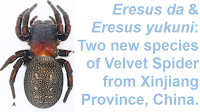
Eresus da & Eresus yukuni: Two new species of Velvet Spider from Xinjiang Province, China.

Velvet Spiders, Eresidae, are a group of highly distinctive Spiders with an almost exclusively Old World distribution (a single species is known from Brazil). They are often brightly coloured (some species are known as Ladybird Spiders for this reason) and typically live within underground tubes lined with silk, acting as ambush predators in areas with low vegetation, and well drained soil. Unusually for Spiders, some species are social, living in large colonies which co-operate in the raising of young. Parental care is a one of the distinguishing features of Velvet Spiders, with the females actively feeding their young for some time after hatching, liquefying their own internal organs in order to do so. The bright colours and distinctive behaviour of Velvet Spiders, combined with a preference for land also favoured by Human farmers, has led to many species having protected status.

In a paper published in the Biodiversity Data Journal on 6 December 2022, Yejie Lin of the Hebei Key Laboratory of Animal Diversity at Langfang Normal University, Shuqiang Li of the Institute of Zoology of the Chinese Academy of Sciences, Xin Zhao and Zhanqi Chen of the Key Laboratory of Tropical Forest Ecology at the Xishuangbanna Tropical Botanical Garden, and Haifeng Chen, also of the Hebei Key Laboratory of Animal Diversity at Langfang Normal University, describe two new species of Velvet Spider from Xinjiang Province, China.

Both new species are placed in the genus Eresus, which gives its name to the group and which contains 24 of the 102 currently described Velvet Spider species.

The first new species described is named Eresus da, where 'da' is a Chinese word meaning 'large', in reference to the large size of the species, the carapace of which can reach over 10 mm in length. Only a single female specimen of this species were observed, this being dark brown in colour, except for the carapace which is a lighter, reddish brown, and the white spots on the abdomen, the whole body being covered by short, white hairs.

Eresus da, holotype female. (A) Dorsal view. (B) lateral view. Lin et al. (2022).

The single known specimen of Eresus da was found living in a silk tunnel about 20 cm in length sheltered behind a clump of desert plants, and connected to an underground nest. The entrance to the tunnel was surrounded by the empty exoskeletons of desert Beetles, which appear to be the main prey of this species.

Eresus da, holotype female. (A) habitat; (B) microhabitat; (C) tunnel wrapped with Beetle exoskeletons; (D) Beetle skeletons (Pimeliinae sp.); (E) Spider with nest. Lin et al. (2022).

The second new species is named Ersus yukuni, in honour of Yu Kun, who collected the single known specimen of the species, a male. The specimen is black in colour, and covered by a dense layer of black and white hairs. 

Eresus kukuni, holotype male. (C) Dorsal view. (D) lateral view. Lin et al. (2022).

See also...

Follow Sciency Thoughts on Facebook.

Follow Sciency Thoughts on Twitter.


Sunday, 5 September 2021

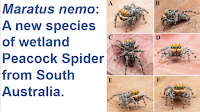
Maratus nemo: A new species of wetland Peacock Spider from South Australia.

Peacock Spiders, Maratus spp., are a unique group of Jumping Spiders (Salticidae) from Australia, noted for the bright colours and elaborate mating displays of the males. This behaviour, combined with the development of relatively cheap digital cameras capable of recording the activities of small spiders, has made them stars on social media, which in turn has led to more study time being focused on the group by arachnologists; of the 91 currently recognised species in the genus, 76 have been described in the last decade. Males of the genus have a distinctive, and often brightly coloured, plate on their opisthosoma (rear body section), which can be erected during mating displays, as well as an elongated third pair of legs used for signalling. 

In a paper published in the journal Evolutionary Systematics on 25 March 2021, Joseph Schubert of Museums Victoria, and the Harry Butler Institute at Murdoch University, describes a new species of Peacock Spider from the wetlands of South Australia.

The new species is named Maratus nemo, in reference to the character Nemo in the Disney film Finding Nemo, the colouration of the males resembling that of this character. The species was first observed by Sheryl Holliday of Nature Glenelg Trust, who posted pictures of the Spiders on social media. The species was discovered living in the Mount Burr Swamp, about 9.5 km to the southeast of Mount McIntyre, and subsequently also found close to the Topperwein Native Forest Reserve, about 14 km to the east of Nangwarry.

The males of Maratus nemo resemble those of the 'Maratus personatus' species group, however, it is currently unclear if this is a true clade (group of organisms including all the descendants of a shared common ancestor), or an example of convergent evolution. Like these species, males of Maratus nemo lack distinctive colouration or flaps on the opisthosoma, but instead has a brightly coloured mask of scales surrounding the eyes, in the case of Maratus nemo these being bright orange with white markings. The remainder of the body is dark brown, and thickly covered with white hairs. Females are light brown in colour, with a lighter covering of off-white hairs. Males range from 4.10 to 4.25 mm in length, females are slightly larger at 5.12 mm.

 
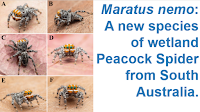
Living male Maratus nemo. (A) Anterolateral view, (B) lateral view, (C) dorsal view, (D) anterior view, (E) anterolateral view, and (F) anterior view. Schubert (2021).

During courtship the male sits on a leaf, where he raises one of his third legs and waves it slowly. If a female approaches, he raises both third legs and waves them more vigorously, while at the same time bobbing his opisthosoma up and down, causing the leaf to vibrate and generating an audible noise. This courtship has only been observed in captivity, and may be more complex in the wild.

 
Living female Maratus nemo. (A) Dorsolateral view, (B) dorsal view, (C) anterolateral view, (D) lateral view, (E) posterolateral view, and (F) anterior view. Schubert (2021).

The species has only been found at two locations in South Australia to date. Both locations are ephemeral wetlands, an environment in which Peacock Spiders have not previously been recorded, with the Spiders being found on the leaves of marsh vegetation sitting in shallow water.

 
Habitat of Maratus nemo in the vicinity of Mount McIntyre, South Australia. (A) Ephemeral wetland complex habitat at Mount Burr Swamp. (B) Marshy vegetation from Mount Burr Swamp. (C) Maratus nemo nov. male in situ. (D) Maratus nemo female in situ. Sheryl Holliday in Schubert (2021).

See also...


Follow Sciency Thoughts on Facebook.

Follow Sciency Thoughts on Twitter


Monday, 14 September 2020

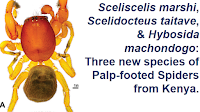
Sceliscelis marshi, Scelidocteus taitave, & Hybosida machondogo: Three new species of Palp-footed Spiders from Kenya.

The Palp-footed Spiders, Palpimanidae, are a small family of araneophagous (Spider-eating) Spiders recognized by the coriaceous carapace, haplogyne genitalia, two spinnerets and especially by the first pair of legs with dorsally enlarged femora and well-developed prolateral scopula on the tibia, metatarsus and tarsus. A total of 152 species in 18 genera are distributed in tropical and subtropical zones worldwide, absent only in the Nearctic and Australia. Within Africa, the family is known to include 56 species belonging to 12 genera, although some of these species are certainly misplaced in the family. More than 800 spider species and subspecies belonging to 55 families are known from Kenya. However, Palpimanidae have not been thoroughly studied. Up to now, only three species have been described: Scelidocteus incisus, Hybosida lesserti, and Hybosida scabra

In a paper published in the journal African Invertebrates on 28 Jult 2020, Ambata Oketch of the Institute of Zoology of the Chinese Academy of Sciences, the National Museums of Kenya, and the University of the Chinese Academy of Sciences, Sergei Zonstein of the Steinhardt Museum of Natural History at Tel Aviv University, and the Department of Zoology and Centre for Invasion Biology at the University of Venda, Esther Kioko also of the National Museums of Kenya, and Shuqiang Li, also of the Institute of Zoology of the Chinese Academy of Sciences, and the University of the Chinese Academy of Sciences, describe  one new genus and three new species of Palpimanid Spiders found during the examination of Spiders collected in various protected sites in Kenya.

The first new species is placed in a new genus, Sceliscelis, which possesses some characteristics that are also found in Sarascelis and Scelidocteus, such as the dentate segments of leg I (which include at least the dorsal surface of the coxa and basal part of the femur) and the spiral embolus. The name Sceliscelis is a combination of 'Sceli' from Scelidocteus and 'Scelis' from Sarascelis. It is given the specific name Sceliscelis marshi, in honour of Brian Marsh OBE, the founder of the Marsh Christian Trust Awards for Ecologists in Africa, which Esther Kioko was awarded in 2019. The species is described from two specimens, one male and one female, both collected from Tsavo West National Park in Taita Taveta County, Kenya.

 
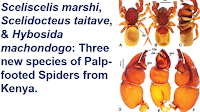
Sceliscelis marshi, male holotype (A)–(C) habitus in dorsal, ventral and lateral aspects (D)–(F) palp: (D) prolateral (E) ventral and (F) retrolateral aspects. Abbreviations: am. accompanying membrane; co, 'conductor'; cy, cymbium; ds, dorsal portion of scutum; em, embolus; hle, hook-like extension; pe, palm-like embolic extension. Scale bars are 1 mm (A)–(C), 0.1 mm (D)–(F). Oketch et al. (2020).

The male has a total body length of 3.83 mm, with a carapace 2.13 mm long, and 1.75 mm wide. The female has a total body lenght of 5.1 mm, and a carapace 3.1 mm long, and 2.2 mm wide. The is dome shaped, coarsely granulated, hairless, and medially elevated, with a longitudinal fovea (thoracic furrow), open posteriorly, in an elongated Ω-shape. Labium triangular, notched, longer than wide but broader at base. Chelicerae directed ventrally, 2 times longer than clypeus, granulate. Endites trapezoidal, about 1.5 times longer than wide. Abdomen clay yellow, oval and covered with short, gray setae in both sexes. Femur of male palp slender, longer than wide, patella shorter than 'conductor'. Cymbium with setae, pointed at tip and indented (prolateral view). Embolus spiral, with accompanying membrane and a silvery, palm-like embolic extension. 'Conductor' sword-shaped, longer than wide, slightly longer than embolus. Endogyne wavy anteriorly, forming a rigid epigastric wall.

 
Sceliscelis marshi, female paratype. Cephalothorax (A) dorsal and (B) ventral aspects (C), (D) endogyne, ventral and dorsal aspects, respectively. Abbreviations: Bl, book lung operculum; ch, receptive chamber; ds, dorsal portion of scutum; Gr, grape-shaped glands; Ls, late Okeral sclerite; Re, rigid extension of posterior wall of epigastric fold; sco, scopula; Sr, sac like receptacle. Scale bars are 1 mm (A), (B), and 0.2 mm (C), (D). Oketch et al. (2020).

The second new species is placed in tbe genus Scelidocteus, and given the specific name taitave, which is a is a combination of Taita and Taveta, the county from which the specimens were collected. The species is described from four specimens, two males and two females, collected from the Mbololo Forest in the Taita Hills of Taita Taveta County.

 
Scelidocteus taitave, male holotype (A), (B) dorsal and ventral habitus respectively (C)–(E) palp: (C) prolateral (D) ventral (E) retrolateral aspects. Abbreviations: am, accompanying membrane; cl, claw like extension; co, 'conductor'; em, embolus; cy, cymbium; rt, retrolateral thorns; sco, scopula. Scale bars are 1mm (A), (B), and 0.2mm  OkOe(C)–(E). Oketch et al. (2020).

Males of this species differ from those of other members of Scelidocteus by the uniquely spiral-shaped embolus. Females of Scelidocteus taitave differ from those of other species by the structure of the endogyne; the orientation of sac-like receptacles touching medially, with a space below them) mounted on oval, membranous receptive chambers and the outline of a rigid extension of the posterior wall of the epigastric fold.

 
Scelidocteus taitave, female paratype (A), (B) habitus (C) endogyne ventral (D) same, ventral (E) same, enlarged (F) leg I. Abbreviations: ch, receptive chamber; Ft, fine threads; Gr, grape-shaped glands; Re, rigid extensions of posterior wall of epigastric fold; Sr, sac like receptacle. Scale bars are 1 mm (A), (B). Oketch et al. (2020).

The males have a total body length of  3.90 mm. Chelicerae flattened anteriorly towards the fangs, 1.60 mm long, cheliceral furrow with several peg-like teeth. Stridulatory mound absent. Clypeus approximately 2 times shorter than length of chelicerae. Sternum 1.09 mm long, 0.86 mm wide at leg II; shield shaped, rebordered, finely granulate. Endites almost D-shaped, labium notch 0.13 long, about a quarter of labium length. Leg I: coxa, patella and tibia possess dark, thorn-like outgrowths and well developed prolateral scopula on tibia and metatarsus. Tarsus I with weakly developed scopula. Abdomen oval with short, grey setae, dorsal portion of epigastric scutum very small, pedicel short, spinnerets short and unsegmented. Palp with tibia as long as wide, approximately 2.5 times wider than femur. Cymbium long and thin, tapering distally. 'Conductor' bifurcate; embolus long and spiral, obscuring some parts of tegulum. Embolus ends with a bleached, claw-like structure at apex.

Females have a total length of 4.88 mm. Carapace 2.19 mm long, 1.72 mm wide. Sternum 1.25 mm long, 1.00 mm wide, labium 0.5 mm long, 0.44 mm wide at the base, labium notch 1/3 length of labium. Vulva with fine, thread-like structures and 3 pairs of stalked, grape-shaped glands attached to a pair of relatively ovate and membranous receptive chambers.

The third new species is placed in the genus Hybosida, and given the specific name machondogo, which is a combination of two Swahili words 'macho', meaning eyes, and 'ndogo’, meaning small, referring to the indiscernible posterior median eyes of this species. The species is described from an adult male specimen from Mount Kenya National Park, and two subadult males Mount Elgon National Park.

 
Hybosida machondogo male holotype (A)–(C) habitus: (A) dorsal (B) ventral and (C) prolateral aspects (D)–(F) palp: (D) prolateral (E) ventral (F) retrolateral. Scale bars are 1 mm (A)–(C), and 0.2 mm (D)–(F). Abbreviations: cy, cymbium; ds, dorsal portion of scutum; em, embolus; pa, patella; Ta, tegula apophysis. Oketch et al. (2020).

Like other members of Chediminae, Hybosida machondogo possess contiguous lateral eyes and accessory structures of the male palp. It closely resembles Hybosida lesserti by having (1) a more compact carapace with the cephalic part narrowed (2) an elevated carapace with a steep posterior slope (3) a strongly convex carapace in lateral view and (4) poorly developed scopula on both the metatarsi and tarsi of legs I. However, Hybosida machondogo differs from Hybosida lesserti and other members of this genus by having (1) 8 eyes instead of 6, (2) a bulb with relatively long, sharp and less curved apophysis (vs. strongly curved in Hybosida lesserti).


Hybosida machondogo, subadult male, habitus (A) dorsal view (B) ventral (C) male holotype, ocular area, anterodorsal (D) thoracic fovea, dorsal. Scale bars are 0.5 mm (A)–(D). Oketch et al. (2020).

The adult male specimen has a total body length of 2.05 mm. The carapace, pedicel and sternum reddish orange, 1.11 mm long, 0.83 mm  wide at leg II, carapace dome-shaped and covered with white setae at the edges, finely rugose. Thoracic region higher than cephalic region, steeply sloping towards pedicel. Fovea crescent-like, bipartite, wide distally (sulci diverging). Sternum with long, gray setae. Labium deeply notched (smoothly recurved in all described palpimanids). Endites colored as sternum, depressed proximally, covered with gray setae. Legs: yellowish without spines. Femur I enlarged and longer than patella; scopula on tibia, metatarsus and tarsus weakly developed (compared to Scelidocteus). Femur II somewhat longer than femora III–IV, tarsal claws long and unidentate. Metatarsi II–IV with distal preening comb. Generally, leg integument appears rough. Abdomen: unsclerotized, uniformly yellowish, oval, narrow towards the pedicel and wide at the middle. Pedicel considerably exposed, lateral and postgastric scutum extensions absent, dorsal portion of scutum present but short. Spinnerets short yellowish and unsegmented.

Palp yellowish, femur longer than tibia, patella about 2 times shorter than femur. Tibia enlarged, almost conical in prolateral view, 1.86 times wider than patella, about 2 times wider than femur. Cymbium about 1.5 times longer than tibia, slightly shorter than apophysis. Tegular region is membranous, apophysis pointed, extends anteriorly. Embolus short, blunt and directed laterally.

This species is peculiar because it is at odds with the initial description of the type species of the genus Hybosida, which states that the number of eyes is 6. It does, however, resemble Hybosida in the shape of the carapace, the fovea and the general structure of the male palp. It is therefore treated as belonging to this genus.

See also...


Follow Sciency Thoughts on Facebook.