
Birthworts, Aristolochiaceae, are perennial rhizomatous herbs, shrubs or lianas (woody climbers), noted for their large ans bizarre flowers. They are considered to be a basal group of Angiosperms (Flowering Plants) in that they split off from other members of the group before the main split between the Monocots and Dicots (i.e. they are close to the base of the phylogenetic tree). This means that the history of the group is of great interest to scientists trying to understand the history of the Angiosperms as a group, though unfortunately their fossil record is patchy and only dates back to the Late Cretaceous. Birthworts are found across Eurasia and the Americas, where they naturally occur in wetlands and at the edges of woodland, particularly in the tropics, though many species have proven adept at colonising man-made environments.
In a paper published in the Nordic Journal of Botany on 14 January 2016, Joelcio Freitas of the Programa de Pós-Graduação em Biodiversidade Tropical at the Universidade Federal do Espírito Santo, Elton John de Lirio of the Programa de Pós-Graduação em Botânica at the Instituto de Pesquisas Jardim Botânico do Rio de Janeiro, Favio González of the Instituto de Ciencias Naturales at the Universidad Nacional de Colombia and Anderson Alves-Araújo, also of the Programa de Pós-Graduação em Biodiversidade Tropical at the Universidade Federal do Espírito Santo, describe a new species of Birthwort from Espírito Santo State in southeastern Brazil.
The new species is placed in the genus Aristolochia, the largest genus within the Aristolochiaceae, and given the specific name zebrina, in reference to the colouration of the perianth limb, which has black and white stripes, Aristolochia zebrina is a trailing prostrate herb, or occasionaly a climber, with clylidrical stems and blade-shaped leaves. The plants were observed flowering between February and June and between September and December. Fruit were observed from February to August.

Aristolochia zebrina was found growing at a number of sites in northern Espírito Santo State, in Restingas (coastal broad-leaf forests) and wet tropical Tabuleiro forests (coastal tropical forests on clay soil). Due to the low number of specimens observed (less than 250) and the small area of covered by the plants, Frietas et al. recomend that the species be classed as Endangered under the terms of the International Union for the Conservation of Nature's Red List of Threatened Species.

See also...
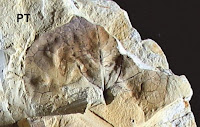 A fossil Birthwort from the Late Miocene of Austria. Birthworts (Aristolochiaceae) are perennial rhizomatous herbs, shrubs or
lianas (woody climbers), with large, conspicuous flowers, found across...
A fossil Birthwort from the Late Miocene of Austria. Birthworts (Aristolochiaceae) are perennial rhizomatous herbs, shrubs or
lianas (woody climbers), with large, conspicuous flowers, found across...

Aristolochia zebrina, anthetic flower showing the strips of the perianth limb. Joelcio Freitas in Freitas et al. (2016).
Aristolochia zebrina was found growing at a number of sites in northern Espírito Santo State, in Restingas (coastal broad-leaf forests) and wet tropical Tabuleiro forests (coastal tropical forests on clay soil). Due to the low number of specimens observed (less than 250) and the small area of covered by the plants, Frietas et al. recomend that the species be classed as Endangered under the terms of the International Union for the Conservation of Nature's Red List of Threatened Species.

Habitat of Aristolochia zebrina in Conceição da Barra. Joelcio Freitas in Freitas et al. (2016).
See also...
A fossil Birthwort from the Late Miocene of Austria. Birthworts (Aristolochiaceae) are perennial rhizomatous herbs, shrubs or
lianas (woody climbers), with large, conspicuous flowers, found across...
Follow Sciency Thoughts on Facebook.


