Showing posts with label Angiosperms. Show all posts

Sunday, 15 December 2024

Florissantia sp.: A fossil flower from the Early Eocene of Rajasthan.

The Malvaceae first appeared in the Cretaceous in North America, and have achieved a global distribution today, most notably as a significant component of almost all tropical forests. The genus Florissantia shows a number of features associated with different extant subfamilies of the Malvaceae, and is known from the Middle Eocene till the Miocene of western North America, with specimens known from British Colombia, Colorado, Montana, Oregon, and Washington, as well as a single specimen being known from the Sikhote Alin mountains of the Russian Far East.

In a paper published in the journal Botany Letters on 21 October 2024, Ashif Ali and Mahasin Ali Khan of the Palaeobotany, Palynology, and Plant Evolution Laboratory at Sidho-Kanho-Birsha University, and Raman Patel and Rajendra Singh Rana of the Department of Geology at Rauthan Hemvati Nandan Bahuguna Garhwal University, describe a specimen of Florissantia from the Early Eocene Palana Formation of Rajasthan, India.

The specimen comes from the Laminate Maroon Shale Bed of the Palana Formation, which is exposed at the Gurha Open-cast Lignite Mine at Bikaner in northwest Rajasthan. It is preserved as part and counterpart on a piece of a piece of split- laminated shale, which has been further exposed by micro excavation of successive layers of the rock with fine needles under a dissection microscope. 

(a) Map of Rajasthan showing the location of the Gurha opencast lignite mine (red star) Bikaner Rajasthan, India; (b) view of the fossil locality. Ali et al. (2024).

The preserved fossil is a star-shaped flower about 13 mm in diameter (sgnificantly smaller than any other member of the genus), with a calyx made up of five fused and rounded sepals of roughly equal length; the petals are missing. Importantly, the sepals each show numerous prominent veins, the pattern of which is used by Ali et al. as a diagnostic tool to place the specimen in the genus Florissantia.

(a) Transversely impressed, radially symmetric, pentamerous fossil flower of Florissantia sp. (SKBU/PPL/R/F/01A, part); (b) magnified image of the specimen showing thick filaments (marked by red arrows) surrounding the compressed, carbonaceous central area; (c) enlarged view of a single calyx lobe showing prominent parallel (marked by blue arrows) and radiating reticulate (marked by white arrows) venation; (d) counterpart of fossil flower of Florissantia sp. (SKBU/PPL/R/F/01B); (e) central area of figured in higher magnification; (f) line drawing of (c) showing parallel (marked by blue arrows) and reticulate (marked by red arrows) venation, Scale bars are 2.5 mm for (a), (b), (d), and (e) and 500 μm for (c) and (f). Ali et al. (2024).

The Palana Formation of Rajasthan has been dated to between about 55 and 52 million years before the present on the basis of palynological data (fossil pollen). This Early Eocene date makes the Bikanar specimen the oldest representative of the genus Florissantia, which together with its unexpected location, potentially makes the specimen highly significant. 

Line drawings of the Bikanar specimen and earlier reported extinct fossil flower species: (a) Bikanar fossil flower of Florissantia sp.; (b )fossil flower of Florissantia ashwillii from the Oligocene of Oregon; (c) fossil flower of Chaneya membranosa from the Miocene of Poland; this appears similar to Florissantia spp, but has unequal sepals. Scale bars are 5 mm. Ali et al. (2024).

The Palana Formation was laid down on the shores of an ancient lake, which is consistent with other locations where members of the genus Florissantia have been found. Other members of the genus are known from lake-associated Floras in tropical, subtropical, and temperate environments, often with some volcanic input; although the presence of volcanic ashes helps to preserve fine structures such as flowers, so it is possible that this connection with volcanic input reflects preservation bias rather than an environmental preference of the living plants.

See also...

Tuesday, 1 August 2023

Phytoliths from the stomach contents of Jeholornis prima, and their implications for the diet of early Birds.

Angiosperms, or Flowering Plants, are dominant members of almost all terrestrial (and some marine) ecosystems today. For a long time their origin was considered mysterious, but in the past two decades a wealth of new fossil material has gone a long way to unravelling this mystery. However, while these fossils can help us understand the phylogeny of the early Angiosperms, the way in which they came to dominate modern food webs through interactions with other organisms is harder to unravel. Modern Birds have a complicated relationship with Angiosperms, often being herbivores, but also pollinators and seed dispersers, but, as with Angiosperms, the fossils of early Birds tell us a limited amount about their ecological roles. 

The Early Cretaceous Jehol Biota of northeastern China is an important resource for our understanding of the early evolution of both Angiosperms and Birds, preserving some of the earliest known Angiosperm fossils as well as a wide diversity of Birds. The Jehol Birds show a wide variation in skull shape, dentition, and general morphology, suggesting a range of ecological and dietary specializations, although it is believed that the majority of these Birds were arboreal (tree-dwelling), and had a diet not dissimilar to modern arboreal Birds, including Insects, small Vertebrates, and some plant matter. These dietry assumptions have been supported by some direct fossil evidence, from the preserved stomach contents of Jehol Birds, as well as the presence of what are believed to have been gastroliths in the gizzards of some specimens. Nevertheless, this falls a long way short of the dietary variation seen in modern Birds, and leaves questions about the extent to which the rise of the Angiosperms and that of the Birds might be connected.

In a paper published in the journal Nature Communications on 28 July 2023, Yan Wu of the Key Laboratory of Vertebrate Evolution and Human Origins at the  Institute of Vertebrate Paleontology and Paleoanthropology of the Chinese Academy of Sciences, Yong Ge, also of the Key Laboratory of Vertebrate Evolution and Human Origins, and of the Department of Archaeology and Anthropology at the University of the Chinese Academy of Sciences, Han Hu of the Department of Earth Sciences at the University of Oxford, Thomas Stidham, again of the Key Laboratory of Vertebrate Evolution and Human Origins, and of the College of Earth and Planetary Sciences at the University of Chinese Academy of Sciences, Zhiheng Li and Alida Bailleul, again of the Key Laboratory of Vertebrate Evolution and Human Origins, and Zhonghe Zhou, once again of the ey Laboratory of Vertebrate Evolution and Human Origins and College of Earth and Planetary Sciences at the University of Chinese Academy of Sciences, present the results of a study in which they attempted to gain a deeper understanding of the relationship between early Birds and Angiosperms by examining the stomach contents of a Bird from the Jehhol Biota for phytoliths.

The specimen examined, IVPP V14978, is a subadult Jeholornis prima, one of the earliest branching Birds other than Archaeopteryx, and known from over a hundred well-preserved specimens. Jeholornis prima retains the long bony tail and akinetic skull of non-Avian Theropod Dinosaurs, but is starting to show the reduced dentition and other derived Bird-like features. A morphometric analysis of mandible and alimentary tract has suggested that it was at least partially frugivorous.

Phytoliths are opaline silica crystals which build up in the leaves of Plants as dissolved monosillicic acid taken up with groundwater is precipitated out as water is lost from the leaves via transpiration. Phytoloths have a long fossil record, are known to be resilient to dissolution, and, importantly, are taxonomically significant, with different groups of plants producing different shaped phytoliths. Previous studies have been able to reconstruct the diets of Dinosaurs by examination of phytoliths recovered from their teeth and faeces. 

Line-drawing, photography, and computed laminography scans of the specimen of Jeholornis prima (IVPP V14978). The stomach area from which the phytoliths were extracted is shaded gray in (a) and shown in the computed laminography scan in (d). (c) & (d) Are focused views of the skull and thoracic region from the computed laminography scans. Black arrows in (d) indicate the gastroliths preserved associated with the residue (black arrows in (b)) sampled from the digestive tract, and the parallel white arrows indicate thoracic and sternal ribs. Abbreviations: c, coracoid; cav, caudal vertebrate; cb, ceratobranchial; che, chevron; cv, cervical vertebrate; de, dentary; ep, epibranchial; fe, femur; fr, frontal; gst, gastroliths; hu, humerus; II-2, manual digit phalanx II-2; III-3, manual digit phalanx III-3; isc, ischium; jp, jugal process; ju, jugal; lc, lacrimal; na, nasal; pa, parietal; pd, postdentary; pl, palatine; pm, premaxilla; pob, postorbital; pu, pedal ungual; pub, pubis; pzg; pre- and post-zygapophyses; qu, quadrate; rec, rectri;, res, residue; sc, scapula; sk, skull; stc, stomach content; sq, squamosal; syn, synsacrum; tib, tibiotarsus; tmt, tarsometatarsus; to, tooth; ul, ulnae; w, wing feathers. Wu et al. (2023).

Specimen IVPP V14978 s one of the smallest known Birds assigned to the Jeholornithidae, and is considered to be a subadult Jeholornis prima, based on the presence of a long bony tail, a strut-like coracoid, and a largely edentulous jaw. About two grams of carbonized material, interpreted as potential food residue within the gastric region of the Bird, was scraped from this specimen with a clean razor blade for analysis. Processing of this sample produced 418 phytoliths, from the gastric region of the Bird, but none from the surrounding sediment, supporting the hypothesis that these were derived from the Bird's stomach contents, not the contamination from the surrounding environment. 

The majority of these phytoliths (68%) have a blocky body with wavy ridge ornamentations and a size of ranging between about 45 and 90 μm. A blocky form and wavy ridgeline is consistent with several types of Plants, including Ferns, Conifers, Grasses, Broad-leaved Trees, and members of the Magnoliales.  While Grasses, Ferns, and Conifers do produce blocky phytoliths with wavy ridgelines, these are rectangular, while those from the sample are polyhedral. Furthermore, the phytoliths of most Broad-leafed Trees have very weak ridgelines, while those of the sample are well developed, making it probable that the phytoliths from the sample came from a Magnoliid. Comparison of the phytoliths to a large selection (over 4000 samples) of modern phytoliths from known plants found that they were most similar in form to those of the Coconut Magnolia, Lirianthe coco, and Machilus nanmu, a type of Laurel found in south China, both members of the Magnoliales. 

Comparison between fossil phytoliths extracted from the digestive tract of Jeholornis prima (IVPP V14978) and modern phytoliths. (a), (b) Fossil blocky phytoliths with wavy ridgelines from the stomach content of Jeholornis prima (IVPP V14978), consistent with the blocky phytoliths in modern Magnoliid leaves; (c) blocky phytoliths with wavy ridgelines, extracted from Lirianthe coco leaves (an extant species of Magnoliales) collected from Guangxi Province, China; (d), (e) fossil phytoliths with radiate lines and a conical projection in the centre, which is similar to the hair base phytoliths in modern plants; (f) hair base phytoliths extracted from extant Ficus tikoua leaves collected from Gongga Mountain, Sichuan, China. Scale bar is equal across all panels. Wu et al. (2023).

Also present in the sample are two phytoliths with a round shape and a protuberant centre, resembling the phytoliths of modern Eudicots, and 132 phytoliths which could not be identified. While these phytoliths cannot be identified, they do provide evidence that the living Bird was consuming foliage from more than one sort of Plant. 

The Magnoliales and Laurales are currently thought to have diverged about 130 million years ago, based on molecular clock dating, with comprehensive adjustments derived from fossil calibrations. Other estimates for this divergence are 117 million years, based on a mega-phylogeny of plastid genomes, and o a reconstructed time frame derived from transcriptomes and nuclear genomes. None of these estimates is at odds with the age of the Jiufotang Formation, from which specimen IVPP V14978 was obtained, which has been dated to about 120 million years before the present, on the basis of radioisotope dating of a volcanic ash layer. The palynological record also suggests that the Jehol Biota included members Angiosperms such as Magnoliapollis, Liliacidites, Asteropollis, Knemapollis, and Chloranthus. Wu et al.'s data suggests that Magnoliids were present and that their leaves formed part of the diet of Jeholornis prima.

The fossils of the Jehol Biota were laid down in lake environments, within an ecosystem with a mixture of Gymnosperm and Angiosperm Plants, as well as a wide variety of Vertebrate and Invertebrate Animals. Many modern Birds are arboreal specialists, and Birds such as Jeholornis prima appear to have been early pioneers of this environment, showing adaptations to an arboreal environment, and having a diet which included fruits, seeds, and leaves. An ecological shift to living in the treetops combined with a dietary shift away from carnivory to include a range of Plant foods could have been a significant driver of Avian evolution away from the ecological niche occupied by their closest relatives, the Dromaeosaurs and Troodontids.

Artist’s reconstruction of Jeholornis prima with potential angiosperm arboreal herbivorous feeding ecology proposed by Wu et al.. The leaf of Cretaceous Angiosperm was reconstructed as the diet of Jeholornis. Wu et al. (2023).

An ecological shift to living in trees combined with an ecological shift to a largely herbivorous diet in forests increasingly becoming dominated by Angiosperms could potentially have had a significant impact on the evolution of the early Birds, during their Cretaceous radiation. Such a transition appears to have been marked by the adoption of gastroliths, as well as a reduction in dentition, a thinning of the enamel on the remaining teeth, and changes in the shape of the skull. A prior morphometric analysis of the mandible of Jeholornis found that it was a generalist herbivore, possibly with a diet similar to that of modern Anserform or Galliform Birds, although it also showed a strong similarity to the Hoatzin, Opisthocomus hoazin, a modern specialist leaf-eater. Wu et al.'s study supports the idea that Jeholornis was a herbivore, with leaves forming at least part of its diet. Leaves are generally considered to be a poor diet for Birds, due to the low amounts of energy they provide, which is not sufficient to support the energy requirements of sustained flight. Jeholornis appears to have had a diet which included seasonally available fruits, and to have used gastroliths during an alternative season to help it process other foods. It is quite possible that it consumed some leaves as part of a wider herbivorous diet, as it the case with modern groups such as Mousebirds. 

See also...

Online courses in Palaeontology. 

Follow Sciency Thoughts on Facebook.

Follow Sciency Thoughts on Twitter.


Sunday, 4 June 2023

A Lotus from the Early Cretaceous Crato Formation of northeastern Brazil, and its implications for the origin of the group.

Angiosperms, or Flowering Plants, are the most numerous and diverse Plant group today, dominating almost all terestrial environments. The ealiest Angiosperm fossils appear an the Early Cretaceous, around the shores of the Tethys Ocean, with many Angiosperm groups appearing sudenly, in forms apparently not much different to today, making it impossible to tell how these groups are related without molecular data.

Lotuses, Nelumbonaceae, are aquatic Plants, superficially similar to Water Lilies, to which they were once thought to be related. They grow annually from submerged rhizomatous roots, producing large flar leaves with hydrophobic coatings which lie flat upon the water surface. Surprisingly, molecular analysis of Angiosperm relationships has revealed that Lotuses not closely related to Water Lilies, which are related to Magnolias, but instead are members of the Order Proteales (Proteas), most closely related to Plane Trees. This is particularly surprising as all other members of the Proteales are woody shrubs and trees, while Lotuses are aquatic annual herbs lacking any woody tissue. 

In a paper published in ths journal Scientific Reports on 2 June 2023, William Vieira Gobo of the Departamento de Paleontologia e Estratigrafa at the Universidade Federal do Rio Grande do Sul,  Lutz Kunzmann of the Abteilung Museum für Mineralogie und Geologie, Roberto Iannuzzi and Thamiris Barbosa dos Santos, also of the Departamento de Paleontologia e Estratigrafa at the Universidade Federal do Rio Grande do Sul, Domingas Maria da Conceição of the Museu dePaleontologia Plácido Cidade Nuvens at the Universidade Regional do Cariri, Daniel Rodrigues do Nascimento and Wellington Ferreira da Silva Filho of the Departamento de Geologia at the Universidade Federal do Ceará, Julien Bachelier and Clément Coifard of the Structural and Functional PlantDiversity Group at the Freie Universität Berlin, describe a new species of Lotus from the Early Cretaceous Crato Formation of Ceará State, Brazil.

The new species is described from pits to the southwest of Nova Olinda in the Araripe Basin of northeastern Brazil, and now in the collections of the Museum für Naturkunde in Berlin and the Senckenberg Forschungsinstitut und Naturmuseum in Frankfurt am Main. The authors acknowledge that there are currently unresolved issues concerning fossils from the Crato deposits, with the Brizilian government regarding all removal of the fossils from the country as illegal, and asking that collections in other parts of the world return them, but note that the Brazilian members of the team were invited by the German institutions to come and study the material. The Plant is named Notocyamus hydrophobus, where 'Notocyamus' means 'Southern Bean' in Greek, a refernce to the term 'Egyptian Bean' used by Teophrastos of Eresos to refer to Lotus seeds, and 'hydrophobus' refers to the hydrophobic leaves of Lotus Plants.

Notocyamus hydrophobus (holotype, MB. Pb. 2002/1047). (A) Overview of the whole plant, with roots, rhizome, leaves, and aggregate fruit in organic connection. A black arrow points to the part of the peduncle used to make the thin sections. (B) Details of higher-order venation. (C) Close-up of palinactinodromous venation and the marginal lamina attachment. (D) Close-up on the enlarged receptacle showing two globose fruitlets (presumed nutlets). Scale bars are 1 cm. Gobo et al. (2023).

The holotype specimen is about 30 cm high and about 25 cm wide, and comprises a rhizome with about 30 roots, 13 leaves, and a single fruiting body. Leaves are 60 to 95 cm long and 60 to 100 mm wide, and oval to eliptical in shape. They are attached to petiole stems 120-200 mm long and 5-10 mm wide. The cells of the leaves are discernable, larger on the upper side than on the lower with each cell bearing a single papilla (hair), agian larger above than below.

Notocyamus hydrophobus (paratype, SMF SM.B 16.522). (A) Isolated leaf. (B), (C) Close-ups of the pattern of venation. Note that abundant structures interpreted as galls occur along the lamina and petiole (arrows point to some of them). Scale bars are 5 mm. Gobo et al. (2023).

The fruiting body is borne on a peduncle stem 22.5 cm long and 4 mm wide. Notably, this peduncle has in inner pith layer surrounded by xylem (wood), a tissue not seen in any modern Lotus, but present in all other members of the Order Proteales. 

Notocyamus hydrophobus (holotype, MB. Pb. 2002/1047). (A)–(B) Transversal section of the peduncle. (A) Overview displaying homoxylic wood with abundant fbers interspersed with parenchymatous rays. Te dashed outline shows the rays connecting with primary xylem that form bundles near the pith. On the periphery, remains of the cambial zone occur in a discontinuous layer that is followed by new vascular increments. (B) Close-up of region near pith showing the primary xylem bundles and their connection with the rays. Abbreviations: pi. pith; px, primary xylem; sx, secondary xylem; r, ray; cz, cambial zone; vi, vascular increments; pxb, primary xylem bundles. Scale bars: (A) 1 mm; (B) 250 µm. Gobo et al. (2023).

The xylum tissue comprises an inner layer of 18 (or possibly 19) primary bundles, surrounded by a secondary homoxylic (vesselless) layer. No growth rings are present, and the whole is surrounded by an ounter layer thought to be the remains of the cambium (bark).

Notocyamus hydrophobus (holotype, MB. Pb. 2002/1047). Radial (A)–(G) and tangential (H) sections of the peduncle. (A) Overview of region adjacent to the pith (to the far right) showing vessels in the xylem followed by the secondary xylem with ray and fber cells (to the far left). (B) Primary xylem cells with helical thickenings and fbers of secondary xylem. (C) A vessel element with scalariform-like pits and simple perforation plates (arrows). (D) Close-up of a fiber showing simple (black arrow) and slit-like pits (white arrow). (E) Ray cells with slit-like pit apertures. (F) Overview of region near cambial zone (dashed outline) showing fber and ray cells in the secondary xylem followed by the layer that gives rise to the new vascular increments. (G) Fusiform and compressed cells from the cambial zone followed by tracheary elements with scalariform-like pits. (H) Ray cells in between fbers of secondary xylem. Abbreviations: v, vessels; px, primary xylem; r, ray; f, fber; cz, cambial zone; vi, vascular increments. Scale bars: (A), (F) 200 µm; (B), (C), (E), (G) 50 µm; (D) 25 µm; (H) 100 µm. Gobo et al. (2023).

The Crato Formation has not been dated precisely, but is thought to be slightly more than 120 million years old, which, if correct, would make Notocyamus hydrophobus the oldest known member of the Nelumbonaceae. Molecular dating techniques have suggested that the Nelumbonaceae branched from theit closest relatives, the Platanaceae (Plane Trees) between 83 and 123 million years ago. Since dates at the younger end of this range can be ruled out by other, more modern-looking fossil Lotuses it is not unreasonable to assume that the group dates from the earlier part of this bracket, or possibly a little older. Either way, the assumption that Notocyamus hydrophobus is a very early member of the group, still showing some similarities to non-Lotus relatives, is not unreasonable.

Reconstruction of Notocyamus hydrophobus in its likely environment. Rebecca Dart in Gobo et al. (2023).

See also...

Follow Sciency Thoughts on Facebook.

Follow Sciency Thoughts on Twitter.


Tuesday, 5 April 2022

Covidifructus multicarpellatus: A multicarpellate fruit from the Late Cretaceous of South Bohemia.

The earliest Flowering Plants are thought likely to have produced flowers with several carpels (ovule-bearing female reproductive organs) free from each other, a state still seen in Plants such as Lotuses and Roses. However, most modern Flowering Plants have flowers with several fused carpels, typically three in Monocotylodons and two to five in Eudicotids. This is thought to have been a key adaptation in Flowering Plants, allowing more efficient pollination and seed/fruit dispersal, which arose multiple times in different lineages early in the history of the Flowering Plants. Although most modern (and fossil) Flowering Plants have fused carpels, plants with more than five carpels in a single whorl are rare, despite having evolved numerous times in different Plant groups, suggesting the advantages of such an arrangement are limited. Today this condition can be seen in some Water Lilies, Water Plantains, Poppies, and several other lineages. Examples are known in the fossil record as well, including Monetianthus mirus, a Water Lily from the Early Cretaceous of Portugal, Carpestella lacunata, probably a member of an extinct group closely related to Water Lilies, from the Early Cretaceous of North America, and Elsemaria kokubunii, probably a member of the Dilleniaceae, a group of woody shrubs with a largely tropical distribution, from the Late Cretaceous of Japan.

In a paper published in the journal Palaeontologica Electronica on 14 January 2022, Zuzana Heřmanová of the National Museum in Prague, Jana Čepičková of the Institute of Geology and Palaeontology at Charles University, Jiří Kvaček, also of the National Museum in Prague, and Maria von Balthazar and Jürg Schönenberger of the Department of Botany and Biodiversity Research at the University of Vienna, describe a new multicarpellate fruit from the Late Cretaceous of South Bohemia.

The specimen comes from the Klikov Formation (Late Turonian–Santonian) at the Zliv-Řídká Blana Quarry, a typical Laurasian Late Cretaceous site which has produced fossils of Plant reproductive organs, leaves, and wood belonging to the Normapolles (an extinct group related to Oaks and Beeches), Proteales (Proteas), Laurales (Laurels), Ericales (Heathers), as well as Insects and the coprolites of larger Animals. It is a charcoalified and 3-dimensionally preserved specimen representing a 10-carpellate syncarpous gynoecium.

The new species is named Covidifructus multicarpellatus, where 'Covidifructus' refers to the Covid-19 pandemic, which provided the authors with the time to work on the project, and 'multicarpellatus' refers to the multicarpellate nature of the specimen. The specimen has 10 carpels in radial symmetry, each of which has a single locule (cavity) holding a large oblong ovule or seed. Lines of dehiscence (i.e. lines along which the body would be expected to split open) are located on the median-dorsal side of each carpel.

 
Covidifructus multicarpellatus; specimen No. NMP F3200; scale bars equal 100 μm in all figures. (A) Small premature capsular fruit in lateral view, semi-globose in overall shape; SEM. (B) Fruit seen in apical view; note preformed dorsal lines of fruit dehiscence; SEM. (C) Close-up of fruit apex showing styles and stigmatic areas (asterisks); note irregular closure of ovary in the very centre; SEM. (D) MicroCT volume rendering, lateral view, showing 10 elongate seeds (green), one seed per carpel. (E) MicroCT volume rendering, apical view, showing regular arrangement of carpels and seeds. (F) Detail of central ovary closure (dashed line); note that some of the carpel flanks (arrowheads) do not extend to the very centre of the closure zone; SEM. Heřmanová et al. (2022).

Heřmanová et al. compared Covidifructus multicarpellatus to a range of extant and fossil multicarpellate fruit-bearing Plants. It does not appear to be closely related to either Monetianthus mirus or Carpestella lacunata. It does appear to resemble illustrations of Elsemaria kokubunii somewhat, although Heřmanová et al. disagree with the original description of this fossil, a single permineralized fruit from the Late Cretaceous of Japan, given by Harufumi Nishida in 1994. If Heřmanová et al.'s interpretation of that fossil is correct, then Covidifructus multicarpellatus and Elsemaria kokubuniii are likely to be related, and both to be members of the Dilleniaceae, but re-examination of the original material of Elsemaria kokubuniii would be needed before this can be confirmed.

See also...


Online courses in Palaeontology. 

Follow Sciency Thoughts on Facebook.

Follow Sciency Thoughts on Twitter.


Thursday, 26 December 2019

Gagea spelaea: A new species of Star-of-Bethlehem from the Western Tian Shan of Kyrgyzstan.

The genus Gagea comprises spring-flowering, herbaceous Lilies know by the common name of Stars-of-Bethlehem. The genus is a taxonomically difficult group, which requires examination of living plants for precise identification. A number of features, including the structure of bulbs, the character of vegetative reproduction, the presence, length, and cross section of the basal leaf, the shape of the inflorescence and capsules, the colour of tepals, and so on, are important for taxonomic identification in this genus. For correct identification, the characters of not only generative but also vegetative individuals are usually required. There are different estimates of the number of species in the genus, from about 100 to more than 320. In Kyrgyzstan 36 species of this genus have been described, with several undescribed taxa known in the mountains surrounding the Fergana Valley.

In a paper published in the Journal of Asia-Pacific Biodiversity on 3 February 2019, Igor Levichev of the Komarov Botanical Institute of the Russian Academy of Sciences, Chang-gee Jang of the Department of Biology Education at Kongju University, Seung Hwan Oh of the Forest Biodiversity Division at the Korea National Arboretum, and Georgii Lazkov of the Institute for Biology of the  National Academy of Sciences of Kyrgyzstan, describe a new species of Star-of-Bethlehem from the Sary-Chelek Nature Reserve in the Chatkal Range of the Jalal-Abad Region of western Kyrgyzstan, part of the Western Tian Shan Mountain Range.

The new species is named Gagea spelaea, where 'spelaea' means a den or small cave, in reference to the environment where the plants were found, on niches on conglomerate cliffs, in the Bokchop River Gorge. This species is distinctive in having completely white flowers, unlike the yellow or yellowish white. The species also has relatively small vegetative bulbils underground at the base, with a slender above-ground plant reaching about 25 cm in height.

Gagea spelaea: (A) general habit; (B) open flower. Georgii Lazkov in Levichev et al. (2019).

See also...

https://sciencythoughts.blogspot.com/2019/10/pseuderia-samarana-new-species-of.htmlhttps://sciencythoughts.blogspot.com/2019/06/thismia-submucronata-new-species-of.html
https://sciencythoughts.blogspot.com/2019/02/aloe-sanguinalis-new-species-of-aloe.htmlhttps://sciencythoughts.blogspot.com/2019/02/sclerosperma-protomannii-sclerosperma.html
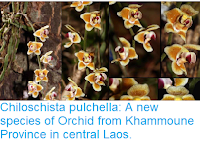
https://sciencythoughts.blogspot.com/2018/12/chiloschista-pulchella-new-species-of.htmlhttps://sciencythoughts.blogspot.com/2018/12/merostachys-mexicana-new-species-of.html
Follow Sciency Thoughts on Facebook.

Saturday, 7 September 2019

Rhaptopetalum rabiense: A new species of Fruitning Tree from southwest Gabon.

The Lecythidaceae are a group of tropical flowering trees and shrubs related to Heathers, which are found across South America, Africa, Madagascar, Asia, Australia and the islands of the Indian and Pacific oceans. Notable members of the group include Brazil Nuts, Bertholletia excelsa, Jequitibá-rosa Trees, and various Asian and Australian Mangroves. The genus Rhaptopetalum currently contains eleven species of Fruiting Trees from Central Africa and one from West Africa.

In a paper published in the journal PhytoKeys on 23 July 2019, David Kenfack of the Forest Global Earth Observatory at the Smithsonian Tropical Research Institute, and the Department of Botany at the  National Museum of Natural History, and Diosdado Ekomo Nguema of the Gabon Biodiversity Program at the Smithsonian Conservation Biology Institute, describe a new species of Rhaptopetalum from southwest Gabon.

The new species is named Rhaptopetalum rabiense, meaning 'from Rabi' in reference to the Rabi Forest of southewestern Gabon, where it was discovered. It is a small tree reaching 4-6 m in height, and a maximum of 20 cm at 1.3 m above the ground (waist height), and covered with pale brown bark. The leaves arranged on the stems alternately in two opposite vertical rows, are hairy and lenticular, and can be up to 18 cm in length and 9 cm in width. Pink and yellow flowers are produced on short stems arising from the main branches in August to October. Fruit are green berries 15-20 mm in diameter, produced in September-December.

Rhaptopetalum rabiense (A) flowering branch (B) lateral view of the flower (C) flower view from above showing the poricidal anthers and the gynoecium (D) fruiting branch. Diosdado Nguema in Kenfack & Nguema (2019).

The species was found growing in both flooding and non-flooding parts of the forest, but the total area occupied by the trees was only 0.214 km², and the entire population of 299 trees was contained within an area of 8.00 km². Since this area has no legal protection, and is threatened by both oil and gas production and logging, Kenfack and Ngeuma assess the species to be Critically Endangered under the terms of the International Union for the Conservation of Nature’s Red List of Threatened Species. Importantly the species could not be found in either the Loango National Park to the west or the Moukalaba Doudou National Park on the east.

Rhaptopetalum rabiense (A) flowering twig (B) close-up of the lower surface showing the indumentum and the punctate lamina (C) detail of inflorescence and stem showing lenticels (D) flower bud (E) opened flower (F) flower with pseudocorolla and stamens removed showing superior ovary (G) longitudinal section of (F) showing pendulous ovules (H) fruiting branch. Kenfack & Nguema (2019).

See also...

https://sciencythoughts.blogspot.com/2019/09/understanding-wild-ecology-of-ebola.htmlhttps://sciencythoughts.blogspot.com/2019/07/clash-between-villagers-and-park.html
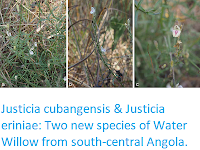
https://sciencythoughts.blogspot.com/2019/07/geissleria-lubiluensis-geissleria.htmlhttps://sciencythoughts.blogspot.com/2019/05/justicia-cubangensis-justicia-eriniae.html
https://sciencythoughts.blogspot.com/2019/02/ceratogyrus-attonitifer-new-species-of.htmlhttps://sciencythoughts.blogspot.com/2019/02/lactifluus-bicapillus-new-species-of.html
Follow Sciency Thoughts on Facebook.