Showing posts with label Bangkok. Show all posts

Thursday, 2 October 2025

Police station and residential buildings evacuated after giant sinkhole opens in Bangkok, Thailand.

Several residential buildings as well as the Samsen Metropolitan Police Station remain closed after a sinkhole approximately 30 m wide and more than 15 m deep opened up beneath the Samsen Road in the Dusit District of Bangkok, Thailand, on Wednesday 24 September 2024. The nearby  Vachira Hospital has been able to remain open, benefiting from a system of deep piles intended to keep it stable during Earthquakes. The sinkhole swallowed a number of vehicles, as well as several electricity pylons, but nobody was injured during the incident.

A massive sinkhole which opened up in Bangkok, Thailand, on 24 September 2025. Chalinee Thirasupa/Reuters.

Sinkholes are generally caused by water eroding soft limestone or unconsolidated deposits from beneath, causing a hole that works its way upwards and eventually opening spectacularly at the surface. Where there are unconsolidated deposits at the surface they can infill from the sides, apparently swallowing objects at the surface, including people, without trace. 

Bangkok is known to be prone to such problems, being situated on a flat plain of alluvial sediments, and having historically suffered from widespread subsidence due to over-extraction of water from underlying aquifers. This incident was initially linked to heavy rainfall in the area, linked to the local rainy season, which peaks in September. However, subsequent investigations have suggested that vibrations from tunnel excavations for a new subway system may have led to the breakage of a water main, causing water to gush into, and erode, the soft sediments beneath the Samsen Road.

Water gushing from a broken water main into a newly opened sinkhole on 24 September 2025. Thailand Construction News.

Soil liquefied by the initial water main break flowed into the under-creation Purple Line Tunnel, creating a void which undermined further water mains, causing them to sag and break, releasing more water and causing the rate of erosion to increase, leading to the dramatic emergence of the sinkhole at about 7.00 am on 24 September. 

This situation was made worse by initial attempts to fix the problem, which involved pouring 700 cubic meters (about 1500 tonnes) of liquid concrete into the hole. This concrete also found the gap into the tunnel system, with its additional mass causing a 30 m² breach into the tunnel system to open up, through which the concrete flowed into the tunnel.

Engineers must now wait for the concrete to set before clearing out and stabilising the breach, then filling in whole, whilst at the same time preventing water from the seasonal rains entering the hole. Initial concerns that the newly constructed Samsen Metropolitan Police Station would need to be demolished have now been dispelled, but engineers are warning that it may be over a year before it is possible for it to reopen. 

See also...

Monday, 30 March 2020

Fodinicola acaciae: A novel Endophytic Actinomycete Fungi isolated from the roots of a Black Wattle Tree, Acacia mangium, in Thailand.

Endophytic Actinomycete Fungi colonise the internal plant tissues and usually have a beneficial effect to the host plant by promoting growth and protecting the plant from biotic and abiotic stresses without any damage or morphological changes to the plant. Isolation and identification of novel genus and species of Endophytic Actinomycetes is an attractive propostition for microbiologists since these organisms are potential sources for plant growth-promoting Bacteria and compounds. Substances isolated from Endophytic Actinomycetes have been shown to produce compounds which enhance plant growth, chelate iron and other elements, reduce plant stress ethylene, and solubilise of inorganic phosphate.

In a paper published in the journal Microorganisms on 25 March 2020, Huyền Thị Thanh Phạm of the Department of Genetics and Omics Center for Agriculture at Kasetsart University, Wipawadee Suwannapan, also of the Department of Genetics at Kasetsart University, Wilaiwan Koomsiri, again of the Department of Genetics and Omics Center for Agriculture at Kasetsart University, Yuki Inahashi of the Kitasato Institute for Life Sciences at Kitasato University, Akira Také of the Department of Microbiology at the Kitasato University School of Medicine, Atsuko Matsumoto, also of the Kitasato Institute for Life Sciences at Kitasato University, and Arinthip Thamchaipenet, once again of the Department of Genetics and Omics Center for Agriculture at Kasetsart University, describe a new species of Endophytic Actinomycete Fungi isolated from the roots of the Black Wattle Tree, Acacia mangium, growing in the grounds of Kasetsart University in Bangkok.

The new species is placed in the genus Fodinicola, which contains only one previously described species, Fodinicola feengrottensis, which was isolated from acidic metal-containing rocks of a medieval alum slate mine in Germany, and is given the specific name acaciae, which derives from 'Acacia', the generic name of the host plant. It is a gram-stain-positive, aerobic, non-motile, catalase-positive, oxidase-negative actinomycete that produces branched substrate mycelium and abundant aerial mycelium. Aerial hyphae break up into irregular rod-like elements. Colonies are wrinkled, beige to orange in colour. Growth occurs between 14 and 42 °C, good growth at 28 °C, and no growth below 14 °C or above 42 °C. Good growth occurs at pH 7.0 and pH 8.0, but no growth occurs at pH 3 nor pH 12. NaCl (salt) tolerance is up to 6%.

Scanning electron micrograph of fragmentation of aerial hyphae of Fodinicola acaciae on agar at 28 °C after 21 days. Scale bar is 2 μm. Pham et al. (2020).

See also...

https://sciencythoughts.blogspot.com/2019/06/looking-for-cause-of-rose-dieback.htmlhttps://sciencythoughts.blogspot.com/2018/05/cylindrocladiella-spp-five-new-species.html
https://sciencythoughts.blogspot.com/2018/05/stamnaria-yugrana-new-species-of-cup.htmlhttps://sciencythoughts.blogspot.com/2018/01/bifiguratus-adelaidae-new-species-of.html
https://sciencythoughts.blogspot.com/2017/12/endocarpon-deserticola-endocarpon.htmlhttps://sciencythoughts.blogspot.com/2017/07/beauveria-araneola-araneogenous-fungus.html
Follow Sciency Thoughts on Facebook.

Monday, 23 October 2017

Seven dead in Thailand flooding.

Seven people have died in flooding in northern Thailand since 10 October 2017, as the country has suffered its heaviest rains for thirty years, with 214 mm of rain falling on Bangkok in a single night this weekend (more than two thirds of the rain that would usually be expected to fall on the city in the entire of October). In order to protect the city, authorities have restricted the outflow of water from the Chao Phraya Barrage, leading to flooding in communities behind the dam; this comes after a decision to increase the outflow from the dam earlier this month that resulted in flooding in communities downstream of the dam, an operation which cannot be repeated without effecting the city, as high rain levels have prevented the floods from subsiding.

An earth barrage in the Khok Samrong district of Lop Buri Province that gave way on Tuesday 17 October 2017, causing flooding in villages downstream. Thia Visa.

Thailand has a tropical climate, with a monsoon season that usually lasts from June to October. Typically September produces the highest rainfall, with the rains trailing off in October. However, as with other countries in Southeast Asia this year, the rains have been exceptionally heavy this year, so that reservoirs and barrages have filled to capacity by the beginning of October, and the rains have persisted longer, pushing water storage systems beyond their capacity.

Flooding in the Sapphaya District of Chai Nat Province, caused by a discharge of water from the Chao Phraya Barrage earlier this month. Chudet Sihawong/The Straits Times.
Monsoons are tropical sea breezes triggered by heating of the land during the warmer part of the year (summer). Both the land and sea are warmed by the Sun, but the land has a lower ability to absorb heat, radiating it back so that the air above landmasses becomes significantly warmer than that over the sea, causing the air above the land to rise and drawing in water from over the sea; since this has also been warmed it carries a high evaporated water content, and brings with it heavy rainfall. In the tropical dry season the situation is reversed, as the air over the land cools more rapidly with the seasons, leading to warmer air over the sea, and thus breezes moving from the shore to the sea (where air is rising more rapidly) and a drying of the climate. This situation is particularly intense in South Asia, due to the presence of the Himalayas. High mountain ranges tend to force winds hitting them upwards, which amplifies the South Asian Summer Monsoon, with higher winds leading to more upward air movement, thus drawing in further air from the sea. 

Diagrammatic representation of wind and rainfall patterns in a tropical monsoon climate. Geosciences/University of Arizona.

See also...

http://sciencythoughts.blogspot.co.uk/2017/01/eighteen-confirmed-deaths-as-flash.htmlhttp://sciencythoughts.blogspot.co.uk/2014/06/three-workers-killed-by-landslide-at.html
http://sciencythoughts.blogspot.co.uk/2014/05/surface-rebound-on-bangkok-plain.htmlhttp://sciencythoughts.blogspot.co.uk/2014/05/magnitude-60-earthquake-in-chiang-rai.html
http://sciencythoughts.blogspot.co.uk/2013/08/oil-spill-devastates-popular-thai.htmlhttp://sciencythoughts.blogspot.co.uk/2013/06/three-workers-killed-in-rockfall-at.html
Follow Sciency Thoughts on Facebook.

Thursday, 29 May 2014

Surface rebound on the Bangkok Plain.

A number of fast growing cities around the world have suffered subsidence as a result of over-extraction of water from aquifers in recent decades, in some cases resulting in severe damage to buildings and infrastructure. Many cities have attempted to mitigate this, either by regulating groundwater pumping or, in more extreme cases, deliberately pumping water back into affected aquifers. However the relationships between over-extraction, subsidence, decreased pumping and surface recovery are poorly understood, particularly as these are slow processes, where subsidence will generally persist for some time after measures to mitigate it are introduced.

In a paper published in the journal Geochemistry, Geophysics, Geosystems on 14 February 2014, Kazuya Ishitsuka of the Department of Urban Management at Kyoto University, Yo Fukushima of the Disaster Prevention Research Institute, also at Kyoto University, Takeshi Tsuji of the International Institute for Carbon-Neutral Energy Research at Kyushu University, Yasuhiro Yamada and Toshifumi Matsuoka, also of the Department of Urban Management at Kyoto University and Pham Huy Giao of the School of Civil Engineering at the Asian Institute of Technology in Pathuthani, Thailand, describe the results of a study of surface levels on the Bangkok Plain over the period November 2007 to December 2010, using the Phased Array type L-band Synthetic Aperture Radar (PALSAR) instrument on the Japan Aerospace Exploration Agency’s Advanced Land Observing Satellite (ALOS).

Bangkok is situated on an area of flat lowlands close to the Chao Playa River Delta. The city is located on top of a number of aquifers, and previously suffered severe subsidence due to over-extraction from two of these, the Phra Pradang, which is located at a depth of 60-80 m, and the Nakorn Luang, located at a depth of 100-140 m. In 1997 the Thai Government introduced to regulate and reduce the levels of extraction from these aquifers, since when water levels are known to have recovered, though the effect on the ground level is less certain.

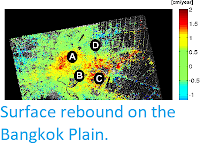
A large area (about 250 km²) of the centre of Bangkok was found to be uplifting during the three years of the study. This area ran from the west bank of the Chao Playa River in the west to Suvarnabhumi International Airport in the east, the northern and southern boundaries of the uplift matching roughly the extent of urbanization on the plane. The northwest part of this area uplifted by 2-3 cm during the three years of the study period, the central part by about 3 cm and the southeastern part by about 1 cm. However to the northeast of the area of uplift was an area where subsidence was still occurring; here the ground sank by an average of 1 cm over the study period. This area is home to a large industrial complex.

Areas of ground movement on the Bangkok plain during the three years of the study. (A) Northwestern uplift zone, where the ground rose 2-3 cm; (B) central uplift zone where the ground raised an average of 3 cm; (C) southeastern uplift zone, where the ground rose an average of 1 cm; (D) subsidence zone, where the ground sank an average of 1 cm. Ishitsuka et al. (2014).

As well as detecting ongoing uplift across much of the study area, Ishitsuka et al. were able to detect strong seasonal variations in the amount of uplift occurring. This varied across the study area, but followed a predictable pattern, with the seasonal uplift beginning close to the Chao Playa River, then spreading outwards to other areas. This strongly implies that the aquifers are being filled from runoff from the surrounding plains via the river; however Ishitsuka et al. also consider an alternative scenario may be occurring, where clay particles close to the surface are swelling and shrinking due to seasonal runoff, and note that it is beyond the method used in the current study to differentiate between these alternative scenarios.

See also…

 Magnitude 6.0 Earthquake in Chiang Rai Province, northern Thailand.

The United States Geological Survey recorded a Magnitude 6.0 Earthquake at a depth of 7.4 km in southern Chiang Rai Province in...


 Oil spill devastates popular Thai tourist resort.

The popular tourist resort of Prao Bay, on Ko Samet Island off the coast of Rayong Province in Thailand has been covered by a 30 cm...


 Three workers killed in rockfall at Thai limestone quarry.

Three workers are known to have died following the collapse of a rockwall at a Thai quarry on Monday 3 June 2013, and another four...


Follow Sciency Thoughts on Facebook.