Showing posts with label Sinkholes. Show all posts

Sunday, 5 July 2026

Five-year-old girl swallowed by sinkhole in Cape Town, South Africa.

A five-year-old girl has been rescued after being swallowed by a sinkhole at Wetland in the Khayelitsha Township of Cape Town, South Africa, on Friday 3 July 2006. The girl, who has not been named, was reportedly visiting her aunt in the area, when a section of road collapsed beneath her, leading her to fall into the hole and be covered over with sand. Local residents acted quickly, and were able to dig her out with handtools before serious harm occurred. 

A sinkhole which opened up in the Wetlands area of Khayelitsha on Friday 3 July 2026, swallowing a five-year-old girl. Siyavuya Khaya/Cape Argus.

Sinkholes are generally caused by water eroding soft limestone or unconsolidated deposits from beneath, causing a hole that works its way upwards and eventually opening spectacularly at the surface. Where there are unconsolidated deposits at the surface they can infill from the sides, apparently swallowing objects at the surface, including people, without trace.

However, on this occasion the problem is thought to have been caused by a bulk sewer pipeline which lies beneath the area. The informal settlement at Wetland has been built over this pipeline, which is in a poor state of maintenance, in need of upgrading, and has suffered a number of sinkhole-related problems as sections of the pipeline have collapsed. Officials from the City of Cape Town, which is responsible for the pipeline, report that they expect more collapses on the pipeline, which they struggle to access because of the presence of the settlement.

See also...

Thursday, 2 October 2025

Police station and residential buildings evacuated after giant sinkhole opens in Bangkok, Thailand.

Several residential buildings as well as the Samsen Metropolitan Police Station remain closed after a sinkhole approximately 30 m wide and more than 15 m deep opened up beneath the Samsen Road in the Dusit District of Bangkok, Thailand, on Wednesday 24 September 2024. The nearby  Vachira Hospital has been able to remain open, benefiting from a system of deep piles intended to keep it stable during Earthquakes. The sinkhole swallowed a number of vehicles, as well as several electricity pylons, but nobody was injured during the incident.

A massive sinkhole which opened up in Bangkok, Thailand, on 24 September 2025. Chalinee Thirasupa/Reuters.

Sinkholes are generally caused by water eroding soft limestone or unconsolidated deposits from beneath, causing a hole that works its way upwards and eventually opening spectacularly at the surface. Where there are unconsolidated deposits at the surface they can infill from the sides, apparently swallowing objects at the surface, including people, without trace. 

Bangkok is known to be prone to such problems, being situated on a flat plain of alluvial sediments, and having historically suffered from widespread subsidence due to over-extraction of water from underlying aquifers. This incident was initially linked to heavy rainfall in the area, linked to the local rainy season, which peaks in September. However, subsequent investigations have suggested that vibrations from tunnel excavations for a new subway system may have led to the breakage of a water main, causing water to gush into, and erode, the soft sediments beneath the Samsen Road.

Water gushing from a broken water main into a newly opened sinkhole on 24 September 2025. Thailand Construction News.

Soil liquefied by the initial water main break flowed into the under-creation Purple Line Tunnel, creating a void which undermined further water mains, causing them to sag and break, releasing more water and causing the rate of erosion to increase, leading to the dramatic emergence of the sinkhole at about 7.00 am on 24 September. 

This situation was made worse by initial attempts to fix the problem, which involved pouring 700 cubic meters (about 1500 tonnes) of liquid concrete into the hole. This concrete also found the gap into the tunnel system, with its additional mass causing a 30 m² breach into the tunnel system to open up, through which the concrete flowed into the tunnel.

Engineers must now wait for the concrete to set before clearing out and stabilising the breach, then filling in whole, whilst at the same time preventing water from the seasonal rains entering the hole. Initial concerns that the newly constructed Samsen Metropolitan Police Station would need to be demolished have now been dispelled, but engineers are warning that it may be over a year before it is possible for it to reopen. 

See also...

Monday, 30 December 2024

Sinkhole closes Interstate 80 highway in New Jersey.

A section of the Interstate 80 highway in Morris County, New Jersey was closed to eastbound traffic after a sinkhole opened beneath it on Thursday 26 December 2024. The sinkhole, which was about 12 m across and about 12 m deep appeared close to the town of Wharton, and was first spotted at about 7.40 am local time. Engineers have excavated around the area and then backfilled the whole area with rock and concrete, and expect the highway to reopen on Monday 30 December.

A sinkhole which appeared beneath the Interstate 80 highway in Morris County, New Jersey, on 26 December 2024. WABC.

Sinkholes are generally caused by water eroding soft limestone or unconsolidated deposits from beneath, causing a hole that works its way upwards and eventually opening spectacularly at the surface. Where there are unconsolidated deposits at the surface they can infill from the sides, apparently swallowing objects at the surface, including people, without trace. 

Repairs being carried out to the Interstate 80 highway near Wharton, New Jersey, following the opening of a sinkhole on 26 December 2024. NorthJersey.com.

On this occasion the sinkhole is thought to have been caused by the collapse of an abandoned mineshaft beneath the highway. Morris County was once home to a hundred mine, principally targeting iron ore, many of which dated back to the eighteenth century, and therefore were poorly mapped by modern standards. The last of these mines closed in 1986, but abandoned mines still occasionally cause problems, including sinkholes, in the area. The Mount Pleasant Mine, which opened in 1786 and closed in 1896 is thought to have run beneath the modern Interstate 80 highway. The mine comprised a single inclined tunnel, which averaged 2 m in width and reached over a kilometre in length and more than 424 m beneath the surface.

See also...

Tuesday, 25 July 2023

Sinkhole swallows car in Coventry, England.

A car has been swallowed by a sinkhole in the city of Coventry, England. West Midlands Police were called to the site at about 4.00 am on Monday 24 July 2023, and have erected a cordon around the area while repairs are caried out. The owner of the car, student paramedic Agshaniya Ramesh has expressed shock at the incident, and does not believe the car to be recoverable.

A car trapped within a sinkhole in Coventry, England, on 24 July 2023. Debbie Stansfield/BBC.

Sinkholes are generally caused by water eroding soft limestone or unconsolidated deposits from beneath, causing a hole that works its way upwards and eventually opening spectacularly at the surface. Where there are unconsolidated deposits at the surface they can infill from the sides, apparently swallowing objects at the surface, including people, without trace. 

The sinkhole after the car was removed. Richard Williams/BBC.

On this occasion the sinkhole was found to have been caused by a burst water main beneath the street, which causes water to leak out, eroding soft sediments beneath the road and causing it to collapse. The water supplier, Severn Trent Water, are carrying out repairs and have apologised for the inconvenience caused. 

See also...

.

Follow Sciency Thoughts on Facebook.

Follow Sciency Thoughts on Twitter.


Wednesday, 22 March 2023

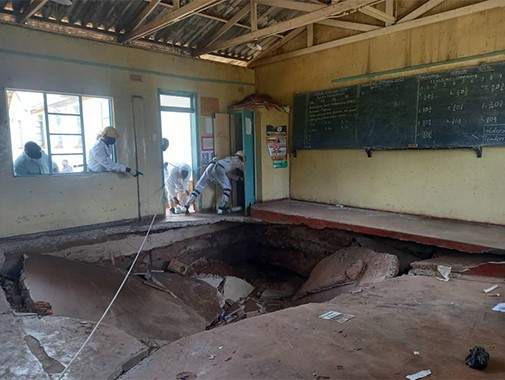
Eighteen students injured as primary school classroom collapses into sinkhole in Zimbabwe.

Eighteen children have been injured after a classroom collapsed into a sinkhole at a primary school in Zimbabwe on Thursday 16 March 2023. The incident happened at about 7.30 am local time, the Globe and Phoenix Primary School in the town of Kwekwe in Midlands Province, about 200 km from Harare, and affected a classroom where grade five students were being taught, which in Zimbabwe implies 10-11 year olds. The school, which has about 1500 pupils, has closed following the incident, with 900 of the pupils having been offered temporary places at the nearby Sally Mugabe Primary School, while the rest will attend classes in large tents erected in the grounds of the Globe and Pheonix School.

Members of the emergency services inspect a classroom which collapsed into a sinkhole in Kwekwe, Zimbabwe, on 16 March 2023. Zimbabwe Situation.

Sinkholes are generally caused by water eroding soft limestone or unconsolidated deposits from beneath, causing a hole that works its way upwards and eventually opening spectacularly at the surface. Where there are unconsolidated deposits at the surface they can infill from the sides, apparently swallowing objects at the surface, including people, without trace. 

However, on this occasion the hole is believed to have been caused by the a collapse within an old gold mine, which underlies the school and which has recently become a centre of activity for illegal miners. The Globe and Phoenix School takes its name from the Globe and Phoenix Mine, a gold mine which operated from the 1890s until 2007, when it  was closed down in 2007 by the Ministry of Mines and the Environmental Management Authority, following a series of safety problems, having originally been founded to educate the children of miners working at the mine.

While there is currently no official mining activity at the site (there are plans for such activity to restart in the future), the mine has become a target for informal miners, who work within many disused mines within Zimbabwe, a practice which is illegal but generally tolerated by the authorities, a country plagued by high unemployment and other economic problems, and is recognized as making a significant contribution to the economy, as such miners are able to sell their product locally rather than smuggling it out to avoid the attention of local authorities, as happens in many African countries. However, the informal nature of this industry makes it extremely dangerous, as few if any health and safety precautions are taken in such mines, and their are occasional reports of armed clashes between rival groups over lucrative sites.

This is particularly problematic at the Globe and Phoenix Mine, which was excavated using a gallery and pillar system, in which pillars of material were left as supports as a seem of gold ore was removed. These remaining pillars have a higher gold content than the unexcavated parts of the seem (which were deemed not economically useful by the original mining company), and are an obvious target for artisanal miners, weakening the structure of the mine, and leading to collapses. 

See also...

Follow Sciency Thoughts on Facebook.

Follow Sciency Thoughts on Twitter.


Tuesday, 3 January 2023

Vandals target the ancient rock art at Koonalda Cave, South Australia.

Vandals have damaged part of an ancient rock carving at Koonalda Cave on the Nullarbor Plain of South Australia, in what is believed to have been a targeted attack. The perpetrators are understood to have forced their way through a barbed wire fence, and dug their way under a metal gate, before targeting the ancient carvings, which are within a sinkhole cave system, not visible from the surface. The vandals carved the words 'Don't look now, but this is a death cave' across a panel of geometric carvings thought to date to about 22 000 years old, and which are considered to be sacred by the local Mirning People. Because the carvings are etched into soft limestone there is little hope of repairing the damage, as removing the graffiti would also involve removing the original art.

Graffiti scrawled across the 22 000-year-old rock art at Koonalda Cave in South Australia. Mirning Cultural Group.

Elders of the Mirning community have expressed sadness and distress at the vandalism, which occurred early in 2022, but which they did not learn about until reports in the media in December. The group have been asking for better security at the site for some years, after earlier events in which vandals had carved their names within the caves.  The cave site is currently protected by a metal gate, with members of the community needing to request a key from the authorities to enter, but which has proven insufficient to deter vandals. Clare Buswell, chair of the Australian Speleological Federation's Conservation Commission, has suggested that the site should be protected by a more modern security system, including surveillance cameras, which might provide a better deterent.

Carvings in Koonalda Cave, photographed before the vandalism took place. Bednarik (2014).

The earliest traces of Human activity in the Koonalda Cave system date to about 34 000 years before the present, although regular use of the caves did not begin till about 27 000 years ago. The rock carvings are thought to date to about 22 000 years ago, with a variety of later artwork also present. Regular occupation of the cave probably ended around 16 000 years ago. As well as a dwelling and art-site, the caves appear to have been mined extensively for flint, which was used to make stone tools.

The entrance to the Koonalda Cave System. Walshe (2017).

The site was first discovered by archaeologists in the 1930s, and dating of the rock art there in the 1960s helped to establish the ancient provenance of the first Human settlers in Australia, dispelling rival theories that the continent was not reached until the Holocene.

See also...


Follow Sciency Thoughts on Facebook.

Follow Sciency Thoughts on Twitter.