Showing posts with label Bayelsa State. Show all posts

Tuesday, 1 December 2020

Apoi Creek covered with crude oil following spill in Bayelsa State, Nigeria.

The Apoi Creek (part of the Niger Delta system) in the Southern Ijaw Local Government Area of Bayelsa State, Nigeria, has been covered by a layer of crude oil following a leak on Sunday 29 November 2020, according to Environmental Rights Action/Friends of the Earth Nigeria. The incident happened at a facility belonging to the Nigerian Agip Oil Company between the communities of Ogboinbiri and Keme-ebiama, with oil reportedly flowing downstream towards the communities of Keme-ebiama, Kokologbene, Apoi, and up to Gbaraun. These communities are almost entirely reliant upon the creek for water for bathing and cooking, as well as Fish and water for irrigating farms.

 
Crude oil on the Apoi Creek in Bayelsa State, Nigeria. EnviroNews Nigeria.

The Niger Delta covers about 70 000 km² (roughly 8% of Nigeria's total landmass), and produces around 2 million barrels of crude oil per day, an industry that has existed in the area since the 1950s. An average of 240 000 barrels of oil are lost into the environment each year, creating massive levels of groundwater and soil pollution. This pollution is in itself highly toxic and leads to a variety of chronic health problems, but in the Niger Delta it is at such high levels that in many places agriculture and aquaculture (fish farming) have become impossible or severely curtailed, creating a food security crisis. Little of the wealth generated by the oil extraction process has reached the people of the Delta and there are no realistic plans to remediate the ongoing crisis. 

 
Location of Apoi Creek within Nigeria’s Niger Delta. Ayanlade & Proske (2015).

Oil companies operating in the Niger Delta have come under considerable criticism from Nigerian and international human rights and environmental groups for failure to report leakages and/or attributing leakages caused by poor maintenance to sabotage or criminal activity, for which it is not obliged to compensate local communities. The Nigerian government has also come under criticism, for being over reliant on expert advice from oil companies as to the cause of leakages.


Oil spill on the Apoi Creek, Nigeria, on 29 November 2020. EnviroNews Nigeria.

The Niger River has been flowing into the Bight of Benin since at least the Cretaceous. During this time it has meandered back and forth across what is now southern Nigeria, as well as moving back and forth with the rise and fall of the sea level. The river caries a great deal of sediment with it, which is dumped when it reaches the sea forming the delta. Over time the organic material within the sediment forms pockets, which are then heated and crushed by the overlying sediment (increasing pressure also increases temperature, and vice versa, which is why aerosol sprays, undergoing rapid decompression, are cold), forcing water out of more complex organic compounds (dehydration) and forming pockets of gas and oil.

 
Schematic map of the Niger Delta showing the distribution of depositional and structural belts. Hooper et al. (2002).

Oil spills are potentially harmful to marine life in a variety of ways. Most obviously it can coat the outside of organisms, causing damage to external structures such as the feathers of Birds and fur of Mammals, as well as smothering many marine invertebrates and plants. It also contains a variety of chemicals which can be directly toxic upset the hormonal balance of many animals. Oil also impedes the feeding of marine organisms, coating both food and feeding organs, but provides an excellent food source for Bacteria, which can lead to Eutrophication events - dramatic increases in Bacteria numbers, which then use all the oxygen in the water, leading other organisms to asphyxiate.

See also...


Follow Sciency Thoughts on Facebook.

Follow Sciency Thoughts on Twitter.


Sunday, 19 January 2020

The Bayelsa State Oil and Environmental Commission's Interim Report on oil pollution in Bayelsa State, Nigeria.

Few countries on the face of the planet have suffered more from oil pollution than Nigeria. Over the last half century, as many as ten million barrels of oil have been spilled across the country, equivalent to a spill similar in size to the Exxon Valdez catastrophe, which devastated the coast of Alaska. every single year for the last fifty years. Furthermore, few parts of Nigeria have suffered worse pollution than Bayelsa State. Bayelsa is one of Nigeria’s main oil producing states, accounting for almost a quarter of its onshore crude oil production, and approximately a third of its oil wealth. It is home to one of Africa’s most diverse ecosystems, a rich but fragile tapestry of wetlands and mangrove swamps. Despite its immense oil reserves, Bayelsa’s people are poor, with the state scoring lower on the United NationsHuman Development Index than any other Nigerian state. Almost three quarters of Bayelsa’s two million people rely on fishing or farming to support themselves. Since oil was first pumped in 1956 by Shell, Bayelsa has suffered a pollution catastrophe on a barely imaginable scale. Exact numbers are hard to come by. However, analysis suggests that if Bayelsa’s share of oil spilled is the same is as its share of oil pumped, as much as a barrel of oil may have been spilled for every man, woman and child living in Bayelsa today. The impact has been devastating. The environmental damage has been tremendous and unique ecosystems have been destroyed. The health of hundreds of thousands of people has been affected by the contamination of the water they drink, the land they grow food on and the air they breathe. Estimates suggest that the pollution could be responsible for as many as 16 000 infant deaths in one year alone.

The Bayelsa State Oil and Environmental Commission was established by Henry Seriake Dickson, Governor of Bayelsa State on 26th March 2019. Its mission is to gather and assess the evidence on the scale and impact of oil spills and associated pollution in Bayelsa state and develop recommendations to ensure existing pollution is cleaned up and future pollution is prevented. The Commission is made up of Dr John Sentamu, Archbishop of York, His Excellency John Kufuor, former President of Ghana, Baroness Valerie Amos, former Under-Secretary General of Humanitarian Assistance at the United Nations, Dr Kathryn Nwajiaku-Dahou of the Department of Politics and International Relations at the University of Oxford, Michael Watts, Professor of Geography at the University of California, Berkeley, Dr Anna Zalik, Associate Professor at the Faculty of Environmental Studies at York University, Dr Isaac ‘Asume’ Osuoka of Social Action International, Professor Engobo Emeseh, Head of School of Law at the University of Bradford, and Roland Hodler, Professor of Public Economics at the University of St Gallen

Since its launch, the Bayelsa State Oil and Environmental Commission has conducted a deep assessment of the evidence on oil pollution in Bayelsa. It has conducted an extensive review of the available literature and documents, has commissioned detailed studies on aspects of the impact of pollution and has conducted over 500 meetings with stakeholders, both internationally and within Nigeria. The Commission's work has been supported by an international network of environmental scientists and forensic experts, a local expert research team and a network of civil society actors with a long track record of documenting oil related environmental damage in the Niger Delta.

The Commissioners have undertaken three visits to the state, held town hall meetings with representatives from eight Local Government Areas (Brass, Ekeremor, Southern Ijaw, Obgia, Kolokuma/Opokuma, Sagbama, Yenagoa), conducted on-site visits with a local team of researchers.

In addition to meeting with communities who have experienced the direct impacts of oil pollution, the Bayelsa State Oil and Environmental Commission has also met with professionals (legal, health, oil servicing companies) civil society organisations, and officials at all levels of government (notably at the Ministry of the Environment, and representatives of regulatory institutions responsible for assessment working in and on Bayelsa (Bayelsa State Ministry of the Environment and state level staff of the Nigerian National Oil Spill Detection and Response Agency). The Commission has also received a written submission from one of the three main international oil companies operating Joint Ventures in the state (Shell Nigeria). Efforts are ongoing to secure oral and written testimony from all international oil companies operating in the state.

The Bayelsa State Oil and Environmental Commission will publish its full report in 2020. It will present the Commission’s findings on the scale and scope of oil pollution in Bayelsa and its causes and will lay out proposals for the remediation of the damage done-both environmental and social-as well as recommendations for changes to the legal, policy and regulatory framework to prevent further pollution in future. However, it published an Interim Report on 1 November 2019, laying out its concerns about oil pollution in Bayalsa State.

Members of a community affected by oil pollution in Bayelsa State, Nigeria. Bayelsa State Oil and Environmental Commission.

Thousands of communities and countless people in Bayelsa Stae have been cast into poverty with their livelihoods destroyed, due to pollution related problems. Communities have been de-stabilised and their cohesion undermined by disputes and competition for resources arising from oil extraction which have been sharpened by spills and their impacts. The cost-in terms of environmental degradation and human suffering has been vast. And it is rising every day.

Furthermore, the individuals and communities affected have found it almost impossible to win redress for their suffering. The oil companies have not done enough to put right the damage that has been caused and the cost and process involved have prevented communities from pursuing legal action.

The Bayelsa State Oil and Environmental Commission has been set up to document this continuing catastrophe and to devise solutions that will help bring an end to pollution crisis and the suffering it has caused. It brings together leaders from the world of government, non-governmental organisations and faith communities with international experts.

One of the Bayelsa State Oil and Environmental Commission’s priorities has been to hear from the people who have been directly affected by the oil contamination. All too often their voices have been ignored. Over six months in 2019, the Bayelsa State Oil and Environmental Commission visited pollution sites across Bayelsa, held meetings in several communities and taken testimony from over 500 victims of oil pollution.

Boatman in Bayelsa State, Nigeria. Bayelsa State Oil and Environmental Commission.

Oil spills and the associated pollution have had untold effects on the environment of Bayelsa State. The loss of habitat and biodiversity, including mangrove swamps as a result of oil spills as well as acid rain damage from gas flaring, has been enormous. Huge swathes of fragile wetlands have been destroyed or put at risk. Water courses that local people rely on for fishing have been contaminated. Farmland has been tainted. There have even been reports of seismic tremors that communities believe are caused by oil extraction.

The members of the Bayelsa State Oil and Environmental Commission have observed many of these problems first-hand. On the Commission’s visit to the Brass Canal, members of the Commission witnessed polluted effluent being dumped directly into the waterway. During another field visit, the Commission witnessed polluted topsoil being dug up and burnt in a pit. Throughout, the Commission has heard repeated testimony on the indiscriminate dumping of waste and the impact it has had. 

A dwelling close to a polluted waterway in Bayelsa State, Nigeria. Bayelsa State Oil and Environmental Commission.

Oil contamination has tainted the farmland people grow their food on, the water they drink and fish in and even the very air they breathe. The health implications have been complex, and often devastating. For instance, research has found that people living near pollution sites have been progressively exposed to elevated levels of heavy metals such as chromium, lead and mercury in their blood stream, leading to increased risk of diseases ranging from Alzheimer’s and Parkinson’s diseases to cancer, diabetes and kidney damage.

The contamination of crops and fish by oil spills has shown to increase the outbreak of diarrhoea in Bayelsa and the bioaccumulation of heavy metals in food as well as affecting food quality. The presence of oil has also resulted in a substantial increase in the prevalence of childhood malnutrition in the affected communities. More broadly, evidence from across Nigeria suggests that high levels of pollution have also contributed to significant increases in child mortality.

Research has also highlighted that communities living near oil impacted areas frequently consume drinking water with high levels of pollution. The list of health effects is long, and their impact will be felt for years, maybe decades to come. What the Commission has seen is just the tip of the iceberg. But it is clear that many people in Bayelsa have suffered life-changing health consequences as a result of oil pollution.

One participant from the Aghoro 1 Community in the Ekeremor Local Government Area noted that a spill occurred in May 2018 and that the community recorded deaths and the destruction of mangrove creeks and farmlands. Letters were written to Shell through the community interface coordinator, but Shell did not respond.

Villagers in Bayelsa State, Nigeria. Bayelsa State Oil and Environmental Commission.

Another member of the same community stated 'when the spill occurred, it was a thing of battle for us in the environment. We really suffered it. Our houses were nearly set ablaze. The spill spoiled the water. We could not bathe or drink the water. The spill killed the Fish in the river. This caused a lot of sicknesses in the community and it killed a lot of people. Many children died because of the spill. We cannot do otherwise than to starve. We waited for relief materials and only few people received it. No food, we have been starving up until this time.'

In Oporoma Community in Southern Ijaw participants noted that there is a high prevalence of ailments in the community, ranging from skin rashes, respiratory illnesses, pneumonia, and growths in female genitals with causes unknown. There are also no near functional health facilities which can be accessed by the community.

About three quarters of Bayelsa’s population relies on farming and fishing to survive. Not only their health, but also their livelihood are at risk when oil pollution poisons their environment. Through its hearings and evidence gathering, the Commission has come across case after case where individuals and communities have lost their livelihoods and, in some cases, reduced to destitution as the result of oil spills.

Oil spills have destroyed many community’s ability to make a living from the land they farm and the water courses they fish. And even where pollution has been more limited, communities have often failed to reap the benefit of oil extraction.

While oil extraction has generated substantial profits for oil companies and tax revenues for the Federal Government, host communities rarely see the benefits. There are often no alternative livelihoods or development benefits. There is widespread under-investment and lack of jobs in communities that host oil company activities and oil companies’ investment in local communities has been infrequent and sporadic.

Projects are often not completed and offers to upskill and train those in the local communities are not fulfilled, leaving many in those communities frustrated and angry at the economic exclusion by oil companies.

One witnes in the Brass Local Government Area stated 'Agip has been here for so many years. They say they have improved on employment level. I am a woman. I was born and bred here. I have lived all my life. This is my London. After graduation they do not employ us. They invite us for interviews, but no job. They employ few labourers and cleaners. There was a time they met the different Amas of Twon to bring in some females for training to be employed. These ladies went for the training. At the end, they brought females from outside. They employed only one or two, just to fulfil all righteousness. When we wanted to cause trouble, the military men were given orders to kill at sight all those who are causing trouble. They have employed people outside this island. But not of the host community'.

Farmers in Bayelsa State, Nigeria. Bayelsa State Oil and Environmental Commission.

Both oil company activity and the competition for resources they have created have undermined community stability and cohesion. As a result, communities that play host to oil activities have often been plagued by conflict, violence and exploitation of vulnerable groups, including children. Oil companies often chose to work with certain groups within communities which exacerbates internal divisions, pitting communities against each other for much needed funds and to be represented during the remediation process.

If the damage done by oil pollution is clear, the path to redress, remediation and compensation often is not. Victims are often unable to pursue their claims due to process, time and most importantly cost. Even where they do, the time taken by the judicial process and potential issues with independence of the judiciary often makes gaining recompense and justice almost impossible. The deck all too often feels stacked against the people who have suffered.

One lawyer representing communities in the area stated 'we are pursuing on the payment that Agip refuses to pay, they have appealed to the Supreme Court with a motion for leave at the Court Of Appeal. For a date to be given, it takes a number of days. These are indigenous communities. I have to finance these matters. Some of these communities cannot pay a surveyor, environmentalist and a valuer.'

Another lawyer observed 'You discover that all the oil companies have their offices in Port Harcourt or Lagos. Engaging a lawyer to go to Port Harcourt is difficult. If you do not have money you cannot handle these cases. Most of the communities do not have a dime to assist you. It is impossible. I have declined a number of cases. There was a directive that they should have their head offices in areas where they operate. Until recently, we never had a Federal High Court. We had to go to Port Harcourt which was a fundamental problem. We also had issues with the filing fees, 50 000 to 100 000 naira (US$140-280) before you could file. These are subsisting fishermen. The burden is transferred to the lawyer and to the agent. Even where you have the Power Of Attorney and you cannot go further, you settle for pittance.'

Fisherwoman in Bayelsa State, Nigeria. Bayelsa State Oil and Environmental Commission.

For over 50 years, oil company activity and its associated impacts have caused untold devastation across Bayelsa State. Hundreds of thousands of people in Bayelsa have been forced to live on contaminated land, drink and fish in contaminated water and breathe contaminated air. Mortality and morbidity rates have risen sharply, as has the incidence of chronic disease, in communities without the resources to cope. Countless lives and livelihoods are being destroyed. Thousands of communities and tens if not hundreds of thousands of people have seen their land and fishing grounds poisoned. Neo-natal death and child malnutrition has risen, and hundreds of thousands have been forced into abject poverty.

The problem has been ignored for too long. And even when the world has paid attention, little has happened. Previous reports have merely sat on the shelf, gathering dust. Action is needed and needed now. The oil companies are beginning to divest from onshore projects in favour of offshore deep-water sites where returns are higher, and risks of environmental damage and social unrest are lower. Time is running out to hold them to account for the legacy of pollution and suffering they are leaving behind. But there is an opportunity for real change.

The Bayelsa State Oil and Environmental Commission’s final report will be published in 2020. It will tackle the causes of this catastrophe and lay out measures to remediate the damage that has already been done and to ensure further spills can be avoided.

Damage caused by oil operations in Bayelsa State, Nigeria. Bayelsa State Oil and Environmental Commission.

See also...


https://sciencythoughts.blogspot.com/2019/12/seven-dead-in-pipeline-explosion-in.htmlhttps://sciencythoughts.blogspot.com/2019/07/communities-gather-meat-after-whale.html
https://sciencythoughts.blogspot.com/2016/07/militant-group-claims-to-have-blown-up.htmlhttps://sciencythoughts.blogspot.com/2015/07/pipeline-explosion-kills-at-least.html
https://sciencythoughts.blogspot.com/2015/03/crude-oil-spill-in-bayelsa-state.htmlhttps://sciencythoughts.blogspot.com/2014/07/exxon-mobile-facility-in-akwa-ibom.html
Follow Sciency Thoughts on Facebook.

Wednesday, 31 July 2019

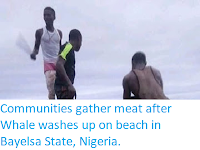
Communities gather meat after Whale washes up on beach in Bayelsa State, Nigeria.

Members of local communities across the Brass Local Government Area of Bayelsa State, Nigeria, have been rushing to a beach near the communities of Ijaw-Kiri, Odioma, and Okpoama after a dead Whale was found there on Sunday 28 June 2019. The Ijaw people of the area do not traditionally hunt Whales, but do consume Whale meat from animals found dead on or near the shore. On this occasion the animal has widely been viewed as a gift from God, sent to help the people during a time of food shortages, following recent poor Fish catches in the area. The last time such a Whale was found in the area was in 2017, and the time before that in 1983.

Local people harvesting meat from a Whale which washed up in the Brass Local Government Area of Bayelsa State, Nigeria, on Sunday 28 July 2019. Ebi Johnson/BBC.

Although local people have viewed the arrival of the Whale as an act of providence, officials from the National Agency for Food, Drug Administration and Control have warned that there can be health risks associated with the consumption of meat obtained in such a way. A number of toxins can accumulate in the meat of Whales, including polychlorinated biphenyls (persistent organic compounds used in a variety of industrial processes), pesticides, and methyl mercury. Such toxins are of particular concern in a Whale that has died of unknown causes, as it might itself have been poisoned by a build up of such bioaccumulative toxins. The agency has warned that pregnant women and small children are at greater risk from such toxins.

See also...

https://sciencythoughts.blogspot.com/2019/01/mercury-and-selenium-levels-in.htmlhttps://sciencythoughts.blogspot.com/2018/11/physeter-macrocephalus-sperm-whales.html
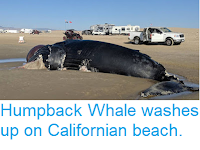
https://sciencythoughts.blogspot.com/2018/11/humpback-whale-washes-up-on-californian.htmlhttps://sciencythoughts.blogspot.com/2018/09/delphinapterus-leucas-beluga-whale.html
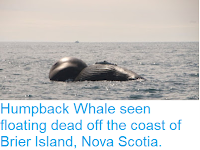
https://sciencythoughts.blogspot.com/2018/09/japanese-proposal-to-allow-resumption.htmlhttps://sciencythoughts.blogspot.com/2018/09/humpback-whale-seen-floating-dead-off.html
Follow Sciency Thoughts on Facebook.

Saturday, 11 July 2015

Pipeline explosion kills at least twelve in Bayelsa State, Nigeria.

Twelve people have been confirmed dead, three more have been seriously injured and one is still missing following an explosion on an oil pipeline in Bayelsa State, Nigeria on Thursday 9 June 2015. The incident happened during repair work to the Agip-operated Tebidaba-Clough Creek Pipeline near the town of Azuzuama, and all of the dead are said to have been part of the repair crew, which included security staff and environmental observers. The work was reportedly being carried out following damage to the pipeline by oil thieves, a highly dangerous practice known locally as 'bunkering'.

Pipeline explosion in Bayelsa State. Nigerian Guardian.

Oil bunkering is a highly risky activity, the oil is highly toxic and both cutting into pipelines and the distillation process frequently result in deadly explosions, which is then refined using home-made fractionation equipment (also dangerous). In addition the authorities are prone to (often draconian) clampdowns on the activities of oil bunkerers, and are threatening to re-introduce the death penalty for those involved in the activity.

However the sale of black-market fuel provides a means of gaining hard cash in an area that has seen little benefit from the presence of the oil companies, and where the oil is often seen as a resource that should belong to the local people, not foreign oil companies or the (fairly remote) government of Nigeria. The environmental problems caused by both legal and illegal oil operations in the Delta strongly impact upon the local economy, which is based upon small scale farming and fishing, leaving many people with no legitimate source of income, which combined with a rapidly growing population and therefore increased demand for food, makes the black market oil industry more attractive than it might otherwise seem.

The Niger River has been flowing into the Bight of Benin since at least the Cretaceous. During this time it has meandered back and forth across what is now southern Nigeria, as well as moving back and forth with the rise and fall of the sea level. The river caries a great deal of sediment with it, which is dumped when it reaches the sea forming the delta. Over time the organic material within the sediment forms pockets, which are then heated and crushed by the overlying sediment (increasing pressure also increases temperature, and vice versa, which is why aerosol sprays, undergoing rapid decompression, are cold), forcing water out of more complex organic compounds (dehydration) and forming pockets of gas and oil. 

Unfortunately oil and hydrocarbons formed in this way tend to develop as a very large number of small oil fields, rather than a few large reserves which can be accessed from a limited number of large oil platforms. This has meant that as the oil industry has developed in southern Nigeria, the country has become criss-crossed by a very large number of small pipelines; such pipeline networks are expensive to maintain, and almost impossible to secure against the activities of oil-bunkerers, leading to both frequent attacks on pipelines and cases where oil companies have sought to use the thefts to justify poor maintenance of remote pipelines.

See also...

An oil spill in Bayelsa State, Nigeria, has been blamed on a poorly maintained pipeline servicing the...

An ExxonMobil terminal on the Quo Iboe River in Akwa Ibom State has been occupied by protestors complaining at the oil company's failure to carry...


Each year since 2006 two environmental groups, the US based Blacksmith Institute andGreen Cross Switzerland have produced an annual report into some of the world's most polluted places. This year's report, titled The World's Worst 2013: The Top Ten...

Follow Sciency Thoughts on Facebook.

Tuesday, 17 March 2015

Crude oil spill in Bayelsa State, Nigeria, blamed on poor maintenance by Shell Petroleum.

An oil spill in Bayelsa State, Nigeria, has been blamed on a poorly maintained pipeline servicing the Shell Petroleum Development Company operated Seibou Oil Well. The leak occurred in January this year, and resulted in the discharge of 549 barrels (87 285 liters) of crude oil onto the Ogboinbiri River in the Southern Ijaw Local Government Area, covering about 300 000 square meters of water and severely affecting local communities. Shell Petroleum responded by closing off the well 15 hours after the leak was reported and cordoning off part of the waterway with booms to contain the spill while the oil was recovered. However the company did not register the spill on its own oil spills registration website, which would have triggered compensation payments for local communities.

The approximate location of the January 2015 Bayelsa oil Spill. Google Maps.

A report by a Joint Investigative Visit, which included representatives of Shell Petroleum as well as representatives of the Bayelsa State Government, the Nigerian National Oil Spills Detection and Response Agency and the environmental group Environmental Rights Action/Friends of Earth Nigeria published on 13 March 2015 has concluded that the spill was caused by a dilapidated and poorly maintained pipeline.

Shell Petroleum and other oil companies operating in the Niger Delta, have in the past come under considerable criticism from Nigerian and international human rights and environmental groups for failure to report leakages and/or attributing leakages caused by poor maintenance to sabotage or criminal activity, for which it is not obliged to compensate local communities. The Nigerian government has also come under criticism, for being over reliant on expert advice from oil companies as to the cause of leakages. In the past Joint Investigative Visits have involved representatives only of the oil companies, the government and local communities, who were often poorly equipped to counter technical arguments given by the companies. The inclusion of representatives of environmental groups in such visits may indicate a tougher line being taken by the Nigerian authorities.

See also...

Exxon Mobile facility in Akwa Ibom State, Nigeria, occupied by protestors.
An ExxonMobil terminal on the Quo Iboe River in Akwa Ibom State has been occupied by protestors complaining at the oil company's failure to carry...

Gas and oil leak at Taylor Creek in Bayelsa State, Nigeria.
Members of the Ikarama community in the northeast of Bayelsa State, Nigeria, have reported that a mixture of natural gas and crude oil is leaking from an...


Exploration company claims to have struck oil off Lagos State, Nigeria. 
Nigeria is the world's fifth largest oil producer, earning over 98% of its export earnings from the sale of hydrocarbons. However the presence of oil has widely been seen as a curse as much as a blessing, with the oil producing areas of the Niger Delta having suffered numerous pollution events in the industry's...


Follow Sciency Thoughts on Facebook.


Friday, 12 July 2013

Gas and oil leak at Taylor Creek in Bayelsa State, Nigeria.

Members of the Ikarama community in the northeast of Bayelsa State, Nigeria, have reported that a mixture of natural gas and crude oil is leaking from an Agip-owned pipeline close to Taylor Creek. The leak apparently started on Monday 8 July 2013, and has reportedly not been addressed by the company at the time of writing. The Friends of the Earth affiliated group Environmental Rights Action have called upon Agip to lower pressure in the pipeline, as local people are extremely concerned about the dangers to health from the fumes, as well as the possibility of explosions; a similar leak led to an explosion in the Southern Ijaw area of the state only three weeks ago.

Gas and oil leaking from a pipeline in Bayelsa State, Nigeria. Alagoa Morris/Friends of the Earth Nigeria/Environmental Rights Action.

Nigeria is the world's fifth largest oil producer, earning over 98% of its export earnings from the sale of hydrocarbons. However the presence of oil has widely been seen as a curse as much as a blessing, with the oil producing areas of the Niger Delta having suffered numerous pollution events in the industry's fifty-year history, and little of the wealth generated filtering down to ordinary Nigerians, 70% of whom still live on less than US$1 a day.

The approximate location of the Taylor Creek leak. Google Maps.


Follow Sciency Thoughts on Facebook.

Monday, 15 April 2013

Oil spill in Bayelsa State, Nigeria.

A major spill has been reported in the Nembe Kingdom area of Bayelsa State, Nigeria, with oil covering mangrove swamps, rivers and commercial waterways. The spillage appears to have originated near to the Shell-owned Well 62, early on the morning of Friday 12 April 2013, and has affected members of the Ewelesuo Community, who report they are having difficultly in gaining access to fresh water and that local fisheries have been severely impacted.

Shell Oil facility on Nembe Creek, Nigeria. Pius Utomi Ekpei/AFP/Getty Images.

Shell has stopped production on the Nembe Creek this month, while security forces carry out a clamp-down on illegal 'bunkering operations' which siphon oil from pipelines for sale on the black market. Shell claims to lose a considerable proportion of its total production in this way in the Niger Delta , and the activity clearly has an impact on the local environment (though Shell has been accused of using the existence of the oil bunkerers as a way of covering for its own environmental misdemeanors). The oil is siphoned off by cutting into the pipelines, which criss-cross the countryside, then crudely distilling the crude in oil drums to produce a low-quality diesel sold across much of Nigeria.

Security forces have shut down a number of such operations in the area this week, and claim the spill came from a new operation, which had apparently gone wrong, saying they found a small camp with cutting equipment as well as cooking utensils, sleeping mats etc.

An illegal refinery on Nembe Creek that was raided by authorities on 22 March. Pius Utomi Ekpei/AFP/Getty Images.

Oil bunkering is a highly risky activity, the oil is highly toxic and both cutting into pipelines and the distillation process frequently result in deadly explosions. In addition the authorities are prone to (often draconian) clampdowns on the activities of oil bunkerers, and are threatening to re-introduce the death penalty for those involved in the activity.

However the sale of black-market fuel provides a means of gaining hard cash in an area that has seen little benefit from the presence of the oil companies, and where the oil is often seen as a resource that should belong to the local people, not foreign oil companies or the (fairly remote) government of Nigeria. The environmental problems caused by both legal and illegal oil operations in the Delta strongly impact upon the local economy, which is based upon small scale farming and fishing, leaving many people with no legitimate source of income, which combined with a rapidly growing population and therefore increased demand for food, makes the black market oil industry more attractive than it might otherwise seem.

A charred body near to a damaged pipeline that exploded near Ilado Village in Lagos State in May 2006, killing an estimated 200 people. Sunday Alambe/AP.

The clampdown comes following a decision by a court in Holland in January that Shell is responsible for the security of its pipelines in the Niger Delta, and that it can be held responsible for damage to the property of third parties.

The clampdown has not gone unopposed in the area. On Friday 5 April a launch carrying 15 police officers was attacked by unknown gunmen, killing 13. Responsibility for the attack has been claimed by the Movement for the Emancipation of the Niger Delta (MEND), a militant group that has carried out a number of attacks on oil companies and security forces in the Delta region since 2006, though authorities have denied this, blaming the incident on criminals instead.

Relatives of the police officers attacked in Bayelsa State waiting for news. Naij.

MEND has also issued a statement to the effect that it has blown up an oil well on Nembe Creek, though both the Nigerian authorities and Shell deny this, as do some former members of the group that have taken part in an amnesty and ceasefire. The statement claims the attacks were in retaliation for the imprisonment of Henry Okah in South Africa, for a bombing in Abuja in 2010. The group has also threatened to attack Muslim targets in Nigeria in retaliation to the activities of the militant Islamic group Boko Haram in the north of the country.

It is unclear to what extent these threats are likely to be followed up. The group has a history of violence, but has in theory been taking part in a ceasefire since 2009, with members receiving government funds as part of the amnesty deal, though there are internal divisions within the organization, and there have apparently been disputes over the distribution of amnesty money. An upsurge in activity combined with an attempt to widen the cause to include religious as well as territorial and economic issues may represent an attempt by one faction within the group to gain control.

See also Nigeria threatens Shell with US$11.5 billion in fines and compensation payments over the Bonga Oil SpillDutch court fines Shell over pollution in ther Niger DeltaPipeline explosion in Ogun State, southwest NigeriaOil barge explosion in Port of Lagos and Amnesty International reports on the 2012 Bodo Oil Spill.

Follow Sciency Thoughts on Facebook.

Sunday, 8 July 2012

Oil spill in Bayelsa State, Nigeria.

Oil has been found leaking from the Nembe-Obama Pipeline in Bayelsa State in the Niger Delta this weekend. It is unclear how long the pipeline had been leaking before it was discovered, or what caused the leak, but pipeline owners the Italian energy giant ENI say the pipeline is now shut off and under repair. Nengi James-Eriworio, Chairman of the Oil and Gas Committee of the Nembe Kingdom,  has accused the oil company of delaying tactics in implementing inspections and cleanups on the pipeline, allowing spilled oil to damage forests and mangroves.

An enterprising local uses the Nembe-Obama Pipeline (recently renamed in honour of the US president) as a laundry aid. National Mirror.

ENI have blamed the spill on the work of saboteurs, a common response from oil companies in the Niger Delta who claim that local people attack pipelines in order to steal the oil which they refine themselves (an extremely hazardous process) or sell on the black market. Whilst this is undoubtably true to some extent, it is difficult to accept that this is the sole cause of leaks in the Delta, nor that this absolves the oil companies of all responsibility.

Oil in the Niger Delta is found in a large number of small reservoirs close to the surface. Consequently the countryside is dotted with a lot of small oil wells, and crisscrossed by a large number of small pipelines. These small pipelines are insecure and vulnerable to sabotage and other forms of damage, and, because they are numerous and often cross long distances, inspecting these pipelines is time-consuming and expensive, so that when leaks do occur they often cause considerable damage to the environment.

Map showing the oil fields (orange), pipelines (black) and terminals (white) of the Niger Delta. Lighter green areas are dry land, darker are mangrove swaps. Agbalagba, Avwiri & Chad-Umoreh (2012).

At the same time the Niger Delta has remained one of the poorest regions of Nigeria, with many people lacking electricity or basic sanitation, and are dependent on industries easily disrupted by the oil industry, such as small scale farming or fishing. This has led to an ongoing series of confrontations between the peoples of the Niger Delta and the oil companies. The Nigerian Government, which is to a large extent reliant on revenues from the oil fields, has often proved to be ineffectual at regulating the oil companies, and has occasionally been savage when dealing with the peoples of the Delta. This situation seems unlikely to be resolved until either Nigeria achieves a sufficiently diverse economy to be able to risk offending the oil companies, or the oil fields of the Delta run dry. Unfortunately at the moment it is looking likely that the later will happen before the former.


Follow Sciency Thoughts on Facebook