Showing posts with label oil. Show all posts

Saturday, 17 February 2024

Oil spill on the coast of Tobago, following wreck of mystery barge.

An oil slick has spread over 160 km on the Caribbean Sea following the wreck of a barge off the coast of the island of Tobago on 7 February 2024. The wreck was not reported by the barge's owners, but instead was spotted by beachgoers who reported it to the Tobago Emergency Management Authority. The barge has capsized on Cove Reed, off the southern coast of the island, and oil from it has spread over reefs and beaches along the southern tip of the island, as well as spreading across the Caribbean Sea towards Grenada and Venezuela.

An aerial image of the capsized barge. Office of the Chief Secretary of Tobago.

The barge appears to have been an unmanned and unpowered vessel, and has the word 'Gulfstream' painted on its side. As an unmanned, unpowered vessel it would not have been required to register with the International Maritime Organization, nor to carry an Automatic Identification System tracker, although it would have been partnered with a manned tugboat, which should (in theory) have complied with both of these requirements.

Before and after satellite images from the Copernicus Sentinel-1 mission show the scale of the oil spill that occurred off the shores of Trinidad and Tobago’s coastline earlier this week. The vessel, identified as the Gulfstream, ran aground and overturned off the southern shores of Tobago Island. The final image of the animation, captured at 10.18 pm GMT on 14 February, shows the oil spill has travelled over 160 km westwards. The spill is moving out of Trinidad and Tobago’s marine area and into Grenada’s southernmost marine area – which could affect neighbouring Venezuela. Satellite radar is particularly useful for monitoring the progression of oil spills because the presence of oil on the sea surface dampens down wave motion. Since radar basically measures surface texture, oil slicks show up well – as black smears on a grey background. European Space Agency.

An investigation by the Trinidad and Tobago Coast Guard found that a barge identified as the Gulfstream left Panama en route for Guyana coupled to a tug called the Solo Creed on 12 January 2024, and that authorities in Guyana reported that neither vessel arrived there. The Solo Creed, identified by the Vessel Finder website as a Tanzanian registered towing vessel, which visited Aruba on 20 January, and was last detected off the coast of Venezuela on 4 February.

An image of the capsized barge on 10 February 2023. Tobago House Assembly/AFP.

The Bellingcat investigative agency has identified a double-hulled barge capable of carrying 60 000 barrels of oil (i.e. 9.5 million litres) called the Gulfstream which was coupled to a tugboat called the Marlin, operating within the United States until 2012, which appears to be a good physical match for the vessel off the coast of Tobago. The Marlin was sold to the Panamanian San Martin Group in 2014, and while there are no official records of the Gulfstream after this, Bellingcat has found photographic evidence of the two vessels operating together between Panama and Venezuela between 2015 and 2020. The Marlin was sold on to another Panamanian company, Star Goods Petroleum, in 2021, and has not transmitted its position since. The Gulfstream was observed in the Astinave shipyard in Ecuador in February 2022, but has not been sighted since. Bellingcat suspect that the renamed Marlin and Gulfstream may still be operating together, as part of a 'ghost fleet' carrying embargoed Iranian oil to Venezuela. Many oil-carrying vessels operating out of Venezuela are considered to be poorly maintained to the point of being dangerous, and the Marlin and Gulfstream, if still operating together, would be 60- and 58-years-old respectively; both vessels would have been built with a planned lifetime of 30 years.

Oil spills are potentially harmful to marine life in a variety of ways. Most obviously it can coat the outside of organisms, causing damage to external structures such as the feathers of Birds and fur of Mammals, as well as smothering many marine invertebrates and plants. It also contains a variety of chemicals which can be directly toxic upset the hormonal balance of many animals. Oil also impedes the feeding of marine organisms, coating both food and feeding organs, but provides an excellent food source for Bacteria, which can lead to Eutrophication events - dramatic increases in Bacteria numbers, which then use all the oxygen in the water, leading other organisms to asphyxiate.

Workers from state own Heritage Petroleum Oil and Gas Company, the state oil company of Trinidad and Tobago, clean up an oil spill that reached Rockly Bay beach, in Scarborough, south western Tobago. Akash Boodan/AP.

Many fishermen on the southern part of Tobago are reporting vessels and equipment damaged by exposure to oil, and beaches across the southern part of the island being forced to close to tourists at the height of the tourist season. Volunteers and local specialists have recovered about 2000 barrels of oil from beaches on Tobago, but the vessel is still leaking and will probably need to be emptied of oil before it can be refloated and the damage repaired.

See also...

Monday, 2 January 2023

Four presumed dead following helicopter crash in the Gulf of Mexico.

The US Coast Guard has called off a search for survivors, following a helicopter crash in the Gulf of Mexico. The helicopter, operated by Rotorcraft Leasing, crashed while taking off from a Walter Oil & Gas owned offshore oil platform, about 16 km to the south of the mouth of the Southwest Pass of the Mississippi River, at about 8.40 am local time on Thursday 29 December 2022. It is reported to have struck the landing pad as it took off, and subsequently to have fallen into the water.

Debris from a helicopter crash on 29 December 2022 next to a Walter Oil & Gas owned offshore oil platform 16 km off the coast of Louisiana. US Coast Guard.

Following an extensive search by helicopter and small boat, which discovered debris from the crash but no signs of the missing pilot or three passengers, the search was called off at 6.15 pm the same day. One of the passengers has been named as David Scarborough (36), from Lizana, Mississippi, who was returning to shore following a two week shift on the oil platform. Scarborough is survived by his wife, Lacy, and a two-year-old son, Sawyer; the couple were expecting a second child in April. The other victims of the crash have not yet been named.

David Scarborough (36), from Lizana, Mississippi, believed to have died in a helicopter crash in the Gulf of Mexico on 29 December 2022. Lacy Scarborough/Sun Herald.

This is the second crash by a Rotocraft Leasing helicopter attended by the US Coast Guard within two weeks; the first incident happened on 15 December when a helicopter with three people on board went down 25 km off the coast of Terrebonne Bay, while attempting to land on an oil platform. On that occasion all three people on board were able to escape into an inflatable raft, and were subsequently airlifted to hospital with back injuries. 

The US Coast Guard also airlifted two workers from offshore oil vessels in the Gulf of Mexico to hospital in December, both also with back injuries, as well as dealing with two separate oil spill incidents.

See also...

Follow Sciency Thoughts on Facebook.

Follow Sciency Thoughts on Twitter.


Tuesday, 7 September 2021

Divers looking for source of oil spill find broken pipelines in the Gulf of Mexico.

Divers searching for the source of an oil slick that appeared on the Gulf of Mexico in the wake of Hurricane Ida have found three broken pipelines on the seabed to the south of the city of New Orleans. The oil was first observed on Wednesday 1 September by an aerial survey caried out by the National Oceanic and Atmospheric Administration, with additional footage being taken from a helicopter chartered by the Associated Press the next day. This prompted a clean-up operation by Talos Energy, who previously leased  Bay Marchand, Block 5, the area where the slick appeared, and Clean Gulf Associatesa nonprofit oil-spill response cooperative hired by Talos to help with the operation. Now divers from Clean Gulf have identified a broken 30 cm diameter pipeline with oil leaking from it, plus two further broken 10 cm pipelines, which are not currently leaking, but which may have contributed to the spill. Talos Energy do not believe that these pipelines were part of their operation, as their records show all seabed pipelines operated by the company were removed when their activities ceased in 2017. If this is correct, then it is unclear who the pipelines belonged to.

 
Satellite image showing an oil slick to the south of Port Fourchon, Louisiana, on 2 September 2021. Maxar Technologies/AP.

Hurricane Ida made landfall in Louisiana on Sunday 29 August 2021, and bringing with it high winds and flooding which led to more than 50 deaths on the eastern United States.  However, the fact that the death toll was not much higher has been hailed as a vindication of the billions of dollars that have been invested in the levee system protecting the city of New Orleans following the catastrophic damage caused by Hurricane Katrina sixteen years ago. The city, which was directly in the path of the storm, suffered wind damage as it was battered by 240 km per hour winds, but only a limited amount of flooding. A plan to evacuate large parts of New Orleans in the event of it being hit by another major hurricane was not put into place because of the rapidity with which the storm formed, developing over the Caribbean Sea only four days before making landfall as the fifth largest storm ever to hit the US coast.

The storm also caused flooding at the Phillips 66 Alliance Refinery, which is beside the Mississippi River to the south of New Orleans, where a sheen has subsequently been observed on the water, implying that some leaking has occurred here to, although the refinery was shut down ahead of the storm, which should have prevented any major incident.

Tropical storms, known as hurricanes in the Atlantic and eastern Pacific, are caused by solar energy heating the air above the oceans, which causes the air to rise leading to an inrush of air. If this happens over a large enough area the inrushing air will start to circulate, as the rotation of the Earth causes the winds closer to the equator to move eastwards compared to those further away (the Coriolis Effect). This leads to tropical storms rotating clockwise in the southern hemisphere and anticlockwise in the northern hemisphere. These storms tend to grow in strength as they move across the ocean and lose it as they pass over land (this is not completely true: many tropical storms peter out without reaching land due to wider atmospheric patterns), since the land tends to absorb solar energy while the sea reflects it.

 
The formation of a tropical cyclone. Natural Disaster Management.

Despite the obvious danger of winds of this speed, which can physically blow people, and other large objects, away as well as damaging buildings and uprooting trees, the real danger from these storms comes from the flooding they bring. Each drop millibar drop in air-pressure leads to an approximate 1 cm rise in sea level, with big tropical storms capable of causing a storm surge of several meters. This is always accompanied by heavy rainfall, since warm air over the ocean leads to evaporation of sea water, which is then carried with the storm. These combined often lead to catastrophic flooding in areas hit by tropical storms.

 
The formation and impact of a storm surge. eSchoolToday.

Many officials in the US, including President Joe Biden, have linked Hurricane Ida directly to global warming, noting that the average storm hitting the US today does seven times as much damage as in the 1970s, that 'hundred year' storms now happen several times a decade, and that states formerly to the north of the hurricane zone are now regularly hit by these storms.

Oil spills are potentially harmful to marine life in a variety of ways. Most obviously it can coat the outside of organisms, causing damage to external structures such as the feathers of Birds and fur of Mammals, as well as smothering many marine invertebrates and plants. It also contains a variety of chemicals which can be directly toxic upset the hormonal balance of many animals. Oil also impedes the feeding of marine organisms, coating both food and feeding organs, but provides an excellent food source for Bacteria, which can lead to Eutrophication events - dramatic increases in Bacteria numbers, which then use all the oxygen in the water, leading other organisms to asphyxiate.

See also...


Follow Sciency Thoughts on Facebook.

Follow Sciency Thoughts on Twitter


Monday, 5 July 2021

Ruptured gas pipeline leads to fountain of fire in the Gulf of Mexico.

A fire broke out on the sea surface in the Gulf of Mexico, after a natural gas pipeline ruptured on Friday 2 July 2021. The pipeline, which connected the KU-C satellite platform on the Ku Maloob Zaap Oil Field, ruptured some time before 5.15 am local time, when the leaking gas ignited, with the fire being brought completely under control by 10.30 am. Although dramatic, nobody was hurt during the incident. It is unclear at this time how the pipeline was damaged, or how the leaking gas was subsequently ignited.

 
A fire on the surface of the Gulf of Mexico on 2 July 2021, caused by a ruptured natural gas pipeline. Manuel López San Martín/Twitter.

The Ku Maloob Zaap oil field is worked by the Mexican state-owned Petróleos Mexicanos (Pemex), in the Bay of Campeche, off the coast of Tabasco State, on the Yucatan Peninsula. The oil field is actually made up of three separate reserves, the Ku reserve, located in Kimmeridgian (Late Jurassic) deposits, the Maloob, which is in Late Cretaceous-Palaeocene strata, and the Eocene Zaap reserve. The field is worked by seventeen drilling platforms connected by 166 km of pipeline. The field has been worked since the early 1980s, with peak production reached in 2009, when the field was producing more than 130 million litres of oil and over three billion litres of natural gas per day, with production having declined steadily since that time.

See also...


Follow Sciency Thoughts on Facebook.

Follow Sciency Thoughts on Twitter.


Sunday, 6 June 2021

Eleven injured in fire at oil refinery in Tehran.

Eleven people were injured fighting a fire at an oil refinery in the south of Tehran, Iran, this week. The fire broke out on Wednesday 2 June 2021, and was brought under control and then extinguished within 24 hours. It was initially thought to have been triggered by a leak from a natural gas pipeline, but is now thought to the leak occurred from a waste storage tank, with a second tank also being engulphed by the blaze. The state-owned Tondgooyan Petrochemical Company, which operates the site, has ruled out sabotage as a cause of the blaze, with an investigation into the precise origin of the fire still ongoing. 

 
Fire at an oil refinery in Tehran on 2 June 2021. Vahid Ahmadi/Tasnim News Agency/AFP/Getty Images.

Iran has suffered a number of serious oil fires in recent years, caused by a combination of a decaying infrastructure, and deliberate attacks by opponents of the regime. However, on this occasion the cause of the fire appears to have been more mundane, with fire the fire likely to have been triggered by volatile fumes leaking from the tank being ignited by the heat of an Iranian summer day.

See also...


Follow Sciency Thoughts on Facebook.

Follow Sciency Thoughts on Twitter


Sunday, 16 May 2021

Major oil leek from ruptured pipeline in the Russian Arctic.

Authorities in the Komi Republic in Northwestern Russia have declared an emergency after crude oil was found to be leaking from a pipeline in a remote area close to the border with the Nenets Autonomous District. The leak, on a pipeline operated by Russian oil producer Lukoil, which connects the Oshskoye Oil Field in Nenets to a storage facility in Komi, is believed to have leaked about seven tons of crude oil before the leak was discovered, with three tons spreading out over the Arctic tundra and about four tons entering the Kolva River. The spill was eventually discovered when the oil travelled downstream to the town of Usinsk, tens of kilometres downstream of the original leak.

 
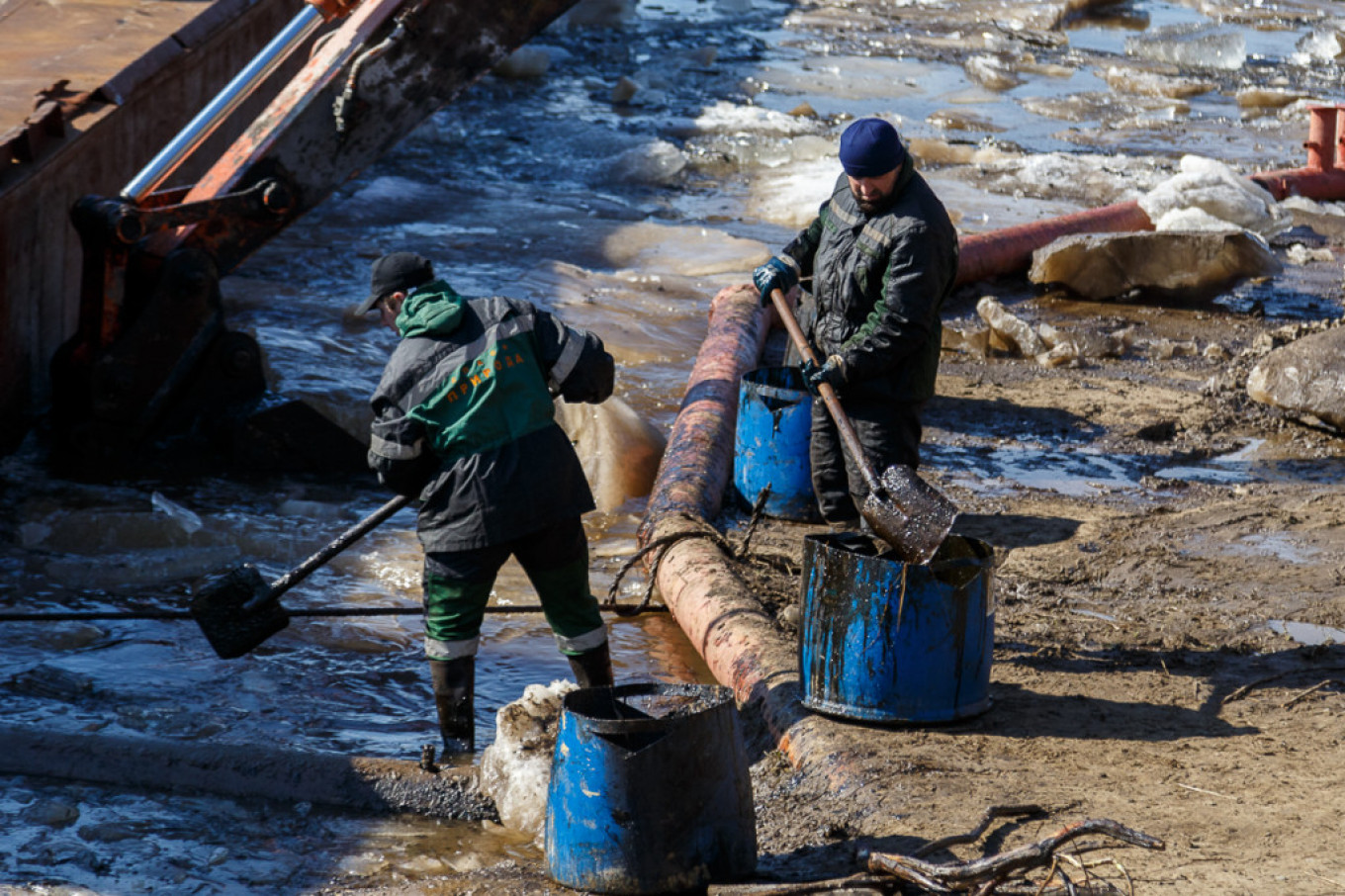
A cleanup operation in Russia's Komi Republic this week, Республика Коми Официальный портал.

Cleaning up the spill is predicted to be very difficult, as the booms which are generally used to contain oil spills on waterways are effectively useless, due to floating ice on the Kolva River, with oil having reached about 30 km downstream of Usinsk. Lukoil is reported to have deployed a team of about 150 workers to tackle the spill, who are reported to be using sorbents (absorbent materials) to try to remove oil from the river.


Oil covered ice blocks on the Kolva River. Комитет спасения Печоры/VK.

The Investigative Committee for the Arkhangelsk Region and Nenets Autonomous District has opened a criminal investigation into the spill, which Greenpeace Russia suspects may have been caused by poor maintenance, with metal pipelines, which are slowly corroded by crude oil, being used beyond their due replacement dates.

See also...


Follow Sciency Thoughts on Facebook.

Follow Sciency Thoughts on Twitter