Showing posts with label Botony. Show all posts

Sunday, 6 August 2017

Notonuphar antarctica: A new species of Water Lily from the Eocene of Seymour Island, Antarctica.

Water Lilies, Nymphaeales, are herbaceous aquatic plants found on all continents except Antarctica, but most diverse in the tropics. They are thought to have been one of the earliest groups of Flowering Plants to appear, splitting away from other members of the Angiosperms early in the history of the group, and have a fossil record dating back to the Early Cretaceous.

In a paper published in the journal Plant Systematics and Evolution on 14 June 2017, Else Friis of the Department of Palaeobiology at the Swedish Museum of Natural History, Ari Iglesias of the Instituto de Investigaciones en Biodiversidad y Ambiente, Marcelo Reguero of the Divisio´n Paleontologı´a de Vertebrados at the Universidad Nacional de La Plata and the Instituto Antártico Argentino, and Thomas Mörs, also of the Department of Palaeobiology at the Swedish Museum of Natural History, describe a new species of Water Lily from the Early to Middle Eocene of Seymour Island, Antarctica.

The new species is named Notonuphar antarctica, where 'Notonuphar' means 'southern-Nuphar' (Nuphar being a modern genus from the Northern Hemisphere which the new genus resembles) and antarctica refers to the location where it was found. The species is described from a series of seeds and seed fragments extracted from sediments by dry sieving. These are coalified on the outside, with a calcified inner core comprised of the mesotesta, endotesta, tegmen and the inner seed tissues.

Notonuphar antarctica, from the Eocene of Seymour Island, Antarctica; synchrotron radiation-based X-ray tomographic microscopy volume renderings of seeds. (a) Holotype; lateral view of seed showing outer smooth surface of exotesta and germination; hilum (hi) and micropyle (mi) are close to each other on the germination cap. (b), (c) Lateral views of seed with exotesta partly broken off exposing the inner calcified core lined by mesotesta and tegmen; note the distinct raphe on the inner core. (d) Apical view of holotype showing germination cap with closely spaced hilum (hi) and micropyle (mi). (e) Apical view of seed with part of exotesta and germination cap preserved; note tall and thick-walled cells exotesta and the thin layer of mesotesta between exotesta and tegmen. (f), (g) Volume renderings cut through the micropylar (mi) and hilar (hi) area of seed shown in (e) in angles perpendicular to each other; mesotesta is thicker close to the micropyle. (h), (i) Volume renderings transversely cut through the micropylar (mi) and hilar (hi) area of seed shown in (e) at two different levels, (h) close to the apex and (i) further down; note narrow zone of exotestal cells (asterisk) between micropyle and hilum/raphe (h cut at orthoslice xy0300; i cut at orthoslice xy0510). Scale bars 1 mm (a–c), 0.5 mm (d–i). Friis et al. (2017).

See also...

http://sciencythoughts.blogspot.co.uk/2016/08/euanthus-panii-flower-from-middle-late.htmlhttp://sciencythoughts.blogspot.co.uk/2016/04/juraherba-bodae-herbaceous-angiosperm.html
http://sciencythoughts.blogspot.co.uk/2016/03/mahonia-mioasiatica-fossil-leaves-from.htmlhttp://sciencythoughts.blogspot.co.uk/2015/12/prunus-kunmingensis-peaches-from-late.html
http://sciencythoughts.blogspot.co.uk/2015/01/the-antarctic-summer-monsoon.htmlhttp://sciencythoughts.blogspot.co.uk/2014/11/supplejack-leaves-from-early-eocene-of.html
Follow Sciency Thoughts on Facebook.

Friday, 25 March 2016

Coprosma cordicarpa: A new species of Pilo from Hawai‘i.

Pilos, Comprosma spp., are fruiting plants related to the Coffees, Coffea spp., found on Pacific islands from Borneo to the Juan Fernández Islands, with the maximum diversity occuring in New Zealand, where there are 55 recorded species. Pilos range from trailing woody shrubs to small trees, and produce a berry-like fruit with two seeds. These fruits are sometimes eaten (particularly the larger ones), and occasionally used to make a Coffee-like drink. The leaves of some Pilos give off a dung-like smell when crushed.

In a paper published in the journal PhytoKeys on 11 February 2016, Jason Cantley of the Department of Biology at Bucknell University and the Department of Botany at the University of Hawai‘i at Mānoa, Margaret Sporck-Koehler of the Division of Forestry and Wildlife of the State of Hawai‘i and the Department of Botany at the University of Hawai‘i at Mānoa, and Marian Chau of the Lyon Arboretum Hawaiian Rare Plant Program and Department of Botany at the University of Hawai‘i at Mānoa, describe a new species of Pilo from Maui.

The new species is named Coprosma cordicarpa, meaning 'heart-shaped fruit, inreference to the shape of the berries. Coprosma cordicarpa is a shrub reaching 2-7 m in height. It was found growing on thesouthern slopes of Haleakalā (East Maui) volcano, with five separate populations between 1000 and 2000 m above sea-level, streteched ut in a rough line 21 km in length from the Kanaio Natural Area Reserve in the eastto the Kaupō Gap Trail in the west.

Field images of Coprosma cordicarpa. (A) Habit and habitat of whole plant with Jason Cantly. (B) Male stem and inflorescences. (C) Female stem and inflorescences. (D–F) Fruits illustrating population variation in color and degree of calyx connation. (A–C), (E) From Kanaio Natural Area Reserve. (D), (F) from Auwahi. Black scale bar at bottom right indicates the following lengths: 0.5 m (A), 1.5 cm (B–C), (E–F), 5 cm (D), 2 cm. Cantly et al. (2016).

Due to the low numbers of Coprosma cordicarpa observed, and its scattered distribition over a very limited range, in an area where much of the environement has been degraded by invasive, introduced animals (particularly Goats) and plants (particularly Kikuyu Grass), leads Cantly et al. to conclude that Coprosma cordicarpa should be considered to be Vulnerable under the terms of the International Union for the Conservation of Nature’s Red List of Threatened Species.

See also...

http://sciencythoughts.blogspot.co.uk/2015/11/sommera-cusucoana-new-species-of.htmlSommera cusucoana: A new species of Sommera from Honduras.                    Sommeras are tropical shrubs or small trees belonging to the Rubiaceae (the same group as plants as Coffee) found in tropical rainforests and occasionally dry Oak forests in Central and South...
http://sciencythoughts.blogspot.co.uk/2014/09/a-new-species-of-hibiscus-from-maui.htmlA new species of Hibiscus from Maui Island, Hawaii.                                                   Hibiscus trees of the genus Hibiscadelphus are known only from the Hawaiian Islands, to which they are endemic. Like many...
Follow Sciency Thoughts on Facebook. 

Mahonia mioasiatica: Fossil leaves from the Late Miocene of Yunnan Province.

The genus Mahonia comprises evergreen shrubs in the family Berberidaceae found today in East Asia and North and Central America, with some species being invasive in other regions, particularly Europe. The reaches its maximum diversity in China today, with about 30 indigenous species (out of about 60 living species), however fossils of the group have not been found there to date, with a long fossil record beginning the Eocene in North America, and fossils also known from the Oligocene onwards in Europe.

In a paper published in the Journal of Plant Research on 21 December 2016, Jian Huang of the Key Laboratory of Tropical Forest Ecology at the Xishuangbanna Tropical Botanical Garden and the University of the Chinese Academy of Sciences, Tao Su, also of the Key Laboratory of Tropical Forest Ecology at the Xishuangbanna Tropical Botanical Garden, Julie Lebereton‑Anberrée, again of the Key Laboratory of Tropical Forest Ecology at the Xishuangbanna Tropical Botanical Garden and the University of the Chinese Academy of Sciences, Shi‑Tao Zhang of the Kunming University of Science and Technology, and Zhe‑Kun Zhou, also of the Key Laboratory of Tropical Forest Ecology at the Xishuangbanna Tropical Botanical Garden, and of the Key Laboratory for Plant Diversity and Biogeography of East Asia at the Kunming Institute of Botany, describe a new species of Mahonia from the Late Miocene Xiaolongtan Formation at Wenshan in Yunnan Province, China.

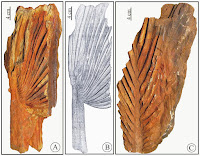
The leaves are assigned to a new species, Mahonia mioasiatica, which derives from Miocene and Asia. A series of leaflets with palmate venation are described, ranging from 2.1 cm to 4.2 cm in length. Huang et al. note that Holly (Ilex) leaves are similar in general shape to those of Mahonia, and also show palmate venation, but note that the bases of the leaves of Mahonia mioasiatica have asymmetrical bases, which is typical of Mahonia, but not known in any species of Holly.

Single specimen of Mahonia mioasiatica preserved on a split slab as part (a) and counterpart (b). Abbreviations: tb truncate base, ps palmate secondary venation (indicated by grey color lines), st spinose tooth. Scale bars are 1 cm. Huang et al. (2015).

Modern members of the genus Mahonia are split into three groups, based upon the venation of their leaves, a classification system which has been supported by molecular studies. Members of the Group Orientales have palmate leaves and are almost entirely found in Asia, members of the Group Occidentales have extensive secondary pinnate veins, and are exclusively found in the Americas, while members of the Section Horridae have intermediate venation, and are also found in the Americas.

Huang et al. note that all three venation types appear early in the North American history of the group, while both Mahonia mioasiatica and previously described fossil European specimens all appear to belong to the Group Orientales. They further note that the majority of modern American species are found in the arid regions of the American southwest, while the Asian species are found in moister, more temperate conditions. This strongly suggests that the different groups are better adapted to different climatic conditions. The climate of eastern North America is more similar to that of East Asia, and the Oligocne-Miocene climate of Europe (when Mahonia invaded that continent) is also considered to have more closely resembled that of warmer, wetter Asian climates than is the case today. This, according to Huang et al., suggests that the genus probably migrated from eastern North America into Europe and thence to Asia, enabling members of the Group Orientales to remain constantly within a warm, wet temperate climate, rather than across the Bering Land Bridge (which formerly connected Alaska to the Russian Far East), a journey that would have required crossing a number of potentially hostile climate zones.

See also...

http://sciencythoughts.blogspot.co.uk/2015/12/prunus-kunmingensis-peaches-from-late.htmlPrunus kunmingensis: Peaches from the Late Pliocene of Yunnan Province.                 Peaches, Prunus persica, are widely grown and consumed fruit around the world today, with a total annual production of about 20 million tons. They have a long historical association with humans, particularly in East Asia, with the oldest known...
http://sciencythoughts.blogspot.co.uk/2014/12/a-new-species-of-chinese-arborvitae.html

A new species of Chinese Arborvitae from the Late Miocene of Yunnan Province.                        The Chinese Arborvitae, Platycladus orientalis, is a species of Cypress widely grown as an ornamental plant in China, North Korea and the Russian Far East. Its precise origin is unknown, though...

http://sciencythoughts.blogspot.co.uk/2014/11/fossil-coryphoid-palm-leaves-from.htmlFossil Coryphoid Palm leaves from the Deccan Intertrappean beds of Madhya Pradesh, India.                                                           Palms are an important component of modern tropical ecosystems, with the majority of species (~90%) restricted to tropical rainforests, where they...

Follow Sciency Thoughts on Facebook.

Wednesday, 10 September 2014

A new species of Hibiscus from Maui Island, Hawaii.

Hibiscus trees of the genus Hibiscadelphus are known only from the Hawaiian Islands, to which they are endemic. Like many Hawaiian plants and animals they have fared badly due to human activities, notably the introduction of non-native species that either outcompete indigenous species or modify their environment irreversibly. Of seven previously described species of Hibiscadelphus, four are believed to be extinct, two survive only in cultivation, while one only has two surviving wild populations, each of 15-20 individuals.

In a paper published in the journal Phytokeys on 25 July 2014, Hank Oppenheimer and Keahi Bustamente of the Plant Extinction Prevention Program at the Department of Botany at the University of Hawai'i, Manoa and Steven Perlman of the National Tropical Botanical Garden in Kalaheo, describe a new species of Hibiscadelphus from West Maui.

The new species is named Hibiscadelphus stellatus, meaning ‘star shaped’, a reference to the pattern of the hairs on its leaves which are arranged in star-shaped clumps, and the bracts which surround its flowers. Hibiscadelphus stellatus is a small tree reaching 3-6 m in height, with many branches and smooth bark.

Hibiscadelphus stellatus. (A) Habit. (B) Flowers and leaves. (C) View of bracts illustrating stellate arrangement. (D) Close-up of flower. Oppenheimer et al. (2014).

Hibiscadelphus stellatus was found growing only on steep rocky slopes at altitudes of between 800 m and 900 m; the slopes all had a windward aspect, and the trees were midslope, between the upper rim of a deep valley and a stream at its bottom, in areas of mosaic tree and shrubland with an open canopy, growing on volcanic basalt derived soils. The trees were observed in February and April, when they were producing buds, flowers, immature and mature fruit; the flowers opened in the middle of the day and produced abundant nectar.

Hibiscadelphus stellatus. (A) Habit. (B) Flower bud. (C) Surface of calyx showing stellate hairs. (D) Flower. (E) Surface of corolla showing two sizes of stellate hairs. (F) Fruit. (G) Longitudinal section of fruit showing seed. Oppenheimer et al. (2014).

Only three populations of Hibiscadelphus stellatus are known, comprising 25, 40 and 23 plants respectively. All three populations are within 400 m of one-another. Seeds were collected from twelve plants representing all three populations, and are being raised at the Olinda Rare Plant Facility on Maui, National Tropical Botanical Garden on Kaua`i and the Lyon Arboretum on O`ahu. The area where the trees was found is judged to be at risk of fire, draught and a variety of invasive species, including Rats, Mice, Slugs, Sand Weevils, Caterpillars, Goats, Pigs and fire-adapted Grasses (Grasses that can survive periodic burning, which kills native Hawaiian plants, thereby allowing the Grasses to spread and colonize new areas).

Distribution map showing known locations of Hibiscadelphus stellatus on West Maui. Oppenheimer et al. (2014).

Hibiscadelphus stellatus is judged to be Endangered under the terms of the International Union for the Conservation of Nature’s Red List of Threatened Species.

See also…


The Chatham Island Forget-me-not (Myosotidium hortensium) is a robust perennial herbaceous plant found in coastal habitats in the Chatham Islands, a remote group of islands roughly 860 km east of Christchurch, New Zealand. The plant of interest to botanists and biogeographers, since its closest known...


The International Union for the Conservation of Nature published its annual update of its Red List of Threatened Species on Thursday 12 June 2014, marking the 50th year of the list's existence, and revising...


The International Union for the Conservation of Nature published its annual update of its Red List of Threatened Species on Thursday 12 June 2014, marking the 50th year of the list's existence, and...


Follow Sciency Thoughts on Facebook.

Thursday, 27 March 2014

A new species of Hydrangea from Mexico and Central America.

Hydrangeas are perennial woody plants related to Dogwoods and Silkleafs. Most species form small shrubs, but some grow to tree sizes, and there are some lianas (woody vines) in the group. Hydrangeas are most abundant and diverse in eastern Asia, but they are found as far west as the Himalayas, and also throughout the Americas. Most Hydrangeas have white flowers, but some species produce pink or blue flowers in response to changes in soil pH, a trait which has made them popular with gardeners. As such they have been introduced to many parts of the world beyond their home ranges, in some places, most notably the Azores, becoming destructive invasive species.

In a paper published in the journal Phytotaxa on 17 March 2014, Marie-Stéphanie Semain of the  Instituto de Ecología of the Centro Regional del Bajío in Mexico and the Research Group on Spermatophytes at the Department of Biology at the University of Gent, Francisco Hernández Najarro of the Herbario of the Secretaria de Medio Ambiente e Historia Natural and Esteban Manuel Martínez Salas of the Herbario Nacional de México at the Departmento de Botánica at the Instituto de Biologica at the Universidad Nacional Autónoma de México describe a new species of Hydrangea from Mexico and Central America.

The new species is given the name Hydrangea albostellata, a reference to the white hairs present on the leaves and flowering stems of the plant. It is a climbing liana reaching 35 m in height, with male and female flowers born on separate plants. Hydrangea albostella is found in cloud forests at altitudes of between 1200  and 2300 m from Chiapas State in southeastern Mexico through Central America as far as Costa Rica.

Branch of
Hydrangea albostellata with four inflorescences, all inflorescence bracts already shed in lower right one where the flower buds are visible, lower left inflorescence partially opened, apical inflorescences still covered by all inflorescence bracts. Semain et al. (2014).

Climbing a 
Hydrangea host tree with specific equipment (note, the Hydrangea is the vine on the tree, not the tree being climbed). Samain et al. (2014).


Follow Sciency Thoughts on Facebook.