Showing posts with label Rubiaceae. Show all posts

Monday, 27 December 2021

Coffea rizetiana: A new species of Coffee from Cameroon.

In the 1980s, the Institut de Reserche pour le Developpement carried out fieldwork in the rainforests of Cameroon and the Republic of Congo (Congo-Brazzaville), searching for new species and strains of Coffee. A large number of specimens were collected, several of which were considered to be representatives of new species, but none were formally described at the time, and the absence of fruiting or flowering specimens meant that none were included in a major review of the genus Cofea in 1998. However, subsequent additional collections have resulted in two of these species being formally described, Cofea charrieriana from southwest Cameroon in 2008 and Cofea anthonyi from Cameroon and the Republic of Congo in 2009.
 
In a paper published in the journal Adansonia on 21 December 2021, Piet Stoffelen of the Meise Botanic Garden, François Anthony of the Unité Mixte de Recherche's Interactions Plantes-Microorganismes-Environnement at the Institut de Reserche pour le Developpement, Steven Janssens, also of the Meise Botanic Garden, and Michel Noirot, also of the Unité Mixte de Recherche's Interactions Plantes-Microorganismes-Environnement at the Institut de Reserche pour le Developpement, describe a new species of Coffee from Mount Kupe in Cameroon, based upon samples collected in 1983 and cultivated at the Meise Botanic Garden, plus additional material collected in 2012, and placed in the Bassin Martin Coffee Collection.

The new species is named Coffea rizetiana, in honour of Georges Rizet of the Orsay University Paris XI, for his role in the 1980s expeditions. It is a small tree, reaching about six metres in height, with elliptical leaves about 6-9 cm long when fully grown, which produces large white flowers and distinctive black fruit, almost spherical and up to 2.3 cm long (this is distinctive among Coffee plants, which tend to have smaller fruit, which are red when ripe).

 
Coffea rizetiana, (A) habit; (B) node with flowers and petioles; (C) detail of flower; (D) fruit; (E) transection of the fruit with two seeds. Scale bars: (A) 3 cm; (B) 2 cm; (C)-(E) 1 cm. Antonio Fernandez in Stoffelen et al. (2021).

Coffea rizetiana has only been recorded growing in a single location, in the south of the Mouyouka-Kompina Forest, on the lower flanks of Mount Kupe, at an altitude of about 60 m. This area has since been cleared for agriculture, and the species is thought to be extinct in the wild, with surviving specimens growing in cultivation on Réunion Island and at the Meise Botanic Garden. It is likely that the distinctive fruit of Coffea rizetiana were consumed (and its seeds scattered by) different Animals than other species of Coffee growing in the area, though this is now impossible to judge.

 
Coffea rizetiana fruit showing its basis (right) and top (left) from the Coffea collection at Bassin Martin (Réunion, France). Stoffelen et al. (2021).

Mount Kupe appears to be somewhat of a hotspot for the genus Coffea, with at least six species growing on or close to its flanks. Coffea rizetiana formerly occupied the understory of the lowland forest on the mountain's lowest flanks. Coffea brevipes is only found on the drier north face of Mount Kupe, although this is otherwise a fairly environmentally tolerant species, found across a wide area of the lower Guinean and Congolian forests. Coffea montekupensis is found on the wet western and southern slopes of Mount Kupe at an elevation of 800 m to 1500 m; this species is found at similar altitudes at other sites in the Bakossi Mountains. Coffea bakossii is found growing at several locations between 700 and 900 m above sealevel; this species is also found elsewhere in the Bakossi Mountains, but is generally considered rare. Coffea liberica appears to grow all over the mountain, with no apparent favoured niche. This is unsurprising, as this is a widespread species found throughout the Guineo-Congolian lowland to submontane forests. Finally, the cultivated Coffea canephora (Robusta Coffee) is grown on the lowland forests surrounding the mountain; despite being grown in the area for about 50 years, this species does not appear to have naturalised to the area, and is not found growing away from Coffee plantations. At least another six species of Coffea are found growing in the forests of southwest Cameroon, leading Stoffelen et al. to recommend that the area should be targeted as a priority for conserving the wild biodiversity of the genus.

See also...


Follow Sciency Thoughts on Facebook.

Follow Sciency Thoughts on Twitter.


Friday, 25 March 2016

Coprosma cordicarpa: A new species of Pilo from Hawai‘i.

Pilos, Comprosma spp., are fruiting plants related to the Coffees, Coffea spp., found on Pacific islands from Borneo to the Juan Fernández Islands, with the maximum diversity occuring in New Zealand, where there are 55 recorded species. Pilos range from trailing woody shrubs to small trees, and produce a berry-like fruit with two seeds. These fruits are sometimes eaten (particularly the larger ones), and occasionally used to make a Coffee-like drink. The leaves of some Pilos give off a dung-like smell when crushed.

In a paper published in the journal PhytoKeys on 11 February 2016, Jason Cantley of the Department of Biology at Bucknell University and the Department of Botany at the University of Hawai‘i at Mānoa, Margaret Sporck-Koehler of the Division of Forestry and Wildlife of the State of Hawai‘i and the Department of Botany at the University of Hawai‘i at Mānoa, and Marian Chau of the Lyon Arboretum Hawaiian Rare Plant Program and Department of Botany at the University of Hawai‘i at Mānoa, describe a new species of Pilo from Maui.

The new species is named Coprosma cordicarpa, meaning 'heart-shaped fruit, inreference to the shape of the berries. Coprosma cordicarpa is a shrub reaching 2-7 m in height. It was found growing on thesouthern slopes of Haleakalā (East Maui) volcano, with five separate populations between 1000 and 2000 m above sea-level, streteched ut in a rough line 21 km in length from the Kanaio Natural Area Reserve in the eastto the Kaupō Gap Trail in the west.

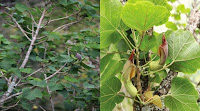
Field images of Coprosma cordicarpa. (A) Habit and habitat of whole plant with Jason Cantly. (B) Male stem and inflorescences. (C) Female stem and inflorescences. (D–F) Fruits illustrating population variation in color and degree of calyx connation. (A–C), (E) From Kanaio Natural Area Reserve. (D), (F) from Auwahi. Black scale bar at bottom right indicates the following lengths: 0.5 m (A), 1.5 cm (B–C), (E–F), 5 cm (D), 2 cm. Cantly et al. (2016).

Due to the low numbers of Coprosma cordicarpa observed, and its scattered distribition over a very limited range, in an area where much of the environement has been degraded by invasive, introduced animals (particularly Goats) and plants (particularly Kikuyu Grass), leads Cantly et al. to conclude that Coprosma cordicarpa should be considered to be Vulnerable under the terms of the International Union for the Conservation of Nature’s Red List of Threatened Species.

See also...

http://sciencythoughts.blogspot.co.uk/2015/11/sommera-cusucoana-new-species-of.htmlSommera cusucoana: A new species of Sommera from Honduras.                    Sommeras are tropical shrubs or small trees belonging to the Rubiaceae (the same group as plants as Coffee) found in tropical rainforests and occasionally dry Oak forests in Central and South...
http://sciencythoughts.blogspot.co.uk/2014/09/a-new-species-of-hibiscus-from-maui.htmlA new species of Hibiscus from Maui Island, Hawaii.                                                   Hibiscus trees of the genus Hibiscadelphus are known only from the Hawaiian Islands, to which they are endemic. Like many...
Follow Sciency Thoughts on Facebook. 

Sunday, 22 November 2015

Sommera cusucoana: A new species of Sommera from Honduras.

Sommeras are tropical shrubs or small trees belonging to the Rubiaceae (the same group as plants as Coffee) found in tropical rainforests and occasionally dry Oak forests in Central and South America. They typically have large fleshy leaves and small flowers, and produce fleshy berries with numerous seeds.

In a paper published in the journal PhytoKeys on 13 October 2015, David Lorence of the National Tropical Botanical Garden in Kalaheo, Hawaii and Anke Dietzsch and Daniel Kelly of the Department of Botany at Trinity College Dublin, describe a new species of Sommera from the Parque Nacional El Cusuco in Cortes Province, Honduras.

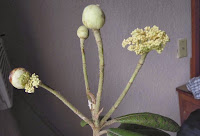
The new species is named Sommera cusucoana, in reference to the park where it was discovered. It has large oval leaves with long red stems, and produces inflorescences each comprising 2-4 small, white tubular flowers, that give rise tolarge, dark red berries.

Sommera cusucoana. Tip of shoot with flower, developing fruits, and leaf pair emerging between pair of stipules. Anke Dietzsch in Lorence et al. (2015).

Sommera cusucoana was described from two small trees found a few meters appart in an area of montane rainforest dominated by tall trees such as Liquidambar styraciflua (American Sweetgum) and Cedrela odorata (Spanish Cedar). The trees werea the bottom of a steep valley at an altitude of 1333 m, with a moist microclimate. The area is somewhat disturbed, being close to campsites and trails used by visitors to the park, as well as natural disturbances such as landslips and tree windfalls. The location is only about 500 m from an area that was clear-felled by loggers in 2010-13 (despite being deep within a national park), and Lorence et al. therefore propose that the species be listed as Critically Endangered under the terms of the International Union for the Conservation of Nature’s Red List of Threatened Species.

See also...

http://sciencythoughts.blogspot.co.uk/2015/02/trying-to-save-sinkhole-cycad.htmlTrying to save the Sinkhole Cycad.               Cycads are an ancient group of Gymnosperm Plants thought to be among the closest surviving relatives of Flowering Plants. They originated in the Palaeozoic, and were once one of the most abundant plant groups on Earth, but were almost wiped out at the end of...
http://sciencythoughts.blogspot.co.uk/2014/05/how-pinuela-affects-soil-communities-in.htmlHow the Piñuela affects soil communities in its native environment.                                 The Piñuela, Bromelia pinguin, is a ground dwelling Bromeliad widely farmed in Central America and the Caribbean both for its fruit and its hedge forming ability. It naturally forms dense clumps spiney growth, unusual in rainforests, where finding two plants of the same...
http://sciencythoughts.blogspot.co.uk/2014/03/a-new-species-of-hydrangea-from-mexico.htmlA new species of Hydrangea from Mexico and Central America.                          Hydrangeas are perennial woody plants related to Dogwoods and Silkleafs. Most species form small shrubs, but some grow to tree sizes, and there are some lianas (woody vines) in the group...
Follow Sciency Thoughts on Facebook.