Showing posts with label Bromeliads. Show all posts

Wednesday, 12 November 2025

Dyckia semperflorens: A new species of Bromeliad from the cold region of Rio Grande do Sul, southern Brazil.

Bromeliads are herbaceous Monocotyledons native to the Americas (with a single species known from West Africa) and related to the Sedges and Grasses. They have a distinctive rosette shape, with blade-like leaves spiraling out from a central point. In some cases the centre of this rosette forms a water reservoir held in place by tightly overlapping leaf-bases, which can contain entire miniature ecosystems. Many Bromeliads are epiphytes, living on the branches of trees, particularly in rainforests, but others live on the ground and many are found in deserts.

The genus Dyckia contains 188 recognised species of Bromeliads, making it one of the most specious genera within the group. The majority of these are found in arid areas of Argentina, Bolivia, Paraguay, Uruguay, and Brazil, with about two thirds of all species being found in Brazil. Species of Dyckia tend to have spiny leaves and a succulent form, and often grow on thin soils or directly on rock. They also tend to be highly endemic, with most species having a limited geographical range, and several species known only from a single location.

In a paper published in the Nordic Journal of Botany on 17 October 2025, Henrique Mallmann Büneker and Jorge Ernesto de Araujo Mariath of the Laboratório de Anatomia Vegetal and Programa de Pós-graduação em Botânica at the Universidade Federal do Rio Grande do Sul, describe a new species of Dyckia from an escarpment beside the Rio dos Touros in the municipality if Bom Jesus in Rio Grande do Sul State, Brazil.

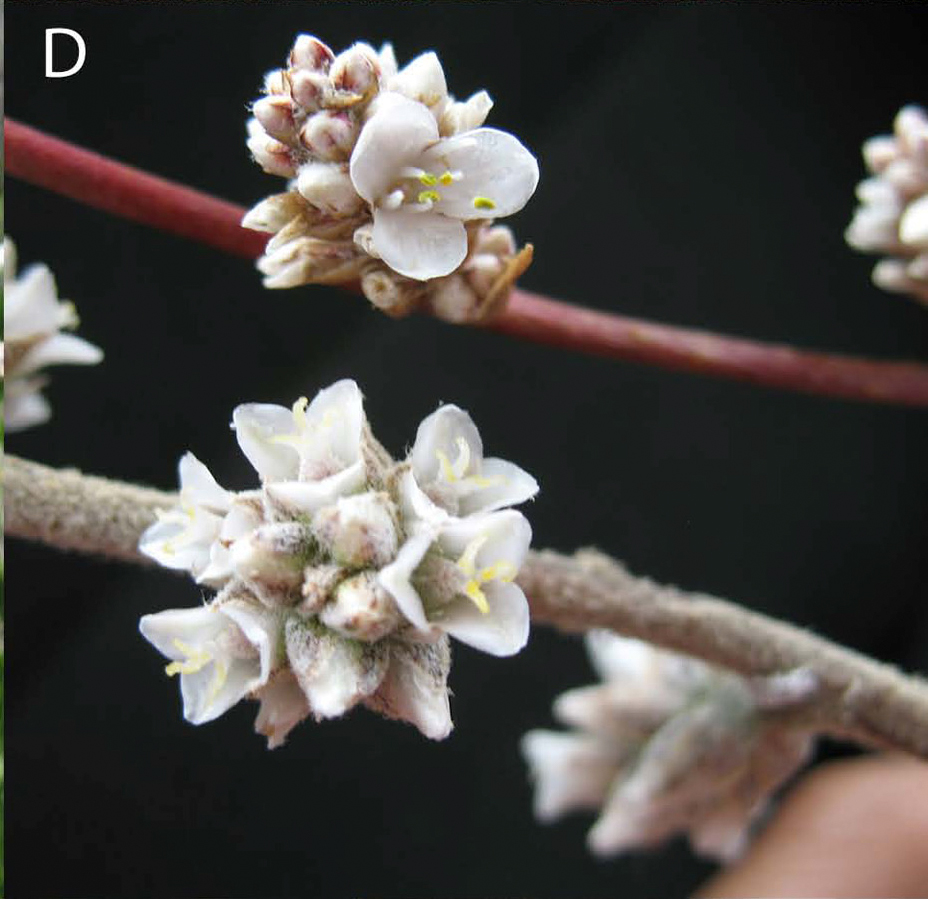
The new species is named Dyckia semperflorens, where 'semperflorens', means 'continuously flowering'; when the species was first observed in 2017 a live specimen was collected and brought to the Planeta Bromélia nursery in Porto Alegre, where it has remained in bloom ever since. Specimens of Dyckia semperflorens reach 65-96 cm in height, and have a rosette diameter of 38-65 cm. Leaves are 47-107 cm in length, with the inner leaves being semi-erect, while the outer ones are more relaxed, all have an elongate triangular shape with a waxy surface and sparse spines on the edges. Flowers are born on an erect or semi-erect peduncle, 20-36 cm in length. Flowers are tubular and greenish or reddish, flowers on the base of the peduncle are larger than those towards the tip.

Dyckia semperflorens.  (A) Habitat, (B) clumping habit, (C) flowering plant habit, (D) rosette, (E) detail of the inflorescence. Henrique Mallmann Büneker in Büneker & Mariath (2025).

Dyckia semperflorens is known from a single location, on a rocky escarpment along the banks of the Touros River, 1054 m above sealevel, in the municipality of Bom Jesus, Rio Grande do Sul State, in southern Brazil. The local environment is dominated by grassland, with patches of  Araucaria forest. The climate here is temperate, with frost and snowfall in the winter. 

The only known population of Dyckia semperflorens grows in an area currently under pressure from cattle grazing and frequent anthropogenic fires, which are used for grassland management in the region. However, there are other similar areas in the region which could potentially support the species, and which have not been explored yet, so Büneker and Mariath refrain from assigning a conservation status to the species at this time.

See also...


Saturday, 10 May 2014

How the Piñuela affects soil communities in its native environment.

The Piñuela, Bromelia pinguin, is a ground dwelling Bromeliad widely farmed in Central America and the Caribbean both for its fruit and its hedge forming ability. It naturally forms dense clumps spiney growth, unusual in rainforests, where finding two plants of the same species is often a challenge. The Piñuela is also known for its Fungus-suppressing abilities, and therefore changes the nature of soils in areas where it is grown.

A stand of wild Piñuela Plants in Costa Rica. Área de Conservación Guanacaste.


In a paper published in the journal BMC Ecology on 5 May 2014, Caitlin Looby of the Department of Ecology and Evolutionary Biology at the University of California-Irvine and William Eaton of the Biology Department at Pace University examine the role of the Piñuela in its native ecosystems in the rainforests of Costa Rica.

Looby & Eaton collected soil samples from both stands of Piñuela and the surrounding forest in the Maquenque National Wildlife Refuge (Refugio Nacional de Vida Silvestre Mixto Maquenque), and analyzed them for moisture, pH, microbial biomass and fungal diversity.

Soils from within stands of Piñuela were found to have similar pH and moisture levels to soils from the surrounding forest, however they showed a marked reduction in microbial biomass, which was typically less than half that of the surrounding soils. The taxonomic composition of fungi within the Piñuela stands was markedly different, dominated by Basidiomycote Fungi of the orders Tremellales (which was completely absent from forest soils) and Agaricales and Ascomycote Fungi of the order Hypocreales, while the soil in the surrounding forests was dominated by the Ascomycote Fungi of the order Helotiales (which was completely absent from the Piñuela soils) and Basidiomycote Fungi of the order Thelephorales (which formed only 5% of the fungi in the Piñuela soils). Members of the phyla Zygomycota, Glomermycota, and Chytridiomycota were found within the Piñuela soils, but not within soils from the surrounding forests.

This study demonstrates that the Piñuela Plant has a profound effect on the composition of the fungal community in soils where it occurs, despite there being little difference in soil pH and moisture, usually thought to be the determining factors in soil community composition in tropical soils. Since the breakdown of organic matter in soils is largely accomplished by fungi and bacteria, this is likely to have an equally profound effect on nutrient flow within these soils.

See also...


Earthstars (Geastrales) are distinctive Macro-fungi (fungi that...


Bromeliads are herbaceous Monocotyledons native to the Americas (with a single species known from West Africa) and related to the Sedges and Grasses. They have a distinctive rosette shape, with blade-like leaves spiraling out from a central point. In some cases the centre of this rosette forms a water reservoir held in place by tightly overlapping leaf-bases, which can contain entire miniature...


Bromeliads are monocotyledonous plants related to grasses. They are a diverse group, including many epiphytes (plants that grow on other plants, typically on the branches of trees), and a number of fleshy, succulent species dwelling in deserts. Bromiliads are noted for their tight whorls of leaves, that sometimes trap pools of water at the base. The group are almost entirely restricted to the American tropics, with a few subtropical species, and a single known species native to West Africa.


Follow Sciency Thoughts on Facebook.

Tuesday, 9 July 2013

A new species of Bromeliad from Tamaulipas State, Mexico.

Bromeliads are herbaceous Monocotyledons native to the Americas (with a single species known from West Africa) and related to the Sedges and Grasses. They have a distinctive rosette shape, with blade-like leaves spiraling out from a central point. In some cases the centre of this rosette forms a water reservoir held in place by tightly overlapping leaf-bases, which can contain entire miniature ecosystems. Many Bromeliads are epiphytes, living on the branches of trees, particularly in rainforests, but others live on the ground and many are found in deserts.

In a paper published in the journal Phytotaxa on 19 June 2013, Ivón Ramírez Morillo and Carlos Jiménez Nah of the Centro de Investigación Científica de Yucatán and Jacinto Treviño Carreón of the Facultad de Ingeniería y Ciencias at the Universidad Autónoma de Tamaulipas describe a new species of Bromeliad from Tamaulipas State in northeast Mexico.

The new species is placed in the genus Hechtia, and given the specific name hernandez-sandovalii, in honour of Luis Hernández Sandoval, who collected the specimens from which the species is described. Hechtia hernandez-sandovalii is a 1-1.8 m high Bromeliad with rosettes up to 35 cm in diameter. New rosettes bud off at the bottom of established plants, forming large colonies. The plant produces 1.15-1.53 m inflorescences with whitish flowers. The plant was found living in a restricted area of the southwest of Tamaulipas State, living both in the open on limestone hills and rocky areas, and as an understory plant in Pine and Yucca forests. Hechtia hernandez-sandovalii was found living at altitudes if between 1800 and 2200 m, in areas where the temperature could range from -4℃ to 41℃.

Individual rosette of Hechtia hernandez-sandovalii. Ramírez Morillo et al. (2013).

Colony of Hechtia hernandez-sandovalii. Ramírez Morillo et al. (2013).

Flowers of Hechtia hernandez-sandovalii. Ramírez Morillo et al. (2013).


Follow Sciency Thoughts on Facebook.

Friday, 1 June 2012

New species of Bromiliad from Brazil.

Bromeliads are monocotyledonous plants related to grasses. They are a diverse group, including many epiphytes (plants that grow on other plants, typically on the branches of trees), and a number of fleshy, succulent species dwelling in deserts. Bromiliads are noted for their tight whorls of leaves, that sometimes trap pools of water at the base. The group are almost entirely restricted to the American tropics, with a few subtropical species, and a single known species native to West Africa.

In a paper published in the journal Phytotaxa on 11 September 2011, Rafael Batista Louzada of the Departamento de Botânica at the Instituto de Biociências at Universidade de São Paulo and the Instituto de Botânica at the Secretaria do Meio Ambiente, and Maria das Graças Lapa Wanderley, also of the Instituto de Botânica at the Secretaria do Meio Ambiente, describe a new species of Bromeliad from the Chapada Diamantina National Park in Bahia State, Brazil.

The new species is placed in the genus Orthophytum, Straight or Erect Bromiliads (so called because of their erect flower spikes) and given the specific name argentum, meaning silver, the leaves having a silvery sheen. It is a 24-34 cm plant, topped by an 11-18 cm flower spike, growing on quartzite rock outcrops between 1000 and 1300 m in altitude; its closest relatives are forest dwellers.

Orthophytum argentium. (A) Whole plant. (B) Complete flower with floral bract. (C) Floral bract. (D) Abaxial sepal. (E) Adaxial sepal. (F) Adaxial sepal with the opposite stamen. (G) Petal with one adnate stamen, showing two petal callosities and two supra basal appendages. (H) Flower section showing adaxial sepal with the opposite stamen, petal with the adnate stamen, petal callosities and appedages, and the gynoecium showing style, stigma and ovary with axial placentation. (I) Detail of the stigma. Louzada & Wanderley (2011).


Follow Sciency Thoughts on Facebook.