Showing posts with label Caecilians. Show all posts

Saturday, 28 December 2024

Ichthyophis yangi: A new species of Caecilian from China.

Caecilians are limbless burrowing Amphibians found in tropical regions of Asia, Africa and South America. They resemble Earthworms, with circular folds on their skin which make them look segmented and skin covering their eyes (though they can see), though they are true Vertebrates with visible jawbones, which all Worms lack.. Unlike snakes they have greatly reduced or even absent tails with their anus close to or at the tips of their bodies. Caecilians are predatory with a well developed sense of smell. 

Members of the Family Ichthyophiidae are found in Asia from India east to the Philippines, and south through Myanmar to southern China, Thailand, and the Malayan Archipelago, ultimately reaching the Wallace Line. the Ichthyophiidae was formerly divided into three genera, Caudacaecilia, Ichthyophis, and Uraeotyphlus, but molecular phylogenies have suggested that Caudacaecilia and Ichthyophis are not genetically distinct, and thus all species from both genera have been placed in the single genus Ichthyophis (this having been named first). Thus, Ichthyophis currently contains 49 species of Caecillians, in two distinct colour types, one having a pair of lateral stripes in a yellow or cream colour, and one lacking any such. All members of a species appear to always belong to a single colour type, but this is no guide to relationships between species.

In a paper published in the journal Asian Herpetological Research on 9 December 2024, Dingqi Rao and Hongxin Zhou of the Kunming Institute of Zoology, Mingzhong Mo of the Forestry and Grassland Administration of Honghe Prefecture, Zhiyong Yu of the Fenshuiling National Nature Reserve, and Xiuyan Li and Shou Liu, also of the Kunming Institute of Zoology, describe a new species of Ichthyophis from Yunnan Province, China.

In 1922 German zoologist Rudolph Mell reported observing a unmarked species of Ichthyophis on Luofu Mountain in Guangdong Province, but aside from this, all other records of the genus in China are of striped species. Then, in June 2023, a group of local residents in Jinping County of Yunnan Province found a dead and partially dried Caecilian beside a road near the village of Maandi, which they took to Mingzhong Mo. He in turn took it to the Kunming Institute of Zoology, where it was recognised as a stripeless Ichthyophis.

A subsequent search of the area by zoologists from the Kunming Institute of Zoology recovered another five specimens, including two sub-adults, all od which were lacking in stripes. A subsequent genetic analysis confirmed that these were a new species of Ichthyophis, forming a sister species to Ichthyophis chaloensisi, a stripeless species from Vietnam. The new species is named in honour of Datong Yang, the first herpetologist to describe a new species of Ichthyophis from China.

Holotype of Ichthyophis yangi in life. Rao et al. (2024).

The largest specimen of Ichthyophis yangi is 324 mm in length and 16 mm wide at its mid-body. All are grey in colour, without any markings. The head is flattened and widest behind the mouth, tapering towards the tip of the snout. The eyes are covered by skin. Teeth are small and hook-shaped. The species is only known from the area around Maandi Village, with most specimens found under stones on farmland close to a stream.

(A) Habitat of Ichthyophis yangi. (B) The place where holotype of Ichthyophis yangi was discovered. Jingchao Wang in Rao et al. (2024).

See also...

Wednesday, 25 December 2019

Caecilia pulchraserrana: A new species of Caecilian from Colombia.

Caecilians are limbless burrowing Amphibians found in tropical regions of Asia, Africa and South America. They resemble Earthworms, with circular folds on their skin which make them look segmented and skin covering their eyes (though they can see), though they are true Vertebrates with visible jawbones, which all Worms lack.. Unlike snakes they have greatly reduced or even absent tails with their anus close to or at the tips of their bodies. Caecilians are predatory with a well developed sense of smell. Most Caecilians are found on continents; island dwelling species are very rare in this group. 

In a paper published in the journal ZooKeys on 30 October 2019, Andrés Acosta-Galvis, Mauricio Torres, and Paola Pulido-Santacruz of the Instituto de Investigación de Recursos Biológicos Alexander von Humboldt, describe a new species of Caecilian from the western foothills of the Serranía de los Yariguíes in Santander Department, Colombia.

The new species is described from specimens collected during a recent herpetological survey in wet tropical forests of the Serranía de los Yariguíes, between 17 February and 1 May 2018 (i.e. during the dry season). Specimens were found in two separate humid spots near the Río Cascajales, which drains Tropical moist broadleaf forests, within the ecoregion of the Magdalena valley montane forests, in the foothills of the Cordillera Oriental. The collecting technique which was used to obtain specimens of the new species, consisted of first asking local people about the locations where they have spotted Caecilians using the common names of 'Blind Snakes', or 'Captain Worms'('Lombrices capitanas'), or 'Motolas' (this common name is specific for the Department of Santander). Subsequently, the reported sites were visited and inspected to select sites under the shade of vegetation, and where the soil is not compact and very humid (usually associated with water springs that form a mosaic of marshy and dry areas). Collecting efforts were focused in the selected damp microhabitats, digging with a hoe to a depth of approximately 20 cm.

The new species is placed in the genus Caecilia and given the specific name pulchraserrana, meaning 'beautiful mountian' in reference to the La Belleza (The Beautiful) municipality in the western foothills of the Serranía de Los Yariguíes (Los Yariguíes Mountains), where the species was discovered. The species is described from five adult specimens, three females and two males, which range from 195 to 232 mm in length, and are dark brownish in colour with thin salmon-coloured chromatophores; the ventral surface of body slightly paler than dorsum, and the annular grooves on sides of body slightly darker than general body colour. The jaw margins, area between the eye and naris, and tentacular regions are pink-orange (salmon), the eyeballs are completely violet blue, and the periorbital region is salmon.

Caecilia pulchraserrana, adult female specimens. Acosta-Galvis et al. (2019).

See also...

https://sciencythoughts.blogspot.com/2017/10/hypogeophis-pti-new-species-of.htmlhttps://sciencythoughts.blogspot.com/2015/02/a-new-species-of-caecilian-from-brazil.html
https://sciencythoughts.blogspot.com/2014/05/a-new-species-of-caecilian-from-french.htmlhttps://sciencythoughts.blogspot.com/2012/02/new-amphibians-from-northeast-india.html


Follow Sciency Thoughts on Facebook.

Monday, 9 October 2017

Hypogeophis pti: A new species of Caecilian from Praslin Island, the Seychelles.

Caecilians are limbless burrowing Amphibians found in tropical regions of Asia, Africa and South America. They resemble Earthworms, with circular folds on their skin which make them look segmented and skin covering their eyes (though they can see). Unlike snakes they have greatly reduced or even absent tails with their anus close to or at the tips of their bodies. Caecilians are predatory with a well developed sense of smell. Most Caecilians are found on continents; island dwelling species are very rare in this group. However one island group they have colonised are the tropical Seychelles in the Indian Ocean, where six species have been described to date. Four of these six species, Hypogeophis rostratus, Grandisonia alternans, Grandisonia larvata, and Grandisonia sechellensis, are found across several islands, and appear to be tolerant of a wide range of habitats, while the remaining two, Praslinia cooperi, and Hypogeophis brevis, appear to be restricted to habitats above 350 m, and are found on the two islands of the Seychelles that reach over 400 m, Mahé and Silhouette, with Hypogeophis brevis only ever recorded from Mahé.

In a paper published in the journal Zootaxa on 6 October 2017, Simon Maddock of the Department of Life Sciences at The Natural History Museum, Department of Genetics, Evolution and Environment at University College London, and the School of Biology, Chemistry and Forensic Science at the University of Wolverhampton, Mark Wilkinson, also of the Department of Life Sciences at The Natural History Museum, Ronald Nussbaum of the Museum of Zoology and Department of Ecology and Evolutionary Biology at the University of Michigan, and David Gower, again of the Department of Life Sciences at The Natural History Museum, describe a new species of Caecillian from Praslin Island in the Seychelles.

The new species is named Hypogeophis pti, where 'pti' means small in Seychellois Creole (deriving from the French 'petit'). The species is notably smaller than any other Caecilian from the Seychelles, with less than 70 vertebrae and a maximum recorded length of 116 mm. This species is grey brown in colour, lighter on the underside, with eyes visible as dark spots. The species was found at three locations, around the village of Ma Katrine, and at Fond Peper and Glacis Noir in the Praslin National Park. All specimens were found at altitudes of between 170 and 350 m, in slightly acid silty clay loam or sandy loam soils beneath dense layers of dried leaves.

Live specimen of Hypogeophis pti from Fond Peper in thr Praslin National Park. Maddock et al. (2017).

See also...

http://sciencythoughts.blogspot.co.uk/2017/02/understanding-origins-of-giant.htmlhttp://sciencythoughts.blogspot.co.uk/2015/02/a-new-species-of-caecilian-from-brazil.html
http://sciencythoughts.blogspot.co.uk/2014/11/the-impact-of-yellow-crazy-ant-on.htmlhttp://sciencythoughts.blogspot.co.uk/2014/05/a-new-species-of-caecilian-from-french.html
http://sciencythoughts.blogspot.co.uk/2012/02/new-amphibians-from-northeast-india.html
Follow Sciency Thoughts on Facebook.

Thursday, 5 February 2015

A new species of Caecilian from Brazil.


Caecilians are tropical Amphibians only distantly related to Frogs and Salamanders. They have highly modified bodies, having lost their limbs and taken on a worm-like soil dwelling lifestyle with a body covered in ring-shaped folds of skin called annuli, which resemble the segments of Annelid Worms, which they resemble closely and are often mistaken for, though a typical vertebrate jaw and a mouth full of sharp teeth reveals their true nature. Members of the South American genus Microcaecilia have their eyes covered over by a layer of bone, further increasing their resemblance to Worms.

In a paper published in the journal Zootaxa on 13 January 2015, MarkWilkinson of the Department of Life Sciences at The Natural History Museum and Marta Maria Antoniazzi and Carlos Jared of the Laboratório de Biologia Celular at Instituto Butantan describe a new species of Microcaecilia from the Área de Proteção Ambiental in Pará State, Brazil.

The new species is named Microcaecilia butantan in honour of Instituto Butantan. The species is described from one female and three male specimens, dug up at a Cupuaçu, Theobroma grandiflorum plantation (a plant related to Cacao producing edible fruit) with hand hoes. The female is 159 mm in length, the males range from 191 to 208 mm. They have more annuli than other known species (over 135 in all specimens) and a continuous tooth row (many species have a gap) with recurved but unserrated teeth.

Microcaecilia butantan,specimen in life dorsal view. Bar is 5 mm. Wilkinson et al. (2015).

Little is known of the natural history of this species, but it was easily found in the rainy season, within both the plantation where it was discovered and the surrounding forest, suggesting that it has a fairly high population at least locally, and so it is not at the current time considered to be under any immediate conservation threat.

The habitat where Microcaecilia butantan was found living. Wilkinson et al. (2015).

See also…

http://sciencythoughts.blogspot.co.uk/2014/05/a-new-species-of-caecilian-from-french.htmlA new species of Caecilian from French Guiana.                                                                            Caecilians (Gymnophiona) are a group of Amphibians only distantly related to Frogs and Salamanders. They have lost all limbs, and live a burrowing lifestyle in moist tropical forests. Caecilians have banded...
Caecilians are limbless burrowing Amphibians found in tropical regions of Asia, Africa and South America. They resemble Earthworms, with circular folds on their skin which make them look...


Follow Sciency Thoughts on Facebook.

Wednesday, 28 May 2014

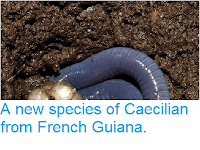
A new species of Caecilian from French Guiana.

Caecilians (Gymnophiona) are a group of Amphibians only distantly related to Frogs and Salamanders. They have lost all limbs, and live a burrowing lifestyle in moist tropical forests. Caecilians have banded scales around their bodies and many species lack external eyes, making them superficially resemble Annelid Worms (Earthworms), though they are true Vertebrates with visible jawbones, which all Worms lack.

In a paper published in the journal PLoS One on 6 March 2013, Mark Wilkinson of the Department of Zoology at The Natural History Museum in London, Emma Sherratt also of the Department of Zoology at The Natural History Museum in London and the Department of Organismic and Evolutionary Biology and Museum of Comparative Zoology at Harvard University, Fausto Starace of Saint Laurent du Maroni in French Guiana and David Gower, also of the Department of Zoology at The Natural History Museum in London, describe a new species of Caecilian from French Guiana.

The new species is placed in the genus Microcaecilia, which already contains eight species, all native to South America. These are small Caecilians with closed skulls and eyes covered over by a layer of bone, which is thought to be an adaptation to burrowing, although it is unclear if the level of bone growth seen is necessary for the digging style employed by the animals (which used the head to shovel aside sediment); on the whole the ecology of these animals is poorly known.

It is named Microcaecilia dermatophaga, meaning ‘skin-eater’ a reference to its reproductive behaviour. One of the specimens studied during the discovery of this species produced a string of five eggs, and a few days later was discovered to have two young, which fed by consuming lipid-rich skin from around the mid-section of the mother’s body. 

Reproductive mode of Microcaecilia dermatophaga. Presumed mother with a connected string of five eggs (top) and with two hatchlings during the period of extended post-hatching parental care and maternal dermatophagy (bottom). Wilkinson et al. (2013).

This mode of juvenile feeding has been observed twice before in Caecilians, firstly in the African species Boulengerula taitanus, and secondly in the South American Siphonops annulatus. These two species are only very distantly related (it is thought that their most recent common ancestor lived over 100 million years ago), and it is therefore thought that the trait is likely to be widely found in Caecilians, a theory which the discovery of such behaviour in Microcaecilia dermatophaga supports.

Microcaecilia dermatophaga is a small Caecilian, the largest specimen discovered reaching 183 mm in length. It is somewhat flattened, and the head is more ‘U’-shaped than ‘V’-shaped when seen in dorsal view. Its teeth are pointed and curved backwards, lacking blades or serrations. The juveniles lacked pigmentation and were pinkish, the adults a darker lilac colour. The smallest free living specimens found in the study were 75-84 mm in length, a size achieved by the hatchlings in 26 days, when they also showed an ability to burrow for themselves and a willingness to take Invertebrate prey. Based upon this Wilkinson et al. conclude that reproduction may begin as early as March or April (the hatchlings in the study were produced in July), and that sexual maturity is reached in about a year.

Adult specimen of Microcaecilia dermatophaga. Wilkinson et al. (2013).

One of the specimens discovered during the study was found within a rotten log, alongside large numbers of Termites, and subsequently fed happily on Termites in captivity. Other specimens consumed Crickets and Earthworms when these were offered, suggesting the species will take a variety of prey. Pieces of what appear to be termite jaws were found embedded in the heads of several specimens, suggesting that this may be a common food item for the species, and also that the extensive bone development in the head of all members of the genus Microcaecilia may be an adaptation enabling feeding on aggressive Termites and Ants, rather than for digging.

Typical environment for Microcaecilia dermatophaga. Forest close to the Mana River (at Angoulême, French Guiana). Wilkinson et al. (2013).

See also…


Caecilians are limbless burrowing Amphibians found in tropical regions of Asia, Africa and South America. They resemble Earthworms, with circular folds on their skin which make them look...


Follow Sciency Thoughts on Facebook.

Wednesday, 22 February 2012

New Amphibians from Northeast India.

Caecilians are limbless burrowing Amphibians found in tropical regions of Asia, Africa and South America. They resemble Earthworms, with circular folds on their skin which make them look segmented and skin covering their eyes (though they can see). Unlike snakes they have greatly reduced or even absent tails with their anus close to or at the tips of their bodies. Caecilians are predatory with a well developed sense of smell.

In a paper published in the Proceedings of the Royal Society B on 22 February 2012, a team of scientists led by Rachunliu Kamei of the Department of Environmental Studies at the University of Delhi, describe the discovery of a new family of previously undescribed Caecilians from the Northwest of India, named as the Chikilidae comprising the single genus Chikila (a local name for the animals)

Specimen of Chikila fulleri brooding eggs in captivity. From Kamei et al. (2012).

The Chikilidae were found to be quite widespread across Northeast India, though genetic studies suggested that their closest relatives were in fact African Caecilians, from which they probably diverged about 140 million years ago. This ties up well with predictions based upon the breakup of the ancient continent of Gondwana, during which India separated from Africa between 160 and 120 million years ago. Caecilians like other Amphibians cannot tolerate salt water, so they cannot have made the crossing after the continents separated. In addition they are restricted to wet tropical climates, and therefore cannot have crossed any colder or drier climatic zones during their history.

Elevation map of Northeast India showing locations where the new Caecilians were found. Different coloured circles represent different species of Chikilidaen. From Kamei et al. (2012).

Kamei et al. suggest that the Chikilidae were probably more widespread in India, and became more restricted as a result of the Deccan Traps volcanic eruptions, that covered much of India in volcanic basalt 65 million years ago at the end of the Cretaceous. Other formerly widespread groups have been shown to have become restricted to the better studied Western Ghats biozone in Southeast India and Sri Lanka at this time, and Kamei et al. suggest that further studies of the far Northwest of India may well uncover other unexpected endemic groups of animals. They also note that many of the forests of the area are currently under threat from a rapidly growing human population, and increasing deforestation.

Map of India and South Asia, showing the study area (square) and the main biogeographical zones. From Kamei et al. (2012).