Showing posts with label Pará State. Show all posts

Wednesday, 11 November 2020

Brazilian authorities rescue 39 slaves from illegal gold mine in Pará State, Brazil.

Inspectors from the  Slave Labour Eradication Division of the Labour Inspection Secretariat in Brazil have rescued 39 slaves from an illegal gold mine in municipality of Jacareacanga Pará State, in a raid staged on 26 October 2020. The workers were reportedly lured to the site with the promise of work, but then forced to borrow money from the mine's owners to purchase food and equipment at inflated prices, and prevented from leaving when they could not repay the loans, effectively becoming bonded labourers, something prohibited under Brazil's slavery laws. The mine was officially listed as a worker's cooperative, but officials became suspicious when it was noted that the 'cooperative' was headed by Raimunda Oliveira Nunes, who is on a black list of employers known to use slave labour. When the inspectors arrived at the site, they found workers living in open shacks without access to clean water, at a site where mining machinery estimated to be worth several million reals (several hundred thousand US dollars), implying that the site was a profitable concern.

 
Accomodation for workers at a mining site in Para State, Brazil, raided by Labour Inspectors in October 2020. Slave Labor Eradication Division of the Labour Inspection Secretariat.

Slavery was abolished in Brazil in 1888, but is still serious problem in Brazil, particularly in industries such as mining and logging, which often are often active in remote locations (sometimes without any legal right to do so), making them hard to police. As part of measures to combat this a 'dirty list' of employers known to be involved in the practice was introduced in 2004. This is separate to the various legal sanctions that can be taken against those involved in slavery, and provides authorities with a watch list of individuals thought to be worthy of particular scrutiny, as well as helping to prevent such individuals gaining access to credit to fund business activities.

Workers accomodation at a mine site raided by Brazilian authorities in October 2020. Slave Labour Eradication Division of the Labour Inspection Secretariat.

Raimunda Oliveira Nunes was added to this list in 2018, when another mine site she owned, also in Pará State, was raided. On that site it was found that 'employees' were forced to buy all food, clothing, water, and equipment from the operation on credit, with all gold recovered being handed over to Nunes' company, and the value (decided by the creditor) of this subtracted from the debt; employees did not have access to the credit book, and were generally only told the extent of their debt if they tried to leave. Access to phones or the internet were forbidden, with anyone wishing to contact the outside world being forced to buy transport to a remote location where there was a radio, then buy access to the radio. Employees were even prevented from developing normal relationships, with male employees being charged for access to female employees.

Nunes was sentenced to five years imprisonment for her role in the operation of the mine raided in 2018, but has yet to begin this sentence as she has lodged an appeal. Labour authorities report that they are currently unable to determine her location. However, her name being on a list of suspect employers did lead to the investigation which uncovered the new mine site.

See also...



Follow Sciency Thoughts on Facebook.

Follow Sciency Thoughts on Twitter.


Saturday, 31 August 2019

Adenomera phonotriccus: A new species of Nest-building Frog from Pará State, Brazil.

The Leptodactylidae are a group of Frogs found throughout Central and South America and the Caribbean,  which are sometimes known as 'Nesting Frogs' from the habit of some species of constructing nests of foam, often away from water (though always in damp environments) in which to incubate their young. There are currently eighteen recognised species of Adenomera, all found in South America to the east of the Andes, although the genus is known to contain a number of cryptic species (species that closely resemble other species, and cannot be separated by simple, non-invasive examination). The presence of cryptic species can have a profound influence on conservation efforts, as ‘species’ thought to be wide ranging with large populations and broad environmental tolerances can turn out to be complexes of closely related but reproductively isolated species, each with a smaller population and distribution, and narrower range of environmental tolerances.

In a paper published in the American Museum Novitates on 7 February 2019, Thiago de Carvalho of the Departamento de Zoologia e Centro de Aquicultura at the Universidade Estadual Paulista, Ariovaldo Giaretta of the Laboratório de Taxonomia e Sistemática de Anuros Neotropicais at the Universidade Federal de Uberlândia, Ariadne Anguelo of the International Union for the Conservation of Nature's Amphibian Specialist Group, Célio Haddad also of the Departamento de Zoologia e Centro de Aquicultura at the Universidade Estadual Paulista, and Pedro Peloso of the Instituto de Ciências Biológicas at the Universidade Federal do Pará, and the Division of Vertebrate Zoology at the American Museum of Natural History, describe a new species of Adenomera from Pará State in Brazil.

The new species is named Adenomera phonotriccus, where 'phonotriccus' means 'voice of a small Bird' in reference to the mating call of the male Frogs, which sounds like call of a Tody-tyrant of the Neotropical genus Hemitriccus. The species is described from four adult male Frogs collected from the western margin of the lower Araguaia River in the municipality of Palestina do Pará. These are small in size, measuring 19.8–21.6 mm in length, and robust, with a mottled brown colouration, sometimes with red stripes, and a white underside.

Live specimens (all adult males) of Adenomera phonotriccus from the type locality (Palestina do Pará, state of Pará, northern Brazil). (A) Holotype (MPEG 41155). (B) Paratopotype CFBH 43130. (C)‒(D) Paratopotype CFBH 43131. De Carvalho et al. (2019).

The new species is known from only a single location on a forest edge in an area of active deforestation, due to conversion of large areas where the species occur into pasture and agricultural land, though it is unclear how widely distributed the species is, and therefore what it's conservation status is.

See also...


https://sciencythoughts.blogspot.com/2019/06/limnonectes-savan-new-species-of-fanged.htmlhttps://sciencythoughts.blogspot.com/2019/04/protofrogs-from-late-triassic-of-arizona.html
https://sciencythoughts.blogspot.com/2018/12/electrorana-limoae-new-species-of-frog.htmlhttps://sciencythoughts.blogspot.com/2018/11/odorrana-kweichowensis-new-species-of.html
https://sciencythoughts.blogspot.com/2018/07/anomaloglossus-meansi-new-species-of.htmlhttps://sciencythoughts.blogspot.com/2018/03/nyctibatrachus-mewasinghi-new-species.html
Follow Sciency Thoughts on Facebook.

Saturday, 10 February 2018

Physoctonus amazonicus: A new species of Far-tailed Scorpion from Pará State in Brazil.

Fat-tailed Scorpions, Buthidae, are the largest group of Scorpions, with over 800 described species. They get their name from the fact that many species have thick tails and slender claws, primarily relying on their venom for both offence and defence, with a handful of species being capable of killing a Human with their sting. The genus Physoctonus currently contains two species, both from the caatingas thornscrub of northeastern Brazil.

In a paper published in the journal ZooKeys on 23 October 2017, Wilson Lourenço of the Muséum national d’Histoire naturelle at the Sorbonne Universités describes a new species of Physoctonus from Pará State in Brazil, based upon material collected by French zoologist Jean Vellard in 1929, and stored since then in the collection of the Muséum national d’Histoire naturelle.

The Vellard made two trips to the Amazon region of Brazil in the 1920s, during which time he studied the Scorpions and Venomous Fish of the area. He subsequently described four new species of Scorpion from Brazil, all of which are still considered valid today. Vallard also left a number of undescribed specimens in museum collections, though these have largely been overlooked to date.

The new species is named Physoctonus amazonicus, in reference to the area where it was found, in the Campos do Pará region between rivers Xingu and Araguaya, part of the Amazon drainage system. The species is a small-to-medium sized Scorpion, reaching a size of at least 28.4 mm (based upon the size of the single known female specimen – the males are unknown) and yellow in colour with brown spots. The only known specimen was found under a Termite mound in cerrado (savanna) grassland.

Physoctonus amazonicus, female specimen in dorsal and ventral views. Lourenço (2017).

See also...

http://sciencythoughts.blogspot.co.uk/2016/04/opsieobuthus-tungeri-scorpion-from.htmlhttp://sciencythoughts.blogspot.co.uk/2015/08/tityus-apozonalli-new-species-of.html
http://sciencythoughts.blogspot.co.uk/2015/05/scorpiops-ingens-new-species-of.htmlhttp://sciencythoughts.blogspot.co.uk/2014/08/two-new-species-of-scorpion-from.html
http://sciencythoughts.blogspot.co.uk/2014/05/a-new-species-of-wood-scorpion-from.htmlhttp://sciencythoughts.blogspot.co.uk/2013/12/a-scorpion-from-late-devonian-of-south.html
Follow Sciency Thoughts on Facebook.

Monday, 26 December 2016

Panaqolus tankei, a new species of Tiger Pleco from the Xingu Basin of Brazil.

Armoured Catfish, Loricariidae, are large Catfish that have bodies covered with extensive bony scales and mouthparts modified to form suckers that are found in most freshwater ecosystems in South America. They are widely traded in the aquarium trade as 'Plecs' or 'Plecos', with stripey forms known as 'Tiger Plecos', and a number of species are known in the aquarium trade that have not yet formally been described in the scientific literature.

In a paper published in the journal PLoS One on 9 November 2016, Christian Andreas Cramer of the Center for Human Genetics at Philipps-University Marburg and the Laboratório de Ictiologia e Pesca at the Universidade Federal de Rondónia and Leandro Melo de Sousa of the Laboratório de Ictiologia at the Universidade Federal do Pará describe a new species of Armoured Catfish from the Xingu Basin of Pará State in Brazil.

The new species is placed in the genus Panaqolus, and given the specific name tankei, in honour of the aquarist Andreas Tanke, for his dedication to the study of Plecs of the genus Panaqolus, andfor being the first person to breed the new species in captivity. The species is small-to-medium sized for a Loricariid, with the largest recorded individual measuring 83 mm in length. The species has a yellowish brown base colouration with darker stripes.

Live coloration of Panaqolus tankei, from the region of Vitória do Xingu (live aquarium specimen). Ralf Heidemann in Cramer & de Sousa (2016).

The species is found on the lower Xingu River, downstreamBeloMonte Waterfalls, typically being found associated with sunken trees and wood. A major hydroectric power plant is currently beinf constructed on the middle reaches of the Xingu, and what effect this will have on the many Catfish species found in the river, the majority of which have very limited distributions, is unclear.

Typical habitat of Panaqolus tankei. Riverbank in Lower Xingu. Cramer & de Sousa (2016).

See also...

http://sciencythoughts.blogspot.co.uk/2014/09/a-new-species-of-armoured-catfish-from.htmlhttp://sciencythoughts.blogspot.co.uk/2014/05/a-new-species-of-armored-catfish-from.html
http://sciencythoughts.blogspot.co.uk/2013/12/a-new-species-of-catfish-from-minas.htmlhttp://sciencythoughts.blogspot.co.uk/2013/11/two-new-species-of-armored-catfish-from.html
http://sciencythoughts.blogspot.co.uk/2013/06/a-new-species-of-armored-catfish-from.htmlhttp://sciencythoughts.blogspot.co.uk/2012/03/new-species-of-armored-catfish-from.html
Follow Sciency Thoughts on Facebook.

Sunday, 27 December 2015

Bobdalgleishia stephanophallus: a new species of Philopterid Chewing Louse from Pará State, Brazil.

Chewing Lice, Ischnocera, are considered to be primitive members of the Lice order, Phthiraptera, which lack specialist adaptations for sucking blood or other bodily fluids. Like other Lice they are ectoparasites living externally on the bodies of warm blooded hosts, usually Birds though one group targets Lemurs, feeding on the feathers and skin of the host. The Philopterid Chewing Lice target a wide range of Birds around the world, including Passarines, Kingfishers, Parrots, Trogons and Woodpeckers.

In a paper published in the journal ZooKeys on 1 December 2015, Michel Valim of the Museu de Zoologia at the Universidade de São Paulo and Armando Cicchino of the Laboratorio de Artrópodos at the Universidad Nacional de Mar del Plata describe a new species of Chewing Louse from a Great Jacamar, Jacamerops aureus ridgwayi, from Pará State in Brazil.

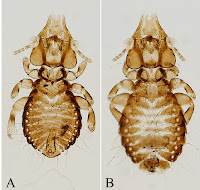
The new species is given the specific name Bobdalgleishia stephanophallus, where 'Bobdalgleishia' honours the late entomologist Robert Dalgleish for his 'special disposition to listen and learn from those who disagree with him on taxonomic issues', and 'stephanophallus' means 'crowned penis' in reference to the male reproductive structure. The species is described from two male and one female specimens found on the preserved skin of a Great Jacamar from the Museu de Zoologia da Universidade de São Paulo obtained in 1943. Valim and Cicchino are aware of the hazards of describing ectoparasites from museum specimens, with a number of documented cases of species being described erroneously based upon poorly preserved parasites that had been transferred to animals other than their hosts post mortem, and to this end examined a large number of further Great Jacamar specimens looking for further examples of Bobdalgleishia stephanophallus without success. In the end it was decided that with well preserved specimens of both sexes it was possible to describe the species, particularly as the specimens show a number of distinctive features not seen in any other documented species, most notably long occular settae (hairs on the eyes), which should make it possible to re-identify this species if it is subsequently found on a different host.

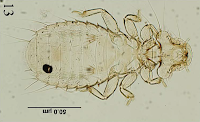
Bobdalgleishia stephanophallus, habitus in dorsal view: (A) male (B) female. Abbreviations: mts, marginal temporal setae 1 and 2; os, ocular seta. Valim & Cicchino (2015).

See also...

http://sciencythoughts.blogspot.co.uk/2013/12/seven-new-species-of-chewing-lice-from.htmlSeven new species of Chewing Lice from Costa Rica.                                               Chewing Lice are parasites living in the feathers of Birds (or occasionally the fur of Mammals). They are considered to be more primitive relatives of the...
http://sciencythoughts.blogspot.co.uk/2012/09/three-new-species-of-chewing-lice-from.htmlThree new species of Chewing Lice from Limpopo Province, South Africa.            Chewing Lice are parasites living in the feathers of Birds (or occasionally the fur of Mammals). They are considered to be more primitive relatives of the...
http://sciencythoughts.blogspot.co.uk/2012/07/three-new-species-of-chewing-lice-from.htmlThree new species of Chewing Lice from Bulbuls in northern Vietnam.                   Chewing Lice (Amblycera and Ischnocera) are specialized parasites on birds and sometimes mammals. They are considered primitive members of the Louse Order Phthiraptera, since they lack the specialized mouthparts that other lice use to drain blood from their hosts, instead either eating dead skin...
Follow Sciency Thoughts on Facebook.
  

Saturday, 1 August 2015

Catasetum telespirense: A new species of epiphytic Orchid from the southern Brazilian Amazon.


In 2011-2012 a series of series of rescue expeditions recovered and relocated around 105 000 epiphytic plants (plants which live on other plants, typically the branches of canopy trees) from the site of the planned Teles Pires Power Plant, which straddles the borders between Paranaíta County in Mato Grosso State and Jacareacanga County in Pará State on the banks of the River Teles Pires. This area is poorly explored by botanists, despite being an area high biodiversity, and many new species were discovered during this operation.

In a paper published in the journal Phytotaxa on 27 March 2015, Adarilda Petini-Benelli of the Instituto de Biociências at the Universidade Federal de Mato Grosso and Célia Regina Araújo Soares-Lopes of the Herbário da Amazônia Meridional at the Universidade do Estado de Mato Grosso describe a new species of epiphytic Orchid from the Teles Pires Power Plant site.

The new species is placed in the genus Catasetum, which currently contains at least 130 species of epiphytic Orchids with many undiscovered species thought likely to be present in unexplored areas of the Amazon, and given the specific name telespirense, in reference to the area where it was found. Catasetum telespirense is an epiphytic herb consisting of a 10-18 cm pseudobulb with 5-7 narrow leaves 20-45 cm in length growing from its base. These leaves are generally shed before the production of the inflorescence (flower-stem), also from the base of the plant. This is 20-45 cm in length and bears 2-10 fragrant yellow or yellow-green flowers 40-45 mm in width.

Male flowers from three specimens of the Catasetum telespirense showing different colours and lip forms. Adarilda Petini-Benelli in Petini-Benelli & Soares-Lopes (2015).

Catasetum telespirense was observed in the wild only at the Teles Pires Power Plant site, which is now lost to development. However discussions with Orchid collectors in Guarantã and Paranaíta Counties in Mato Grosso State and Jacareacanga  County in Pará State revealed that many had specimens of this plant, which most claimed had been collected from sites designated for development, in order to protect the plants, though one collector did admit collecting specimens from an unthreatened site. Clearly both urban development and unregulated collecting of the plants have implications for the conservation of Catasetum telespirense, and Petini-Benelli & Soares-Lopes suggest that the Orchid should be listed as Endangered under the terms of the International Union for the Conservation of Nature’s Red List of Threatened Species, due to the limited known range of the species, the low number of specimens recorded within this area, and the threats posed to the species by human activity.

Catasetum telespirense, general view of the plant flowering and without leaves, male flowers. Alexandre da Silva Medeiros in Petini-Benelli & Soares-Lopes (2015).

See also…

Orchids of the genus Liparis are found across tropical Asia, New Guinea, the islands of the southwest Pacific and tropical and subtropical regions of the Americas. There are currently sixty five species known to grow...

Orchids of the genus Gastrodia are found across temperate and tropical Asia, Oceania and Madagascar. They are mycoheterotrophs; parasitic plants which obtain nutrients and sugars from Mycorrhizal Fungi(Fungi which normally form symbiotic...


The International Union for the Conservation of Nature published its annual update of its Red List of Threatened Species on Thursday 12 June 2014, marking the 50th year of the list's existence, and revising the status of a number of Plant and Animal species from around the...


Follow Sciency Thoughts on Facebook.


Thursday, 5 February 2015

A new species of Caecilian from Brazil.


Caecilians are tropical Amphibians only distantly related to Frogs and Salamanders. They have highly modified bodies, having lost their limbs and taken on a worm-like soil dwelling lifestyle with a body covered in ring-shaped folds of skin called annuli, which resemble the segments of Annelid Worms, which they resemble closely and are often mistaken for, though a typical vertebrate jaw and a mouth full of sharp teeth reveals their true nature. Members of the South American genus Microcaecilia have their eyes covered over by a layer of bone, further increasing their resemblance to Worms.

In a paper published in the journal Zootaxa on 13 January 2015, MarkWilkinson of the Department of Life Sciences at The Natural History Museum and Marta Maria Antoniazzi and Carlos Jared of the Laboratório de Biologia Celular at Instituto Butantan describe a new species of Microcaecilia from the Área de Proteção Ambiental in Pará State, Brazil.

The new species is named Microcaecilia butantan in honour of Instituto Butantan. The species is described from one female and three male specimens, dug up at a Cupuaçu, Theobroma grandiflorum plantation (a plant related to Cacao producing edible fruit) with hand hoes. The female is 159 mm in length, the males range from 191 to 208 mm. They have more annuli than other known species (over 135 in all specimens) and a continuous tooth row (many species have a gap) with recurved but unserrated teeth.

Microcaecilia butantan,specimen in life dorsal view. Bar is 5 mm. Wilkinson et al. (2015).

Little is known of the natural history of this species, but it was easily found in the rainy season, within both the plantation where it was discovered and the surrounding forest, suggesting that it has a fairly high population at least locally, and so it is not at the current time considered to be under any immediate conservation threat.

The habitat where Microcaecilia butantan was found living. Wilkinson et al. (2015).

See also…

http://sciencythoughts.blogspot.co.uk/2014/05/a-new-species-of-caecilian-from-french.htmlA new species of Caecilian from French Guiana.                                                                            Caecilians (Gymnophiona) are a group of Amphibians only distantly related to Frogs and Salamanders. They have lost all limbs, and live a burrowing lifestyle in moist tropical forests. Caecilians have banded...
Caecilians are limbless burrowing Amphibians found in tropical regions of Asia, Africa and South America. They resemble Earthworms, with circular folds on their skin which make them look...


Follow Sciency Thoughts on Facebook.

Tuesday, 6 May 2014

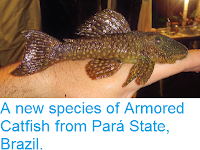
A new species of Armored Catfish from Pará State, Brazil.

Armored Catfish, Loricariidae, are large river-dwelling Fish native to Central and South America. They are covered in plate-like bony scales, and have distinctive 'suckermouths' used to attach themselves to a substrate in fast flowwing waters while still breathing. They are the largest group of Catfish, with over 680  described species and a fossil record that dates back to the Miocene. They are known in the aquarium trade as 'plecs'.

In a paper published in the journal ZooKeys on 29 April 2014, Gabriel de Souza da Costa e SilvaFábio Fernandes RoxoRicardo Britzke and Claudio Oliveira of the Laboratório de Biologia e Genética de Peixes at the Departamento de Morfologia at the Instituto de Biociências at the Universidade Estadual Paulista "Júlio de Mesquita Filho", describe a new species of Armored Catfish from the Rio Tapajós and Rio Tracuá in Pará State, Brazil.

The new species is placed in the genus Pseudancistrus and given the specific name zawadzkii, in honour of Cláudio Henrique Zawadzki, of the Universidade Estadual de Maringá, an expert on Catfish.  Pseudancistrus zawadzkii is a 128.7−87.5 mm dark greenish-brown Armoured Catfish with yellow spots. It has a distinctive 'mustache' of odontodes (a form of scale structurally similar to a tooth, with a pulp cavity and dentine and enamel layers, but found outside the mouth and not used as a tooth) on either side of the snout. Such structures are usually for sensory purposes in Fish; just as human teeth can be notoriously sensitive to the wrong things being placed in our mouths, the tooth-like structures of some fish can be used to probe sediments or scent the water for desired foodstuffs.

Pseudancistrus zawadzkii, female specimen. Silva et al. (2014).

Pseudancistrus zawadzkii was found living living around the confluence of the Rio Tapajós and Rio Tracuá in Pará State, Brazil; an area of fast flowing, clear waters with numerous waterfalls and rocky islands.

Map showing the two locations (black circle and red square) where Pseudancistrus zawadzkii was found living. Silva et al. (2014).

See also...


Follow Sciency Thoughts on Facebook.