Showing posts with label Calymmian. Show all posts

Wednesday, 26 December 2018

Evidence for a connection between large igneous province eruption and black shale deposition in the Mesoproterozoic.

The Mesoproterozoic Era is an arbitrarily defined period of geological history, lasting from 1600 to 1000 million years ago. Unlike more recent geological time periods the Mesoproterozoic is defined arbitrarily, without reference to geologic events, as the absence of a widespread fossil record combined with the fact that the landmasses that occurred at this time have long since broken up and reformed in different combinations, makes in hard to use the kind of events that are used to define the boundaries of more recent periods, such as mass extinctions or large igneous province emplacements. The Mesoproterozoic is divided into three Periods, again defined arbitrarily upon dates rather then geological events, with the Calymmian lasting from about 1600 to about 1400 million years ago, the Ectasian lasting from 1400 to 1200 years ago, and the Stenian, lasting from 1200 to 1000 years ago.

In a paper published in the journal Geology on 25 September 2018, Shuan-Hong Zhang of the Institute of Geomechanics and the MLR Key Laboratory of Paleomagnetism and Tectonic Reconstruction of the Chinese Academy of Geological Sciences, Richard Ernst of the Department of Earth Sciences at Carleton University and the Faculty of Geology and Geography at Tomsk State University, Jun-Ling Pei and Yue Zhao, also of the Institute of Geomechanics and the MLR Key Laboratory of Paleomagnetism and Tectonic Reconstruction of the Chinese Academy of Geological Sciences, Mei-Fu Zhou of the Department of Earth Sciences at The University of Hong Kong, and Guo-Hui Hu, again of the Institute of Geomechanics and the MLR Key Laboratory of Paleomagnetism and Tectonic Reconstruction of the Chinese Academy of Geological Sciencesn, describe the correlation of a series of igneous eruptions and black shale depositions from the Mesoproterozoic, which they suggest could be used to define the boundaries between geological periods in the way that happens with more modern geological sequences.

Zhang et al. observe that a number of Mesoproterozoic large igneous provinces have been dated to approximately 1380 million years ago, including the Mashak Large Igneous Province in on the eastern margin of the Baltica Craton (now in the southern Urals), the Hart River–Salmon River Arch Large Igneous Province on the western margin of the Laurentia Craton (the western United States), the Midsommersø–Zig-Zag Dal Large Igneous Province in northern Greenland, the Chieress Large Igneous Province in the Anabar shield of the northern Siberia Craton, the Kunene-Kibaran Large Igneous Province in the Congo Craton of Central Africa, the Pilanesberg Large Igneous Province in the Kalahari Craton of Southern Africa. Smaller igneous features in other cratons including, West Africa, Amazonia, and East Antarctica, have been dated to the same time.

Furthermore, at least two black shale deposits, the Xiamaling Formation in northern China and the Velkerri Formation in North Australia, have been dated to the same time, with several other similar deposits, while not yet directly dated, appear to be off similar age based upon their stratigraphic positions (i.e. they are found in between rocks older than 1380 million years and rocks younger than 1380 million years) including the Dzhelindukon and Vedreshev formations in Siberia, the Bijaigarh Shale and black shales from the Srisailam Formation in India, and the Serra do Garrote Formation of Brazil.

Representative stratigraphic columns of black shales in Xiamaling Formation in North China Craton (A–C) and Velkerri Formation in North Australian Craton (D–G). Zhang et al. (2018).

Black shales are typically associated with major oceanic anoxia events, such as the the one associated with the End Permian Extinction. The presence of widespread Mesoproterozoic black shales has previously been associated with generally low oxygen levels during this era, but this is no longer considered to be the case, as oxygen levels in the atmosphere are thought to have begun to rise quite quickly after the end of the deposition of banded ironstone formations about 1800 million years ago (these formations are thought to have formed as oxygen released by early Algae or photosynthetic Bactria reacted with iron in the water of the oceans, causing it to settle out as rust, with oxygen starting to build up in the atmosphere once this iron had been used up), and multicellular fossils interpreted as Eukaryotic Algae (Seaweeds) are known from about 1560 million years ago onwards.

Based upon this, Zhang et al. see evidence for a widespread igneous event about 1380 million years ago, which may have been associated with the breakup of the ancient supercontinent of Nuna, and which led to a global anoxic ocean event. Furthermore, they argue that since this event is recorded in strata around the world, that the date of 1380 million years ago should be adopted as the boundary between the Calymmian and Ectasian periods, rather than the arbitrary date of 1400 million years ago.

Distribution of ca. 1380 Ma large igneous provinces (LIPs) and black shales in paleogeographic reconstruction map of Nuna supercontinent. Zhang et al. (2018).

See also...

https://sciencythoughts.blogspot.com/2016/09/determining-oxygen-content-of-earths.htmlhttp://sciencythoughts.blogspot.com/2016/08/could-there-have-been-life-on-ancient.html
https://sciencythoughts.blogspot.com/2016/05/multicellular-eukaryotic-organisms-from.htmlhttps://sciencythoughts.blogspot.com/2015/04/seeking-earths-earliest-fossils.html
http://sciencythoughts.blogspot.co.uk/2012/02/cooking-primordial-soup-did-first-life.htmlhttp://sciencythoughts.blogspot.com/2012/02/oldest-animals-pre-ediacaran-sponges.html
Follow Sciency Thoughts on Facebook.

Wednesday, 25 May 2016

Multicellular Eukaryotic organisms from the 1.56-billion-year-old Gaoyuzhuang Formation of North China.

Sediments across the Earth contain numerous macrofossils (fossils of big things that can be found with the naked eye, as opposed to smaller microfossils which are found by sieving sediments or examining thin slices of rock under a microscope) from the Cambrian Explosion (542 million years ago) onwards, with numerous such fossils also now known from the Ediacaran Period (635-542 million years ago) and even some from the later part of the Cryogenian (720-635 million years ago). Earlier than this the fossil record is harder to interpret, with several disputed claims of multicellular organisms, as well as uncertainty as to whicj are the earliest cells that can be described as tuly Eukaryotic (having cells with a nulceus like animals and plants, as opposed to Prokaryotic cells which lack such nuclei, as in Bacteria and Archeans).

In a paper published in the journal Nature Communications on 17 May 2016, Shixing Zhu of the Tianjin Institute of Geology and Mineral Resources of the China Geological Survey and the State Key Laboratory of Biogeology and Environmental Geology at the China University of Geosciences, Maoyan Zhu of the State Key Laboratory of Palaeobiology and Stratigraphy at the Nanjing Institute of Geology and Palaeontology, Andrew Knoll of the Department of Organismic and Evolutionary Biology at Harvard University, Zongjun Yin and Fangchen Zhao, also of the State Key Laboratory of Palaeobiology and Stratigraphy at the Nanjing Institute of Geology and Palaeontology, Shufen Sun, aslo of the Tianjin Institute of Geology and Mineral Resources of the China Geological Survey, Yuangao Qu of the Centre for Geobiology at the University of Bergen, Min Shi, also of the State Key Laboratory of Biogeology and Environmental Geology at the China University of Geosciences and Huan Liu, again of the Tianjin Institute of Geology and Mineral Resources of the China Geological Survey, describe a series of Multicellular Eukaryotic fossils from the 1.56-billion-year-old Gaoyuzhuang Formation of North China.

At 1.56-billion years old the Gaoyuzhuang Formation is considered to be Calymmian, or Early Mesoproterozoic, in age, though these are definations based upon age rather fossil content as with later geologic periods. It comprises a series of calcarous shales and mudstones that outcrop across a wide area of North China, though fossils were found only at two locations, one in Qianxi County in Guizhou Province and the other in Kuancheng County in Hebei Province.

Zhu et al. found four different fossil forms, linear forms with parallel sides but no preserved ends, leaf-shaped forms which taper at one end, oblong forms with rounded ends and parallel sides, and tounge-shaped forms. All forms show well defined margins on at least two sides, unlike algal mats which spread amorphously, and one small example of a leaf-shaped form was found to have a stipe (stem) and holdfast similar to that seen in modern seaweeds. 

 Macroscopic fossils from the Gaoyuzhuang Formation. (a) Linear fossil without preservation of either end (a(1)) and fragment of tongueshaped fossil (a(2)), Qg98017. (b) Linear fossil without preservation of either end (b(1)) and tongue-shaped fossil with longitudinal striations (b(2)), Qg20011; (c,d) Cuneate fossils, 07kg1332 (c), Qg20017 (d). (e) Oblong fossil with possible holdfast, 07 kg1331. (f) Cuneate fossil preserved with differentiated holdfast, Qg98021; (g) linear fossil without preservation of either end. Scale bars, 5 cm (in a,b,g), 20mm (in c), 40mm (in d) and 5mm (in e,f). Zhu et al. (2016).

These morphologies strongly support the idea that these were photosynthetic multicellular organisms with pre-determined growth patterns, albeit simple ones, similar to moder marine Macro-Algae (Seaweeds). Of the three modern groups of Macro-Algae (Red, Green and Brown) two (Red and Green) have been predicted by some studdies to have shared a common ancestor in the Early Mesoproterozoic (Brown Algae are thought to be quite unrelated and much younger). The Gaoyuzhuang fossils could potentially be representatives of this ancestral Algal group, though the presence of similar morphologies in the unrelated Brown Algae indicates that this simple bodyplan has evolved at least twice in Eukaryotes, raising the possibility that similar forms could have arisen quite separately in an extinct group of Eukaryotes in the Early Mesoproterozoic.

In addition to examening macrofossils Zhu et al. took sediment samples from the Gaoyuzhuang Formation and treated them by acid maceration (mashing up and disolving in acid). This yielded a number of fragments of cellular material, up to 1 mm across, comprised of tightly packed masses of polyhedral cells 6–18 μm in diameter. These were found to be made of altered carbon-based material, strongly supporting the idea that these were remains of living material, though evidence of internal structure could not be found. These cannot be directly linked to the macrofossils, but they are large enough to be clearly Eukaryotic in origin, and in the absense of any other structures from which they might have come, are thought to provide further evidence for the idea that the macrofossils represent Multicellular Eukaryotic Algae.

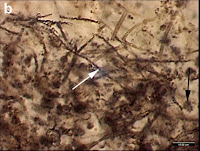
Polygonal cells forming a multi-layered network from the Gaoyuzhuang Formation. Scale bar is 20 μm. Zhu et al. (2016).

See also...

http://sciencythoughts.blogspot.co.uk/2015/04/seeking-earths-earliest-fossils.htmlSeeking Earth’s earliest fossils.                           In the nineteenth century the origin of life seemed an intractable problem for palaeontologists, with large complex animal fossils appearing in the Cambrian explosion, but scientists having access to neither examples of earlier fossils nor the means with which to examine them...
http://sciencythoughts.blogspot.co.uk/2012/02/cooking-primordial-soup-did-first-life.htmlCooking the primordial soup; did the first life emerge in volcanic pools?                          The blood plasma and lymph of modern animals is similar in chemical composition to seawater, strongly supporting the idea that animal life began in the oceans, but the liquid inside our cells has a quite different chemistry, suggesting that cells...
 http://sciencythoughts.blogspot.co.uk/2012/02/oldest-animals-pre-ediacaran-sponges.htmlThe oldest animals - Pre-Ediacaran Sponges from Namibia(?)                                     Sponges are curious creatures. They are considered to be animals as they are multicellular and some of them have fixed body shapes, however they show no...

Follow Sciency Thoughts on Facebook.