Showing posts with label Guizhou Province. Show all posts

Friday, 17 January 2025

Zosterophyllum baoyangense: A new species of Zosterophyllopsid Plant from the Early Devonian of Guizhou Province, China.

The first Vascular Plants appeared and underwent a dramatic radiation similar to that seem in Animals in the Cambrian, during the Late Silurian and Early Devonian. During this time both vegetative and sexual reproduction appeared, with some of the earliest Plants able to cover large areas through clonal growth, while at the same time producing spores which enabled them to distribute to new areas. During the Early Devonian structures such as leaves, roots, megaspores and secondary xylem also appeared. The Zosterophyllopsids formed a characteristic part of many Early Devonian floras, with species reported from China, North America, Europe and Australia. These Plants lacked leaves, and had a characteristic 'K'; or 'H' branching pattern, combined with lateral spike sporangia.

In a paper published in the journal Proceedings of the Royal Society B on 15 January 2025, Pu Huang of the Nanjing Institute of Geology and Palaeontology, Jia-Shu Wang of the Geological Museum of China and the Key Laboratory of Orogenic Belts and Crustal Evolution at Peking University, Yi-Ling Wang, also of the Key Laboratory of Orogenic Belts and Crustal Evolution at Peking University, Lu Liu of the National Natural History Museum of China, Jing-Yu Zhao of the School of Resources and Civil Engineering at Suzhou University, and Jin-Zhuang Xue also of the Key Laboratory of Orogenic Belts and Crustal Evolution at Peking University, describe a new species of Zosterophyllopsid Plant from the Early Devonian of Guizhou Province, China.

The new species is described upon the basis of two compression fossils from the Plant-bearing beds from the lower part of the Early Devonian Mangshan Group at Baoyang in Duyun City in Guizhou Province. These beds have been determined to be Pragian in age (410.8-407.6 million years old) on the basis of fossils which are also found in the Posongchong Formation of Yunnan Province, which in turn has been dated on the basis of spore assemblages, Plants and stratigraphic correlation It is placed in the genus Zosterophyllum, and given the specific name baoyangense, meaning 'from Baoyang'.

Zosterophyllum baoyangense  (a), (b) PB203562, part and counterpart, showing a fertile axis with K-shaped branching and a terminal spike. Arrows highlight branching points. The parts indicated by arrows (c) and (d) are enlarged in (c), (d), respectively; (c) K-shaped branching; (d) branching point showing a nearby protuberance (arrow); (e), (f) Enlarged view of the terminal spike in (a) and (b); (g) enlarged view of the basal part of the spike in (e). Arrow points to the margin of the basal sporangium. (h) Enlargement of the distal sporangia in (f) (arrow h), showing dehiscence line (white arrow) and peripheral rim along the convex distal margin (the area between two black arrows). Scale bars: (a), (b) 10 mm; (c)–(f), 1 mm; (g), (h), 0.5 mm. Huang et al. (2025).

Zosterophyllum baoyangense comprises a rhizome system with K-shaped branching and upright sporangia-bearing spikes 5.8-10.8 mm high. Each of these spikes has 5-10 sporangia, arranged in a spiral pattern. The sporangia are oval to semicircular, 1.6−2.0 mm high and 0.9−1.4 mm wide, departing from axis at an acute angle by a short stalk.

The Zosterophyllopsids are a distinctive group of Plants found worldwide from the Late Silurian to the Late Devonian. There are currently 37 described genera in the group, although it is not completely certain they form a monophyletic group. The earliest members of the group appear in the Ludlow (427.4-423.0 million years ago), with the group reaching its maximum diversity during the Pragian, then declining during the Emsian (410.62-393.47 million years ago), and eventually disappearing during the Frasnian (382.7-372.2 million years ago.

Zosterophyllum baoyangense is notably smaller that other members of same genus, with a complete specimen measuring 45.4 mm in length and 0,5-1.3 mm in width, with a spike 10.8 mm high. For comparison, the contemporary Zosterophyllum confertum from western Germany can reach 5.1 mm in width with a preserved length of 440 mm. Silurian members of the genus were typically smaller, though they grew over time, while Emsian species, while rarer, show a wider range of sizes. 

All species of Zosterophyllum lack any form of spikes, leaves, or leafy structures. However, they are presumed to have been able to photosynthesize due to the presence of stomata. With such a simple bodyplan, the only way that these plants would have been able to increase their photosynthetic surface would have been to get larger, a trend observed from their origin in the Late Silurian and through the Early Devonian. 

Zosterophyllum baoyangense, however, does not comply with this trend, being much smaller than known contemporary species, and even most Silurian specimens. Huang et al. suggest that this may be a sign of a much shorter life-cycle than other species. This in turn could be an adaptation to an unstable environment, or one with very limited resources, showing that early Vascular Plants had begun to show adaptation to different environments by the Early Devonian. 

Artist’s restoration of part of the Early Devonian Mangshan Flora, with Plant communities of Zosterophyllum baoyangense at the front, and Teyoua antrorsa, Zosterophyllum australianum and an unnamed zosterophyllopsid to the back. Huang et al. (2025).

The history of Vascular Plants can be divided into five evolutionary floras, the Rhyniophytic Flora, dominated by Rhyniophytes and Cryptospore producers, the Eophytic Flora, dominated by Zosterophyllopsids, followed by the Palaeophytic Flora,  the Mesophytic Flora and the (modern0 Cainophytic Flora. The Plants of the Rhyniophytic Flora were typically very small, and it is thought that the (first) terrestrial habitats that they inhabited were probably very ephemeral. The Plants of the Eophytic Flora, while still very simple, are generally much larger, which has been interpreted as a sign of more stable environments developing. In South China, however, a strongly seasonal wet-dry climate is known to have developed in the Early Devonian, which may have made it harder for early Plants to stabilize environments, producing dwarfed species such as Zosterophyllum baoyangense, which could have completed their entire life-cycles in a shorter period of time.

See also...

Wednesday, 13 March 2024

Dinocephalosaurus orientalis: New specimens shed new light upon a remarkable marine Archosauromorph from the Middle Triassic of southwestern China.

Archosauromorphs first appeared in the Permian, and became the dominant Vertebrate group in terrestrial ecosystems during the Mesozoic. While Archosauriform groups such as the Pseudosuchians (Crocodile-lineage Archosaurs) and Avemetatarsalians (Pterosaurs and Dinosaurs) became the dominat groups of Archosaurs from the Jurassic onwards, a variety of non-Archosauriform Archosauromorphs, such as the Rhynchosauria, Allokotosauria, and Tanystropheidae played an important role in Triassic ecosystems. The Tanystropheidae are one of a number of groups of highly gracile (slender) Triassic Archosauromorphs, once thought to represent a single clade, but now thought to be a loose group of basal Archosauromorphs, refered to as non-Crocopodans, where the Crocopodans comprise the Rhynchosauria, Allokotosauria, and Archosauriforms.

These gracile non-Crocopodans were a diverse group, inhabiting terrestrial, freshwater, and marine environments, and in one case (Ozimek volans),  possibly taking to the air. However, their delicate skeletons did not favour preservation, and many species are known only from compressed and fragmentary remains. One such species is Dinocephalosaurus orientalis, a non-Crocopodan Archosauromorph from the Middle Triassic Guanling Formation of Guizhou Province, China, which was described in 2003 from a specimen comprising an isolated, well-preserved skull and the first three anterior cervical vertebrae preserved in articulation. Subsequent specimens revealed that Dinocephalosaurus orientalis was of similar size and proportions to the better known Tanystropheus longobardicus, but while both species have extremely elongated necks, exceeding the lengths of their trunks, the  neck of Tanystropheus longobardicus has 13 elongated  cervical vertebrae, whereas Dinocephalosaurus orientalis has at least  32 vertebrae in  its  neck.  Furthermore, a specimen which cannot confidently be assigned to the species, but which must clearly be closely related, was found to be gravid, with an embryo (not an egg) within its abdominal cavity, indicating the birth of live young, almost certainly an adaptation to a fully marine lifestyle.

In a paper published in journal Earth and Environmental Science Transactions of the Royal Society of Edinburgh on 23 February 2024, Stephan Spiekman of the Staatliches Museum für Naturkunde Stuttgart, Wei Wang of the Institute of Vertebrate Palaeontology and Palaeoanthropology of the Chinese Academy of Sciences, Lijun Zhao of the Zhejiang Museum of Natural History, Oliver Rieppel of the Field Museum of Natural History, Nicholas Frazer of National Museums Scotland, and Chun Li, also of the Institute of Vertebrate Palaeontology and Palaeoanthropology of the Chinese Academy of Sciences, describe five new specimens of Dinocephalosaurus orientalis, and discuss their implications for our understanding of the species. 

The holotype of Dinocephalosaurus orientalis. (a) Photograph. (b) Photograph with interpretative drawing. Abbreviations: fr, frontal; j, jugal; la, lacrimal; mx, maxilla; na, nasal; op, opisthotic; pa, parietal; pl, palatine; pm, premaxilla; pof, postfrontal; po, postorbital; pro, prootic; pt, pterygoid; scl, sclerotic plates; soc, supraoccipital; sq, squamosal. Spiekman et al. (2024).

The first additional specimen described by Spiekman et al., IVPP V13898, has previously been described in 2008, and is the specimen upon which most of our current understanding of the species is based. This specimen comprises the skull, most of the vertebral column, elements of all four limbs and some elements of the pectoral and pelvic girdle. This specimen is more complete than the holotype (first specimen described), however, the skull is relatively poorly preserved, strongly dorsoventrally compressed and exposed in ventral view.

Dinocephalosaurus orientalis, IVPP V13898 (referred specimen). (a) Photograph. (b) Interpretative drawing. Spiekman et al. (2024).

The second next specimen, IVPP V17977, is described for the first time, as are all subsequent specimens. This specimen comprises the skull and mandible preserved in ventral view on one block, followed by the first to the 16th cervical vertebrae, together with associated cervical ribs, preserved in articulation on three additional slabs.

Dinocephalosaurus orientalis, IVPP V17977 (referred specimen). (a) The specimen as preserved on four slabs (photograph, scale bar in cm). (b) Interpretative drawing of the skull, lower jaw and cervical vertebrae 2–9. Abbreviations: ang, angular; ax, axis; bs, basisphenoid; cv, cervical vertebra; d, dentary; ncr, neural crest; oph, opisthotic; pl, palatine; poz, postzygapophysis; prz, prezygapophysis; pt, pterygoid; q, quadrate; v, vomer. Spiekman et al. (2024).

The second new specimen, ZMNH M8727, comprises elements of an exploded skull, a total of 28 cervical vertebrae of which the axis and the following 17 cervical vertebrae are preserved in articulation; two scattered vertebrae located next to the 28th cervical vertebra, one of them exposed in anterior view, a string of six vertebrae lying in front of the remains of the pectoral girdle and forelimbs, plus associated cervical, dorsal and gastral ribs.

Dinocephalosaurus orientalis, ZMNH M8727 (referred specimen). (a) Photograph. (b) Interpretative drawing. Abbreviations: ax, axis; co, coracoid; d, dentary; hu, humerus; mx, maxilla; pm, premaxilla; pt, pterygoid; q, quadrate; ra, radius; sc, scapula; ul, ulna. Spiekman et al. (2024).

The third new specimen, ZMNH M8728, comprises a partially preserved skull exposed in right lateral view, plus the cervical and most of the dorsal vertebral column represented by 56 vertebrae preserved in articulation (i.e. 32 cervical vertebrae and 23 dorsal vertebrae), cervical and dorsal ribs; elements of both pectoral girdles and forelimbs; and the gastral rib basket.  

Dinocephalosaurus orientalis, ZMNHM8728 (referred specimen). (a) Photograph. (b) Interpretative drawing. Abbreviations: cl, clavicle; co, coracoid; co-sc, articulated coracoid and scapula; cr, cervical rib; cv, cervical vertebra; hu, humerus; ns, neural spine; ra, radius; ul, ulna. Spiekman et al. (2024).

The next new specimen, ZMNH M8752, comprises the skull and mandible, neck, trunk and complete tail, ribs, gastral ribs, pectoral girdle and forelimbs as well as pelvic girdle and hindlimbs, making it one of the most complete specimens known.

Dinocephalosaurus orientalis, ZMNH M8752 (referred specimen). (a) Photograph. (b) Interpretative drawing. Abbreviations: as, astragalum;  ca, calcaneum; ca.v, caudal vertebra; cl, clavicle; co, coracoid; cv, cervical vertebra; do.v, dorsal vertebra; dt, distal tarsal; fib,  fibula; hu, humerus; in, intermedium; mand, mandible; ra, radius; sc, scapula; tib, tibia. Spiekman et al. (2024).

The final new specimen, IVPP V20295, however, is the most complete and fully articulated specimen recovered to date, comprising a skull is preserved in dorsal view and is in complete articulation with the neck and the rest of the body, which is essentially exposed on its left side. The total vertebral count is 145, comprising 32 cervical vertebrae, 30 dorsal vertebrae, 2 sacral vertebrae and 81 caudal vertebrae.

Dinocephalosaurus orientalis IVPP V20295.Complete articulated skeleton in dorsal to left lateral view. Abbreviations: ax, axis; ca.v, caudal vertebra; cv, cervical vertebra; do.v, dorsal vertebra; ga, gastralia; l.co, left coracoid; l.fe, left femur; l.hu, left humerus; l.il, left ilium; l.is left  ischium; l.man, left manus; l.pes, left pes; l.pu, left pubis; l.ra, left radius; l.sc, left scapula; r.hu, right humerus; r.co, right coracoid; r.fi, right fibula; r,ma, right manus; r.ra, right radius; r.sc, right scapula; r.ti, right tibia; r.ul, right ulna. Spiekman et al. (2024).

Based upon this new material, Spiekman et al. re-interpret Dinocephalosaurus orientalis as a large non-Crocopodan Archosauromorph, reaching as much as 6 m in length, with a neck twice as long as its trunk. It's post-orbital skull is short, and the suborbital fenestra has been obliterated. There is a single fang on each pre-maxillary, as well as further fangs on the front part of the maxilla and dentary. There are 62 pre-sacral vertebrae, of which 32 are cervical, as well as two sacral vertebrae and 81 caudal vertebrae. The limbs are reduced, apparently due to paedomorphosis (the retention of juvenile traits in adults), with a lack of suturing in several places in clearly adult specimens, and a reduction in the number of phalanges.

Dinocephalosaurus orientalis, ZMNHM8728, interpretative drawings of selected elements. (a) Right mandibular ramus in lateral view. (b) Right pterygoid in lateral view. (c) Posterior cervical vertebrae and anteriormost dorsal vertebra (cv26–do.v1) in right lateral view. (d) Mid-dorsal vertebrae in right lateral view. (e) Right forelimb, as preserved. (f) Left forelimb, as preserved. Abbreviations: ang, angular; ar, articular; c, centrum; cv, cervical vertebra; d, dentary; dc, distal carpal; do.v, dorsal vertebra; hu, humerus; int, intermedium; mc, metacarpal; ncr, neural crest; ns, neural spine; pl.p.pt, palatine process of the pterygoid; poz, postzygapophysis; prz, prezygapophysis; q.p.pt, quadrate process of the pterygoid; sang, surangular; sym, symphysis; tr.p, transverse process; tr.p.pt, transverse process of the pterygoid; ra, radius; rad, radiale; ul, ulna; uln, ulnare. Spiekman et al. (2024).

Spiekman et al. also note that a specimen of an aparently gravid Dinocephalosaurus has been described from a different location, Luoping County in Yunnan Province. This specimen is incomplete making confident assignment to the same species difficult, but has no traits which would justify erecting a second species. Notably, although presumably an adult, this specimen is only about half  the size of the largest specimens from the Guanling Formation specimens, suggesting  that if it does belong to the same species, then that species  must have  shown strong sexual dimorphism.

Specimens of Dinocephalosaurus orientalis are quite abundant in the Guanling Formation, a coastal deposit laid down in the eastern Tethys Ocean, but no similar specimens have to date been found in deposits from the western Tethys, which outcrop in Europe and the Middle East, despite many of these sites having been sampled extensively for over three centuries. However, based upon their new material, Spiekman et al. not that two maxillae from the Lower Muschelkalk of Krapkowice and Gogolin in Upper Silesia, Poland, and a dentary from the Lower Muschelkalk of Winterswijk in the Netherlands, currently assigned to 'Lamprosauroides goepperti', show strong similarities to Dinocephalosaurus orientalis, although the extremely fragmentary nature of this European material prevents a proper re-evaluation at this time.

Extremely elongate necks appear to have been achieved at least twice in non-Crocopodan Archosauromorphs, with Dinocephalosaurus orientalis increasing the number of vertebrae in its neck, while Tanystropheus spp. increased the length of the individual cervical vertebrae. While this might seem likely to have given Dinocephalosaurus orientalis a more flexible neck than Tanystropheus spp., both taxa had elongated cervical ribs which would have served to stiffen the neck, something widespread in non-Crocopodan Archosauromorphs. 

It is possible thar the arrangement of cervical ribs and an elongate neck would have facilitated suction feeding, however, both taxa have 'fish-trap' dentition, suggesting that this is unlikely, as the long teeth would tend to prevent prey being drawn into the buccal cavity. Instead Spiekman et al. theorise that both taxa probably caught prey with a lateral snapping motion of the head, something which has also been proposed for piscivorous Triassic Sauropterygians. 

Restoration of Dinocephalosaurus orientalis. The skull in (a) left lateral; (b) dorsal; and (c) ventral views. (d) The skeleton in left lateral view with a silhouette of a diver for scale. Abbreviations; ect, ectopterygoid; fr, frontal; j, jugal; la, lacrimal; mx, maxilla; na, nasal; pa, parietal; pal, palatine; pm, premaxilla; po, postorbital; pof, postfrontal; prf, prefrontal; pt, pterygoid; q, quadrate; sq, squamosal; vo, vomer. Spiekman et al. (2024).

The largest specimens of Dinocephalosaurus orientalis are considered to be adults with some confidence, showing full fusion of the bones of the skull and trunk region. Notably, a specimen from the Triassic of Yunnan, which appears very similar to Dinocephalosaurus orientalis, but is not complete enough to confidently assign to the species, is gravid, suggesting either that Dinocephalosaurus orientalis was sexually dimorphic, or that a second, much smaller species of Dinocephalosaurus was also present. The limbs of Dinocephalosaurus orientalis are underdeveloped, with little development of articular surfaces and poorly ossified carpus and tarsus, even compared to the functionally similar Tanystropheus spp., suggesting that Dinocephalosaurus orientalis had a greater degree of adaption to a marine environment, and was probably not capable of leaving the water and crawling onto land. 

See also...

Tuesday, 21 December 2021

Phallus cremeo-ochraceus & Phallus rigidiindusiatus: Two new species of Stinkhorn from China.

Stinkhorns are gasteroid Basidiomycote Fungi (Basidiomycote Fungi with spores that develop inside their basidiocarps, rather than on the surface), found throughout the tropical, subtropical regions of the world. These Fungi produce foul-smelling, phallic-looking Mushrooms, which has given them mystic implications in the folklore of many cultures. At least 31 species of Stinkhorn are found in China, some of which are eaten, and even grown commercially. However, the exact taxonomic status of these Chinese Stinkhorns is often unclear, for example, the species Phallus indusiatus has been reported in south and southwestern China since the 1960s, but modern genetics-based taxonomic surveys have suggested that this species is restricted to South America, making the status of Chinese Stinkhorne populations given this name unclear.

In a paper published in the journal MycoKeys on 16 December 2021, Ting Li of the State Key Laboratory of Applied Microbiology Southern China at the Institute of Microbiology of the Guangdong Academy of Sciences, and the College of Science at Tibet University, Wang-Qiu Deng, Bin Song and Ming Zhang, also of the State Key Laboratory of Applied Microbiology Southern China at the Institute of Microbiology of the Guangdong Academy of Sciences, Mu Wang of the Tibet Agricultural and Animal Husbandry University, and Tai-Hui Li, one again of the State Key Laboratory of Applied Microbiology Southern China at the Institute of Microbiology of the Guangdong Academy of Sciences, describe two new species of Stinkhorns from south and southwest China, based upon populations previouslt assigned to Phallus indusiatus. 

The first new species described is named Phallus cremeo-ochraceus, which refers to the ochre colour of its receptacle (mushroom-head). It has a white or slightly pinkish indusium (net-like structure that hangs from the rim of the receptacle) and pseudostipe (stem). The species was confirmed as new based upon genetic analysis of individuals collected from leaf litter in a Bamboo grove in the Xiaoqikong Scenic Area in Libo County, Guizhou Province, in July 2020.

 
Basidiomata of Phallus cremeo-ochraceus. (a)-(c) GDGM 80700 d GDGM 85857. Scale bars: 5 cm (a), 2 cm (b), (d), 1 cm (c). Li et al. (2021).

The second new species is named Phallus rigidiindusiatus, which refers to the ridged nature of its indusium, which is particularly thick, and therefore rather stiff. This species was found growing in soil in broad-leafed forests and Bamboo groves, at a number of locations in Guangdong, Hunan, and Guizhou provinces.

 
Basidiomata of Phallus rigidiindusiatus. (a) GDGM 54237 (b) GDGM 85470 (c), (e), (f) GDGM 81196 (d) 81195. Scale bars: 5 cm (a)-(c), 3 cm (d), 2 cm (e), 1 cm (f). Li et al. (2021).

See also...


Follow Sciency Thoughts on Facebook.

Follow Sciency Thoughts on Twitter.
 

Thursday, 11 June 2020

Widespread flooding in Guangxi, Hunan and Guizhou Provinces, China.

The provinces of Guangxi and Hunan in southern China have been hit by extensive flooding over the last week, displacing many people from their homes and resulting in at least nineteen deaths. In Guangxi more than 230 000 people have been forced to flee their homes, with over a thousand homes confirmed to have been destroyed, after the Lijiang River burst its banks, flooding a wide area, including parts of the city of Guilin, and resulting in at least six deaths, with several more people still missing. A series of rainfall associated floods and landslides have killed at least thirteen people in Hunan Province, with several more people missing, and Guizhou has also reported at least eight people missing after similar incidents. 

Flooding in Rong'an County, to the east of Guilin in Guangxi Province, China. AFP/Getty Images.

South China has a monsoonal tropical climate, with peak rainfall falling in May and June, when Guangxi can expect to see more than 250 mm of rain per month in a typical year. Landslides are a common problem after severe weather events, as excess pore water pressure can overcome cohesion in soil and sediments, allowing them to flow like liquids. Approximately 90% of all landslides are caused by heavy rainfall.

Flooding in Yangshuo County, to the south of Guilin, on 7 June 2020. AFP.

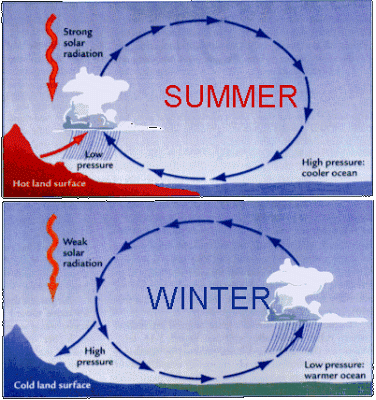
Monsoons are tropical sea breezes triggered by heating of the land during the warmer part of the year (summer). Both the land and sea are warmed by the Sun, but the land has a lower ability to absorb heat, radiating it back so that the air above landmasses becomes significantly warmer than that over the sea, causing the air above the land to rise and drawing in water from over the sea; since this has also been warmed it carries a high evaporated water content, and brings with it heavy rainfall. In the tropical dry season the situation is reversed, as the air over the land cools more rapidly with the seasons, leading to warmer air over the sea, and thus breezes moving from the shore to the sea (where air is rising more rapidly) and a drying of the climate.

  Diagrammatic representation of wind and rainfall patterns in a tropical monsoon climate. Geosciences/University of Arizona.
 
See also...

https://sciencythoughts.blogspot.com/2020/03/landslide-derails-train-in-hunan.htmlhttps://sciencythoughts.blogspot.com/2019/11/magnitude-earthquake-in-guangxi.html
https://sciencythoughts.blogspot.com/2019/10/magnitude-52-earthquake-in-guangxi.htmlhttps://sciencythoughts.blogspot.com/2019/07/thirty-six-confirmed-deaths-following.html
https://sciencythoughts.blogspot.com/2017/08/landslide-in-guizhou-province-china.htmlhttps://sciencythoughts.blogspot.com/2017/01/landslide-kills-at-least-two-in-hunan.html
Follow Sciency Thoughts on Facebook.

Wednesday, 4 December 2019

Amamiclytus wuxingensis: A new species of Longhorn Beetle from Guizhou Province, China.

Longhorn Beetles, Cerambycidae, are a widespread and diverse group, noted for their elongated antennae, which are often longer than their bodies (though some species lack these). Their larvae are wood-boring grubs, which can be destructive to timber, and many species are considered pests, both in the forestry industry and in human dwellings as woodworm. Some of the largest species of Beetle are Longhorns, including the 16 cm Titan Beetle (Titanus giganteus) of South America. Members of the genus Amamiclytus are Small-bodied Longhorn Beetles with black, glossy bodies and white pubescent markings on the elytra (wing cases), found across Asia including India, Sri Lanka, China, Thailand, Laos, Vietnam, and the Ryukyu Islands. There are currently nineteen described species in the genus, two of which are known from China.

In a paper published in the journal ZooKeys on 14 November 2019, Shulin Yang and Cha Wang of the School of Life Sciences at Guizhou Normal University, describe a new species of Amamiclytus from Guizhou Province, China.

The species is decribed from two male specimens collected by by net sweeping on a Flowering Bird Cherry, Prunus sp., in the village of Wuxing in Leishan County. The species is named Amamiclytus wuxingensis, meaning 'from Wuxing'. These specimens are 3.5 and 5.0 mm in length, predominantly black and glossy, with brown mouthparts, antenna, abdomen and legs. The body is sparsely covered with long pale hairs.

Amamiclytus wuxingensis, male specimen in dorsal view. Scale bar is 1 mm. Yang & Wang (2019).

See also...

https://sciencythoughts.blogspot.com/2019/12/angimordella-burmitina-pollen.htmlhttps://sciencythoughts.blogspot.com/2019/08/incoltorrida-spp-hydroscapha.html
https://sciencythoughts.blogspot.com/2019/06/promyrmister-kistneri-new-species-of.htmlhttps://sciencythoughts.blogspot.com/2019/06/cloud-of-ladybird-beetles-confuese-us.html
https://sciencythoughts.blogspot.com/2019/04/silesaurus-opolensis-coprolites-from.htmlhttps://sciencythoughts.blogspot.com/2019/04/lophorrhinides-muellerae-new-species-of.html
Follow Sciency Thoughts on Facebook.