Showing posts with label Mesoproterozoic. Show all posts

Tuesday, 18 November 2025

The furthest lunar apogee or 2025.

On Thursday 20 November 2025, at 2.49 am GMT, the Moon will be at its furthest point from the Earth in 2025, a distance of 406 692 km. The Moon orbits the Earth every 27.5 days, and like most orbiting bodies, its orbit is not completely circular, but slightly elliptical, so that the distance between the two bodies varies by about 3% over the course of a month. This elliptical orbit is also not completely regular, it periodically elongates then returns to normal, making some perigees closer than others. Because this is an elongating and contracting elliptical orbit, rather than a change in the average distance between the Earth and the Moon, the most extreme Lunar Perigee and Apogee of each year typically happen in the same Lunar Month; this year the closest Lunar Perigee occurred at 10.30 pm GMT on Wednesday 5 November.

Diagram showing the relationship of the Lunar orbit and Lunar month. Southern Astronomical Delights.

Although this is the furthest point from the Earth that the Moon will reach in 2025, it is not exceptional. The Moon reached 406 710 km from the Earth on 29 March 1984, and will reach 406 705 on 1 December 2043. 

The Earth-Moon System to Scale, 650 km/pixel. John Walker/Fourmilab.

However, there is evidence that the Earth and Moon have been moving steadily apart since the formation of the Earth/Moon system, about 4.5 billion years ago. Studies of the shells of Rudists, a sort of Bivalve Mollusc which laid down layers of shell daily, have found that the Cretaceous year was 372 days long. Since the length of a year is unlikely to have changed without the Earth shifting profoundly on its orbit, the most plausible explanation for this is that the days were shorter. Since the length of the day is driven by the closeness of the Moon, that the Moon was significantly closer, with an average distance from the Earth of approximately 383 000 km in the Late Cretaceous (about 80 million years ago) compared to 384 400 km today. 

This fits with measurements that made by the  Lunar Laser Ranging experiments, which work byby bouncing lasers off a mirror left on the Moon. The first of these experiments was set up by NASA's Apollo Program, with additional mirrors being placed by the Soviet Lunokhod remote operated Moon vehicles, and the Indian Chandrayaan-3 mission. All of these experiments have shown that the Moon is moving away from us at an average of 38 mm per year.

Measuring the distance between the Earth and the Moon by bouncing a laser between the Earth and a mirror and the Moon. All distances are to scale, with the light moving in real time for the scale. James O'Donoghue/NASA/Solar System Scope/Wikimedia Commons.

This would seem to imply that the collision which is thought to have formed the Earth/Moon system would have occurred about 1.5 billion years ago, something for which there was no evidence. Studies of Mesoproterozoic Banded Ironstone formations in Australia have shown a 23.3 year variation in tidal cycles, which are also determined by the lunar distance. Today, these cycles follow an 18.6 year cycle, which suggests the average distance between the Earth and the Moon between about 1.5 and 2.0 billion years ago was approximately 332 000 km, suggesting that the rate at which the Moon is retreating from the Earth has increased over time.

See also...

Tuesday, 4 November 2025

The closest Lunar Perigee of 2025.

At 10.30 pm GMT on Wednesday 5 November the Moon will be at its closest point to the Earth in 2025, at a distance of 356 832 km. This will fall nine hours and eleven minutes after the Full Moon, at 1.19 pm on the same day, making it particularly large in the sky. The Moon completes one orbit about the Earth every 27.5 days, and like most orbiting bodies, its orbit is not completely circular, but slightly elliptical, so that the distance between the two bodies varies by about 3% over the course of a month. This elliptical orbit is also not completely regular, it periodically elongates then returns to normal, making some perigees closer than others. These cycles mean that the Moon often reaches its furthest point from the Earth (apogee) of the year in the same lunar cycle, with the furthest Lunar Apogee of 2025 falling on 20 November.

Simplified diagram of the Moon's orbit. NASA.

Although this is the closest point to the Earth that the Moon has reached this year, it is not exceptional. The Moon reached 356 589 km from the Earth on 21 January 2023, and will reach 356 649 km from the Earth on 24 December 2026. The closest the Moon can come to the Earth is currently about 356 375 km, while its maximum distance is about 406 720 km.

The Earth-Moon System to Scale, 650 km/pixel. John Walker/Fourmilab.

However, there is evidence that the Earth and Moon have been moving steadily apart since the formation of the Earth/Moon system, about 4.5 billion years ago. Studies of the shells of Rudists, a sort of Bivalve Mollusc which laid down layers of shell daily, have found that the Cretaceous year was 372 days long. Since the length of a year is unlikely to have changed without the Earth shifting profoundly on its orbit, the most plausible explanation for this is that the days were shorter, and since the length of the day is driven by the closeness of the Moon, that the Moon was significantly closer, with an average distance from the Earth of approximately 383 000 km in the Late Cretaceous, about 80 million years ago, compared to 384 400 km today. This fits with measurements that made by bouncing lasers off a mirror left on the Moon by the Apollo Program astronauts, which have shown that the Moon is moving away from us at an average of 38 mm per year.

Measuring the distance between the Earth and the Moon by bouncing a laser between the Earth and a mirror and the Moon. All distances are to scale, with the light moving in real time for the scale. James O'Donoghue/NASA/Solar System Scope/Wikimedia Commons.

However, this would imply that the collision which is thought to have formed the Earth/Moon system would have occurred about 1.5 billion years ago, something for which there was no evidence. Studies of Mesoproterozoic Banded Ironstone formations in Australia have shown a 23.3 year variation in tidal cycles, which are also determined by the lunar distance. Today, these cycles follow an 18.6 year cycle, which suggests the average distance between the Earth and the Moon between about 1.5 and 2.0 billion years ago was approximately 332 000 km, suggesting that the rate at which the Moon is retreating from the Earth has increased over time.

See also...

Monday, 6 May 2024

Multicellular Eukaryotic fossils from the Mesoproterozoic Chuanlinggou Formation of North China.

All life found on Earth today is made up of cells, with the vast majority of organisms still being unicellular; it is generally presumed that the earliest forms of life would have been single-celled Prokaryotes (organisms with cells which lack internal divisions and organelles).  Multicellularity has arisen numerous times within both Prokaryotic and Eukaryotic groups, although complex multicellularity, with cells differentiated into specialist forms and organised communication between cells, has only arisen six or seven times, and only in Eukaryotes.

The earliest widely accepted multicellular Eukaryotic fossils, filaments and spherical groups of cells, appear around the Mesoproterozoic-Neoproterozoic boundary, while filamentous Prokaryotes are known from the Archaean. Early multicellular Eukaryotes include Bangiomorpha pubescens, a putative Red Alga from 1050 million-year-old deposits in the Canadian Arctic, Eosolena loculosa, a Eukaryote of uncertain affinities from 1030 million-year-old deposits in Siberia, Arctacellularia tetragonala, another species of uncertain affinities from 1000 million-year-old deposits in the Democratic Republic of Congo, Proterocladus antiquus, a possible Green Alga from 950 million-year-old deposits in North China, Archaeochaeta guncho, another species of uncertain affinities from 950 million-year-old deposits in northwestern Canada, and Ourasphaira giraldae, a possible Fungi from 890 million year old deposits in the Canadian Arctic. 

Some putative multicellular Eukaryotes have also been recorded from earlier in the Mesoproterozoic, including Eosolena minuta, from 1500 million-year-old deposits in northern Siberia, or the carbonacious impressions of the Gaoyuzhuang Formation in North China, which can reach tens of centimetres across, or the possible Eukaryotic microfossils from the 1600 million-year-old Tirohan Dolomite of central India. The oldest examples of the coilled microfossil Grypania are currently dated to about 2100 million years before the present (i.e. Late Palaeoproterozoic) although it is debated whether this is a Eukaryote or a Cyanobacterium. Of similar age are the pyritic macrostructures of the Francevillian Biota of Gabon, though there is some debate as to whether there are of biological origins at all.

In 1989, micropalaeontologist Yan Yuzhong published a description of a filamentous Eukaryotic fossil from the 1630 million-year-old Chuanlinggou Formation of North China in the Bulletin of the Tianjin Institute of Geology and Mineral Resources. At this time journals were only available in print, and the Bulletin, which was printed in Chinese, had almost no circulation outside of China. Furthermore, the quality of the images in Yan's paper were rather poor, leading to the publication being largely overlooked.

In a paper published in the journal Science Advances on 24 January 2024, Lanyun Miao and Zongjun Yin of the State Key Laboratory of Palaeobiology and Stratigraphy at the Nanjing Institute of Geology and PalaeontologyAndrew Knoll of the Department of Organismic and Evolutionary Biology at Harvard University, Yuangao Qu of the Institute of Deep-sea Science and Engineering of the Chinese Academy of Sciences, and Maoyan Zhu, again of the State Key Laboratory of Palaeobiology and Stratigraphy at the Nanjing Institute of Geology and Palaeontology, and of the College of Earth and Planetary Sciences of the University of the Chinese Academy of Sciences, re-examine the Chuanlinggou Formation fossils, and discuss the implications of these for the origin of multicellular Eukaryotic life.

Samples of grey shale were collected from the Wengjiazhuang Section of the Chuanlinggou Formation in Kuancheng County of Hebei Province, which has been dated to 1634.8 million years before the present (±6.9 million years) using uranium/lead ratios in zircons. Zircons are minerals formed by the crystallisation of cooling igneous (or in this case, impact) melts. When they form, they often contain trace amounts of uranium, which decays into (amongst other things) lead at a known rate. Since lead will not have been present in the original crystal, it is possible to calculate the age of a zircon crystal from the ratio between these elements. Microfossils were then extracted from these shales by acid maceration.

This technique recovered flattened greyish or pale brown filamentous fossils, which Miao et al. describe as Qingshania magnifica, the name used by Yan Yuzhong for his material. These are not the only filamentous fossils derived from the Chuanlinggou Formation shales, but are significantly larger than other forms, supporting the idea that they are Eukaryotic in origin, while the other forms are Prokaryotic, probably Cyanobacteria. The 278 individual specimens Miao et al. identified ranged from 20 to 194 μm in diameter, with a maximum length of 860 μm. The filaments were straight or curved, and made up of smooth-walled cells, more than 20 of which were present in the longest specimens. These cells are generally cylindrical in shape, with a cell length of 15 to 190 μm. Terminal cells, where preserved, are hemispherical. None of the specimens had any form of external sheath or holdfast.

Transmitted-light photomicrographs of Qingshania magnifica from the Chuanlinggou Formation. (A) to (D) and (K) Filaments with cells of varying length and width. (E) Four-celled filament with hemispherical terminal cell. (F) and (G) Filament with notably decreasing cell width toward one end. Note that (F) and (G) represent the same specimen; (F) lost the narrowest part of the filament as shown in (G). (H to J) Filaments displaying more uniformity of cell dimensions. (L) Two-celled filament with ovoid terminal cell. All specimens were handpicked from organic residues of acid maceration and photographed in wet mounts, except for (K), which was photographed from a permanent strew mount. Solid and empty gray triangles in (A), (C), and (K) indicate the longest and the shortest cells, respectively, within single filaments. tb, transverse band (interpreted as cross wall); tr, transverse ring (interpreted as partially preserved cross wall). Scale bars 50 μm (A) to (E), (I), (J), and (L) and 100 μm (F) to (H) and (K). Miao et al. (2024).

The specimens show considerable variation, with the largest being ten times as wide as the smallest, individual cells being cylindrical, barrel-shaped, or cup-shaped, and filaments being of even width or tapering towards one end. Despite this variation, Miao et al. treat them all as a single species, suggesting that the variations reflect s different growth or developmental stages within the population.

Micrographs of Qingshania magnifica from the Chuanlinggou Formation. (A) Transmitted-light photomicrograph of a five-celled filament with constant width and dark narrow transverse bands. (B) Scanning electron microscope image of (A) showing surface features and the preservation as a complete compression. Note the obliquely compressed cross wall of the right terminal cell showing smooth surface and no other particular features. (C) to (E) Magnifications of (B), showing smooth wall surface and the well-defined contact between adjoining cells manifested by a very shallow groove (marked by cyan arrowheads) along transverse bands. (C) and (E) represent dashed boxes in (A) and (B); (D) corresponds to the dashed box in (C). Scale bars, 50 μm (A) and (B), 10 μm (C), and 2 μm (D) and (E). Miao et al. (2024).

Some of the filaments have small, round-to-ovoid structures within some of their cells. These structures are faint, but always contained entirely within the cell, making it unlikely that they are separate structures superimposed upon the filaments. Inclusions within cells, from both Proterozoic and Phanerozoic settings, have variously been interpreted as endocysts, collapsed cytoplasm, or organelles. The fossils are interpreted as being compressed cell walls, which makes it likely that structures withing them would be endocysts. A variety of Eukaryotic and Prokaryotic groups produce endospores in response to worsening conditions (such as the end of a growing season), but these tend to have protective envelopes thicker than the outer cell wall, which is not the case with these structures. However, the structures are found only in larger cells, and are only slightly smaller than the smallest cells, which suggests that they may be some form of asexual reproductive spore; similar spores are produced by some extant filamentous Algae, such as Urospora wormskioldii.

Transmitted-light photomicrographs of Qingshania magnifica with a small round or ovoid inclusion from the Chuanlinggou Formation. (A), (C), and (D) Filaments with constant width. (B) and (E) Magnifications of dashed boxes in (A) and (C), respectively, showing details of round inclusions. (F) Filament of notably varying width. Note that the middle cell of the filament is cyathiform in shape. (G and H) Magnifications of dashed box in (F) and (D), respectively. All specimens were handpicked from organic residues of acid maceration and photographed in wet mounts. Scale bar, 50 μm (A), (C), (D), and (F). Miao et al. (2024).

Microscale Raman and Fourier transform infrared spectroscopic investigations of the composition of the filaments suggested that the cell walls of Qingshania magnifica were composed largely of aromatic compounds, with a lower proportion of aliphatic compounds, with the aliphatic compounds forming long chains with little branching. This is not sufficient to make any  assessment of the taxonomic status of Qingshania magnifica on its own, but is quite distinct from the composition of Cyanobacterial cells found in the same deposits.

The original specimens of Qingshania magnifica described by Yan in 1989 were identified from thin sections of yellowish-green shales, and had a maximum width of about 250 μm and were up to 6000 μm in length. Yan identified these as Green Algae, placing them in the modern family Ulotrichaceae. Miao et al.'s specimens are slightly smaller, but preserve more detail, allowing for a more detailed reconstruction.  They interpret Qingshania magnifica as a simple multicellular organism with large cells and a degree of morphological variation, with a life cycle that involved spores produced within cells, which then produced thin filaments, which grew into thicker filaments, which were capable of producing more spores.

A wide range of both Prokaryotic and Eukaryotic organisms produce filaments of cells today. Among Prokaryotes, these include at least eleven phyla of Bacteria and one of Archaeans. The most sophisticated filamentous Prokaryotes are Cyanobacteria, which produce a range of forms including straight, tapering, and branching filaments. However, no known Cyanobacterium, or other Prokaryote, living or fossil, closely resembles Qingshania magnifica. Filamentous Eukaryotes include Algae such as Archaeplastids (the group that includes both Red and Green Algae) and Ochrophytes (the group that includes Brown Algae, Golden Algae, and Diatoms), as well as filamentous Fungi and Oomycetes (Water Molds). The cells of Qingshania magnifica are completely surrounded by cell walls, which suggests that each cell acquires its own nutrition, by either photosynthesis or osmotrophy (absorbing nutrients from the environment). This is also quite different from the hyphal structure seen in Fungi and Oomycotes, even the septate forms. making it unlikely that Qingshania magnifica could be assigned to either of these groups. Furthermore, molecular clock estimates suggest that Fungi did not appear till about 1000 million years ago, and Oomycotes probably around the dawn of the Cambrian.

Based upon this analysis, Miao et al. conclude that Qingshania magnifica is most likely to have been a Eukaryotic Algae. This is consistent with molecular clock analyses, which suggest plastids (chloroplasts) were first acquired by unicellular Algae during the Palaeoproterozoic. The morphology of Qingshania magnifica is also consistent with younger fossils interpretted as Green Algae, as well as several modern members of that group. However, Miao et al. do no conclude there is sufficient evidence to confidently place Qingshania magnifica within the Green Algae, as originally proposed by Yan, instead concluding that it could be a Green Algae, a Red Algae, a stem group Archaeplastid, or even a member of an entirely extinct Eukaryotic group. Whichever of these is true, Qingshania magnifica provides strong support for a Late Palaeoproterozoic appearance of the crown group Eukaryotes, rather than a Late Mesoproterozoic one, which has sometimes been proposed. 

Overview of early evolution of the Eukarya along with fossil records. (A) Simplified Eukaryotic tree with divergence time estimates of major branches by molecular clock study. LECA, Last Eukaryotic Common Ancestor. Dashed grey lines represent hypothetical stem-group Eukaryotes, which are extinct. Abbreviation: Pha., Phanerozoic. (B) Representative fossil records of early Eukaryotes. The oldest unambiguous Eukaryotic fossils are unicellular forms, e.g., Tappania plana and Shuiyousphaeridium macroreticulatum from the approximately 1650 million-year-old Ruyang Group; Dictyosphaera macroreticulata, Germinosphaera alveolata, and Valeria lophostriata from the Changzhougou Formation and lowermost Chuanlinggou Formation of North China. The Qingshania magnifica represents the current oldest convincing multicellular Eukaryote from the approximately 1635 million-year-old upper Chuanlinggou Formation of North China. The oldest Red Alga is Bangiomorpha pubescens from the approximately 1050 million-year-old Hunting Formation, Canada. The oldest Green Alga is Proterocladus antiquus from the approximately 950 million-year-old Nanfen Formation of North China. The oldest putative Fungus is Ourasphaira giraldae from the approximately 890 million-year-old Grassy Bay Formation of Canada. The oldest Amoebozoans are vase-shaped microfossils, e.g., Cycliocyrillium torquata from the approximately 750 to 730 million-year-old Kwagunt Formation, part of the Chuar Group of Arizona. Scale bars, 500 μm for the oldest Green Alga and 50 μm for all other specimens. Miao et al. (2024).

See also...

Saturday, 20 April 2024

Assessing the importance of plate tectonic for the development of complex life.

Over the past three decades, research has shown that the overwhelming majority of stars in our galaxy have planets. Logically, a proportion of those planets will have the conditions for life, and life will actually arise on some proportion of the planets which can support it. Furthermore, a small proportion of the planets with life are likely to produce intelligent life, capable of radio communication and other activities which we might be able to detect. This works out at a very small proportion of stars hosting civilizations, but a very small proportion of hundreds of billions still works out at a very large number. We have, nevertheless, never detected any sign of intelligent life (of life at all) beyond our own planet, leaving us, as far as we know the only civilization in the universe, something referred to as the Fermi Paradox. A number of possible explanations have been offered for this paradox, most of which revolve around the idea that while life is probably quite common in the galaxy, complex life is probably much rarer. A variety of reasons why this might be the case have also been proposed, with a link to the other phenomenon also as far as well know unique to our planet, plate tectonics, frequently being proposed.

In a paper published in the journal Scientific Reports on 12 April 2024, Robert Stern of the Department of Sustainable Earth Systems Science at the University of Texas at Dallas, and Taras Gerya of the Department of Earth Sciences at ETH-Zurich, re-examine the biological and geological history of the Earth, looking for connections between key stages in the development of life on Earth and changes in the Earth's geological activity.

Life is generally accepted to have first appeared on Earth more than 3800 million years ago, but the first Animals did not appear until less than 1000 million years ago. Various possible explanations have been proposed for this, including lower oxygen levels on the early Earth and a possible lack of key biological innovations until more recent times. The fact that Animals, Plants, and even multicellular Algae did not appear until quite late in the Neoproterozoic suggests that some profound change in the Earth or its biology led to this development, and Stern and Gerva suggest that this change was a shift from single lid to plate tectonics, and the subsequent profound shifts in the Earth's atmospheric oxygen levels.

The timing of the onset of plate tectonics is still a matter of debate among Earth Scientists, with two broad camps, one which argues that plate tectonics began during the Archean, while the other argues that the current plate tectonic regime began in the Neoproterozoic (although there may-or-may-not have been earlier phases of plate tectonics on Earth). The processes of seafloor spreading, subduction, and continental collision lead to the formation of a distinctive set of minerals, rocks, and rock assemblages, some of which appear to be absent before the onset of the Neoproterozoic, although it has been argued that these differences are due to higher mantle temperatures on the early Earth. Similarly, it is possible to track the movements of continents over the Neoproterozoic and Phanerozoic through the traces of magnetic fields left in some types of rocks when they form, but in rocks older than about 1200 million years this method is not reliable, leaving us uncertain about the movement of the continents that long ago. 

In previous work, Robert Stern divided indicators of plate tectonics into three groups, (1) indicators of seafloor spreading and subduction initiation, (2) subduction indicators, and (3) plate collision indicators. All of these indicators are present in rocks from Neoproterozoic and Phanerozoic times, but their presence in older rocks is far less clear. 

In order for plate tectonics to operate, it is necessary for oceanic lithosphere to be subducted at plate margins, and it is likely that this oceanic lithosphere was not sufficiently strong and dense enough for this to happen in a coherent way until the upper mantle had cooled to between 100°C and 150°C above current temperatures, again something which is predicted to have happened in the Neoproterozoic.

If plate tectonics did indeed start, then it is unlikely to have started all over the world at once, but instead should have started in one place, then taken hundreds of millions of years to spread around the globe. This would result in a gradual increase in the presence of Stern's three indicators for the presence of plate tectonics, something which can again be seen in the Neoproterozoic rock record. The first ophiolites, which are indicators of subduction initiation, appear about 870 million years ago, with the first indicators of actual subduction zones appearing about 750 million years ago, and the first indicators of continental collision appearing about 600 million years ago. 

As far as we understand, an active silicate body can have either a single lid or plate tectonic system. This being the case, for plate tectonics to have initiated in the Neoproterozoic, the Earth must have had a single lid system in the Mesoproterozoic. Stern's previous work also identified three potential indicators for single lid systems. These are (1) an elevated thermal regime, (2) an abundance of unusual dry magmas such as A-type granites and anorthosites, and (3) a lack of new continental margins. The Mesoproterozoic shows an absence of Stern's indicators for plate tectonics, but is rich in the three indicators for single lid tectonics. Curiously, indicators for plate tectonics do appear to be present in the Palaeoproterozoic.

Evolution of Earth’s tectonic regime over the past 1.6 billion years; (a) single lid tectonic indicators, (b) plate tectonic indicators cumulative plot, (c) simplified climate history, (d) Simplified biological evolution. Stern & Gerva (2024).

There is a similar shift in the formation of mineral deposits between the Mesoproterozoic and Neoproterozoic, with orogenic gold and porphyry copper deposits, all associated with an active tectonic regime, being common in Neoproterozoic strata but absent in the Mesoproterozoic, while iron oxide copper gold  deposits and iron-titanium-vanadium-phosphorus deposits, both of which are associated with anorthosites are common in the Mesozoic but rare in the Neoproterozoic.

Finally, the palaeomagnetic record does not show any significant movement of continental landmasses during the Mesoproterozoic, while this is common in younger rocks. Particularly noteworthy is the supercontinent of Nuna (or Colombia), which assembled during the Palaeoproterozoic, then appears to have persisted relatively unchanged throughout the Mesoproterozoic.

Plate tectonics requires a global mosaic of plates, which it could be reasonably expected would take hundreds of millions of years to form a a single lid system. Theoretically, following the formation of an initial subduction zone with associated transform systems and divergent plate boundary margins, the system could slowly propagate to form a global mosaic. The rate at which such a system could form would be governed by the rate at which new subduction zones can form and lengthen. In Cretaceous and younger rocks, subductive trenches appear to be able to lengthen at rates of between 100 and 600 km per million years, which would require between 92 and 550 million years to develop a global network of about 55 000 km of convergent margins.

The last 1.6 billion years of Earth’s tectonic history. Stern & Gerva (2024).

The Neoproterozoic is also known to have had major carbon isotope excursions (changes in the proportions of different carbon isotopes laid down in sedimentary deposits) as well as several glacial interludes, major disruptions to the Earth's environment which we associate with plate tectonics. The most notable of these is the Neoproterozoic Snowball Earth, a prolonged phase of near-global glaciation, which may have been triggered by a huge increase in volcanic activity or true polar wander.  The first major carbon isotope event in the Neoproterozoic is the Bitter Springs Event, at about 811 million years before the present, while the youngest is the Shuram Event, about 570 million years ago. If these events bracket a change from a single lid to a plate tectonic system, then that change took about 241 million years, with the Neoproterozoic Snowball Earth, which started at about 720 million years ago and ended about 580 million years ago, in the middle. If the beginning and end of the Snowball Earth mark the transition period then it is shorter, at about 140 million years. The fact that both the carbon isotope excursions and the glaciation events were sporadic suggests that this process was not smooth, bur occurred in a series of episodes. The Palaeoproterozoic is also noted for several isotope excursions, as well as glacial events, and the Great Oxidation Event, during which the Earth first developed an oxygenated atmosphere. All of these events occurred between about 2.50 and 2.05 billion years ago, with a proposed interval of plate tectonics between 2.05 and 1.80 billion years ago, giving an apparent different relationship between these geochemical events and plate tectonics. This Palaeoproterozoic tectonic interval appears to have ended with the formation of the Supercontinent of Nuna, although these ancient events are not well understood and would merit significant further investigation.

Life first appeared on Earth more than 3.8 billion years ago, but appears to have remained fairly simple for the next three billion years, with all terrestrial ecosystems dominated by Prokaryotes (Bacteria and Archaea), simple organisms which lack cell nuclei organelles. All complex multicellular life on Earth is Eukaryotic (i.e. has cells with nuclei and organelles), so Eukaryotic life had to appear before multicellular life-forms. The fossil record shows what appear to be Eukaryotic single-celled organisms dating back to at least the Palaeoproterozoic, suggesting a link between the emergence of the first Eukaryotes and the Great Oxygenation Event, the first case of co-evolution between the evolution of the atmosphere and Eukaryotic life.

The Mesoproterozoic lacks any such major events, making it impossible to split it into any subdivisions, and making its beginning and end points somewhat arbitrary. The interval between 1800 and 800 million years ago (roughly the Mesoproterozoic) has been referred to as the 'Boring Billion' because of this lack of events, with oxygen levels staying roughly constant, geobiological systems apparently remaining unchanged, and constant carbon isotope ratios throughout. The period, which lasted for about 20% of Earth's history, also saw stability in the proportion of sulphur molybdenum, chromium, and strontium isotopes trapped in sediments throughout, and a prolonged low nutrient system.

In contrast, the Neoproterozoic is a period of both climatic instability and rapid biological evolution, during which the Snowball Earth occurred, as well as major shifts in the carbon cycle, the ocean's oxygen content, a major diversification in microscopic Eukaryotes, and the appearance of Metazoans. The era can be split into three periods based upon clear geological differences, the longer and somewhat uneventful Tonian, between 1000 and 720 million years before the present, the Snowball Earth Cryogenian, and the Ediacaran, which saw the first widespread Metazoan fossils. Molecular clocks suggest that the first multicellular organisms appeared during the Tonian, the bilaterian body plan appeared in the Cryogenian, and that the majority of Metazoan phyla diversified during the Late Ediacaran, between 560 and 540 million years ago. All known Animal phyla are believed to have arisen during the Neoproterozoic.

Five conditions are thought to have been needed for this biological shift to have occurred; an increased nutrient supply, increased oxygen levels in both the atmosphere and oceans, an improved climate, an increased rate of habitat formation and destruction, and a sustained evolutionary pressure caused by such shifting environments.

Summary diagram showing how plate tectonics stimulates life and evolution whereas a single lid tectonic style retards life and evolution. Stern & Gerva (2024).

Nutrients are essential for life, and in particular organic carbon (i.e. compounds with bio-available carbon - we cannot, for example, eat diamonds), ammonium (which provides bio-available nitrogen), ferrous iron (again, bio-available iron) and phosphates (bio-available phosphorus). Phosphorus, in particular, plays vital role in biogeochemistry and is considered a global limiting nutrient. A shortage of phosphorus is thought to have been one of the major restrictions on the Mesoproterozoic biosphere. Phosphorus typically becomes available through the erosion of rocks, and its subsequent delivery to the oceans via rivers. This makes it likely that rock weathering was much reduced during the Mesoproterozoic. In the modern world, fresh rocks are constantly exposed at the surface due to tectonic processes, providing new sources of phosphorus and other nutrients, while soil formation covers rocks, inhibiting this supply. The Earth has gone through phases of enhanced nutrient supply associated with major uplift events, such as the Pan-African Orogeny, the Transgondwanan Supermountain Orogeny, and the Circum-Gondwanan Orogens, which all occurred on convergent plate boundaries associated with tectonic transitions. These events greatly increased the rate of erosion, and therefore the delivery of phosphorus into the oceans, with the microbial enhancement of carbon and sulphate acid weathering being an important part of this delivery process. Rising oxygen levels in the atmosphere would have increased the role of microbes in weathering, which in turn would have increased the rates at which organic carbon was buried and phosphorus was delivered to the oceans, resulting in depleted phosphorus depletion in palaeosols (preserved terrestrial soils), something observed during both the Neoproterozoic Oxygenation Event and the Palaeoproterozoic Great Oxygenation Event.

Further evidence for a major onset of uplift, erosion, and weathering during the Ediacaran can be seen in a rise in the proportion of the isotope strontium⁸⁷ within marine sediments. Strontium⁸⁷ is radiogenic, formed by the decay of rubidium within rocks, and can enter the water column either by the erosion of rocks in which this decay has occurred, or by the erosion of older marine sediments. The proportion of this isotope began to rise during the Tonian, and continued to do so throughout the Neoproterozoic, with a significant increase during the Ediacaran, and the highest values recorded in Earth's rock record being found in the Early Palaeozoic. This Neoproterozoic increase in the proportion of strontium⁸⁷ is thought to have been associated with the Pan-African uplifts and the formation of the Transgondwanan Supermountains. These events were caused by continental collisions, with no similar events having apparently happened during the Mesoproterozoic. Thus the low strontium⁸⁷ levels seen in the Mesoproterozoic are another line of evidence supporting a phase of single lid tectonics during this era. The production of phosphorus, iron, and other nutrients by erosion broke the Mesoproterozoic nutrient drought, stimulating biological evolution. 

Free oxygen levels in both the atmosphere and oceans are likely to have been caused by a proliferation of photosynthetic Cyanobacteria, Prokaryotes which have been around since at least the Palaeoproterozoic, combined with a more efficient burial of organic carbon (which will tend to react with free oxygen). This increased oxygen availability enabled the evolution of larger more complicated organisms, such as Animals, something impossible under the low-oxygen conditions of the Mesoproterozoic. Larger, more complicated Animals need higher oxygen levels than smaller, simpler ones, with oxygen levels during the Cambrian thought to have been much lower than today, but Mesoproterozoic oxygen levels are thought to have been lower still, incapable of supporting even simple Animal life. A range of isotopic proxies indicate a significant oxygenation event during the Neoproterozoic, leading to oxygen levels capable of supporting Animal life in most marine ecosystems by the end of the Cryogenian. 

The most likely explanation for this increase in oxygen is that an increase in nutrient supply led to a boom in phytoplankton growth, converting more carbon dioxide into organic matter. This would have allowed the development of more sophisticated Algae with increased photosynthetic abilities, something thought to have happened in the Late Cryogenian. This in turn further boosted oxygen production, as well as transforming the base of the food chain and providing novel food sources for the first Animals. An alternative explanation is increased weathering on land, leading to more nutrients flowing into the oceans, provoking a surge in Cyanobacterial and Algal production, which caused oxygen levels to rise. The common element to all hypothesis is that more phytoplankton were dying and being buried, increasing the  amount of organic carbon sequestered at the same time as sedimentation rates increased in the new rift basins and continental margins of the changing world.

A stable climate is important for Metazoan life. Prokaryotes can thrive at temperatures between 0°C and about 120°C, but most Animal life needs a temperature between about 5°C and about 35°C. Single lid and plate tectonics will provide different climatic regimes. Under a plate tectonic system, the regular release of volcanic gasses can have either a warming or cooling effect; notably mid-ocean ridges produce large amounts of carbon dioxide, tending to warm the climate, while volcanoes on convergent margins produce lots of sulphur dioxide, tending to cool the environment. 

The presence of oceans on the Earth's surface tends to modulate the overall temperature, due to the thermal inertia of water (it takes a lot more energy to warm water than air). This means that the Earth has a more temperate climate when a higher proportion of its surface is covered by water, and a harsher climate when the proportion of the surface covered by water is lower. This means that during a plate tectonic regime, the climate will go through cycles, with a warm greenhouse phase typically arising about 100 million years after a continental breakup event as the oceans widen. It is unclear how the depth and extent of the oceans would have varied under a single lid tectonic system, but it is likely that any change would have been considerably less significant than under a plate tectonic regime.

The process of weathering silicate rocks uses carbon dioxide. This means that the continual exposure and weathering of new silicate rocks, as happens under a plate tectonic system, will consume more carbon dioxide, leading to a reduction in the proportion of this greenhouse gas in the atmosphere, cooling the climate. Thus the enhanced erosion and weathering under a plate tectonic regime will not only release more nutrients, leading to more photosynthesis in the oceans and a subsequent rise in the burial of organic carbon in marine sediments, it also directly removes carbon dioxide from the atmosphere. Under a single lid system, the amount of uplift occurring should be close to zero, leading to a much lower nutrient flux and a lower exposure of silicate rocks to weathering by carbon dioxide.

Plate tectonics also removes large amounts of marine carbonate rocks and buried organic carbon from the Earth's surface systems as they are drawn down into the Earth at subduction zones, further reducing the amount of carbon dioxide in the atmosphere, and leading to further cooling. 

The carbon cycle on planets with single lid tectonic cycles is not well understood, and that of the Mesoproterozoic Earth less so. Two planets in the modern Solar System have single lid tectonic systems, Venus and Mars, and both of these have atmospheres which are more than 95% carbon dioxide, suggesting a poor ability to cycle this gas. However, models of the early Earth suggest that it might have been possible to recycle carbon dioxide reasonably efficiently if volcanic activity was sufficiently high, through the weathering, burial, sinking and delamination of carbonated crust. This fits with the observation that the Mesoproterozoic Earth had a relatively warm climate without any glacial phases, despite the Sun being 5-20% dimmer than today, presumably due to the contribution of greenhouse gasses.

The constant formation and then destruction of new ecosystems is a feature of an active plate tectonic system. This is also something required for the efficient evolution of biological organisms, but is unclear to what extent this would happen under a single lid tectonic system, possibly leading to a system of biological stasis.

The continuous environmental change of a plate tectonic system should present a constant need for biological innovation, with constantly changing nutrient fluxes, topographies, climates, and habitats. This is particularly true along active plate margins, in shallow marine ecosystems which appear to have been hotspots for biological innovation throughout the Earth's recent history. In these environments plate tectonics produces shifting habitats with abundant nutrient and sediment supplies, as well as strong currents and tides, which will tend to distribute these nutrients. 

The switch a plate tectonic system appears to have stimulated the rapid diversification of life, something which may not have been possible at all under a single lid system. The most dramatic environmental shifts encountered under a single lid system are likely to have been mantle plumes, which would cause global warming when they first appeared, due to the production of carbon dioxide, followed by a period of cooling as weathering of basalts leads to carbon oxide levels lowering again. Under this system the oceans would also likely suffer from conditions of anoxia, acidification, and toxic metal-input.

Without the driving force of plate tectonics, the evolution of biological life appears to be an extremely slow process. Under a plate tectonic regime, the evolution and demise of new organisms, groups of organisms, and whole global ecosystems, appears to follow the opening and closing of oceans. This makes it extremely unlikely that complex life would have arisen on Earth without the development of a plate tectonic system.

We know that life appeared in Earth's oceans more than 3.8 billion years ago, and remained within the oceans for more than 3 billion years. Despite this, it is generally accepted that the presence of dry land on Earth was needed for both the origin and evolution of life, since without this all nutrients would eventually be lost from surface systems. It is possible that the first life originated in ancient palaeosols (or more accurately, regalith), but seawater appears to have been a vital environment for much of the history of life, providing a nutrient bath in which primitive organisms could absorb nutrients through their cell membranes, as well as protection from the Sun's harmful ultraviolet radiation. All complex life on Earth is Eukaryotic, and it is generally accepted that Eukaryotic cells first evolved in the sea, where water would provide structural support for these larger cells until they evolved it themselves. This structural support would also have been needed for the first Metazoans, which appear to have been the soft-bodied organisms recorded in the Ediacaran Biotas.

Stern and Gerva reason that while primitive life must evolve in the sea, advanced civilizations need to evolve on dry land. Changing terrestrial ecosystems provide even more varied habitats than the oceans, providing an additional stimulus for biological evolution, and areas around the margins of continental plates tend to produce particularly varied habitats, as can be seen in the circum-Mediterranean, Mesoamerica, Madagascar and Southeast Asia today. The harsher terrestrial environment also stimulates life to produce specialist water retention and gas exchange structures, reproduction by internal fertilization, and movement systems which do not rely on the support of water, all of which lead organisms to become increasingly sophisticated and complex. 

This biological complexity is one of the prerequisites to developing a system for organisms to transfer experiences and knowledge to one-another, which in turn has the potential to lead to abstract thinking, and the development of language, technology, and science.  In particular, an advanced civilization would require the organisms building it to develop a familiarity with both fire and electricity, something more-or-less impossible if they are restricted to water. Thus the development of an advanced civilization on a planet would require the presence of a plate tectonic system, which Stern and Gerva suggest should be added to the Drake Equation.

The Drake Equation, as envisaged by astrobiologist Frank Drake, proposed that the number of potentially detectable  advanced civilizations in the Galaxy would be equal to the average rate of star formation, multiplied by the fraction of stars which host planets, multiplied by the fraction of planets which hold the conditions for life, multiplied by the fraction of planets which hold the conditions for life which actuallt develop life, multiplied by the proportion of planets with life which develop civilizations, multiplied by the proportion of civilizations which produce detectable signals (such as radiowaves etc.), multiplied by the lifetime of such civilizations. 

Based upon this, Drake made an 'educated guess' that between 200 and 50 000 000 detectable civilizations might exist in the Galaxy, with subsequent estimates by other scientists producing figures from below a hundred to several million. Stern and Gerva suggest that the proportion of planets with life that go on to develop civilizations should be considerably lower than in most estimates, due to the additional requirement for these planets to develop plate tectonic systems which operate for several hundred million years.

See also...

Thursday, 24 December 2020

Looking for the origin of the Eukaryotes.

The Eukaryotic cell is strikingly distinct from its much simpler Prokaryote relatives, possessing not only a nucleus, but also a complex cytoskeleton, a sophisticated endomembrane system, and mitochondria, the last of these the result of an ancient endosymbiosis with a Proteobacterium. How this complex cell evolved has long been a puzzle, in part because of the lack of living intermediate taxa that would help determine the sequence in which these distinctive Eukaryotic characters appeared. The recent discovery of the Asgard Archaea, a group closely related to eukaryotes that possesses homologues of several Eukaryote genes, has heightened interest in this problem, as they represent, in a sense, the transitional forms that have long been sought. Nonetheless, there will always be evolutionary transitions that cannot be inferred using modern taxa, as is well illustrated by the Birds, whose evolutionary history would be a mystery without the rich fossil record of the Dinosaurs. The fossil record of early Eukaryotes traditionally has been dismissed as useless for reconstructing Eukaryogenesis, in part because the important transitions involve characters which are typically not preserved (e.g. the nucleus, mitochondria, cytoskeleton), and in part because the prevailing view of early Eukaryote evolution assumes these transitions took place long before the first Eukaryotes show up in the fossil record. 

In a paper published in the journal Interface Focus on 30 March 2020, Susannah Porter of the Department of Earth Science at the University of California at Santa Barbara argues that there are fossil proxies that could be used for inferring the relative order in which some Eukaryotic characters evolved, and focus on four in particular: (i) excystment structures (medial splits or pylomes, i.e. circular openings in the cyst wall) which imply the capacity to form cysts; (ii) spines and pylomes, which require the cell to be able to change its shape and thus imply a complex cytoskeleton; (iii) sterane biomarkers which imply sterol synthesis; and (iv) evidence of Eukaryotes living in oxic habitats, which implies aerobic respiration, and thus the possession of mitochondria. Contrary to widespread assumptions, current evidence allows the possibility that some of these characters evolved significantly later than the first recognisable Eukaryotic fossils appeared, potentially enabling us to identify their time of appearance in the fossil record.

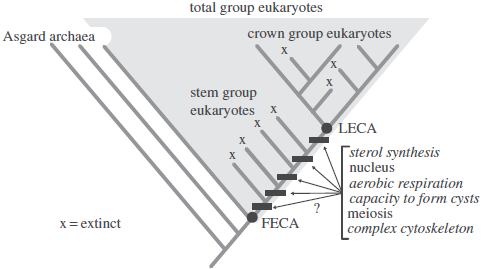
Before discussing the early Eukaryote fossil record, it is useful to review some common terms. Crown Group Eukaryotes are defined as the last common ancestor of all living Eukaryotes plus all of its descendants, both extinct and extant. This last common ancestor is commonly referred to as the Last Eukaryotic Common Ancestor. Stem Group Eukaryotes are those lineages that diverged prior to the appearance of the Last Eukaryotic Common Ancestor, but after the split with the group’s closest living relatives, a clade of Asgard Archaea in the case of Eukaryotes. Stem Groups are, by definition, extinct, and possess some, but not all, of the characters that define the Crown Group. Stem and crown groups together make up the Total Group. The term First Eukaryotic Common Ancestor, is often used to refer to the initial lineage of Total Group Eukaryotes, just after its split from its closest living relative. Eukaryogenesis refers to the interval between the First Eukaryotic Common Ancestor and the Last Eukaryotic Common Ancestor, when the characters that define the Crown Group evolved.

 
Diagram illustrating important terms and the evolution of selected characters that define modern Eukaryotes. Characters in italics are the focus of this paper. Note that the evolutionary sequence of characters that evolved after the First Eukaryotic Common Ancestor and before the Last Eukaryotic Common Ancestor cannot be resolved without the fossil record. Porter (2020).

The oldest widely accepted evidence of Eukaryotes is large (greater than 100 μm), spiny, ornamented, organic-walled microfossils found in latest Palaeoproterozoic rocks (about 1650 million years old). Throughout the Mesoproterozoic, organic-walled microfossil assemblages include a variety of Eukaryotic fossils, but it is not until the latest Mesoproterozoic and early Neoproterozoic that there is evidence for modern (i.e. crown group) Eukaryotes. This includes a handful of fossils plausibly assigned to various modern Eukaryotic supergroups, the first appearance of Eukaryotic steranes, and evidence of other Crown Group innovations like tests and biomineralised scales.

The most common explanation for these patterns is that while Crown Group Eukaryotes appeared more than 1.65 nillion years ago, they remained minor components of Mesoproterozoic ecosystems until their dramatic diversification in the early Neoproterozoic. Evidence offered in support of this view includes the absence of steranes from Mesoproterozoic rocks, which indicates that Eukaryotes must have been severely limited in abundance, and widespread ocean anoxia during this time, which means that early Eukaryotes, which require oxygen for aerobic respiration, must have been spatially restricted to the few habitats where sufficient oxygen was present. Porter evaluates the evidence for early crown group Eukaryotes and suggest instead that the data allow another end-member possibility: crown group Eukaryotes did not appear until the late Mesoproterozoic, and early Mesoproterozoic Eukaryotes had not yet acquired the capacity for aerobic respiration or sterol synthesis.

There are two end-member models of early Eukaryote evolution, which differ with respect to the age of the Last Eukaryotic Common Ancestor. If the Last Eukaryotic Common Ancestor appeared early (e.g. 1600–1800 million years ago), then Crown Group Eukaryotes must have inhabited Mesoproterozoic seas and are probably well represented among Mesoproterozoic Eukaryote fossil assemblages. Crown Group Eukaryotes would have been capable of aerobic respiration, and therefore would have lived in oxygenated environments (at least some of the time), and would have had the capacity to synthesize sterols. If, however, the Last Eukaryotic Common Ancestor appeared near the end of the Mesoproterozoic, then, depending on when in stem group evolution these characters evolved, it is possible that all early Mesoproterozoic Eukaryotes were anaerobic, unable produce sterols, or both. These different scenarios have different implications for our ability to trace Eukaryogenesis in the fossil record. If the Last Eukaryotic Common Ancestor appeared early, before the first recognisably Eukaryotic fossils, then those characters must have appeared in taxa that either did not leave a fossil record or are not recognisably Eukaryotic, making it difficult if not impossible to know the order in which they evolved. If, however, the Last Eukaryotic Common Ancestor appeared much later than the oldest recognisably Eukaryotic fossils, then it might be possible to track the appearance of different Crown Group characters through the Mesoproterozoic.

 
Models of early Eukaryote evolution. If the Last Eukaryotic Common Ancestor appears early, then Eukaryotes with cysts, a complex cytoskeleton, sterols and the capacity for aerobic respiration must have lived during Mesoproterozoic time. In this model, the lack of detectable steranes during this time would reflect limited abundance of Eukaryotes, particularly Crown Eukaryotes. Eukaryogenesis (orange box) would have preceded the record of recognisably Eukaryotic fossils (indicated by grey box). If the Last Eukaryotic Common Ancestor appeared late, then Mesoproterozoic rocks dominantly preserve Stem Group Eukaryotes, many of which may be anaerobic or lacked the ability to synthesise sterols, or both. Stages in Eukaryogenesis may be observable, given overlap with the fossil record. Porter (2020).

So, when did the Last Eukaryotic Common Ancestor appear? Unfortunately, molecular clock estimates for the age of the Last Eukaryotic Common Ancestor span a range of over 1 billion years, making it difficult to have much confidence in any particular estimate. Several arguments, however, favour a younger age for the Last Eukaryotic Common Ancestor. First, older ages for the Last Eukaryotic Common Ancestor seem to be driven primarily by the inclusion of Bangiomorpha pubescens, a presumed Bangiophyte Red Algal fossil. Many of these analyses used a now-outdated age for Bangiomorpha pubescens (1198 million years versus the recent report of 1.047 billion year), and this presumably accounts for some of the discrepancy. In addition, it is also possible that Bangiomorpha pubescens is neither a Bangiophyte nor even a Crown Group Red Alga. Other more deeply diverging Red Algal species exhibit similar filamentous forms, similar multicellular holdfasts and packets of spores that form in a similar way to the wedge-shaped cells of Bangiomorpha pubescens, suggesting these characters could have evolved multiple times early in Rhodophyte evolution. Bangiomorpha pubescens is therefore perhaps better interpreted as a part of Total Group Red Algae, as it could represent part of the Stem Group, rather than the Crown Group, of this clade. Notably, the analysis by Diana Chernikova, Sam Motamedi, Miklós Csürös, Eugene Koonin, and Igor Rogozin, assigned Bangiomorpha pubescens to Total Group Red Algae (using it to calibrate the split between Red and Green Algae), and yielded age estimates for the Last Eukaryotic Common Ancestor that were much less offset from those using Phanerozoic calibrations only (e.g. 1200–1400 million years with Bangiomorpha pubescens versus 1100–1300 million years without Bangiomorpha pubescens). This analysis used the now-outdated calibration age for Bangiomorpha pubescens (1100–1200 million years), suggesting that both a corrected age and more conservative taxonomic assignment for Bangiomorpha pubescens might remove the discrepancy altogether, with Phanerozoic and Proterozoic calibrations aligning in support of a younger (1100–1300 million years ago) age for the Last Eukaryotic Common Ancestor.

 
Selected molecular clock constraints on the initial divergence within crown group eukaryotes (i.e. the age of the Last Eukaryotic Common Ancestor). Estimates that do not use the fossil Bangiomorpha pubescens as a calibration point are 200–300 million years younger than those that do. Porter (2020).

Second, though estimates for the Last Eukaryotic Common Ancestor vary widely, there is consistent agreement among molecular clock analyses that the Eukaryotic supergroups diverged within 300 million years of the Last Eukaryotic Common Ancestor. Thus, if the Last Eukaryotic Common Ancestor appeared early (1600–1800 million years ago), then there should be evidence for Eukaryotic supergroups roughly 1300–1500 million years ago. Though the Mesoproterozoic is not as well sampled as the Neoproterozoic, thus far the picture seems to be that Eukaryotic supergroups diverged in the latest Mesoproterozoic and early Neoproterozoic, with fossils plausibly assigned to the Archaeplastida, Amoebozoa and Opisthokonta, appearing 1050–750 million years ago, along with other innovations widespread among living Eukaryotes (such as biomineralized scale microfossils; 811 million years ago). Thus, if Eukaryotic supergroups diverged 1050–750 million years ago, then these molecular clock analyses are telling us that the Last Eukaryotic Common Ancestor appeared around 1350–1050 million years ago.

Finally, models of phylogenetic diversification suggest it is highly unlikely that a Crown Group would survive at low diversity for approximately half its life (e.g. 800 million years) before it radiated. Rather, clades that survive to the present day (by definition any crown group) tend to start off with higher net rates of diversification relative to other (nonsurviving) clades. This is because clades that happened to have diversified rapidly early in their history are simply more likely to survive to become Crown Groups. It is not easy to persist at low diversity for hundreds of millions of years; there is just too much risk of going extinct. These phylogenetic models also indicate that after the Crown Group emerges, the Stem Group rapidly declines. This again reflects survivorship bias; if they did not decline rapidly, it is unlikely they would have gone extinct, which by definition, they must have, given that they are Stem Groups. Thus, the interval of overlap between Stem and Crown Group Eukaryotes should be short; if the Last Eukaryotic Common Ancestor did appear around 1.6–1.8 billion years ago, there should be few Stem Group Eukaryotes present by late Mesoproterozoic time. These results do not hold in special cases, e.g. when the Crown diversification follows a mass extinction, and, therefore, it is not easy to know how to apply them to the particular case of Eukaryotes. However, there is no obvious evidence for mass extinction in the Mesoproterozoic or early Tonian. Regardless, the null model suggests that once the Last Eukaryotic Common Ancestor had appeared, Crown Eukaryotes should have diversified rapidly. Thus, if Crown Group Eukaryotes diversified in the early Neoproterozoic, then the null model favours a younger (i.e. late Mesoproterozoic) age for the Last Eukaryotic Common Ancestor. Given reasons to favour a younger Last Eukaryotic Common Ancestor, Porter now turns to the fossil record and review the evidence for when important Eukaryogenic characters evolved.

Many Eukaryotes enter a resting stage during times of environmental stress, forming resistant-walled structures known as cysts. Encystation is so widespread, found among all the Eukaryotic supergroups, that it seems likely that the Last Eukaryotic Common Ancestor was also able to encyst, or least possessed a capacity to readily evolve cysts such that cysts evolved again and again within Crown Group Eukaryotes. Cysts are most easily recognised in the fossil record by the presence of excystment structures, pre-programmed openings by which the cells escape. Two types are common in Proterozoic fossils: medial splits, in which the cyst opens along an equatorial line often dividing the cyst into two separate hemispheres; and well-defined (typically circular) openings, known as pylomes. Fossils exhibiting medial splits are common in assemblages throughout the Proterozoic, including those with the oldest recognized Eukaryotes. Possible pylomes are reported in Dictyosphaera macroreticulata from 1744 to 1411 million years ago Ruyang Group, North China, with definite occurrence by 1100 million years ago (Leiosphaeridia kulgunica in the Atar/El Mreïti Group, Mauritania).

 
Examples of fossils and characters. (a), (b) Bangiomorpha pubescens from the late Mesoproterozoic Hunting Formation, Somerset Island, arctic Canada. Note cross-section in (b) showing distinctive wedge-shaped cells. (c), (f ) Excystment structures in Eukaryotic microfossils. (c) Circular pylome with partially detached lid, in Kaibabia gemmulella. (f) Medial split, in Leiosphaeridia crassa. Both (c) and (f) are from the late Tonian Chuar Group, Grand Canyon, USA. (d), (e) Indirect evidence for a complex cystoskeleton in Eukaryotic microfossils. (d) Irregularly distributed hollow processes in Tappania plana. (e) Spiny ornamentation in Dictyosphaera macroreticulata. Both (d) and (e) are from the early Mesoproterozoic Ruyang Group, North China. Porter (2020).

In Eukaryotes, the cytoskeleton is involved in controlling cell shape, cell movement, phagocytosis and intracellular trafficking. Though traditionally considered a diagnostic character of Eukaryotes, the discovery of actin and tubulin homologues in Bacteria and Archaea indicated cytoskeletal building blocks were already present in the First Eukaryotic Common Ancestor, and, in fact, recent discoveries of numerous homologues of cytoskeletal genes in Asgard Archaea suggest that the First Eukaryotic Common Ancestor had a dynamic actin cytoskeleton, perhaps even capable of phagocytosis. Nonetheless, many Eukaryotic cytoskeletal genes do not have homologues in the Archaea, suggesting that Eukaryotes have a much more complex cytoskeleton than their closest Archaeal relatives. It is difficult to know how to translate these genotypic differences into phenotypic differences we might observe in the fossil record, however. In the past, the presence of irregularly distributed, branching processes in Eukaryotic fossils has been used as evidence for a Eukaryotic cytoskeleton (in Tappania plana), but the presence of similar, irregularly distributed, long, sometimes branching protrusions extending from Asgard Archaeal cells recently described from culture suggests this might not be a uniquely Eukaryotic feature. Similarly, it is difficult to know whether complex ornamentation or the presence of spines in a fossil implies a complex (Eukaryotic) cytoskeleton or whether the First Eukaryotic Common Ancestor could have produced these with its more primitive cytoskeleton.

 
Proxy records for four characters of crown group Eukaryotes (coloured circles), and inferred age constraints on their appearances (coloured arrows): (a) cysts, represented by microfossils with excystment structures (medial splits or pylomes); and (b) the presence of a complex cytoskeleton, represented by microfossils with spines or pylomes, which indicate an ability of the cell to change its shape; (c) sterol synthesis, represented by sterane biomarkers; (d ) aerobic respiration, represented by the occurrence of Eukaryotes in oxic habitats (grey circles indicate evidence is ambiguous). Note that, with the exception of steranes, the absence of a proxy record is not taken to imply the absence of the character, age constraints in (a), (b), (d), show hard minimums but no maximums. Note also that age constraints in (a)–(d) do not take into account data from other records, e.g. fossil evidence for crown group Eukaryotes at 1.05 billion years. Porter (2020).

Thus, rather than focusing on proxies for a complex cytoskeleton, it might make sense to focus on features that the Eukaryotic cytoskeleton confers, recognising that some of these might have been present in the First Eukaryotic Common Ancestor. In particular, the ability for a cell to change shape, a key feature of the Eukaryotic cytoskeleton that is linked to the ability to phagocytose,  might be inferred through several fossil proxies. Two have already been mentioned: evidence for an actively growing (and remodelling) cell wall (as in Tappania plana) and the presence of spines in cell walls or cysts, which probably formed via the extension of long, narrow protrusions of the cell membrane. Another proxy might be the presence of pylomes, as it might imply that the cell changed shape, squeezing through the hole to escape the cyst. 

The distribution of sterols across the tree of Eukaryotes suggests that they were present in the Last Eukaryotic Common Ancestor, although it is possible that lateral gene transfer is at least in part responsible for this distribution. Archaea do not appear to have sterol genes, suggesting that the capacity for sterol synthesis appeared during the First Eukaryotic Common Ancestor–Last Eukaryotic Common Ancestor transition. (Note that while some bacteria produce sterols, their sterol synthesis genes are generally thought to have been acquired from Eukaryotes via lateral gene transfer). Thus far, biomarker studies of Mesoproterozoic rocks have failed to turn up convincing evidence of indigenous Eukaryotic steranes; this is the case even in units with diverse Eukaryotic fossils, in facies that would be favourable to sterol-producing Eukaryotes (i.e. oxic, nutrient-rich). Though this has generally been interpreted to indicate either an extremely low abundance of Eukaryotes or preservational bias, it may instead be that the absence of Eukaryotic steranes reflects the fact that sterol synthesis had not yet evolved. This would be consistent with a late appearance of Last Eukaryotic Common Ancestor (i.e. less than 1100 million years ago), but would also be consistent with an earlier appearance if the genes for sterol biosynthesis were transferred via lateral gene transfer among early Crown Group Eukaryotes. (Note that a recent molecular clock analysis concluded that some sterol biosynthesis genes were present in early Eukaryotes about 2.3 billion years ago (1.75–3.05 billion years ago). However, this does not imply that they were forming Eukaryotic sterols but rather might have been forming ‘protosterols’).

Today, mitochondria are essential for Eukaryotic respiration in aerobic habitats. Thus, it is reasonable to assume that evidence for aerobic respiration in early eukaryotes implies the presence of mitochondria in these organisms. (Note, however, that the converse is not true: evidence for an anaerobic lifestyle does not imply that these Eukaryotes lacked mitochondria.) Despite frequent acknowledgement in the literature that late Palaeoproterozoic and Mesoproterozoic Eukaryotic fossils are probably best interpreted as Stem Group Eukaryotes, there is a widespread assumption that nonetheless they must have been aerobic (and therefore possessed mitochondria). In part, this might reflect assumptions about the age of the Last Eukaryotic Common Ancestor, but it might also be based on the idea that aerobic respiration is required for the relatively large size and complexity of late Palaeoproterozoic and Mesoproterozoic Eukaryotic microfossils. Discoveries of anaerobic Eukaryotes over the last decade, however, have shown that this is not the case. Some anaerobic Protists (including free-living forms) can reach hundreds of micrometres in size and possess complex structures, including elaborate attachment sites, complicated cytoskeletons, large nuclei and thousands of flagella. In some cases, there is evidence that large size and complexity evolved within ancestrally anaerobic lineages, indicating that aerobic respiration is neither necessary to sustain large size and complexity, nor required to evolve it. Thus, the fairly large, ornamented Eukaryotic cells found in late Palaeoproterozoic and Mesoproterozoic rocks cannot be assumed to have been aerobic. (Whether their large size and complexity implies the presence of mitochondria per se, however, is more difficult to know).

A better proxy for aerobic respiration in early Eukaryote fossils is evidence that those Eukaryotes lived in oxygenated environments. Currently, the most widely used tool for reconstructing local redox conditions in an ancient water column is iron speciation, which uses the ratio of highly reactive iron versus total iron in a sample as a proxy for water column anoxia. Ratios of 0.22 or less are taken to indicate fully oxygenated water column, whereas highly reactive iron versus total iron ratios of 0.38 or higher suggest water column anoxia (ratios in between are ambiguous). Unless there is reason to think the organisms were infaunal, the presence of Eukaryotic microfossils in oxic samples should generally indicate that those organisms were aerobic. (While Eukaryotic fossils recovered from anoxic samples have traditionally been interpreted to be planktonic Eukaryotes that lived in the oxic surface layer of a stratified water column, it is also possible they were anaerobic and lived lower in the water column or on the seafloor). The link is not clear-cut, however, because both the iron speciation proxy and microfossil assemblages are integrated records, providing information about redox conditions and communities over some interval of time: samples that indicate an oxic water column might have witnessed short episodes of anoxia, and therefore might host fossils of anaerobic Eukaryotes. Conversely, the absence of Eukaryotes from oxic samples does not imply aerobic Eukaryotes did not exist, as they may be missing for other reasons, such as a lack of food, preservational bias or dilution due to high Cyanobacterial fossil abundance. Thus, no single sample should be taken as definitive evidence for (or against) aerobic Eukaryotes. But a consistent pattern across many samples and many units through time could provide compelling evidence for the absence of aerobic respiration.

Unfortunately, there are only a handful of studies in which iron speciation and fossil occurrence data come from the same samples, and the data are too sparse to come to any definitive conclusions about when aerobic Eukaryotes evolved. Nonetheless, unpublished work on the roughly 780–730 million year old Chuar Group (USA) suggests that the proxy may be useful: numerous oxic shale samples from throughout the Galeros Formation contain well-preserved Eukaryotic fossil assemblages that show the same species richness as those from anoxic samples providing good evidence for aerobic Eukaryotes at this time (not surprisingly) and suggesting there is no inherent preservational bias against organisms that lived in fully oxygenated water columns. Further back in time, the data become more difficult to interpret, and the evidence for aerobic Eukaryotes becomes less certain. In a palaeoecological study of the roughly 1100 Ma Atar/El Mreïti Formation of northwest Africa, there are only two fossiliferous oxic samples, only one of which preserves definitive Eukaryote species as minor components (less than 3% of the assemblage). However, the anoxic samples, which are much more numerous, are not dissimilar: although these can record abundances of Eukaryotes up to greater than 25% of the assemblage, the median Eukaryote abundance is nonetheless 0%. An analysis of drill core from the 1400 million year old Kaltasy Formation (Russia) revealed a suite of oxic samples, but definitive eukaryotes are rare or absent. This stands in contrast with more diverse assemblages from unknown redox habitats preserved in roughly coeval units from Australia and the USA. In the roughly 1450 million year old Roper Group, diverse Eukaryotes occur in environments interpreted to have been oxygenated, but iron speciation data are based on an outdated extraction method, and more recent research suggests that marine anoxia characterised the depositional basin of the Roper Group.

We know that First Eukaryotic Common Ancestor was an anaerobic organism, and that the oldest fossilised Eukaryotes lived in oceans that were dominantly anoxic. Thus, the default assumption should be that the earliest Eukaryotes to show up in the fossil record were anaerobic, with the onus on palaeontologists to show this is not true. The very limited data for Mesoproterozoic Eukaryotes discussed by Porter do not provide strong evidence either way: though a few Eukaryotic specimens are reported from oxic samples, the possibility that they reflect brief appearances of anaerobic organisms in anoxic conditions cannot be ruled out. A critical reading of the available data, therefore, would suggest that while aerobic Eukaryotes were present by roughly 800 million years ago, there is no definitive evidence that Eukaryotes occupied oxic habitats during the Mesoproterozoic. Contrary to widespread assumptions about early Eukaryotes, aerobic respiration, and therefore possibly mitochondria,  might have been acquired late in Mesoproterozoic time, and late in stem group evolution.

The four characters can be mapped onto a phylogeny of early Eukaryotes, where the appearance of the Last Eukaryotic Common Ancestor is placed at 1100 million years. The limits of this approach are well illustrated: while the fossil record can provide definitive minimum age constraints on the appearance of these characters, cysts and a complex cytoskeleton by about 1650 million years ago, aerobic respiration (and thus mitochondria) by about 800 million years ago and sterol synthesis by 820 million years ago, it is more difficult to place maximum age constraints on the appearance of these characters. This relies on evidence of absence, which is particularly a problem with the fossil record, where preservational controls are always a concern. However, hypotheses regarding the timing of the origin of these characters remain testable using the rock record. For example, if continued sampling of well-preserved Mesoproterozoic and Palaeoproterozoic rocks consistently yields biomarkers, but never steranes, it may suggest that the strata in question predate sterol biosynthesis. Similarly, the timing of the evolution of aerobic respiration may be constrained by strata that consistently yield well preserved and abundant Eukaryotic body fossils in anoxic habitats but negligible occurrences in oxic habitats. While the absence of evidence in these scenarios does not necessarily provide definitive evidence that Eukaryotes lacked these distinctive characters, the simplest explanation is that these characters had not yet evolved.

The prevailing view of the early eukaryote fossil record is that the Last Eukaryotic Common Ancestor appeared by 1.6–1.8 billion years ago, and that the first Eukaryotes we see had the capacity for sterol synthesis and aerobic respiration. If this is true, then, given what we know about the Archean and Palaeoproterozoic fossil record, we have little hope of reconstructing Eukaryogenesis. But there is good reason to think this is not true. Molecular clock analyses allow the possibility that Last Eukaryotic Common Ancestor arose much later, a scenario favoured by current views that crown group diversification occurred in the latest Mesoproterozoic and Tonian. The consistent lack of detectable steranes in Mesoproterozoic rocks, especially in units that should host them, points to the possibility that Eukaryotic sterol synthesis had not yet evolved. Finally, there is no clear-cut evidence that Eukaryotes lived in oxic habitats during the Mesoproterozoic, permitting the possibility that aerobic respiration, and perhaps mitochondria, which are essential for aerobic respiration,  was acquired late in Eukaryote evolution. Continued studies of body fossil and biomarker assemblages placed within a palaeoenvironmental and redox context may allow us to track Eukaryogenesis in the fossil record, and identify the environmental conditions that allowed the appearance of such complex life.

See also...


Online courses in Palaeontology. 

Follow Sciency Thoughts on Facebook.

Follow Sciency Thoughts on Twitter.