Showing posts with label Chongqing. Show all posts

Saturday, 5 March 2022

Bashanosaurus primitivus: A new species of Stegosaur from the Middle Jurassic of Chongqing Municipality, China.

The Stegosaurs were a distinctive group of Ornithischian Dinosaurs whose fossils are known from the Middle Jurassic to the Early Cretaceous, and which are distinctive for the presence of a double row of plates or spines which run along the back from the neck to the tip of the spine. The earliest known Stegosaurs appear in the Middle Jurassic in Europe, China, Argentina, and Morocco, a distribution which implies the group emerged some time before the oldest fossils we know.

In a paper published in the Journal of Vertebrate Paleontology on 3 March 2022, Dai Hui and Li Ning of the Chongqing Laboratory of Geoheritage Protection and Research at the Chongqing Bureau of Geological and Mineral Resource Exploration and Development, Susannah Maidment of the Department of Earth Sciences at the Natural History Museum, Wei Guangbiao  of the Chongqing Institute of Geological Survey, Zhou Yuxuan, Hu Xufeng, Ma Qingyu, Wang Xunqian, and Hu Haiqian, also of the Chongqing Laboratory of Geoheritage Protection and Research, and Peng Guangzhao of the Zigong Dinosaur Museum, describe a new species of Stegosaur from the Middle Jurassic Lower Member of the Shaximiao Formation of Chongqing Municipality, China. 

The new species is described upon the basis of material from the Dinosaur Quarry at Laojun Village, a site discovered in 2017, and which has been excavated systematically to form a wall of Dinosaur fossils 150 m long and 8 m high. The Lower Member of the Shaximiao Formation comprises grayish-yellow massive fine-grained lithic feldspathic sandstones and purplish red silty mudstones in multiple rhythmic layers of uneven thickness; the siltstones contain calcareous nodules. This 'redbed' facies is interpretted to indicate a semi-arid, terrestrial paleoenvironment. Various attempts have been made to date this bed radiometrically, yielding dates of between 158 and 172 million years old.
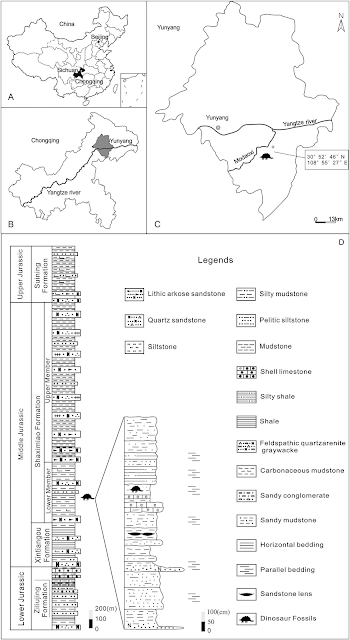
 
Maps showing the location where Bashanosaurus primitivus was recovered. (A) Sketch map of China showing the location of Chongqing Municipality. (B) sketch map of Yunyang County. (C) Sketch map of the fossil locality. (D) Stratigraphic chart with Lower Member of the Shaximiao Formation in Yunyang County, Chongqing Municipality, China. Dai et al. (2022).

The new species is named Bashanosaurus primitivus, where 'Bashanosaurus' is a combination of 'Bashan-', an ancient name for Chongqing, and '-saurus', meaning 'Lizard', a comon suffix for Dinosaur names, and 'primitivus' refers to the fact that a phylogenetic analysis revealed the species to be the most primitive member of the Stegosauria (that it is to say it is the earliest branching member of the group, with all other Stegosaurs being more closely related to one-another than they are to Bashanosaurus primitivus). The new species is described from three specimens, CLGPR V00006-1, V00006-2, and V00006-3, all from the 'wall' of Dinosaur specimens from the Dinosaur Quarry at Laojun Village.

 
(A) Photograph (top) and interpretative sketch (bottom) of Bashanosaurus primitivus (CLGPR V00006-1) on the west side of the Dinosaur Fossil Wall. (B) Photograph (top) and interpretative sketch (bottom) of Bashanosaurus primitivus (CLGPR V00006-2) in the middle of the Dinosaur Fossil Wall. Abbreviations: cav, caudal vertebra; co, coracoid; dv, dorsal vertebra; f, femur; fl, fibula; mt, metatarsal; pl, plate; r, rib; sc, scapula; sp, spine; t, tibia. Dai et al. (2022).

Specimen CLGPR V00006-1 is designated the holotype of the species (that is to say, any other specimen which is judged to be the same species as CLGPR V00006-1 is therefore considered to be a specimen of Bashanosaurus primitivus). This specimen is preserved on the west side of the wall of Dinosaur fossils and comprises one dorsal vertebra, two caudal vertebrae, right scapula, right coracoid, left femur, left tibia, left fibula, one metatarsal, three pieces of dermal armor (1 plate and 2 spines) and some ribs. Specimen CLGPR V00006-2 is preserved in the middle of the wall of Dinosaur fossils, and comprises five dorsal vertebrae, right tibia, right fibula, one piece of dermal plate, and some ribs. CLGPRV00006-3 is a dorsal vertebra from the east side of the wall of Dinosaur fossils.
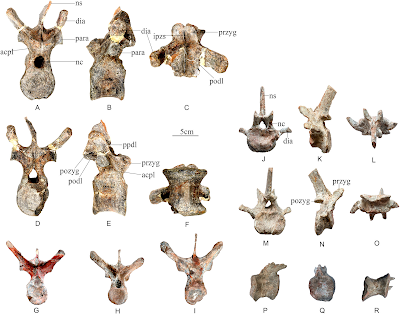
 
(A)–(F) Dorsal vertebrae referred to Bashanosaurus primitivus (CLGPR V00006-3) from the Middle Jurassic of China. (A) Anterior; (B) left lateral; (C) dorsal; (D) posterior; (E) right lateral; (F) ventral; (G) posterior views of dorsal vertebrae referred to Bashanosaurus primitivus (CLGPR V00006-1) from the Middle Jurassic of China. (H) Posterior view of dorsal vertebrae referred to Bashanosaurus primitivus (CLGPR V00006-2) from the Middle Jurassic of China. I, anterior view of dorsal vertebrae referred to Bashanosaurus primitivus (CLGPR V00006-2) from the Middle Jurassic of China. (J)–(O) anterior caudal vertebrae referred to Bashanosaurus primitivus (CLGPR V00006-1) from the Middle Jurassic of China. (J) anterior; (K) left lateral; (L) dorsal; (M) posterior; (N) right lateral; (O) ventral. (P)–(R) middle caudal vertebrae referred to Bashanosaurus primitivus (CLGPR V00006-1) from the Middle Jurassic of China. (P) right lateral; (Q) posterior; (R) ventral. Abbreviations: acpl, anterior centroparapophyseal lamina; dia, diapophysis; ipzs, intraprezygapophyseal shelf; nc, neural canal; ns, neural spine; para, parapophysis; podl, postzygodiapophyseal lamina; pozyg, postzygapophysis; ppdl, paradiapophyseal lamina; przyg, prezygapophysis. Dai et al. (2022).

Bashanosaurus primitivus shows a number of distinctive features not seen in any previously described Stegosaur. These include parapophyses of dorsal vertebrae, which are elevated on stalks at the base of the transverse process, the shape of the scapula blade, which is slender and flares distally, the acromial process of the scapula, which is small, triangular and poorly developed, the 4th trochanter of the femur, which is positioned below the middle of the shaft, and the bases of the dermal plates, which are strongly convex and transversely thickened, and are separated from the anterior/posterior margins of the plates by a distinct groove.

A fourth Stegosaur specimen, CLGPR V00006-4, was recovered from an exploratory trench, about 900 m away from the Dinosaur Fossil Wall. This specimen comprises a partial cranium, a dorsal vertebra, and a piece of dermal armour, which is not sufficient to assign it two species level, since two Stegosaur species have now been described from the Lower Member of the Shaximiao Formation, Bashanosaurus primitivus, and Huayangosaurus taibaii, which was described in 1984, from material from the Shaximiao Formation in of Sichuan Province. 

 
(A)–(F) Braincase referred to the Stegosauria but not to species level. (CLGPRV0005-4) from the Middle Jurassic of China. (A) Anterior; (B) left lateral; (C) right lateral; (D) posterior; (E) dorsal; (F) ventral. (G)–(L) Dorsal vertebrae referred to the Stegosauria but not to species level. (CLGPRV0005-4) from the Middle Jurassic of China. (G) Anterior; (H) left lateral; (I) dorsal; (J) posterior; (K) right lateral; (L) ventral. (M)–(R) Dermal armour referred to the Stegosauria but not to species level. (CLGPRV0005-4) from the Middle Jurassic of China. (M) Anterior; (N) posterior; (O) left lateral; (P) right lateral; (Q) dorsal; (R) ventral. Abbreviations: boc, basioccipital; bpt, basipterygoid process; bsp, basiphenoid; cc, carotid canal; c.n.I, III, V, VII, XII exit for cranial nerves; dia, diapophysis; f, frontal; fime, fissura metotica; fm, foramen magnum; fo, foramen ovale; ipzs, intraprezygapophyseal shelf; ist, integumentary structure; nc, neural canal; ns, neural spine; oc, occipital condyle; os, orbitosphenoid; p, parietal; para, parapophysis; poc, paroccipital process; pozyg, postzygapophysis; przyg, prezygapophysis; ps, parasphenoid; soc, supraoccipital; sf, supratemporal fossae; sq, squamosal. Dai et al. (2022).

A phylogenetic analysis, based upon a previous study of the group published by a team led by Sussanah Maidment in 2020, found that Bashanosaurus primitivus is the sister taxon to Chungkingosaurus jiangbeiensis, a Stegosaur from the Late Jurassic Upper Member of the Shaximiao Formation, and that together these two species form a sister group to all other Stegosaurs. 

 
A single most parsimonious tree recovered by the phylogenetic analysis. The numbers below the line are Bremer supports, the numbers above the line are GC frequencies. Ankylosauria was represented by three taxa, Gastonia, Euoplocephalus, and Sauropelta in the analysis, but these are shown here as a single terminal taxon for clarity. Dai et al. (2022).

Dai et al. also carried out a radiometric analysis of the deposits which produced Bashanosaurus primitivus, using thorium/uranium ratios in detrital zircons (uranium-thorium dating works because uranium decays to thorium at a known rate, so that the ratio of the two elements in minerals that naturally incorporate uranium but not thorium can be used to establish a date for the minerals).  This produced a range of ages, which would be expected from durable minerals in sedimentary rocks, but the youngest were dated to roughly 169 million years old, implying that the rocks of the Lower Member of the Shaximiao Formation were deposited no earlier than the Bajocian Stage of the Middle Jurassic. 

If the Lower Member of the Shaximiao Formation is Bajocian in origin, then that would make the Stegosaurs found within it, Bashanosaurus primitivus and Huayangosaurus taibaii, the oldest known Stegosaur speciemens. Since Huayangosaurus taibaii is the next branching clade within the Stegosauria after the clade that comprises Bashanosaurus primitivus and Chungkingosaurus jiangbeiensis, this strongly supports an Asian origin for the Stegosauria as a whole.

Dai et al.'s results suggest that the Lower Member of the Shaximiao Formation at Dinosaur Quarry at Laojun Village is Middle Jurassic in age. However, another recent study has suggested that the Lower Member of the Shaximiao Formation at Zigong in Sichuan Province should be dated to the Late Jurassic. Dai et al. suggest that this is because, in the Middle Jurassic, the centre of deposition within the Sichaun Basin (which contains the Shaximiao Formation) was in the northeast, shifted over time due to the rapid filling of the basin by material derived from the intracontinental subduction of the Qinling orogenic belt and Daba Mountains, with the upshot that the Shaximiao Formation may be laterally diachronous (that is to say of different ages across it's horizontal extent). If this is the case, then the rocks which produced Huayangosaurus taibaii may be younger than those which produced Bashanosaurus primitivus, even though they are part of the same member of the same formation.

Bashanosaurus primitivus is therefore the oldest known Stegosaur in Asia, and one of the oldest known Stegosaurs in the world, with geochronological data supporting a Bajocian age for the Lower Member of the Shaximiao Formation at Dinosaur Quarry. Bashanosaurus primitivus is also one of the earliest branching Stegosaurs phylogenetically, forming a clade with Chungkingosaurus jiangbeiensis that forms the sister group to all other Stegosaurs. This strongly supports the hypothesis that the Stegosauria as a whole had an Asian origin.

See also...


Online courses in Palaeontology. 

Follow Sciency Thoughts on Facebook.

Follow Sciency Thoughts on Twitter.


Monday, 30 November 2020

Smelting zinc in medieval China.

Themain difficulty in zinc-metal production is that while zinc oxide is not reduced by carbon below 1000°C, zinc-metal boils at 907°C, becoming vapour that must be condensed to liquid metal before it comes into contact with enough air to oxidise it back to zinc oxide. A great deal of research has been done on zinc smelting in India. It is widely acknowledged that India was the first country in the world to smelt zinc; the earliest archaeological evidence comes from Zawar in Rajasthan and dates as early as AD 1025–1280. Chinese zinc production can be traced back to at least the early Ming Dynasty (early sixteenth century). Chinese and Indian zinc-smelting technologies are quite different in their condensing techniques, furnaces and retorts (the condensing pots). The discovery of zinc-smelting sites in the Upper and Middle Yangtze River region shows that Chinese zinc-smelting technology probably has an independent technical origin and tradition.

According to historical records, brass was used instead of bronze during the Jiajing period of the Ming Dynasty (AD 1522–1566); this significantly reduced the cost of coin casting. The scale of zinc smelting, however, suggests that it was an important element of the economy during the Ming and Qing Dynasties. Interest in ancient Chinese zinc-smelting technology has increased in recent years.

In a paper published in the journal Antiquity on 9 June 2020, Yuniu Li of Sichuan University, Birui Xiao of the Chongqing Cultural Heritage Research Institute, Gill Juleff of the Department of Archaeology at the University of Exeter, Wan Huang of the Sichuan Provincial Cultural Relics and Archaeology Research Institute, and Dadi Li and Jiujiang Bai, also of the Chongqing Cultural Heritage Research Institute, present the results of a study which began in 2004, in which a series of archaeological surveys and excavations of zinc-smelting sites in the Upper and Middle Yangtze River region have been conducted.

Some 40 zinc-related sites have been discovered and recorded. The majority of the sites are located along the banks of the Yangtze River, probably for convenience of transportation. Our study suggests that people in this region mastered the retort method (reduction and condensation) of extracting zinc as early as the middle of the Ming Dynasty (AD 1435–1572).

 
Locations of the zinc-smelting sites in the Upper and Middle Yangtze River region. Li et al. (2020).

The smelting sites can be identified in three regions: on the banks of the Yangtze River; the Qiyao Mountain region; and the Wu River region in Youyang County. One of the bestpreserved sites is Linjiangerdui in Zhong County. This site was excavated in 2013, 2017 and 2018. As the site lies within what is now a reservoir (as part of the Three Gorges scheme) it is partially submerged and excavation can only be carried out between May and September each year when water levels are low. The Linjiangerdui site lies to the south of the Yangtze River, west of the Shuiyang stream, and east of a Han Dynasty cemetery site (202 BC–220 AD). The site lies on a slope with the elevation varying between 155 m on the north side and 170m on the south; it covers a total area of 15 000 m². Over the three seasons, 22 zinc-smelting furnaces were excavated and recorded, together with a large number of pits and postholes representing places of preparation and storage for ore and coal, over 1000 retorts (both used and unused) and domestic pottery and porcelain.

 
Site view of Linjiangerdui. Li et al. (2020).

The ore recovered is lead-zinc ore, which possibly comes from the Qiyao Mountain region. A number of samples of unsmelted ore and slag were analysed and 14 radiocarbon assays were taken from charcoal samples. These produced dates between 1408 and 1650 AD (at 95.4% confidence).

 
Example of zinc-smelting furnace at Linjiangerdui. Li et al. (2020).

Historical documents provide some information on ancient zinc-smelting processes. The Tiangongkaiwu (The products of heaven and man by Song Yingxing, 1587–1666), records a zinc-smelting method of Luganshi (smithsonite) together with a drawing of the process. Many details of the process, including the precise dimensions of the retorts, the smelting process and the structure of the furnace are either inaccurate or missing from this text, however. Li et al.'s fieldwork has revealed new archaeological evidence of the zinc-smelting process in this region. The excavated retorts were ceramic with a condensing zone at the top. The natural distillation effect is caused by the differential temperature gradient between the top and the bottom of the retorts, which causes zinc vapour to rise from the heated base and condense asmetal in the upper condensing zone. Based on the historical texts and radiocarbon results, the zinc-smelting sites in the Upper and Middle Yangtze River region date to the middle of the Ming Dynasty (AD 1435–1572). Linjiangerdui is the earliest and largest ancient zinc-smelting site discovered in China to date and provides valuable data for understanding zinc-smelting technology as well as the social processes enmeshed in zinc smelting in China.

 
(a) Unused retorts; (b) used retorts; (c) retort pockets; (d) porcelain of the Ming Dynasty. Li et al. (2020).

The zinc-smelting sites in the Upper and Middle Yangtze River region vary in date, scale and technological complexity. While Li et al. have established the chronological sequence of these sites, further work is needed to understand the differences between sites and the reasons for variation. Comparison with other zinc-smelting sites known from the Hunan and Guangxi provinces will offer a macro-perspective on ancient Chinese zinc production, and illuminate the origin, development and spread of this technology.

 
Illustration of zinc smelting in Tiangongkaiwu. Li et al. (2020).

See also...


Follow Sciency Thoughts on Facebook.

Follow Sciency Thoughts on Twitter. 


Sunday, 27 September 2020

Sixteen fatalities caused by mine fire in Chongqing, China.

Sixteen miners have died and one is being treated in hospital following a fire at a coal mine in the Municipality of Chongqing in southwest China on Sunday 27 September 2020. The fire is understood to have broken out at the Songzao Mine on a conveyer belt used to carry coal from the excavation front to the surface. This ignited coal dust in the mine, which is more or less pure carbon, which reacted with oxygen in the atmosphere to produce deadly carbon monoxide gas (carbon usually produces carbon dioxide when it burns, but within coal mines, where there is abundant carbon, in a powdered form, and a limited supply of oxygen, then incomplete combustion often occurs, resulting in the formation of the much more deadly carbon monoxide). The cause of the incident is still being investigated, but it is understood that the mine had previously been fined for breached of safety regulations.

 
Rescue workers at the Songzao Coal Mine in Chongqing on Sunday 27 September 2020. Associated Press.

Coal is formed when buried organic material, principally wood, in heated and pressurized, forcing off hydrogen and oxygen (i.e. water) and leaving more-or-less pure carbon. Methane is formed by the decay of organic material within the coal. There is typically little pore-space within coal, but the methane can be trapped in a liquid form under pressure. Some countries have started to extract this gas as a fuel in its own right. When this pressure is released suddenly, as by mining activity, then the methane turns back to a gas, expanding rapidly causing, an explosion. This is a bit like the pressure being released on a carbonated drink; the term 'explosion' does not necessarily imply fire in this context, although as methane is flammable this is quite likely.

Coal is also comprised more or less of pure carbon, and therefore reacts freely with oxygen (particularly when in dust form), to create carbon dioxide and (more-deadly) carbon monoxide, while at the same time depleting the supply of oxygen. This means that subterranean coal mines need good ventilation systems, and that fatalities can occur if these break down.

China gains 70% of its energy from coal-burning power stations, which places the country under great pressure to maintain coal supplies. This has led to a poor safety record within the mining sector, particularly in the private sector, where there is a culture of seeking quick profits in poorly regulated (and sometimes officially non-existent) mines.  However, the Chinese authorities have been making efforts to remedy this situation, introducing safety regulations and closing (or at least attempting to close) mines that fail to comply. Annual deaths in Chinese mines have steadily fallen from 6995 in 2002 to 316 in 2019.

See also...


Follow Sciency Thoughts on Facebook.

Follow Sciency Thoughts on Twitter.