Showing posts with label Stegosaurs. Show all posts

Saturday, 5 March 2022

Bashanosaurus primitivus: A new species of Stegosaur from the Middle Jurassic of Chongqing Municipality, China.

The Stegosaurs were a distinctive group of Ornithischian Dinosaurs whose fossils are known from the Middle Jurassic to the Early Cretaceous, and which are distinctive for the presence of a double row of plates or spines which run along the back from the neck to the tip of the spine. The earliest known Stegosaurs appear in the Middle Jurassic in Europe, China, Argentina, and Morocco, a distribution which implies the group emerged some time before the oldest fossils we know.

In a paper published in the Journal of Vertebrate Paleontology on 3 March 2022, Dai Hui and Li Ning of the Chongqing Laboratory of Geoheritage Protection and Research at the Chongqing Bureau of Geological and Mineral Resource Exploration and Development, Susannah Maidment of the Department of Earth Sciences at the Natural History Museum, Wei Guangbiao  of the Chongqing Institute of Geological Survey, Zhou Yuxuan, Hu Xufeng, Ma Qingyu, Wang Xunqian, and Hu Haiqian, also of the Chongqing Laboratory of Geoheritage Protection and Research, and Peng Guangzhao of the Zigong Dinosaur Museum, describe a new species of Stegosaur from the Middle Jurassic Lower Member of the Shaximiao Formation of Chongqing Municipality, China. 

The new species is described upon the basis of material from the Dinosaur Quarry at Laojun Village, a site discovered in 2017, and which has been excavated systematically to form a wall of Dinosaur fossils 150 m long and 8 m high. The Lower Member of the Shaximiao Formation comprises grayish-yellow massive fine-grained lithic feldspathic sandstones and purplish red silty mudstones in multiple rhythmic layers of uneven thickness; the siltstones contain calcareous nodules. This 'redbed' facies is interpretted to indicate a semi-arid, terrestrial paleoenvironment. Various attempts have been made to date this bed radiometrically, yielding dates of between 158 and 172 million years old.
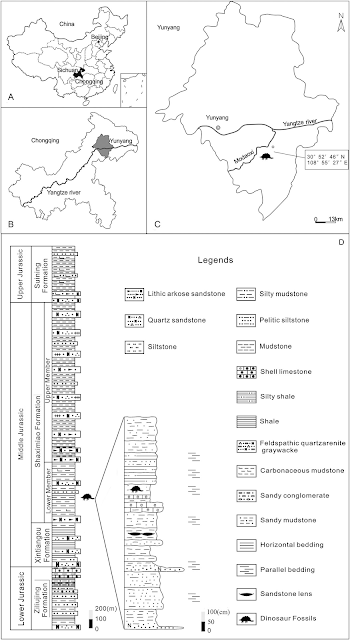
 
Maps showing the location where Bashanosaurus primitivus was recovered. (A) Sketch map of China showing the location of Chongqing Municipality. (B) sketch map of Yunyang County. (C) Sketch map of the fossil locality. (D) Stratigraphic chart with Lower Member of the Shaximiao Formation in Yunyang County, Chongqing Municipality, China. Dai et al. (2022).

The new species is named Bashanosaurus primitivus, where 'Bashanosaurus' is a combination of 'Bashan-', an ancient name for Chongqing, and '-saurus', meaning 'Lizard', a comon suffix for Dinosaur names, and 'primitivus' refers to the fact that a phylogenetic analysis revealed the species to be the most primitive member of the Stegosauria (that it is to say it is the earliest branching member of the group, with all other Stegosaurs being more closely related to one-another than they are to Bashanosaurus primitivus). The new species is described from three specimens, CLGPR V00006-1, V00006-2, and V00006-3, all from the 'wall' of Dinosaur specimens from the Dinosaur Quarry at Laojun Village.

 
(A) Photograph (top) and interpretative sketch (bottom) of Bashanosaurus primitivus (CLGPR V00006-1) on the west side of the Dinosaur Fossil Wall. (B) Photograph (top) and interpretative sketch (bottom) of Bashanosaurus primitivus (CLGPR V00006-2) in the middle of the Dinosaur Fossil Wall. Abbreviations: cav, caudal vertebra; co, coracoid; dv, dorsal vertebra; f, femur; fl, fibula; mt, metatarsal; pl, plate; r, rib; sc, scapula; sp, spine; t, tibia. Dai et al. (2022).

Specimen CLGPR V00006-1 is designated the holotype of the species (that is to say, any other specimen which is judged to be the same species as CLGPR V00006-1 is therefore considered to be a specimen of Bashanosaurus primitivus). This specimen is preserved on the west side of the wall of Dinosaur fossils and comprises one dorsal vertebra, two caudal vertebrae, right scapula, right coracoid, left femur, left tibia, left fibula, one metatarsal, three pieces of dermal armor (1 plate and 2 spines) and some ribs. Specimen CLGPR V00006-2 is preserved in the middle of the wall of Dinosaur fossils, and comprises five dorsal vertebrae, right tibia, right fibula, one piece of dermal plate, and some ribs. CLGPRV00006-3 is a dorsal vertebra from the east side of the wall of Dinosaur fossils.
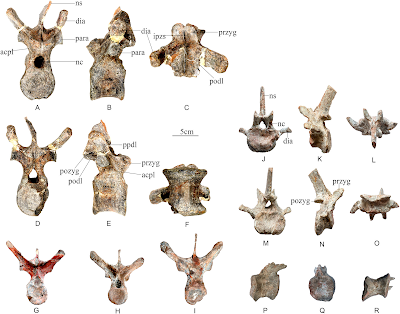
 
(A)–(F) Dorsal vertebrae referred to Bashanosaurus primitivus (CLGPR V00006-3) from the Middle Jurassic of China. (A) Anterior; (B) left lateral; (C) dorsal; (D) posterior; (E) right lateral; (F) ventral; (G) posterior views of dorsal vertebrae referred to Bashanosaurus primitivus (CLGPR V00006-1) from the Middle Jurassic of China. (H) Posterior view of dorsal vertebrae referred to Bashanosaurus primitivus (CLGPR V00006-2) from the Middle Jurassic of China. I, anterior view of dorsal vertebrae referred to Bashanosaurus primitivus (CLGPR V00006-2) from the Middle Jurassic of China. (J)–(O) anterior caudal vertebrae referred to Bashanosaurus primitivus (CLGPR V00006-1) from the Middle Jurassic of China. (J) anterior; (K) left lateral; (L) dorsal; (M) posterior; (N) right lateral; (O) ventral. (P)–(R) middle caudal vertebrae referred to Bashanosaurus primitivus (CLGPR V00006-1) from the Middle Jurassic of China. (P) right lateral; (Q) posterior; (R) ventral. Abbreviations: acpl, anterior centroparapophyseal lamina; dia, diapophysis; ipzs, intraprezygapophyseal shelf; nc, neural canal; ns, neural spine; para, parapophysis; podl, postzygodiapophyseal lamina; pozyg, postzygapophysis; ppdl, paradiapophyseal lamina; przyg, prezygapophysis. Dai et al. (2022).

Bashanosaurus primitivus shows a number of distinctive features not seen in any previously described Stegosaur. These include parapophyses of dorsal vertebrae, which are elevated on stalks at the base of the transverse process, the shape of the scapula blade, which is slender and flares distally, the acromial process of the scapula, which is small, triangular and poorly developed, the 4th trochanter of the femur, which is positioned below the middle of the shaft, and the bases of the dermal plates, which are strongly convex and transversely thickened, and are separated from the anterior/posterior margins of the plates by a distinct groove.

A fourth Stegosaur specimen, CLGPR V00006-4, was recovered from an exploratory trench, about 900 m away from the Dinosaur Fossil Wall. This specimen comprises a partial cranium, a dorsal vertebra, and a piece of dermal armour, which is not sufficient to assign it two species level, since two Stegosaur species have now been described from the Lower Member of the Shaximiao Formation, Bashanosaurus primitivus, and Huayangosaurus taibaii, which was described in 1984, from material from the Shaximiao Formation in of Sichuan Province. 

 
(A)–(F) Braincase referred to the Stegosauria but not to species level. (CLGPRV0005-4) from the Middle Jurassic of China. (A) Anterior; (B) left lateral; (C) right lateral; (D) posterior; (E) dorsal; (F) ventral. (G)–(L) Dorsal vertebrae referred to the Stegosauria but not to species level. (CLGPRV0005-4) from the Middle Jurassic of China. (G) Anterior; (H) left lateral; (I) dorsal; (J) posterior; (K) right lateral; (L) ventral. (M)–(R) Dermal armour referred to the Stegosauria but not to species level. (CLGPRV0005-4) from the Middle Jurassic of China. (M) Anterior; (N) posterior; (O) left lateral; (P) right lateral; (Q) dorsal; (R) ventral. Abbreviations: boc, basioccipital; bpt, basipterygoid process; bsp, basiphenoid; cc, carotid canal; c.n.I, III, V, VII, XII exit for cranial nerves; dia, diapophysis; f, frontal; fime, fissura metotica; fm, foramen magnum; fo, foramen ovale; ipzs, intraprezygapophyseal shelf; ist, integumentary structure; nc, neural canal; ns, neural spine; oc, occipital condyle; os, orbitosphenoid; p, parietal; para, parapophysis; poc, paroccipital process; pozyg, postzygapophysis; przyg, prezygapophysis; ps, parasphenoid; soc, supraoccipital; sf, supratemporal fossae; sq, squamosal. Dai et al. (2022).

A phylogenetic analysis, based upon a previous study of the group published by a team led by Sussanah Maidment in 2020, found that Bashanosaurus primitivus is the sister taxon to Chungkingosaurus jiangbeiensis, a Stegosaur from the Late Jurassic Upper Member of the Shaximiao Formation, and that together these two species form a sister group to all other Stegosaurs. 

 
A single most parsimonious tree recovered by the phylogenetic analysis. The numbers below the line are Bremer supports, the numbers above the line are GC frequencies. Ankylosauria was represented by three taxa, Gastonia, Euoplocephalus, and Sauropelta in the analysis, but these are shown here as a single terminal taxon for clarity. Dai et al. (2022).

Dai et al. also carried out a radiometric analysis of the deposits which produced Bashanosaurus primitivus, using thorium/uranium ratios in detrital zircons (uranium-thorium dating works because uranium decays to thorium at a known rate, so that the ratio of the two elements in minerals that naturally incorporate uranium but not thorium can be used to establish a date for the minerals).  This produced a range of ages, which would be expected from durable minerals in sedimentary rocks, but the youngest were dated to roughly 169 million years old, implying that the rocks of the Lower Member of the Shaximiao Formation were deposited no earlier than the Bajocian Stage of the Middle Jurassic. 

If the Lower Member of the Shaximiao Formation is Bajocian in origin, then that would make the Stegosaurs found within it, Bashanosaurus primitivus and Huayangosaurus taibaii, the oldest known Stegosaur speciemens. Since Huayangosaurus taibaii is the next branching clade within the Stegosauria after the clade that comprises Bashanosaurus primitivus and Chungkingosaurus jiangbeiensis, this strongly supports an Asian origin for the Stegosauria as a whole.

Dai et al.'s results suggest that the Lower Member of the Shaximiao Formation at Dinosaur Quarry at Laojun Village is Middle Jurassic in age. However, another recent study has suggested that the Lower Member of the Shaximiao Formation at Zigong in Sichuan Province should be dated to the Late Jurassic. Dai et al. suggest that this is because, in the Middle Jurassic, the centre of deposition within the Sichaun Basin (which contains the Shaximiao Formation) was in the northeast, shifted over time due to the rapid filling of the basin by material derived from the intracontinental subduction of the Qinling orogenic belt and Daba Mountains, with the upshot that the Shaximiao Formation may be laterally diachronous (that is to say of different ages across it's horizontal extent). If this is the case, then the rocks which produced Huayangosaurus taibaii may be younger than those which produced Bashanosaurus primitivus, even though they are part of the same member of the same formation.

Bashanosaurus primitivus is therefore the oldest known Stegosaur in Asia, and one of the oldest known Stegosaurs in the world, with geochronological data supporting a Bajocian age for the Lower Member of the Shaximiao Formation at Dinosaur Quarry. Bashanosaurus primitivus is also one of the earliest branching Stegosaurs phylogenetically, forming a clade with Chungkingosaurus jiangbeiensis that forms the sister group to all other Stegosaurs. This strongly supports the hypothesis that the Stegosauria as a whole had an Asian origin.

See also...


Online courses in Palaeontology. 

Follow Sciency Thoughts on Facebook.

Follow Sciency Thoughts on Twitter.


Thursday, 24 October 2019

Stegosaurs from the Late Jurassic Morrison Formation of Montana.

The Stegosauria is a group of Ornithischian (Bird-hipped) Dinosaurs that is characterised by the possession of a series of plates and spikes that extend from the neck to the tail in two parasagittal rows. The best known genus of the group, Stegosaurus, is from the Upper Jurassic of the western USA, but members of the group are known from all continents except for Antarctica and Australia, and their temporal range extends from the Middle Jurassic to the late Early Cretaceous. Despite the iconic status of Stegosaurs among Dinosauria, they are poorly known as fossils, with most genera being known from single partial skeletons and/ or fragmentary remains. Consequently, they have received relatively little attention, and much remains unknown about their palaeobiology.

In a paper published in the journal Acta Palaeontologica Polonica on 5 August 2019, Cary Woodruff of the Great Plains Dinosaur Museum and Field Station, the Department of Ecology and Evolutionary Biology at the University of Toronto, and the Royal Ontario Museum, David Trexler of the Two Medicine Dinosaur Center, and Susannah Maidment of the Department of Earth Sciences at the Natural History Museum, describe two sets of Stegosaur remains from the Late Jurassic Morrison Formation of Montana, an area further north than any that have previously produced described Stegosaur remains.

The Upper Jurassic Morrison Formation of the western United States comprises the deposits of rivers and floodplains that were laid down in a broad shallow basin over about 10 million years in the Kimmeridgian (157.3-152.1 million years ago and Tithonian (152.1-145.0 million years ago). The deposits host a diverse and well-preserved Dinosaurian fauna that includes such well-known taxa as Apatosaurus, Diplodocus, and Stegosaurus. The Dinosaurs of the southern part of the Morrison Basin, from Colorado, Utah, and southern Wyoming, have been intensively studied for about 150 years, but those from northern outcrops in northern Wyoming and Montana are much less exploited. An increasing body of evidence suggests that northern Morrison faunas were somewhat different to their southern counterparts but further exploration in this part of the basin is needed.

The first specimen described by Woodruff et al., GPDM 205, was collected in 2004 by the Judith River Dinosaur Institute from the 5E Ranch, owned by the Hein family, in the Little Snowy Mountains of Fergus County, Montana. The specimen is now housed at the Great Plains Dinosaur Museum in partnership with the Judith River Foundation. GPDM 205 was collected in close proximity to Camarasaurus sp. specimen GPDM 220. Unfortunately, neither field notebooks nor quarry maps exist for the excavation of this specimen, so Woodruff et al. do not possess any documentation regarding taphonomy. However, Susanneh Maidment visited the 5E Ranch quarry in 2005 and was told by the excavation crew that the specimen was found disarticulated, and stratigraphically above the Camarasaurus remains. 

The material assigned to GPDM 205 comprises a prepared humerus, ulna, and radius, plus an unprepared coracoid, fragmentary scapula, humerus, and ulna. During the 2005 field season, at the time of Susanneh Maidment’s visit, a carpal and some poorly preserved dermal plates from this specimen were also recovered. Several other Stegosaur specimens were discovered during the 2005 field season at the 5E Ranch quarry, and were excavated over subsequent years. These specimens currently reside in a private collection, and thus are unavailable for study.

Left humerus of Stegosaur GPDM 205 from the 5E Ranch, Little Snowy Mountains, Fergus County, Montana, USA; in anterior (A₁), posterior (A₂), lateral (A₃), medial (A₄), dorsal (A₅), and ventral (A₆) views. Woodruff et al. (2019).

The second specimen, GPDM 178, was collected in 2003 and 2004 by the Judith River Dinosaur Institute near the town of Giffen, Cascade County, Montana, on land belonging to the Yurek family. Elements were initially found eroding out of a hill adjacent to the Yurek’s house. The distal end of the right tibia was the first element recovered, and it was not immediately recognised as a fossil. For a period of time, this 'black rock'  served as a door stop until construction of a pole barn on the hill started, and further elements were discovered below the surface. At this time the Yurek family contacted the Judith River Dinosaur Institute, and the excavation commenced. The specimen is now housed at the Great Plains Dinosaur Museum in partnership with the Judith River Foundation 

 Partial right tibia of Stegosaur GPDM 178, near Giffen, Cascade County, Montana; in medial (A₁, A₆), lateral (A₂, A₇), anterior (A₃, A₅), dorsal (A₄), and ventral (A₈) views. (A₁)–(A₄) proximal end, (A₅)–(A₈), distal end. Woodruff et al. (2019).

GPDM 178 consists of a partial skeleton including both crania and post-crania. Several field jackets that are labelled as dorsal ribs or vertebrae await preparation. Only those elements prepared to-date are described, though the skeletal reconstruction for this specimen includes all elements collected as recorded in the quarry log.

Skeletal reconstruction of the stegosaurs GPDM 178 (A) and GPDM 205 (B) scaled together based on humeral lengths. Black, elements preserved in each specimen; gray, missing elements. Human scale is the Artemision Bronze featuring the deity of Zeus as 1.83 m in height. Woodruff et al. (2019).

Three genera of Stegosaur have previously been described from the Morrison Formation, Alcovasaurus, Hesperosaurus, and Stegosaurus, though unfortunately neither of the Montana specimens is complete enough to assign them to a specific genus, as useful diagnostic features are not preserved.

The specimens GPDM 178 and 205 represent the northernmost Stegosaurs found to-date, and GPDM 178 is the northernmost Dinosaur fossil thus far recovered from the entire Morrison Formation. Interestingly, according to a Works Progress Administration report from 1938, a 'Stegosaurus' was found at Sheep Creek, 25 miles north of Great Falls, Montana. If true, then this specimen is the northernmost Morrison Formation dinosaur, as GPDM 178 was found near equivalent distance southeast of Great Falls, Montana. Unfortunately, this report does not mention what material was collected or where it was sent. Searching for this material in Montana institutions with historic palaeontological collections and the National Museum of Natural History has yielded no results. Therefore Woodruff et al. believe that these remains, if true, have subsequently been lost or discarded. Thus by default, GPDM 178 is the northernmost record of the Stegosauria.

(A) Map of the USA with indicated the state of Montana, were the Stegosaur specimens GPDM 178 and GPDM 205 were found. (B) Map of Montana with the extent of the Morrison Formation in green, and the general locations of GPDM 178 and GPDM 205 indicated by the Stegosaurus skull silhouettes. Woodruff et al. (2019).

See also...

https://sciencythoughts.blogspot.com/2019/04/cricosaurus-bambergensis-new-species-of.htmlhttps://sciencythoughts.blogspot.com/2018/10/piranhamesodon-pinnatomus-piranha-like.html
https://sciencythoughts.blogspot.com/2018/10/maraapunisaurus-fragillimus-edward.htmlhttps://sciencythoughts.blogspot.com/2018/10/evidence-of-giant-theropods-from-late.html
https://sciencythoughts.blogspot.com/2018/01/vadasaurus-herzogi-new-species-of.htmlhttps://sciencythoughts.blogspot.com/2017/12/ostromia-crassipes-second-species-of.html
Follow Sciency Thoughts on Facebook.