Showing posts with label Corals. Show all posts

Friday, 22 July 2022

Swiftia phaeton: A new species of deepwater Octocoral from the coast of Mauritania.

Despite being relatively close to the numerous oceanological research institutes of western Europe, the deep waters off northwest coast of Africa have been relatively underexplored compared to those of many other regions of the world. The coast of Mauritania is known to be home to home to the world's largest Coral mound barrier, and their are extensive Coral colonies occupying the marine canyons off the Mauritanian coast, both fuelled by nutrient-rich upwellings from the deep Atlantic ocean along this section of coast.

In a paper published in the journal ZooKeys on 17 June 2022, Íris Sampaio of the Marine Research Department at Senckenberg am Meer, and the University of the Azores, and Lydia Beuck and André Freiwald, also of the Marine Research Department at Senckenberg am Meer, describe a new species of deepwater Octocoral from the coast of Mauritania.

The new species is placed in the genus Swiftia, and given the specific name phaeton, in reference to the PHAETON mission of the Research Vessel Maria S. Merian, which visited the coast of Mauritania, and recovered the first specimens of the species. The Greek Demigod Phaeton (or Phaëthon), is also linked to the region. A son of the Sun-god Apollo, he is supposed to have crashed his father's chariot into the Sahara Desert, burning the Earth and making the area uninhabitable. 

Swiftia phaeton forms simple colonies, either unbranching or with one or two divisions. The colonies are bright red in colour, with polyps densely packed on the branches. Tentacles are yellowish white.

Swiftia phaeton from Mauritania. (A) In situ colony with expanded polyps on coral framework. (B) Colony after ethanol preservation with expanded polyps (holotype SMF 13112). (C) In situ colony with retracted polyps on coral framework. (D) Part of a branch (paratype SMF 13113). (E) Fragment of specimen with anthocodiae slightly expanded (paratype SaM-ID 1566). (F) Polyp and coenenchyme details (paratype SaM-ID 1352). Scale bars are 1 cm (A)–(C) or 300 µm (D)–(F). (A) & (C) Tomas Lundälv/Sven Lovén Center for Marine Infrastructure in Sampaio et al. (2022), (B), (D)-(F) Sampaio et al. (2022).

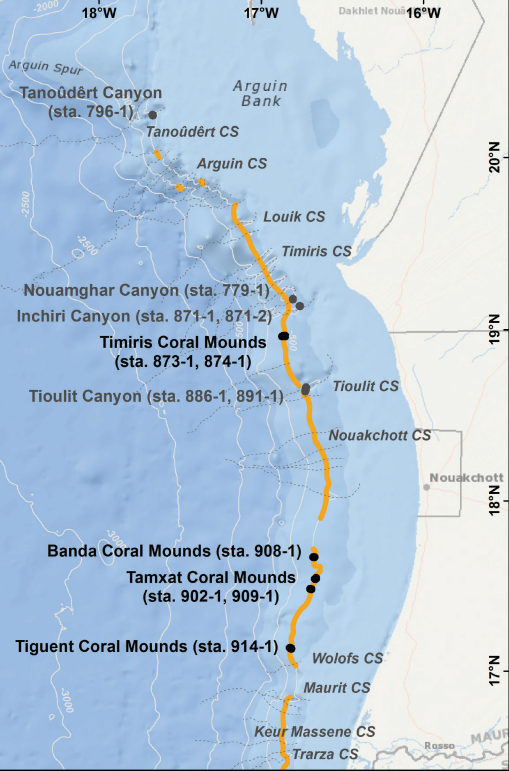
Swiftia phaeton was found living in Tanoûdêrt Canyon at a depth of 595 m, on the Timiris Mounds at depths of 446-602 m, in the Tioulit Canyon at a depth of 618 m, in the Southern Tamxat Mound Complex at a depth of 450 m, and on the Central Tamxat Mound Complex at a depth of 486 m.

Map showing MSM 16/3 ‘PHAETON’ ROV dive locations along the Mauritanian slope. Location names and GeoB 14 stations (sta.): grey, canyons; black, Coral mounds; orange, Scleractinian distributions. Sampaio et al. (2022).

See also...

Follow Sciency Thoughts on Facebook.

Follow Sciency Thoughts on Twitter.


Wednesday, 9 December 2020

Terpios hoshinota: Killer Sponge found to be invading the Coral Reefs of the Lakshadweep Archipelago.

Coral killing Sponges have the potential to overgrow live Corals, eventually killing the Coral polyps, and thus leading to an epidemic. The Cyanobacteria-symbiotic Sponge, Terpios hoshinota, also known as the Black Disease, was first reported from Guam in 1973, and later described from the coral reefs of the Ryukyu archipelago (Japan). It is identified by its gray to blackish encrustations. Since its first occurrence, it has been observed in several coral reef localities around the globe, viz., the Great Barrier Reef, Papua New Guinea, Taiwan, Philippines, Indonesia, South China Sea, Thailand, Palk Bay and the Gulf of Mannar on the southern tip of India, Maldives, and Mauritius.

In a paper published in the Journal of Threatened Taxa on 26 October 2020, Rocktim Ramen Das of the National Centre for Sustainable Coastal Management Forest and Climate Change in Chennai, Tamil Nadu, and the Graduate School of Engineering and Science at the University of the Ryukyus, and Chemmencheri Ramakrishnan Sreeraj, Gopi Mohan, Kottarathil Rajendran Abhilash, Vijay Kumar Deepak Samuel, Purvaja Ramachandran, and Ramesh Ramachandran, also of the National Centre for Sustainable Coastal Management, confirm that the species has further extended its habitat into the pristine atolls of the Lakshadweep Archipelago in the Arabian Sea, and requires urgent attention.

 
Bangaram & Thinnakara atoll (Inset, red star). Das et al. (2020).

During the coral reef surveys conducted at Lakshadweep in November 2016, Terpios hoshinota was observed overgrowing on several colonies of Acropora muricata, Isopora palifera, Cyphastrea sp., Dipsastraea lizardensis and Porites lutea in the atoll encircling Bangaram and Thinnakara Islands. Out of 34 sites surveyed, six exhibited the presence of Terpios hoshinota. The Coral colonies on the atoll were patchy and the depth of the atoll varied between 2 and 12 meters. As depth increased, (i.e. deeper than 5 m) large boulder Corals were observed whereas the shallow regions (shallower than 5 m) had greater Coral diversity. Certain areas consisting of large Acropora beds, rocks, rubbles, and dead reef were also observed. The affected Corals displayed grayish/blackish encrustations of Terpios hoshinota forming a mat-like layer on live Corals taking the shape of the Coral in all cases. The osculum in the Sponge, a primary character with a radiating network of canals, was clearly visible and the thickness of the mat was less than 1mm. It was observed that the encrusting Sponges were propagating laterally and infecting the other live Coral colonies. Other associated communities such as Ascidians and Clams remain unaffected; calcareous Serpulid tubes were overgrown by the Terpios, although the Animal was unharmed. Furthermore, in some colonies along with Terpios hoshinota, Algal presence was noted, but the Sponge was absent in the colonies which were completely covered with Turf Algae. Environmental parameters assessed with a multiparameter water quality probe revealed that the area was unpolluted with an optimum level of dissolved oxygen (5.04-8.21 mg per litre), and low turbidity (0.3 to 0.8 Nephelometric Turbidity Units). Sea surface temperature during the survey was 28.2°-30.1°C. It is important to note that, Bangaram and Thinnakara is one of the few atolls in Lakshadweep where tourism is permitted, as a result, limited amounts of diving and other water-related recreational activities can be seen in the area.

 
(A) Encrustations of Terpios hoshinota on Acropora muricata, (A1) erpios hoshinota exhibiting osculum with radiating networks. (B) Encrustation on Isopora palifera, (B1) Terpios hoshinota mat, (B2) Bleached ring, (B3) Live Coral. (C) Terpios hoshinota taking shape of a Coral (Cyphastrea sp.). (D) Terpios hoshinota overgrowing calcareous serpulid tubes, (D1) Animal unaffected. Das et al. (2020).

Previous studies suspected that the outbreak of Terpios hoshinota is related to increased water turbidity or due to high anthropogenic stress/pollution its close proximity to mainland, as reported in the south eastern reefs of India (about 800 km from Lakshadweep), Guam, and in Green Island, Taiwan. A similar conclusion, however, cannot be applied in the case of Lakshadweep because of its isolated geography and with comparatively less anthropogenic activities. As a result, Das et al.'s observation contradicts this hypothesis and is more in line with the findings of Qi Shi, Gou Hui Liu, Hong Qiang Yan, and Hui Ling Zhang, who observed Terpios hoshinota outbreak in unpolluted areas of Yongxing Island (South China Sea), highlighting the difficulty in establishing a negative co-relationship between water quality and Black Disease outbreak. In terms of host selectivity, the Killer Sponge has affected several Coral species in different parts of the world and in the reefs of Palk Bay, it has affected all genera surveyed. In Vaan Island, Gulf of Mannar, the dominant genus Montipora was the most susceptible. Das et al.'s observation though could not reveal any specific host coral selectivity, Das et al. speculate that the dense branching Acropora Coral beds in site 3, 5 and 6 were more easily overgrown because the Killer Sponge prefers branching Corals as reported from Mauritius. Das et al. further conclude that the Coral composition in any specific location may play an important role in determining its host.

 
Acropora colonies (Site 3): (A) (A1) Terpios hoshinota (A2) Algae. (B) Acropora colonies (Site 5) completely over grown by Turf Algae, Killer Sponge/Black Disease absent. Das et al. (2020).

Terpios hoshinota is a belligerent contender for space and is known to overgrow corals from its base where it interacts with Turf Algae. Branching Acropora beds in site 3, 5 and 6 consisted both Algae (e.g. Dictyota sp.) and the Killer Sponge. Additionally, a massive Turf Algae which covered area of about 0.35 km in the Terpios hoshinota occurrence site highlights a complex ecological scenario. Such complex interactions between Sponges, Corals and Algae can be only understood through long term monitoring. Manuel González-Rivero, Laith Yakob, and Peter Mumby stated that Sponges can act as a potential group that can facilitate and influence Coral-Algal shifts by acting as a 'third antagonist' as observed in Glover’s atoll (Belize).

Based on their knowledge of the life history of Terpios hoshinota Das et al. hypothesize site 5/6 scenario as follows: (1) Terpios hoshinota invades and overgrows the Acropora beds (2) The Coral dies which is followed by the death of the Killer Sponge (3) Turf Algae takes over. Moreover, reports of Turf Algae being a dominant component in the atolls might indicate a faster transition. Globally Elevated sea surface temperature is a major threat to Coral Reefs, and the reefs of India, including the atolls, are no different. With reports indicating that elevated sea surface temperature has already depleted the Coral ecosystem of Lakshadweep, which was evident during 1998, 2010, and 2016, mass bleaching events, it can provide an opportunity for Sponges to invade. The dynamics of waterflow may also play a crucial role in this regard.

Das et al.'s findings confirm that the infestation of Terpios hoshinota on the coral colonies of Lakshadweep is currently limited to only Bangaram and Thinnakara as it was not observed in the other atolls surveyed. Although there is a possibility that the Killer Sponge could invade nearby atolls as seen in other regions, large-scale damage cannot be concluded at this stage. This is in fact the first documentation of Terpios hoshinota on the reefs of Lakshadweep and can be regarded as a baseline for subsequent studies. Further, to protect the reefs of Lakshadweep, a long term Coral health monitoring program is required which will allow us to understand the nature of occurrence, distribution, the impact and the causative factors of the Killer Sponge and to understand it’s larger threat to the reefs. Black Disease along with other Coral associated diseases needs enlarged emphasis according to which various Coral Reef management plans can be initiated.

See also...


Follow Sciency Thoughts on Facebook.

Follow Sciency Thoughts on Twitter


Monday, 3 August 2020

The Ba Moussa West Coral fauna, a new Early Carbiniferous Coral assemblage from central Morocco.

Mississippian rocks are common in the Moroccan Meseta. They have been studied and described by French geologists since the beginning of the twentieth century. The Mississippian stratigraphic successions are clearly different in the western and in the eastern parts of the Meseta. The succession was considered quite continuous from the Devonian to the Serpukhovian. However, sedimentation in the eastern part of the central Meseta (Azrou-Khenifra Basin) is more complicated. It took place in both a shallow-water carbonate platform and a deeper water flysch basin, within a tectonically active setting, involving movements of blocks, and transgressions and regressions that produced some gaps and unconformities. Sedimentation during the Tournaisian, early and mid Visean in the basin is regarded as being absent by some authors, whereas continuous or sporadic sedimentation during that time interval is suggested by others.

In a paper published in the Journal of Palaeogeography on 11 February 2020, Sergio Rodríguez of the Universidad Complutense de Madrid and the Instituto de Geociencias at the Consejo Superior de Investigaciones Científicas, Ian Somerville of the School of Earth Sciences at University College Dublin, Pedro Cózar, also of the Instituto de Geociencias at the Consejo Superior de Investigaciones Científicas, Javier Sanz-López of the Departmento de Geología at the Universidad de Oviedo, Ismael Coronado of the Institute of Paleobiology, Felipe González of the Departmento de Ciencias de la Tierra at the Universidad de Huelva, Ismail Said, also of the Universidad Complutense de Madrid, and Mohamed El Houicha of the Laboratoire de Géodynamique et Géomatique at the Université Chouaïb Doukkali, report the recent discovery of a relatively rich Mississippian (early Visean) Coral fauna in the southern part of the Azrou-Khenifra Basin, describe the Corals in detail and their host limestone rocks, and comment on their comparison and affinity with other coeval Coral assemblages in North Africa, Europe and southwest Asia. The microfossil content was also studied to enhance the biostratigraphic discussion and significance of the Coral fauna.

The beginning of Carboniferous sedimentation in the Khenifra region, which lies in the southern part of the Azrou-Khenifra Basin and contains the largest Mississippian outcrops in the eastern central Meseta, is usually considered to occur within the widely known late Visean transgression. However, two early Visean transgressions have been cited. The first one is imprecisely located as “to the north of Ba Moussa (point 1)”. The second one was equated with the base of V2b of mid Visean age.

In the southwestern margin of the Azrou-Khenifra Basin at Sidi Lamine and Tabainout, a thick shallow-water carbonate succession with basal Mississippian conglomerate and sandy limestone can be seen to rest unconformably on older (Ordovician) tilted siltstones and sandstones. A similar relationship is seen at the southeastern margin of the basin at Tiouinine where shallow water sandy limestones rest unconformably on red Ordovician sandstones.

(a) Location of Khenifra in central Morocco; (b) Geological map of Azrou-Khenifra Basin with Ba Moussa West coral fauna locality and other Coral localities mentioned in the text; (c) Simplified geological sketch map of Ba Moussa West area and the location of the studied limestone horizons BMW1 and BMW2. hV-Fm1, Lower Visean; hV-Fm2, Upper Visean. Rodríguez et al. (2020).

The eastern part of the Azrou-Khenifra Basin, northwest of Khenifra, is a region of mostly deep-water rythmic mudstones. However, recent field investigations at Ba Moussa West, northwest of a nappe folded as a north-south trending syncline, and approximately 3 km northwest of Khenifra city margins, have discovered two pale gray weathering limestone units within a thick dark gray siltstone and shale rhythmic succession. These limestones contain abundant corals that form the focus of this paper. The limestone units form two distinct parallel ridges, some 50m apart, and traceable laterally for over 200 m. They form prominent features on the landscape, compared to the subdued topography of the more easily eroded mudstones which encase the limestones. The beds dip steeply to the east (70°) and in places can be vertical. The two ridges expose respectively, 4.90m and 4.10m thicknesses of well-bedded limestones (with beds ranging typically from 10 to 40 cm thick) with thin dark gray shale interbeds.

(a) View looking south of limestone ridge (BMW1) about 5 m thick showing steeply dipping beds overlain and underlain by softer shales; (b) Limestone bed with large angular quartzite and sandstone lithoclasts (beside coin) succeeded by thin laminated sandy limestone and black shales, in turn overlain by bioclastic limestone rich in Corals; solitary Rugose Coral Siphonophyllia (black arrows) and Cerioid Tabulate Coral Turnacipora (white arrow), coin diameter is 2.5 cm; (c) Close-up view of richly bioclastic limestone bed with sharp base, showing abundant transverse sections of Siphonophyllia and Sychnoelasma (black arrows), hammer length is 40 cm; (d) Coarse-grained crinoidal limestone with longitudinal and transverse sections of Siphonophyllia khenifrense; (e) Thin section of rudstone at BMW1 showing bioclasts and lithoclasts. Abbreviations: br, brachiopod; bz, bryozoan; co, coral; cr, crinoid; gr, gastropod; st, sandstone; (f) Thin section of rudstone at BMW2 showing bioclasts and lithoclasts. Abbreviations: br, brachiopod; co, coral; cr, crinoid; sl, siltstone; st, sandstone. Rodríguez et al. (2020).

The limestones are variable in composition and texture, comprising coarse-grained, bioclastic and lithoclastic calcirudites, rich in crinoids, thick-shelled Brachiopods and relatively abundant Corals. The limestone beds consist of numerous sedimentary events. Some have sharp, erosive bases and show grading with laminated tops. Large angular lithoclasts of sandstone and siltstone (up to 20 cm in diameter) occur in some beds. Other limestones are buff weathered, fine-grained, laminated calcarenites. Under the petrological microscope two microfacies are differentiated. The first microfacies, which is less common, is a laminated Crinoidal wackestone-packstone containing small fragments of Crinoidal plates, Corals and Bryozoans. The second one, which is dominant, is a polymictic rudstone with fragmented Corals, Crinoids, Bryozoans, Brachiopods, Trilobites, Gastropods, Bivalves, Foraminifers and angular to subangular grains of quartzite sandstone and siltstone. The disposition of siliciclastic clasts and bioclasts is random in some beds, suggesting rapid sedimentation, but in some beds, most clasts are disposed mainly parallel to the stratification. The fragmentation of bioclasts is also variable.

The limestones can be regarded as proximal debris flow and multistorey high-density turbidite bodies, with numerous event beds, deposited in a prevailing succession of distal turbidite beds. Thus, the coral assemblage is allochthonous and may have been transported far from its original depositional shelf setting.

The two limestone horizons (BMW1 and BMW2) were sampled and corals were collected. Samples from BMW1 contain almost entire Brachiopods and Corals, whereas in BMW2 most bioclasts are completely broken and very few Coral specimens are identifiable at generic or specific level. The coral assemblage is relatively rich, but their diversity is quite low (5 genera and 7 species). The assemblage comprises solitary Rugose Corals and Tabulate colonies. Many corals are well preserved and nearly complete, missing only the apexes and showing sometimes compressed calices when they show few skeletal elements and are filled with muddy sediment. However, others are completely fragmented or crushed or have lost much of their dissepimentaria. Fifty specimens were collected, of which 38 have been definitively identified.

Thin sections of samples were studied to describe the microfossil content. Owing to the brecciated character of many beds, including boulders of large size, only the fine-grained limestones yield Foraminifers. Assemblages are relatively abundant in those fine-grained limestones, although specimens are commonly crushed, and diversity is limited to a few genera. Assemblages from BMW1 are slightly richer than BMW2, although this may be the result of more intense sampling and sectioning.

A large sample from limestone BMW1 (3.8 kg weight) was etched with 8%–10% buffered formic acid solution, following the standard technique to avoid damaging. The low abundance of Conodont elements includes one complete P1 element and six broken elements with upper surface damaged and a few with surface dissolution, which could be in relation to significant transport and resedimentation of elements. The colour of Conodonts shows values of 4.5 to 5 for the alteration index. Reworking of Conodonts may be causing a higher colour alteration index value, but small recrystallised apatite surface is observed in Conodonts. Some specimens preserve a smooth surface, but etched surfaces with pits are often discerned. It suggests short heating on proximity to an igneous intrusion.

Conodonts from samples of BMW1. (a)–(b) Fragment of element of Kladognathus sp., DGO 15624, and detail of the face where breakage shows a lamellar inner structure and small apatite crystal 2–3 μm in size interpreted as recystallized and, later, slight dissolution; (c)–(e) Aboral and oral views of Mestognathus cf. beckmanni, DGO 15625, and detail of the margin of the platform with a strong dissolution located on the ornamentation of ridges and carina causing the inversion of surface relief; (f) Oral view of Polygnathus lobatus with pits due to dissolution of the Conodont surface, DGO 15622; (g) Gnathodus pseudosemiglaber, DGO 15623; (h)–(i) Oral and aboral views of Polygnathus inornatus, DGO 15621. Conodonts are stored in the Museum of Geology of the University of Oviedo. Rodríguez et al. (2020).

The allochthonous shales embedding the limestone horizons were sampled for palynomorphs. A total of 12 shale samples were crushed and dissolved following the classical extraction techniques. After complete removal of carbonate and silicate minerals, the organic remains were oxidized with Fuming Schulze solution and mounted in slides for microscope analysis. Palynomorphs recovered from shales are dominated by phytoclasts and, in minor proportions, by spores, whereas organic-walled marine microphytoplankton and amorphous organic matter are virtually absent. The reduced number of spores and their irregular state of preservation precluded further taxonomic identification. The large proportion of equidimensional to lath-shaped phytoclasts and the absence of marine components may be explained by the intense reworking and effective dilution associated to low-density turbidity currents. The brownish-black to black colour of spores and phytoclasts points to a thermal alteration index which essentially agrees with the colour alteration index values observed for conodonts from the limestone sample.

The Coral assemblage from Ba Moussa West contains a new species of Siphonophyllia, with other solitary Rugose Corals, such as Sychnoelasma urbanowitschi, Cravenia lamellata, Cravenia tela, and Cravenia rhytoides. Colonial Tabulate Corals recorded include Turnacipora megastoma, and Pleurosiphonella crustosa. Themost abundant specimens collected belong to the genus Siphonophyllia (20) and Turnacipora (7). Most other species are represented only by three specimens or less.

The assemblage is similar to that described from lower Visean (Arundian) Moel Hiraddug Formation in North Wales, UK. In both regions the large Siphonophylliid Corals represent the dominant component in dark gray bioclastic limestone and shale lithofacies, in which colonial Rugose Corals are absent. However, the Ba Moussa succession has a lower diversity Coral assemblage and the specimens are not as well preserved. This may be explained by the sedimentological setting at Ba Moussa, with the Corals occurring in graded limestone beds containing large exotic clasts, interpreted as debris flow and proximal turbidite deposits.

The stratigraphic range of Sychnoelasma urbanowitschi, and the three species of Cravenia (Cravenia lamellata, Cravenia tela, and Cravenia rhytoides) is very restricted, typically diagnostic of the early Visean throughout Western Europe. Turnacipora megastoma occurs also, typically in the early Visean.

The Ba Moussa West assemblage has similarities with Tafilalt in Eastern Morocco, where a richer early Visean solitary Rugose assemblage is recorded including Cravenia, Siphonophyllia and Sychnoelasma, but where colonial Rugose genera are also absent. Similar assemblages containing dominant Cyathopsids plus Sychnoelasma, Pleurosiphonella and Micheliniids have been reported in Canada and United States, and in Mid-Asia.

The Ba Moussa limestone beds are clearly older than other Mississippian sections in the Khenifra area, as confirmed by the associated Foraminifers and Conodonts. Coral assemblages from Tabainout and Sidi Lamine, 20 km and 30 km respectively, further west of Ba Moussa West, at the western margin of the Azrou-Khenifra Basin, contain fasciculate and massive colonial Rugose Coral genera (Siphonodendron and Lithostrotion) of late Visean (Asbian) age. Both sections have basal transgressive deposits with in situ shallow-water limestones containing ooids and Calcareous Algae. At Tiouinine, 8 km southeast of Khenifra on the eastern margin of the basin, very rich and diverse late Visean (Brigantian) Coral assemblages form a reefal tract. The early Visean age of the Ba Moussa West limestone correlates with the early Visean age of the transgressive point 1, located to the north of Ba Moussa.

The assemblage in samples from BMW1 contains the Foraminifers Earlandia vulgaris, Earlandia elegans, Endothyra spp., Endothyra similis, Endolaxina sp., Endothyranopsis (Eosinopsis) sp., Eosparastaffella sp., Eosparastaffella concinna, Eosparastaffella evoluta, Eosparastaffella interiecta, Eosparastaffella macdermoti, Eosparastaffella aff. macdermoti, Eosparastaffella ovalis, Eosparastaffella simplex, Eosparastaffella tumida subsp. 1, Eosparastaffella vdovenkoae, Eotextularia diversa, Granuliferella sp., Globoendothyra sp., Lapparentidiscus sp.,? Lituotubella sp., Mediocris mediocris, Mediocris ovalis, Mediocris aff. ovalis, Omphalotis sp., Pseudoplanoendothyra sp., Septabrunsiina sp., Septaglomospiranella sp., Spinobrunsiina sp., Spinolaxina sp., Tetrataxis sp. and Urbanella (Brenckleites) fragilis. The Algospongia recorded are very common Kamaena delicata and Palaeoberesella lahoseni, as well as Stacheoides spissa and Exvotarisella sp.

(a) Eotextularia diversa, BMW1, Pc4367; (b) Latiendothyranopsis sp., BMW2; (c) Omphalotis sp., BMW1, Pc4364; (d) Eoparastaffella tumida, BMW1, Pc4364. (e) Granuliferella sp., BMW1, Pc4364; (f) Mediocris aff. ovalis, BMW1, Pc4366; (g) Eoparastaffella simplex, BMW1, Pc4366; (h) Eoparastaffella ex gr. simplex (Eoparastaffella tumida subsp. 1), BMW1, Pc4367; (i) Eoparastaffella aff. concinna, BMW1, Pc4365; (j) Eoparastaffella evoluta, BMW2; (k) Eoparastaffella vdovenkoae, BMW1, Pc4366; (l) Eoparastaffella macdermoti, BMW1, Pc4364; (m) Eoparastaffella ovalis, BMW1, Pc4367; (n) Endolaxina sp., BMW1, Pc4367; (o) Pseudoplanoendothyra sp., BMW1, Pc4364; (p) Endothyranopsis (Eosynopsis) sp., BMW1, Pc4364. Scale bar same for all figures. Rodríguez et al. (2020).

The assemblage is characterized by a high diversity in Eoparastaffella species, and in particular, the first species with pointed periphery in the last whorl, Eoparastaffella tumida subsp. 1 and Eoparastaffella ex gr. simplex. Although the marker for the base of the MFZ9, as well as the marker for the base of the Visean, Eoparastaffella tumida subsp. 1 is derived from Eoparastaffella simplex from the basal levels of the MFZ9, and thus, the assemblages can be attributed to the base of the Visean. It is noteworthy for the occurrence of Eoparastaffella concinna and Eoparastaffella evoluta, also derived from Eoparastaffella simplex in more advances stages of the MFZ9.

The foraminiferal assemblage recorded in BMW2 is composed of Earlandia minor, Earlandia vulgaris, Endothyra spp., Endothyra ex gr. bowmani, Endothyra prisca, Endothyra similis, Eotextularia diversa, 'Glomospira' sp., Eoparastaffella sp., Eoparastaffella concinna, Eoparastaffella interiecta, Eoparastaffella macdermoti, Eoparastaffella simplex, Eoparastaffella tumida subsp. 1, Eoparastaffella vdovenkoae, Mediocris mediocris, Latiendothyranopsis sp., Omphalotis sp., Plectogyranopsis sp., and Pseudoplanoendothyra sp. This assemblage also contains the pointed and slender Eoparastaffella, including Eoparastaffella. concinna, which is a more evolved form than the ancestral stock of pointed Eoparastaffella. In consequence, the assemblage is also assigned to an advanced stage in the MFZ9. The Algospongia recorded in those levels contain Palaeoberesella lahoseni, Kamaena delicata, Issinella sp., and Exvotarisella sp.

The Conodont fauna studied in samples from BMW1 includes Polygnathus inornatus, Polygnathus lobatus (that is usually related with the first species), and a fragment of Polygnathus sp. These taxa were usually described in the early to mid Tournaisian SiphonodellaPolygnathus inornatus Assemblage Zone in the British Isles. However, it has been indicated that Polygnathus inornatus ranged up to the upper Tournaisian Gnathodus typicus Conodont Zone in Cornwall (UK). Polygnathus inornatus have been reported in the upper Tournaisian Scaliognathus anchoralis Zone of the Moravia-Silesia and the Dinant-Namur basins, and in the earliest Visean, just at the first occurrence of Pseudognathodus homopunctatus in the Belgian area. A late Tournaisian to early Visean age is supported by the occurrences of one P1 element of Gnathodus pseudosemiglaber, one P1 fragment of Mestognathus sp. and one P2 element probably corresponding to Kladognathus sp. The fragment of Mestognathus sp. shows dissolution of the carina and ornamentation of the platform, and the blade and the dorsal part of the platform are broken. The parapet area is close to that described in Mestognathus praebeckmanni. The secondary keel seems to be formed with a basal groove, as in Mestognathus beckmanni, but the specimen is broken. The first occurrence of Mestognathus beckmanni was indicated just below the lower boundary of the Visean Stage at the Global Boundary Stratotype Section in the Pengchong section, South China and in a few localities of Western Europe, although it is often recorded in Visean beds. The early Visean Pseudognathodus homopunctatus species is lacking in Rodríguez et al.'s sample.

The new species of Siphonophyllia is named Siphonophyllia khenifrense, which refers to the town of Khenifra within the Azrou-Khenifra Basin in Morocco. Seventeen whole specimens were recovered, all from Ba Moussa West, as well as 29 transverse sections and 15 longitudinal sections.

The whole specimens are cylindrical Corallites between 20 mm and 40 mm in alar diameter and recorded fragments are up to 20 cm long, often without calice. The dissepimentarium is often abraded. The outer wall is thin.

Siphonophyllia khenifrense. (a)–(c) Holotype DPM BMW1-1: (a) DPM BMW1-1A, transverse section., (b) DPM BMW1-1B, transverse section., (c) longitudinal sections; (d)–(e) DPM BMW1-6: (d) transverse section, (e) longitudinal sections; (f)–(g) DPM BMW1-20: (f) longitudinal sections, (g) transverse section.; (h) DPM BMW2-16, transverse section; (i) DPM BMW2-4, transverse section; (j) Wall microstructure in Siphonophyllia khenifrense, DPM BMW1-1, L, Lamellae; (k) Septal microstructure in Siphonophyllia khenifrense, DPM BMW2-16, Gr, Granular axial septum; F, Fibronormal middle zone; L, Lamellar external zone. Black arrows indicate the position of the cardinal septum. Corals are housed in the Geodinamica, Estratigrafía y Paleontología Department of the Universidad Complutense de Madrid. Rodríguez et al. (2020).

The tabularium diameter varies from 17 mm in immature stage to 31 mm in adult stage. The tabularium is wide, 3/5 to more than 4/5 Corallite diameter; the variation in tabularium width is a function of the age of the specimen (immature vs mature Corallite) and variation in the width of the dissepimentarium, which although generally narrow, can also be variably preserved. The number of major septa ranges commonly between 42 and 61, but up to 68 may be present. The septa are long, almost reaching the axis in immature stage but withdrawn from the centre in mature adult stage. They are straight to slightly flexuous in the tabularium, thinning axially and straight to sinuous in the dissepimentarium. Major septa are strongly thickened in the tabularium but are thin in the dissepimentarium; septa can be slightly thicker in cardinal quadrants and thinner in counter quadrants. The minor septa are also thickened where they penetrate slightly into the tabularium, but not as thick as majors; in the dissepimentarium they are thin. They are variable in length, from 1/4 to 1/3 length of majors. The cardinal septum is slightly shorter in most mature Corallites and located in a closed small cardinal fossula. It is often flanked by two major septa which are shorter than the others. Counter septum is inconspicuous, but shorter in late adult stages.

The dissepimentarium is narrow (typically 1/10 to 1/5 Corallite diameter) and mainly composed of interseptal regular dissepiments. The dissepiments are more irregular in the external part of the dissepimentarium, with occasional lonsdaleoid dissepiments. Typically 3 to 6 rows of slightly angular concentric dissepiments are present in the dissepimentarium. In longitudinal section, the dissepiments are small and elongate. They are declined to the tabularium from 60° to 70°.

The tabulae are mostly complete flat domes with some splitting; horizontal, medially sagging and convex tabulae can be present, sloping down peripherally to prominent gutters. They are relatively widely spaced numbering between 6 and 12 each centimetre.

The wall microstructure is microlamellar, as well as the septal stereoplasm and thickenings of tabulae and dissepiments. The septal mesoplasm is granulofibrous with incipient development of microtrabeculae. The tabulae and dissepiments are microgranular.

At least four transgressive phases have been differentiated in the Azrou-Kenifra Basin which were related with fault activity and resedimentation on the margins of tectonic blocks. The early Visean Corals at Ba Moussa West are the oldest occurrence in this basin, and are an important fauna differentiated from the commonly described faunas in late Visean beds of the western margin of the basin at Sidi Lamine and Tabainout, as well as in the northern part of the basin at Adarouch.

The early Visean age in the MFZ9 is older than the previously considered age for North Ba Moussa point 1 (Zone 11 or equivalent MFZ10), in spite of Foraminifer species that was based on their zonal correlation, Earlandia vulgaris and Eotextularia diversa, are also occurring in samples from BMW1 and BMW2 (assigned here to the MFZ9).

The Ba Moussa West succession is a resedimented body of shale, siltstone and limestone with early Visean microfossils and Corals, indicating that the probable age of sedimentation was very close to that of skeletal growth of the components. The corals and microfossils correspond to shallow-water taxa dwelling on a neighbouring sedimentary relief. The coralline assemblage shows a distinctive dominance of solitary rugosans, the absence of colonial Rugosans and occurrence of colonial Tabulate Corals. Moreover, the solitary forms are dominated by Siphonophyllia khenifrense and Sychnoelasma urbanowitschi, and the Tabulate Coral Turnacipora megastoma. A similar association of Siphonophyllia aff. garwoodi and Sychnoelasma urbanowitschi is known from the early Visean of the Laval syncline in Normandy (north France), although with colonial Rugosans there (Solenodendron spp.). This colonial genus is not recorded in the Azrou-Khenifra Basin first until the late Visean.

This colonial genus is not recorded in the Azrou-Khenifra Basin first until the late Visean. However, none of the seven listed key taxa of this subzone are recorded in Morocco, although the genera Siphonophyllia, Cravenia and Sychnoelasma are present. Perhaps of greater significance though, is that whereas Siphonophyllia hawbankense is only recorded in the underlying upper Tournaisian RC4ß1 subzone, a new taxon Siphonophyllia hawbankense subsp. A which starts in this subzone, extends into RC4ß2 subzone. The strong possibility exists though, that this corresponds to the small Siphonophyllia urbanowitschi of Ba Moussa, which represents the transition to larger typical forms in RC5 Zone.

The Ba Moussa West Coral fauna, although quite restricted in its diversity, nevertheless, contains typical elements of the Western European Coral province (which includes North Africa and Nova Scotia). In particular, the dominance of solitary Rugosa and Tabulate Corals is a feature of the early Visean assemblages which are recognised in northwest Europe: Normandy (north France), southern Belgium, southwest Province, North Wales, Craven Lowlands and South Cumbria (Great Britain), and Dublin Basin (Ireland). Similar early Visean faunas with solitary rugosans are known in the eastern part of the Anti-Atlas region at Tafilalt in eastern Morocco and in the Béchar Basin in Algeria. The late Tournaisian to early Visean Rugose Coral fauna from Tafilalt is richer than that from Ba Moussa. It is dominated by solitary genera, both undissepimented (Sychnoelasma, Cravenia) and dissepimented (Bifossularia, Cyathoclisia, Clisiophyllum, Siphonophyllia, Palaeosmilia, Amygdalophyllum), and is lacking colonial Rugosans.

Palaeogeographic distribution of the Coral taxa recorded in Ba Moussa West in the Palaeotethys region and around Laurentia and Baltica. (s) Siphonophyllia, (u) Sychnoelasma urbanowitschi, (c) Cravenia, (t) Turnacipora, (p) Pleurosiphonella. (1) Ba Moussa West, (2) Tafilalt, (3) Midcontinent, (4) Western Interior, (5) Canadian Rockies, (6) Carnic Alps, (7) Western Europe, (8) Eastern Europe, (9) Moscow Basin, (10) Ural Mountains, (11) Tian-Shan (Northwest China), (12) Turkey, (13) Transcaucasia, (14) Iran, (15) Himalaya, (16) South China. Rodríguez et al. (2020).

It was previously considered that since the Azrou-Khenifra Basin only had late Visean and younger Coral assemblages, so too the Jerada Basin in northeast Morocco, they were isolated from other marine basins in the early Visean. Connections among the Azrou-Khenifra Basin, northwest Europe, Tafilalt, and other Saharian basins in Algeria (Béchar Basin) were open from the Asbian and Brigantian (late Visean). The Ba Moussa West Corals, Foraminifers and Conodonts suggest that marine seaways were available for migrations between the Azrou-Khenifra Basin and other regions from the early Visean. Similar early Visean faunas with solitary Rugosans are known in the eastern part of the Anti-Atlas region at Tafilalt, in eastern Morocco and in the Béchar Basin in Algeria. The marine connections between northwest Europe and the southern part of the Azrou-Khenifra Basin is supported by similar early Visean assemblages recognized in northwest Europe with abundant solitary Rugose and Tabulate Corals, but with colonial Rugosans: Normandy (north France), southern Belgium, southwest Province, North Wales, Craven Lowlands and South Cumbria (Great Britain), and Dublin Basin in Ireland.

In relation to the tabulate corals, the Tabulate Turnacipora megastoma in the Ba Moussa West assemblage was also known from Central Saharian basins, but also from the Chadian-Arundian (early Visean) locations in northwest Europe (UK, Ireland, France, Germany?). The occurrence of Pleurosiphonella crustosa is the first report in North Africa and suggests marine connection with the Urals. It was first described from the upper Tournaisian of Transcaucasia and its age range extends here slightly into the early Visean. The dispersion between southwest Asia (Armenia, Taurides and Alborz) and the Azrou-Khenifra Basin, via Tafilalt, Béchar and Sinai, is poorly established. Some solitary Rugosans (Siphonophyllia) are common to all areas, but others, such as Kueichouphyllum and the colonial form Eokoninkocarinia, indicative of Asiatic affinity are clearly absent in Morocco.

A new early Visean Coral assemblage has been discovered transported in the rhythmic facies deposits of the southern part of the Azrou-Khenifra Basin, northwest of Khenifra, Morroco. The Ba Moussa West coral fauna includes the new species Siphonophyllia khenifrense, as well as Sychnoelasma urbanowitschi, Cravenia lamellata, Cravenia tela, Cravenia rhytoides, Turnacipora megastoma and Pleurosiphonella crustosa. The early Visean age of the Coral assemblage is supported by microfossil data, which confirms a previous hypothesis that indicated a first transgression during the early Visean in the Carboniferous of the Meseta. The allochthonous coral assemblage was recovered from coarse-grained proximal limestone debris flow and turbidite beds within a fault-bounded rhythmic unit in the eastern part of the basin. No evidence remains of the former early Visean shallow-water platform from which the Corals were derived. All other in situ platform carbonate rocks around the southern margin of the Azrou-Khenifra Basin are of late Visean (Asbian–Brigantian) age. The early Visean Ba Moussa West Coral fauna can be compared with that from the Saharian basins of southeast Morocco and Algeria. Most of the genera and species in the Ba Moussa West assemblage are identical to those in Western Europe, indicating possible marine connections. The new Rugose species described, Siphonophyllia khenifrense, is probably endemic to North Africa. Its ecological niche in northwest Europe was occupied by Siphonophyllia cylindrica or Siphonophyllia aff. garwoodi.

The microfossil determinations provide greater precision in the age dating of the Ba Moussa West limestones. The foraminiferal assemblages from BMW1 can be attributed to the lowermost Visean (MFZ9). Similarly, the Conodont fauna recovered from the same beds, although sparse, suggests a late Tournaisian to early Visean age.

See also...

https://sciencythoughts.blogspot.com/2020/06/phestilla-fuscostriata-new-species-of.htmlhttps://sciencythoughts.blogspot.com/2020/06/methylmercury-poisoning-as-possible.html
https://sciencythoughts.blogspot.com/2020/06/spirobranchus-spp-christmas-tree-worms.htmlhttps://sciencythoughts.blogspot.com/2020/05/understanding-distribution-of-corals-on.html
https://sciencythoughts.blogspot.com/2020/05/acropora-cervicornis-assessing-success.htmlhttps://sciencythoughts.blogspot.com/2020/05/deciphering-changes-in-symbiotic.html
Follow Sciency Thoughts on Facebook.

Friday, 29 May 2020

Understanding the Gorgonian Soft Corals of the Caribbean.

Gorgonian Octocorals are one of the most abundant, diverse, and eye-catching features on western Atlantic and Caribbean shallow-water Coral Reefs. The term ‘Gorgonian’’ commonly refers to Octocorals (Subclass Octocorallia, Order Alcyonacea) with an internal supporting axis and branching or tree-like appearance. The upright three-dimensional structure of Gorgonians provides essential habitat, food, and protection for a variety of organisms, including commercially important species. Gorgonians have also been heavily studied as a source for marine natural products (i.e., anticancer, antitumor, anti-inflammatory, antifungal, and antimicrobial properties) and their potential as bioindicators and bioarchives. Despite their importance and abundance, Gorgonians have received relatively little attention in research and monitoring efforts, compared to the focus on Hard Corals (Scleractinians), in part because of difficulties with field identification.

Like Scleractinian Corals, shallow-dwelling Gorgonians exist in a variety of reef habitats (i.e., hardbottoms, patch reefs, transitional reefs, and bank reefs) throughout the Caribbean; however, Gorgonians seem to thrive in a wider range of environmental conditions. Distribution patterns of species have been well documented and are shaped primarily by (1) temperature, (2) light, (3) depth, (4) substratum type, (5) hydrodynamics, and (6) sedimentation. In addition, numerous morphological and physiological mechanisms, including growth rates, skeletal structure, reproduction, recruitment, feeding modes, and immune response, further filter species into habitats based on sensitivities to the aforementioned abiotic factors. 

The earliest records of data collection on shallow-water Octocorals date back as far as Louis Agassiz in the nineteenth century. More extensive research on octocorals began in the late 1950s and early 1960s, with an increasing interest in octocorals as potential sources of marine natural products after scientists noticed the strong aromatics of Eunicea mammosa. Research on the biology and ecology ofGorgonians gained momentum in the 1970s and continued through the 1980s in conjunction with the establishment and designation of several marine parks and sanctuaries. Ecological studies conducted through the 1990s and 2000s were mostly sporadic in nature and were focused primarily on growth and reproduction. In recent years, there has been an increased interest in gorgonians with reports of increased abundances, and their abilities to withstand climate-change impacts.

Although past research has provided a strong foundation to build upon, many topics require further development and investigation given the recent reports of increased abundances and evidence of Gorgonian resistance to global stressors such as elevated temperatures, ocean acidification, and nutrient enrichment.

In a paper published in the journal Coral Reefs on 31 January 2020, Selena Kupfner Johnson and Pamela Hallock of the College of Marine Science at the University of South Florida, present a synthesis of knowledge gained from more than a hundred years of widely scattered (1) taxonomical, (2) biological, and (3) ecological research on shallow-water symbiotic Gorgonians in the western Atlantic and Caribbean region, with the primary goals of providing a comprehensive resource document with a brief summary of past research, accessible bibliography, and suggestions for future work that can be used by researchers and resource managers interested in Gorgonians.

Representative photographs of shallow-water Gorgonian habitats taken along the Florida Keys Reef Tract in 2019: (a) nearshore hardbottom, (b) patch reef, (c) shallow fore reef, (d) shallow spur and groove, (e) deep fore reef, (f) deep spur and groove. Florida Fish and Wildlife Conservation Commission Fish and Wildlife Research Institute in Kupfner Johnson & Hallock (2020).

The Subclass Octocorallia is a monophyletic group that contains approximately 3000 species currently divided into three orders: Order Pennatulacea (Sea Pens), Order Heliopaoracea (Blue Corals), and Order Alcyonacea (Soft Corals, Gorgonians, and Stoloniferans). The Order Alcyonacea is the largest of the three orders and has been subdivided into six subordinal groups based mainly on skeletal structure.

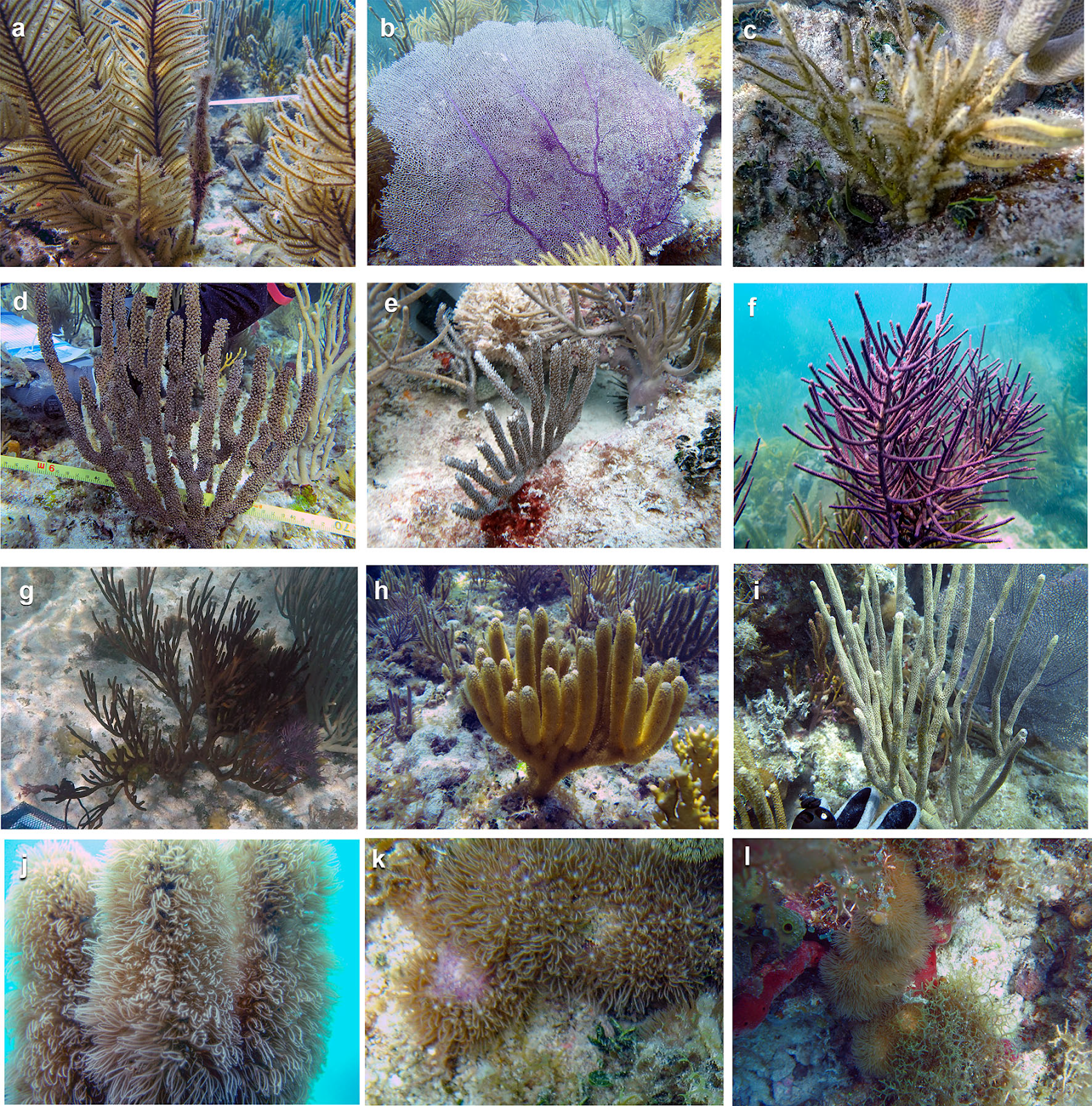
Members of the suborders Alcyoniina, Protoacluonaria, and Stolonifera, which lack an internal skeletal axis, are most abundant in the Indo-Pacific region and commonly referred to as ‘Soft Corals’. Most Octocorals found in shallow Caribbean waters have a supporting internal axis composed of proteinaceous material called gorgonin and varying amounts of calcite and are commonly referred to as ‘Gorgonians’. This term encompasses members of three suborders, Calcaxonia, Holaxonia, and Scleraxonia, that were previously assigned to the Order Gorgonacea, which is now synonymized with the Order Alcyonacea. Calcaxonians have a solid axis with calcite in the loculi, Holaxonians have a hollow axis with varying amounts of calcite, and Scleraxonians have an axis made of fused sclerites. Shallow-water Gorgonian communities are dominated by members of the Suborder Holaxonia, with a few members from Suborder Scleraxonia, while members of Calcaxonia are found mostly in deeper habitats. Eleven genera are commonly found in shallow-water Caribbean reef habitats less than 25 m in depth and include 54 species that host algal symbionts belonging to the Symbiodiniacae. Holaxonian genera are divided among two families: the Family Gorgoniidae (Gorgoniids) includes Antillogorgia, Gorgonia, and Pterogorgia, and the Family Plexauridae (Plexaurids) includes Eunicea, Muricea, Muriceopsis, Plexaura, Plexaurella, and Pseudoplexaura. The suborder Scleraxonia includes two genera: Briareum and Erythropodium.

Representative photographs of the 11 common Gorgonian genera reported in shallow waters of the western Atlantic and Caribbean: (a) Antillogorgia, (b) Gorgonia, (c) Pterogorgia, (d) Eunicea, (e) Muricea, (f) Muriceopsis, (g) Plexaura, (h) Plexaurella, (i) Pseudoplexaura, (j) Briareum (digitate form), (k) Briareum (encrusting form), and (l) Erythropodium. Selena Kupfner Johnson in Kupfner Johnson & Hallock (2020).

Current systematics are based on morphological characters that include size and shape of colony, branching pattern, distribution of polyps, axis structure, and sclerite morphology. Many Gorgonians can be field identified to genus level using external features; however, species-level field identification can be quite subjective and microscopic examination of sclerites is often needed. This has led some researchers to recomend grouping species that are commonly confused in the field when comparing data collected by multiple observers. Additionally, Kupfner Johnson and Hallock recommend grouping subspecies, such as Eunicea calyculata typica and Eunicea calyculata coronata, when conducting cross-study comparisons to minimize inconsistencies with identification between studies.

Representative photograph of (a) Eunicea tayrona with magnified views of the (b) branch tip and (c) sclerite morphology. Kupfner Johnson & Hallock (2020).

Several taxonomic species-level revisions have occurred since 1981. Plexaurella dichotoma and Plexaurella fusifera were synonymised in 1985; however, many studies still refer to them as separate species. Plexaura kuna was identified as a new species in 1996. Prior to that, Plexaura kuna was commonly confused with Plexaura homomalla. A revision of the Candelabrum Octocorals of the genus Eunicea and added Eunicea tayrona as a new species in 2009, which closely resembles Eunicea fusca but has distinctly reduced sclerites. Based upon molecular studies, Plexaurella flexuosa was reassigned to Eunicea flexuosa in 2007. The genus name Pseudopterogorgia was changed to Antillogorgia in 2012.

Molecular phylogenetic studies continue to make progress toward further taxonomic resolution; however, efforts are still in their infancy and a lack of morphological characters and species-level molecular markers is inhibiting a full revision of the subclass. An exceptional and detailed review of the ongoing molecular phylogenetic studies including an evaluation of molecular markers previously used to evaluate subfamilial relationships and future progress toward the development of new markers was provided in 2010.

Gorgonians are morphologically diverse, differing in axis structure, colony form, flexibility, biochemical composition, and growth rate, allowing them to inhabit numerous habitats from inshore shallow waters to offshore deepwaters. With skeletons composed of a highly durable protein surrounded by calcareous sclerites, colonies can grow to heights up to 2 m, produce a variety of growth forms, and recent evidence suggests they are resistant to ocean acidification. Scleraxonians (e.g. Briareum asbestinum) have an axis composed of tightly fused calcareous sclerites, called the axial medulla, with varying levels of protein surrounded by a thin layer of coenchyme. Holaxonians (e.g. Gorgoniids and Plexaurids) have an internal axis composed of a hollow central cord surrounded by concentric layers (like tree rings) made of highly durable insoluble protein called gorgonin. The axis is surrounded by an axial sheath and coenchyme. In some Holaxonian species (e.g. Plexaurella spp.), calcite is deposited between concentric layers in the loculi.

Schematic of basic Gorgonian anatomy: (a) cross-section schematic through a Scleraxonian; (b) cross section of a Holaxonian; (c) axial structure of Holaxonian. Kupfner Johnson & Hallock (2020).

The tree-like nature has some distinct advantages: (1) upright growth minimizes the need to compete for bottom space, (2) enhanced ability to capture light, and (3) branching allows for easier particle capture in the water column. Although general morphology can be attributed to genetics, environmental conditions can also influence colony form, making identification difficult. For example, Eunicea flexuosa has been reported as tall and slender in calmer, deeper waters, and broad and bushy in shallow waters. Growth form is a trait that showcases Gorgonians’ high adaptability. Gorgonians exhibit the following colony forms: encrusting (e.g. Briareum and Erythropodium), unbranched (e.g. Briareum), plumose or pinnate (e.g. Antillogorgia and Muriceopsis), reticulate (e.g. Gorgonia), whip-like (e.g. Pterogorgia), and branched (e.g. Eunicea and Plexaura). Branched colonies can be further categorised as candelabra, bushy, or branched. Holaxonians are arborescent (i.e. tree-like) and have a variety of shapes and sizes. Scleraxonians are mostly encrusting or digitate forms.

Schematic of different Gorgonian colony forms found throughout the western Atlantic and Caribbean. Selena Kupfner Johnson in Kupfner Johnson & Hallock (2020).

Flexibility is another functional trait that allows Octocorals  to withstand a diversity of habitats from deep to shallow with varying hydrodynamic regimes. Flexibility is highly dependent on the skeletal composition, as well as the shape and arrangement of sclerites in the coenchyme. Axes that are heavily mineralized with calcite between axial layers are stiffer, and those that have little mineralization are generally more flexible. For example, Gorgonia ventalina, which are often found in high-energy waters, are flexible with a stiff base and have little or no mineralisation in the axes, while taxa characterised by more rigid colonies, such as Plexaurella nutans, which are heavily mineralised, are generally found in calmer waters. Taxa exhibiting moderate stiffness, such as most Eunicea spp., are found in areas with moderate wave energy.

Growth rates are typically measured in situ as changes in colony height over time. Alternatively, annual growth bands can be measured, but they require removal of whole colonies at the base. However, it is important to note that while annual banding is assumed for symbiotic species, it has only been validated in temperate and deepwater species. Among those taxa for which data are available, Plexaurids have an average growth rate of 5 cm/year and Gorgoniids often double the rate of Plexaurids. To date, the oldest shallow-water Gorgonians recorded have been approximately 30–40 years, although the maximum age is still unknown.

Growth rates are variable between species, within species, and even within individual colonies, making studies on age and growth rates of shallow-water Gorgonians challenging. Gorgonians exhibit determinate growth. As such, growth rates decrease as the colony matures and are generally highest during the first 5 years. Rapid growth in the first few years makes the recruits less susceptible to mortality from burial and when the colony reaches an optimal size for gamete production and energy is diverted from growth to reproduction. Growth rates may also increase post-disturbance or after partial mortality at the site of injury. Eunicea flexuosa has been shown to twice as long to heal as Pseudoplexaura porosa after injury. Additionally, habitat-related differences in growth rates and morphology (e.g., thickness of branches, polyp density, stiffness, and branching patterns) have been documented in widely distributed species, such as Eunicea flexuosa, Briareum asbestinum, Antillogorgia spp., and Gorgonia spp. For example, thicker branches have been observed in shallow fore-reef areas where wave energy is generally higher.

Gorgonians are known to be gonochoristic (have separate sexes) and are able to reproduce both sexually and asexually. Sexual reproduction is considered the dominant mode for most Caribbean symbiotic species. However, new colonies of some speces, for example Plexaura kuna and Eunicea fusca, may also form asexually via vegetative propagation. 

Sexual reproductive modes can be divided into three categories: broadcast spawning, internal brooding, and external brooding. Reproductive mode heavily influences connectivity and diversity. Most Caribbean Gorgonians studied thus far are either broadcast spawners or brooders with varying synchronized gametogenic cycles. Timing is dependent on environmental conditions and is species-specific. For instance, Gorgonia ventalina spawns year-round, whereas other Gorgonians seem to have a narrower window to reproduce. Broadcasters tend to be more widely distributed than brooders, as larvae are transported mainly by currents. Broadcasters release gamete bundles into the water column where they break apart and are fertilized. After fertilization, the zygotes develop into planktonic larvae that remain in the water column for several days to weeks, then settle and metamorphose into polyps (aka: spat). Once settled, the polyp begins to form a colony through the process of budding, a form of asexual reproduction. Eunicea and Plexaura species that have been studied thus far are broadcasters. Brooding is thought to promote recruitment and survival in frequently disturbed habitats, because larvae settle quickly and are frequently fully equipped with Algal symbionts. Internal brooders have larvae that develop within the females; then, days to weeks later, the larvae are released when they are ready to metamorphose, leaving little time in the water column to be eaten by predators. In external brooders, fertilization and partial development occur in mucus pouches on the surface of the female colonies. The larvae are released from the colony when they are ready to settle, resulting in settlement within the same area as the mother colony. Brooding species studied thus far include Briareum asbestinum, Pterogorgia anceps, Antillogorgia bipinnata, and Antillogorgia elisabethae

Reproductive cycle of brooding and broadcast spawning Gorgonians. Selena Kupfner Johnson in Kupfner Johnson & Hallock (2020).

Studies of asexual propagation in Caribbean Gorgonian species are sparse. The only well-studied species thus far are Plexaura kuna and Eunicea fusca. Asexual propagation may allow for higher rates of population increase and therefore, the ability to survive and recover quickly after disturbances such as storms. However, asexual modes are a disadvantage for genetic diversity, leaving species more susceptible to disease.

No matter the mode of reproduction, substratum and light are limiting factors for settlement and recruitment. Larvae prefer a consolidated hard substrate for attachment, which is often in cracks and under ledges protected against sediment burial. Among the limited number of taxa for which data are available, roughly 60% of brooding species receive their Algal symbionts through vertical transmission, while the studied spawning species uptake their symbionts horizontally from the environment. The larvae that are equipped with symbionts require light and therefore settle on surfaces where light capture is optimal.

Additional reviews are needed for asexual reproduction and recruitment to gain a deeper understanding of mechanisms driving biodiversity on Coral Reefs, especially regarding environmental stressors.

Most tropical shallow-water Gorgonians host Algal endosymbionts and thereby have the ability to utilise both heterotrophic and photoautotrophic food sources. Heterotrophic capabilities have been linked to polyp size, branching pattern, and orientation to current. Gorgonians have been observed feeding on particulate organic matter, zooplankton, and microplankton from the water column; however, the relative dependence on heterotrophic feeding is still unknown in most taxa.

Traditional feeding experiments on Gorgonians date back as far as 1918, when Lewis Cary studied 11 species of Gorgonians and found species with the greatest surface-to-volume ratios had higher metabolisms than species with low ratios. A more recent study elaborated on Cary’s work using light–dark bottle experiments and carbon-isotope tracers. This study found significant differences in photosynthesis to respiration rates among 11 Gorgonian species. These differences negatively correlated with polyp size. Sea Fans and Sea Plumes (Family Gorgoniidae) reportedly acquire most of their energy from photosynthesis of their Algal symbionts, while Plexaurids (Branched Sea Rods) exhibited varying degrees of heterotrophy. Plumose and reticulate morphologies with small polyps likely maximise light exposure and optimise symbiont densities and nutrient exchange via increased surface area-to-volume ratios. Branched rod-shaped colonies with larger polyps might better support suspension-feeding by increasing water movement around the polyps. The relationship between polyp size and dependence upon photosynthesis suggests that some trade-offs may exist for different feeding modes. This is clearly a topic meriting additional research.

Another fundamental aspect of nutrition that is still unknown is variability in autotrophy and heterotrophy in relation to environmental change. Stable isotope analyses of Octocorals are becoming more routine in ecological studies as tracers of trophic level and source nitrogen. Bulk analyses are relatively simple and cost-effective, with potential to produce useful results, though confounding effects such as light can complicate interpretations. Recently, compound-specific stable isotope analysis has shown potential to distinguish nitrogen sources by use of amino acids, providing a tool to explore trophic interactions. Further studies on nutritional pathways and resource allocation could provide added insight into distribution patterns, physiological response to changing environmental conditions, as well as intraspecific and interspecific phenotypic variability.

Gorgonians, like other Cnidarians, have intriguingly complex immune systems that are equipped with an arsenal of bioactive compounds and various physiological mechanisms that help defend against foreign invaders and enhance resilience to environmental stress. These mechanisms include (1) mucus shedding, (2) melanisation, (3) secondary metabolites, (4) wound healing by amoebocytes, and (5) rapid lesion recovery. Main causes of death include, but are not limited to, detachment and burial from storms, overgrowth, predation, and disease.

General immune response pathways have been described in detail. The first line of defense for gorgonians includes physical barriers (e.g. mucus and sclerites) that help prevent threats from entering the organism, much like skin functions in Humans. Mucus has a range of defensive functions. It can act as sunscreen, can contain antipredatory compounds, and can be sloughed off to prevent sediment suffocation and entry of foreign material. Sclerites have also exhibited antipredatory qualities. 

The internal immune response begins with the detection and recognition of ‘self versus non-self’ via pattern recognition receptors. After a threat has been identified, signaling pathways are activated to begin the associated effector response. These pathways activate cellular and chemical defenses with the end goal of destroying, isolating, eliminating the threat. Cellular responses include phagocytosis, encapsulation, cell lysis, and melanisation. Chemical responses include numerous secondary metabolites, antimicrobial peptides, enzymes, and reactive oxygen species. Once the threat has been eliminated, repair mechanisms are triggered that are essential to recovery and resilience and include apoptosis, antioxidants, and wound-healing amoebocytes.

Schematic of general components of immune response found in Gorgonians. Selena Kupfner Johnson in Kupfner Johnson & Hallock (2020).

An area of much-needed focus is how Octocoral immune function varies with changing environmental conditions. The detection of invaders requires resources to be allocated toward immunity. Prolonged stress could cause a reduction in available energy and lead to an immune-compromised health state (e.g., reproductive failure of infected colonies) To date, more than a dozen diseases have been reported to affect Gorgonians in the wider Caribbean. In addition, bleaching has been reported in eight of the 12 shallow-water genera: Muricea, Plexaurella, Pseudoplexaura, Pterogorgia, Briareum, Muriceopsis, Erythropodium, and Eunicea (only Eunicea flexuosa). However, bleaching can be difficult to assess as many Gorgonians have dark pigmentation in the tissues and sclerites that remain even after loss of symbionts.

Studies investigating the structure of Gorgonian assemblages began primarily in the early 1960s and have continued to the present. At least one distributional study was conducted in each of the seven eco-regions of the Caribbean basin between 1968 and 2018. Although direct comparisons of distributional studies are difficult because of differences in timing and sampling effort, some consistent trends can be extracted and used to guide further studies, especially those concerned with identifying potential bioindicator species.

Map marking locations of select distributional studies (stars). Numbered eco-regions are as follows: (1) Floridian, (2) Bahamian, (3) Greater Antilles (Northern Caribbean), (4) Eastern Caribbean, (5) Southern Caribbean, (6) Southwestern Caribbean, (7) Western (Meso) Caribbean. Kupfner Johnson & Hallock (2020).

Gorgonian population dynamics are principally driven by a range of interconnected environmental factors. Many of these are heavily influenced by Human activities, including temperature, substrate type and availability, structural complexity, water movement, sediment transport, depth, light intensity, and salinity. In addition, biotic factors such as competition, predation, symbioses, reproduction, settlement, and developmental properties provide local-scale refinement. Together, these abiotic and biotic factors have been shown to induce habitat filtering and morphologic variability. 

Temperature controls many physiological and ecological processes (e.g., metabolic rates, reproduction, dissolved oxygen content, chemical reaction rates) and as such is one of the most widely recognized influences on the distribution and growth of marine organisms. All organisms have an optimal range, and their capacity to tolerate temperatures outside of this range directly affects survival. Few studies have investigated the temperature tolerances of gorgonians. Lewis Cary found the maximum upper limit of 12 species in Dry Tortugas to be between 34.5 and 38.2°C for a 24 hour exposure. Resistance was determined to be species-specific, with Plexaurids being least resistant and the Scleraxonian Briareum asbestinum being most resistant. A study in the 1970s determined the optimal ranges and extremes for six common species off Palm Beach, Florida. The optimal temperature range for Gorgonians was similar to that of Scleractinians, between 18 and 33°C, with a lower tolerance generally 15–17°C and an upper tolerance consistent with Cary’s findings. In general, Gorgonians appear to have a higher tolerance to warm temperatures and may be more restricted in distribution because of lower limits; however, more work is needed in this area.

The nature of the substratum (i.e., bottom relief), substratum availability, type of sediment, and sediment transport are proximal factors controlling settlement and survival of planulae. Excess sedimentation can impede recruitment and growth (e.g. by burial), reduce light attenuation, and increase abrasion. Gorgonians typically favor open areas of rough, solid bottom, with little to no inclination, for attachment. Recruits frequently find refuge in depressed areas between Scleractinians on reefs. However, it is not unusual for severe storms to fill these depressed areas with sediment, especially on patch reefs that are surrounded by a sand halo. This is likely why the tops of shallow-water patch reefs are often more populated with Gorgonians than the sloping sides.

Currents and wave energy control food and sediment transport, which have a marked influence on larval dispersal, recruitment, plankton dispersal, morphology, and orientation. The ‘tree-like’ nature and morphological plasticity of shallow-water Gorgonians allow them to inhabit a variety of flow regimes from shallow water with high wave action and surge, to deeper water with low energy, current-driven zones. Research has correlated axis stiffness with water-movement- based zonation in 13 species of Caribbean Gorgonians. The stiffest axes were found in deeper waters with low wave energy and surge. Shallow waters with moderate surge and wave energy had the most flexible axes. The orientation of fan-shaped and candelabrum-shaped Gorgonians perpendicular to net flow of water is so well documented that Gorgonians have been used as indicators of general flow patterns. This positioning is thought to enhance feeding efficiency and particle capture in deepwater species and optimize light capture in shallow-water species such as Gorgonia ventalina.

Nearly all shallow-water Caribbean Gorgonians host Dinoflagellate endosymbionts. The need for photosynthates therefore limits these species from growing in deeper waters with low light availability. Moreover, local bathymetry and nature of the substratum can cause significant variations in light intensity (i.e., turbidity, reflectance, and shading). For example, sandy bottoms increase reflectance and overhanging topography provides shade. Species with Algal symbionts are generally found in waters shallower than 16 m, while only a few species lacking Algal symbionts are found at depths of up to 25 m (e.g. Iciliogorgia schrammi). 

Salinity ranges are much less understood, but the areas where reefs are best developed have an average salinity of 36.0 parts per thousand. In general, Gorgonians seem to be able to withstand hypersaline conditions more easily than reduced salinities, with an optimal range of 29.5–42.5 parts per thousand. There is also evidence that Gorgonians may be able to acclimate to lower salinities if the changes are gradual. However, this is one of many ecological parameters that needs further investigations.

Several ecological studies have recently emerged that provide evidence to support the hypothesis that Gorgonian Octocorals may be more resistant to stressors, such as elevated temperatures, bleaching, nutrient enrichment, and ocean acidification, and recover faster after disturbances than Scleractinian Corals. In fact, two locations in the Caribbean have recently reported shifts to Octocoral-dominated states based on long-term retrospective analyses of photographic data: (1) fore-reef environments of the Florida Keys and (2) reef sites in the US Virgin Islands. However, the extent of such population shifts and implications to ecosystem services are poorly understood. Possible explanations for these shifts that require further investigation include:

  1. The tree-like nature of gorgonians makes them better spatial competitors against Macroalgae because of rapid linear extension rates, which minimises the potential for smothering by Macroalgae. 
  2. Higher post-disturbance recruitment rates allow Gorgonians to exploit space made available by declining populations of Scleractinians.
  3. Gorgonians and Scleractinians are biologically and morphologically diverse, and as such, their adaptive capabilities and threshold responses to changing environmental conditions may also vary considerably 
The next step is to investigate these hypotheses regarding mechanisms favoring changes in gorgonian abundance. Quantitative studies that encompass more than Scleractinians are needed, in addition to studies that evaluate water quality data. Population models could be developed to predict future changes in Gorgonian communities due to environmental influences, based upon targeted surveys and additional analyses of historical records. With additional knowledge, documented trends in Gorgonian octocoral species abundance and richness could be dependable indicators for environmental conditions on reefs.
 
As global temperatures rise, storm frequency increases, and other climate-change-related stressors continue to impact Coral Reefs. Policy makers and resource managers urgently seek biological indicators that can be used as proxies to assess environmental conditions. Gorgonians are ideal candidates for bioindicators because they (1) are long-lived, (2) are sessile and cannot migrate, (3) build a protein axis which records conditions at the time of formation in annual bands, (4) are abundant and easily sampled, (5) have distributions strongly connected to abiotic factors, and (6) exhibit consistent sensitivities to changes in abiotic conditions. 
 
The use of Gorgonians as effective bioindicators for identifying sources of anthropogenic pollution has been demonstrated in several studies around the Caribbean (e.g. sewage and agricultural fertilisers)  Because the skeletal axes of Gorgonians are composed primarily of protein, large amounts of nitrogen are incorporated into the skeleton from the environment. This creates a record of the environmental conditions at the time of synthesis, giving the skeletal components immense value as bioarchives. Species used previously in the wider Caribbean for stable isotopic studies aimed at identifying sources of anthropogenic nitrogen include Gorgonia ventalina, Eunicea flexuosa, Plexaura homomalla, Antillogorgia spp., and Pseudoplexaura porosa. However, additional work is still needed to determine how isotopic values differ within and between species that are exposed to the same array of environmental conditions.
 
Studies that have utilised the whole Gorgonian assemblage as a tool for biomonitoring are limited to a few areas off of Cuba  Higher abundances of ‘sensitive’ species are considered to be indicative of stable/favorable conditions, whereas higher abundances of ‘tolerant’ species are often indicative of suboptimal conditions. Some researchers have defined stress tolerators as ‘slow-growing organisms that are able to survive in nearly all habitats, but only dominate in habitats where physiological stress precludes or slows the growth of ruderals (rselected species) and competitors’. One researcher attempted to develop gorgonian indices based on the presence of tolerant species. He used the sum of relative abundances of 11 species, identified as tolerant to hydrodynamic stress, to infer the degree of hydrodynamic stress in a variety of reef habitats. The hydrodynamic index included Eunicea calyculata, Eunicea flexuosa, Eunicea mammosa, Eunicea tourneforti, Gorgonia flabellum, Gorgonia ventalina, Muricea muricata, Plexaurella dichotoma, Pterogorgia anceps, Pterogorgia citrina, and Pterogorgia guadalupensis. Another study applied similar principles to infer the degree of organic pollution based on presence of six species considered tolerant to polluted environments. The pollution index included Eunicea calyculata, Eunicea flexuosa, Eunicea mammosa, Eunicea tourneforti, Plexaura kukenthali, and Pseudoplexaua flagellosa. A later study proposed the addition of a seventh species, Pterogorgia citrina, to the pollution index.
 
To further validate which species or species groups are the best-suited indicators of specific environmental conditions, a deeper quantitative multivariate analysis of environmental parameters affecting distributions in all ecoregions of the Caribbean is needed. Additionally, because current taxonomy is based on several morphologic characters, exploring functional alternatives or coarser taxonomic linkages could reduce the need to identify individuals to species level or eliminate the need for taxonomic experts, thereby providing a more widely applicable biotic index. 
 
Although the current state of knowledge on the biology, ecology, and taxonomy of symbiotic Gorgonians has grown considerably during the last century, this group continues to be underrepresented in long-term coral reef monitoring efforts. This neglect has primarily been attributed to difficulties in differentiating species in the field and the need for microscopic sclerite verifications. However, Gorgonians are abundant and integral components of Coral Reef communities and their functional importance is reason to overcome these challenges. With recent reports of increased abundances in parts of the Caribbean, as well as emerging evidence of resistance to elevated temperatures, ocean acidification, and nutrient enrichment, there is now a growing interest in the ecological and physiological mechanisms that contribute to their success under changing environmental conditions. 
 
Because there are substantial amounts of published information on various aspects of Gorgonian biology and ecology, Kupfner Johnson and Hallock recommend that in-depth reviews on the specific topics included in this paper be undertaken. At present, sexual reproduction and molecular phylogenetics are the only topics for which reviews have been published within the past decade. Thus, the primary goals of this Kupfner Johnson and Hallock's paper was to emphasize the untapped potential of Gorgonians for detecting environmental change, and to gather widely scattered information into one reference document that can be used to promote and inform future studies. As reefs continue to lose Scleractinian coral cover, Kupfner Johnson and Hallock recommend that reef researchers more broadly consider Gorgonian ecology as a critical component of reef science.
 
See also...
 
https://sciencythoughts.blogspot.com/2019/01/heliopora-hiberniana-second-species-of.htmlhttps://sciencythoughts.blogspot.com/2019/01/hana-hanagasa-and-hana-hanataba-two-new.html
https://sciencythoughts.blogspot.com/2018/04/adelogorgia-osculabunda-adelogorgia.htmlhttps://sciencythoughts.blogspot.com/2018/02/antipathozoanthus-obscurus.html
https://sciencythoughts.blogspot.com/2017/06/sinularia-mesophotica-new-species-of.htmlhttps://sciencythoughts.blogspot.com/2017/04/flagelligorgia-gracilis-new-species-of.html
Follow Sciency Thoughts on Facebook.