Showing posts with label Crocodiles. Show all posts

Wednesday, 31 December 2025

Using Environmental DNA to search for Crocodiles in Madagascar.

The world is currently suffering from multiple interconnected environmental crises, including a rapid loss of biodiversity in many parts of the world. Madagascar, a global biodiversity hotspot with a large number of species found nowhere else, is considered to be particularly at risk, due to unprecedented rates of habitat loss. However, tracking this loss is challenging, as monitoring species loss involves a large amount of labour intensive work by specialist taxonomic experts, often involving access to expensive equipment.

Environmental DNA offers a potential way to reduce this workload, allowing for monitoring to be carried out by non-specialist staff collecting samples of sediment, water or even air. Since such methods to not require direct observation of threatened species, they are far less environmentally intrusive.

Nile Crocodiles, Crocodylus niloticus, were persecuted across their range by hunters seeking their skins, as well as harvesting of their eggs, until the mid-twentieth century. Since this time, the population has recovered in many parts of Africa due to conservation efforts. In Madagascar, the species is monitored by the Malagasy Crocodile Management Unit, which aims not just to establish the recovery of the species, but to minimise Human-Crocodile conflicts by helping people and livestock to avoid potentially lethal Crocodile encounters.

Previous work using environmental DNA has succeeded in detecting Crocodiles kept under laboratory conditions, but struggled to locate them in the wild, although methods such as water sweeps have proven more successful.

In a paper published in the journal Biodiversity and Conservation on 23 October 2025, Mai Fahmy of the Department of Undergraduate Biololgy at Stony Brook University, and the Division of Invertebrate Zoology at the American Museum of Natural History, Soja Manjakamanana Zafimanaoela of the Université d’Antananarivo, Njakamamapiadana Mamenofahasoavana Rinah and Jerison William Ranaivosolo of Stony Brook University's Centre ValBio in Madagascar, Noel Rowe of Primate Conservation Inc., Patricia Wright, also of the Centre ValBio, and of the Department of Anthropology and Interdepartmental Doctoral Program in Anthropological Sciences at Stony Brook University, and Evon Hekkala, also of the Department of Undergraduate Biololgy at Stony Brook University, and the Division of Vertebrate Zoology at the American Museum of Natural History, present the results of a study, in which they attempted to detect Crocodiles in Madagascar using sediment samples as well as specialist environmental DNA filters and Coffee filters, in an attempt to find a cost-effective method of detecting the Animals. 

Anivorano lake in northern Madagascar, traditionally held to be sacred. Here the local population periodically sacrifices Zebu Cattle to the Crocodiles, which are believed to contain the spirits of pas chiefs, in a ceremony that also involves dancing and singing. On such occasions, the Crocodiles are fed beef from a beach about 30 m long near a sacred tree, and subsequently typically remain in the area for about eight hours, basking on the beach or in the water.

Map of collection localities across Madagascar. TSP, Tsimanampetsotse National Park. Fahmy et al. (2025).

Fahmy et al. collected sediment from a belly print left on the beach by a Crocodile, Crocodile faecal matter, and water from an area close to where Crocodiles were basking. The water and faecal samples were subsequently passed through Coffee filters, which were retained. 

At the Ankarana Special Reserve, also in northern Madagascar, Fahmy et al. collected sediment samples from the river mouth leading into the Ankarana Cave System, with two samples collected from the footprints of Crocodiles, one adult and one juvenile. Water was also collected from a flooded cave entrance, and again filtered through a coffee filter.

Water samples were also collected from the Ihosy, Mananantanana, and Matitanana rivers in central and southeastern Madagascar, and filtered through specialist environmental DNA filters. These are wide, fast flowing rivers, used exclusively by the local population for transport, hygiene, and watering livestock. Samples were taken following sightings of Crocodiles, and only with the explicit permission of local communities.

Nile Crocodile, Crocodylus niloticus, spotted in the Matitanana River while sampling. Mai Fahmy in Fahmy et al. (2025).

Finally, four samples were collected from a submerged cave located in Tsimanampesotse National Park in southwest Madagascar. Nile Crocodiles have never been observed in these caves, although they are known to inhabit the nearby Onalahy River. The caves were, however, utilised by the extinct Madagascan Horned Crocodile, Voay robustus, which is thought to have died out about 1250 years ago. These samples were again filtered through Coffee filters. A sediment sample was also collected from beneath a subfossil Horned Crocodile in the caves.

A total of seventeen samples were collected and processed. Four of the samples were subsequently discarded because they were found to contain only Human DNA, and one because it contained Sheep DNA. In the remaining samples, the greatest number of species were recovered from the Coffee filter samples; although this did not represent the greatest diversity. Sediment and environmental DNA samples produced equal numbers of species, although greater overall diversity was recorded in the sediment samples. DNA associated with members of the Family Podicipedidae (Grebes) was recovered exclusively in the environmental DNA filters, while DNA associates with the Family Naididae (Tubifex Worms) was recovered exclusively from sediment samples.

Crocodile DNA was recovered from both sediment samples and Coffee filters, but not from specialist environmental DNA filters. However, Fahmy et al. do not suggest that this is because Coffee filters are superior to environmental DNA filters, as the later were only used to filter water samples from fast flowing rivers, where recovering Crocodile DNA is known to be difficult. 

Zebu Cattle drinking from Matitanana River. Mia Fahmy in Fahmy et al. (2025).

Three samples yielded Crocodile DNA, all from Lake Anivorano. These included the sediment sample taken from the Crocodile belly print, and the Coffee filters through which the faecal sample and water from close to Crocodiles basking in the lake were filtered. The analysis recovered these as belonging to the genus Crocodylus, and most likely as coming from Nile Crocodiles, Crocodylus niloticus, with a lower chance of coming from Orinoco Crocodiles, Crocodylus intermedius, of American Crocodiles, Crocodylus acutus, neither of which are found in Madagascar. 

The three most abundant species in the results were Cattle, Bos taurus, Chickens, Gallus gallus, and Domestic Pigs, Sus scrofa. Also detected were Ring-tailed Lemur, Lemur catta, and an unknown species of Grebe (Podicepepidae). This could not be identified to species level, although several Grebes are known from Madagascar, including the Little Grebe, Tachybaptus ruficollis, and the Madagascar Grebe, Tachybaptus pelzelnii. Interestingly, the Madagascar Grebe does not have any genetic material recorded in the GenBank database, against which the samples were compared.

The method developed by Fahmy et al. did not establish the presence of Crocodiles in anywhere they were not known to occur, but did establish that it was possible to detect Crocodiles using environmental DNA in Madagascar, and that it was possible to use Coffee filters as a means of recovering environmental DNA, a much cheaper option than specialist filters.

See also...


Monday, 19 February 2024

Investigating Crocodile attacks around Roviana Lagoon, New Georgia, the Solomon Islands.

Saltwater Crocodiles, Crocodylus porosus, are found in coastal environments in the Asia-Pacific region from the Bay of Bengal, throughout Southeast Asia and New Guinea, to northern Australia, and as far east as the Solomon Islands. Unlike other Crocodile species, they are not currently considered to be threatened, being classified as of Least Concern under the terms of the International Union for the Conservation of Nature's Red List of Threatened Species. However, this assessment is essentially dependent on good relations between Human and Crocodile populations; Saltwater Crocodiles will attack Humans and livestock, causing injuries and deaths, as well as less obvious economic damage by excluding Humans from areas where they become dangerous. This in turn can lead to retaliatory actions by Humans, removing troublesome Crocodiles, or sometimes whole populations, from areas where they are seen as harmful. 

Saltwater Crocodiles feed in tidal rivers and creeks, freshwater lakes and Mangrove forests, and will occasionally forage on Coral reefs. While they cross open sea to seek new territory, they do not usually hunt or feed there. Female Saltwater Crocodiles can reach about 3 m in length, and can weigh as much as 150 kg, but the largest males can reach more than 6 m in length and weigh more than 1000 kg. Males will try to defend a territory and the females within it, chasing away smaller males, who then go on to look for territories of their own, which can lead to changes in the social structure and behaviour of Crocodile groups.

In a paper published in the journal Orynx on 22 January 2024, Shankar Aswani of Rhodes University and Joshua Matazima of the University of Queensland present the results of a study of negative Human-Crocodile interactions around Roviana Lagoon on the island of New Georgia in the Solomon Islands.

A previous study examined Human-Crocodile interactions across the Solomon Islands over the period 1998-2017. This study identified 225 Crocodile attacks across the islands, with 83 of these being fatal, including 31 on children. Aswani and Matazima's study concentrates on a much smaller area, and is aimed at understanding Human-Crocodile interactions in a specific, localised environment with a view to developing specific policies for that location, something which it is difficult to achieve from wider scale national surveys.

Aswani and Matazima's study concentrated on four villages, Dunde, Baraulu, Nusa Hope, and Kozou, located on the 700 km² Roviana Lagoon, on the southwest of New Georgia island. Each village has a population of between 50 and 300 people. Twenty three men and thirty seven women from sixty households across the four villages were interviewed by three locally hired assistants, in the local Roviana language. Twenty of the interviewees reported that a member of their household being attacked by a Crocodile between 2000 and 2020, four in Dunde, seven in Baraulu, five in Nusa Hope and four in Kozou.

Locations of the four villages (Dunde, Baraulu, Nusa Hope and Kozou) in which residents were interviewed regarding incidents with Saltwater Srocodiles, Crocodylus porosus, in  Roviana Lagoon, New Georgia Group, western Solomon Islands, during 2000-2020. Aswani & Matazima (2024).

A total of twenty attacks were recalled, of which two were fatal. Ten of the recalled incidents happened in the evening, eight in the afternoon, and two in the morning. Sixteen victims were female, and four were male; one woman and one man were killed during the study period. Two were under twenty years of age, eight were between 20 and 39, two were 40-59, and eight were over sixty years of age. The majority of the victims were attacked while collecting shellfish along the sea shore and in Mangrove forests. Ten of the victims were attacked when the water was murky, with the other ten attacked when the water was clear. No retaliatory attacks were made against Crocodiles be the people of the area.

The pattern of attacks recorded in Roviana Lagoon were quite different to that recorded in the Solomon Islands-wide survey, although it may be similar to other localised areas within the nation. Across the Solomons, the majority of the victims were male, attacked at night while fishing, while in Roviana Lagoon the majority of the victims were female, attacked in the afternoon or early evening while gathering shellfish. Clearly, any system developed to minimize the number of Crocodile attacks based upon the national statistics would have little impact at Roviana Lagoon, since such a plan would likely concentrate on protecting men involved in night-fishing, an activity not practiced in Roviana Lagoon. Even a female specific plan developed from national statistics would be unlikely to be helpful, as across the Solomon Islands the majority of women are attacked while washing clothes.

Shellfish gathering, both for sustenance and sale, is an important activity to the women of Roviana Lagoon, but clearly leaves them vulnerable to attacks by Crocodiles. This activity is carried out almost exclusively by women, although they are frequently accompanied by children of both sexes. Most of the attacks happened in late afternoon or early evening, and water clarity did not appear to be a factor, possibly because the low sun shining onto clear water can make submerged Crocodiles just as hard to spot as the water being cloudy. 

Aswani and Matazima recommend that in order to minimise the number of Crocodile attacks, the women of Roviana Lagoon avoid collecting shellfish in the late afternoon and evening as much as possible, and that where this cannot be avoided, always forage in groups at this time of day, which will both improve the chances of spotting Crocodiles before attacks occur, and of rescuing any victims should attacks occur. They further recommend that future studies of Crocodile attacks focus on much narrower geographic areas when the purpose is to develop strategies to minimise attacks.

See also...

Sunday, 7 May 2023

Remains of missing fisherman found inside two Crocodiles in northern Queensland.

The remains of a fisherman who went missing in the Rinyirru (Lakefield) National Park in northern Queensland, Australia, have been found inside two Crocodiles close to the area where he went missing. Kevin Darmody, 65, vanished while fishing with friends on the Kennedy River on 29 April this year, with witnesses reporting hearing a scream and a loud splash at about the time when he vanished. Following a search that lasted several days, local police located and killed two Saltwater Crocodiles, Crocodylus porosus, slightly upstream of the area where he went missing. To their surprise, Human remains believed to have come from Mr Darmody were found inside both Animals, something rare in cases of Crocodile attacks.

Kevin Darmody, 65, went missing while fishing in the Rinyirru (Lakefield) National Park on 29 April 2023, and believed to have been eaten by Crocodiles. Brisbane Times.

Crocodile attacks on Humans are relatively rare, but they are opportunistic ambush predators and will potentially attack anything going close to the water. Saltwater Crocodiles have a particularly poor reputation for such behaviour, being the largest species of Crocodile and notoriously aggressive. These Crocodiles are one of the few Crocodile species not considered vulnerable to extinction, being found from India to Australia  and inhabiting many areas that Humans shun, such as Mangrove forests and islands without fresh water.

Saltwater Crocodile, Crocodylus porosus, in northern Queensland. Christopher Testa/ABC News.

Despite this fearsome reputation, attacks by Saltwater Crocodiles are still unusual, with only 13 fatalities recorded in Queensland since records began in 1985, and only one other attack involving more than one Crocodile. Despite this, calls for a cull of Crocodiles in parts of Queensland where they come into conflict with Humans are common, particularly after attacks, and this incident has not been an exception. Crocodiles are protected in Queensland, where hunting led to their population falling to around 5000 in 1974. Since that time the population has recovered at a rate of about 2% per year, with the current population estimated at between 20 000 and 30 000, most of which live around Cape York and the Gulf of Carpentaria.

Conservationists in Queensland oppose a cull of Crocodiles not just because this would be bad for the Crocodiles, but because they do not believe it would be good for people. They argue that the likelihood of Crocodile attacks is more closely related to Human behaviour than Crocodile population density, and that a cull might make people more complacent in Crocodile habitats, and therefore vulnerable to attacks. Instead they argue for education campaigns to raise public awareness of Crocodiles and how to behave around them.

See also...

Follow Sciency Thoughts on Facebook.

Follow Sciency Thoughts on Twitter.


Sunday, 19 March 2023

Crocodile captured after attacking 12-year-old girl in Northern Territory, Australia.

A 12-year-old girl has escaped with minor injuries after being attacked by a Saltwater Crocodile, Crocodylus porosus, while collecting water plants for a Fish tank in a creek to the south of Darwin on Thursday 16 March 2023. The girl was treated at the Palmerston Regional Hospital in Darwin, before being discharged, while the Crocodile was captured in a trap set by park rangers and will be relocated. A spokesperson for the Northern Territory Crocodile Management Team has stated that the girl was extremely lucky not to have received more serious injuries as the Crocodile was about 2.2 m in length, large enough to inflict significant injuries on an adult Human. Water levels are currently high in the Northern Territory, due to the annual rainy season, and Crocodiles are able to enter many waterways which are to shallow to offer them good cover at other times of year. Rangers have removed about 70 Crocodiles from such waterways so far this year, compared to a total of 273 removed in 2022.

Crocodile captured in a creek to the south of Darwin after attacking a 12-year-old girl on Thursday 16 March 2023. Department of Environment, Parks and Water Security.

Crocodile attacks on Humans are relatively rare, but they are opportunistic ambush predators and will potentially attack anything going close to the water. Saltwater Crocodiles have a particularly poor reputation for such behaviour, being the largest species of Crocodile and notoriously aggressive. These Crocodiles are one of the few Crocodile species not considered vulnerable to extinction, being found from India to Australia  and inhabiting many areas that Humans shun, such as Mangrove forests and islands without fresh water.

See also...

Follow Sciency Thoughts on Facebook.

Follow Sciency Thoughts on Twitter.


Sunday, 8 May 2022

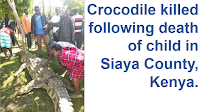
Crocodile killed following death of child in Siaya County, Kenya.

A Crocodile has been killed after a fatal attack on a child in Siaya County, Kenya, on Saturday 7 April 2022. The Animal is reported to have snatched a three-year-old boy and mauled him to death while his helpless mother looked on. in the East Asembo area, where the family has gone to collect water from Lake Victoria. The same Crocodile, described as over five metres in length, was later killed by local fishermen who caught the Animal by offering it meat attached to a hook and rope, before dragging it from the water and attacking it with pangas and axes. 

 
Crocodile killed by localfishermen in East Asembo, Kenya, on Saturday 7 May 2022. Isaiah Gwengi/The Standard.

The Kenya Wildlife Service has warned against villagers taking such matters into their own hands, asking that instead such attacks are reported so that the problem can be addressed by proffesionals who may be able to relocate problem Animals. Nile Crocodiles, Crocodylus niloticus, are considered to be of Least Concern under the terms of the  International Union for the Conservation of Nature’s Red List of  Threatened Species, but are still protected in many countries, due to historic hunting which decimated populations in many areas. The number of attacks on Humans by Crocodiles and Hippopotemus on the Kenyan shores of Lake Victoria have risen sharply in recent years, something which is thought to be driven by a rising Human population encroaching on areas where the Animals live. In August 2020 a 32-year-old woman was killed by a Crocodile while collecting water from the same beach.

See also...


Follow Sciency Thoughts on Facebook.

Follow Sciency Thoughts on Twitter. 

Tuesday, 12 April 2022

Fisherman attacked by Crocodile in Belize.

A man is being treated for injuries to the face after being attacked by a Crocodile while spear fishing on Friday 8 April 2022. Joshua Young of Caye Caulker, an offshore island in the Caribbean Sea, made it back to shore safely after being attacked by the Animal and was taken to the Karl Heusner Memorial Hospital for treatment. He is described as being in a stable condition.

 
The location of Caye Caulker on the coast of Belize. Google Maps.

Two types of Crocodile are commonly found in Belize, the American Crocodile, Crocodylus acutus, and the Morelet’s Crocodile, Crocodylus moreletii, both of which are large enough to present a threat to Humans. 

The Morelet's Crocodile reaches about 3 m in length, and while generally not considered a danger to Humans, at least 12 fatal attacks by this species have been recorded, with large prey such as Cattle and Tapirs often taken by fully grown adults. However, whilst fairly common in Belize, the Morlet's Crocodile is essentially a freshwater species, and while it will occasionally enter brackish marshes or lagoons, is unlikely to be found in the open marine waters around Caye Caulker.

 
A Morelet's Crocodile in Belize. The Croc Docs.

The American Crocodile, Crocodylus acutus, is found throughout the Caribbean, Central America, and parts of northern South America, southern and western Mexico, and parts of Florida. American Crocodiles are unusual in that, while they will enter freshwater environments, their favoured habitat is saltwater lagoons, mangroves, and small islands, a habit they share with only one other Crocodile species, the Indo-Pacific Saltwater Crocodile, Crocodylus porosus. This makes the American Crocodile a much more likely candidate for the attack on Mr Young.

 
An American Crocodile, Crocodylus acutus, in Placencia Lagoon, Belize. Crocodile Research Coalition.

The species can grow quite large, with mature males often exceeding 4 m in length and the largest measuring slightly over 6 m, but are not particularly agresive towards Humans as long as they are left alone. They predominantly feed on small Mammals, Birds, Fish, and Turtles, but have been known to take larger prey on occasion, including Cattle. American Crocodiles are classified as Vulnerable under the terms of the International Union for the Conservation of Nature's Red List of Threatened Species.

The Belize Forest Department has warned people against feeding Crocodiles, especially around tourist areas, as this can lead to them becoming aclimatised to Humans, leading to further conflict. They have also warned fishermen to be careful of how they dispose of Fish waste, which can also lead to Crocodiles associating Humans with food.

See also...


Follow Sciency Thoughts on Facebook.

Follow Sciency Thoughts on Twitter.