Showing posts with label Divergent Plate Margin. Show all posts

Thursday, 30 May 2024

Town of Grindavik evacuated again as new eruption begins on the Reykjanes Peninsula, Iceland.

Eruptive activity on the Reykjanes Peninsula, Iceland began again on 29 May 2024, according to the Icelandic Met Office, the first such eruption since activity on a fissure which opened in March petered out three weeks ago. The activity is thought to have started when magma flowing from the magma reservoir beneath Svartsengi into the area beneath the Sundhnúkur crater row. At about 4.00 pm on 29 May the magma encountered groundwater penetrating through a fissure from a previous eruption, leading to a phreatic explosion as a large volume of the water was turned into steam instantly. This led to the formation of a new fissure running southwest to northeast (parallel to previous fissures on the peninsula) for about 2.4 km. This fissure has produced lava fountains up to 50 m high, and is extruding lava at a rate of about 1500-2000 m³ per second. The eruption has prompted the evacuation of the town of Grindavik, and the nearby Blue Lagoon Geothermal Spa. The fissure is further from the town than the eruption in January which saw lava entering the streets of the settlement and several buildings destroyed, but is also significantly larger, and is evolving significant amounts of toxic gasses.

A volcanic fssure on the Reykjanes Peninsula, Iceland, which opened on 29 May 2024. Marco Di Marco/AP.

Although dramatic, lava flows are not usually considered particularly dangerous, as their advancing fronts are quite slow and can quickly be outpaced by an able-bodied Human being. The more deadly volcanic events are pyroclastic flows, such as the one which engulphed the Roman town of Pompeii, in which clouds of superheated gas and ash move downhill at high speeds in an avalanche-like motion, and phreatic explosions, caused by bodies of lava encountering bodies of water, which evaporate almost instantly, causing huge explosions.

The size and position of the new fissure on the Reykjanes Peninsula, Iceland. Icelandic Met Office/BBC.

Iceland lies directly upon the Mid-Atlantic Ridge, a chain of (mostly) submerged volcanoes running the length of the Atlantic Ocean along which the ocean is splitting apart, with new material forming at the fringes of the North American and European Plates beneath the sea (or, in Iceland, above it). The Atlantic is spreading at an average rate of 25 mm per year, with new seafloor being produced along the rift volcanically, i.e. by basaltic magma erupting from below. The ridge itself takes the form of a chain of volcanic mountains running the length of the ocean, fed by the upwelling of magma beneath the diverging plates. In places this produces volcanic activity above the waves, in the Azores, on Iceland and on Jan Mayen Island. All of this results in considerable Earth-movement beneath Iceland, where Earthquakes are a frequent event.

The passage of the Mid-Atlantic Ridge beneath Iceland. NOAA National Geophysical Data Center.

See also...

Sunday, 14 January 2024

Lava from new volcanic fissure reaches the town of Grindavik, Iceland.

A flow of lava from a new fissure associated with the Fagradalsfjall Volcano on the Reykjanes Peninsula has reached the town of Grindavik, following a new erruption on Sunday 14 January 2024. The town was evacuated when the fissuere first opened in November 2023, so the lava flows are thought to present no threat to Human life, but at least one property has been destroyed, and it is likely that the lava will keep flowing for some time, doing further damage to the town's infrastructure.

A flow od lava entering the town of Grindavik. Eggert Jóhannesson/Morgunbladid.

Although dramatic, lava flows are not usually considered particularly dangerous, as their advancing fronts are quite slow and can quickly be outpaced by an able-bodied Human being. The more deadly volcanic events are pyroclastic flows, such as the one which engulphed the Roman town of Pompeii, in which clouds of superheated gas and ash move downhill at high speeds in an avalanche-like motion, and phreatic explosions, caused by bodies of lava encountering bodies of water, which evaporate almost instantly, causing huge explosions.

An aerial photograph of the 14 January 2024 eruption, showing its proximity to the town of Grindvik. Iceland Civil Protection/Reuters.

Iceland lies directly upon the Mid-Atlantic Ridge, a chain of (mostly) submerged volcanoes running the length of the Atlantic Ocean along which the ocean is splitting apart, with new material forming at the fringes of the North American and European Plates beneath the sea (or, in Iceland, above it). The Atlantic is spreading at an average rate of 25 mm per year, with new seafloor being produced along the rift volcanically, i.e. by basaltic magma erupting from below. The ridge itself takes the form of a chain of volcanic mountains running the length of the ocean, fed by the upwelling of magma beneath the diverging plates. In places this produces volcanic activity above the waves, in the Azores, on Iceland and on Jan Mayen Island. All of this results in considerable Earth-movement beneath Iceland, where Earthquakes are a frequent event.

The passage of the Mid-Atlantic Ridge beneath Iceland. NOAA National Geophysical Data Center.

See also...


Wednesday, 20 December 2023

Volcanic eruption on the Reykjanes Peninsula, Iceland.

On 11 November 2023 residents of the town of Grindavík on the Reykjanes Peninsula, Iceland, were evacuated from their homes following a major increase in seismic activity beneath the nearby Fagradalsfjall Volcano. The evacuations were triggered by the discovery of a magma tunnel running directly beneath the town at a depth of about 1.5 km. This is about 12 km long, originating near Stóra-Skógfell hill, and running beneath the town and some way out to sea. Seismic activity in the area has remained high in the area in the intervening weeks, although some people had begun to return to their homes. 

Slightly after 10.15 pm on Monday 18 December 2023, a new volcanic fissure opened on the peninsula, spewing vast amounts of lava and prompting a new series of evacuations. The fissure is about 3.5 km in length, and about 3 km from the town of Grindavík. It is currently producing 100-200 m³ of lava per second, although this is not flowing towards the town, and is not thought to present a threat to Human life.

Lava spewing from a new volcanic fissure on the Reykjanes Peninsula, Iceland, which opened on Monday 18 December 2023. BBC.

Although dramatic, lava flows are not usually considered particularly dangerous, as their advancing fronts are quite slow and can quickly be outpaced by an able-bodied Human being. The more deadly volcanic events are pyroclastic flows, such as the one which engulphed the Roman town of Pompeii, in which clouds of superheated gas and ash move downhill at high speeds in an avalanche-like motion, and phreatic explosions, caused by bodies of lava encountering bodies of water, which evaporate almost instantly, causing huge explosions.

People watching a lava flow on the Reykjanes Peninsula, Iceland, this week. Kristin Elisabet Gunnarsdottir/AFP/Getty Images.

Iceland lies directly upon the Mid-Atlantic Ridge, a chain of (mostly) submerged volcanoes running the length of the Atlantic Ocean along which the ocean is splitting apart, with new material forming at the fringes of the North American and European Plates beneath the sea (or, in Iceland, above it). The Atlantic is spreading at an average rate of 25 mm per year, with new seafloor being produced along the rift volcanically, i.e. by basaltic magma erupting from below. The ridge itself takes the form of a chain of volcanic mountains running the length of the ocean, fed by the upwelling of magma beneath the diverging plates. In places this produces volcanic activity above the waves, in the Azores, on Iceland and on Jan Mayen Island. All of this results in considerable Earth-movement beneath Iceland, where Earthquakes are a frequent event.

The passage of the Mid-Atlantic Ridge beneath Iceland. NOAA National Geophysical Data Center.

See also...

Follow Sciency Thoughts on Facebook.

Follow Sciency Thoughts on Twitter.


Sunday, 12 November 2023

Icelandic town evacuated due to concerns about volcanic eruption.

The town of Grindavík on the Reykjanes Peninsula, Iceland, which has about 3000 permanent residents plus a thriving tourism industry, was evacuated on Saturday 11 November 2023, following a sharp increase in Earthquakes in the area, which geologists fear may be linked to an imminent eruption from the nearby Fagradalsfjall Volcano. Iceland, which is an Earthquake-prone country with numerous active volcanic fields, began to suffer an increase in seismic activity on 25 October, since when it has suffered around 22 000 Earthquakes, with the Reykjanes Peninsula being particularly affected. In the 24 hours before the evacuation was ordered, 1400 Earthquakes were reported beneath Iceland, 880 of them beneath the Reykjanes Peninsula.

A crack in a road in the town of Grindavík on the Reykjanes Peninsula, Iceland, caused by an Earthquake this week. Ragnar Visage/RÚV/Reuters.

The evacuations were triggered by the discovery of a magma tunnel running directly beneath the town at a depth of about 1.5 km. This is about 12 km long, originating near Stóra-Skógfell hill, and running beneath the town and some way out to sea. There appears to be a considerable amount of lava in this tunnel, leading to fears that any eruption would be considerably larger than the Vestmannaeyjar eruption of 1973, in which a 3 km long fissure opened, resulting in the destruction of 400 homes, and an ashfall which covered most of Iceland, reaching 5 m deep in places, although only a single person lost their life. 

The length of the magma tunnel and its position partly under the town of Grindavík.  Kristrún Eyjólfsdóttir/RÚV.

Iceland lies directly upon the Mid-Atlantic Ridge, a chain of (mostly) submerged volcanoes running the length of the Atlantic Ocean along which the ocean is splitting apart, with new material forming at the fringes of the North American and European Plates beneath the sea (or, in Iceland, above it). The Atlantic is spreading at an average rate of 25 mm per year, with new seafloor being produced along the rift volcanically, i.e. by basaltic magma erupting from below. The ridge itself takes the form of a chain of volcanic mountains running the length of the ocean, fed by the upwelling of magma beneath the diverging plates. In places this produces volcanic activity above the waves, in the Azores, on Iceland and on Jan Mayen Island. All of this results in considerable Earth-movement beneath Iceland, where Earthquakes are a frequent event.

The passage of the Mid-Atlantic Ridge beneath Iceland. NOAA National Geophysical Data Center.

See also...

Follow Sciency Thoughts on Facebook.

Follow Sciency Thoughts on Twitter.


Tuesday, 11 July 2023

Eruption on Mount Fagradalsfjall, Iceland.

The Icelandic Meteorological Office has reported an eruption on Mount Fagradalsfjall, part of the Krýsuvík-Trölladyngja Volcanic System, on the Reykjanes Peninsula, to the southwest of Reykjavik. The eruption began on Monday 10 July 2023, following about a week of intense seismic activity, with lava and smoke issuing from a fissure on one of the volcano's flanks. Small fissure eruptions of this kind are not unusual on Mount Fagradalsfjall, and the event is unlikely to cause any wider disruption.

Lava and smoke issuing from a fissure on the side of the Fagradalsfjall volcano. Reuters.

The Krýsuvík-Trölladyngja Volcanic System comprises a composite fissure swarm about 50 km in length, with no central volcano, but several small shields (i.e. volcanic structures made up largely of overlapping lava deposits that resemble upturned bowls rather than a cone) including Mount Fagradalsfjall. The system was quiet for about 800 years before re-activating in 2021, since when small fissure eruptions of the type seen this week have happened several times.

Iceland lies directly upon the Mid-Atlantic Ridge, a chain of (mostly) submerged volcanoes running the length of the Atlantic Ocean along which the ocean is splitting apart, with new material forming at the fringes of the North American and European Plates beneath the sea (or, in Iceland, above it). The Atlantic is spreading at an average rate of 25 mm per year, with new seafloor being produced along the rift volcanically, i.e. by basaltic magma erupting from below. The ridge itself takes the form of a chain of volcanic mountains running the length of the ocean, fed by the upwelling of magma beneath the diverging plates. In places this produces volcanic activity above the waves, in the Azores, on Iceland and on Jan Mayen Island. All of this results in considerable Earth-movement beneath Iceland, where Earthquakes are a frequent event.

The passage of the Mid-Atlantic Ridge beneath Iceland. NOAA National Geophysical Data Center.

See also...

Follow Sciency Thoughts on Facebook.

Follow Sciency Thoughts on Twitter.


Saturday, 27 March 2021

Eruption on Mount Fagradalsfjall, Iceland.

The Icelandic Meteorological Office has reported an eruption on Mount Fagradalsfjall, part of the Krýsuvík-Trölladyngja Volcanic System, on the Reykjanes Peninsula. The eruption started at about 8.45 pm local time on Friday 19 March 2021, with a fissure 500-700 m in length opening up to the southeast of the main volcano, and produced lava fountains up to about 100 m high, with the lava spreading to cover an area of about 1 km² by the next day. The eruption persisted for several days, but decreased in intensity steadily. While spectacular, the eruption was not particularly dangerous, attracting large crowds of onlookers, some of whom took the opportunity to cook sausages on the cooling lava.

 
Crowds of onlookers watch a fissure eruption to the southeast of Mount Fagradalsfjall on the Reykjanes Peninsula, Iceland. AFP/Getty Images.

The Krýsuvík-Trölladyngja Volcanic System comprises a composite fissure swarm about 50 km in length, with no central volcano, but several small shields (i.e. volcanic structures made up largely of overlapping lava deposits that resemble upturned bowls rather than a cone) including Mount Fagradalsfjall. The system has been essentially quiet for about 800 years, with the last known eruption happening in the fourteenth century, and the last major eruption two centuries before that. However, an eruption in the area was expected, as a very large number (over 50 000) of earthquakes had been recorded beneath the system over the past few weeks, something which is often indicative of fresh magma moving into chambers beneath inactive volcanoes.

 
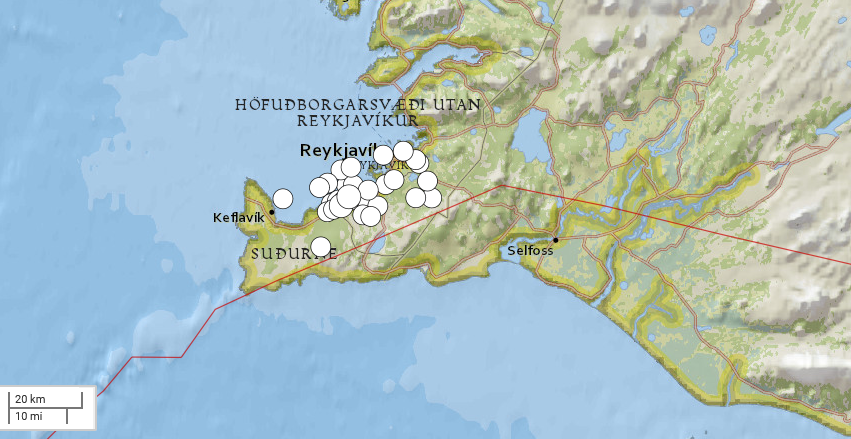
Earthquakes with a Magnitude of 4.0 or greater on the Reykjanes Peninsula over the past 30 days. USGS.

Iceland lies directly upon the Mid-Atlantic Ridge, a chain of (mostly) submerged volcanoes running the length of the Atlantic Ocean along which the ocean is splitting apart, with new material forming at the fringes of the North American and European Plates beneath the sea (or, in Iceland, above it). The Atlantic is spreading at an average rate of 25 mm per year, with new seafloor being produced along the rift volcanically, i.e. by basaltic magma erupting from below. The ridge itself takes the form of a chain of volcanic mountains running the length of the ocean, fed by the upwelling of magma beneath the diverging plates. In places this produces volcanic activity above the waves, in the Azores, on Iceland and on Jan Mayen Island. All of this results in considerable Earth-movement beneath Iceland, where Earthquakes are a frequent event.

 
The passage of the Mid-Atlantic Ridge beneath Iceland. NOAA National Geophysical Data Center.

See also...


Follow Sciency Thoughts on Facebook.

Follow Sciency Thoughts on Twitter.