Showing posts with label Fleas. Show all posts

Sunday, 22 March 2020

Saurophthirus laevigatus: A new species of Flea from the Early Cretaceous Yixian Formation of Liaoning Province, China.

Siphonaptera, commonly known as Fleas, are one of the widely known blood-sucking ectoparasitic Insects, comprising more than 2500 described species in 16 extant families. Up to now, the fossil Siphonaptera contain 16 species in five families from Cainozoic amber and Mesozoic compression fossils. All Cainozoic Fleas have been placed in two families, the Ctenophthalmidae and Pulicidae, while all Mesozoic Fleas, grouped in three families, the Pseudopulicidae, Saurophthiridae, and Tarwiniidae, which together form an extinct superfamily, the Saurophthiroidea, comprising nine species within five genera. Saurophthirus longipes, an unusual insect from the Early Cretaceous Zaza Formation of Baissa in Siberia, was described by Arnold Ponomarenko in 1976. He reported that its similarities with Fleas are piercing-sucking proboscis and soft distensible abdomen. A family of Saurophthiridae was established by Ponomarenko ten years later in 1986, including only this species. Another species of this family, Saurophthirus exquisitus, was described in 2013, based on three specimens, from the Early Cretaceous Yixian Formation of Liaoning Province, China, and it was suggested that the Saurophthiridae represent a transitional group from basal to extant Fleas. These fossil Fleas display some features seen in crown Fleas but are still considerably different from extant Fleas in many morphological characters, e.g., the absence of pronotal and genal ctenidia (comblike structures) on the body, the lack of the uniquely modified jumping hind legs, distinct ctenidia on the tibiae, more developed eyes, antennae with more than 15 segments, absence of laterally compressed abdomen, presence of medium body size, swollen hind coxae and partially extended male genitalia. These features indicate that Saurophthirus is more closely related to modern Fleas than to the Cretaceous genera Pseudopulex and Tarwinia.

In a paper published in the journal Acta Palaeontologica Polonica on 21 February 2020, Yanjie Zhang of the College of Life Sciences at Capital Normal University, Chungkun Shih, also of the College of Life Sciences at Capital Normal University, and of the Department of Paleobiology at the Smithsonian National Museum of Natural History, Alexandr Rasnitsyn of the Palaeontological Institute of the Russian Academy of Sciences, and Dong Ren and Taiping Gao, again of the College of Life Sciences at Capital Normal University, describe a new species of Saurophthirus from from the Yixian Formation of Liaoning Province, China, which produces Insects ranging in age from about 128.2 to 121.6 million years, with the majority of the specimens dated to about 125 million years ago (Early Cretaceous).

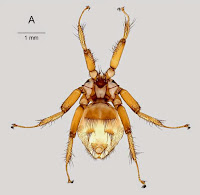
The new species is named  Saurophthirus laevigatus, meaning 'smooth' in Latin. It is described from a single, male, specimen with body almost perfectly fusiform and 9.8 mm long excluding antennae, almost completely-preserved ventral view, slightly dorsoventrally compressed. 

Saurophthirid Flea Saurophthirus laevigatus, male (holotype, CNU-SIP-LL2015001) from the Early Cretaceous Yixian Formation of Northeastern China. (A) Part, habitus in general view (A₁), line drawing (A₃), enlargement of antenna (A₂), details of genitalia (A₄), (A₅); 7, 8, 9, the seventh to ninth abdominal segments. (B) Counterpart, general view (B₁), enlargements of claws (B₂), (B₃), arrows. (A₅) photographed under alcohol. Scale bars: (A₁), (B₁) 1 mm; (A₃) 2 mm; (A₂), (A₄), (A₅), (B₂), (B₃) 0.5 mm. Zhang et al. (2020).

Extant Fleas display peculiar morphological characters including relatively small body-size, laterally compressed body, the uniquely modified jumping middle and hind legs. However, the morphological characters of the stem-group Fleas are primitive compared to the crown Fleas. The fossil Fleas known from the Mesozoic possess the following features to support their Flea affinity: the piercing-sucking mouthparts with serrate stylets to penetrate thick and body coverings; relatively large body with long but thin legs and scythe-shaped claws for living on a large surface; body and legs with stiff spines and setae all directed backward imply that they adapted to fix and move on a surface covered with hairs or feathers. Each of the above features separately can be probably found in some other insect groups. However, for insects having all these characters combined, they were most likely adapted to blood sucking of vertebrate host with outgrowths like hairs or feathers. Saurophthirids have been suggested to resemble crown-group Fleas. The new species has the 'transitional' characters of Saurophthiridae and particularly genus Saurophthirus, including the medium body size, short piercing-sucking stylet mouthparts, slender legs (enlarged hind coxae) and the half-retracted male genitalia.

Up to now, three families, four genera with seven fossil species of basal Flea insects have been reported from the Cretaceous of Australia, Russia, and the Northeastern China. In contrast to the species from the Jurassic, the taxa from the Cretaceous have a higher degree of richness, suggesting the Cretaceous is an important stage of evolutionary radiation after the origination of basal Fleas in the Jurassic.

For ectoparasitic insects living in feathers of feathered Dinosaurs, Pterosaurs, or Birds or in hairs of Mammals, their small body size would have provided advantage for concealment in the host and reduced probability for being detected and removed by the host. Furthermore, Zhang et al. consider that the reason for decreasing body size of basal Fleas was to reduce the blood intake and minimize Flea’s demand for food and energy inputs. The blood consumption of the flea is positively correlated with its weight, and the blood consumption of female Fleas are significantly higher than males. The blood consumption of the female Cat Flea, Ctenocephalides felis, per day is equivalent to 15.15 times of their body weight. So, Zhang et al. believe that the Early Cretaceous Fleas, especially the transitional Fleas, became smaller in order to avoid host detection and reduce blood intake, which is the adaptation to ectoparasitic life in the early stage of evolution. 

In addition, the evolution of the male genitalia is clearly indicated in fossils. The basal taxa from the Jurassic have entirely exposed genitalia with broad gonostylus articulated at apex to form a wide clasping organ, in contrast to the half-retracted genitalia from the Early Cretaceous. Therefore, Zhang et al.  believe that the new species with more retracted genitalia might have provided concealment and protection.

See also...

https://sciencythoughts.blogspot.com/2016/05/araeopsylla-goodmani-araeopsylla-smiti.htmlhttps://sciencythoughts.blogspot.com/2016/01/fossil-fleas-from-mesozoic-are-they-or.html
https://sciencythoughts.blogspot.com/2014/12/a-new-species-of-flea-from-early.htmlhttps://sciencythoughts.blogspot.com/2013/04/a-new-species-of-flea-from-philippines.html
https://sciencythoughts.blogspot.com/2012/03/giant-fleas-from-jurassic-of-china.html
Follow Sciency Thoughts on Facebook.

Tuesday, 3 May 2016

Araeopsylla goodmani & Araeopsylla smiti: Two new species of Bat Flea from Madagascar and Kenya.

Bat Fleas, Ischnopsyllidae, are specialised Fleas, Siphonaptera, which predominantly target Bats (flying animals present additional challenges for ectoparasites, and the different coverings of Birds and Bats mean that few species can target both; though both groups are highly prone to parasites, suggesting that targeting them is a successful ecological strategy). There are currently around 120 described species from every continent except Antarctica (which also lacks Bats).

In a paper published in the journal ZooKeys on 15 March 2016, Michael Hastriter of the Monte L. Bean Life Science Museum at Brigham Young University describes two new species of Bat Flea from Madagascar and Kenya. Both are placed in the genus Araeopsylla.

The first new species described is named Araeopsylla goodmani, in honour of Steven Goodman of the Field Museum of Natural History, who collected the specimen from which this species has been described, for his work on the Bats and small Mammals of Madagascar. The species is described from three female specimens obtained from a single male Black and Red Free-tailed Bat, Chaerephon jobimena, captured by the Namaza River in southern Madagascar.


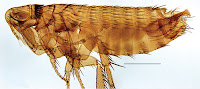
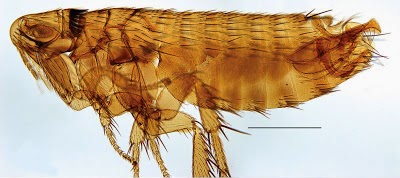
Araeopsylla goodmani, female specimen in lateral view. Scale bar is 500 μm. Hastriter (2016).

The second species described is named Araeopsylla smiti, in honour of Francicus Smit of the Natural History Museum for his work on Fleas. The species is described from a single male specimen collected by Hastriter from a Spotted Free-tailed Bat, Chaerephon bivittatus, captured near Lake Harrington in Kenya's Rift Valley in 1968, and to date the only specimen of Araeopsylla ever collected in Kenya (though the genus is well known from other areas in Africa).

Araeopsylla smiti, male specimen. (8) Head and pronotum. (9) Terminal segments, before dissection. (10) Basimere, telomere, and eighth tergum. (11) Aedeagus, eighth sternum, and distal arm of ninth sternum, (Cr. Scl., Crescent Sclerite; LL, Lower Lobe; M.D.L., Median Dorsal Lobe; S.I.T., Sclerotized Inner Tube). (12) Hind tibia. (13) Fourth and fifth segments of distitarsomere 2. Scale bars are 200 μm (8–12), 100 μm (13). Hastriter (2016).

See also...

http://sciencythoughts.blogspot.co.uk/2016/01/fossil-fleas-from-mesozoic-are-they-or.htmlFossil Fleas from the Mesozoic - are they or aren't they?                                              Putative Mesozoic fossil Fleas were first recorded in Australia and Russia in the 1970s, with a number of recent publications describing Fleas from the Jurassic and Cretaceous of China. These Fleas have been speculated to have been ectoparasites (parasites...
http://sciencythoughts.blogspot.co.uk/2014/12/nycteribiid-bat-flies-from-southwest.htmlNycteribiid Bat Flies from the southwest Indian Ocean.                                                            Nycteribiid Bat Flies are True Flies, Diptera, that have lost their wings and adopted a lifestyle as ectoparasites of Bats. They have an unusual lifestyle, with the larva maturing within the female Fly (which only produces one larva at a time), then being ‘laid’ during the pupa stage. The female Fly leaves her host Bat to lay this pupa, which hatches 3-4 weeks later, producing a new...
http://sciencythoughts.blogspot.co.uk/2013/04/a-new-species-of-flea-from-philippines.htmlA new species of Flea from the Philippines. Fleas of the Family Stivaliidae are found across Africa, Australasia and Southeast Asia. They are specialist parasites of Rodents and Shrews (and...
Follow Sciency Thoughts on Facebook. 

Franciscus Smi
Franciscus Smi
Franciscus Smi

Friday, 22 January 2016

Fossil Fleas from the Mesozoic - are they or aren't they?

Putative Mesozoic fossil Fleas were first recorded in Australia and Russia in the 1970s, with a number of recent publications describing Fleas from the Jurassic and Cretaceous of China. These Fleas have been speculated to have been ectoparasites (parasites that live on the exterior surfaces of their hosts) of a range of vertebrate animals, including feathered Dinosaurs, Birds, Pterosaurs and Mammals, however these associations are all based upon the presence of the Flea fossils in the same strata as their possible hosts; no Flea has been found preserved within the fur or feathers of a host animal.

In a paper published in the journal BMC Evolutionary Biology on 11 January 2016, Katharina Dittmar of the Department of Biological Sciences and Graduate Program of Evolution, Ecology, and Behavior at the University at Buffalo, Qiyun Zhu, also of the Department of Biological Sciences at the University at Buffalo, Michael Hastriter of the Monte L. Bean Museum at Brigham Young University and Michael Whiting of the Department of Biology and M. L. Bean Museum at Brigham Young University review these findings and find no evidence that the Insects preserved were or were not Fleas and/or ectoparasites of vertebrate animals.

Fleas can be identified morphologically by a number of features, these being lateral (sideways) flattening, the absence of wings combined with a highly modified wing joint, a saddle-shaped pygidium (structure formed of the rearmost segments), highly modified rear legs allowing the distinctive jumping movement associated with Fleas, mouthparts modified to form a piercing stylet and reduced eyes. While the numerous putative 'Flea' fossils are generally Flea-like in appearance, only two of these features, reduced eyes and modifieds mouthparts forming a piercing stylet, have been observed, both of which are known to have arisen separately in a wide range of Insect groups, preventing the confident assignment of these Insects to the order Siphonaptera (Fleas). Furthermore Dittmar et al. note that genetic studies of Fleas using molecular clock methodologies have predicted that the group arose some time during the Cretaceous, making putative Jurassic and even Early Cretaceous fossil Fleas somewhat unlikely.

 A possible fossil Flea from the Early Cretaceous Yixian Formation of Liaoning Province, China. Gao etal. (2014).

From an ecological perspective these Insects have been identified as animal ectoparasites based upon the presence of piercing stlylets and the presence of claws and bristles which would enable them to cling onto their hosts. However such stylets are present in Insects with a range of different lifestyles, including bloodsucking (Fleas, Mosquitoes), sucking the sap of plants (Aphids) and even predating other invertebrates (Assassin Bugs), and so cannot be taken in themselves as evidence of a bloodsucking lifestyle, while claws and bristles facilitate movement in a variety of complex three dimensional environments, not just feathers and fur, leading Dittmar et al. to conclude there is no evidence for or against an ectoparasitic lifestyle in these specimens.

See also...

http://sciencythoughts.blogspot.co.uk/2014/12/a-new-species-of-flea-from-early.htmlA new species of Flea from the Early Cretaceous of Liaoning Province, China.      The first Mesozoic fossil Fleas were discovered in Cretaceous deposits in Australia and Russia in the 1970s. However no further Mesozoic Fleas...

http://sciencythoughts.blogspot.co.uk/2013/04/a-new-species-of-flea-from-philippines.htmlA new species of Flea from the Philippines. Fleas of the Family Stivaliidae are found across Africa, Australasia and Southeast Asia. They are specialist parasites of Rodents and Shrews (and...
http://sciencythoughts.blogspot.co.uk/2012/03/giant-fleas-from-jurassic-of-china.htmlGiant Fleas from the Jurassic of China.      Fleas are highly specialized parasitic insects, preying on mammals and birds. They are related to Flies and Scorpionflies, though this relationship is not obvious as Fleas have become physically specialized, loosing their wings, altering their body shape and evolving specialized legs and mouthparts. A number of putative fossil fleas have been described from the Jurassic...
Follow Sciency Thoughts on Facebook.
 

Friday, 5 December 2014

A new species of Flea from the Early Cretaceous of Liaoning Province, China.


The first Mesozoic fossil Fleas were discovered in Cretaceous deposits in Australia and Russia in the 1970s. However no further Mesozoic Fleas were reported between 1976 and 2012, since when a number of fossil Fleas have been reported from the Jurassic and Early Cretaceous of northeastern China. These Mesozoic Fleas are larger than modern Fleas (with Jurassic Fleas being larger than Cretaceous Fleas), and are thought to have fed on feathered Dinosaurs, early Birds, Mammals and Pterosaurs.

In a paper published in the journal BMC Evolutionary Biology on 27 August 2014, Taiping Gao and Chungkun Shih of the College of Life Sciences at Capital Normal University, Alexandr Rasnitsyn of the Palaeontological Institute of the Russian Academy of Sciences and the Natural History Museum in London, XingXu of the Key Laboratory of Evolutionary Systematics of Vertebrates at the Instituteof Vertebrate Paleontology and Paleoanthropology of the Chinese Academy ofSciences, Shuo Wang of the Key Laboratory of Evolutionary Systematics of Vertebrates, and of the Graduate University of the Chinese Academy of Sciences, and Dong Ren, also of the College of Life Sciences at Capital Normal University describe a new species of Flea from the Early Cretaceous Yixian Formation of Liaoning Province, China.

The new species is placed in the genus Pseudopulex, which already contains two species, and given the specific name tanlan, meaning ‘avaricious’ in Mandarin, due to the fully distended abdomen of the female specimen, and the voracious feeding this implies. The species is described from two specimens, a female 9.26 mm in length and a male 9.5 mm in length. Both specimens come from an exposure of the Yixian Formation at Dawangzhangzi Village, which has been dated to 124.6 million years old.

Female specimen of Pseudopulex tanlan, (A) photograph and (B) line drawing. Gao et al. (2014).

The female specimen of Pseudopulex tanlan has a notably distended abdomen, which Gao et al. interpret as a sign that it had fed shortly before its death. The width of the abdomen is 4.0 mm, equal to 43% of its length, compared to an average of 28% for other described female Mesozoic Fleas. Gao et al. estimate that when not distended the abdomen would only have been 2.6 mm wide, suggesting that the Insect had ingested about 0.02 ml of blood, roughly 15 times the amount that modern Fleas typically consume.

Male specimen of Pseudopulex tanlan, (A) photograph and (B) line drawing. Gao et al. (2014).

See also…

Hangingflies are long-legged Scorpionflies (Mecoptera), a group of insects related to the True Flies. Scorpionflies get their name from the reproductive organs of the males of some species, which resemble the tails of Scorpions. Despite this fierce appearance most species are harmless herbivores, though it is thought that fleas are highly...

http://sciencythoughts.blogspot.co.uk/2013/04/a-new-species-of-flea-from-philippines.htmlA new species of Flea from the Philippines.  Fleas of the Family Stivaliidae are found across Africa, Australasia and Southeast Asia. They are specialist parasites of Rodents and Shrews (and occasionally...
http://sciencythoughts.blogspot.co.uk/2012/03/giant-fleas-from-jurassic-of-china.html Giant Fleas from the Jurassic of China.         Fleas are highly specialized parasitic insects, preying on mammals and birds. They are related to Flies and Scorpionflies, though this relationship is not obvious as Fleas have become physically specialized, loosing their wings, altering their body shape and evolving specialized legs and mouthparts. A number of putative fossil fleas have been described from the Jurassic...

Follow Sciency Thoughts on Facebook.

Wednesday, 10 April 2013

A new species of Flea from the Philippines.

Fleas of the Family Stivaliidae are found across Africa, Australasia and Southeast Asia. They are specialist parasites of Rodents and Shrews (and occasionally Birds), spending much of their life-cycle living in the host's nest, rather than on the animal itself. Their closest relatives, Pygiopsylid and Lycopsyllid Fleas, are mainly parasites of Marsupials and Monotremes.

In a paper published in the journal ZooKeys on 18 January 2013, Michael Hastriter of the Monte L. Bean Life Science Museum at Brigham Young University and Sarah Bush of the Department of Biology at the University of Utah describe a new species of Stivaliid Flea found living on Luzon Shrews (Crocidura grayi) on Luzon Island in the Philippines.

The new species is placed in the genus Lentistivalius, which is found on Mice and Shrews (and in one case Birds) across Southeast Asia, and given the specific name philippinensis, meaning from the Philippines. It is a 2.5 mm spiny flea with a prominent spur on its hind limb, named from two male specimens, the female being unknown.


Lentistivalius philippinensis. Scale bar is 500 μm. Hastriter & Bush (2013).

The location where Lentistivalius philippinensis was discovered.

See also Giant Fleas from the Jurassic of China.

Follow Sciency Thoughts on Facebook.

Thursday, 1 March 2012

Giant Fleas from the Jurassic of China.

Fleas are highly specialized parasitic insects, preying on mammals and birds. They are related to Flies and Scorpionflies, though this relationship is not obvious as Fleas have become physically specialized, loosing their wings, altering their body shape and evolving specialized legs and mouthparts. A number of putative fossil fleas have been described from the Jurassic and Cretaceous of Asia and Australia, but these are very different to modern fleas, leading many scientists to question if they are in fact fleas.

In a paper in the 29 February 2012 edition of the journal Nature, a team of scientists led by Diying Huang of the State Key Laboratory of Palaeobiology and Stratigraphy at the Nanjing Institute of Geology and Palaeontology part of the Chinese Academy of Sciences, describing a number of fleas from the Middle Jurassic and Early Cretaceous of China.

Giant Fleas from the Middle Jurassic (165 million years ago) of Daohugou in Inner Mongolia. The female, left is 20 mm long, the male, right, 15 mm. From Huang et al. (2012).

These fleas lack the jumping legs of modern fleas, but are fairly flea-shaped, and do have the mouthparts of fleas. They appear to be adapted to clinging onto feathers or course hairs. Modern reptiles have thick, scaly skins, which offer protection against fleas (though some other parasites can deal with this), but many Jurassic Dinosaurs are known to have been feathery, and Pterosaurs appear to have had hairy skin. Hair and feathers are superior to scales in many ways, particularly insulation, but parasites such as fleas find it easy to get underneath them and target the soft skin beneath.

Fleas from the Early Cretaceous (125 million years ago) of Huangbanjigou in Liaoning Province. (a) Male. Scale bar 2 mm. (b) Enlargement of the mouthparts of (a). Scale bar 1 mm. (c) Enlargement of the genitalia of (a). Scale bar 1 mm. (d) Female. Scale bar 2 mm. From Huang et al. (2012).

The described fleas are very large compared to modern fleas, up to 20 mm (2 cm) in length, suggesting they may have fed on similarly large target species (the largest mammals of the time were a few centimeters long, unlikely to have been able to support such large parasites). Certainly fleas which evolved on the feathers of Dinosaurs and hair of Pterosaurs would be pre-adapted to live on the feathers of birds and fur of mammals, when these became available.

These new Fleas may also help to resolve the status of previously described species that have been disputed as Fleas, buy helping to build up an understanding of the character traits present in early members of the group.

Tarwinia australis, a putative fossil Flea from the Late Cretaceous of Australia. Like the Chinese Fleas Tarwinia lacks the jumping legs of modern species, which had caused some palaeontologists to question whether it was a true Flea. From Museum Victoria.

Strashila incredibilis, a possible Flea from the Late Jurassic of Eastern Siberia. It appears unlike either Jurassic or Modern Fleas, and may be some sort of Louse. Grimaldi & Engel (2005). Evolution of the Insects. Cambridge University Press.