Showing posts with label Freshwater Perch. Show all posts

Wednesday, 25 December 2013

Two new species of Gourami from Sumatra.

Gourami (Osphronemidae) are freshwater members of the Perch Order (Perciformes) found from Pakistan to Korea and south to Indonesia. They are often found in shallow, warm, oxygen-poor waters, and have a special lung-like labyrinth organ, that allows them to gulp air and absorb oxygen from it. Many species of Gourami are mouth breeders (i.e. they raise their young in their mouths), others build nests and are often highly terretorial.

In a paper published in the journal Vertebrate Zoology on 10 December 2012, Ingo Schindler and Horste Linke describe two new species of Gourami from Sumatra, Indonesia. Both are placed in the genus Parosphromenus, which is known from Peninsula Thailand and Malaysia, as well as Sumatra, Borneo and some smaller Indonesian islands.

The first new species is named Parosphromenus gunawani, in honour of Gunawan ‘Thomas’ Kasim, whi helped to collect the specimens from which the species is named. Thus is a 124-130 mm yellowish or light brown Fish, with darker stripes and black red and blue bands on its fins. The species was found living in waters 30-100 cm deep in peat swamps in northern Jambi province. The water in these swamps was coloured a dark brown, and had a pH averaging about 4.1 (roughly as acid as Tomato juice).

Parosphromenus gunawani, adult male. Schindler & Linke (2012).

The second new species is named Parosphromenus phoenicurus, meaning 'crimson tail'. This is a 129-133 mm yellowish or light brown Fish with black, red and blue bands on its fins and a distinctive red and black tail. It was found living in black swampwater, with a pH of about 5.25 in the Sungai
Kampar river drainage at Langgam in the province of Riau.

 Parosphromenus phoenicurus, adult male. Schindler & Linke (2012).

 Island of Sumatra, showing collecting sites for  Parosphromenus phoenicurus (yellow dot) and  Parosphromenus gunawani (red dot).  Schindler & Linke (2012).


Follow Sciency Thoughts on Facebook.

Friday, 14 September 2012

A new species of Cichlid Fish from Lake Malaŵi.

The Cichlids are an extremely successful group of freshwater Perciform Fish (Perches), found in North, Central and South America, as well as the Caribbean, the Middle East, South Asia and, most notably Africa, where the group reaches its highest diversity. Over 700 species have been described from Lake Malaŵi alone, which is more species of freshwater fish than have been described from the entire Northern Hemisphere and slightly over 1% of every vertebrate species ever described. 

In a paper published in the journal Zootaxa on 6 August 2012, researcher and Cichlid specialist Michael Oliver describes a new species of Cichlid from Lake Malaŵi. The new species is based upon two specimens in museum collections; the first caught in an experimental sampling expedition, north of Thumbi Island West at a depth of 17-38 m, in 1980, and now sits in the collection of the Peabody Museum of Natural History at Yale University, and the second purchased from indigenous fishermen at Nkhata Bay in 1997, and now in the collection of the Royal Museum for Central Africa in Tervuren, Belgium. Since the Cichlid fauna of Lake Malaŵi has been studied and sampled extensively for many years and only two specimens of this fish are known it is presumed to be quite rare.

Map of Lake Malaŵi, showing the locations where the two specimens were found. Oliver (2012).

The new Cichlid is placed in the genus Hemitaeniochromis, which until now contained only a single species (Hemitaeniochromis urotaenia), and is given the name Hemitaeniochromis brachyrhynchus, the short-snouted HemitaeniochromisHemitaeniochromis brachyrhynchus has a shorter snout than Hemitaeniochromis urotaenia, caused by a narrowing of the lacrimal bones (which form part of the eye socket); this also causes larger eyes in Hemitaeniochromis brachyrhynchus. The colouration of Hemitaeniochromis brachyrhynchus is unkown, as both preserved specimens have lost their original colour.

The Yale specimen (a) and Royal Museum specimen (b) of Hemitaeniochromis brachyrhynchus. (a) is 123.6 mm long and (b) is 81.5 mm long. Oliver (2012).
The closely related Hemitaeniochromis urotaenia. Oliver (2012).


Follow Sciency Thoughts on Facebook.

Thursday, 9 August 2012

Two new species of Asian Sea Bass from South Asia.

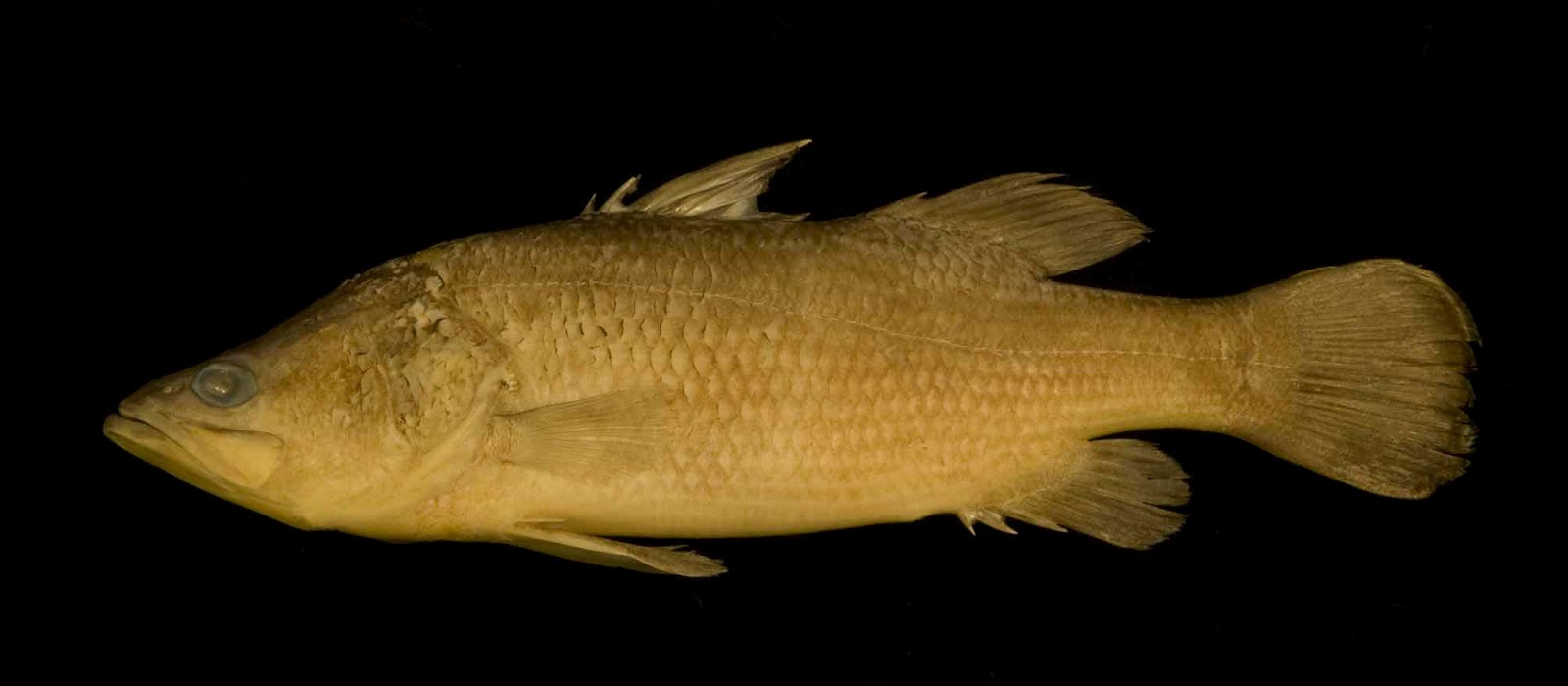
Freshwater Perch of the genus Lates are large carnivorous fish found in Africa, Asia and Australia. The best known African species is the Nile Perch, Lates niloticus, but there are a number of other species in the lakes and rivers of East Africa and Arabia. Further east there are only two species recognized, the Japanese Perch, Lates japonicus, and the Barramundi or Asian Sea Bass, Lates calcarifer, which is found from the Persian Gulf to Northern Australia. Lates calcarifer is not completely tied to freshwater, as it breeds in brackish estuarine or even shallow marine waters and fully marine populations are known, though it is generally considered a river fish. This ability to live in seawater helps to explain the wide distribution of Lates calcarifer, but it has long been suspected that the species might in fact be made up of a number of cryptic species; populations apparently identical but genetically distinct and incapable of interbreeding.

In a paper published in the journal Zootaxa on 16 May 2012, Rohan Pethiyagoda of the Australian Museum in Sydney and Anthony Gill of the Macleay Museum and School of Biological Sciences at the University of Sydney present the results of a genetic survey of 'Lates calcarifer' from Australia, India, Malaysia, Myanmar (Burma), Singapore, Sri Lanka and Thailand, which uncovered two new, cryptic, species in Sri Lanka and Myanmar, which are formally described in the paper.

The original illustration of Lates calcarifer (or Holocentrus calcarifer as it was originally called); the precise origin of this fish is unclear. Bloch (1790)/Pethiyagoda & Gill (2012).

The first new species described is Lates lakdiva, where 'lakdiva' means coming from Sri Lanka, and Pethiyagoda and Gill propose that this fish should be known as the Sri Lankan Sea Bass in English. This species is described from three fish obtained at the St John’s Fish Market in Colombo, Sri Lanka, in 1994 by the Australian Museum. The three fish measure 220 mm, 239 mm and 256 mm, respectively. The conservation status of Lates lakdiva is extremely uncertain, as the precise origin of the fish is unknown, and large numbers of Lates sp. (i.e. fish in the genus Lates but of uncertain species) have been introduced to estuaries of rivers in Sri Lanka by the fishing industry in recent years.

Specimen of Lates lakadiva. This has been preserved in alcohol since 1994, and its original coloration is unclear. Pethiyagoda & Gill (2012).

The second new species is Lates uwisara, named in honour of U Wisara, a Burmese monk who died as a result of a hunger strike while in prison for protesting against British rule, and who is considered a national hero in Myanmar. It is described from four specimens collected from river estuaries between Yangon and Sittang in 2005 and now in the Australian National Fish Collection at the Commonwealth Scientific and Industrial Research Organisation in Hobart. The four specimens are 353 mm, 363 mm, 332 mm and 350 mm in length, respectively. Pethiyagoda and Gill propose that this fish should be known as the Myanmar Sea Bass in English. Specimens of this fish were also found from fish farms in French Polynesia (where there are no native Lates). Since Lates are also farmed in Myanmar, this raises the possibility that the fish is not native to the areas where it was found.

Specimen of Lates uwisara. This has also lost its original coloration, having been preserved in alcohol since 2005. Pethiyagoda & Gill (2012).

See also New species of Priapiumfish from the Mekong DeltaNew species of Japanese Goby from TaiwanHead-Butting in Giant Bumphead ParrotfishNew species of Sleeper Gobie from the Early Miocene of Otago, New Zealand and Boney Fish on Sciency Thoughts YouTube.

Follow Sciency Thoughts on Facebook.