Showing posts with label Perch. Show all posts

Sunday, 23 March 2014

A new species of Sweeper from the Comoro Islands.

Sweepers (Pempheridae) are small nocturnal Fish found in the Western Atlantic and Indo-Pacific. They are members of the Perch order, Perciformes, with deeply keeled flattened bodies and large eyes. Some species are eaten and some others caught for use in aquaria. 

In a paper published in the journal Zootaxa on 21 March 2014, Randall Mooi of the Manitoba Museum and the Department of Biological Sciences at the University of Manitoba and John Randall of the Bishop Museum in Honolulu describe a new species of Sweeper from the Comoro Islands.

The new species is placed in the genus Pempheris and given the specific name bexillon, meaning banner or flag in Greek, a reference to the brightly coloured dorsal fin of the new species. Pempheris bexillon is described from 11 specimens caught around the Comoro Islands, and a further 12 specimens from around the Mascarine Islands and Madagascar, at depths of less than 100 m. It is a 129-151 mm Sweeper with a distinctive yellow and black dorsal fin.

Pempheris bexillon in left lateral view. Mooi & Randall (2014).


Follow Sciency Thoughts on Facebook.

Wednesday, 25 December 2013

Two new species of Gourami from Sumatra.

Gourami (Osphronemidae) are freshwater members of the Perch Order (Perciformes) found from Pakistan to Korea and south to Indonesia. They are often found in shallow, warm, oxygen-poor waters, and have a special lung-like labyrinth organ, that allows them to gulp air and absorb oxygen from it. Many species of Gourami are mouth breeders (i.e. they raise their young in their mouths), others build nests and are often highly terretorial.

In a paper published in the journal Vertebrate Zoology on 10 December 2012, Ingo Schindler and Horste Linke describe two new species of Gourami from Sumatra, Indonesia. Both are placed in the genus Parosphromenus, which is known from Peninsula Thailand and Malaysia, as well as Sumatra, Borneo and some smaller Indonesian islands.

The first new species is named Parosphromenus gunawani, in honour of Gunawan ‘Thomas’ Kasim, whi helped to collect the specimens from which the species is named. Thus is a 124-130 mm yellowish or light brown Fish, with darker stripes and black red and blue bands on its fins. The species was found living in waters 30-100 cm deep in peat swamps in northern Jambi province. The water in these swamps was coloured a dark brown, and had a pH averaging about 4.1 (roughly as acid as Tomato juice).

Parosphromenus gunawani, adult male. Schindler & Linke (2012).

The second new species is named Parosphromenus phoenicurus, meaning 'crimson tail'. This is a 129-133 mm yellowish or light brown Fish with black, red and blue bands on its fins and a distinctive red and black tail. It was found living in black swampwater, with a pH of about 5.25 in the Sungai
Kampar river drainage at Langgam in the province of Riau.

 Parosphromenus phoenicurus, adult male. Schindler & Linke (2012).

 Island of Sumatra, showing collecting sites for  Parosphromenus phoenicurus (yellow dot) and  Parosphromenus gunawani (red dot).  Schindler & Linke (2012).


Follow Sciency Thoughts on Facebook.

Sunday, 24 November 2013

The new species of Anthia from the Marquesa Islands in French Polynesia.

Anthias (Anthiinae), or  are small brightly coloured fish belonging to the Grouper Family (Serranidae) in the Perch Order (Perciformes). They are found in large numbers on many coral reefs, and tend to be highly endemic (i.e. species tend to have limited ranges), leading to a large number of different species. The variety, bright colouration and sociable nature of Anthias make them popular in the aquarium trade. All Anthias are born female, and join the harem of a male that controls a section of reef upon reaching maturity. Anthias grow throughout their lives, and when a male dies the largest female in his harem will  change sex, becoming male and taking over the harem.

In a paper published in the journal Zootaxa on 8 May 2013, Jeffrey Williams of the Division of Fishes at the Department of Vertebrate Zoology at the National Museum of Natural History and Erwan Delrieu-Trottin and Serge Plans of the Centre de Recherche Insulaire et Observatoire de l'Environnement at the Université de Perpignan describe two new species of Anthia from the Marquesa Islands in French Polynesia. 

The first new species described is placed in the genus Plectranthias and given the specific name flammeus, meaning fiery. Plectranthias flammeus is a 11.5–23.4 mm, white Fish with red, orange and yellow blotches. It was found living on a rock wall with a rubble and sand base near Nuku Hiva Island, towards the northwest end of the Marquesa Island chain.


Plectranthias flammeus. Williams et al. (2013).

The second new species is placed in the genus Pseudanthias and given the specific name oumati, a Marquesan word for the Sun, in reference to its brilliant yellow colour. Pseudanthias oumati is a 58 mm bright yellow Fish. It was found living near a sloping reef at a depth of 50-55 m near Fatu Hiva island at the southeastern end of the Marquesa group.

Pseudanthias oumatiWilliams et al. (2013).

The localities where the two Anthia species were discovered. Plectranthias flammeus, green, and Pseudanthias oumati, red. Google Maps. 

See also New species of Wrasse from the Unfortunate IslandsA new species of deepwater Goatfish from Vanuatu, A new species of Goby from the southwest Indian OceanA new species of Blenny from Curaçao and A new species of Jawfish from the coast of Kerala State, India.

Follow Sciency Thoughts on Facebook.

Friday, 16 August 2013

A new species of Cichlid Fish from the Río Acaray in Paraguay.

The Cichlids are an extremely successful group of freshwater Perciform Fish (Perches), found in North, Central and South America, as well as the Caribbean, the Middle East, South Asia and, most notably Africa, where the group reaches its highest diversity. There are one of the most diverse Fish, and therefore Vertebrate, families, with over 1600 described species. Over 700 species have been described from Lake Malaŵi alone, which is more species of freshwater fish than have been described from the entire Northern Hemisphere and slightly over 1% of every vertebrate species ever described. hey are popular in the aquarium trade, which has led to them becoming naturalized in many parts of the world where they are not native.

In a paper published in the journal Zootaxa on 23 April 2013, Sven Kullander of the Department of Zoology at the Swedish Museum of Natural History and Carlos de Lucena of the Laboratório de Ictiologia at the Museu de Ciências e Tecnologia at the Pontifícia Universidade do Rio Grande do Sul describe a new species of Cichlid Fish from the Río Acaray drainage basin in Paraguay.

The new species is placed in the genus Crenicichla and named Crenicichla gillmorlisi, in honour of Walter Gill Morlis, a fisheries officer of the Itaipú Binacional Hydroelectric Project in Ciudad del Este, Paraguay. Crenicichla gillmorlisi is a silvery Cichlid Fish with an olive sheen reaching 174 mm in length. It has a specked body and a distinctive bar beneath the eye.

Crenicichla gillmorlisi, male specimen from the Yguazú Reservoir. Walter Gill Morlis in Kullander & de Lucena (2013).

Crenicichla gillmorlisi appears to be restricted to the drainage basin of the Río Acaray, a tributary of the  Río Paraná, where it appears to dwell close to overgrown riverbanks, often with turbid water. The Río Acaray now has two barriers to Fish movement, the Acaray Hydroelectric Power Plant and the Yguazú Reservoir, both of which dam the river. This clearly divides the population of Crenicichla gillmorlisi into smaller sub-populations, though what effect this is having on the long-term viability of the species is unclear.

The known distribution of Crenicichla gillmorlisi; black spots represent sites where the fish has been found. Kullander & de Lucena (2013).

Typical habitat where Crenicichla gillmorlisi has been found. Kullander & de Lucena (2013).


Follow Sciency Thoughts on Facebook.

Monday, 1 July 2013

Five new species of Mbuna from Lake Malaŵi.

Mbuna are rock dwelling Cichlids known only from Lake Malaŵi in East Africa. They are typically colourful Fish, and often sexually dichromic (the males and females are different colours), making them popular in the aquarium trade. Mbunas are social Fish, with each males defending a territory a group of females. They are mouth brooders, with the females incubating the eggs in their mouths, and the newly hatched fry returning to the mothers mouth for shelter when threatened.

In a paper published in the journal Zootaxa on 8 May 2013, Jay Stauffer  and Kristin Black of the School of Forest Resources at Pennsylvania State University, and Adrianus Konings of the Cichlid Press describe five new species of Mbuna from Lake Malaŵi, all placed within the genus Metriaclima.

The first new species is named Metriaclima pambazuko, 'pambazuko' being the Swahili word for sunrise, a reference to the orange or red dorsal fins of the males. Metriaclima pambazuko is a 61-75 mm  (adult length) Mbuna found around Lundo and Hingi Islands on the Tanzanian part of the lake and Londi Bay on the Mozambique shore. The males are blue with 5-7 black bars the dorsal fin is blue gray or black, shading to yellow, orange or red away from the body. Females are grey-blue or light brown with grey bars.

Metriaclima pambazuko, (top) 70 mm male from Hongi Island, (bottom) 55 mm female from Londo Bay. Stauffer et al. (2013).

The second new species is Metriaclima lundoense, 'lundoense' referring to Lundo Island, the only locality where the Fish was found. Metriaclima lundoense has an adult length of 63-85 mm. The males are blue with black bars, the females light brown with blue and green highlights and (sometimes) faint brown bars.

Metriaclima lundoense, (top) 80 mm male, (bottom) 70 mm female. Both from around Lundo Island. Stauffer et al. (2013).

The third new species described is named Metriaclima midomo, 'midomo' meaning 'lips' in Swahili, the Fish having enlarged lips relative to other members of the genus. Metriaclima midomo has an adult length of 66-99 mm. The males are blue with green highlights and 5-9 black bars, the females are blue with green highlights and 5-7 faint bars. The fish were found only around Lundo Island.

Metriaclima midomo, (top) 80 mm male, (bottom) 70 mm female. Both from around Lundo Island. Stauffer et al. (2013).

The fourth new species is named Metriaclima tarakiki, 'tarakiki' meaning slender in Swahili, the fish being elongate in shape. Metriaclima tarakiki has an adult bodylength of 72-120 mm, the males are blue-white with 7-9 black bars, the females have two colour schemes, some being light brown others being yellow or orange with black blotches. The fish were found around Ngkuyo Island and Higga Reef on the Tanzanian part of the lake.

Metriaclima tarakiki, (top) 110 mm male from Higga Reef, (bottom) 90 mm female from Higga Reef. Stauffer et al. (2013).

The final new species is named Metriaclima nigrodorsalis, 'nigrodorsalis' meaninf 'black-dorsal' in Latin, the males and some females having a black band on the dorsal fin. Metriaclima nigrodorsalis has an adult length of 55-84 mm. This is a variable Fish with several different colour schemes, the males can be light blue, dark blue or yellow, with a yellow or grey belly and 6-10 black bars, the females cna be blue or light brown with grey or dark brown bars. Metriaclima nigrodorsalis was found at N’kolongwe, Thundu, Nkhungu, Chiloelo, and Charlie’s Bay, all on the Mozambican part of the lake.

Metriaclima nigrodorsalis, (top) 75 mm male from N'kolongwe, (upper middle) 70 mm female from N'kolongwe, (lower middle) 75 mm male from Chiloelo, and (bottom) 80 mm male from Nkhungu Point. Stauffer et al. (2013).

Map of Lake Malaŵi, showing locations where Mbuna were sampled in this study. Stauffer et al. (2013).


Follow Sciency Thoughts on Facebook.

Sunday, 30 June 2013

A new species of deepwater Goatfish from Vanuatu.

Goatfish are largish, often brightly coloured Fish in the Mullet Family, Mullidae (making them Perciformes). They are bottom feeding Fish that have deep, elongated bodies and whiskers which they use for probing sediments for invertebrate prey. Goatfish are highly prized as food Fish in many cultures.

In a paper published in the journal Zootaxa on 31 May 2013, Franz Uiblein of the Institute of Marine Research in Bergen and the South African Institute of Aquatic Biodiversity and Romain Causse of the Borea Research Unit at the Muséum national d'Histoire naturelle, discuss the discovery of a new species of deepwater-dwelling Goatfish from Vunuatu in the South Pacific.

The new species is placed in the genus Upeneus, and given the specific name vanuatu, in reference to where it was discovered - making it the Vanuatu Goatfish. Upeneus vanuatu was discovered living in the waters off Espiritu Santo and Malo Islands, at depths of 191-321 m. This is only the fourth species in the genus to have been found living at depths in excess of 100 m, though since two of the other three species have been discovered since 2000, Ublein and Causse suggest that there may be more, undiscovered, deepwater species in this genus around the world. 

Upeneus vanuatu has an adult size of 80-100 mm, it is a rose-pink Fish with patterns of bars on its fins, these patterns being variable and possibly specific to the individual Fish. 

Upeneus vanuatu, 8.3 cm specimen caught of the island of Malo in Vanuatu. Uiblien & Causse (2013).


Follow Sciency Thoughts on Facebook.

Saturday, 29 June 2013

Choking on Fish is a significant cause of death for Dolphins in Indian River Lagoon, Florida.


Bottlenose Dolphins (Tursiops truncatus) are predatory Ceteceans, which primarily hunt small Fish. They are intelligent, social animals, which hunt in packs and are capable of developing new hunting methods to deal with novel prey items.

In a study published in a paper in the journal PLoS One on 19 June 2013, a group of scientists led by Megan Stolen of the Hubbs-SeaWorld Research Institute looked at causes of death among stranded Dolphins in the Indian River Lagoon and adjacent areas of the Atlantic Ocean over a 14 year period from 1997 to 2011. During this period they found that 14 of 350 Dolphin deaths in the lagoon were a direct result of choking on fish (4% of the total), while none of the 186 dead Dolphins recovered from the open ocean had died in this way. Dolphins that have died in this way have been found before, but this is extremely rare; of 19 recorded cases of Dolphins choking on Fish known globally, 14 are from this location and discussed in this study. 

The body of a Bottlenose Dolphin with a Fish lodged in its esophagus. In this case the Fish is a Sheepshead (Archosargus probatocephalus). Stolen et al. (2013).

In all cases the Fish were lodged in the esophagus of the Dolphins, compressing or displacing the larynx, and preventing the Dolphins from breathing. In five cases the Fish were found with their tales still protruding from the Dolphin's mouth. In seven cases the Fish were held in place close to the larynx by strong dorsal spines. Eight of the Dolphins were male, two Female and one to badly decomposed to be identified. Twelve of the Dolphins were adults, two juveniles.

In five of the cases the Fish were associated with fishing tackle; two of the Fish had lures attached, and one Fish had a line attached with hooks that had become embedded in the Dolphin's esophagus. In the remaining two cases lines and lures were present, but not attached to the fish, making it hard to say with confidence that they had come from this Fish which had killed the Dolphin.

All the fish were between 19 and 40 cm in length; well within the normal range of Fish consumed by Bottlenose Dolphins. Eight of the fish could be identified to specific level; six Sheepshead (Archosargus probatocephalus), one Black Chin Tilapia (Sarotherodon melanotheron) and one striped mojarra (Diapterus plumieri). Two other fish were tentatively identified as Tilapia (Cichlidae) and one as a Jack (Carangidae).
Sheepshead are a common Fish on the southern Atlantic and Gulf coasts of the US, but are not normally considered an important prey item for Dolphins. They are spiny members of the Perch order (Perciformes) and have a deeper body profile than the Fish usually favored by Dolphins, suggesting that they are a rather risky prey item, which Dolphins would normally avoid. Why the Dolphins of Indian River Lagoon are targeting this Fish is unclear.

The Sheepshead (Archosargus probatocephalus), a deep-bodied, spiny, Perciform Fish. Wikimedia Commons/Bulletin of the United States Fish Commission.

Tilapia (which are also Perciformes) are not native to Florida, but have been introduced via Fish farms and are becoming increasingly common in the lagoons. They are similar in shape to familiar prey Fish, but again have prominent spines which may facilitate them becoming lodged in the throats of Dolphins.

The Black Chin Tilapia (Sarotherodon melanotheron), a spiny non-native Fish. Jacques Panfili/Fishbase.

The precise reason for the high number of choking mortalities among Dolphins in Indian River Lagoon cannot be stated with confidence. One case could clearly be attributed to fishing tackle associated with the Fish, and in four other cases tackle was present but could not be established as the cause of death. Three Dolphins died as a result of consuming an unfamiliar, introduced fish, but far more died after consuming native Fish that Dolphins usually avoid; the reason for this change in feeding behavior is not clear.


Follow Sciency Thoughts on Facebook.

Friday, 14 September 2012

A new species of Cichlid Fish from Lake Malaŵi.

The Cichlids are an extremely successful group of freshwater Perciform Fish (Perches), found in North, Central and South America, as well as the Caribbean, the Middle East, South Asia and, most notably Africa, where the group reaches its highest diversity. Over 700 species have been described from Lake Malaŵi alone, which is more species of freshwater fish than have been described from the entire Northern Hemisphere and slightly over 1% of every vertebrate species ever described. 

In a paper published in the journal Zootaxa on 6 August 2012, researcher and Cichlid specialist Michael Oliver describes a new species of Cichlid from Lake Malaŵi. The new species is based upon two specimens in museum collections; the first caught in an experimental sampling expedition, north of Thumbi Island West at a depth of 17-38 m, in 1980, and now sits in the collection of the Peabody Museum of Natural History at Yale University, and the second purchased from indigenous fishermen at Nkhata Bay in 1997, and now in the collection of the Royal Museum for Central Africa in Tervuren, Belgium. Since the Cichlid fauna of Lake Malaŵi has been studied and sampled extensively for many years and only two specimens of this fish are known it is presumed to be quite rare.

Map of Lake Malaŵi, showing the locations where the two specimens were found. Oliver (2012).

The new Cichlid is placed in the genus Hemitaeniochromis, which until now contained only a single species (Hemitaeniochromis urotaenia), and is given the name Hemitaeniochromis brachyrhynchus, the short-snouted HemitaeniochromisHemitaeniochromis brachyrhynchus has a shorter snout than Hemitaeniochromis urotaenia, caused by a narrowing of the lacrimal bones (which form part of the eye socket); this also causes larger eyes in Hemitaeniochromis brachyrhynchus. The colouration of Hemitaeniochromis brachyrhynchus is unkown, as both preserved specimens have lost their original colour.

The Yale specimen (a) and Royal Museum specimen (b) of Hemitaeniochromis brachyrhynchus. (a) is 123.6 mm long and (b) is 81.5 mm long. Oliver (2012).
The closely related Hemitaeniochromis urotaenia. Oliver (2012).


Follow Sciency Thoughts on Facebook.

Sunday, 9 September 2012

Two new species of Sandperch from the South China Sea.

Sandperches are usually small, elongate, spiny fish in the Perch order. They are often brightly coloured and live close to the seafloor, where they feed on Crustaceans and other invertebrates. Male Sandperch are often territorial, defending a harem of females. Some forms excavate burrows.

Many populations of Sandperch from the Indian Ocean and South China Sea were formerly classified under the name Parapercis somaliensis, until a study published in 2008 which placed the South China Sea specimens in a separate species, Parapercis shaoi. In 2010 a third species, Parapercis randalli, was described from specimens collected off the south coast of Taiwan.

(Top) Parapercis shaoi. (Bottom) Parapercis randalli. Ho et al. (2012).

In a paper published in The Raffles Bulletin of Zoology on 29 February 2012, Hsuan-Ching Ho of the National Museum of Marine Biology & Aquarium and the Institute of Marine Biodiversity and Evolutionary Biology at the National Donghwa University, Chia-Hao Chang of the Department of Biological Science and Technology at the National Chiao Tung University and Kwang-Tsao Shao of the Biodiversity Research Center at Academia Sinica, describe two new species of Sandperch from individuals that were put to one side during the 2010 study due to their unusual coloration, and which have now been shown to be separate species via DNA analysis. 

The first new species described is Parapercis kentingensis, the Kenting Sandperch, named for the Kenting National Park in southern Taiwan, where the first specimens were found, though additional samples were obtained from across the northern part of the South China Sea and from coastal waters near Japan. Parapercis kentingensis is a 107-137 mm reddish fish with brown blotches on its body and brown spots on its fins, and a yellowish bar beneath the eyes.

Parapercis kentingensis. Ho et al. (2012).

The second new Fish described is named Parapercis rubromaculata, the Redspot Sandperch. It is a 78-114 mm fish with numerous red spots, that was found along the south coast of Taiwan and in the northern South China Sea.

Parapercis rubromaculata. Ho et al. (2012).


Follow Sciency Thoughts on Facebook.

Thursday, 9 August 2012

Two new species of Asian Sea Bass from South Asia.

Freshwater Perch of the genus Lates are large carnivorous fish found in Africa, Asia and Australia. The best known African species is the Nile Perch, Lates niloticus, but there are a number of other species in the lakes and rivers of East Africa and Arabia. Further east there are only two species recognized, the Japanese Perch, Lates japonicus, and the Barramundi or Asian Sea Bass, Lates calcarifer, which is found from the Persian Gulf to Northern Australia. Lates calcarifer is not completely tied to freshwater, as it breeds in brackish estuarine or even shallow marine waters and fully marine populations are known, though it is generally considered a river fish. This ability to live in seawater helps to explain the wide distribution of Lates calcarifer, but it has long been suspected that the species might in fact be made up of a number of cryptic species; populations apparently identical but genetically distinct and incapable of interbreeding.

In a paper published in the journal Zootaxa on 16 May 2012, Rohan Pethiyagoda of the Australian Museum in Sydney and Anthony Gill of the Macleay Museum and School of Biological Sciences at the University of Sydney present the results of a genetic survey of 'Lates calcarifer' from Australia, India, Malaysia, Myanmar (Burma), Singapore, Sri Lanka and Thailand, which uncovered two new, cryptic, species in Sri Lanka and Myanmar, which are formally described in the paper.

The original illustration of Lates calcarifer (or Holocentrus calcarifer as it was originally called); the precise origin of this fish is unclear. Bloch (1790)/Pethiyagoda & Gill (2012).

The first new species described is Lates lakdiva, where 'lakdiva' means coming from Sri Lanka, and Pethiyagoda and Gill propose that this fish should be known as the Sri Lankan Sea Bass in English. This species is described from three fish obtained at the St John’s Fish Market in Colombo, Sri Lanka, in 1994 by the Australian Museum. The three fish measure 220 mm, 239 mm and 256 mm, respectively. The conservation status of Lates lakdiva is extremely uncertain, as the precise origin of the fish is unknown, and large numbers of Lates sp. (i.e. fish in the genus Lates but of uncertain species) have been introduced to estuaries of rivers in Sri Lanka by the fishing industry in recent years.

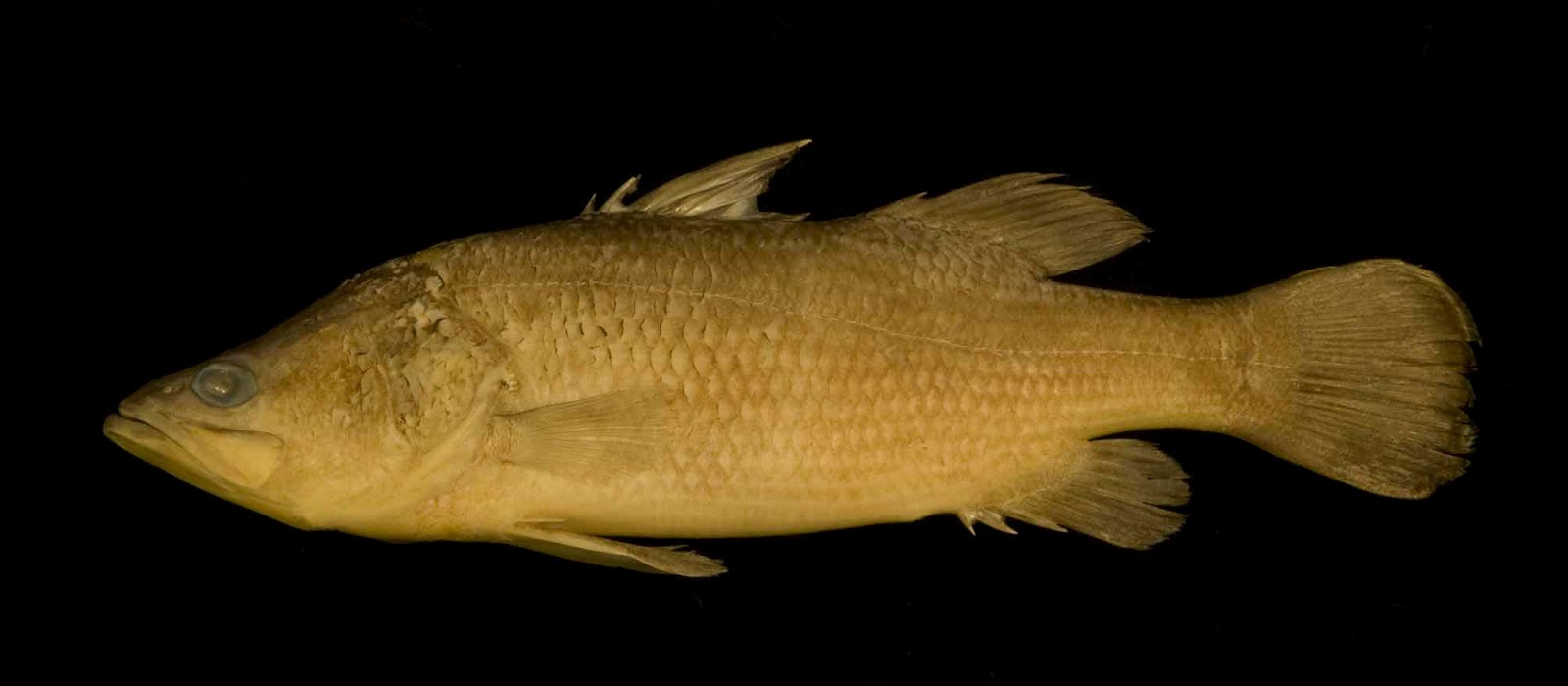
Specimen of Lates lakadiva. This has been preserved in alcohol since 1994, and its original coloration is unclear. Pethiyagoda & Gill (2012).

The second new species is Lates uwisara, named in honour of U Wisara, a Burmese monk who died as a result of a hunger strike while in prison for protesting against British rule, and who is considered a national hero in Myanmar. It is described from four specimens collected from river estuaries between Yangon and Sittang in 2005 and now in the Australian National Fish Collection at the Commonwealth Scientific and Industrial Research Organisation in Hobart. The four specimens are 353 mm, 363 mm, 332 mm and 350 mm in length, respectively. Pethiyagoda and Gill propose that this fish should be known as the Myanmar Sea Bass in English. Specimens of this fish were also found from fish farms in French Polynesia (where there are no native Lates). Since Lates are also farmed in Myanmar, this raises the possibility that the fish is not native to the areas where it was found.

Specimen of Lates uwisara. This has also lost its original coloration, having been preserved in alcohol since 2005. Pethiyagoda & Gill (2012).

See also New species of Priapiumfish from the Mekong DeltaNew species of Japanese Goby from TaiwanHead-Butting in Giant Bumphead ParrotfishNew species of Sleeper Gobie from the Early Miocene of Otago, New Zealand and Boney Fish on Sciency Thoughts YouTube.

Follow Sciency Thoughts on Facebook.