Showing posts with label Cichlid. Show all posts

Saturday, 14 April 2018

Trematocranus pachychilus: A new species of Cichlid Fish from Lake Malaŵi.

The Cichlids are an extremely successful group of freshwater Perciform Fish (Perches), found in North, Central and South America, as well as the Caribbean, the Middle East, South Asia and, most notably Africa, where the group reaches its highest diversity. Over 800 species have been described from Lake Malaŵi alone, which is more species of freshwater fish than have been described from the entire Northern Hemisphere and slightly over 1% of every vertebrate species ever described. The genus Trematocranus currently contains three species, all endemic to Lake Malaŵi. These are fairly large Fish, reaching about 250 mm in length, typically having a spotted pattern, with several rows of teeth on their pharyngeal plates.

In a paper published in the journal ZooKeys on 14 March 2018, Katrien Dierickx and Mark Hanssens of Ichthyology at the Royal Museum for Central Africa, Bosco Rusuwa of the Department of Biology at the University of Malawi, and Jos Snoeks, also of Ichthyology at the Royal Museum for Central Africa, and of the Laboratory of Biodiversity and evolutionary genomics at Leuven University, describe a new species of Trematocranus from Jafua Bay on the Mozambique shore of Lake Malaŵi.

The new species is named Trematocranus pachychilus, meaning 'thick-lip', in reference to the lips of this species, which are notably thicker than those of other members of the genus. The species is described from three specimens caught in 1998 and stored in alcohol at the Royal Museum for Central Africa. These range from 117.7 to 154.6 mm in length, and have lost their original colouration. They are deep bodied and laterally flattened, with teeth sharp and pointed at the front of the mouth and flat and rounded at the back; the rear teeth of the outer rows are bicusped, while the inner row are unicusped, though in larger specimens there are more bicusped teeth.

Trematocranus pachychilus, preserved specimen, adult male, 154.6 mm SL, Lake Malawi, Jafua Bay. Dierickx et al. (2018).

See also...
http://sciencythoughts.blogspot.co.uk/2014/10/a-new-species-of-cichlid-fish-from.htmlhttp://sciencythoughts.blogspot.co.uk/2014/05/a-new-species-of-cichlid-fish-from-lake.html
http://sciencythoughts.blogspot.co.uk/2013/08/a-new-species-of-cichlid-fish-from-rio.htmlhttp://sciencythoughts.blogspot.co.uk/2013/07/five-new-species-of-mbuna-from-lake.html
http://sciencythoughts.blogspot.co.uk/2013/01/two-new-species-of-cichlid-fish-from.htmlhttp://sciencythoughts.blogspot.co.uk/2012/10/a-new-species-of-cichlid-fish-from-lake.html
Follow Sciency Thoughts on Facebook.

Tuesday, 7 October 2014

A new species of Cichlid Fish from the Amazon Basin in Peru.

Cichlid Fish of the genus Apistogramma are found in waterways across tropical South America. There are currently 84 known species, of which 18 are found in the Peruvian Amazon Basin. They are small Fish, never exceeding 60 mm in length, the males growing larger than the females and typically being more brightly coloured.

In a paper published in the journal Zootaxa on 2 October 2014, Ricardo Britzke and Claudio Oliveira of the Departamento de Morfologia at the Universidade Estadual Paulista and Sven Kullander of the Department of Zoology at the Swedish Museum of Natural History, describe a new species of Apistogramma from a small tributary of the Ampyiacu River in the upper Amazon Basin in eastern Peru.

The new fish is named Apistogramma ortegai, in honour of the ichthyologist Hernán Ortega Torres of the Museo de HistoriaNatural at the Universidad Nacional Mayor de San Marcos. It is a deep bodied, flattened Fish reaching a maximum recorded length of 50.5 mm. The males are an iridescent blue with red marks around the scales of the lateral band, the females are similar but with black marks.

Apistogramma ortegai, live colouration in male (A) and female (B). Britzke et al. (2014).

Apistogrammaortegai was found only in a single small stream, which fed into a tributary of the Ampyiacu River, which in turn runs into the Amazon. The stream is small (50 cm at its deepest) and runs through an area of thick forest. It is warm (26°C) and slightly acidic (pH 6), and lacks any aquatic vegetation, though there were fallen leaves on the bottom, which was otherwise sandy with a little clay.

Locality where Apistogramma ortegai was found. Peru, Departamento Loreto, Distrito Pebas, small stream tributary of Ampiyacu River. Britzke et al. (2014).

Map showing the locality where Apistogramma ortegai was found. Britzke et al. (2014).

See also…

The Cichlid Fish genus Chalinochromis is endemic to Lake Tanganyika in East Africa. To date two species have been formally described, Chalinochromis...


http://sciencythoughts.blogspot.co.uk/2013/07/five-new-species-of-mbuna-from-lake.html Five new species of Mbuna from Lake Malaŵi.                                                      Mbuna are rock dwelling Cichlids known only from Lake Malaŵi in East Africa. They are typically colourful Fish, and often sexually dichromic (the males and females...
  
Follow Sciency Thoughts on Facebook.

Tuesday, 27 May 2014

A new species of Cichlid Fish from Lake Tanganyika.

The Cichlid Fish genus Chalinochromis is endemic to Lake Tanganyika in East Africa. To date two species have been formally described, Chalinochromis brichardi, from the area around Magari in Burundi at the north end of the lake, and Chalinochromis popelini from the area around Moba in Congo, on the southwest shore of the lake. In addition two further species are known in the aquarium trade, but have never been formally described, Chalinochromisbifrenatus’ and Chalinochromisndobhoi’, both from the central eastern shore of the lake.

In a paper published in the journal Zootaxa on 22 April 2014, Sven Kullander of the Department of Zoology at the Swedish Museum of Natural History, Mikael and Magnus Karlsson of African Diving Ltd in Dar es Salaam and Michael Norén, also of the Department of Zoology at the Swedish Museum of Natural History, describe a new species of Chalinochromis from the south of Lake Tanganyika.

The new species is named Chalinochromis cyanophleps, meaning ‘blue-veined’, in reference to a conspicuous blue stripe beneath the eye. Chalinochromis cyanophleps is a 103.3-129.3 grey Cichlid Fish with blue fins, which have brighter blue tips and a conspicuous blue stripe beneath its eye. Both sexes show similar colouration, as do the juveniles, though these have faint brown vertical bars.

Chalinochromis cyanophleps in natural habitat at Namansi, depth 8 m. Kullander et al. (2014).

Chalinochromis cyanophleps was found living at depths of 5-10 m to the west the village of Namansi in Nkansi District, Tanzania, and along much of the southeast coast of Lake Tanganyika from Mvuna Island to Kala Bay, at depths of 6-45 m. It was hard to observe, living in rock crevices and caves, and found only as single Fish or breeding pairs.

Chalinochromis cyanophleps, breeding pair in their nest at Kisi Island, depth 12 m. Kullander et al. (2014).

Type locality of Chalinochromis cyanophleps, western shore of Namansi village. Kullander et al. (2014).

See also…


Mbuna are rock dwelling Cichlids known only from Lake Malaŵi in...


Follow Sciency Thoughts on Facebook.

Friday, 16 August 2013

A new species of Cichlid Fish from the Río Acaray in Paraguay.

The Cichlids are an extremely successful group of freshwater Perciform Fish (Perches), found in North, Central and South America, as well as the Caribbean, the Middle East, South Asia and, most notably Africa, where the group reaches its highest diversity. There are one of the most diverse Fish, and therefore Vertebrate, families, with over 1600 described species. Over 700 species have been described from Lake Malaŵi alone, which is more species of freshwater fish than have been described from the entire Northern Hemisphere and slightly over 1% of every vertebrate species ever described. hey are popular in the aquarium trade, which has led to them becoming naturalized in many parts of the world where they are not native.

In a paper published in the journal Zootaxa on 23 April 2013, Sven Kullander of the Department of Zoology at the Swedish Museum of Natural History and Carlos de Lucena of the Laboratório de Ictiologia at the Museu de Ciências e Tecnologia at the Pontifícia Universidade do Rio Grande do Sul describe a new species of Cichlid Fish from the Río Acaray drainage basin in Paraguay.

The new species is placed in the genus Crenicichla and named Crenicichla gillmorlisi, in honour of Walter Gill Morlis, a fisheries officer of the Itaipú Binacional Hydroelectric Project in Ciudad del Este, Paraguay. Crenicichla gillmorlisi is a silvery Cichlid Fish with an olive sheen reaching 174 mm in length. It has a specked body and a distinctive bar beneath the eye.

Crenicichla gillmorlisi, male specimen from the Yguazú Reservoir. Walter Gill Morlis in Kullander & de Lucena (2013).

Crenicichla gillmorlisi appears to be restricted to the drainage basin of the Río Acaray, a tributary of the  Río Paraná, where it appears to dwell close to overgrown riverbanks, often with turbid water. The Río Acaray now has two barriers to Fish movement, the Acaray Hydroelectric Power Plant and the Yguazú Reservoir, both of which dam the river. This clearly divides the population of Crenicichla gillmorlisi into smaller sub-populations, though what effect this is having on the long-term viability of the species is unclear.

The known distribution of Crenicichla gillmorlisi; black spots represent sites where the fish has been found. Kullander & de Lucena (2013).

Typical habitat where Crenicichla gillmorlisi has been found. Kullander & de Lucena (2013).


Follow Sciency Thoughts on Facebook.

Monday, 1 July 2013

Five new species of Mbuna from Lake Malaŵi.

Mbuna are rock dwelling Cichlids known only from Lake Malaŵi in East Africa. They are typically colourful Fish, and often sexually dichromic (the males and females are different colours), making them popular in the aquarium trade. Mbunas are social Fish, with each males defending a territory a group of females. They are mouth brooders, with the females incubating the eggs in their mouths, and the newly hatched fry returning to the mothers mouth for shelter when threatened.

In a paper published in the journal Zootaxa on 8 May 2013, Jay Stauffer  and Kristin Black of the School of Forest Resources at Pennsylvania State University, and Adrianus Konings of the Cichlid Press describe five new species of Mbuna from Lake Malaŵi, all placed within the genus Metriaclima.

The first new species is named Metriaclima pambazuko, 'pambazuko' being the Swahili word for sunrise, a reference to the orange or red dorsal fins of the males. Metriaclima pambazuko is a 61-75 mm  (adult length) Mbuna found around Lundo and Hingi Islands on the Tanzanian part of the lake and Londi Bay on the Mozambique shore. The males are blue with 5-7 black bars the dorsal fin is blue gray or black, shading to yellow, orange or red away from the body. Females are grey-blue or light brown with grey bars.

Metriaclima pambazuko, (top) 70 mm male from Hongi Island, (bottom) 55 mm female from Londo Bay. Stauffer et al. (2013).

The second new species is Metriaclima lundoense, 'lundoense' referring to Lundo Island, the only locality where the Fish was found. Metriaclima lundoense has an adult length of 63-85 mm. The males are blue with black bars, the females light brown with blue and green highlights and (sometimes) faint brown bars.

Metriaclima lundoense, (top) 80 mm male, (bottom) 70 mm female. Both from around Lundo Island. Stauffer et al. (2013).

The third new species described is named Metriaclima midomo, 'midomo' meaning 'lips' in Swahili, the Fish having enlarged lips relative to other members of the genus. Metriaclima midomo has an adult length of 66-99 mm. The males are blue with green highlights and 5-9 black bars, the females are blue with green highlights and 5-7 faint bars. The fish were found only around Lundo Island.

Metriaclima midomo, (top) 80 mm male, (bottom) 70 mm female. Both from around Lundo Island. Stauffer et al. (2013).

The fourth new species is named Metriaclima tarakiki, 'tarakiki' meaning slender in Swahili, the fish being elongate in shape. Metriaclima tarakiki has an adult bodylength of 72-120 mm, the males are blue-white with 7-9 black bars, the females have two colour schemes, some being light brown others being yellow or orange with black blotches. The fish were found around Ngkuyo Island and Higga Reef on the Tanzanian part of the lake.

Metriaclima tarakiki, (top) 110 mm male from Higga Reef, (bottom) 90 mm female from Higga Reef. Stauffer et al. (2013).

The final new species is named Metriaclima nigrodorsalis, 'nigrodorsalis' meaninf 'black-dorsal' in Latin, the males and some females having a black band on the dorsal fin. Metriaclima nigrodorsalis has an adult length of 55-84 mm. This is a variable Fish with several different colour schemes, the males can be light blue, dark blue or yellow, with a yellow or grey belly and 6-10 black bars, the females cna be blue or light brown with grey or dark brown bars. Metriaclima nigrodorsalis was found at N’kolongwe, Thundu, Nkhungu, Chiloelo, and Charlie’s Bay, all on the Mozambican part of the lake.

Metriaclima nigrodorsalis, (top) 75 mm male from N'kolongwe, (upper middle) 70 mm female from N'kolongwe, (lower middle) 75 mm male from Chiloelo, and (bottom) 80 mm male from Nkhungu Point. Stauffer et al. (2013).

Map of Lake Malaŵi, showing locations where Mbuna were sampled in this study. Stauffer et al. (2013).


Follow Sciency Thoughts on Facebook.

Saturday, 26 January 2013

Two new species of Cichlid Fish from Lake Victoria.

Cichlid Fish are widespread freshwater Perch (Perciformes), found in Africa, South America, southern North America, parts of the Caribbean, Madagascar, the Middle East and South Asia. There are one of the most diverse Fish, and therefore Vertebrate, families, with over 1600 described species. They are popular in the aquarium trade, which has led to them becoming naturalized in many parts of the world where they are not native.

In a paper published in the journal ZooKeys on 2 January 2013, a team of scientists led by Marnix de Zeeuw of the Naturalis Biodiversity Center in Leden describe two new species of Cichlid Fish from the waters of southern Lake Victoria. Neither of these is, strictly speaking, new to science, but neither has been formally described before.

The first species described is named Haplochromis argens, it has appeared previously in numerous scientific publications under the name Haplochromis 'argens' (argens meaning silver) from the 1970s onwards, but has never actually been properly described. Haplochromis argens is a 53-78 mm, slender Cichlid Fish. Males have a blue-to-purple sheen on their upper sides and a yellow-to-green sheen on their flanks, as well as reddish fins with spots on the anal fin. They consume zooplankton in the photic zone (top part of the water that light can penetrate), being restricted to the top two meters at night, but foraging deeper at night. The species was abundant in the Mwanza, Speke and Emin Pasha Gulfs and around Kome Island until the 1980s, but suffered a collapse in population due to the introduction of Nile Perch (Lates niloticus) to the lake, and have not recovered despite the success of measures to reduce the Nile Perch population. The species is also well known in the aquarium trade.

Haplochromis argens; (top) male specimen from Emin Pasha Gulf, (middle) male specimen from Mwanza Gulf, (bottom) line drawing. Scale bar is 10 mm. de Zeeuw et al. (2013).

The second Cichlid Fish is named Haplochromis goldschmidti; it has previously been known as Haplochromis 'dusky argens', and is now named after Tijs Goldschmidt, the scientist who first referred to the Fish, and an expert on the Cichlids of Lake Victoria who has studied both their ecology and evolution, and the extinction event they suffered as a result of the introduction of the Nile Perch. It is similar to H. argens, but darker and with a curved profile. It is known only from Emin Pasha Gulf; it is unclear if the species survives.

Haplochromis goldschmidti; (top and middle) male specimens, (bottom) line drawing of male specimen. Scale bar is 10 mm. de Zeeuw et al. (2013).

Southern Lake Victoria. (A) The known distribution of Haplochromis argens (crosshatched area). (B) Area where Haplochromis argens specimens were collected in Mwanza Gulf. Letters indicate the locations of research stations. (C) Locations where specimens were collected in Emin Pasha Gulf. Circles are for H. argens, triangles for H. goldschmidtide Zeeuw et al. (2013).


Follow Sciency Thoughts on Facebook.
Sunday, 7 October 2012

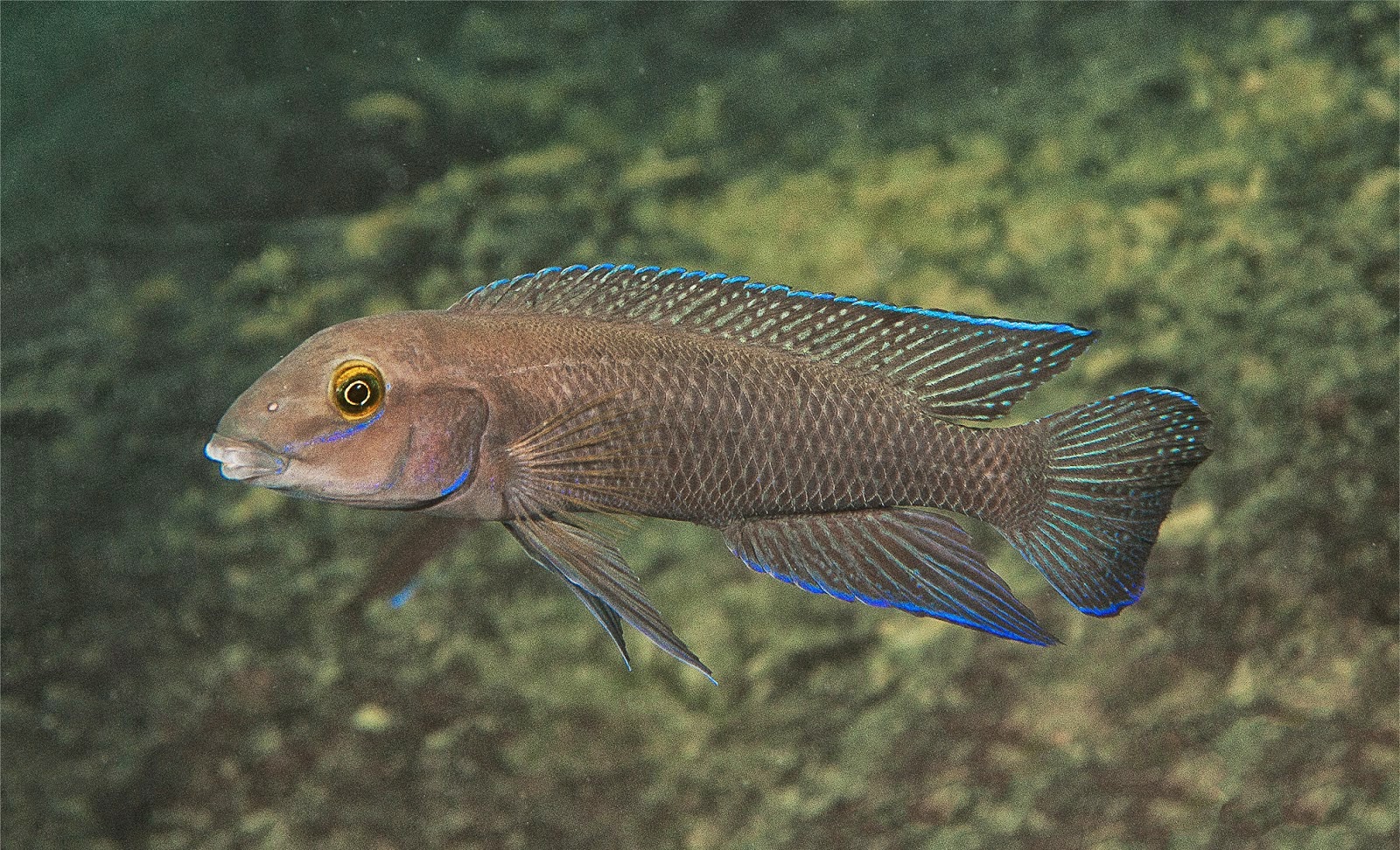
A new species of Cichlid Fish from Lake Tanganyika.

Cichlid fish of the genus Lepidiolamprologus are restricted to Lake Tanganyika in east Africa. There are at least six species, and possibly over ten, though taxonomists differ about classification schemes for the genus.

In a paper published in the journal Zootaxa on 20 September 2012, Sven Kullander of the Department of Vertebrate Zoology at the Swedish Museum of Natural History and  Magnus and Mikael Karlsson, of African Diving Ltd. in Dar es Salaam propose a new species of fish in the genus, from the waters around Kamamba Island near the east shore of the lake.

Kamamba Island. Kullender et al. (2012).

The new Fish is named Lepidiolamprologus kamambae, meaning from Kamamba. It is a 118-135 mm mottled brown fish, with a protruding lower jaw, known only from male specimens.

Lepidiolamprologus kamambae in the wild. Kullender et al. (2012).

Map showing the distribution of Lepidiolamprologus kamambae, and closely related species within the same genus (top). Members of the genus Lepidiolamprologus (bottom). (A) L. kamambae. (B) L. kendalli. (C) L. elongatus. (D) L. profundicolaKullender et al. (2012).

See also A new species of Cichlid Fish from Lake MalaŵiTwo new species of Sandperch from the South China SeaA new species of Toothcarp from IranNew species of Grenadier from Japan and Boney Fish on Sciency Thoughts YouTube.

Follow Sciency Thoughts on Facebook.

Friday, 14 September 2012

A new species of Cichlid Fish from Lake Malaŵi.

The Cichlids are an extremely successful group of freshwater Perciform Fish (Perches), found in North, Central and South America, as well as the Caribbean, the Middle East, South Asia and, most notably Africa, where the group reaches its highest diversity. Over 700 species have been described from Lake Malaŵi alone, which is more species of freshwater fish than have been described from the entire Northern Hemisphere and slightly over 1% of every vertebrate species ever described. 

In a paper published in the journal Zootaxa on 6 August 2012, researcher and Cichlid specialist Michael Oliver describes a new species of Cichlid from Lake Malaŵi. The new species is based upon two specimens in museum collections; the first caught in an experimental sampling expedition, north of Thumbi Island West at a depth of 17-38 m, in 1980, and now sits in the collection of the Peabody Museum of Natural History at Yale University, and the second purchased from indigenous fishermen at Nkhata Bay in 1997, and now in the collection of the Royal Museum for Central Africa in Tervuren, Belgium. Since the Cichlid fauna of Lake Malaŵi has been studied and sampled extensively for many years and only two specimens of this fish are known it is presumed to be quite rare.

Map of Lake Malaŵi, showing the locations where the two specimens were found. Oliver (2012).

The new Cichlid is placed in the genus Hemitaeniochromis, which until now contained only a single species (Hemitaeniochromis urotaenia), and is given the name Hemitaeniochromis brachyrhynchus, the short-snouted HemitaeniochromisHemitaeniochromis brachyrhynchus has a shorter snout than Hemitaeniochromis urotaenia, caused by a narrowing of the lacrimal bones (which form part of the eye socket); this also causes larger eyes in Hemitaeniochromis brachyrhynchus. The colouration of Hemitaeniochromis brachyrhynchus is unkown, as both preserved specimens have lost their original colour.

The Yale specimen (a) and Royal Museum specimen (b) of Hemitaeniochromis brachyrhynchus. (a) is 123.6 mm long and (b) is 81.5 mm long. Oliver (2012).
The closely related Hemitaeniochromis urotaenia. Oliver (2012).


Follow Sciency Thoughts on Facebook.