Showing posts with label G-type Dwarf Stars. Show all posts

Friday, 11 December 2015

Detecting debris disks around small nearby stars in old Hubble images.

Debris disks are rings of dust, rock and icy material left surrounding stars after planet formation has occurred (unlike protoplanetary disks, which are present around very young stars only, and which are thought to be largely consumed by planetary formation). Our Solar System has two such debris disks, the Asteroid Belt and the Kuiper Belt, and in recent years improved telescope technology has allowed astronomers to detect debris disks around about 80 of other stars. Most of these disks have been detected only at infrared wavelengths; imaging disks at visual wavelengths enables astronomers to study the morphology and composition of such disks in far greater detail, enabling them to predict the presence of planets that cannot be directly detected and better understand planetary formation around other stars.

Almost all debris disks that have been discovered to date have been found around larger stars. There are several possible reasons for this. Firstly the majority of smaller stars are thought to form in dense star clusters (i.e. very close to other forming stars), which may prevent the formation of such disks. Smaller stars also tend to be less stable, prone to larger and more frequent stellar flares, tending to have higher stellar winds and stronger magnetic fields, all of which may potentially disrupt any debris disks, causing them to dissipate early in the history of such stellar systems. Alternatively such disks may actually be fairly common around smaller stars, but mostly be bellow the level of detectability due to the lower levels of heat and light emitted by smaller stars and the smaller size of the systems in general.

In a paper published on the arXiv database at Cornell University Library on 7 December 2015, a team of scientists led by Élodie Choquet of the Space Telescope Science Institute, describe four new debris disks discovered around small nearby stars Hubble Space Telescope images, the Archival Legacy Investigation of Circumstellar Environments (ALICE) project, which uses the Karhunen-Loeve Image Projection (KLIP) algorithm (better software) to analyse old images for debris disks that may not have previously been discovered.

The first disk described is around the M3.2 star  (Red Dwarf Star with a mass less than 36% of that of our Sun) TWA 7. This star is about 34.5 parsecs (112.5 light years) away, and is associated with the TW Hydrae moving group, which is thought to be about 10 million years old, although one study has suggested that TWA 7 may be as young as 4 million years old. No emissions associated with accretion have been detected from this system, suggesting that any disk present would be an evolved debris disk rather than a protoplanetary disk with ongoing planetary formation. Infrared studies of the system with the Herschel Space Observatory have suggested that it might have two debris disks, one with a temperature of about 66 K at a distance of about 38 AU from the star (i.e. a debris disk with a temperature of 38 degrees centigrade above absolute zero which is 38 times as far from the star as the Earth is from the Sun) and one with a temperature of about 20 K at a distance of about 75 AU from the star. Choquet et al. were able to resolve a disk at a distance of 35 AU from the star. They could find no evidence of an outer disk, though they cannot rule out the existence of such a disk which may be to faint to detect.

 Input unprocessed model of the debris disk around TWA 7. Choquet et al. (2015).

The second star examined was TWA 25, an M0.5 star (Red Dwarf Star with  less that 50% of the mass of the Sun) 54 parsecs (176 light years) from out Solar System. TWA 25 is also associated with the TW Hydrae moving group, and is estimated to be about 13 million years old. The Herschal Space Observatory failed to find any evidence of a debris disk around TWA 25, though the Wide-field Infrared Survey Explorer (WISE) space telescope did record an excess of infrared at some wavelengths, which can be an indication of such a disk. Choquet et al. found an inclined disk around TWA 25, edge on from our perspective and about 78 AU from the star.

 Input unprocessed model of the debris disk around TWA 25. Choquet et al. (2015).

The third star examined was HD 35650, a K6V star (Orange Dwarf Star with less than 80 of the mass of the Sun) roughly 18 parsecs (58.7 light years) from our Solar System. HD 35650 is thought to be associated with the AB Doradus moving group, which is thought to be between 50 and 200 million years old. The Spitzer Space Telescope detected an excess of infrared radiation at a wavelength of 70 μm, but not at 24 μm, which it is thought may indicate a debris disk with a temperature of 60K. Choquet et al. were able to detect an asymmetric disk at about 54 AU from the star, 70% brighter on the north side than the south. This disk appears to be compressed along its northwest axis, possibly due to the system moving into a denser area of interstellar medium.

 Input unprocessed model of the debris disk around HD 35650. Choquet et al. (2015).

The final star looked at was HD 377, a G2V star (a stat with roughly the same mass as the Sun), approximately 39.1 parsecs (127.5 light years) from the Solar System. It this instance the Spitzer Space Telescope detected an infrared excess at 24 μm to 160 μm, the WISE space telescope at 22 μm and the James Clark Maxwell Telescope at 850 μm. This was thought likely to be indicative of two debris disks, one with a temperature of 240 K at a distance of 2.4 AU and one with a temperature of 57 K at 136.4 AU. Choquet et al. were able to detect a single debris disk, at a distance of 86 AU from the star.

Input unprocessed model of the debris disk around HD 377. Choquet et al. (2015).

See also...

http://sciencythoughts.blogspot.co.uk/2014/05/the-debris-disk-around-hr-4796-a.htmlThe debris disk around HD 4796 A.             The term debris disk is applied to any ring of sub-planetary sized objects around a star. In our Solar System both the Main Asteroid Belt and the Kuiper Belt would qualify as debris disks, though in practice neither of these belts would be detectable around another star with current technology. However younger star systems often have much more detectable debris disks, containing extensive fields of dust from...
http://sciencythoughts.blogspot.co.uk/2014/05/discovering-new-debris-disks-in-old.htmlDiscovering new debris disks in old Hubble images.                                                          The term ‘debris disk’ is used to refer to any ring of sub-planetary objects about a star; in our Solar System both the Main Asteroid Belt and the Kuiper Belt count as debris disks. In practice, asteroids and comets around other stars are not detectable with current technology, but large volumes of dust are, and since such volumes of dust around a star are expected to have a...
http://sciencythoughts.blogspot.co.uk/2013/06/the-debris-disk-of-49-ceti.htmlThe debris disk of 49 Ceti.                            49 Ceti is a bright star in the constellation of Cetus, 194 light years from the Earth, with a mass slightly over 2 times that of the Sun. It is a young star, only about 40 million years in age, and is surrounded by a large debris disk, which has been shown to be rich in Carbon Monoxide. In an system this old it would generally be assumed that such a disk was made of comet-type bodies, with the detectable free Carbon Monoxide...
Follow Sciency Thoughts on Facebook.
 

Tuesday, 28 April 2015

Determining the Habitable Zone of 70 Virginis.


70 Viriginis is a G-type Yellow Dwarf Star about 59 light years from Earth in the constellation of Virgo. It is calculated to have a mass 109% of that of the Sun, but radius 194% of the Sun’s, and a lower temperature, 5393K, compared to 5778K for the Sun, from which it is calculated to be somewhat older, approximately 7.77 billion years (compared to about 5.0 for the Sun). This star hosts one of the first discovered exoplanets, 70 Virginis b, asuperjovian planet in a short (116 days) but highly eccentric orbit discovered in 1996.

In a paper published on the arXiv database at Cornell University Library on 15 April 2015 and submitted for publication in The Astrophysical Journal, Stephen Kane of the Department of Physics & Astronomy at San Francisco State University, Tabetha Boyejian of the Departmentof Astronomy at Yale University, Gregory Henry of the Center of Excellence in Information Systems at Tennessee State University, Katherina Feng of the Departmentof Astronomy and Astrophysics and Center for Exoplanets & Habitable Worlds at Pennsylvania State University and the Department of Astronomy & Astrophysics at the University of California, Santa Cruz, Natalie Hinkal, also of the Department of Physics & Astronomy at San Francisco State University, Debra Fischer, also of the Department of Astronomy at Yale University, Kaspar von Braun of Lowell Observatory, Andrew Howard of the Institute for Astronomy at the University of Hawaii and Jason Wright, also of the Department of Astronomy and Astrophysics and Center for Exoplanets & Habitable Worlds at Pennsylvania State University, present a fresh study of the 70 Virginis system using new data from the Cente rfor High Angular Resolution Astronomy (CHARA array) at Georgia State University and the HIRES echelle spectrometer on the 10.0m Keck I telescope, which they combine with previously acquired data on the system from the Hamilton Echelle Spectrograph on the 3.0m Shane Telescope at Lick Observatory and the ELODIE spectrograph on the 1.93m telescope at Observatoirede Haute-Provence, which they use to build a model of the Habitable Zone of the system, and calculate the possibility of an Earth-sized planet remaining in a stable orbit within it.

Kane et al. derive a ‘conservative’ habitable zone for the 70 Virginis system with an inner boundary at 1.63 AU from the star (i.e. 1.63 times the average distance at which the Earth orbits the Sun) and an outer boundary at 2.92 AU from the star, and an ‘optimistic’ habitable zone with an inner boundary at 1.29 AU and an outer boundary at 3.08 AU.

A top-down view of the 70 Virginissystem showing the extent of the Habitable Zone calculated using the stellar parameters established with the CHARA, HIRES, Hamilton Echelle and ELODIE data. The conservative Habitable Zone is shown as light-gray and optimistic extension to the Habitable Zone is shown as dark-gray. The revised Keplerian orbit of the known planet is overlaid as a continuous dark line. Kane et al. (2015).

Next Kane et al. attempted to calculate the possibility of an Earth-sized planet remaining in a stable orbit within this habitable zone. In order to do this they calculated the stability of planets at the inner and outer margins of the conservative and optimistic Habitable Zones (i.e. 1.29 AU, 1.63 AU, 2.92 AU and 3.08 AU), since if these orbits are stable then intermediate orbits, fully within the Habitable Zone, ought to be available.

These calculations revealed that while it was possible for an Earth-sized planet to remain in a stable orbit within the habitable zone, the gravitational influence of the known planet, 70 Virginis b, would make it impossible for such a planet to remain in a stable orbit in the same orbital plane as the larger body. This is problematic if we consider the Solar System to be a typical planetary system, as all the planets in the Solar System orbit in approximately the same plane, and models of Solar System formation suggest that this was the way in which they formed, apparently ruling out other configurations. However other stellar systems have been discovered in which not all the planets orbit in the same plane, indicating that such an outcome is not impossible.

Kane et al. calculate that an Earth-sized planet orbiting 70 Virginis at a distance of 1.29 AU would need to have an orbit tilted at an angle of at least 24˚ to that of 70 Virginis b to remain stable. Such a planet at 1.63 AU would need to be tilted at 25˚ to remain stable, one at 2.92 at 10˚ and one at 3.08 AU at 3˚. This is roughly linear, with hypothetical planets further from 70 Virginis b able to adopt less inclined orbits due to the reduced influence of its gravity, though the planet at 1.63 was more affected than that at 1.29 AU, due to its being closer to being in a resonant orbit (planets in resonant orbits pass one-another regularly on their orbital cycle, typically with the inner planet completing two orbits for one of the outer planet or some similar arrangement; such resonant orbital arrangements are extremely stable, but orbits close to resonant arrangements are highly unstable, with the smaller body typically being either pushed into the stable arrangement or ejected from the system completely).

See also…

The Kepler Space Telescope has discovered over 4000 candidate planets, around 40% of which are in systems with multiple planets. Many of the early multiple planet systems discovered contained one or more...
 
 
The Kepler Space Telescope observed a 115 square degree of space for four years (from May 2009 till May 2013), looking for potential planets around the 150 000 stars in the magnitude range 8-16 within the field. In this time it found a total of 4233 candidate planets, of which 965 have subsequently been confirmed. The conformation of such a planet requires follow...
 
http://sciencythoughts.blogspot.co.uk/2014/07/conformation-of-third-planet-in-kepler.htmlConformation of the third planet in the Kepler-51 System.                                               Kepler-51 is a G-type Yellow Dwarf star 2800 light years from Earth in the constellation of Cygnus. It has a...
Follow Sciency Thoughts on Facebook.

Sunday, 27 July 2014

Conformation of the third planet in the Kepler-51 System.

Kepler-51 is a G-type Yellow Dwarf star 2800 light years from Earth in the constellation of Cygnus. It has a mass 1.04 times that of the Sun, a radius 0.94 times that of the Sun and an effective surface temperature of 6017 K (compared to 5778 K for the Sun). It is a young star, thought to be about 300 million years old. When it was originally designated as a potential planet hosting star in the Kepler Survey it was given numbered KOI-620 (Kepler Object of Interest-620); this was updated to Kepler-51 in 2013, when two transiting planets (planets that pass in front of the star when seen from Earth) in the system were confirmed, Kepler-51b and Kepler-51c; when naming objects in other stellar systems stars are given upper case letters and planets lower case letters, in this instance the star in the Kepler-51 system would be Kepler-51A, though as the only star in the system it is usually referred to simply as Kepler-51. A third probable planet in the system could not be confirmed, and therefore retains the designation KOI-602.02 (planets in the Kepler Survey that have not been confirmed retain a KOI designation, even if the system has been re-designated due to the discovery of other planets).

Kepler-51b (formerly KOI-620.01) was found to have an orbital period of 45 days, a radius equal to 0.07074 times that of Kepler-51A, and a maximum mass of 2.33 times that of Jupiter. Kepler-51c (formerly KOI-620.03) was found to have an orbital period of 85 days, a radius 0.0573 times that of Kepler-51A, and a maximum mass of 2.60 times that of Jupiter. KOI-620.02 was found to have a (probable) orbital period of 130 days and a radius 0.0972 times that of Kepler-51A (it was not possible to estimate the mass of this body). 

The three bodies have orbital periods close to a 1:2:3 orbital resonance. Orbital resonances occur when bodies passing close to one-another exchange some momentum, causing one to slow and the other to accelerate at each pass. Once this starts to happen the two bodies must either settle into a stable resonance or else one will be forced out of its orbit onto a new trajectory. Given that the planets of the Kepler-51 system are all quite close together, it would be expected that they would be in resonant orbits.

In a paper published on the online arXiv database at Cornell University Library on 12 February 2014, Kento Masuda of the Department of Physics at The University of Tokyo presents a new study of the Kepler-51 system, also based upon Kepler Space Telescope data, which confirms the presence of a third planet in the system.

Masuda calculates that Kepler-51b has a mass only 2.1 times that of the Earth, but a radius 7.1 times that of the Earth, and that it orbits Kepler-51A at a distance of 0.25 AU (i.e. 25% of the distance at which the Earth orbits the Sun, and considerably less than the distance at which Mercury orbits the Sun), with an orbital period of 45 days. He also estimates the average equatorial temperature on the planet to be 543 K (270˚C).

He calculates that Kepler-51c has a mass of approximately 4.0 times that of the Earth, a radius 9.0 times that of the Earth, and orbits at a distance of 0.38 AU (38% of the distance at which the Earth orbits the Sun, and slightly less than the distance at which Mercury orbits) with a period of 85 days. He further estimates that the planet has an average equatorial temperature of 439 K (166˚C).

KOI-620.02, now redesignated Kepler-51d, is calculated to have a mass 7.6 times that of the Earth and a radius 9.7 times that of the Earth. It orbits Kepler-51A at a distance of 0.51 AU (51% of the distance at which the Earth orbits the Sun; greater than the distance at which Mercury orbits the Sun, but still considerably less than the distance at which Venus orbits) with a period of 130 days. The planet is estimated to have an average equatorial temperature of 381 K (108˚C), and to lie in the innermost part of the habitable zone of the Kepler-51 system (i.e. the zone in which liquid water might potentially exist).

All of these planets have extremely low densities, which can only be explained if they have substantial hydrogen and/or helium atmospheres. The presence of large, low density planets in orbits close to their host stars has become one of the hardest phenomena to explain in the study of exoplanets. Our understanding of how planetary formation occurs suggests that such planets must be formed beyond the system’s Snow Line; the point beyond which these elements can for ice, which is capable of accumulating into large bodies. In the inner part of a stellar system these elements would be gaseous, due to heating from the star, and could not therefore collect together to form the atmosphere of a planet. Such planets are therefore usually explained by formation in the outer part of a stellar system followed by inward migration, but this is in many cases somewhat hard to explain, particularly in cases such as Kepler-51 where young, hot, low density planets appear to be packed into close, resonant orbits, the evolution of which is difficult to model, particularly where short time periods are available for this evolution to occur.

Masuda also reported the occurrence of a planetary eclipse in the Kepler-51 system; i.e. one of the planets passing in front of another as both transit the star. This is only the second time such an event has been reported, the first having occurred in the Kepler-89 system. This event allows for the measurement of the relative inclinations of the orbits of the planets involved, in this case Kepler-51b and Kepler-51d. Surprisingly this angle of inclination is quite large, with the orbit of Kepler-51d apparently tilted at an angle of 25.3˚ relative to the orbit of Kepler-51b. Such a mismatch between two resonant planets in close orbits is likely to be extremely unstable, unless Kepler-51c orbits at a precisely intermediate angle, which would make the evolution of the system even harder to explain.

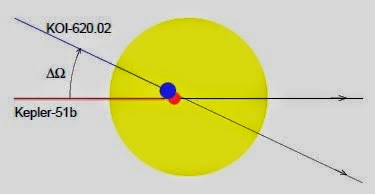
Trajectories of the two planets for the best-fit PPE model. This is a snapshot at the time when the two planets are closest in the plane of the sky. Masuda (2014).

See also…

 The planets of HD 141399.

HD 141399 is a K-type orange dwarf star 118 light years from Earth in the constellation of Boötes. It has a mass 1.14 times that of the Sun, a radius 1.46 times the Sun’s, an effective surface temperature of 5360 K (compared to 5778 K for the Sun), and is 1.59 times as luminous as the Sun.


 Kepler 186f: an Earth-sized planet in the habitable zone of a Red Dwarf star.

One of the key objectives in the search for planets orbiting other stars has been to locate planets in the habitable zones of such stars, i.e. planets on which liquid water could potentially exist. A number of...


 The Kepler 210 planetary system.

Since it began its survey of the section of the sky dubbed the Kepler Deep Field in 2009, the Kepler Space Telescope has discovered 2321 probable planets around 1790 stars, and it is thought that the vast majority of these probable planets will turn out to be true...


Follow Sciency Thoughts on Facebook.

Saturday, 26 July 2014

CoRoT-27b, a massive, dense planet on a short-period orbit about a G-type star.

2MASS 1183241962 (replace with original designation) is a G-type Yellow Dwarf Star similar to our Sun. It has a mass 1.05 times that of the Sun, a radius 1.08 times that of the Sun,an effective surface temperature of 5900 k (compared to 5778 K for the Sun) and is estimated to be about 4.2 billion years old. 

In a paper published in the journal Astronomy & Astrophysics on 21 February 2014 and on the arXiv database at Cornell University Library on 17 January 2014, a team of scientists led by Hannu Parviainen of the Instituto de Astrofísica de Canarias, the Departmento Astrofísica at the Universidad de La Laguna and the Department of Physics at Oxford University, describe the discovery of a large exoplanet in the 2MASS 1183241962 system using the CoRoT Space Telescope with backup observations by the 3.6 m telescope at the European Space Agency’s La Silla Observatory in Chile.

With the conformation of a planet in the 2MASS 1183241962 system discovered by the CoRoT Space Telescope it is renamed the CoRoT-27 system (i.e. the 27th system with a confirmed planet discovered by CoRoT), with the star becoming CoRoT-27A and the planet CoRoT-27b (when naming bodies in other stellar systems stars are given upper case letters and planets lower case letters).

POSS image showing the surroundings of CoRoT-27 and the photometric aperture mask (solid line). One contaminating star (marked as 1) falls partially within the aperture mask, with an estimated contamination factor of 2:4% 0:95%. Parviainen et al. (2014).

CoRoT-27b orbits CoRoT-27A at an average distance of 0.0476 AU (i.e. 4.76% of the average distance at which the Earth orbits the Sun which is also 8.4% of the distance at which Mercury orbits the Sun), completing one orbit every 3.58 days (86 hours). It has an estimated mass of 10.39 times that of Jupiter and an estimated radius of 1.007 times that of Jupiter, giving it an approximate density of 12.6 grams per cubic centimetre (compared to 5.5 grams per cubic centimeter for Earth, the dens).

The high mass of CoRoT-27b takes it close to the range of smaller Brown Dwarfs; objects intermediate between planets and stars, where hydrogen fusion does not occur, but where deuterium (a heavy isotope of hydrogen) fusion can occur. The lower mass limit for this is thought to be between 11 and 16 Jupiter masses, though mass is not the only factor involved, the potential for deuterium fusion also depends on the metal and helium content of the body. It has been suggested that the two types of bodies could be differentiated by their formation, with planets forming by accretion and Brown Dwarfs by gravitational collapse, but with no obvious method for determining how bodies such as CoRoT-27b have formed this is not particularly useful. It is possible that CoRoT-27b’s mass does in fact exceed 11 Jupiter masses, but it is certainly less than 13 Jupiter masses, and Parviainen et al. therefore conclude that while Brown Dwarf status cannot be completely ruled out, it is, at best, highly unlikely.

Whilst Hot Jupiter type planets (planets of Jovian or Superjovian size close to their parent stars) are now understood to be quite common, very large dense Hot Jupiters such as CoRoT-27b are quite rare, with only five previously described. These are Hat-P-20b (which has a mass equivalent to 7.2 Jupiters and a radius 0.867 times that of Jupiter), CoRoT-20b (which has a mass equivalent to 4.24 Jupiters and a radius 0.84 times that of Jupiter), WASP-18b (which has a mass 10.43 times that of Jupiter and a radius 1.165 times Jupiter's), XO-3b (which has a mass equivalent to 11.79 Jupiters and a radius 1.217 times that of Jupiter) and Kepler-75b (which has a mass equivalent to 9.9 Jupiters and a radius 1.03 times that of Jupiter, giving it a density of 11 grams per cubic centimetre).

Of these HAT-P-20b and CoRoT-20b have been the subject of modelling attempts, with the most likely explanation for the density of both planets being a high concentration of heavy elements in their cores. It is also worth noting that all of these planets were found in orbit about F-type stars, with the exception of Kepler-75b, which also orbits a G-type star, and which is also the closest match to CoRoT-27b in its other parameters.


The discovery of a large number of Hot Jupiter type planets (large gas giant planets orbiting very close to their parent stars) in recent years has challenged out...


 Kepler 63b; a giant planet in a polar orbit.

KIC 11554435 (or Kepler Input Catalogue 11554435) is a young, sunlike star 652 light years from the Earth. It is thought to be between 200 and 300 million years old with a mass 98% of the Sun's and an effective surface temperature of ~5576 K, as opposed to 5778 K for the Sun. As a young star it rotates considerably faster than the Sun, roughly once every 5.4 days, while the Sun...


 The atmosphere of Wasp 12b.

Wasp-12b is a super-Jovian Hot Jupiter type planet (a planet larger than Jupiter orbiting very close to its parent star) 871 light years from Earth in the constellation of Auriga. It orbits Wasp-12A, a G-type yellow dwarf star slightly bigger and hotter than our sun (1.35 × the...


Follow Sciency Thoughts on Facebook.

Wednesday, 18 July 2012

Two planets found orbiting the Sun-like star HD 207832

HD 207832 is a Sun-like G-type Dwarf Star 177 light years from Earth in the constellation of Piscis Austrinus. It is slightly smaller than the Sun, with a mass 94% of the Sun's and an effective surface temperature of 5710 K (compared to 5778 K for the Sun).

In a paper published on the online arXiv database at Cornell University Library on 11 July 2012, and accepted for publication in the Astrophysical Journal, a team of scientists led by Nader Haghighipour of the Institute for Astronomy and NASA Astrobiology Institute at the University of Hawaii-Manoa describe the discovery of two planets orbiting HD 207832, during a study with the High Resolution Echelle Spectrometer at the Keck Observatory. The planets were found using the radial velocity technique, which detects planets by the effect their mass (and therefore gravity) has on the motion of the star.

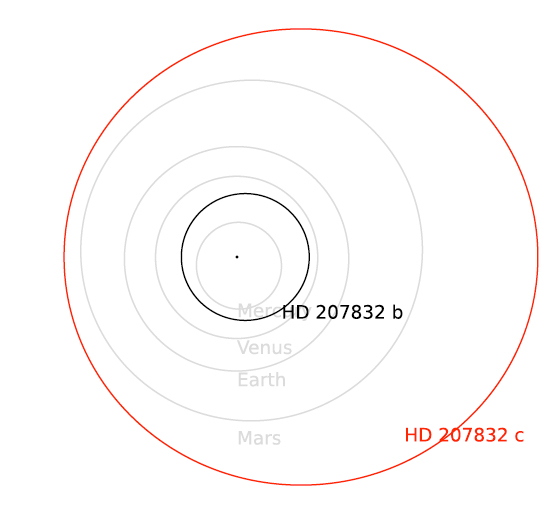
The first of these new planets, HD 207832b, has a mass 56% of that of Jupiter (or 187% of that of Saturn), and orbits the star every 162 days at a distance of 0.57 AU (i.e. 57% of the distance at which the Earth orbits the Sun). 

The second of these planets, HD 207832c, has a mass 73% of that of Jupiter, and orbits the star every 1156 days (3.2  Earth years) at a distance of 2.112 AU.

Diagrammatic representation of the HD 207832 System, showing the orbits of the two planets, and the orbits of the inner four planets of our own Solar System for comparison. The Visual Exoplanet Catalogue.

Since HD 207832 is an essentially Sun-like star, we would expect the distribution of any planets around it to follow the same pattern as in our own Solar System. Our current models of planetary system formation suggest that planets as large as HD 207832b and HD 207832c should not form close into a Sun-like star, but rather further out within the system. This suggests that the planets of the HD 207832 System have migrated inwards for some reason, though the cause of this is not apparent.

Haghighipour et al. tried to construct a computer model of the HD 207832 System, to determine if any other planets might be present in the inner system. They found that there could potentially be a planet as large as the Earth inside the orbit of HD 207832b; although there is no actual evidence to suggest such a planet exists.

See also Two Hot Jupiters found in the Beehive ClusterTwo new more planets discovered in the Gliese 676 systemThe peculiar planets of Kepler-36HATSouth network discovers its first planet and Exoplanets on Sciency Thoughts YouTube.

Follow Sciency Thoughts on Facebook.

Wednesday, 11 July 2012

Two Hot Jupiters found in the Beehive Cluster.

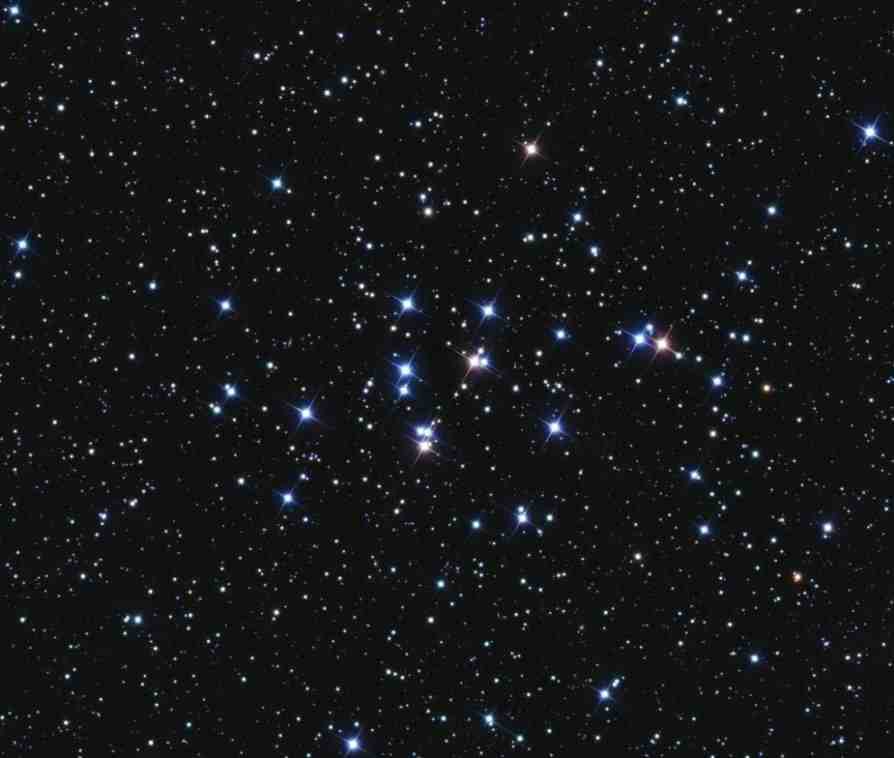
The Beehive Cluster (also M44, Praesepe, the Manger) is an open cluster (a group of stars in close proximity presumed to share a common origin) 577 light years from Earth in the constellation Cancer. It is 22.8 light years across, contains over a thousand stars and is believed to be roughly 600 million years old.

M44, the Beehive Cluster. Greg Parker/The New Forrest Observatory.

In a paper published on the online arXiv database at Cornell University Library on 3 July 2012, a team of scientists led by Samuel Quinn of the Department of Physics & Astronomy at Georgia State University, describe the discovery of two Hot Jupiter type planets within the Beehive Cluster, using the 1.5-m Tillinghast Reflector at the Fred L. Whipple Observatory on Mt. Hopkins in Arizona.

The first of the new planets is named Praesepe 0201b. This orbits the star Praesepe 0201, an F class Dwarf Star 1.234 times the Sun's mass and an effective surface temperature of 6174 K (our Sun has an effective surface temperature of 5778 K). The planet has a mass 0.54 times that of Jupiter, and completes one orbit every 3.43 days.

The second planet is Praesepe 0211b, which orbits the star Praesepe 0211, a G-type dwarf star (the same class of star as out Sun) with 0.952 of the Sun's mass, and an effective surface temperature of 5326 K. The planet has a mass 1.844 times that of Jupiter, and completes one orbit every 2.15 days.


Follow Sciency Thoughts on Facebook.
Wednesday, 20 June 2012

HATSouth network discovers its first planet.

The Hungarian-made Automated Telescope South project (HATSouth) is a network of six robotic telescopes located at three separate sites in the Southern Hemisphere, the Las Campanas Observatory in Chile, the High Energy Stereoscopic System site in Namibia and Siding Spring Observatory in New South Wales, designed to search for exoplanets in the southern sky. It is run as a collaborative project by the Max Planck Institute for Astronomy, Harvard-Smithsonian Center for Astrophysics, Princeton University, the Australian National University, and the Pontificia Universidad Catolica de Chile.

The location of the three HATSouth sites. Bakos et al. (2012).

In a paper published in the online arXiv database at Cornell University Library on 8 June 2012, a team of scientists led by Kaloyan Penev of the Department of Astrophysical Sciences at Princeton University and the Harvard-Smithsonian Center for Astrophysics describe the first planet discovered by the HATSouth network.

The new planet is named HATS-1b, and the star it orbits HATS-1A (it was formerly GSC 6652-00186). HATS-1A is a G-type Dwarf Star, very similar to our own Sun (98.6% of the Sun's mass, with a surface temperature of 5870 K, compared to 5778 K for our Sun), though a little older at 6 billion years, compared to our Sun's 4.5 billion years, roughly 988 light years from the Earth.

HATS-1b is a Hot Jupiter type planet, with 1.85 times Jupiter's mass, orbiting HATS-1A at a distance of 0.044 AU (i.e. 4.4% of the distance between the Earth and the Sun) every 3.45 days. It is thought to have an average equatorial temperature of 1359 K.

The comparative sizes of HAT-1b and the planets of our Solar System. The Visual Exoplanet Catalogue.

Large planets close to their stars are the easiest to detect; their gravity exerts more influence on the star than smaller, more distant planets, causing the stars to wobble more pronouncedly, and those that transit their stars (such as HATS-1b) do so more often and obscure more of the star's light. It is unsurprising, therefore, that the first planet discovered by the HATSouth survey should be a Hot Jupiter type planet (though this is still no mean achievement). The discovery does, however, prove that the system is working, so more discoveries from HATSouth are to be expected.

See also The object orbiting GD66 is probably a planet, not a Brown DwarfLooking for HD 97658bThe atmosphere of WASP-24bSilicate snow on HD 189733 and Exoplanets on Sciency Thoughts YouTube.

Follow Sciency Thoughts on Facebook.