Showing posts with label Hot Jupiter. Show all posts

Saturday, 26 July 2014

CoRoT-27b, a massive, dense planet on a short-period orbit about a G-type star.

2MASS 1183241962 (replace with original designation) is a G-type Yellow Dwarf Star similar to our Sun. It has a mass 1.05 times that of the Sun, a radius 1.08 times that of the Sun,an effective surface temperature of 5900 k (compared to 5778 K for the Sun) and is estimated to be about 4.2 billion years old. 

In a paper published in the journal Astronomy & Astrophysics on 21 February 2014 and on the arXiv database at Cornell University Library on 17 January 2014, a team of scientists led by Hannu Parviainen of the Instituto de Astrofísica de Canarias, the Departmento Astrofísica at the Universidad de La Laguna and the Department of Physics at Oxford University, describe the discovery of a large exoplanet in the 2MASS 1183241962 system using the CoRoT Space Telescope with backup observations by the 3.6 m telescope at the European Space Agency’s La Silla Observatory in Chile.

With the conformation of a planet in the 2MASS 1183241962 system discovered by the CoRoT Space Telescope it is renamed the CoRoT-27 system (i.e. the 27th system with a confirmed planet discovered by CoRoT), with the star becoming CoRoT-27A and the planet CoRoT-27b (when naming bodies in other stellar systems stars are given upper case letters and planets lower case letters).

POSS image showing the surroundings of CoRoT-27 and the photometric aperture mask (solid line). One contaminating star (marked as 1) falls partially within the aperture mask, with an estimated contamination factor of 2:4% 0:95%. Parviainen et al. (2014).

CoRoT-27b orbits CoRoT-27A at an average distance of 0.0476 AU (i.e. 4.76% of the average distance at which the Earth orbits the Sun which is also 8.4% of the distance at which Mercury orbits the Sun), completing one orbit every 3.58 days (86 hours). It has an estimated mass of 10.39 times that of Jupiter and an estimated radius of 1.007 times that of Jupiter, giving it an approximate density of 12.6 grams per cubic centimetre (compared to 5.5 grams per cubic centimeter for Earth, the dens).

The high mass of CoRoT-27b takes it close to the range of smaller Brown Dwarfs; objects intermediate between planets and stars, where hydrogen fusion does not occur, but where deuterium (a heavy isotope of hydrogen) fusion can occur. The lower mass limit for this is thought to be between 11 and 16 Jupiter masses, though mass is not the only factor involved, the potential for deuterium fusion also depends on the metal and helium content of the body. It has been suggested that the two types of bodies could be differentiated by their formation, with planets forming by accretion and Brown Dwarfs by gravitational collapse, but with no obvious method for determining how bodies such as CoRoT-27b have formed this is not particularly useful. It is possible that CoRoT-27b’s mass does in fact exceed 11 Jupiter masses, but it is certainly less than 13 Jupiter masses, and Parviainen et al. therefore conclude that while Brown Dwarf status cannot be completely ruled out, it is, at best, highly unlikely.

Whilst Hot Jupiter type planets (planets of Jovian or Superjovian size close to their parent stars) are now understood to be quite common, very large dense Hot Jupiters such as CoRoT-27b are quite rare, with only five previously described. These are Hat-P-20b (which has a mass equivalent to 7.2 Jupiters and a radius 0.867 times that of Jupiter), CoRoT-20b (which has a mass equivalent to 4.24 Jupiters and a radius 0.84 times that of Jupiter), WASP-18b (which has a mass 10.43 times that of Jupiter and a radius 1.165 times Jupiter's), XO-3b (which has a mass equivalent to 11.79 Jupiters and a radius 1.217 times that of Jupiter) and Kepler-75b (which has a mass equivalent to 9.9 Jupiters and a radius 1.03 times that of Jupiter, giving it a density of 11 grams per cubic centimetre).

Of these HAT-P-20b and CoRoT-20b have been the subject of modelling attempts, with the most likely explanation for the density of both planets being a high concentration of heavy elements in their cores. It is also worth noting that all of these planets were found in orbit about F-type stars, with the exception of Kepler-75b, which also orbits a G-type star, and which is also the closest match to CoRoT-27b in its other parameters.


The discovery of a large number of Hot Jupiter type planets (large gas giant planets orbiting very close to their parent stars) in recent years has challenged out...


 Kepler 63b; a giant planet in a polar orbit.

KIC 11554435 (or Kepler Input Catalogue 11554435) is a young, sunlike star 652 light years from the Earth. It is thought to be between 200 and 300 million years old with a mass 98% of the Sun's and an effective surface temperature of ~5576 K, as opposed to 5778 K for the Sun. As a young star it rotates considerably faster than the Sun, roughly once every 5.4 days, while the Sun...


 The atmosphere of Wasp 12b.

Wasp-12b is a super-Jovian Hot Jupiter type planet (a planet larger than Jupiter orbiting very close to its parent star) 871 light years from Earth in the constellation of Auriga. It orbits Wasp-12A, a G-type yellow dwarf star slightly bigger and hotter than our sun (1.35 × the...


Follow Sciency Thoughts on Facebook.

Wednesday, 7 May 2014

Two Hot Jupiters found to be in triple star systems.

The discovery of a large number of Hot Jupiter type planets (large gas giant planets orbiting very close to their parent stars) in recent years has challenged out theories of stellar system formation. In theory gas giant type planets should only be able to form in the outer parts of a star system, beyond the 'snow line' where ice particles can accumulate within a protoplanetary disk. Since such planets could not form close to the stars, it was originally theorized that they must have formed in the outer part of the stellar system and then spiraled inwards for some reason. However this should lead to planets that still orbited in the plane on which the star rotated (plane of the stellar system), whereas many such planets seem to have orbits quite strongly tilted with regard to this plane. This has led to the development of two further theories, firstly that such systems could come about due to disruption of protoplanetary disks by strong magnetic fields from the host star, and the presence of undetected companion stars in the system, able to disrupt protoplanetary disks through gravitational torque.

In a paper published on the arXiv database at Cornell University Library on 30 March 2014, a team of scientists led by Eric Bechter of the Department of Physics at the University of Notre Dame describe the first results of the 'Friends of Hot Jupiters' program, which aims to systematically search for undetected companions to stars with known Hot Jupiters, with an emphasis on looking for dim Red Dwarfs (stars with masses less than 40% of that of the Sun) or Brown Dwarfs (which mass to fuse hydrogen in their cores like true stars, but are massive enough to fuse deuterium) detectable at infrared wavelengths.

Bechter et al. report the existence of new companion stars in two systems; WASP-12 and HAT-P-8, both of which were already known to be binary systems, with remote Red Dwarf companions orbiting the primary star. Both were directly imaged using the Keck II AO system at the W.M. Keck Observatory on Mauna Kea, Hawaii.

The Wasp-12 system was discovered in 2009. The primary star, WASP-12A, is a yellow dwarf star slightly larger than the Sun, roughly 800 light years from Earth in the constellation of Auriga. This is orbited by a planet, WASP-12b (when naming objects in other star systems stars are identified with upper case letters and planets lower case letters) with about 1.41 times the mass of Jupiter orbiting every 1.09 days at a distance of 0.0229 AU (2.29% of the distance at which the Earth orbits the Sun), this planet having an orbit tilted 59° to the plane of rotation of WASP-12A. In 2011 a second star was detected in the WASP-12 system, a red dwarf with approximately 38% of the Sun's mass named WASP-12B.  

Betcher et al. report closer examination of this companion star reveals that it also has a smaller companion, named WASP-12C, a red dwarf with 37% of the Sun's mass. These two stars orbit one-another at a distance of 21 AU.

Keck AO discovery image of WASP-12 B,C taken on 2 February 2012. North is up and east is left (east is reversed in astronomical images compared to standard maps, as the observer is looking up not down). Follow up observations separated by more than one year recovered the companion. Betcher et al. (2014).

The HAT-P-8 system was discovered in 2008. Its primary star, HAT-P-8A, is an F-type yellow-white dwarf star with roughly 1.28 times the mass of our Sun 750 light years from Earth in the constellation Pegasus. This is orbited every 3.08 days by a planet, HAT-P-8b with a mass 1.52 times as large as Jupiter at a distance of 0.487 AU (4.87% of the distance between the Earth and the Sun), the orbit of this planet being at 15° to the plane of the star's rotation. This system was found to have a companion star, HAT-P-8B, in 2011, this being an M-type red dwarf star with a mass 22% that of the Sun's.

Betcher et al. report the discovery of a third star in the system, HAT-P-8C, a smaller red dwarf with roughly 18% of the Sun's mass. This orbits HAT-P-8B at a distance of about 15 AU.

Keck AO discovery images of HAT-P-8 B,C taken on UT 24 June 2012. North is up and east is left. Follow up observations separated by more than one year recover the companion. Betcher et al. (2014).

See also...


KIC 11554435 (or Kepler Input Catalogue 11554435) is a young, sunlike star 652 light years from the Earth. It is thought to be between 200 and 300 million years old with a mass 98% of the Sun's and an effective surface temperature of ~5576 K, as opposed to 5778 K for the Sun. As a young star it rotates considerably faster than the Sun, roughly once every 5.4 days, while the Sun takes slightly under 24.5 days to complete a rotation, and has a high level of starspot activity (the same as sunspot activity but on a different star).


Wasp-12b is a super-Jovian Hot Jupiter type planet (a planet larger than Jupiter orbiting very close to its parent star) 871 light years from Earth in the constellation of Auriga. It orbits Wasp-12A, a G-type yellow dwarf star slightly bigger and hotter than our sun (1.35 × the Sun's mass, with a surface temperature of 6300 K, as opposed...


The HATNet (Hungarian made Automated Telescope Network) project uses eight small (11 cm diameter lens) telescopes located at the  Fred Lawrence Whipple Observatory in Arizona and the Mauna Kea Observatory in Hawaii, to search for exoplanets. Such Earth-based networks are playing an increasingly important role in...


Follow Sciency Thoughts on Facebook.

Sunday, 29 September 2013

Kepler 63b; a giant planet in a polar orbit.

KIC 11554435 (or Kepler Input Catalogue 11554435) is a young, sunlike star 652 light years from the Earth. It is thought to be between 200 and 300 million years old with a mass 98% of the Sun's and an effective surface temperature of ~5576 K, as opposed to 5778 K for the Sun. As a young star it rotates considerably faster than the Sun, roughly once every 5.4 days, while the Sun takes slightly under 24.5 days to complete a rotation, and has a high level of starspot activity (the same as sunspot activity but on a different star).

In a paper published on the online arXiv database at Cornell University Library on 26 August 2013, and accepted for publication in The Astrophysical Journal, a team of scientists led by Roberto Sanchis-Ojeda of the Department of Physics and Kavli Institute for Astrophysics and Space Research at the Massachusetts Institute of Technology, describe the discovery of a superjovian planet in orbit about KIC 11554435 by the Kepler Space Telescope. The system is renamed Kepler 63, with the star becoming Kepler 63A and the planet Kepler 63b (naming conventions dictate that stars are given upper case letters and planets lower case letters).

Kepler 63b orbits Kepler 63A every 9.43 days at an estimated distance from the star of 0.08 AU (8% of the distance at which the Earth orbits the Sun), making it a 'Hot Jupiter' type planet, transiting the star (passing in front of it from out point of view) as it does so. It has a highly oblique orbit, at 104° to the plane of the star's rotation. Kepler 63b has a radius 6.1 times that of Jupiter, and while it was not possible to determine its mass, this was given an upper limit of 120 times that of Jupiter.

Sanchis-Ojeda et al. were also able to detect a particularly large and apparently permanent starspot (or cluster of starspots) close the the pole of rotation of Kepler 63A that is turned towards us. This moves around the pole with the star's rotation, so that it is sometimes in line with the orbit of the planet and sometimes not.

Locations of the spot, transit chord, and planet at midtransit, according to the best-fitting model. Sanchis-Ojeda et al. (2013).


Follow Sciency Thoughts on Facebook.

Tuesday, 11 June 2013

The atmosphere of Wasp 12b.

Wasp-12b is a super-Jovian Hot Jupiter type planet (a planet larger than Jupiter orbiting very close to its parent star) 871 light years from Earth in the constellation of Auriga. It orbits Wasp-12A, a G-type yellow dwarf star slightly bigger and hotter than our sun (1.35 × the Sun's mass, with a surface temperature of 6300 K, as opposed to 5770 K for our sun), every 26 hours at a distance of 0.229 AU (2.29 % of the distance at which the Earth orbit's the Sun more than ten times as close to its star as Mercury). Wasp-12b is 1.39 as massive as Jupiter but has 28.3 times its volume, being inflated by the heat of the star, with an average surface temperature of 2525 K. Wasp-12b is probably elliptical in shape, and tidally locked, with one face (end) pointing permanently to the star. This face of the planet would reach temperatures in excess of 3000 K, hot enough for the atmosphere to slowly boil away into space. The material lost in this way probably forms an accretionary disk about the star, which will slowly be drawing mass from the planet.

An artist's impression of Wasp 12b. NASA/JPL/Caltech.

In a paper published on the arXiv database at Cornell University Library on 7 May 2013, a team of scientists led by Kevin Stevenson of the Department of Astronomy and Astrophysics at the University of Chicago describe the results of a spectrographic study Wasp 12b by the Spitzer Space Telescope.

This study concludes that the atmosphere of Wasp 12b is probably dark and opaque. Stevenson et al. suggest that the atmosphere of Wasp 12b is either rich in Oxygen with Titanium Oxide, Vanadium Oxide and water forming major components, or rich in Carbon, containing substantial concentrations of Titanium Hydride, Methane and Hydrogen Cyanide.


Follow Sciency Thoughts on Facebook.

Friday, 7 September 2012

The HATNet project announces the discovery of three new Hot Jupiter type planets.

The HATNet (Hungarian made Automated Telescope Network) project uses eight small (11 cm diameter lens) telescopes located at the  Fred Lawrence Whipple Observatory in Arizona and the Mauna Kea Observatory in Hawaii, to search for exoplanets. Such Earth-based networks are playing an increasingly important role in the search for exoplanets, since while they do not discover the shear number of planets that the space-based telescopes find, the planets they do discover tend to be more amicable to follow-up observations by Earth-based observatories.

In a paper published on the online arXiv database at the Cornell University Library on 13 July 2012, a team of scientists led by Joel Hartman of the Department of Astrophysical Sciences at Princeton University, announce the discovery of three new Hot-Jupiter type planets by the HATNet project. All three planets have been observed both by the light they occlude when they pass in front of their host stars, and by the movement they cause in the star as they orbit about it. This enables scientists to estimate both the volume and the mass of the planets, revealing that all of the planets have lower masses, but higher volumes than Jupiter, which matches predictions that gaseous planets close to stars will expand due to the heat of the star.

The first new planet obits the star GSC 1364-01424; this is the 39th star found to have a planet by HATNet, and the system is therefore renamed HAT-P-39, with the star being HAT-P-39A and the planet HAT-P-39b (naming conventions dictate that stars are given upper case letters and planets lower case letters. 

HAT-P-39A is about 2094 light years from Earth in the constellation of Gemini. It is an F-class star, slightly larger and hotter than our Sun, with a mass 1.4 times the Sun's and a radius 1.6 times the Sun's. It's effective surface temperature is 6430 K, compared to 5778 K for our Sun. The star is thought to be about 2 billion years old.

HAT-P-39b orbits this star at a distance of 0.0509 AU (that is to say 5.09% of the distance at which the Earth orbits the Sun), completing one orbit every 3.54 days (85 hours). It has a mass equivalent to 0.599 times that of Jupiter, but a radius 1.57 times Jupiter's. It is thought to have an average equatorial temperature of 1752 K, compared to 303 K for Earth or 152 K for Jupiter.

Diagram showing the mass of HAT-P-39b compared to the planets of out Solar System. Visual Exoplanet Catalogue.

The second new planet orbits the star GSC 3607-01028, now renamed HAT-P-40A, another F-class star, 1634 light years from Earth in the constellation of Lacerta. HAT-P-40A has a mass 1.5 times that of the Sun, and 2.2 times the Sun's radius. Its effective surface temperature is 6080 K, and it is thought to be about 2.7 billion years old.

HAT-P-40b orbits this star at a distance of 0.0608 AU (6.08% of the distance at which the Earth orbits the Sun), taking 4.46 days (107 hours) to complete one circuit about the star. I has 0.615 times the mass of Jupiter, and 1.73 times the radius. Its average equatorial temperature is 1770 K.

Diagram showing the comparative masses of HAT-P-40b and the planets of our Solar System. Visual Exoplanet Catalogue.

The final new planet orbits GSC 0488-02442, now renamed HAT-P-41A, another F-class star, this one  1014 light years away in the constellation of Aquila. HAT-P-41 A has 1.42 times the Sun's mass and 1.68 times the Sun's radius. It has an effective surface temperature of 6390 K, and is thought to be 1.5 billion years old.

H-band AO image of HAT-P-41. Hartman et al. (2012).

The planet HAT-P-41b orbits this star every 2.69 days (65 hours) at a distance of 0.0424 AU (4.24% of the distance between the Earth and the Sun). It has 0.8 times he mass of Jupiter and 1.68 times Jupiter's radius. It's average equatorial temperature is thought to be 1941 K.

Diagram showing the comparative masses of HAT-P-41b and the planets of our Solar System. Visual Exoplanet Catalogue.

See also A fourth body in the KOI-13 systemTwo Hot Jupiters found in the Beehive ClusterA new study of the Kepler 11 planetary systemThe object orbiting GD66 is probably a planet, not a Brown Dwarf and Exoplanets on Sciency Thoughts YouTube.

Follow Sciency Thoughts on Facebook.

Monday, 20 August 2012

A fourth body in the KOI-13 system.

The KOI-13 system (Kepler Object of Interest system) comprises a pair of A-type White Dwarf stars 1630 light years from Earth, orbiting each to closely to be well differentiated. The larger of these, KOI-13α, has a mass 2.05 times that of the Sun, the smaller, KOI-13β, has a mass 1.95 times that of the Sun. In 2011 the Kepler Space Telescope discovered an object (KOI-13.01) orbiting one of these stars every 1.76 days. This object was discovered by the dimming it caused as it passed in front of the star, which meant it was possible to calculate its radius (2.2 times that of Jupiter), but not its mass, leaving scientists unsure whether the object was a very large planet or a Brown Dwarf. In February 2012, a team from the University of Cambridge published a model of the KOI-13 system which suggested that KOI-13.01 was likely to be a super-heated (and therefore super-inflated) Hot Jupiter type planet, with a mass 8.3 times that of Jupiter.

An artists impression of the KOI-13 system. Inset is a telescope image of the stars, scale bar is 1 arc-second. Konkoly Observatory.

In a paper published on the online arXiv database at Cornell University Library on 10 August 2012, and in the journal Astronomy & Astrophysics on 13 August 2012, a team of scientists led by Alexandre  Santerne of the Laboratoire d’Astrophysique de Marseille and Observatoire de Haute-Provence at the Université d’Aix-Marseille & CNRS, detailing the results of a new study of the KOI-13 system using the SOPHIE Spectrograph at the Observatoire de Haute-Provence.  This study used the radial velocity method, which measures the wobble of stars caused by the gravity of objects orbiting around them, to try to determine the mass of KOI-13.01. 

Santerne et al. concluded that KOI-13.01 has a maximum mass of 14.8 times that of Jupiter if it orbits KOI-13α and 9.4 times that of Jupiter if it orbits KOI-13β, supporting the theory that this is a large Hot Jupiter type planet rather than a Brown Dwarf. 

They also found evidence for an extra stellar-mass object within the system, which they name KOI-13γ. This appears to have a mass between 0.4 and 1.0 that of our Sun, and to orbit one of the stars every 65.8 days in an eccentric orbit that does not cross the plane of the star when seen from Earth. KOI-13γ could be potentially the same star as KOI-13.01 if it is towards the smaller end of this mass range, but the most likely scenario that could be modeled was that KOI-13.01 orbits KOI-13α, while KOI-13γ orbits KOI-13β.

See also KOI-13b, a big, hot planet not a Brown Dwarf and Exoplanets on Sciency Thoughts YouTube.

Follow Sciency Thoughts on Facebook.

Wednesday, 11 July 2012

Two Hot Jupiters found in the Beehive Cluster.

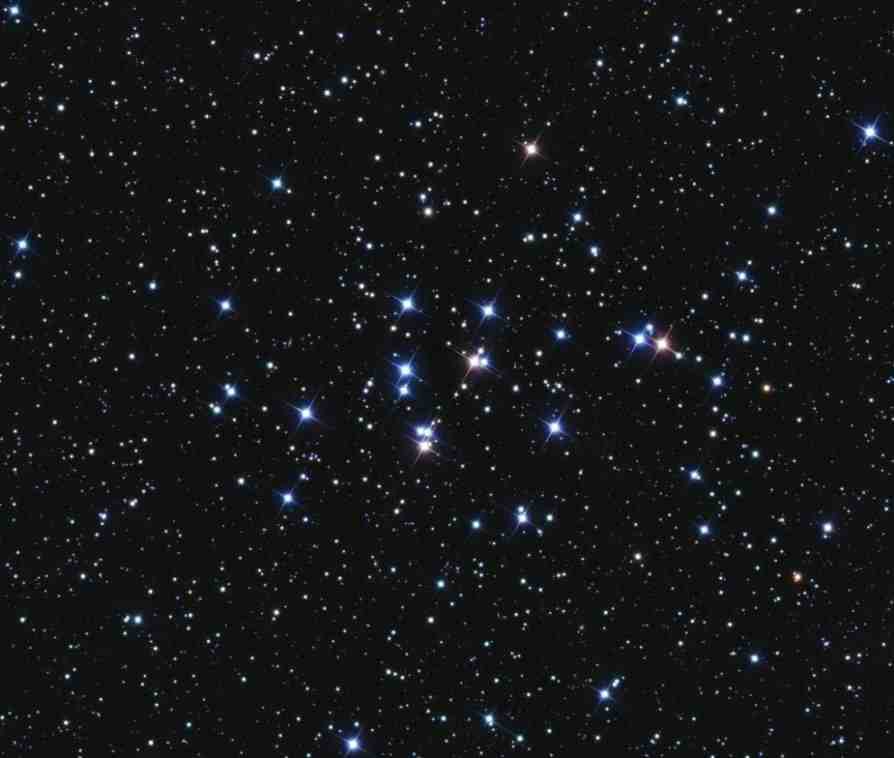
The Beehive Cluster (also M44, Praesepe, the Manger) is an open cluster (a group of stars in close proximity presumed to share a common origin) 577 light years from Earth in the constellation Cancer. It is 22.8 light years across, contains over a thousand stars and is believed to be roughly 600 million years old.

M44, the Beehive Cluster. Greg Parker/The New Forrest Observatory.

In a paper published on the online arXiv database at Cornell University Library on 3 July 2012, a team of scientists led by Samuel Quinn of the Department of Physics & Astronomy at Georgia State University, describe the discovery of two Hot Jupiter type planets within the Beehive Cluster, using the 1.5-m Tillinghast Reflector at the Fred L. Whipple Observatory on Mt. Hopkins in Arizona.

The first of the new planets is named Praesepe 0201b. This orbits the star Praesepe 0201, an F class Dwarf Star 1.234 times the Sun's mass and an effective surface temperature of 6174 K (our Sun has an effective surface temperature of 5778 K). The planet has a mass 0.54 times that of Jupiter, and completes one orbit every 3.43 days.

The second planet is Praesepe 0211b, which orbits the star Praesepe 0211, a G-type dwarf star (the same class of star as out Sun) with 0.952 of the Sun's mass, and an effective surface temperature of 5326 K. The planet has a mass 1.844 times that of Jupiter, and completes one orbit every 2.15 days.


Follow Sciency Thoughts on Facebook.

Friday, 29 June 2012

Two new views of τ Boötis b.

τ Boötis is a binary star system roughly 50 light years from Earth in the constellation of Boötis; the system (or more accurately its primary star) is naked-eye visible from Earth on a dark night. The primary star (τ Boötis A) is a Yellow-White K-type dwarf star with 1.3 time the mass of the Sun and an effective surface temperature of 6360 K (compared to 5778 K for our Sun). This is orbited by a Red Dwarf companion (τ Boötis B) with a mass 40% of the Sun's at a distance of 240 AU (i.e. 240 times the average distance between the Earth and the Sun. In 1997 a Hot-Jupiter type planet was discovered orbiting τ Boötis A every 3.3 days at a distance of 0.0481 AU; this planet was named τ Boötis b.

The position of τ Boötis (here written as Tau Bootis) in the constellation of Boötes. EarthSky.org

τ Boötis b does not transit (pass in front of) τ Boötis A when seen from Earth; it was detected by the tiny wobble that its gravity causes in the motion of the star. This means that only a rough estimation of the planets mass could be made, and nothing determined about its atmospheric chemistry. However techniques in planetary science have moved on since the 1990s, and it is now in theory possible to undertake a spectrographic analysis of the atmosphere of a non-transiting planet, and to determine some of the other properties of such a planet by measuring the Doppler Shifting of these spectra, particularly that produced by the gas Carbon Monoxide. on 27 June 2012 two papers were published on the online arXiv database at Cornell University Library detailing different analyses of data on the τ Boötis System obtained by the Very Large Telescope, located at the European Southern Observatory on Cerro Paranal, Chile.

In the first of these papers a team of scientists lead by Matteo Brogi of the Leiden Observatory at Leiden University, conclude that the orbit of τ Boötis b is inclined at an angle of 44.5° relative to the Earth, and that the planet has a mass 5.95 times that of Jupiter. They also conclude that the atmosphere of τ Boötis b lacks a thermal inversion; that is to say it cools steadily at higher altitudes rather than having cloud-trapping warmer and cooler layers as on Earth. Such thermal inversions have been detected on other Hot-Jupiter type planets; Brogi et al. theorize that τ Boötis b may have lost the heat absorbing compounds (such as water and methane) that cause such inversions due to high levels of ultra-violet irradiation from τ Boötis A.

Schematic representation of the orbit of τ Boötis b about τ Boötis A. The arrow points towards Earth. The star and the orbit are to scare; the planet has been magnified ×3 for clarity. Brogi et al. (2012).

In the second paper Florian RodlerMercedes Lopez-Morales and Ignasi Ribas, of the Institut de Ciències de l’Espai at the Universitat Autònoma de Barcelona, conclude that the orbit of τ Boötis b is inclined at an angle of 47° relative to the Earth, and that the planet has a mass 5.6 times that of Jupiter. They furthermore conclude the atmosphere has an average temperature in excess of 1800 K (compared to 287.2 K for Earth or 735 K for Venus).


Follow Sciency Thoughts on Facebook.

Wednesday, 20 June 2012

HATSouth network discovers its first planet.

The Hungarian-made Automated Telescope South project (HATSouth) is a network of six robotic telescopes located at three separate sites in the Southern Hemisphere, the Las Campanas Observatory in Chile, the High Energy Stereoscopic System site in Namibia and Siding Spring Observatory in New South Wales, designed to search for exoplanets in the southern sky. It is run as a collaborative project by the Max Planck Institute for Astronomy, Harvard-Smithsonian Center for Astrophysics, Princeton University, the Australian National University, and the Pontificia Universidad Catolica de Chile.

The location of the three HATSouth sites. Bakos et al. (2012).

In a paper published in the online arXiv database at Cornell University Library on 8 June 2012, a team of scientists led by Kaloyan Penev of the Department of Astrophysical Sciences at Princeton University and the Harvard-Smithsonian Center for Astrophysics describe the first planet discovered by the HATSouth network.

The new planet is named HATS-1b, and the star it orbits HATS-1A (it was formerly GSC 6652-00186). HATS-1A is a G-type Dwarf Star, very similar to our own Sun (98.6% of the Sun's mass, with a surface temperature of 5870 K, compared to 5778 K for our Sun), though a little older at 6 billion years, compared to our Sun's 4.5 billion years, roughly 988 light years from the Earth.

HATS-1b is a Hot Jupiter type planet, with 1.85 times Jupiter's mass, orbiting HATS-1A at a distance of 0.044 AU (i.e. 4.4% of the distance between the Earth and the Sun) every 3.45 days. It is thought to have an average equatorial temperature of 1359 K.

The comparative sizes of HAT-1b and the planets of our Solar System. The Visual Exoplanet Catalogue.

Large planets close to their stars are the easiest to detect; their gravity exerts more influence on the star than smaller, more distant planets, causing the stars to wobble more pronouncedly, and those that transit their stars (such as HATS-1b) do so more often and obscure more of the star's light. It is unsurprising, therefore, that the first planet discovered by the HATSouth survey should be a Hot Jupiter type planet (though this is still no mean achievement). The discovery does, however, prove that the system is working, so more discoveries from HATSouth are to be expected.

See also The object orbiting GD66 is probably a planet, not a Brown DwarfLooking for HD 97658bThe atmosphere of WASP-24bSilicate snow on HD 189733 and Exoplanets on Sciency Thoughts YouTube.

Follow Sciency Thoughts on Facebook.

Thursday, 23 February 2012

Silicate snow on HD 189733b.

HD 189733b was discovered in 2005 by astronomers working at the Haute-Provence Observatory; its discovery was announced in a paper in the journal Astronomy & Astrophysics by a team of researchers lead by François Bouchy of the Laboratoire d'Astrophysique de Marseille and the Haute-Provence Observatory. It is a Hot Jupiter type planet 63 light years from Earth in the constellation of Vulpecula, orbiting a K-type Orange Dwarf star (HD 189733A), with a mass 80% that of the suns, at a distance of 0.03 AU, i.e. 3% of the distance between Earth and the Sun, or one tenth of the distance at which Mercury orbits the Sun.

Illustration of HD 189733b by Martin Kornmesser of the Hubble European Space Agency Information Centre.

HD 189733b is one of the best studied Hot Jupiter type-planets. It has a mass of 1.13 × that of Jupiter, 6.17 × Jupiter's volume. It orbits HD 189733A once every 53.25 hours. The planet has an atmosphere comprised primarily of hydrogen (H₂) and helium (He), but significant amounts of water (H₂O), methane (CH₄) and carbon monoxide (CO) have been also detected.

In a paper published on the online arXiv database at Cornell University Library on 21 February 2012, and accepted for publication in the Monthly Notices of the Royal Astronomical Society, a team of scientists lead by Catherine Huiston of the Astrophysics Group at the School of Physics at Exeter University describe an attempt to produce a vertical temperature profile for the atmosphere of HD 189733b using the Hubble Space Telescope, and the conclusions derived from their results.

Huitson et al. resolved the temperature of HD 189733b to 1280 K in the lower atmosphere, bellow heights of 500 km, rising to 3600 K in the outer layers of the atmosphere. They also found a distinct scattering effect in the atmosphere that they attributed to the presence of magnesium silicate (MgSiO₃).

MgSiO₃ is of interest to geologists on Earth as it forms different minerals at different pressures, thereby serving as a proxy for how deep within the Earth's mantle rocks originated at. In the lower atmosphere of HD 189733b it could have far stranger properties, since it sublimates (turns directly from a solid to gas) at about 1300 K (depending on pressure). Thus it could evaporate within the lower atmosphere, rise till it met a temperature inversion, where the temperature fell below the sublimation point, then fall as snow till the temperature rose high enough to sublimate it again.

Tuesday, 21 February 2012

Wasp-12b; slowly boiling away...

Wasp-12b is a super-Jovian Hot Jupiter type planet (a planet larger than Jupiter orbiting very close to its parent star) 871 light years from Earth in the constellation of Auriga. It orbits Wasp-12A, a G-type yellow dwarf star slightly bigger and hotter than our sun (1.35 × the Sun's mass, with a surface temperature of 6300 K, as opposed to 5770 K for our sun), every 26 hours at a distance of 0.229 AU (2.29 % of the distance at which the Earth orbit's the Sun more than ten times as close to its star as Mercury). Wasp-12b is 1.39 as massive as Jupiter but has 28.3 times its volume, being inflated by the heat of the star, with an average surface temperature of 2525 K. It was discovered in 2008 by the SuperWASP planetary survey, and its discovery announced in a paper in The Astrophysical Journal in 2009, by a team of scientists led by Leslie Hebb of the School of Physics and Astronomy at the University of St. Andrews.

In a paper published on 26 January 2012 in the online arXiv database at Cornell University Library a team of scientists led by Nicolas Cowan of the Center for Interdisciplinary Exploration and Research in Astrophysics and the Department of Physics & Astronomy at Northwestern University describe a new study of Wasp-12b, based upon data from the Spitzer Space Telescope.

Cowan et al. came to the conclusion that Wasp-12b is probably elliptical in shape, and tidally locked, with one face (end) pointing permanently to the star. This face of the planet would reach temperatures in excess of 3000 K, hot enough for the atmosphere to slowly boil away into space. The material lost in this way probably forms an accretionary disk about the star, which will slowly be drawing mass from the planet.

An artist's impression of Wasp 12b, by Greg Bacon of The Space Telescope Science Institute.

Wednesday, 18 January 2012

Sunset on Osiris.

'Osiris' is an informal name given to the planet HD 209458b, the first transiting exoplanet (planet in another solar system, detected as its orbit regularly brings it in front of its star when seen from Earth), discovered by the European Space Agency's Hippacaros Satellite in 1999, when press interest in exoplanets still warranted their being given names rather than just numbers. It is a Hot Jupiter type planet, with a mass 69% of that of Jupiter and a volume 250% of Jupiter's (the lower mass of the planet makes for less gravity to pull it into a tighter ball, and the higher temperature also makes the planet expand, leading to a planet with a smaller mass but a larger volume than Jupiter) orbiting a sun-like star 150 light years from Earth in the constellation of Pegasus. The planet orbits the star at a distance of 0.044 AU; 4.4% of the distance between the Earth and the Sun, or 12.5% of the distance at which Mercury orbits the sun. It has a year of only 84 hours.

Later studies by the Spitzer Space Telescope, and the Very Large Telescope revealed the planet to have a circular orbit, a surface temperature of at least 750 °C, and an atmosphere rich in Carbon Monoxide (CO) with clouds of silica dust (SiO₂), and superstorms with winds reaching 7000 km/h.

In 2008 a team lead by David Sing of the Institute d'Astrophysique de Paris at Université Pierre et Marie Curie was able to create a complete optical spectrum for the planet, using data gathered by the Hubble Space Telescope, their results being published in a paper in the Astrophysical Journal. Sing et al. found sodium and hydrogen ions (Na+ and H+) as well as Vanadium and Titanium Oxides. They also found that the planets atmosphere has a temperature inversion and distinct troposphere and stratosphere, as on Earth. They calculated that the atmospheric temperature at the bottom of the atmosphere would be around 1700 °C, falling to about 500 °C at the top of the troposphere, then rising again slowly in the stratosphere. They calculated that this could led to clouds of liquid sodium at the top of the troposphere, leading to sodium 'rain' that would evaporate in the hotter lower troposphere to rise up and recondense in the cloudy layer.

On 6 January 2012, Frédéric Pont of the University of Exeter published an image of a sunset on Osiris on the ExoClimes Website based upon the Hubble spectrographic data. This has a strange, greenish tinge to it, due to the absorption of light in the orange part of the spectrum by the gaseous sodium. Pont acknowledges that this image was influenced by an earlier video of a sunset on Osiris that appeared on the Instítut national des sciences de l'univers website in 2008, and may also have been influenced by the fact that David Sing now works at Exeter.

Pont's image of a sunset on Osiris.

Pont also produced an image of a sunset on HD 189733b, another Hot Jupiter type planet with a well studied atmosphere. HD 189733b lies in a binary system 63 light years from Earth in the constellation of Vulpecula. The planet orbits close to the system's primary star (HD 189733A), an orange dwarf with 82% of the mass of the sun, a radius 75% of the suns and 26% of its luminosity. A second star, a dim red dwarf (HD 189733B) orbits every 2300 years at a distance of 216 AU (i.e. 216 times the distance at which the Earth orbits the Sun, or seven times the distance at which Neptune orbits the Sun). HD 189733b is only 0.03 AU from HD 189733A (3% of the distance between the Earth and the Sun), and is slowly boiling away into space as a consequence. It orbits the star once every 53 hours. Sodium, Potasium and Carbon Dioxide have been found in its atmosphere, which is thought to lack an inversion layer and distinct stratosphere and troposphere, due to the extreme heating caused by the close-by star. None of this appears to be visible in the sunset picture,

Pont's image of a sunset on HD 189733b.

Tuesday, 17 January 2012

A fresh look at Wasp-43b.

Wasp-43b was identified as a likely planet by the SuperWASP extra-solar planet detection program's WASP-South Observatory in South Africa in 2009 and confirmed by further observations by WASP-South and WASP-North at the Isaac Newton Group of Telescopes on La Palma. Its discovery was announced in 2011 in a paper in the journal Astronomy & Astrophysics by a team lead by Coel Hellier of the Astrophysics Group at Keele University.

Wasp-43b is a Hot-Jupiter type planet orbiting Wasp-43, a K-type Red Dwarf star roughly 260 light years from the Earth in the constellation of Sextans. Wasp-43 was identified as the lowest mass star then discovered to host a Hot-Jupiter type planet. Wasp-43 orbited this star every 374.4 hours at a distance of 0.014 AU (1.4% of the distance between the Earth and the Sun), making it the closest known Hot Jupiter to its star. The planet was calculated to have a mass of 1.8 times that of Jupiter, and 90% of Jupiter's radius.

An artist's impression of Wasp-43b.

On 13 January 2012 a paper was published on the online arXiv database at Cornell University Library by a team lead by Michael Gillon of the Université de Liège detailing a revised study of the Wasp-43 system combining the original WASP data with new data gathered by the TRAPPIST Telescope, at the European Southern Observatory's La Silla Observatory in Chille, and the Very Large Telescope, also at La Silla.

This more refined view of the system gives the star, Wasp-43A, a radius of 72% of that of our sun and a mass of 2.5% the sun's. Wasp-43b orbits this star at a distance of 0.015 AU (1.5% of the distance between the Earth and the sun) making it the closest known Hot Jupiter to its host star. Wasp-43b has a mass of 2.04 times that of Jupiter, and 1.04 times its radius. Despite being the closest known Hot Jupiter to its star, Wasp-43b is not thought to be highly irradiated for this type of planet. Indeed with a cool star, a high density implying a large core and a very stable orbit it is quite likely that Wasp-43b has sat in its current configuration quite happily for several billion years.

A comparison of the size of Wasp-43b and the planets of our own solar system.

Tuesday, 27 December 2011

Wasp-19b: a Highly Irradiated Hot Jupiter.

Wasp-19b is an exoplanet slightly larger than Jupiter (1.1 times the mass, 1.31 times the radius) orbiting a G-type star 815 light years from the Earth in the constellation of Vela. It was discovered in 2009 by the WASP-South Telescope near Sutherland in Northern Cape Province, South Africa, and its discovery reported in a paper in The Astrophysical Journal by a team lead by Leslie Hebb of the School of Physics and Astronomy at the University of St. Andrews in Scotland.

Wasp-19b has the shortest year of any known planet, orbiting its star in slightly under 19 hours, at a distance of 1.65% of that at which the Earth orbits the Sun. This comfortably places Wasp-19b in the 'Hot Jupiter' category of planets, large planets orbiting close to their stars. But Wasp-19b is hot even for a Hot Jupiter, since the star it orbits is not a cool Red Dwarf, like most Hot Jupiters, but a G-type star with a mass 95% of that of the Sun, a radius 93% of that of the Sun (which is 7.15 times that of Wasp-19b), and a luminosity 71% of that of the Sun. Wasp-19b has an almost circular orbit, with an eccentricity of just 6000 km (that is to say when it is at its closest to its star it is only 6000 km closer than when it is at its furthest).

A simple model of the Wasp-19 system.

This month a team lead by David Anderson of the Astrophysics Group at Keele University published a paper on the arXiv online Database at Cornell University Library detailing the results of a spectrographic study of the atmosphere of Wasp-19b using the Spitzer Space Telescope; this paper has also been accepted for publication in the Monthly Notices of the Royal Astronomical Society.

Most Hot Jupiters appear dark due to Titanium and Vanadium Oxides (TiO and VO) trapped it warm layers of the upper stratosphere, but Wasp-19b appears bright, suggesting that it lacks these dark-molecule trapping layers. The most likely explanation for that is that it lacks a stratified atmosphere due to the high energy input it receives from it's star. Thus it is likely to have both Titanium and Vanadium Oxide in its atmosphere, just not trapped in a discreet layer where they can act as a dark layer.

The precise makeup of the atmosphere of Wasp-19b could not be determined by this study, but the team were able to narrow it down to two possible models. The first, the 'carbon rich' model has an atmosphere comprised primarily of Carbon Monoxide (CO) and Methane (CH₄); the second, or 'oxygen rich', model has an atmosphere composed mostly of Carbon Monoxide, Carbon Dioxide (CO₂) and Water (H₂O).

See also The Atmosphere of GJ1214b, TrES-2b, the black planet and Exoplanets on Sciency Thoughts YouTube.

Saturday, 26 November 2011

A new study of the HAT-P-13 planetary system.

The HAT-P-13 planetary system was discovered in 2009, by the Hungarian-made Automated Telescope Network, a network of six small telescopes located at Konkoly Observatory near Budapest, Steward Observatory in Arizona, the Wise Observatory in the Negev Desert, Israel, Las Campanas Observatory in Chile, Siding Spring Observatory in Australia and the International Amateur Observatory near Gamsberg in Namibia. The HATNet project aims to detect and study extrasolar planets transiting their host stars. The star-system is in the constellation Ursa Major, roughly 697 light years from the Earth. It is also sometimes referred to as GSC 03416-00543, which is General Star Catalogue followed by a set of co-ordinates.

The star in the system HAT-P-13A ('A' for the first object discovered in the system, capitalized because it is a star) is a G-type main sequence star, the same type of star as our sun, though it is slightly larger, older and cooler. It is 1.2 times as massive as the sun, has a radius 1.5 times as great, and has a much higher metal content, a sign it is reaching the end of its life on the main sequence of stars.

This star is circled by at least two major planets, with the possibility of a third.

HAT-P-13b ('b' for the second body in the system, not capitalized because it is not a star) is a transiting Hot-Jupiter type planet. It orbits the star every 70 hours at 4% of the distance between the Earth and the sun, and has a mass 85% of that of Jupiter. Despite its lower mass it has a considerably larger volume due to its high temperature, giving it a radius of 1.3 times that of Jupiter.

HAT-P-13c is a much has not been directly observed, but its presence is known with a considerable degree of confidence, due to its strong gravitational effect on HAT-P-13b. It has a mass of at least 15 times that of Jupiter, making it a borderline contender for Brown Dwarf status; an object large enough to undergo convection in the interior like a star, rather than chemical stratification like a planet, but not massive enough to fuse hydrogen like a star. Brown Dwarfs may fuse deuterium and possibly lithium, and generate a considerable amount of heat due to gravitational effects. HAT-P-13c orbits at approximately 1.86 times the distance at which Earth orbits the sun (slightly further out than Mars) every 428 days. It has not been seen to transit (pass in front of) HAT-P-16A, but may do so.
The orbit of HAT-P-13b and HAT-P-13c. It is not clear if HAT-P-13c passes in front of the star when seen from Earth.


Despite the confidence with which astronomers view the existence of HAT-P-13c, attempts at building a model of the system have consistently failed to predict accurately the transits of HAT-P-13b. This has led to speculation that the system may contain a fourth body, HAT-P-13d, though this has not been detected, nor have scientists been able to develop a reliable model of the system using a four-body scenario.

On 24 November 2011 a paper was posted on the online arXiv database at Cornell University Library, by a team lead by John Southworth of the Astrophysics Group at Keele University, describing a new study on the HAT-P-13 system and the conclusions drawn from it. This paper is due to be published in print form in the Monthly Notices of the Royal Astronomical Society.

Southworth et al. reviewed a number of studies made of the HAT-P-13 system using Cassini Telescope at Loiano Observatory in Italy, a Schmidt-Cassegrain telescope at Portalegre in Portugal, a 1.2 m telescope at the Fred L Whipple Observatory in Arizona, two telescopes at Konkoly Observatory, and the Faulkes Telescope in Hawaii, and attempted to build a model of the system based upon this.

Like previous studies, Southworth et al. were unable to satisfactorily resolve the known data about the HAT-P-13 system and come up with a working model that could predict the transits of HAT-P-13b, either with or without HAT-P-13d. They were, however, able to build a model of the system without a forth body if they assumed that both HAT-P-13A and HAT-P-13b were considerably more massive than previously assumed, leading the team to conclude that this was in error in earlier studies, rather than a missing body from the system.

Friday, 12 August 2011

TrES-2b, the black planet.

TrES-2b was discovered by the in 2006 by the Trans-Atlantic Exoplanet Survey, using telescopes at the Palomar Observatory in California and the Lowell Observatory in Arizona. It was the second planet discovered by the survey, hence its name, TrES from Trans-Atlantic Exoplanet Survey, 2 for the second planet discovered and b for a planet which is the second object in the system (a second star would get the designation B). The discovery was announced in a paper in The Astrophysical Journal by a team lead by Francis T. O'Donovan of the California Institute of Technology. The Trans-Atlantic Exoplanet Survey used simultaneous observations several relatively small (& therefore cheap) telescopes to identify regular drops in light intensity from stars, which might indicate planets passing in front of the star. The discovery was confirmed by the Keck Observatory.

TrES-2b was discovered by the very slight dimming it causes when it passes in front of its host star.

The planet orbits the star GSC 03549-02811, a yellow-dwarf main sequence star 718 light years away in the constellation of Drago. For this reason the planet could be referred to as GSC 03549-02811b and the star as GSC 03549-02811A, but this is unwieldily so it is not normally used. GSC stands for Guide Star Catalogue, a catalogue of stars designed for the Hubble Space Telescope. The numbers are co-ordinates, rather than numbers from a list, enabling the list to (potentially) include every object in the sky.

TrES-2b was the first transiting exoplanet (planet detected transiting across the disk of its star) discovered within the Kepler Field. This is the area of space which the Kepler Space Telescope is permanently trained upon. Unlike Hubble, Kepler does not move. It points permanently at the same point in space to build up a very detailed picture of the star systems in its field, and any planets they have. Since the Kepler team were forwarded as to the existence of TrES-2b, they were able to quickly identify it when Kepler came on line in 2009. Thus it was the first planet imaged by Kepler and is sometimes referred to as Kepler-1b (making the star Kepler-1A).

In February 2009 a team led by Sebastian Daemgen of the Max-Planck-Institut für Astronomie published a paper in the journal Astronomy & Astrophysics in which they announce the discovery of a second star in the TrES system using the Calar Alto telescope in Almeria, Spain. This second star is a dim K-type star orbiting TrES-2A at a distance of 232 AU (i.e. 232 times as far from the main star as Earth is from the sun, or nearly 5 times as far away as Pluto at its furthest from the sun). Since it was more distant than and discovered after TrES-2b it was given the designation TrES-2C, though it is unusual for a star to have a designation lower than a planet in the same system. A K-type star is a star with a surface temperature between 3700 and 5200 K; in contrast our sun is a G-type star, which implies a star with a temperature between 5,200 and 6000 K. K-type stars tend to be older stars running out of fuel or much smaller stars that have never got as hot as our sun, as is the case with TrES-2C.

TrES-2b is a 'hot jupiter' type planet; a gas giant twice the mass of Jupiter orbiting its star at a tenth of the distance at which Mercury orbits the sun.

In August 2011 The Royal Astronomical Society issued a press release announcing a forthcoming paper in the journal Monthly Notices of the Royal Astronomical Society, in which a team led by David Kipping of the Harvard-Smithsonian Center for Astrophysics detail the results of a long-term spectrographic study of TrES-2b using the Kepler Space Telescope. This has revealed that the planet is inexplicably dark in the visible part of the spectrum, emitting almost no light whatsoever. The planet is known to have a surface temperature of around 1000°C, and to have an atmosphere containing gaseous sodium, potassium and titanium oxide, all of which absorb light in the visible part of the spectrum and emit it at other wavelengths, but this cannot account for the darkness of the planet, which remains a mystery.

An artists impression of TrES-2b.