Showing posts with label K-type Stars. Show all posts

Tuesday, 11 October 2016

Understanding the ring system of J1407b.

J1407 (or to give it its full name, 1SWASP J140747.93-394542.6), is a 16 million-year-old K-type orange dwarf star 420 light years from Earth in the Scorpius-Centaurus OB association, in the constellation of Centaurus. In 2007 this star underwent a series of complex eclipses over a period of 56 days, which astronomers eventually concluded were most likely to have been caused by a large planetary companion with an extended ring system and an eccentric orbit, named J1407b, passing in front of the star. Ring systems around planets are thought to be product of the way in which the planets form. As a young planet grows in mass material is pulled from the circumstellar disk (disk of material surrounding the young star from which the planets form) into a circumplanetary disk (disk around the planet). Most of this material eventually accretes onto the planet of is lost back into space, but some can go on to form a system of moons or rings around the planet, the most notable example of this in our own Solar System being the ring system seen around the planet Saturn).
  
In a paper published on the arXiv database at Cornell University Library on 27 September 2016 and accepted for publication in the journal Astronomy & Astrophysics, Steven Rieder of the RIKEN Advanced Institute for Computational Science and Sterrewacht Leiden at Leiden University, and Matthew Kenworthy, also of Sterrewacht Leiden at Leiden University, describe a series of models of the J1407 system and the conclusions about the system drawn from these.

Rieder and Kenworthy assumed that the ring system orbited the planet in the same plane as the planet orbited the star, and that the planet had an average distance from the star of 5AU (i.e. five times the distance at which Earth orbits the Sun), giving it an orbital period of 11 years. The Star was given a mass equivalent to 0.9 times that of the Sun, while the planet was modelled at a series of increments at 20, 40, 60, 80 and 100 times that of Jupiter. Since the planet has never been directly detected it is assumed that the long access of the orbit is directed towards the Earth (eccentric orbits are essentially egg-shaped), which it the most likely explanation of a large companion body escaping detection in the system, with the eclipses occurring at or very close to the planetary perihelion (i.e. the closest point on the orbit to the star, where the planet is moving fastest). The obit of the planet was modelled at eccentricities of between 0.6 and 0.7, meaning that at perihelion it would be between 1.5 and 2.0 AU from the star and moving at a rate of between 27 and 33 kilometers per second.
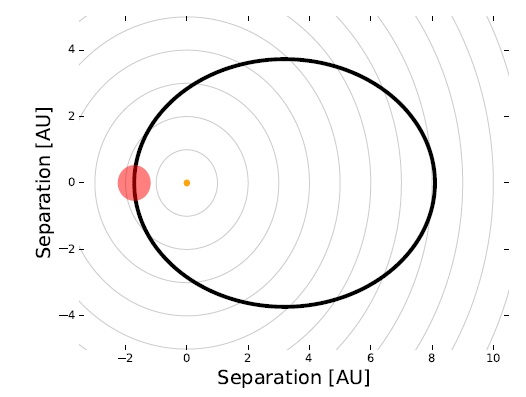
 The orbit of J1407b model B80, with J1407b located at pericentre. The J1407b system (red) is shown to scale for the initial size of the model. The size of the star (orange) is exaggerated by a factor 20. Grey circles indicate the distance to the star in AU, while the black ellipse shows the orbit. Rieder & Kenworthy (2016).

Each model planet was surrounded by a series of 50 rings with an inner edge ranging from 0.26 AU to 0.66 AU. Particles were assumed to start equidistant from each other within each ring, but the radial distance of each particle was then changed by a random amount. Each ring system generated in this way was run through the simulation twice, once with a prograde orbit (i.e. in the same direction as the orbit of the planet) and once in a retrograde orbit (i.e.. in the opposite direction to the orbit of the planer. Particles that travelled beyond 2AU from the planet were assumed to have been lost from the system. The simulation was run for 9000 orbits, equivalent to 500 000 years.

Rieder and Kenworthy found that rings with prograde orbits tended to be disrupted easily in the simulations, with the largest surviving ring system in a prograde orbit being capable of producing an eclipse only 40 days long, far shorter than the observed phenomenon. Ring systems with retrograde orbits, however, fared better, and several simulations were capable of producing eclipses 56 days in length or even longer. This suggests that the eclipses could well be caused by a planet, J1407b surrounded by a series of rings with a retrograde orbit. This is not an unreasonable requirement, as in our own Solar System the panets Venus and Uranus have retrograde rotations, and this has also been obeserved in exoplanet such as WASP-17b. The simulations also suggest that the planet is likely to be large, closer in size to 100 times as massive as Jupiter than 20 times as massive. Such an object would be more likely to be a Brown Dwarf than a planet (Brown Dwarfs are objects to large to be considered planets, but to small to be considered stars; they are thought to be able to fuse deuterium in their cores, but not hydrogen). 

See also...
http://sciencythoughts.blogspot.co.uk/2016/09/faint-companions-discovered-to-two.htmlFaint companions discovered to two planet-hosting stars.                                               Almost all planets orbiting other stars have been discovered by one of two planetary detection techniques: occlusion, on which the planet passes in front of the star, causing the amount of light reaching us from that star to dim ever so slightly on a regular timescale, or radial velocity, in which the gravity of the planet causes the host star to wobble back and...
http://sciencythoughts.blogspot.co.uk/2015/11/the-possibility-of-earth-mass-planet-in.htmlThe possibility of an Earth-mass planet in the habitable zone of the Kepler-68 system.      The Kepler Space Telescope has located many multi-planet systems since its inception, which combined with discoveries made by other planet-hunting missions has enabled scientists to begin to construct models of planetary systems orbiting other stars. This is particularly complicated where not all planets are visible to the space telescope, which is only...
http://sciencythoughts.blogspot.co.uk/2015/11/generating-free-oxygen-in-atmosphere-of.htmlGenerating free oxygen in the atmosphere of exoplanets without the presence of life.           In the past two decades over a thousand planets have been found orbiting stars other than our own, many of which appear to be small rocky planets in the habitable zones of their stars (i.e. the zone in which such a...
Follow Sciency Thoughts on Facebook.

Monday, 5 September 2016

Imaging the inner disk of LkCa 15.

LkCa 15 is a young (2-5 million-year-old) K5-type orange dwarf star, roughly 547 light years from Earth in the Taurus-Auriga star-forming region in the constellation of Taurus. It has approximately the same mass as the Sun but only about 74% of its luminosity, new material is still accreting onto the star at a rate of about one Earth mass every 23 years. The system has a one of the best known transition disks (a structure on the way from being a protoplanetary disk, a dense structure from which planets are thought to form, to a debris disk, a relict of earlier planet-formation, such as the Main Asteroid Belt and Kuiper Belt in our Solar System), which comprises an inner disk close to the star, a gap with three candidate planets and an outer disk which begins at about 50 AU from the star (i.e. 50 times as far from the star as the Earth is from the Sun). This is recognizably similar to our Solar System, with an outer disk in a similar position to our Kuiper Belt, three large candidate planets in a similar position to the four giant planets of our Solar System (Jupiter, Saturn, Uranus and Neptune) and an inner disk in the region occupied by our inner planets (Mercury, Venus, Earth and Mars), however while the outer disk of LkCa 15 has been well studied and the planets imaged several times, resolving the inner disk has proven problematic.

In a paper published on the arXiv database at Cornell University Library on 2 September 2016, a team of scientists led by Christian Thalmann of the Institute for Astronomy at ETH Zurich describe the results of a new study of the LkCa 15 system using the SPHERE (Spectro-Polarimetric High-contrast Exoplanet REsearch) instrument on the European Southern Observatory’s Very Large Telescope, and discuss the implications of this study.

Thalmann et al. made two rounds of observations with the instrument, which makes long exposure still images, the first making images with an exposure time of 32 seconds, using a coronagraph to block out the light from the star (the DEEP images), and the second making images with an exposure time of 0.85 seconds and not using a coronagraph (the FAST images.

The DEEP images were able to resolve both disks of LkCa 15 and the gap between them in much better detail than has previously been possible. These show the inner disk to be a roughly elliptical structure, comparable in shape and orientation to the outer disk, but approximately half the size. The FAST images show similar structures to the DEEP images, though at a lower resolution.

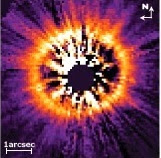
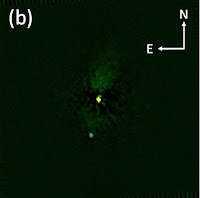
SPHERE IRDIS J-band imaging polarimetry of LkCa 15. Each panel shows the DEEP and FAST images side-by-side at the same scale, with insets showing the shape of the PSF core (a) Polarized flux of Deep at linear stretch (arb. units). The inner disk saturates the color scale. (b) The corresponding S/N map at a stretch of [-10σ , 10σ ]. (c) Polarized flux of DEEP after scaling with an inclined r² map to render the faint disk structures visible (arb. units). (d-f) The same three images for FAST. While overall sensitivity is lower in these data, they a fford an unobstructed view onto the inner disk. In all panels, the star’s location is marked with a white disk. The black wedges on the color scales mark the zero level. Thalmann et al. (2016).


The two arms of the inner disk appear to be asymmetrical, with the western arm trending outward and the eastward arm curling inward, and there appears to be a local brightening along the far side of the minor axis. There is also an apparent darkening on the inner part of the disk, possibly indicating a gap within it, though Thalmann et al. are cautious of over-interpreting these results, which are at the very limit of the telescope's operating capacity. The three candidate planets were also resolved, though again Thalmann et al. advise caution, but in this case they do feel the evidence for the best understood planet (LkCa 15b), is particularly strong, and note that such a planet could cause some of the apparent structures seen in the inner disk.

Thalmann et al. resolve the outer disk as being tilted at an angle of 60° seen by an Earth-based observer. They could not resolve any spirals or structural asymmetries within this outer disk, but did note four dimmed radial lines at 50° , 135° , 200° , and 325°. The nature of these lines is unclear, though they could be shadows cast by inner disk regions or magnetospheric accretion columns.

Analysis of the outer disk structure of LkCa 15. (a) Ellipse fits to the maximum gradient (solid blue line) and the flux minimum (dotted blue line) in the r²-scaled DEEP image. (b) Comparison of the best-fit gap edge in J-band (blue solid line) with those in RI-band (red long-dashed line) and sub-millimeter interferometry (green short-dashed line). (c) Full-intensity KLIP image (5 subtracted modes) of the Full data in the K1K2 filter for comparison. The gap edge derived from the DEEP image coincides very well with the edge of the bright crescent in the KLIP image. (d) The image in panel (a) at a harder stretch, emphasizing the surface brightness variations in the outer disk. Four position angles with reduced brightness are marked, possibly indicating transient shadowing from the inner disk. Thalmann et al. (2016).


See also...

Transition disks around LkCa 15.             Planets are thought to form in protoplanetary disks, which is to say disks of gas and dust around young stars. However not all the material in a protoplanetary disk is likely to be used up in the formation of planets, leaving one or more debris disks, such as the Main Asteroid Belt and Kuiper Belt in our own Solar System. These debris disks typically contain rocky and icy bodies, but not...
Searching for circumplanetary disks around LkCa 15.                                                        Just as young stars are typically surrounded by a disk of material that is accreting onto the star as well as potentially coalescing to form planets (circumstellar or protoplanetary disks), comets and other bodies; young planets, particularly very large ones, ought in theory to be surrounded by smaller disks of material, accreting onto the planet and potentially coalescing to form moons....
Follow Sciency Thoughts on Facebook.

Friday, 22 January 2016

Transition disks around LkCa 15.

Planets are thought to form in protoplanetary disks, which is to say disks of gas and dust around young stars. However not all the material in a protoplanetary disk is likely to be used up in the formation of planets, leaving one or more debris disks, such as the Main Asteroid Belt and Kuiper Belt in our own Solar System. These debris disks typically contain rocky and icy bodies, but not free gas. However this is not an instantaneous event, and a period exists where a planetary system is forming accompanied by one or more disks of dust and gas; these evolving disks in forming planetary systems are called 'transition disks.

In a paper published on the arXiv database at Cornell University Library on 5 January 2015 and accepted for publication in the Publications of the Astronomical Society of Japan, a team of scientists led by Daehyun Oh of the Department of Astronomical Science of the Graduate University for Advanced Studies and the National Astronomical Observatory of Japan discuss the results of a study of the LkCa 15 stellar system and its transition disks made with the Subaru Telescope.

LkCa 15 is a young (2-5 million-year-old) K5-type orange dwarf star, roughly 547 light years from Earth in the constellation of Taurus. It has approximately the same mass as the Sun but only about 74% of its luminosity, new material is still accreting onto the star at a rate of about one Earth mass every 23 years.  The system has a well documented transition disk as well as two candidate planets, with a second inner disk having been discovered in 2015.

Oh et al. were able to clearly resolve two elliptical disks around LkCa 15, these are apparently in the same plane, tilted at a angle of 44˚ from our perspective. However the gap separating these disks, which forms an apparent third component to the system, appears to be tilted at a greater angle, 52˚. Since this gap is only an apparent member of the disk system, not a genuine object, this apparent difference in angle can only be a product of the structure of the two actual rings.

PI and overlapped polarization vector map images (2.0′′ × 2.0′′) before (a) and after (b) halo subtraction. The saturated region is occulted by a software mask (r∼0.1′′ ), the vectors are binned with spatial resolution, and the lengths are arbitrary for presentation purposes. (a): The effect of a polarized halo appears to have a tendency toward the minor axis of the disk. (b): The polarization tendency to the minor axis was removed, and the disk-origin polarization along the disk surface was revealed. Bottom: The radial Stokes Qr (c) and Ur (d) images. In the Qr image, both the outer and inner disks are significantly detected as expected from the PI image. On the other hand, the Ur image shows no disk-like component. Oh et al. (2015).

In order to resolve this Oh et al. examined the brightness asymmetries of the disks in order to glean further information about their inclination. This works because the side of the disk behind the star is reflecting light directly back towards us, whereas light reaching us from the near side has to be scattered through the disk. Using this method they found that the inner portions of the disks were misaligned by about 13˚, the best explanation for this being that the inner disk is significantly warped.

Elliptical fitting results of the inner disk (purple), the gap (yellow), and the outer disk (red). The image has been smoothed by a gaussian with r=2 pixels to reduce the effects of speckles on the inferred structure of the disk. The central region is also shown in the right top panel. White star indicates the location of LkCa 15. Green and orange stars indicate where the planet candidates LkCa 15 b and c were detected in 2014, respectively (Sallum et al. 2015). Empty green and orange circles indicate the locations of two infrared sources seen in 2009-2010 (Kraus & Ireland 2012), which are assumed as LkCa 15 b and c, respectively. Oh et al. (2015).

This study greatly adds to the evidence for the presence of one or more planets or protoplanets in the LkCa 15 system. The warping of the inner disk observed would require the presence of a planet with a planet having a mass at least equivalent to that of Jupiter, while the gap between the two disks is about 27 AU (27 times the distance at which the Earth orbits the Sun), which would require multiple such large planets to clear.

See also...

http://sciencythoughts.blogspot.co.uk/2015/12/detecting-debirs-disks-around-small.htmlDetecting debris disks around small nearby stars in old Hubble images.                        Debris disks are rings of dust, rock and icy material left surrounding stars after planet formation has occurred (unlike protoplanetary disks, which are present around very young stars only, and which are thought to be largely consumed by planetary formation). Our Solar System has two such debris disks, the Asteroid Belt and the Kuiper Belt, and in recent years...
http://sciencythoughts.blogspot.co.uk/2015/03/the-outer-disk-of-t-chamaeleontis.html

The outer disk of T Chamaeleontis.                 T Chamaeleontis is a T Tauri star (a very young star which has not yet began to generate heat by hydrogen fusion, but which produces considerable energy through gravitational heating) estimated to be about 7 million years old, roughly 350 light years from Earth in the constellation of Chamaeleontis. It is known to be surrounded by two transition disks (disks of dust and gas surrounding very young stars, thought to...


http://sciencythoughts.blogspot.co.uk/2014/07/the-keplerian-disk-of-class-i-protostar.htmlThe Keplerian Disk of Class I Protostar L1489 IRS.                                               Recent studies of the Keplerian Disks around other Protostars with the Submillimeter Array (SMA) have suggested that in the early Class 0 Protostar stage little rotation occurs within the Keplerian Disk and the rate of infalling (i.e. the rate at which material falls from the Disk onto the Protostar) is high. In late...


Follow Sciency Thoughts on Facebook.


Friday, 11 December 2015

Detecting debris disks around small nearby stars in old Hubble images.

Debris disks are rings of dust, rock and icy material left surrounding stars after planet formation has occurred (unlike protoplanetary disks, which are present around very young stars only, and which are thought to be largely consumed by planetary formation). Our Solar System has two such debris disks, the Asteroid Belt and the Kuiper Belt, and in recent years improved telescope technology has allowed astronomers to detect debris disks around about 80 of other stars. Most of these disks have been detected only at infrared wavelengths; imaging disks at visual wavelengths enables astronomers to study the morphology and composition of such disks in far greater detail, enabling them to predict the presence of planets that cannot be directly detected and better understand planetary formation around other stars.

Almost all debris disks that have been discovered to date have been found around larger stars. There are several possible reasons for this. Firstly the majority of smaller stars are thought to form in dense star clusters (i.e. very close to other forming stars), which may prevent the formation of such disks. Smaller stars also tend to be less stable, prone to larger and more frequent stellar flares, tending to have higher stellar winds and stronger magnetic fields, all of which may potentially disrupt any debris disks, causing them to dissipate early in the history of such stellar systems. Alternatively such disks may actually be fairly common around smaller stars, but mostly be bellow the level of detectability due to the lower levels of heat and light emitted by smaller stars and the smaller size of the systems in general.

In a paper published on the arXiv database at Cornell University Library on 7 December 2015, a team of scientists led by Élodie Choquet of the Space Telescope Science Institute, describe four new debris disks discovered around small nearby stars Hubble Space Telescope images, the Archival Legacy Investigation of Circumstellar Environments (ALICE) project, which uses the Karhunen-Loeve Image Projection (KLIP) algorithm (better software) to analyse old images for debris disks that may not have previously been discovered.

The first disk described is around the M3.2 star  (Red Dwarf Star with a mass less than 36% of that of our Sun) TWA 7. This star is about 34.5 parsecs (112.5 light years) away, and is associated with the TW Hydrae moving group, which is thought to be about 10 million years old, although one study has suggested that TWA 7 may be as young as 4 million years old. No emissions associated with accretion have been detected from this system, suggesting that any disk present would be an evolved debris disk rather than a protoplanetary disk with ongoing planetary formation. Infrared studies of the system with the Herschel Space Observatory have suggested that it might have two debris disks, one with a temperature of about 66 K at a distance of about 38 AU from the star (i.e. a debris disk with a temperature of 38 degrees centigrade above absolute zero which is 38 times as far from the star as the Earth is from the Sun) and one with a temperature of about 20 K at a distance of about 75 AU from the star. Choquet et al. were able to resolve a disk at a distance of 35 AU from the star. They could find no evidence of an outer disk, though they cannot rule out the existence of such a disk which may be to faint to detect.

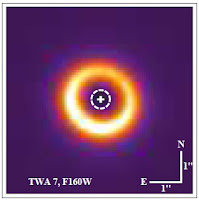
 Input unprocessed model of the debris disk around TWA 7. Choquet et al. (2015).

The second star examined was TWA 25, an M0.5 star (Red Dwarf Star with  less that 50% of the mass of the Sun) 54 parsecs (176 light years) from out Solar System. TWA 25 is also associated with the TW Hydrae moving group, and is estimated to be about 13 million years old. The Herschal Space Observatory failed to find any evidence of a debris disk around TWA 25, though the Wide-field Infrared Survey Explorer (WISE) space telescope did record an excess of infrared at some wavelengths, which can be an indication of such a disk. Choquet et al. found an inclined disk around TWA 25, edge on from our perspective and about 78 AU from the star.

 Input unprocessed model of the debris disk around TWA 25. Choquet et al. (2015).

The third star examined was HD 35650, a K6V star (Orange Dwarf Star with less than 80 of the mass of the Sun) roughly 18 parsecs (58.7 light years) from our Solar System. HD 35650 is thought to be associated with the AB Doradus moving group, which is thought to be between 50 and 200 million years old. The Spitzer Space Telescope detected an excess of infrared radiation at a wavelength of 70 μm, but not at 24 μm, which it is thought may indicate a debris disk with a temperature of 60K. Choquet et al. were able to detect an asymmetric disk at about 54 AU from the star, 70% brighter on the north side than the south. This disk appears to be compressed along its northwest axis, possibly due to the system moving into a denser area of interstellar medium.

 Input unprocessed model of the debris disk around HD 35650. Choquet et al. (2015).

The final star looked at was HD 377, a G2V star (a stat with roughly the same mass as the Sun), approximately 39.1 parsecs (127.5 light years) from the Solar System. It this instance the Spitzer Space Telescope detected an infrared excess at 24 μm to 160 μm, the WISE space telescope at 22 μm and the James Clark Maxwell Telescope at 850 μm. This was thought likely to be indicative of two debris disks, one with a temperature of 240 K at a distance of 2.4 AU and one with a temperature of 57 K at 136.4 AU. Choquet et al. were able to detect a single debris disk, at a distance of 86 AU from the star.

Input unprocessed model of the debris disk around HD 377. Choquet et al. (2015).

See also...

http://sciencythoughts.blogspot.co.uk/2014/05/the-debris-disk-around-hr-4796-a.htmlThe debris disk around HD 4796 A.             The term debris disk is applied to any ring of sub-planetary sized objects around a star. In our Solar System both the Main Asteroid Belt and the Kuiper Belt would qualify as debris disks, though in practice neither of these belts would be detectable around another star with current technology. However younger star systems often have much more detectable debris disks, containing extensive fields of dust from...
http://sciencythoughts.blogspot.co.uk/2014/05/discovering-new-debris-disks-in-old.htmlDiscovering new debris disks in old Hubble images.                                                          The term ‘debris disk’ is used to refer to any ring of sub-planetary objects about a star; in our Solar System both the Main Asteroid Belt and the Kuiper Belt count as debris disks. In practice, asteroids and comets around other stars are not detectable with current technology, but large volumes of dust are, and since such volumes of dust around a star are expected to have a...
http://sciencythoughts.blogspot.co.uk/2013/06/the-debris-disk-of-49-ceti.htmlThe debris disk of 49 Ceti.                            49 Ceti is a bright star in the constellation of Cetus, 194 light years from the Earth, with a mass slightly over 2 times that of the Sun. It is a young star, only about 40 million years in age, and is surrounded by a large debris disk, which has been shown to be rich in Carbon Monoxide. In an system this old it would generally be assumed that such a disk was made of comet-type bodies, with the detectable free Carbon Monoxide...
Follow Sciency Thoughts on Facebook.
 

Thursday, 5 February 2015

A compact planetary system around an ancient star.


The Kepler Space Telescope has discovered over 4000 candidate planets, around 40% of which are in systems with multiple planets. Many of the early multiple planet systems discovered contained one or more giant planets (planets of similar size to, or larger than, Jupiter), which tend to be easier to detect. More recent discoveries have found a wider range of planets, enabling comparisons to be drawn about the systems that host these planets. All of the giant planets have been found in systems with metal rich stars, indicating that they are relatively young and have formed late in the Universe’s history (all metal in the Universe is thought to have formed in old and dying stars, and as the universe has aged the amount of metal has steadily increased, so that younger stars contain more metal from the outset), but smaller planets have been found around a much wider range of stars, implying that such planets began to form much earlier in the Universe’s 13.8 billion year history.

In a paper published on the arXiv database at Cornell University Library on 26 January 2014 a team of scientists led by Tiago Campante of the School of Physics and Astronomy at the University of Birmingham and the StellarAstrophysics Centre at the Department of Physics and Astronomy at Aarhus University describe a system of planets around the ancient low metal star Kepler 444, which is estimated to be about 11.2 billion years old.

Kepler 444 was formerly designated as KOI 3158 (Kepler Object of Interest 3158, implying the 3158th star in the Kepler field found to have candidate planets), becoming Kepler 444 with the conformation of its planets (Kepler 444 implying the 444th system in the Kepler field with confirmed planets). It also has the catalogue designations HIP 94931, KIC 6278762 and LHS 3450. It is a K-type dwarf star, with about 75% of the mass of the Sun and an effective surface temperature of 5046 K (compared to 5778 K for our Sun).

It is also one of the closest stars in the Kepler study, at a distance of only 116.4 light years, and is part of the Arcturus Stream, a group of ancient stars with similar proper motions; these were formerly thought to have formed outside the Milky Way proper, in a now defunct satellite galaxy, though this is now considered unlikely, with the stars probably originating in the Thick Disk, an area ranging from one to five kiloparsecs of the galactic plane (85% of the galaxy’s stars originate within the Thin Disk, which lies within one kiloparsec of the galactic plane).

Campante et al. followed up the initial Kepler observations of the system with observations from the Keck I telescope and HIRES spectrograph on Mauna Kea, the Robo-AOlaser-adaptive-optics system, the Palomar Observatory 60-inch telescope and the NIRC2 instrument mounted on the Keck II 10-meter telescope.

These observations found a second, dimmer star at a distance of 1.8 arcseconds from Kepler 444 (an arcsecond is one sixtieth of an arcminute, which is one sixtieth of a degree, which is one three hundred and sixtieth of the sky envisioned as a sphere surrounding the Earth). This second star shows a common radial velocity with the primary star, suggesting that it is orbiting Kepler 444 roughly once every 430 years. Data from the HIRES spectograph further suggests that this second body is itself a pair of M-type Red Dwarf stars, the larger of which has an effective surface temperature of 3464 K, the smaller being cooler.

NIRC2 adaptive optics image of Kepler-444. The image was obtained using the K’filter (2:124mm) for a total of 378 s of integration time. Declination and right ascension coordinates (J2000.0) are given alongthe vertical and horizontal axes, respectively. Campante et al. (2015).

The Kepler 444 system had five planetary candidates, all of which were resolved to be true planets rather than background objects with a 99.9% certainty. The planets are all have short orbital periods, implying that they are all close to the star, within 0.06 AU (i.e. 6% of the distance at which the Earth orbits the Sun), and the orbital periods appear to be resonant; which is what would be expected from tightly packed planets.

Next Campante et al. examined the possibility that the planets might orbit one or both of the companions, rather than Kepler 444 itself. Since the data from the Kepler Space Telescope records the amount of dimming that occurs when a planet passes in front of a star, it is possible to calculate the radius of that planet if the brightness of the star is known. This suggests that the planets would have radii of 1.33, 1.64, 1.75, 1.80, and 2.45 times that of the Earth if they are orbiting the companion bodies. Since it would be virtually impossible for planets to retain gaseous envelopes or significant volumes of ice this close to a star, these bodies would have to be rocky in nature, and therefore have significant masses. Attempts to model such a system with bodies of such high masses close together suggested that such a system would be unstable and the planets would be lost within decades or centuries, ruling out this scenario.

This suggests that the five planets are indeed orbiting the K type star, from which their radii can be calculated to be 0.403, 0.497, 0.530, 0.546, and 0.741 times that of the Earth respectively, a much more stable configuration.

Thus the first planet, Kepler 444b (when naming bodies in other star systems planets are given lower case letters and stars upper case letters), will have a radius 40.3% of the Earth’s (roughly comparable with Mercury), and orbit the Keppler 444A (the main star in the system) every 3.6 days, at a distance of 0.04178 AU (4.178% of the average distance between the Earth and the Sun).

The second planet, Kepler 444c will have a radius 49.7% of that of the Earth (comparable to Mars), and orbit Kepler 444A every 4.5 days at a distance of 0.04881 AU.

Kepler 444d will have a radius 53.0% of that of the Earth (again comparable to that of Mars) and orbit Kepler 444A every 6.2 days at a distance of 0.06 AU.

Kepler 444e will have a radius 54.6% of that of the Earth, and orbit Kepler 444A every 7.7 days at a distance of 0.0696 AU.

Finally Kepler 444f will have a radius 74.1% of that of the Earth (intermediate between those of Mars and Venus) and orbit Kepler 444A every 9.7 days at a distance of 0.0811 AU.

Semi-major axes of planets belonging to the highly-compact multiple-planet systems Kepler-444, Kepler-11, Kepler-32, Kepler-33, and Kepler-80. Semi major axes of planets in the Solar System are shownfor comparison. The vertical dotted line marks the semi-major axis of Mercury. Symbol size is proportionalto planetary radius. Note that all planets in the Kepler-444 system are interior to the orbit of the innermostplanet in the Kepler-11 system, the prototype of this class of highly-compact multiple-planet systems.Campante et al. (2015).

Kepler 444 is the oldest star yet found to host planets, the former holder of which title was Kepler 10, at an age of 10.4 billion years. It is considered to be a second generation star (i.e. made of matter that had previously been in only one other star since the origin of the universe), unlike the Sun and most other known planet-hosting stars, which are third generation stars. This means that at the time when the Solar System was forming, the planets of the Kepler 444 system were already older than the Earth is now. The existence of rocky planets this early in the history of the Universe suggests that life may also have originated very early, and that truly ancient ecosystems may exist somewhere in the Universe.

See also…

http://sciencythoughts.blogspot.co.uk/2015/02/follow-up-observations-of-kepler.htmlFollow up observations of Kepler candidate stars.                                                                           The Kepler Space Telescope observed a 115 square degree of space for four years (from May 2009 till May 2013), looking for potential planets around the 150 000 stars in the magnitude range 8-16 within the field. In this time it found a total of 4233 candidate planets, of which 965 have subsequently been confirmed. The conformation of such a planet requires follow up...
http://sciencythoughts.blogspot.co.uk/2014/07/conformation-of-third-planet-in-kepler.htmlConformation of the third planet in the Kepler-51 System.                                               Kepler-51 is a G-type Yellow Dwarf star 2800 light years from Earth in the constellation of Cygnus. It has a...
Kepler 186f: an Earth-sized planet in the habitable zone of a Red Dwarf star.
One of the key objectives in the search for planets orbiting other stars has been to locate planets in the habitable zones of such stars, i.e. planets on which liquid water could potentially exist. A number of.
Follow Sciency Thoughts on Facebook.

Monday, 26 May 2014

The planets of HD 141399.

HD 141399 is a K-type orange dwarf star 118 light years from Earth in the constellation of Boötes. It has a mass 1.14 times that of the Sun, a radius 1.46 times the Sun’s, an effective surface temperature of 5360 K (compared to 5778 K for the Sun), and is 1.59 times as luminous as the Sun. 

In a paper published on the online arXiv database at Cornell University Library on 29 April 2014, a team of scientists led by Steven Vogt of the Lick Observatory of the Department of Astronomy and Astrophysics at the University of California at Santa Cruz, describe the results of a study of the HD 141399 system using the HIRES spectrometer of the Keck-I telescope, and the Levy spectrometer of the new Automated Planet Finder at Lick Observatory to detect Doppler shifts in the motion of HD 141399; tiny motions towards and away from the observer caused by the gravitational pull of planets orbiting a star.

Based upon these observations, Vogt et al. conclude that HD 141399 is host to four planets, dubbed HD 141399 a, b, c and d. Under this naming system the star becomes HD 141399 A, as bodies in other stellar systems are designated with upper case letters to indicate stars and lower case letters to indicate planets.

The first of these new planets is HD 141399 b, which orbits the star at 0.4425 AU (i.e. 44.25% of the distance at which the Earth orbit’s the Sun) every 94.35 days, has a mass 46% of that of Jupiter, and a radius 94% that of Jupiter’s. It is thought to have a rocky or metallic core more than 30 times the mass of, which forms roughly two thirds of its radius, as well as a substantial gaseous envelope, mostly of hydrogen and helium, but potentially with large water clouds. Its effective surface temperature is thought to be about 500 K (227°C).

The second planet, HD 141399 c, orbits HD 141399 A every 202.08 days at a distance of 0.7023 AU (70.23% of the distance at which the Earth orbit’s the Sun). It has a mass 1.36 times that of Jupiter, a radius 1.03 times that of Jupiter, an effective surface temperature of about 390 K (117°C). HD 141399 c is also thought to have a rocky or metallic core more than 30 times the mass of the Earth, but forming less than 50% of its radius, as well as a large gaseous envelope, largely of hydrogen and helium but potentially with large volumes of water clouds. HD 141399 c appears to be in or close to a 2:1 orbital resonance with HD 141399 b (orbital resonances form when bodies with similar orbits pass close enough to exchange some momentum, so that at each pass one will speed up and the other slow down; once this starts to happen bodies must reach a stable resonance or one will be forced out of its orbit and into a radically new trajectory).

The third planet, HD 141399 d, orbits the star every 1070.35 days at a distance of 2.1348 AU (i.e. 213.48% of the distance at which the Earth orbits the Sun). It is thought to have a mass 1.22 times that of Jupiter, including a rocky or metallic core with a mass more than 30 times that of the Earth, making up less than 50% of its radius, plus a large gaseous envelope made up largely of hydrogen and helium

The fourth planet, HD 141399 e, orbits every 3717.35 days at a distance of 4.8968 AU. It has 69% of Jupiter’s mass, including a rocky or metallic core more than 30 times the mass of the Earth, and a gaseous envelope comprising mainly hydrogen and helium, which makes up more than 50% of its radius. This size and positioning actually makes HD141399 one of the most Jupiter-like planets known, not because such planets are thought to be rare, but because they are hard to detect.

The orbits of the proposed planetary system around HD 141399. The points correspond to the location of the planets at the initial observation epoch 2452833.85. The lines from the origin correspond to each planet's perihelion. The light lines are 1000 orbits of the planets drawn from the converged segment of the Markov Chain. The dashed lines are the orbits of the solar system planets with Mercury, Venus, Earth, Mars, and Jupiter all shown here. Vogt et al. (2014).

Vogt et al. also note that because HD 141399 is reasonably close and bright (though not quite bright enough to be naked-eye detectable) it is one of the most amenable known planet-hosting stars for study by amateur astronomers, noting that a planetary transit (i.e. one of the planets passing in front of the star), while not a particularly likely event, should be detectable by an astronomer armed with a telescope under one meter, such transits having previously been detected by amateur astronomers studying HD 17156b and HD 80606b.

See also…


One of the key objectives in the search for planets orbiting other stars has been to locate planets in the habitable zones of such stars, i.e. planets on which liquid water could potentially exist. A number of planets with habitable zone orbits have been described in recent...


Since it began its survey of the section of the sky dubbed the Kepler Deep Field in 2009, the Kepler Space Telescope has discovered 2321 probable planets around 1790 stars, and it is thought that the vast majority of these probable planets will turn out to be true planets...


 The planets of Gliese 163.

Gliese 163 (or GJ 163) is an M-class Red Dwarf Star approximately 48.6 light years from Earth in the constellation of Dorado, with about 40% of the mass of our Sun and an effective temperature of about 3500 K (compared to 5778 K for our Sun).


Follow Sciency Thoughts on Facebook.

Friday, 2 May 2014

Searching for circumplanetary disks around LkCa 15.

Just as young stars are typically surrounded by a disk of material that is accreting onto the star as well as potentially coalescing to form planets (circumstellar or protoplanetary disks), comets and other bodies; young planets, particularly very large ones, ought in theory to be surrounded by smaller disks of material, accreting onto the planet and potentially coalescing to form moons. Such disks should potentially be detectable, although as these disks are smaller and less massive than circumstellar disks, so they will be correspondingly hard to observe.

In a paper published on the arXiv database at Cornell University Library on 22 April 2014, a team of scientists led by Andrea Isella of the Department of Astronomy at the California Institute of Technology, describe the results of a search for circumplanetary disks around the young star LkCa 15, using the National Radio Astronomy Observatory's Karl G. Jansky Very Large Array.

LkCa 15 is a young (2-5 million-year-old) K5-type orange dwarf star, roughly 547 light years from Earth in the constellation of Taurus. It has approximately the same mass as the Sun but only about 74% of its luminosity, new material is still accreting onto the star at a rate of about one Earth mass every 23 years. The system has an observed circumstellar disk with an inner margin about 45 AU from the star (i.e. about 45 times the average distance at which the Earth orbits the Sun), the area starward of this inner edge being thought to have coalesced into a number of planetary bodies. The material beyond 45 AU is unlikely to go on to form planets as it is too diffuse and scattered (hence circumstellar disk rather than protoplanetary disk), but may form comets or similar bodies. A single potential planet has been detected in the LkCa 15 system, LkCa 15b; if this observation is accurate the planet has a mass 6-10 times that of Jupiter and orbits at a distance of 16 AU. Such a large, young planet, or any other similar body in the system, would be likely to have a large circumplanetary disk, which would be amenable to detection.

Isella et al. were able to detect an inner ring of material about the LkCa 15, apparently made up of about 3 Earth masses of dust and fine grains within a few AU of the star. However they were not able to detect any circuplanetary disk about the candidate planet LkCa 15b, or any other body in the system. This non-detection does not mean such disks do not exist, but rather that if they do then they were below the limits for detection by the array. One or more disks comprising about 10% of the mass of Jupiter within 1 AU of a planet could still potentially exist in the LkCa 15 system, although this would imply that, despite the young age of the system and any potential planets, that the majority of planetary accretion has already taken place.

(Top) 1.6” x 1.6” map of the LkCa 15's continuum disk emission observed at the wavelength of 7 mm obtained by reducing the weights of the complex visibilities measured on the longest baselines to increase the sensitivity of the extended structures. The rms noise level in the map is 6.1 µJy beam-1 . The FWHM of the synthesized beam is 0.15”. (Center) Map of the 7 mm emission obtained by adopting natural weighting of the complex visibilities to maximize the angular resolution and the point source sensitivity. The rms noise level is 3.6 µJy beam-1 and the FWHM of the synthesized beam is 0.07”. The green ellipse corresponds to an orbital radius of 45 AU and traces the outer edge of the dust depleted cavity as measured from the observations at 1.3 mm. (Bottom) Map of the innermost 45 AU disk region. Contours are plotted at 2 and 4x the noise level. The white triangle shows the expected position of LkCa 15 b assuming that the star is located at the peak of the 7 mm emission. Isella et al. (2014).

See also…


Follow Sciency Thoughts on Facebook.