Showing posts with label Horticulture. Show all posts

Saturday, 1 June 2019

Looking for the cause of a Rose dieback outbreak in South Korea.

Roses, Rosa sp., are flowering shrubs widely cultivated as ornamentalgarden plants, as well as for cut flowers and for use in foods. As a crop Roses are of great economic importance, but prone to a wide range of infections, particularly diebacks (diseases in which the plant dies back from the stem tips) caused by a wide range of Fungal pathogens. The range of pathogens causing similar infections in Roses is a particular problem, as outbreaks can cause extensive damage before an appropriate treatment is found.

In a paper published in the journal Plant Disease on 30 May 2019, Oliul Hassan, Dae Min Lee, Chi Hyun Kim, and Taehyun Chang, of the College of Ecology & Environmental Sciences at the Kyungpook National University, report on an investigation into the cause of a dieback outbreak that occured in a garden in Sngju, South Korea in August 2018.

The disease started from flower buds and spread to engulf the entire peduncle (flower stem). Hassan et al. took samples of infected tissue from the plants, and cultivated these on Potato Dextrose Agar at 25°C in a dark environment. This produced a culture of single-celled Ascomycote Fungi, which was gene sequenced and thereby revealed to be Colletotrichum gloeosporioides, a widespread Fungal pathogen which has previously been found to infect a wide range of plant hosts, though Hassan et al were able to find no previous records of it infecting Roses.

Roses suffering from dieback at a garden in Sngju, South Korea. Hassan et al (2019).

See also...

http://sciencythoughts.blogspot.com/2019/05/viola-beati-new-species-of-viola-from.htmlhttp://sciencythoughts.blogspot.com/2019/05/ficus-pongumphaii-new-speices-of-fig.html
http://sciencythoughts.blogspot.com/2019/05/tamarix-humboldtiana-new-species-of.htmlhttp://sciencythoughts.blogspot.com/2019/02/thesium-nautimontanum-new-species-of.html
http://sciencythoughts.blogspot.com/2018/09/begonia-medogensis-new-species-of.htmlhttp://sciencythoughts.blogspot.com/2018/08/vatica-najibiana-new-species-of.html
Follow Sciency Thoughts on Facebook.

Monday, 29 December 2014

A new species of Chinese Arborvitae from the Late Miocene of Yunnan Province.


The Chinese Arborvitae, Platycladus orientalis, is a species of Cypress widely grown as an ornamental plant in China, North Korea and the Russian Far East. Its precise origin is unknown, though it is thought to be native to Gansu, Hebei, Shaanxi and Shanxi Provinces. Genetic studies have suggested that the last common ancestor that it shared with its closest known relative, Microbiota decussate, lived about 33 million years ago in the Early Oligocene.

In a paper published in the journal PLoS One on 17 December 2014, Jing-Yu Wu of the Key Laboratory of Mineral Resources in Western China at the School of Earth Sciences and College of Earth and Environmental Sciences at LanzhouUniversity and the State Key Laboratory of Palaeobiology and Stratigraphy at the Nanjing Institute of Geology and Paleontology, and Su-Ting Ding, Qi-Jia Li, Zhen-Rui Zhao and Bai-Nian Sun, also of the Key Laboratory of Mineral Resources in Western China, describe a new species of Platycladus from the Late Miocene Nanlin Formation in Lianghe County in Yunnan Province.

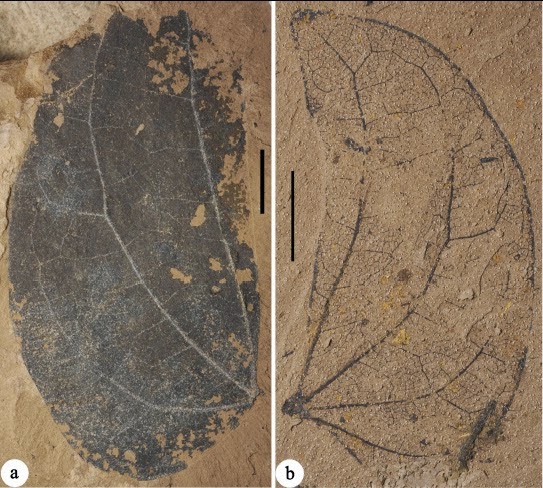
The new species is named Platycladus yunnanensis, meaning ‘from Yunnan’. It is described from eight specimens, all of flattened splays of foliage preserved in mud- and siltstones, from which it was possible to extract some of the material for examination under a light microscope.

Folliage branch of Platycladus yunnanensis in matrix. Scale bar is 1 cm. Wu & Ding et al. (2014).

These are the oldest specimens of Platycladusor Microbiotaknown (specimens of Microbiota have been reported from the Pliocene of Russia), and Wu & Ding et al. are able to confidently date the deposits that produced them to between 6.77 and 7.20 million years old, using potassium/argon isotope dating of basalt layers above and below the sediments. Argon-Potasium dating relies on determining the ratio of radioactive Potasium⁴⁰ to Argon⁴⁰ within minerals from igneous or metamorphic rock to determine how long ago the mineral cooled sufficiently to crystalize. Potasium⁴⁰ is often incorporated into cooling volcanic rocks, whereas any inert Argon present will escape as a gas. No further Potasium⁴⁰ or Argon⁴⁰ will enter the mineral from this point, but Argon⁴⁰ is produced by the decay of radioactive Potassium⁴⁰ at a steady rate, enabling scientists to establish a precise date for the crystalization of the minerals containing the two elements.

Foliage branch of the extant Platycladus orientalis. Scale bar is 1 cm. Wu & Ding et al. (2014).

The modern Platycladusorientalisis thought to be native to areas of China far cooler and drier than Yunnan Province, though it will live there and has naturalised in parts of the province and neighbouring Sichaun. Platycladus yunnanensisis essentially similar to the modern Platycladus orientalis, though it does have open stomatal pits and shallowly sunken guard cells, which are generally considered to be adaptations to a warm, moist climate, as would be predicted for the Late Miocene of Yunnan Province.

(C) Outer view of the stomatal zone in the abaxial cuticle of facial leafof Platycladus yunnanensis, showing the Florin rings. (D) Outer view of the stomata in the abaxial cuticle of lateral leaf, showing the elliptical stomatal pit and surrounding Florin ring. Wu & Ding et al. (2014).

See also…

The Domestic Tree Peony, Paeonia suffruticosa, has a long history of cultivation in China, where records of the plant growing in gardens go back at least 1400 years. Domestic Tree Peonies are noted for their beauty and fragrance, and are known as the ‘King of Flowers’ in...
The Legumes are one of the most successful groups of modern plants, with over 19 000 described species; over 9% of all known Dicots are Legumes. The group...
 

Follow Sciency Thoughts on Facebook.

Tuesday, 25 November 2014

The origin of the ‘King of Flowers’.


The Domestic Tree Peony, Paeonia suffruticosa, has a long history of cultivation in China, where records of the plant growing in gardens go back at least 1400 years. Domestic Tree Peonies are noted for their beauty and fragrance, and are known as the ‘King of Flowers’ in China. However the precise origin of the domestic Tree Peony is obscure, with most experts believing that it is a hybrid of two or more of the wild Tree Peony species found in China, but with no consensus as to which plants might be involved.

In a paper published in the Proceedings of the Royal Society: SeriesB, Biological Sciences on 5 November 2014, a team of scientists led by Shi-Liang Zhou of the State Key Laboratory of Systematic and Evolutionary Botany at the Institute of Botany at The Chinese Academy of Sciences describe the results of a genetic study of Paeonia suffruticosa and the nine wild Tree Peony species found in China, in order to determine the relationships of the domestic plant.

The ‘King of Flowers’, Paeonia suffruticosa, at Prague Botanic Garden. Karel Jakubec/Wikimedia Commons.

Zhou et al. found that Paeonia suffruticosais a hybrid of at least five wild species, Paeonia cathayana, Paeonia rockii, Paeonia qiui, Paeonia ostii and Paeonia jishanensis, with most of the cultivars obtained by hybridizing female Paeonia cathayana flowers with males of another species, though sometimes other plants had been used as the female, and many cultivars had been achieved by further hybridization.

Zhou et al. further note that all the wild Tree Peony species involved come from central China, the area in which the domestic plant was first cultivated, and that the majority are now rare or endangered. In particular they note that only a single specimen of Paeonia cathayana, the species that appeared to contribute the most to the origin of the domestic plant, could be found growing in the wild, in the mountains to the south of Louyang. Paeonia ostii also seemed to be reduced to a single wild specimen, this time on a cliff in central Anhui Province, and Paeonia qiui was found only in a handful of small populations in western Hubei Province. Paeonia jishanensis still has several relatively large populations, but this species is known to reproduce vegitatively (non-sexually), so it is unclear how genetically diverse these populations are (low genetic diversity populations can be extremely vulnerable to disease, and apparently large and healthy populations are sometimes wiped out suddenly). Only one species, Paeonia rockii, is still relatively widespread, being found across a large area of central and western China, but this is widespread population is largely composed of widely scattered very small populations and individuals, making this species also vulnerable.

The distribution of nine wild tree peony species. (1) Paeonia ludlowii; (2) Paeonia delavayi; (3) Paeonia decomposita; (4) Paeonia rotundiloba; circle, Paeonia rockii; diamond, Paeonia jishanensis; square, Paeonia ostii; triangle, Paeonia qiui; hexagon, Paeonia cathayana. Zhou et al. (2014).

Approximately one tenth of the dry land surface of the Earth has now been converted to agricultural purposes by Humans, and that while this has benefitted us enormously, it has come at great cost to many wild species, particularly the progenitors (wild ancestors) of most of our crops, which for the most part formerly grew in the best areas for growing their domestic relatives. This is known to present food security problems for Human populations, as domestic crops tend to be less genetically diverse and therefore more vulnerable to disease than their wild relatives, and the loss of these wild relatives reduces the available genetic diversity that might be needed to breed crops resilient to as yet unknown threats. Zhou et al. observe that in addition to this known problem with agricultural plants, the widespread cultivation of ornamental plants in parks and gardens presents an additional threat to biodiversity, that should also be a focus for botanists and conservationists.

See also…
http://sciencythoughts.blogspot.co.uk/2014/11/the-impact-of-invasive-native-shrub-on.html The impact of an invasive native shrub on semi-arid cattle rangelands in Zimbabwe. 
The term ‘invasive species’ is most commonly associated with species which have been introduced to new areas by human activity (such as Eurasian species in Australia), but also applies to species that have been able to expand to new areas within their native ranges...


Bush Currants, Miconieae, are berry producing tropical trees and shrubs in the Melanastome Family, Melastomataceae. They are found throughout the tropics but at their most diverse in Colombia, where over 490 species have been described.


The Legumes are one of the most successful groups of modern plants, with over 19 000 described species; over 9% of all known Dicots are Legumes. The group owe their success largely to the presence of symbiotic nitrogen-fixing Bacteria in their roots, which enable Legumes to thrive in nutrient-poor soils. The group...


Follow Sciency Thoughts on Facebook.