Showing posts with label Isotope Dating. Show all posts

Friday, 5 July 2024

Re-dating the oldest known figurative cave art.

The rock-art left behind by prehistoric cultures has the potential to provide us with insights into the lives of these long-vanished peoples. Dating this art is notoriously difficult. In the past few decades the predominant approach has been the analysis of uranium and its decay products within flowstone layers partially covering ancient art. Flowstone is formed by the deposition of calcium carbonate onto surfaces by evaporating water; typically water that has flowed through limestone deposits then run out onto a surface such as a cave wall or cliff face before evaporating. The most obvious examples of this are stalagmites and stalactites, though many caves have an interior surfaces covered by flowstone. Where these flowstone deposits occur in caves with paintings they will often overlay the artwork, which means that if the flowstone can be dated, then a minimum age for the art can be established (as the art cannot be younger than the flowstone that overlays it).

This method has been used to date ancient art in many parts of the world, including Western Europe, Island Southeast Asia, and Russia. Notably, a hand-stencil in Spain has been dated to 64 800 years before the present, which implies that it must have been made by a Neanderthal artist, although the reliability of the data used in this study has been questioned. The oldest date we currently have for figurative cave art comes from Sulawesi, Indonesia, where an image of a Warty Pig, Sus celebensis, at Leang Tedongnge in the Maros-Pangkep karst has been given a minimum age of 45 500 years.

The methods used to date flowstone samples to date have relied upon dissolving a sample to form a solution, something which will tend to homogenise the sample, averaging the age of multiple layers overlaying a piece of art, and therefore producing a younger age estimation for the art than if the oldest of these layers could be isolated. 

In a paper published in the journal Nature on 3 July 2024, a team of scientists led by Adhi Agus Oktaviana of the School of Humanities, Languages and Social Science at Griffith University, the Pusat Riset Arkeometri of the Badan Riset dan Inovasi Nasional, the Griffith Centre for Social and Cultural Research, and the Center for Prehistory and Austronesian Studies, and Renaud Joannes-Boyau of the Geoarchaeology and Archaeometry Research Group at Southern Cross University, present the results of a study which used laser-ablation uranium-series dating to provide more accurate dates for the Leang Tedongnge image, as well as other examples of cave art in the same region. 

The laser-ablation method enables the targeting of an area 44 μm in diameter, within a laboratory environment. This enables far smaller samples to be collected than with previous methods, which typically involved grinding a sample from the rockface with a rotary tool. With the laser ablation method it is possible to take a polished thin section of rock, and target points upon that, which is both cheaper and less destructive than traditional methods, as well as far more accurate, as it enables specifically targeting the layer of rock directly overlaying the pigment.

Map of the study area. (a) The Indonesian island of Sulawesi, showing the location of the southwestern peninsula (area inside rectangle). (b) South Sulawesi, with the limestone karst area of Maros-Pangkep indicated by blue shading. The locations of cave sites with dated Late Pleistocene rock art were as follows: 1, Leang Bulu’ Sipong 4; 2, Leang Karampuang; 3, Leang Tedongnge; 4, Leang Timpuseng. Oktaviana & Joannes-Boyau et al. (2024).

At the Leang Bulu’ Sipong 4 site in the Maros-Pangkep karst, a 4.5 m wide panel on the rear wall of a cave depicts a number of Human, or Therianthrope (Human-Animal hybrid) figures, interacting with Warty Pigs and Anoas (Dwarf Buffalo), Bubalus sp.. The figures are holding some form of objects, possibly spears or ropes. The artwork may depict a hunting scene, or possibly a visual representation of a myth.

Dated rock art panel at Leang Bulu’ Sipong 4. (a) Photostitched panorama of the rock art panel. Ther, Therianthrope. (b) Tracing of the dated rock art panel showing the results of laser-ablation uranium-series dating. (c) Transect view of the rock art sample BSP4.5 after removal from the artwork, highlighting the paint layer and the three integration zones (ROIs) and associated age calculations. (d) Laser-ablation-multicollector inductively coupled plasma mass spectrometry imaging of the BSP4.5 thorium²³²/uranium²³⁸ isotopic activity ratio. Oktaviana & Joannes-Boyau et al. (2024).

The imigary at Leang Bulu’ Sipong 4 is covered by four distinct speleothems (flowstone deposits), which have previously been dated to minimum ages of 35 100 years, 43 900 years, 40 900 years, and 41 000 years. The new data obtained by Oktaviana & Joannes-Boyau et al. revises these dates to minimums of 27 600 years, 39 600 years, 39 500 years, and 48 000 years. Most of these ages are similar or older to the previously obtained ages, though one younger date was obtained, possibly because Oktaviana & Joannes-Boyau et al. were careful to avoid areas showing clear signs of post-depositional alteration. 

Since the speleothems overlie the rock art, the oldest speleothem must still be younger than the art, giving a minimum age. The art was previously dated to a minimum of 43 900 years old, but Oktaviana & Joannes-Boyau et al.'s data raises that minimum age to 48 000 years, an increase of over 4000 years, older than the previous oldest dated art at Leang Tedongnge.

At the Leang Karampuang site, again in the Maros-Pangkep karst, a ceiling panel depicts three Human or Therianthrope figures interacting with an Animal, probably another Warty Pig, although the preservation here is poor due to surface exfoliation (flakes breaking off the surface of the limestone), and extensive overlying coralloid growths (small nodes of calcite, aragonite or gypsum that form on surfaces in caves). The image executed in red, and comprises the large, Pig-like Animal, 92 x 38 cm, in side view, with an infill pattern of stripes or lines, consistent with depictions of Pigs and other Animals elsewhere in South Sulawesi. There are other Pig depictions within the Leang Karampuang cave, although it is uncertain if they are the same age as the dated example. The Pig is surrounded by three Humanoid figures. The largest of these is 42 v 27 cm and lacks legs; it has both arms extended and appears to have a rod-shaped object in its left hand.  The second figure measures 28 x 25 cm and is located directly in front of the Pig, with its head in front of the Pig's snout. The final figure, measuring 35 x 5 cm, is upside-down relative to the other figures, with its legs splayed out away from the Pig and one hand reaching towards the Pig's head. A possible fourth figure may have once been present between the first and third figures. There are also at least three hand stencils on the same panel, two which appear to be contemporary with the Pig, plus one darker one which is partially overlain by the Pig, and presumably, therefore, pre-dates it.

Oktaviana & Joannes-Boyau et al. collected samples from four coralloid growths, one overlying each of the figures, plus one from the Pig. The oldest date came from the coralloid overlying the second figure, with a minimum age of 51 200 years. The minimum dates from the first and third figures were 18 700 years and 44 000 years respectively, while the coralloid growth from the Pig yielded a minimum age of 31 900 years. Thus, if the figures and Pig do represent a single piece of artwork, as seems likely, then the whole scene can be assumed to have a minimum age of 51 200 years, making it the oldest known piece of figurative art in the world. 

Dated rock art panel at Leang Karampuang. (a) Photostitched panorama of the rock art panel. (b) Tracing of the rock art panel showing the results of laser-ablation uranium-series dating. (c) Tracing of the painted scene showing the Human-like figures (H1, H2 and H3) interacting with the pig. (d) Transect view of the coralloid speleothem, sample LK1, removed from the rock art panel, showing the paint layer and the three integration zones (ROIs), as well as the associated age calculations. (e) Laser-ablation-multicollector inductively coupled plasma mass spectrometry imaging of the LK1 thorium²³²/uranium²³⁸ isotopic activity ratio. Oktaviana & Joannes-Boyau et al. (2024).

Oktaviana & Joannes-Boyau et al.'s method shows that the Leang Bulu’ Sipong 4 art is over 4000 years older than the previously determined age, with a minimum age of 48 000 years, while the Leang Karampuang art is at least 51 200 years old. These dates significantly increase the maximum known age of figurative art. The oldest known art dates from the Middle Stone Age of southern Africa, between 75 000 and 100 000 years ago, but this comprises geometric marks carved into ochre nodules. Figurative art is presumed to have arisen within Africa, and from there to have been carried around the world by migrating Humans, but there is currently no evidence for this, and it cannot be excluded that this form of expression arose in another region and then spread back to Africa.

The South Sulawesi art also challenges to long-standing preconceptions about cave art, which have come about largely from studies based upon the extensive European rock-art record. These are that Humans and/or Human-like figures did not appear in rock art until the very end of the Pleistocene, and the other is that narrative compositions were absent from early rock art. 

Three of the oldest dated rock art panels in the world come from South Sulawesi, Leang Karampuang, at least 51 200 years old, Leang Bulu’ Sipong, at least 48 000 years old, and Leang Tedongnge, at least 45 500 years old, all include figures, and all appear to involve interactions between the figures and one-another and/or Animals which imply a narrative context. Another piece of cave art, at Leang Timpuseng, dated to at least 35 300 years before the present, depicts a Pig standing in a painted line, presumably representing a ground surface. This depiction of composed scenes presumably had some communicative function, allowing the telling of a story through a narrative interpretation of the art, probably in conjunction with oral storytelling. Thus, this cave-art can also be interpreted as evidence of the emergence of a consistent form of mythology, many thousands of years before any such evidence appears in Europe.

See also...

Tuesday, 19 July 2022

Understanding the incorporation of older Human bodyparts into Bronze Age burials in Britain.

Improvements in dating techniques have led archaeologists to conclude that many artefacts placed in graves in Bronze Age Britain were already old when they were deposited. This possibly made them heirloom objects buried with people of significant standing, and retained till that point as an indicator of relationships to an older generation. Burials from this period also frequently include partial Human remains as well as the main burials, which raises the prospect that these objects too might have been heirloom objects prior to their burial.

Partial remains, including articulated and disarticulated fragments of bodies, are frequent occurrences in Chalcolithic and Early Bronze Age burials in Britain, and have traditionally been interpreted as evidence for the disturbance of earlier remains at sites which were re-used due to some spiritual significance. From about 2100 BC onwards, the cremation of remains prior to burial became the predominant funerary practice, although these cremation burials appear to have often only comprised fragments of the deceased, and on occasion fragments of more than one individual.

In a paper published in the European Journal of Archaeology on 25 May 2022, Joanna Brück of the School of Archaeology at University College Dublin, and Thomas Booth of the Skoglund Laboratory at the Francis Crick Institute, explore the possibility that the partial remains found in many Bronze Age British burials may be the result of the deliberate placement of these remains as artefacts in their own right, rather than the accidental disturbance of earlier remains.

A number of recent studies have found evidence of bodies in Bronze Age tombs in Britain being mummified before they were deposited. The most famous of these is the mummy from Cladh Hallan on South Uist, which was deposited beneath the floor of a Late Bronze Age/Early Iron Age roundhouse, but the practice has also been recorded from Chalcolithic and Early Bronze Age tombs. It is therefore not unreasonable to wonder if partial remains, articulated, disarticulated or cremated, from Bronze Age tombs in Britain might also have been mummified prior to their placement within the burial sites.

Brück and Booth collated 81 radiocarbon dates from fifteen graves at thirteen different locations; sixty four of these were from previous studies and seventeen are new to this publication. Of the thirteen burial sites, eleven were Chalcolithic or Early Bronze Age in origin. Eleven of the graves contained only unburnt bone, while the remaining four contained cremated remains. In the case of graves containing unburnt bones from both whole and partial bodies, the whole skeletons were used to provide an assumed date of burial, while other remains were dated separately and compared to these. In the case of graves containing cremated remains, each bone was dated separately. All but two of the graves were modern excavations, with osteological examination of the site being used to exclude the possibility of bones from the same individual being dated. Two of the sites included in the study were the subject of earlier excavations, though in both cases Brück and Booth are confident that the records provided by the archaeologists who carried out these digs were good enough to prevent double-sampling of the same individuals.

Bones which can be shown to have been old at the time of their burial could have been placed deliberately or accidentally, but the high proportion of burials in which older bones are incorporated makes accidental inclusion unlikely, as would any consistent relationship between the age of the main burial and the age of other bones included within a grave. Brück and Booth's data suggests that many of the partial remains incorporated into Bronze Age burials in Britain are about two generations older than the main burials; i.e. they had apparently been looked after elsewhere for decades, but not centuries. Other partial remains incorporated into burials showed no age difference to the main burial, but it is still possible that they were older, just not sufficiently so for the techniques used to detect the difference. 

Brück and Booth note that a high proportion of seafood in a persons diet can have an impact on the isotopic signature of their bones, but also observe that numerous previous studies have suggested that seafood was at most a very minor component of the British Bronze Age diet.

Histological examination of bones can also tell us a great deal about how they are treated after death. When individuals are buried in a dry, but well aerated, environment (such as that of most Bronze Age tombs), their bones will tend to suffer a great deal of bacterial bioerosion. On the other hand, bones of individuals who are prepared in some way prior to burial in the same environment, for example by mummification or excarnation (removal of the flesh from the bones), will show much less bone damage.

Seven of the thirteen sites examines were found to contain partial remains significantly older than the main burials. These remains all show less bioerosion than the main burials, suggesting that they were subjected to different treatment prior to their incorporation within the graves, and that this different treatment had begun immediately after death. 

At one site, Melton Quarry in East Yorkshire, the disarticulated and incomplete remains of an infant were found between the legs and torso of a complete and articulated adult. Radiocarbon dates obtained from the two sets of remains showed that the infant was in fact probably between 189 and 348 years older than the adult, and had relatively low levels of bioerosion to its bones, suggesting that the child had been stripped of their flesh shortly after death. Brück and Booth suggest that this infant may then have been kept in some sort of organic bag, possibly worn by a person, until the time of their eventual burial. 

Another example comes from a slab-lined grave found on the Cnip Headland on the Isle of Lewis. This grave contained one set of incomplete and partially articulated remains, thought to be those of an adolescent male, as well as the disarticulated remains of at least two adults. The adolescent male was placed on his right side, and it is thought that he was in an advanced state of putrefaction when he was buried; several vertebrae, the left fibula, and the right humorous were all out of position, suggesting that these parts of the body were skeletallised by the time burial occurred. There were also spaces between the head and torso, and the torso and lower body, which suggest the individual may have been in several pieces. However, the bones of the left hand are well articulated, which makes it likely that the hand was intact and fleshed at the time of deposition. The right arm, and both feet, are completely missing. The bones of this individual show little bioerosion, which may imply he was excarnated and then buried before complete skeletonisation occurred. However, a disarticulated bone from a layer depositionally below the adolescent produced a younger radiocarbon age, implying that his bones were already old when they were placed into the tomb. It is possible that the remains had been buried elsewhere and then excavated and placed in the Cnip Headland tomb, however calculations made using the OxCal radiocarbon calibration program suggest that between three and 82 years had passed between the death of the youth and his burial in the tomb, and again his bones show relatively low levels of bioerosion, suggesting that some form of treatment of the remains happened soon after death.
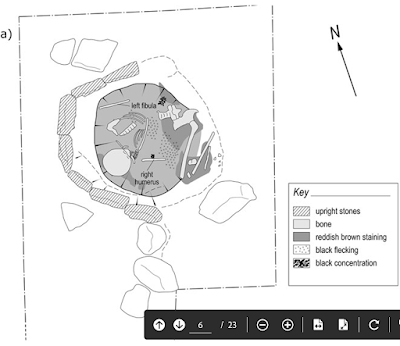
Cnip Headland, Isle of Lewis: plan of the partially articulated burial. Brück & Booth (2022).

Another burial of note is that at Windmill Fields in North Yorkshire. Here the primary burial is that of an adult woman, whose skeleton was articulate but heavily bioeroded, consistent with her having been buried whole and fully fleshed. In front of this individual had been stacked the disarticulated remains of another three individuals, an adult male, an adult female, and a probable adolescent female. Approximate dates were obtained from the crania of the two adults, suggesting that they are between 59 and 179 years older than the principle burial. Close to this burial was a pit with dark staining, consistent with a wooden structure such as a coffin having once been present. Further disarticulated bones were found within this structure, which were found to be of a similar age to the two crania, suggesting that this was the original location of the disarticulated remains found with the main burial.
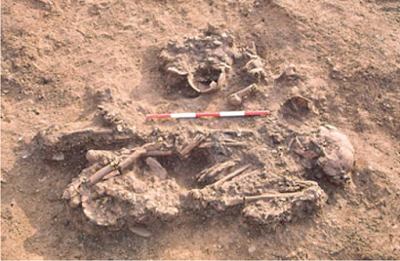
Windmill Fields, Ingleby Barwick, Stockton-on-Tees: inhumation burial accompanied by a carefully arranged stack of disarticulated bone. Tees Archaeology in Brück & Booth (2022).

It has been known for a long time that Bronze Age burial chambers in Britain were frequently reopened to place additional remains within them, and more recently it has also become clear that remains were also removed from them. 

The South Dumpton Down site in Kent contains two complete individuals buried in the Early Bronze age, one of which is also accompanied by a detached Human mandible. This mandible was not found to be anonymously older than the two intact individuals, but showed a level of decomposition which suggests that it was removed from a body that had died some time before. It is unclear whether this implies removal from a tomb of from remains kept elsewhere, but the revisiting of burials is known to have occurred in this area. One nearby site consists of a shaft with five bodies on it, which had been deposited sequentially. Several of these bodies were missing their skulls, suggesting that pieces of the skeletons were being removed as well as new bodies added. It is quite possible that the mandible was removed from one of these bodies, although if they are less than decades older than the other burial the dating technique used would be unable to detect the age difference.

A pit at Cotswold Community near Ashton Keynes in Wiltshire yielded fragments of burned bone from both Humans and Animals, as well as pieces of beaker pottery, charcoal, burnt stone and plant remains. Dates were obtained from a fragment of Human femur and a piece of Animal bone, with the femur proving to be between five and 175 years older than the Animal. It has been suggested that such pits represent settlements, due to the presence of possible domestic contents (charcoal, burnt Animal remains, pottery fragments), but these sites could also represent locations revisited periodically, possibly for annual festivals or other such events. If that is the case then it is also quite possible that the remains, or partial remains, of the dead might have been brought to these sites, either specifically, or as part of a wider pattern of carrying portions of the dead with a semi-mobile community. 

Analysis of the locations examined by Brück and Booth suggests that certain bones from grave sites may have been predominantly chosen for redeposition elsewhere, notably long limb-bones and skulls, However, they also caution that their sample size is small, and for the most part they are reliant on data collected by other archaeologists, who were not looking for data on this topic.

The comparison of burned and unburned bone using isotope dating methods is problematic, and Brück and Booth have sought to avoid this, including only four sites with burned bone in their study. Two of these sites again produced anonymously old bones, and although Brück and Booth are less confident of these findings, this does appear consistent with the data from non-cremation burials.

The Trelowthas burial in Cornwall comprises a stone cist filled with cremated bones from numerous individuals. The site also contained an urn containing further cremated remains, from at least two individuals, which appears to have been placed their at a later date. However, analysis of the remains in the urn suggests that they were between three and 72 years older than the other remains. Brück and Booth believe this is indicative of these remains being kept elsewhere between their cremation and their eventual placement within the tomb, possibly in an environment where they would be encountered, and possibly even handled, by the living on a regular basis.

Another pit burial was found in the middle of a stone circle at Whitton Hill in Northumberland. This yielded 21.6 kg of bone from at least 24 individuals, including both adults and children. Only a single individual could be sexed, being found to be female. All of the bones here appear to have deposited in a single event, but the three bones which could be dated yielded different ages, with the older skeletons being between three and 115 and between three and 37 years older than the youngest skeleton. This has previously been interpreted as remains from an older cremation being accidentally incorporated into the deposit, although there is no evidence for the site having been revisited. Brück and Booth suggest that, in the light of evidence from other sites of a similar age, this is likely to be another example of older remains being deliberately included into a burial.

Brück and Booth present a large body of evidence for the incorporation of older remains into Bronze Age burials (and in particular Early Bronze Age) in Britain. Some of these appear to have been recovered from other grave sites specifically for re-internment within the new burial, but others show signs of practices such as mummification and excarnation not seen in primary burials, strongly suggesting that these bodies were treated differently from the time of death. Brück and Booth strongly suspect that this may have involved carrying portions of the dead with the living, possibly as a form of personal ornamentation, a practice known from some modern Human groups.

Brück and Booth suggest that the incorporation of older Human remains into Bronze Age burials is likely to indicate kinship between these remains and the principle occupiers of the graves, given that the occupants of other multi-occupancy grave-sites from the same period are typically related. 

This can be confirmed for one site, the Boscombe Bowmen burial at Boscombe Down in Wiltshire. Here several sets of adult and child remains were found together, with one adult male being accompanied by a bundle of bones representing the partial remains of at least four other individuals; two adult males, a subadult male and a juvenile. The bones in the bundle were principally long bones (i.e. arm or leg bones) from the left side of the body, but the skeleton also had two further crania and a partial mandible at his feet. DNA was recovered from both the male skeleton and one of the skulls (an adult male, 25-30 years old), enabling comparison of the relationships between these two individuals. This revealed that this two came from different lineages on their maternal side, but paternally were related, potentially being half-siblings, cousins, an uncle (or great uncle) and nephew, or grandfather (or great grandfather) and grandson. Unfortunately this skull was not radiocarbon dated, but one of the bones from the bundle, a femur, was, and was found to be significantly older than the intact skeleton.
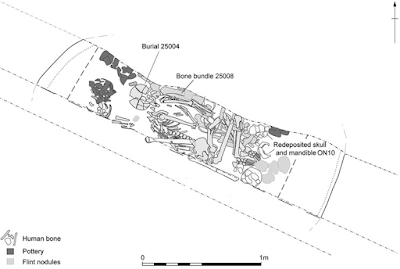
The Boscombe Bowmen, Wiltshire: plan. Wessex Archaeology in Brück & Booth (2022).

Furthermore, strontium isotope analyses of tooth enamel from the skeleton and the two detached skulls suggests that all three undertook similar childhood journeys (strontium isotopes in water vary with local geology, and are incorporated in tooth and bone, providing a record of where people have lived). This implies that either all three had undertaken a the same journey as children, presumably together as living contemporaries, or all three had lived at a similar location away from the burial site, and been transported to that site after death. Either case would imply that the individuals involved shared some measure of shared life-history as well as a genetic relationship, and that this is likely to be reflected in the decision to bury them together.

Next Brück and Booth examined the age gap between partial remains found within graves and the principal occupants of those graves, finding that the principle occupants were on average about 95 years younger than the partial remains incorporated into their burials. They suggest this may represent a rough upper limit on the cultural memory of these older individuals as living people.

Not all ancient skeletons can be confidently sexed, particularly when dealing with partial remains, but of the partial remains incorporated into younger burials which could be identified, four were male and two female, implying that gender was not considered important when selecting remains for this purpose. Therefore, if these burials do represent the inclusion of remains of significant relatives with the recently deceased, then perception of who was a significant relative was apparently not related to gender.

The age of these older relatives also appears relatively unimportant. Of the examined remains for which an age could be determined, four were adults, one a subadult, one an adolescent, and one was an infant aged 2-4 months. Views on who represents an adult are known to have changed significantly over written history, making it unlikely that the views of Bronze Age Britons were identical to those of their modern descendants, but this is unlikely to have included babes-in-arms, making it plausible that age at death was unrelated to the status of individuals, when determining significant relationships.

Brück and Booth also note that perceived kinship is unrelated to biological relationships, which may present difficulties when establishing relationships between individuals within ancient burials.

Finally, Brück and Booth mention the burial of an adult male at Wilsford in Wiltshire, dated to between 1950 and 1970 BC, who was found to have among his grave goods a whistle made from a Human femur. It has been suggested that this was the grave of a shaman or other ritual specialist. Brück and Booth were able to date the whistle from this grave, finding it was not significantly older that the skeleton it was buried with, and therefore that the two individuals could have been known to one-another in life, as well as having both been known by the people who placed the whistle in the grave with the body. Though the relationship between the two individuals could not be determined, there are clearly other possibilities than the two being relatives, for example the whistle could have been made from the bone of another ritual specialist, possibly a previous holder of the same role within the community, or a person perceived as an enemy by the deceased or whole community.

Bronze Aged peoples are known to have valued goods made from certain materials, such as jet or amber, and treated these as being significant and powerful items. It is not an unreasonable supposition that goods made from Human remains would be seen as being similarly significant, and that the ownership of such items may have conferred social status. The incorporation of Human remains into burials as grave goods may also be an indication of status, although this is difficult to unravel from funeral practices intended to reflect ritual, familial, or emotional relationships between the dead. Brück and Booth note that the tendency to finally deposit relics made from Human remains at about the time when the individuals from whom these were made would have been disappearing from the collective memory of the group may also be significant.

See also...

Follow Sciency Thoughts on Facebook.

Follow Sciency Thoughts on Twitter.


Friday, 8 April 2022

The Cabeço da Amoreira burial: An Early Modern Era West African buried in a Mesolithic shell midden in Portugal.

The Tagus and Sado valleys of central Portugal contain numerous shell middens, dating back to the Late Mesolithic, roughly 6500 to 5000 years ago. As well as depositories for waste shells, these sites were used as burial grounds by the people who made them. A number of these sites were excavated by archaeologists in the 1930s, producing a series of sets of Human remains, buried within the middens without grave goods. One site, Cabeço da Amoreira at Muge in the Tagus Valley yielded an individual noted at the time as being both notably taller and better preserved than others recovered from such sites. More recently, scientists working on a database of Mesolithic European genomes have begun to sequence individuals from these Mesolithic Portuguese sites, including the Cabeço da Amoreira individual, in the process of which they found that this individual was not closely related to other individuals from Mesolithic burials in Portugal, or elsewhere in Europe, but rather appeared to be of African descent.

In a paper published in the Journal of Archaeological Science: Reports on 21 February 2022, Rita Peyroteo-Stjerna of Human Evolution at Uppsala University and the Centro de Arqueologia da Universidade de Lisboa, Luciana Simões, also of Human Evolution at Uppsala University, Ricardo Fernandes of the Department of Archaeology at the Max Planck Institute for the Science of Human History, the School of Archaeology at the University of Oxford, and the Faculty of Arts at Masaryk University, independent researcher Gonçalo Lopes, and Torsten Günther and Mattias Jakobsson, again of Human Evolution at Uppsala University, present the results of the follow up study which used multiple lines of enquiry to determine the origin of the Cabeço da Amoreira individual.

 
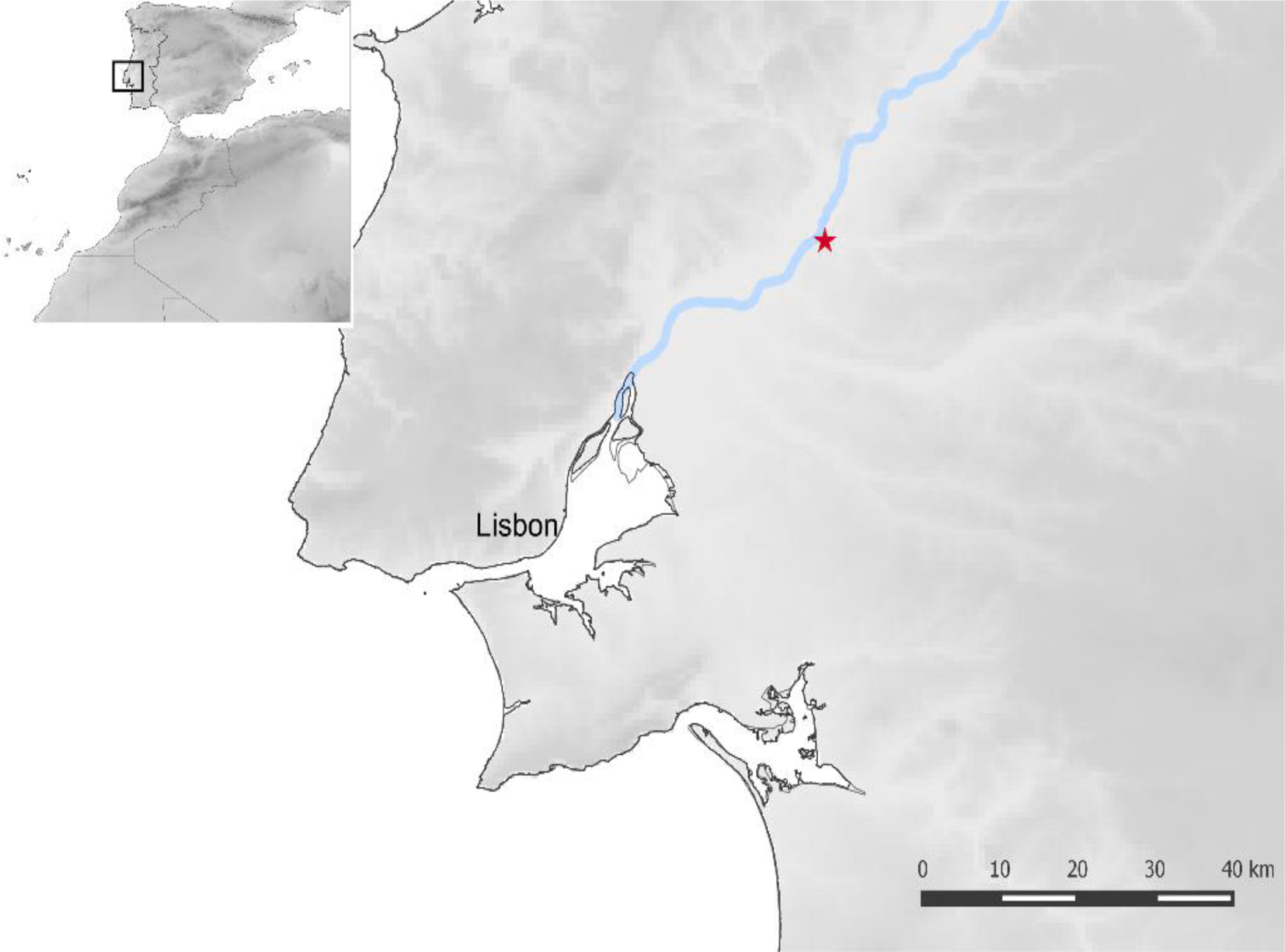
Location of Cabeço da Amoreira shell midden (indicated by the star), Muge, Tagus valley, Portugal. Peyroteo-Stjerna et al. (2022).

Radiocarbon dating of material from the Cabeço da Amoreira site, including bone, charcoal and shells, have produced dates of between 6500 and 5000 BC, consistent with a Mesolithic origin for the site, however, radiocarbon dating of collagen from the individual buried at the site yielded dates between 1529 and 1763 AD, and probably between 1631 and 1793, consistent with an Early Modern origin. 

Relationships between Early Modern Europe and Africa were dominated by the trans-Atlantic slave trade, which saw millions of people taken from Africa and shipped to European colonies in the New World, and to a lesser extent Europe itself. Portugal is estimated to have directly imported 2-3000 African slaves per year between the fifteenth and nineteenth centuries. Most of these remained enslaved their whole lives, though some were freed and able to live relatively independent lives, albeit very much at the bottom of the social scale. 

Because mitochondrial DNA is found in the mitochondria, organelles outside the cell nucleus, it is passed directly from mother to child without being sexually recombined each generation, enabling precise estimations of when individuals shared common ancestors, at least through the female line; this is known as the female haplogroup. It is also possible to trace direct ancestry through the male line, using DNA from the Y chromosome, which is passed directly from father to son without sexual recombination; this is known as the male haplogroup. Since everyone has mitochondria, it is possible to determine the female haplogroup of all Humans, but generally only males have a Y chromosome and can be assigned to a male haplogroup.

Genetic analysis of the Cabeço da Amoreira individual established that he had a Y chromosome, indicating that he was male. It was also possible to determine both his male haplogroup. He was found to belong to the E1b1a male haplogroup, which is the most widespread in sub-Saharan Africa, being commonly found in Nigeria, Congo, Cameroon, Gabon, Guinea-Bissau, and among Bantu-speakers in Southern Africa.

A principle component analysis based upon his entire recoverable genome revealed that Cabeço da Amoreira man showed a greater genomic similarity to West Africans than to other populations, and in particular, to people of Gambian or Mandinka origin. 

 
(A) Principal component analysis. Worldwide modern populations (circles coloured according to continent) and Cabeço da Amoreira man projected as a yellow, red outlined diamond. (B) Geographic distribution of the genetic affinity of the studied individual with modern African populations, measured by outgroup-f₃. The two highest f₃ scores are depicted with diamonds. Peyroteo-Stjerna et al. (2022).

Peyroteo-Stjerna et al. next looked for alleles (gene variants) associated with sub-Saharan populations, finding that Cabeço da Amoreira man had a number of alleles which would further support an African origin, notably the FY*B allele, which is associated with resilience to Malaria, and a number of skin pigmentation alleles, namely MFSD12 rs10424065; DDB1 rs11230664; OCA2 rs1800404; SLC45A2 rs16891982; and HERC2 rs6497271, which are more commonly associated with sub-Saharan African populations than with Europeans (skin pigmentation is complicated, genetically speaking, and it is not possible to directly determine someone's exact skin tone from their genome at the current time, but it is possible to associate allele abundances with specific populations). Cabeço da Amoreira man also lacked the alleles for lactase persistence (i.e. retaining the ability to digest milk into adult life), sugesting that he was lactose intolerant, something more common in Africans than Europeans.

A stable isotope analysis for carbon and oxygen isotopes, based upon bone collagen from Cabeço da Amoreira man, suggested that when he was growing up his diet comprised largely C₄ Plants, supplemented with seafood. A diet of C₄ Plants is not at all typical for Portugal (or elsewhere in Europe) in the Early Modern period, although it would have been common in parts of West Africa, notably the Sahel Region (which reaches the coast in the Senegambia region and southern Mauritania), where the principal crops for the time would have been Sorghum and Millet, both of which are C₄ Plants. Further south, in the West African forest zone, the principal crops were Rice (a C₄ Plant) in the west and a more mixed vegecultural diet (also based around C₄ Plants) in the east. Therefore, the C₄ Plant component of Cabeço da Amoreira man's diet makes it likely that he came from the Sahel region, and the seafood component further ties him to the Senegambia and Mauritania region.

 
Estimated area of origin of Cabeço da Amoreira man (mug019) in West Africa and place of burial in Portugal. Traditional plant food-producing systems in West Africa. Peyroteo-Stjerna et al. (2022).

Around 35 000 slaves were brought to Portugal from Africa between 1514 and 1866. Records of these movements are fairly complete after 1750, but older records are somewhat patchy, making the origin of Cabeço da Amoreira man difficult to reconstruct in this way. However, it is known that slaves were brought to Portugal from predominantly from Guinea-Bissau and The Gambia, with smaller numbers arriving from the Cape Verde islands, Princes Island and São Tomé, Bance Island (Sierra Leone), the Gold Coast (Ghana), Senegal and Whydah (on the coast of modern Benin). 

Most slaves in Portugal during this period would have been baptised as Christians, and buried in Christian burial grounds. However, there are records of slaves being buried in other ways, including by roadsides, in wastelands or in Olive groves. The Church generally kept good records of births, deaths, marriages, and baptisms during this period, for all social classes including slaves, which offered some hope of discovering the identity of Cabeço da Amoreira man. Peyroteo-Stjerna et al. were able to identify two deaths of interest in the Cabeço da Amoreira area in the seventeenth century, the first of an unnamed slave on 5 May 1633, for whom no burial location is listed, and the second of the murder of a man named João at Arneiro da Amoreira on 1 November 1676; João is described as being brown skinned, which may indicate that he was of mixed origins, but he was buried in a churchyard, so presumably was not Cabeço da Amoreira man.

One notable feature of the Cabeço da Amoreira burial is that the body does not appear to have been buried hastily, but rather laying upon a bed of sand which had been used to line the grave, something not seen in Mesolithic shell midden burials (the difference was noted at the time of excavation, but the significance of this, understandably, was not realised).This implies that the burial at this location was planned and carefully executed, rather than being the hurried disposal of the body of a slave or murder victim.

Shell midden burials, both ancient and modern, are known from the Senegambia region, and are still sometimes practiced among Serer fishermen in the Saloum Delta. Here, some families maintain temporary settlements on islands deep within the delta, which are used for four-to-five months each year, when shellfish are harvested. Since these sites are essentially located on shifting sandbanks, the shell middens that build up their form stable hardgrounds, which can be used for purposed such as supporting structures and burying anyone who dies while the temporary villages are in use.

 
Modern cemetery on a shell midden, at Fadiouth in the Saloum Delta, Senegal. Hardy et al. (2015).

This does not unequivocally tie the Cabeço da Amoreira burial to the Senegambia region, but does create a plausible scenario in which members of a community transplanted to Portugal, who had practiced shell midden burials in their homeland, might have chosen to recreate the practice in their new environment.

See also...


Follow Sciency Thoughts on Facebook.

Follow Sciency Thoughts on Twitter.


Thursday, 17 March 2022

Dating the Hiawatha Impact Structure.

The Hiawatha Impact Structure is an approximately 31 km wide geomorphological structure beneath the Hiawatha Glacier in northwestern Greenland, which has been interpreted as an impact structure on the basis of the structure revealed by airborne radar surveys (a relatively flat, circular depression with an elevated rim and a subtle central uplift), structures in the bedrock along the ice margin, which strike tangentially to the subglacial rim, and the presence of shocked quartz and other impact-related grains in glaciofluvial sediments derived from the largest river draining the structure.

Dating this structure has proved to be difficult. It lies on the surface of the highly metamorphosed 1.95– to 1.75–billion-year-old Ellesmere-Inglefield Mobile Belt, and overlain by the Hiawatha Glacier, which is part of the 2.6 million-year-old Greenland Ice Shelf. This gives a maximum possible age of 1.75 billion years, but, due to the constantly moving nature of the glacier, no minimum age. Impact structures have a fairly constant width-to-depth ratio, so it can be predicted that when it formed the 31 km wide Hiawatha Structure would have had a depth of about 800 m when newly formed. Today it has a depth of about 320 m, implying a loss of about 480 m via erosion since the structure first formed. Estimates of the rate of erosion in subglacial environments vary between 10 m and 10 km per million years, giving the Hiawatha Structure an age of somewhere between 50 thousand and 50 million years. It has also been suggested that the anomalous radiostratigraphy of the ice of Hiawatha Glacier compared to the rest of the Greenland Ice Sheet may be a sign that the impact occurred after the formation of the glacier, making it less than 2.6 million years old.

In a paper published in the journal Science Advances on 9 March 2022, a team of scientists led by Gavin Kenny of the Department of Geosciences at the Swedish Museum of Natural History, William Hyde of the Globe Institute at the University of Copenhagen, Michael Storey of the Quadlab at the Natural History Museum of Denmark, and Adam Garde of the Geological Survey of Denmark and Greenland, present the results of a study which aimed to find a date for the Hiawatha Impact using argon-argon dating of impact-related glaciofluvial sands and uranium-lead analysis of shocked zircons from glaciofluvial clasts of impact melt rock.

Argon-argon dating relies on determining the ratio of radioactive argon⁴⁰ to non-radioactive argon³⁹ within minerals from igneous or metamorphic rock (in this case impact melts) to determine how long ago the mineral cooled sufficiently to crystallise. The ratio of argon⁴⁰ to argon³⁹ is constant in the atmosphere, and this ratio will be preserved in a mineral at the time of crystallisation. No further argon³⁹ will enter the mineral from this point, but argon⁴⁰ is produced by the decay of radioactive potassium⁴⁰, and increases in the mineral at a steady rate, providing a clock which can be used to date the mineral.

Zircons are minerals formed by the crystallisation of cooling igneous (or in this case, impact) melts. When they form, they often contain trace amounts of uranium, which decays into (amongst other things) lead at a known rate. Since lead will not have been present in the original crystal, it is possible to calculate the age of a zircon crystal from the ratio between these elements.

Kenny et al. used a sample of well-sorted, fine-grained sand (HW21-2016) collected from a floodplain about 300 m from the terminus of the Hiawatha Glacier, and about 5 km from the Hiawatha Structure. Examination of satellite and aerial images shows that the section of floodplain material from which the sample was collected did not begin to build up until 2010, making Kenny et al. confident that it does contain material which has been washed along current sub-glacial waterways, and therefore does originate from the Hiawatha Structure.

 
Location and geomorphological setting of Hiawatha Glacier, northwest Greenland. (A) Regional view of northwest Greenland. (B) Bedrock topography mapshowing the Hiawatha structure, and sampling locations of glaciofluvial sediment for argon⁴⁰/argon³⁹ analysis (HW21-2016) and clasts of impact melt rock for zircon uranium/lead analysis (HW19-01 and HW19-05). Bed topography based on NASA and Alfred Wegener Institute airborne radar-sounding data. Samples HW19-01 and HW19-05 are from the same location on a wide riverbank 4 km downstream of the terminus of Hiawatha Glacier. White line represents the present-day margin of the Greenland Ice Sheet. Kenny et al. (2022).

In addition to the sand samples, Kenny et al. selected on two pebble-sized clasts (HW19-01 and HW19-05) obtained from a wide riverbank roughly 4 km downstream from the terminus of Hiawatha Glacier and less than 10 km from the edge of the Hiawatha structure. Both are clast-rich impact melt rocks with a dark grey, aphanitic, hemicrystalline melt matrix dominated by lath-like plagioclase feldspar microlites, that are thought likely to have reached the location where they were found via subglacial and glaciofluvial transport. Portions of both these pebbles were crushed an zircons extracted for analysis.

 
Images of impact melt rocks from the Hiawatha structure. (A) Feldspathic microlitic matrix with clasts of toasted quartz (qtz) and checkerboard feldspars (fsp). (B) Lightly toasted quartz fragment with two sets of PDFs that are considered unequivocal evidence of shock metamorphism. (C) Checkerboard feldspar. (D) Petrographic context of a granular and porous zircon (zr) grain in the feldspathic (fsp) matrix of impact melt rock, with accessory biotite (bt), ilmenite (ilm), and altered cordierite (crd). In contrast to zircon grains like this one that were in direct contact with the impact melt, zircon grains within clasts in impact melt rock do not display porous and granular textures. BSE, backscattered electrons; PPL, plane-polarized light; XPL, cross-polarized light. Kenny et al. (2022).

The sand grains extracted from the floodplain close to the glacier edge were examined visually to look for signs of impact melting. Four types of grains were identified within the sample. The first, and most abundant group, making up 40% of the sample, have a greenish gray, yellow, or dark organic-rich matrix with feldspathic microspherulites about 10 to 50 μm across and fragments of quartz and feldspar. The second most abundant grain type, making up 20% of the sample, have a non-crystalline, glassy, or commonly schlieric matrix and mineral fragments. The third most abundant grain type, making up 12% of the sample have a hemicrystalline, presumably feldspathic matrix and numerous mineral fragments. Finally, 6% of the grains have a dark, hemicrystalline, presumably feldspathic matrix and microlites presumably of pyroxene and ilmenite. Another 20% of the sample have overlapping features between these groups or are dark without distinct features. Also included in the study was a grain of pale, ellipsoidal to spherical silica ooids with nuclei of quartz fragments.

Stepwise argon⁴⁰/argon³⁹ analysis of these sand grains produced a range of readings, which is consistent with minerals from older episodes of melting being included within an impact melt, with 29 of the samples producing more than one age (consistent with partial melting and recrystallization of a mineral grain), of which 23 produced a younger age of 58.5 million years. Since no younger age was produced by any grain within the sample, Kenny et al. take this as the most probable age of the impact melt, making the impact a Late (but not Terminal) Palaeocene event. 

Fifteen unshocked zircons were selected from the two pebble-sized clasts, and subjected to uranium/lead analysis, most of which produced ages clustering around 1915 million years old, with the youngest being about 1485 million years old and the oldest about 2300 million years old. This is consistent with the age of intrusive felsic rocks in the area, supporting the hypothesis that the melts are of local origin. The altered zircons within the sample provided a range of ages between 1915 and 57.99 million years old, with the majority clustered at the minimum end of this range.

Unshocked zircons from the two pebble clasts collected about 10 km downstream of the Hiawatha Glacier give uranium/lead ages consistent with those of intrusive felsic rocks which outcrop at a number of sites around the crater, and which are therefore likely also to outcrop beneath it. Shocked zircons from the same material produce uranium/lead ages of about 58 million years. Argon⁴⁰/argon³⁹ analysis of sand particles from closer to the glacier yield a similar age. All of these samples appear to have been washed out from beneath the Hiawatha Glacier by a river which cuts through the rim of the Hiawatha Impact Structure. The simplest explanation for this is that the impact which caused this structure occurred in the Late Palaeocene. 

When the Hiawatha Impact Structure was first discovered it was thought likely to be less than 2.6 million years old; i.e. younger than the ice sheet which covers it. It has even been proposed that it might be as young as 12 900 years old, linking the impact to the onset of the Younger Dryas glacial episode. Kenny et al.'s findings suggest that the impact structure is much older than this, long predating glacier formation in Greenland.

Modelling of the original shape of the Hiawatha Impact Structure suggests that it has suffered about 500 m of vertical erosion since it was formed 58 million years ago, a much lower rate of erosion than has been predicted for subglacial features. This potentially has profound implications for the interpretation of other features beneath the Greenland Ice Sheet, although Kenny et al. are cautious of placing to much emphasis on this result without drill-core data to confirm the current interpretation of the structure of the feature. However, if this is correct then it means that a number of other features beneath the ice sheet are likely to be much older than previously thought, including a substantial river system currently thought to be subglacial in origin, but which might instead represent a long-standing morphological feature.

 
Geological map of Inglefield Land and Prudhoe Land, northwest Greenland. Previously published zircon uranium/lead ages for bedrock samples are shown in black text, and the age of unshocked zircon in clasts of impact melt rock sampled 4 km downstream from the terminus of Hiawatha Glacier (present study) is shown in green text. The dominant age of unshocked zircon in the impact melt rock samples (1915 ± 8 million years) is indistinguishable from the zircon uranium/lead ages of three felsic igneous intrusions in the vicinity of Hiawatha Glacier (bold text), supporting a local origin for the clasts of impact melt rock. Kenny et al. (2022).

Numerous pebble-sized charcoal fragments, many with cellular structures indicative of Conifer wood, have been found in the outwash of the Hiawatha Glacier. These have previously been taken as evidence of an Early Pleistocene forest system in Greenland, but the new date for the Hiawatha Impact Crater suggests that, if these are related to the impact event, then they must also be Palaeocene in origin. This actually fits well with our understanding of the Palaeocene Arctic, with Conifer fossils known from several Arctic sites.

The anomalous radiostratigraphy of the ice of Hiawatha Glacier compared to the rest of the Greenland Ice Sheet has been invoked as evidence for a young age for the impact structure beneath the glacier. If the glacier is in fact much younger than the impact structure, then an alternative explanation for the radiostratigraphy is needed. Kenny et al. suggest that this might have been caused by water flowing into the crater beneath the ice sheet and then building up until it escaped catastrophically. Alternatively, a collapse of the Nares Strait Ice Bridge in the Early Pleistocene could have disrupted ice structures in northwest Greenland.

The boundary between the Palaeocene and the Eocene, 55.93 million years ago, is marked by a global carbon isotope excursion, and the onset of a period of rapid warming that led to the Palaeocene-Eocene Thermal Maximum. This is close to the age of the Hiawatha Impact Structure, but not identical, and is better explained by massive flood basalt volcanism associated with the opening of the northeast Atlantic about 56 million years ago. There was also a significant lava flow outburst in Greenland in the Palaeocene, but this has been dated to 62 million years ago, older than the Hiawatha Impact Structure, and therefore unrelated to it. A number of spherule beds have of Palaeocene age have previously been discovered in western Greenland and on the northeastern coast of the United States, but these are now thought to be of volcanic origin, rather than impact related.

However, the Marquez Impact Structure in Texas has been dated to 58.3 million years ago, which is a very close match with the Hiawatha Impact Structure, suggesting that a link between the two is quite possible. The coincident age of two large impact structures may imply that other impacts happened at the same time, and that evidence of these is either undiscovered or has been lost. The timing of the Hiawatha and Marquez impacts does coincide with the end of the Late Palaeocene Carbon Isotope Maximum, a sudden increase in the proportion of carbon¹³ and a concurrent episode of global cooling, which ended abruptly at about 58 million years ago, when carbon¹³ levels dropped sharply and the Earth began a long-term warming trend. The absence of a distinct ejecta layer associated with the Hiawatha Impact makes it impossible to date this event with sufficient precision to link it to this shift, but Kenny et al. do note that the shift in carbon isotope ratios was far more sudden than is usually observed. The Chicxulub Impact has been linked to a major shift in carbon isotope ratios, but this, much larger, event is also known to have caused major disruption to the biosphere, which is generally assumed to be the cause of the carbon isotope shift. No known shift in the biosphere has been recorded which can be associated with the Hiawatha Impact, and no impact other than the Chicxulub event is known to have had any measurable influence on the Earth's biosphere, but this does not rule out the possibility that an impact such as the Hiawatha event could have caused changes to the biosphere which have not been recorded.

See also...


Follow Sciency Thoughts on Facebook.

Follow Sciency Thoughts on Twitter.


Monday, 30 November 2020

Dating the earliest Myriapods.

Understanding how organisms colonised the land, is crucial to clarify extant biodiversity and biological adaptation. But, evaluating the rate and pattern of land colonisation requires precise dating of the fossil of early land biotas and reconciling them with evolutionary divergence based on morphology and molecular clocks. The frequent striking inconsistency between the ages of fossils and their phylogenies limits our understanding of macroevolution, and it reduces confidence in phylogenetic inference: this is especially the case for the first land Animals. Arthropoda (Insects, Spiders, Centipedes and their allies) were the first, and are the largest group of land Animals in both numbers and biomass. The first fossil land Arthropod-Plant assemblages are rare and only found in Late Silurian (about 425 million years old) to Early Devonian (about 410 million years old) equatorial terrestrial and freshwater sediments within and marginal to the ancient Caledonian mountains which stretched from New York to Germany. The earliest fossil land Arthropods are Myriapods (Millipedes and Centipedes) from the latest Silurian (about 425 million years old) of Scotland and Wales. 

Yet, while Arachnid molecular phylogenies fit the fossils, Myriapod molecular clock phylogenies do not and suggest a late Cambrian (500 million years) monophyletic origin and divergence of the Myriapod classes, which implies not only a marine origin of the classes and possible independent land colonisation events during Myriapod evolution, but also that pre-late Silurian Myriapods are not preserved in the geological record. Though the first land Arthropods were initially very small with thin cuticle, and are difficult to preserve except under unusual conditions, nevertheless, there are enough organic-rich sediments with soft bodied fossils in appropriate environments in Cambrian to early Silurian times, that any existing land Arthropods would be at least occasionally preserved if present. But they are not. Apart from the doubtful Diplopod (Millipede), Casiogrammu ichthyeros, from the Hagshaw Hills, none occur in the Silurian Fish beds of the Midland Valley of Scotland, famed for their diverse freshwater Arthropods and oldest complete Fish fossils (but with no vascular plant remains), and currently assigned on fossils spores to the Wenlock (about 430 million years old). In any case, given that the dating of the Silurian Fish beds is so uncertain, this Diplopod? Could be the same age as or only slightly older than the Kerrera fossils, and similarly possibly aquatic. Pre-late Silurian tracks and trails of supposed land Arthropods are suspect and may represent, as is common today, only temporary excursion onto land. The earliest land Arthropod fossils are Millipedes associated with the first Vascular Plants in the latest Silurian (Pridoli) around 420 million years ago. But, while the earliest fossil Vascular Plant fossils are found at about 425 million years old (Upper Silurian), molecular phylogenies indicate a 515 million years old to 470 million years old (Late Ordovician-Silurian) origin. The precise timing of the appearance of the first land Arthropod and Plant fossils is difficult to determine because of the problem of correlating the deposits of the lakes, river and coasts, in which they occur, with the standard marine-based geological time scale, and there are almost no radiometric dates from associated sediments to help in this.

In a paper published in the journal Historical Biology on 15 May 2020, Michael Brookfield and Elizabeth Catlos of the Department of Geological Sciences at the University of Texas at Austin, and Stephanie Suarez of the Department of Earth and Atmospheric Sciences at the University of Houston, present the latest results in an ongoing study which aims to provide accurate dates for these first land biotas.

 
Caledonian mountains with cited localities. Ron Blakey in Brookfield et al. (2020).

Brookfield et al. determined the ages of these first land arthropods, with uranium/lead dating of zircons in the earliest Millipede-bearing sediments from three places, in western England (Ludlow) and Scotland (Cowie, Kerrera). These sediments are associated with contemporary explosive volcanic activity, so the youngest concordant zircons give not only the maximum age of the enclosing sediment  (a sediment cannot be older than the youngest thing in it, though it can be younger) but also a good estimate of the actual age of the sediment from the age of the contemporary volcanic rocks Zircons were separated from sediment samples taken either just above and below the arthropod-bearing beds (Kerrera and Cowie) or from heavy mineral separates obtained for other studies (Ludlow). Both the Kerrera and Ludlow dates are new. The Cowie date comes from an earlier study by Stephanie Suarez, Michael Brookfield, Elizabeth Catlos, and Daniel Stöckli, also of the Department of Geological Sciences at the University of Texas at Austin, and is included by Brookfield et al. to show the apparently rapid progressive coevolution of land Arthropods and Floras in semi-arid continental environments during the latest Silurian. The Kerrera Arthropods come from a temporary lake deposit with Anapsid Fish, interbedded with coarse semi-arid intermontane basin sediments, at the base of the Lorne Plateau Lavas. The only previous radiometric ages for Kerrera come from a lava at the top of the Lorne Plateau Lavas, 600 metres above the Kerrera sediments. Their uranium/lead zircon age of 425 ± 0.7 million years is a uranium/lead thermal ionisation mass spectrometry concordia age from two zircons which give individual ages of 425.4 ± 0.8 million years and 424.5 ± 0.8 million year. Zircons, however, are among the first minerals to crystallise from a cooling magma chamber, may be mixed populations from separate batches of magma, and can be several 100 000 years older than the lava eruption at the surface. The youngest concordant zircon gives a maximum age for the eruption of 424.5 ± 0.6 million years. The time taken for 600 metres of lavas to erupt is not known, but from other more recent similar lava piles, which accumulated over a fairly short time geologically, we can make an estimate. The average 1000 metre thick Grand Ronde Basalt lavas of the Miocene Columbia River Plateau were erupted over a 400 000 years period between 16.5 and 16.1 million years ago. A comparable duration is likely for the Lorne Plateau lavas, which seem to have erupted fairly continuously. Of the 52 zircons Brookfield et al. analysed, the youngest concordant ages were 426.5 ± 4.5 million years and 425.4 ± 4.8 million years, which are statistically indistinguishable. The 1 million years between the midpoints of the youngest Kerrera zircon and the youngest top Lorne Lava zircon is thus a reasonable estimate of the time taken for the Lorne Lava pile to accumulate.

 
Sections at Ludlow, Kerrera, and Cowie with Youngest dated zircons. Brookfield et al. (2020).

The Ludlow Arthropods, accompanied by a fragmentary Cooksonia flora come from one organic-rich siltstone lens filling ripple troughs in fine sandstone just above the Ludlow bone bed lag deposit, a sandstone marking the change from shallow marine to semi-arid continental environments. Brookfield et al. analysed 29 zircons from heavy mineral concentrations, obtained for Conodont analysis, from two samples of the basal Bone Bed near Ludlow. Nineteen of these were within the expected latest Silurian (Pridoli) biostratigraphic age. The youngest dates of 420.0 ± 8.9 million years and 420.3 ± 8.1 million years are, like those from Kerrera, statistically indistinguishable. The Cowie dates of 413.7 ± 4.4 million years and 414.3 ± 7.1 million years which bracket the Millipede-bearing Fish bed, are younger than both the Kerrera and Ludlow.

These ages are consistent with the evolutionary stages shown by the fossil Millipedes and associated Arthropods. 

The Kerrera and Ludlow Myriapods are Kampecarids which show no obvious structural adaptation to land. The Kerrera Kampecarids, Kampecaris obanensis and Archidesmus sp. occur with an early vascular ‘Cooksonia’ flora, Eurypterids and Anapsid fish in a freshwater lake deposit in a semi-arid fluvial environment. Kampecarids also sporadically occur in late Silurian to early Devonian freshwater lake environments throughout Scotland. The Ludlow Millipedes are also accompanied by the early vascular Cooksonia flora, and by a more diverse fauna of Arachnids, a Centipede and Eurypterids, eroded and redeposited either by a coastal storm deposit from a back-barrier environment or by a tsunami from more inland semiarid coastal plain environments. The most diverse Cowie Millipedes belong to the extinct Archipolyploda superorder and consist of Cowiedesmus eroticopodus which derives its name from preserved male gonopods, and Albadesmus almondi and Pneumodesmus newmani which do not have modified appendages preserved. Pneumodesmus newmani, however, has spiracles on the lateral parts of the sternites which are direct evidence of air breathing, and, before our dating, was taken to be the oldest fully terrestrial Animal. The Cowie deposit was laid down in a temporary lake environment related to braided and meandering streams in a semi-arid intermontane basin, but curiously, contains no identifiable Plant remains or spores. There is thus a progressive change in the Arthropod faunas across the Silurian/Devonian (Pridoli/Lochkovian series) boundary around 419 to 421 million years ago; from Kerrera (about 425 million years old, Ludlow series), through Ludlow (about 420 million years old, Pridoli series), to Cowie (about 414 million years old. Lochkovian series), and this increased diversification continues into younger more diverse early Devonian (Emsian) land biotas, like the Rhynie Chert intermontane basin hot springs biota from Aberdeenshire, and the Gaspé, eastern Canada and Alken, Germany, delta marsh biotas. The diverse Rhynie Chert, with an argon⁴⁰/argon³⁹ age of 407.1 ± 2.2 million years, has a diverse flora and fauna dominated by the Vascular Cryptogam Plants, Rhynia, Aglaophyton, and Horneophyton, and Arthropods; Arachnids (Trigonotarbida), Mites (Acariformes), Harvestmen (Opiliones), a possible Millipede (Diplopoda), Centipedes (Chilopoda), and Springtails (Collembola). Neither the Gaspé nor the Alken biotas have been dated radiometrically. But both have somewhat similar biota to Rhynie, despite their very different environment, with Vascular Cryptogams of the slightly more evolved Zosterophyllum flora, accompanied not only by Arachnids (Trigonotarbids), and Centipedes (Chilopoda), but also by freshwater Eurypterids and Anapsid Fish. By the Middle Devonian (about 385 million years ago), complex forests with ten-metre-tall trees and associated diverse arthropod communities had become established, for example at Cairo and Gilboa, New York. Nevertheless, the composition of the land biotas does not differ significantly from upland lake margins to delta front marshes from latest Silurian to mid-Devonian, a rapidly evolving successions of pioneer communities of Arthropods/Vascular Plants seems to have exploded over the Acadian landscape in a very few million years.

 
The Kampecarid Millipede, Kampecaris obanensis, from the 425-million-year-old Kerrera deposits of Scotland, currently the oldest known Myriapod. British Geological Survey.

From fossil evidence, the time from initial colonisation by Arthropod-Vascular Plant communities to complex forest communities took place over less than 40 million years (425–385 million years ago). An essentially intermontane lake margin Pridoli FW/land biota in the Acadian mountains centred on Scotland evolved rapidly and migrated, undoubtedly via rivers, to colonise floodplain marshes in the adjacent lowlands by the Emsian, as there is little difference in contemporary biotas. Molecular phylogenies of the Myriapods, however, indicate a monophyletic origin and divergence about 100 million years earlier, while the origin of Vascular Plants is similarly placed from 100 to 50 million years prior to their first body fossils. Which is correct?

Though non-Vascular Plants and possibly amphibious Arthropods were around in the Ordovician, the fossil evidence is clear that Vascular Plant/land Arthropod biotas evolved together in the Late Silurian (about 425 million years ago) and not earlier. If the molecular clock timing were correct, then land Arthropods should be found under exceptional circumstances in earlier deposits. These might be meiofaunal. So, such Arthropod should be looked for in silicified pre-Late Silurian organic soils or hot springs deposits like the Devonian Rhynie Chert, though we know of no such deposits or biotas.

See also...


Online courses in Palaeontology. 

Follow Sciency Thoughts on Facebook.

Follow Sciency Thoughts on Twitter.