
In 1984 palaeontologists David Raup and Jack Sepkowski of the Department of Geophysical Sciences at the University of Chicago analysed the occurrence
of mass extinction events on Earth and came to the conclusion that these events
appeared to be cyclic in nature. Since no known Earthly phenomena is cyclic on
a scale of tens of millions of years, he suggested an extra-terrestrial cause for
such events, leading to a brief period when it became fashionable to try to
explain such extinction events by means of large impact events. This hypothesis
lives on in the Alvarez Impact Event Theory, which postulates that the End
Cretaceous Extinction was caused by a large body impacting into the Yucatan
Peninsula in Mexico, but has otherwise fallen from favour. Our ability to place
dates in ancient events has dramatically improved since the 1960s, and has led
scientists to conclude that extinction events were not cyclic in occurrence,
and we have come up with robust explanations for most of these events which do
not need to invoke extra-terrestrial causes. At the same time our understanding
of Solar System dynamics has improved to the point where we can rule out cyclic
events on a tens of millions of years scale, and we have found numerous large
impact craters on Earth that do not seem associated with even the smallest
extinction events.
While major impact events occurring regularly on a tens of millions of
years scale has now been ruled out, at the opposite end of the scale we do
expect small events to occur regularly on an annual scale, for example we can
state with confidence the days on which meteor showers will fall, as the Earth
passes through the orbital trail of comets or other bodies which leave trails
of dusty or sand-size grains in their paths, resulting in harmless but visible
showers of micrometeorites falling on Earth.
In a paper published on the arXiv database at Cornell University
Library on 1 September 2014 and accepted for publication in the Monthly Notesof the Royal Astronomical Society, Carlos and Raul de la Fuente Marcos of the UniversidadComplutense de Madrid describe the results of a study in which they analysed
the distribution of multi-kiloton impacts on Earth since 2000 in order to
determine whether the distribution of these events was truly random.
De la Fuente Marcos and de la Fuente Marcos started by taking data
collected by the Comprehensive Nuclear-Test-Ban Treaty Organization, which uses
infrasound sensors to look for clandestine nuclear tests, but which have also
recorded a 26 events attributed to objects with masses between one and 500
kilotons impacting the Earth’s atmosphere since 2000. This was adjusted for
known inaccuracies, such as the 22 September 2007 event which was recorded as
occurring over the Indian Ocean, but which was observed over the South Pacific,
and other events not detected by the network, such as the 18 kiloton object
which impacted the atmosphere over Botswana on 21 November 2009, resulting in a
list of 33 events between 2000 and 2013 that were included in the study. Only
one of these events, the 7 October 2008 impact of Apollo asteroid 2008 TC3 near
Almahatta Sitta in Sudan was detected in advance, and then only by a matter of
hours.

Geographical distributions of the events included in
the study. De la Fuente Marcos and de la Fuente Marcos (2014).
The list included four calendar days on which more than on object
hit the Earth on the same day, albeit in different years (including one set of
three objects on 8 October 2004, 2008 and 2009). In addition there were 9
events that occurred within one day in different years, 14 events that occurred
within two days on different years and three events that occurred within three
days. De la Fuente Marcos and de la Fuente Marcos calculate that there is a
35.7% chance of two such events falling on the same day, but only a 4.05%
chance of four such pairings occurring. They further calculate that there is
only a 1.9% chance of 9 events occurring within one day in different years,
a 0.93% chance of 14 events occurring
within two days and a 2.16% chance of 16 events occurring within three days in
different years.

Calendar-day distributions of the events in the study. Green
points correspond to impacts in the northern hemisphere and blue points
correspond to impacts in the southern hemisphere. There are 17 impacts in the
northern hemisphere and 16 in the southern one. The calendar day distribution
for impacts in the northern hemisphere is almost uniform. In contrast, the
equivalent distribution for the southern hemisphere is very asymmetric. The
overall impact risk for the southern hemisphere is 50 per cent higher than that
of the northern hemisphere from September to December.De la Fuente Marcos and
de la Fuente Marcos (2014).
This strongly suggests that the distribution of impact events
throughout the year is non-random, and that impacts are preferentially likely
to happen on certain days of the year, presumably as the Earth’s orbit
intersects other orbital pathways where more than one object follows the same
path. This can occur for one of two reasons. Firstly a single object can break
up for some reason, and the resultant bodies continue to follow the same path.
This most notably occurred in 1994, when comet Shoemaker-Levy 9 broke up
into several component bodies after a close encounter with Jupiter, each of
these daughter bodies going on to impact the planet. Alternatively different
bodies can be shepherded into similar orbital paths by repeated encounters with
planets. This occurs because when two bodies pass close to one-another they
exchange some momentum energy, so that one body speeds up slightly and the
other slows down slightly. When this happens repeatedly between a very large
body, such as a planet, and a very small body, such as an asteroid, the smaller
body is herded into a resonant orbit with the larger body, and over time many
objects can be herded into such orbital paths.

Images of the impacts on Jupiter caused by the breakup of comet Shoemaker-Levy 9 in 1994 at (left) visible and (right) ultraviolet wavelengths. NASA/Hubble Space Telescope.
The 15 February 2013 Chelyabinsk impact event has been studied
particularly extensively, due to the large and conspicuous nature of this
event, and the impacting body has tentatively been linked to a family of
resonant asteroids. The Chelyabinsk object is believed to have been on
an orbital pathway intersecting the Earth’s orbit at an angle of 146.5˚.
The South China Sea impact event of 18
February 2000 occurred within three calendar days of the Chelyabinsk event, and
this object has also been suggested to have been travelling at 146.5˚ to the
Earth’s orbital trajectory, strongly supporting the idea that these bodies
hailed from a single population.

The fireball caused by the Chelyabinsk Bolide. Astro Bob.
The North Pacific object of 23 April 2001 fell between Hawaii and
California. The Sutter’s Mill Meteor of 22 April 2012 fell in California and
may be related to this. The Sutter’s Mill Meteor if thought to have been on a
trajectory at an angle of ~212.5˚ to the orbit of the Earth, falling towards the
Sun at the time of the impact, possibly similar to the trajectory of a Jupiter
Family Comet (a comet with a period of less than 20 years, and an inclination of less than 30˚ to the plain of the Solar System). The Santiago del Estero object fell in Argentina in 21
April 2013, but appears to have had quite different properties to the other two
impacts, and is probably unrelated.
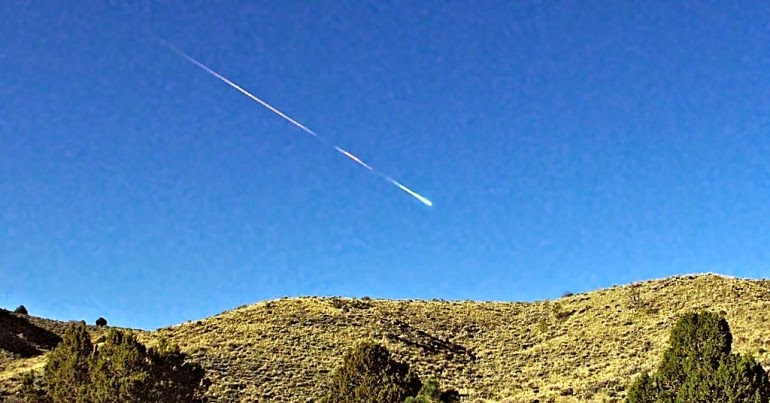
Sutter’s Mill Meteor seen from Reno, Nevada. Lisa Warren/NASA.
The Crete Bolide of 6 June 2002 and the Reisadalen Event of 7 June
2007, which occurred close to the Norway/Finland border, both involved objects
travelling at an angle of 255.5˚ to the Earth’s orbital trajectory, and falling
towards the Sun at the time of the impact.
A bright fireball observed over Washington State on 3 June 2004 may also
be related to these objects.
The Southern Ocean event of 3 September 2004, which fell near
Antarctica, the Indian Ocean Event of 2 September 2006 and the South Pacific
Event of 3 September 2010 all appear to be related. All were apparently
travelling at an angle of 340˚ to the orbital path of the Earth, and falling
towards the Sun at the time of the impact. It has been suggested that the
parent body of the Southern Ocean event was a small Aten Family Asteroid (an
asteroid which orbits mostly inside the orbit of the Earth, but which is
further away some of the time), with an orbital period of 293 days. Aten Family
Asteroids are thought to have particularly short lifetimes, as the planets of
the Inner Solar system are quite close together, so that orbits are easily
perturbed by repeated encounters with these planets, resulting in objects
breaking up, colliding with something or being thrown out of the system.
The South Pacific event of 22 September 2007 and the Vitim event
over Siberia on 24 September 2002 appear to be related, both objects having
been travelling at an angle of 359˚ to the Earth’s orbit prior to their
impacts.
The Indian Ocean event of 7 October 2004, the Almahatta Sitta impact
in Sudan on 7 October 2008 also appear to be connected, both having involved
objects travelling at 14˚ to the Earth’s orbit. The Almahatta Sitta impact
involves the only asteroid in the study observed prior to its impact on the
Earth, 2008 TC3, which in turn has been linked to the Nysa-Polana Asteroid
Family (expand). The South Sulawesi event of 8 October 2009 appears to be
unrelated.

A recovered piece of the Almahatta Sitta meteorite. Jon Taylor/Wikimedia Commons.
The 10 November 2002 North Pacific impact and 9 November 2005 New
South Wales impact also appear to be related. Both caused by objects travelling
at almost 47˚ to the Earth’s orbital trajectory.
The 26 December 2007 South Pacific event and 25 December 2010 North
Pacific event also appear related, both having impacted at an angle of ~93˚.
De la Fuente Marcos and de la Fuente Marcos are confident that there
is less than a 5% chance that all of the objects occurring on similar
trajectories on similar dates could be coincidences. They note that streams of
asteroids containing large bodies that intersect the Earth’s orbit are unlikely
to persist for very long periods of time, as such bodies are likely to either
impact the Earth or Moon or be disrupted into different orbits by their gravity
or those of nearby planets. However such streams of asteroids could still
potentially persist for several decades, leading to a series of connected
impacts.
See also…

The Chelyabinsk Meteorite detonated in the atmosphere over the southern
Russia on 15 February 2013 with an equivalent energy to 500 kilotons of
TNT. From the size of the explosion it is estimated to have...

65 million years ago, at the end of the Cretaceous, the Earth underwent
the last of the five great mass extinctions recorded in the fossil
record. While this is by no means the largest of these events, it is the
most familiar to the general public, as it was responsible for the
extinction of, amongst other things, the non-Avian Dinosaurs and the
large marine Reptiles of the...

Lake Bosumtwi is an 8 km diameter roughly circular lake about 30 km to
the southeast of Kumasi in the Ashanti Province of Ghana. It is thought
to have been created by a large meteorite impacting the Earth roughly
1.07 million years ago during the Late...
Follow Sciency Thoughts on Facebook.


