Showing posts with label Jade Mining. Show all posts

Saturday, 25 December 2021

Dozens feared dead following landside at Myanmar jade mine.

One person has been confirmed dead and dozens more are feared to have died following a landslide on a spoil heap in the jade-mining town of Hpakant in Myanmar's northwestern Kachin Province on Wednesday 22 December 2021. The incident happened at about 4.00 am local time, when local people and migrants drawn to the area by the prospect of finding jade were scouring the spoil heap for material missed by the official mining operation. Rescue teams report finding one body and twenty five people with injuries, who were taken to a local hospital for treatment, but it is feared that between 20 and 80 more people could still be missing, either buried beneath the debris or swept into a lake at the bottom of the slope; unfortunately because of the illegal nature of the activity, scavenging the spoil heaps tends to take place at night, no records are kept of how many people are involved, and local communities are reluctant to report missing relatives to the authorities.

 
Rescue workers searching a spoil heap in Hpakant, Myanmar, where dozens of people are feared to have been buried in a landslide on Wednesday 22 December 2021. EPA.

Myanmar is the world's largest producer of jade, though much of this is produced (along with other precious and semi-precious minerals such as amber) at unregulated (and often illegal) artisanal mines in the north of the country, from where it is smuggled into neighbouring China. Accidents at such mines are extremely common, due to the more-or-less total absence of any safety precautions at the site. At many sites this is made worse by the unregulated use of explosives to break up rocks, often leading to the weakening of rock faces, which can then collapse without warning. The majority of people in this industry are migrant workers from the surrounding countryside, not registered with any local authority, which can make it difficult for rescuers to identify victims following such events, or even gain accurate assessments of the number of people likely to have been involved in such accidents.

 
The approximate location of the town of Hpakant. Google Maps.

See also...


Follow Sciency Thoughts on Facebook.

Follow Sciency Thoughts on Twitter.


Thursday, 2 July 2020

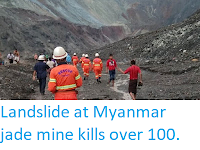
Landslide at Myanmar jade mine kills over 100.

A total of 126 people have now been confirmed dead and 23 more injured following a landslide at a jade mine in Myanmar on 2 July 2020. The incident happened at a mine in the town of Hpakant in Kachin State in the north of the country, where people searching for chunks of jade on the spoil heap of a large commercial mine were caught in a landslide believed to have been triggered by heavy rains associated with the onset of the monsoon season. Landslides are a common problem after severe weather events, as excess pore water pressure can overcome cohesion in soil and sediments, allowing them to flow like liquids. Approximately 90% of all landslides are caused by heavy rainfall. 

Rescue workers at a jade mine in Hpakant, Myanmar, following a landslide on 2 July 2020. Myanmar Fire Services Department.

Myanmar is the world's largest producer of jade, though much of this is produced (along with other precious and semi-precious minerals such as amber) at unregulated (and often illegal) artisanal mines in the north of the country, from where it is smuggled into neighbouring China. Accidents at such mines are extremely common, due to the more-or-less total absence of any safety precautions at the site. At many sites this is made worse by the unregulated use of explosives to break up rocks, often leading to the weakening of rock faces, which can then collapse without warning. The majority of people in this industry are migrant workers from the surrounding countryside, not registered with any local authority, which can make it difficult for rescuers to identify victims following such events, or even gain accurate assessments of the number of people likely to have been involved in such accidents.

The approximate location of the town of Hpakant. Google Maps.

Monsoons are tropical sea breezes triggered by heating of the land during the warmer part of the year (summer). Both the land and sea are warmed by the Sun, but the land has a lower ability to absorb heat, radiating it back so that the air above landmasses becomes significantly warmer than that over the sea, causing the air above the land to rise and drawing in water from over the sea; since this has also been warmed it carries a high evaporated water content, and brings with it heavy rainfall. In the tropical dry season the situation is reversed, as the air over the land cools more rapidly with the seasons, leading to warmer air over the sea, and thus breezes moving from the shore to the sea (where air is rising more rapidly) and a drying of the climate.

 Diagrammatic representation of wind and rainfall patterns in a tropical monsoon climate. Geosciences/University of Arizona.

Much of Southeast Asia has two distinct Monsoon Seasons, with a Northeast Monsoon driven by winds from  the South China Sea that lasts from November to February and a Southwest Monsoon driven by winds from the southern Indian Ocean from March to October. Such a double Monsoon Season is common close to the equator, where the Sun is highest overhead around the equinoxes and lowest on the horizons around the solstices, making the solstices the coolest part of the year and the equinoxes the hottest. However Myanmar is largely protected from the Northeast Monsoon by the mountains separating the country from Yunnan Province in China.
   
The winds that drive the Northeast and Southwest Monsoons in Southeast Asia. Mynewshub.

See also...

https://sciencythoughts.blogspot.com/2020/04/landslide-kills-three-at-myanmar-jade.htmlhttps://sciencythoughts.blogspot.com/2019/09/magnitude-55-earthquake-in-sagaing.html
https://sciencythoughts.blogspot.com/2019/08/landslide-kills-at-least-61-in-mon.htmlhttps://sciencythoughts.blogspot.com/2019/07/landslide-kills-at-least-nineteen-at.html
https://sciencythoughts.blogspot.com/2019/05/magnitude-51-earthquake-in-sagaing.htmlhttps://sciencythoughts.blogspot.com/2019/04/collapse-at-myanmar-ruby-mine-kills-two.html
Follow Sciency Thoughts on Facebook.

Saturday, 25 April 2020

Landslide kills three at Myanmar jade mine.

Three people have died and another one has been injured following a landslide on a spoil heap at a former jade mine in the town of Mohnyin in Kachin State, Myanmar, on Thursday 23 April 2020. All four are thought to have been scavenging on the 12-19 m high spoil heap for pieces of the mineral missed by the original miners, a common occupation in the area.

The approximate location of the 23 April 2020 Mohnyin mine landslide. Google Maps.

Myanmar is the world's largest producer of jade, though much of this is produced (along with other precious and semi-precious minerals such as amber) at unregulated (and often illegal) artisanal mines in the north of the country, from where it is smuggled into neighbouring China. Accidents at such mines are extremely common, due to the more-or-less total absence of any safety precautions at the site. At many sites this is made worse by the unregulated use of explosives to break up rocks, often leading to the weakening of rock faces, which can then collapse without warning. The majority of people in this industry are migrant workers from the surrounding countryside, not registered with any local authority, which can make it difficult for rescuers to identify victims following such events, or even gain accurate assessments of the number of people likely to have been involved in such accidents.

See also...


https://sciencythoughts.blogspot.com/2019/09/magnitude-55-earthquake-in-sagaing.htmlhttps://sciencythoughts.blogspot.com/2019/08/landslide-kills-at-least-61-in-mon.html
https://sciencythoughts.blogspot.com/2019/07/landslide-kills-at-least-nineteen-at.htmlhttps://sciencythoughts.blogspot.com/2019/05/magnitude-51-earthquake-in-sagaing.html
https://sciencythoughts.blogspot.com/2019/04/collapse-at-myanmar-ruby-mine-kills-two.htmlhttps://sciencythoughts.blogspot.com/2019/04/mudslide-at-myanmar-jade-mine-kills.html
Follow Sciency Thoughts on Facebook.

Monday, 29 July 2019

Landslide kills at least nineteen at Myanmar jade mine.

Nineteen people have now been confirmed dead following a landslide at a jade mine at Seikhmu near Hpakant in Kachin State, Myanmar, on Sunday 28 July 2019. The incident happened at about 2.30 in the morning local time, at a concession operated by the Yarzahtarni Jade Mining Company, and swept through an encampment where workers at the mine were sleeping, with several of those killed thought to have been security guards rather than miners. 

Rescue workers at the scene of a landslide at a jade mine in Kachin State, Myanmar, on 28 July 2019. Thinkhar Civil Society.

Myanmar is the world's largest producer of jade, though much of this is produced (along with other precious and semi-precious minerals such as amber) at unregulated (and often illegal) artisanal mines in the north of the country, from where it is smuggled into neighbouring China. Accidents at such mines are extremely common, due to the more-or-less total absence of any safety precautions at the site. At many sites this is made worse by the unregulated use of explosives to break up rocks, often leading to the weakening of rock faces, which can then collapse without warning. The majority of people in this industry are migrant workers from the surrounding countryside, not registered with any local authority, which can make it difficult for rescuers to identify victims following such events, or even gain accurate assessments of the number of people likely to have been involved in such accidents.

The incident occurred following several hours of rain in the area associated with the Southeast Asian Southwest Monsoon, which has also caused a series of landslips and flash floods in the area. Landslides are a common problem after severe weather events, as excess pore water pressure can overcome cohesion in soil and sediments, allowing them to flow like liquids. Approximately 90% of all landslides are caused by heavy rainfall. This year's monsoon has been particularly severe, with floods and landslips occurring across Myanmar.

Monsoons are tropical sea breezes triggered by heating of the land during the warmer part of the year (summer). Both the land and sea are warmed by the Sun, but the land has a lower ability to absorb heat, radiating it back so that the air above landmasses becomes significantly warmer than that over the sea, causing the air above the land to rise and drawing in water from over the sea; since this has also been warmed it carries a high evaporated water content, and brings with it heavy rainfall. In the tropical dry season the situation is reversed, as the air over the land cools more rapidly with the seasons, leading to warmer air over the sea, and thus breezes moving from the shore to the sea (where air is rising more rapidly) and a drying of the climate.

 Diagrammatic representation of wind and rainfall patterns in a tropical monsoon climate. Geosciences/University of Arizona.
  
Much of Southeast Asia has two distinct Monsoon Seasons, with a Northeast Monsoon driven by winds from  the South China Sea that lasts from November to February and a Southwest Monsoon driven by winds from the southern Indian Ocean from March to October. Such a double Monsoon Season is common close to the equator, where the Sun is highest overhead around the equinoxes and lowest on the horizons around the solstices, making the solstices the coolest part of the year and the equinoxes the hottest. However Myanmar is largely protected from the Northeast Monsoon by the mountains separating the country from Yunnan Province in China.
 
The winds that drive the Northeast and Southwest Monsoons in Southeast Asia. Mynewshub.
 
See also...
 
https://sciencythoughts.blogspot.com/2019/05/magnitude-51-earthquake-in-sagaing.htmlhttps://sciencythoughts.blogspot.com/2019/04/collapse-at-myanmar-ruby-mine-kills-two.html
https://sciencythoughts.blogspot.com/2019/04/mudslide-at-myanmar-jade-mine-kills.htmlhttps://sciencythoughts.blogspot.com/2018/11/magnitude-52-earthquake-in-chine-state.html
https://sciencythoughts.blogspot.com/2018/07/fifteen-confirmed-deaths-following.htmlhttps://sciencythoughts.blogspot.com/2018/06/thirteeen-people-killed-in-series-of.html
Follow Sciency Thoughts on Facebook.