Showing posts with label Kepler Space Telescope. Show all posts

Monday, 2 February 2015

Follow up observations of Kepler candidate stars.


The Kepler Space Telescope observed a 115 square degree of space for four years (from May 2009 till May 2013), looking for potential planets around the 150 000 stars in the magnitude range 8-16 within the field. In this time it found a total of 4233 candidate planets, of which 965 have subsequently been confirmed. The conformation of such a planet requires follow up observations from ground-based telescopes in order to eliminate potential sources of false readings, such as previously undetected faint companion or background stars.

In a paper published on the arXiv database at Cornell University Library on 14 November 2014, and in the Astronomical Journal on 15 January 2015, a team of scientists led by Mark Everett of the National Optical Astronomy Observatory present the results of follow up observations on eighteen Kepler candidate stars, several of which are confirmed to host planets.

Follow up observations were made from the Differential SpeckleSurvey Instrument at Gemini North on 25−31 July 2013, although the observations were hampered by light leakage on 25 July and by Tropical Storm Flossie brushing the Hawaiian Islands on 29-30 July, so most of the useful observations were in fact made on 27 July 2013. Further follow up observations of several candidate stars were made with the Lick Observatory Shane 3.5 m, the PalomarObservatory Hale 5 m or the 10m Keck-II Telescopes.

The KOI 115 system (that is ‘Kepler Object of Interest’ 115, the designation given to star systems with unconfirmed planets in the Kepler field), has previously been confirmed to host two planets and redesignated as the Kepler 105 system (i.e. the 105th system in the Kepler Field confirmed to host one or more planets). These planets were reconfirmed by the Gemini North Survey. The star has an effective surface temperature of 6075 K (compared to 5778 K for our Sun) and a mass 1.027 times that of the Sun. The planets were previously found to have orbital periods of 5.4 and 7.1 days, the new data from Gemini North in addition suggests that these planets have radii of 2.54 and 1.44 times that of the Earth, respectively.

The KOI 265 system has a candidate planet with a radius of 1.71 times that of the Earth, with an orbital period of 3.6 days. Everett et al. validate this planet with a 94% certainty level, though this is not considered sufficient to confirm the existence of a planet.

KOI 268 is a dwarf star with an effective surface temperature of 6343 K, with a candidate planet orbiting every 110 days. Everett et al.’s data reveals the presence of two previously undiscovered nearby stars, identified as neighbours B and C. Of these neighbour B is a small star with an effective surface temperature of 4007 Kwhich lies close enough to KIO 268 that the candidate planet is impossible to validate. It could be a planet with a radius of 3.04 times that of the Earth orbiting KOI 268, but it could also be a planet with a radius of 9.33 times that of the Earth orbiting Neighbour B (a larger planet would be needed to reduce the total light produced by the two stars if the planet is occluding the dimmer star); if the latter were the case then it would have a low equilibrium temperature, about 217 K.

KOI 274 has previously been confirmed to host two planets with periods of 15 and 22.8 days, and redesignated as Kepler 128. Everett et al. were able to confirm theses planets, and that the star is a single system. They also estimate that the planets both have about 1.2 times the radius of the Earth.

KOI 284 has previously been confirmed to host three planets, and a possible fourth, and redesignated as Kepler 132. However a nearby star makes it hard to resolve the system further; it was impossible to determine whether this star is a companion (orbiting the main star) or a field star (behind the star and unrelated to it, close only because of the angle from which we are viewing the system), though a companion is thought to be the more likely scenario. If this is the case then all of the planets, including the unconfirmed candidate, will have a radius between 1-2 times that of the Earth.

KOI 369 is a dwarf star with an effective surface temperature of 6157 K has previously been confirmed to host two planets, and redesignated as Kepler 144. Everett et al. are able to reconfirm these planets and estimate that they have radii of 1.78 and 1.69 times that of the Earth, respectively.

KOI 1537 is a dwarf star with an effective surface temperature of 6260 K and a candidate planet with a period of 10 days. A previous study suggested that a second star was close to this star, either as a companion or a field star, however Everett et al. were able to find no evidence for this second star. They were able to validate the planet with an 86.7% certainty (not enough to confirm its existence) and estimate its radius to be 1.35 times that of the Earth.

KOI 1964 is a dwarf star with an effective surface temperature of 5574 K and a candidate planet with an orbital period of 2.2 days. It also has a neighbouring star about 4” (four arc seconds; the sky, imagined as a globe, is divided into 360 degrees, each of which is divided into 60 arcminutes, with each arc minute being further divided into 60 arcseconds) to its north, as seen from Earth. This makes it very hard to confirm the planet is orbiting KOI 1964, though Everett et al. were able to come up with three possible scenarios. Firstly the second star could be a bound companion to KOI 1964, and the planet could also orbit KOI 1964 and have a radius of 0.764 times that of the Earth. Secondly, the second star could be a field star somewhere in the background and the planet could orbit KOI 1964 and have a radius of 0.785 times that of the Earth. Thirdly the second star could be a field star, and the planet could orbit that star, in which case the star would have an effective surface temperature of 3892 K and the planet a radius of 2.03 times that of the Earth.
 
Example high resolution imagery of KOI 1964 and its surroundings in 4 filters. The upper two panels are reconstructed images from speckle observations at 692 nm (upper left) and 880 nm (upper right) taken at Gemini North. The lower two panels are adaptive optics images at J (lower left) and Ks (lower right) taken at the Palomar Hale Telescope. Each image is oriented with North at the top and East to the left. The speckle images are 1.8′′ ×1.8′′ and the adaptive optics images are approximately 15′′ ×15′′ as seen by the scales. A faint neighbour star is detected 0.4′′ to the north of the brighter KOI star. Everett et al. (2014).

KOI 2311 is a sunlike dwarf star with two candidate planets, orbiting with periods of 192 and 14 days. There is a faint second star at a separation of 1”, making it hard to establish the true nature of the planets. Everett et al. Calculate that if the inner planet orbits KOI 2311 then it has a radius of 0.932 that of the Earth and if it orbits the second star it has a radius of 4.16 times that of the Earth. The if the outer planet is orbiting KOI 2311 then it is calculated to be cool (337 K) and have a radius of 115 times that of the Earth, while if it orbits the second star then it is colder (117 K) and has a radius of 5.14 times that of the Earth (making it larger than Neptune).

KOI 2365 is a sunlike star with two candidate planets. This was found to be a solitary star, and the planets were validated with a confidence of 99.9%, considered enough to confirm their existence. The system is therefore redesignated as Kepler 430, and the planets as Kepler 430b (when naming objects in other star systems planets are given lower case letters and stars upper case letters), which has a 36 day orbital period, a radius of 3.25 times that of the Earth and a temperature of 667 K, and Kepler 430c, which has an 111 day orbital period, a radius of 175 times that of the Earth and a temperature of 458 K.

KOI 2593 is another isolated star, this time with a single candidate planet. Everett et al. were only able to validate the planet with a 90.6% confidence, though they did establish the star has a surface temperature of 6119 K and the potential planet has a mass of 1.10 times that of the Earth and a temperature of 974 K.

KOI 3097 is an isolated star with three candidate planets. Everett et al. were able to establish that the star has a surface temperature of 6004 K, and validate the planets with a confidence of 99.8%. The system is redesignatedKepler 431, and the planets become Kepler 431b, with a 6.8 day orbital period, a radius of 0.764 times that of the Earth and a temperature of 1032 K, Kepler 431c with an 8.7 day orbital period, a radius of 0.668 times that of the Earth and a temperature of 951 K, and Kepler 431d with an 11.9 day orbital period, a radius of 1.11 times that of the Earth and a temperature of 865 K.

KOI 3204 is a hot dwarf star with a surface temperature of 7338 K and a candidate planet which orbits it every 0.57 days. Everett et al. validated the planet with a confidence of 98.5% (not enough to confirm it), and calculate it has a radius of 1.01 times that of the Earth and a temperature of 3268 K.

KOI 3224 is an isolated dwarf star with a single candidate planet. Everett et al. calculate that the star has a surface temperature of 5382 K, and validate the planet with a 90.5% certainty. They calculate that this candidate planet has a radius of 0.667 times that of the Earth, and a temperature of 1129 K.

KOI 3255 is a faint, cool dwarf star with a surface temperature of 4427 K, a single candidate planet with a 66.7 day orbital period, and two close stars, the relatively bright neighbour B at a separation of 0.18”, and the fainter neighbour C at 3”. The closeness of neighbour B makes it impossible to validate the planet, though Everett et al. calculate that it could be orbiting KOI 3255, in which case it would have a radius of 2.11 times that of the Earth and a temperature of 294 K, or neighbour B, in which case it would have a radius of 2.42 times that of the Earth and a temperature of 276 K, either of which scenarios would make it a habitable zone candidate.

KOI 3284 is the smallest star included in this study. It has a surface temperature of 3688 K (smaller stars are cooler than larger stars) and a candidate planet with a 35 day orbital period. It also has two close stars, neighbour B which has a separation of 0.44” and neighbour C. Because of the closeness of neighbour B it was impossible to validate the planet, nor was it possible to determine if neighbour B was a companion or a field star, though neighbour C did appear to be a background star. Everett et al. calculate that if neighbour B is a background star and the planet orbots KOI 3284 then the planet will have a radius of 0.99 times that of the Earth and a temperature of 272 K, that if it orbits KOI 3284 and neighbour B is a bound companion it will have a radius of 1.00 times that of the Earth and a temperature of 272 K, or if it orbits neighbour B and neighbour B is a bound companion to KOI 3284, then the planet will have a radius of 1.46 times that of the Earth and a temperature of 184 K, scenarios that make it a small habitable zone candidate.

KOI 4407 is a dwarf star with a single candidate planet that has a 1.34 day orbital period, and two close by stars that might be gravitationally bound companion stars or background field stars. It was possible to calculate that the surface temperature of KOI 4407 is 6408 K, but the presence of the neighbour stars makes it difficult to characterise the planet. Everett et al. were able to validate this planet, but only with a confidence of 19.2%. They calculate that if the two neighbour stars are actually components of a triple star system, then the planet probably has a radius of 0.65 times that of the Earth and a temperature of 2121 K, though the radius could possibly be anywhere between 0.64 and 0.75 times the Earth’s.

See also…
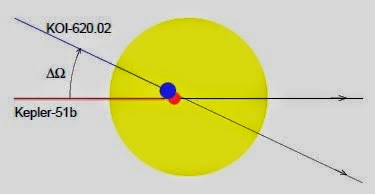
http://sciencythoughts.blogspot.co.uk/2014/07/conformation-of-third-planet-in-kepler.htmlConformation of the third planet in the Kepler-51 System.                                               Kepler-51 is a G-type Yellow Dwarf star 2800 light years from Earth in the constellation of Cygnus. It has a...

Kepler 186f: an Earth-sized planet in the habitable zone of a Red Dwarf star.
One of the key objectives in the search for planets orbiting other stars has been to locate planets in the habitable zones of such stars, i.e. planets on which liquid water could potentially exist. A number of...


 The Kepler 210 planetary system.
Since it began its survey of the section of the sky dubbed the Kepler Deep Field in 2009, the Kepler Space Telescope has discovered 2321 probable planets around 1790 stars, and it is thought that the vast majority of these probable planets will turn out to be true...
Follow Sciency Thoughts on Facebook.

Monday, 28 April 2014

Kepler 186f: an Earth-sized planet in the habitable zone of a Red Dwarf star.

One of the key objectives in the search for planets orbiting other stars has been to locate planets in the habitable zones of such stars, i.e. planets on which liquid water could potentially exist. A number of planets with habitable zone orbits have been described in recent years, though the majority have been large, gas giant type planets, unlikely to be capable of supporting life. The few potentially rocky worlds discovered, such as Kepler 62f or Gliese 581d, have also been considerably larger than the Earth.

In a paper published in the journal Science on 18 April 2014, a team of Scientists led by Elisa Quintana of the SETI Institute and NASA’s Ames Research Center, describe the discovery of an Earth-sized planet in the habitable zone of another star, based upon observations by the Kepler Space Telescope, and additional follow up observations by the ground-based Keck-II and Gemini-North telescopes.

The star, named Kepler 186 (i.e. the 186th star in the Kepler survey discovered to have planets) is an M-type Red Dwarf star (151 parsecs – translate to light years) from the Earth, with a solar radius 47% of that of the Sun and a mass 0.478 times that of the Sun. This star is calculated to have an effective surface temperature of 3788 K, compared to 5778 K for the Sun, and an iron abundance roughly half the Sun’s. Such stars are extremely long lived and slow evolving, so their habitable zones are likely to remain stable for billions of years. In the case of the Kepler 186 system this habitable zone is estimated to be between 0.22 and 0.40 AU from the star (i.e. between 22% and 40% of the average distance at which the Earth orbits the Sun).

The Kepler 186 system was found to have at least five planets, detected as they passed in front of the star rather than by any tidal wobble they created on the stars movement (a common way of detecting large exoplanets). The presence of additional planets which did not pass in front of the star during the period of the survey, either because their orbital period was too long or because their orbit was inclined to the rest of the system, could not be ruled out. All of these planets are thought to be small rocky bodies, rather than large gas giant type planets, none of them having a radius larger than 1.5 times that of the Earth.

Four of these planets orbit considerably inside the system’s habitable zone (i.e. they are too close to the star for liquid water to exist), at between 0.0343 and 0.110 AU from the star (between 3.43% and 11.0% of the average distance between the Earth and the Sun). However the fifth planet, named Kepler 186f, orbits at a distance of 0.356 AU from the star, comfortably within the system’s habitable zone.

A schematic diagram of the Kepler- 186 system. A top-down view of the system during a transit of planet f. The relative planet sizes are correct but are not on the same scale as the orbits (shown as black curves). Quintana et al. (2014).

Kepler 186f has a radius of 1.11 times that of the Earth, and takes 130 days to orbit its parent star. Its mass is thought to be between 0.32 times that of the Earth (for a body comprised of pure ice) and 3.77 times that of the Earth (for a body comprised of pure iron); for a body with a similar composition to the Earth this would give a mass 1.44 times that of the Earth. 

Being within a star’s habitable zone does not necessarily mean a planet is habitable. Mars is considered to lie within the habitable zone of our Solar System, however its small size means that it cannot retain a dense atmosphere, and therefore water cannot form a liquid on its surface (it is thought that if Mars were Earth-sized then it would have liquid water, and possibly life, on its surface). 

Kepler 186f is clearly large enough to retain liquid water at its surface, but the ability of a planet in a Red Dwarf system to acquire a large volume of water is unclear. The Earth is thought to have formed to close to the Sun for much water to have accumulated during its formation; current models suggest that it acquired the water that forms its oceans by bombardment by icy comets early in its history. These comets formed further out in the protoplanetary disk from which the planets formed, beyond the ‘snow line’, where the system was cool enough for water ice to form. The planets of the Kepler 186 system are all in a common orbital plain, suggesting that they formed from  a protoplanetary disk similar to that hypothesized for the Solar System, but it is not clear if a young Red Dwarf system would form a large body of comets beyond its snow line, with which to bombard  a young, Earth-like planet.

A side-­on view comparing Kepler-­186 with the solar system (with Earth and Mars in the habitable zone) and the Gliese 581 planets. The stars are located at the left edge of the plot. The dark grey regions represent conservative estimates of the habitable zone while the lighter grey regions are more optimistic extensions of the habitable region around each star. Quintana et al. (2014).

The remaining planets of the Kepler 186 system are all thought to be too hot for liquid water to exist. 

Kepler 186b is thought to orbit at a distance of 0.0343 AU, and to complete one orbit every 3.89 days. This planet has a radius 1.07 times that of the Earth, and is calculated to have a mass of between 0.90 times that of the Earth, for a pure silicate body, and 3.23 times that of the Earth, for a pure iron body.

Kepler 186c is thought to orbit at a distance of 0.0520 AU, and to complete one orbit every 2.27 days. This planet has a radius 1.25 times that of the Earth, and is calculated to have a mass of between 1.56 times that of the Earth, for a pure silicate body, and 6.30 times that of the Earth, for a pure iron body.

Kepler 186d is thought to orbit at a distance of 0.0781 AU, and to complete one orbit every 13.3 days. This planet has a radius 1.40 times that of the Earth, and is calculated to have a mass of between 2.38 times that of the Earth, for a pure silicate body, and 10.0 times that of the Earth, for a pure iron body.

Kepler 186e is thought to orbit at a distance of 0.110 AU, and to complete one orbit every 22.4 days. This planet has a radius 1.27 times that of the Earth, and is calculated to have a mass of between 1.66 times that of the Earth, for a pure silicate body, and 6.76 times that of the Earth, for a pure iron body.

See also…


Follow Sciency Thoughts on Facebook.

Monday, 17 March 2014

The Kepler 210 planetary system.


Since it began its survey of the section of the sky dubbed the Kepler Deep Field in 2009, the Kepler Space Telescope has discovered 2321 probable planets around 1790 stars, and it is thought that the vast majority of these probable planets will turn out to be true planets. The star given the designation KOI 676 (Kepler Object of Interest 676) was identified as a probable planet-host in 2011. It is a K-type Orange Dwarf Star, with 63%of the Sun’s mass, and an effective temperature of 4300K (compared to 5778K for the Sun), and is thought to be about 350 million years old.

In a paper published on the online arXiv database at Cornell University Library on 13 March 2014, and accepted for publication in the journal Astronomy & Astrophysics, Panagiotis Ioannidis and Jürgen Schmitt of the Hamburger Sternwarte at Universität Hamburg, Chrysa Avdellidou of the Centre for Astrophysics and Planetary Science at the School of Physical Sciences at The University of Kent, Canterbury, Carolina von Essen, also of the Hamburger Sternwarte at Universität Hamburg, and Eric Algol of the Department of Astronomy at the University of Washington, describe the discovery of a planetary system about KOI 676.

With the conformation of planets the system is renamed Kepler 210 (i.e. the 210th confirmed planetary system in the Kepler study), and the Star becomes Kepler 210A (when naming objects in other stellar systems stars are given upper case letters and planets lower class letters). Two planets, calculated to be roughly Neptune-sized, were detected making transits of the star on a regular basis, these are named Kepler 210b, which orbits the star once every 2.45 days, and Kepler 210c, which orbits the star every 7.97 days.

These two planets appear to have somewhat eccentric orbits (i.e. they have highly elliptical orbits and get notably closer and further away from the star during each circuit about it), which proved difficult to model based upon the available data about the mass and orbits of the star and planets. Ionnidis et al. tried a variety of models in order to try to explain this, and concluded that the most likely explanation was the presence of a third planet, with a mass of between 30% and 60% that of Jupiter, orbiting the star every 63 days, the gravity of which would perturb the other bodies in the way observed.

This theoretical body is given the designation KOI 676.03, retaining the system’s provisional designation due to its  theoretical, rather than confirmed, status.

The suggested configuration of the Kepler 210 system. The innermost planet is Kepler 210a, the outermost KOI 676.03. The arrow points towards Earth. Scale bars are in AU (Astronomical Units); 1 AU is the average distance between the Earth and the Sun.


Follow Sciency Thoughts on Facebook.

Sunday, 29 September 2013

Kepler 63b; a giant planet in a polar orbit.

KIC 11554435 (or Kepler Input Catalogue 11554435) is a young, sunlike star 652 light years from the Earth. It is thought to be between 200 and 300 million years old with a mass 98% of the Sun's and an effective surface temperature of ~5576 K, as opposed to 5778 K for the Sun. As a young star it rotates considerably faster than the Sun, roughly once every 5.4 days, while the Sun takes slightly under 24.5 days to complete a rotation, and has a high level of starspot activity (the same as sunspot activity but on a different star).

In a paper published on the online arXiv database at Cornell University Library on 26 August 2013, and accepted for publication in The Astrophysical Journal, a team of scientists led by Roberto Sanchis-Ojeda of the Department of Physics and Kavli Institute for Astrophysics and Space Research at the Massachusetts Institute of Technology, describe the discovery of a superjovian planet in orbit about KIC 11554435 by the Kepler Space Telescope. The system is renamed Kepler 63, with the star becoming Kepler 63A and the planet Kepler 63b (naming conventions dictate that stars are given upper case letters and planets lower case letters).

Kepler 63b orbits Kepler 63A every 9.43 days at an estimated distance from the star of 0.08 AU (8% of the distance at which the Earth orbits the Sun), making it a 'Hot Jupiter' type planet, transiting the star (passing in front of it from out point of view) as it does so. It has a highly oblique orbit, at 104° to the plane of the star's rotation. Kepler 63b has a radius 6.1 times that of Jupiter, and while it was not possible to determine its mass, this was given an upper limit of 120 times that of Jupiter.

Sanchis-Ojeda et al. were also able to detect a particularly large and apparently permanent starspot (or cluster of starspots) close the the pole of rotation of Kepler 63A that is turned towards us. This moves around the pole with the star's rotation, so that it is sometimes in line with the orbit of the planet and sometimes not.

Locations of the spot, transit chord, and planet at midtransit, according to the best-fitting model. Sanchis-Ojeda et al. (2013).


Follow Sciency Thoughts on Facebook.

Sunday, 14 July 2013

An Earth-mass planet in an eight hour orbit.

The Kepler Space Telescope has discovered a large number of planets with orbits of only a few days, mostly in the 'Hot Jupiter' class of objects, which have masses equal to or greater than that of Jupiter and orbit close to their stars, a class of objects that astronomers had not predicted prior to their discovery. As the project has built up more data the presence of smaller planets in short orbits has also been revealed. As part of a project to examine exoplanets in the Kepler Field of View with the shortest orbital periods, a team of scientists led by Roberto Sanchis-Ojeda of the Department of Physics, and Kavli Institute for Astrophysics and Space Research at the Massachusetts Institute of Technology, describe an Earth-mass planet in an eight hour orbit about a G-type yellow dwarf star, the shortest known orbit of a confirmed planet, in a paper published on the arXiv online database at Cornell University Library on 17 May 2013.

The planet in question orbits the star KIC 8435766, which has approximately 84% of the Sun's mass, and an effective surface temperature of ~5143 K (compared to 5778 K for our Sun). The planet is named KIC 8435766b, and has approximately 1.1 times the mass of the Earth. It orbits the star once every eight and a half hours, and is estimated to have a surface temperature of 2300-3100 K.

An artists impression of a rocky planet close to a yellow star. Darke Max Macedo.


Follow Sciency Thoughts on Facebook.

Saturday, 24 November 2012

Citizen scientists discover a sub-Jovian planet in a quaternary star system.

The Planet Hunters is a citizen science project (i.e. a science project carried out largely by members of the public) which asks visitors to a website to look at randomly selected 30 light-curves from the Kepler Space Telescope, and look for patterns. Volunteers who find patterns that may indicate planets can flag these up for investigation by astronomers.

In a paper published on the online arXiv database at Cornell University Library on 12 October 2012, a team of scientists led by Megan Schwamb of the Yale Center for Astronomy and Astrophysics and the Department of Physics at Yale University describe the first planet discovered by the Planet Hunters project, a sub-Jovian planet in the KIC 4862625 star system (Kepler Input Catalogue 4862625), roughly 5000 light years from Earth in the constellation of Cygnus.

The planet, named PH1, has a maximum possible mass 169 times that of the Earth, slightly over half the mass of Jupiter but considerably larger than Saturn. It orbits a binary pair of stars, named Aa and Ab, every 138 days at a distance of 0.634 AU (63.4% of the distance at which the Earth orbits the Sun). The larger of these two stars Aa, is an F-type yellow-white star, with a mass of 1.5 times the mass of the Sun. This is orbited by a smaller, M-type red dwarf star with a mass 0.4 times that of the Sun every 20 days at a distance of 0.17 AU. All of these components eclipse (pass in front of) one-another when seen from our Solar System.

Diagram showing the relative positions of PH1, Aa and Ab in the inner part of the KIC 4862625 system. Shwamb et al. (2012).

Orbiting this system at a distance of roughly 1000 AU is a second pair of binary stars, detected by their gravitational influence upon the primary binary. These are named Ba and Bb, Ba probably being a G-type yellow dwarf star with 99% of the mass of our Sun and Bb probably being a M-type red dwarf star with a mass 51% if the Sun's.

The whole system is thought to be about 2 billion years old, compared to about 4.5 billion years for our Solar System.


Follow Sciency Thoughts on Facebook.

Monday, 20 August 2012

A fourth body in the KOI-13 system.

The KOI-13 system (Kepler Object of Interest system) comprises a pair of A-type White Dwarf stars 1630 light years from Earth, orbiting each to closely to be well differentiated. The larger of these, KOI-13α, has a mass 2.05 times that of the Sun, the smaller, KOI-13β, has a mass 1.95 times that of the Sun. In 2011 the Kepler Space Telescope discovered an object (KOI-13.01) orbiting one of these stars every 1.76 days. This object was discovered by the dimming it caused as it passed in front of the star, which meant it was possible to calculate its radius (2.2 times that of Jupiter), but not its mass, leaving scientists unsure whether the object was a very large planet or a Brown Dwarf. In February 2012, a team from the University of Cambridge published a model of the KOI-13 system which suggested that KOI-13.01 was likely to be a super-heated (and therefore super-inflated) Hot Jupiter type planet, with a mass 8.3 times that of Jupiter.

An artists impression of the KOI-13 system. Inset is a telescope image of the stars, scale bar is 1 arc-second. Konkoly Observatory.

In a paper published on the online arXiv database at Cornell University Library on 10 August 2012, and in the journal Astronomy & Astrophysics on 13 August 2012, a team of scientists led by Alexandre  Santerne of the Laboratoire d’Astrophysique de Marseille and Observatoire de Haute-Provence at the Université d’Aix-Marseille & CNRS, detailing the results of a new study of the KOI-13 system using the SOPHIE Spectrograph at the Observatoire de Haute-Provence.  This study used the radial velocity method, which measures the wobble of stars caused by the gravity of objects orbiting around them, to try to determine the mass of KOI-13.01. 

Santerne et al. concluded that KOI-13.01 has a maximum mass of 14.8 times that of Jupiter if it orbits KOI-13α and 9.4 times that of Jupiter if it orbits KOI-13β, supporting the theory that this is a large Hot Jupiter type planet rather than a Brown Dwarf. 

They also found evidence for an extra stellar-mass object within the system, which they name KOI-13γ. This appears to have a mass between 0.4 and 1.0 that of our Sun, and to orbit one of the stars every 65.8 days in an eccentric orbit that does not cross the plane of the star when seen from Earth. KOI-13γ could be potentially the same star as KOI-13.01 if it is towards the smaller end of this mass range, but the most likely scenario that could be modeled was that KOI-13.01 orbits KOI-13α, while KOI-13γ orbits KOI-13β.

See also KOI-13b, a big, hot planet not a Brown Dwarf and Exoplanets on Sciency Thoughts YouTube.

Follow Sciency Thoughts on Facebook.

Monday, 25 June 2012

The peculiar planets of Kepler-36.

The Kepler Space Telescope has been staring constantly at the same part of the Galaxy for over three years, looking for the tell-tale dimming and wobbling of stars that reveals the presence of planets around them. During this time it has discovered a number of remarkable planetary systems that have revolutionized our thinking on how such systems form and evolve.

In a paper published on the online arXiv database at Cornell University Library on 20 June 2012, and in the journal Science on 21 June 2012, a team of scientists led by Joshua Carter of the Harvard-Smithsonian Center for Astrophysics announce the discovery of a new, and rather remarkable, planetary system named as Kepler-36.

The system's star, Kepler-36A, is an essentially sun-like star that has reached the subgiant stage of its life; it is coming to the end of its hydrogen supply and starting to fuse helium. This generates more heat than hydrogen, causing the star to expand. Kepler-36A has 1.071 times the mass of the Sun, and an effective surface temperature of 5911 K (compared to 5778 K for our Sun).

This is orbited at a distance of 0.115 AU (i.e 11.5% of the distance between the Earth and the Sun) every 13.8 days, by Kepler-36b, a super-Earth type planet with a mass 4.45 times that of the Earth, thought to be most likely composed largely of rock and water, and at 0.128 AU every 16.2 days by Kepler-36c, a mini-Neptune type planet with a mass 8.08 times that of the Earth, thought to be composed largely of gaseous hydrogen and helium. 

The orbits of these two planets are remarkably close together, closer than any pair of planets previously discovered, separated by just 0.013 AU (1.945 milion km), so that at their closest the two planets are only five times as far apart as the Earth and the Moon, at which distance Kepler-36c would be 2.5 times as large in the sky of Kepler-36b as the full moon is in the sky of Earth.

An artist's impression of how Kepler-36c would appear from Kepler-36c at the closest point in the two planets' orbits. Harvard-Smithsonian Center for Astrophysics/David Aguilar.

As well as being remarkably close, the two planets are remarkably different in composition. In our Solar System there is a clear differentiation between rocky and gaseous planets, with the former confined to the inner part of the system and the later to the outer parts. This is thought to be a result of the way in which the Solar System formed, with volatile gasses largely driven out of the inner system by the heat of the early Sun. Since we have begun studying other planetary systems, we have come to understand that this is not always the case, with many systems having large gaseous planets close to their stars. Scientists believe such planets are likely to have formed further out in their systems, then migrated inwards as friction with material in the protoplanetary disks slowed them down in their orbits. However this is the first time we have seen a rocky and a gaseous planet in such close proximity, and modeling the formation of the Kepler-36 system is difficult based upon our current understanding of the formation of planetary systems.


Follow Sciency Thoughts on Facebook.

Tuesday, 5 June 2012

A new study of the Kepler 11 planetary system.

The Kepler 11 system was the eleventh planetary system discovered by the Kepler Space Telescope; its discovery being announced in a paper in the journal Nature in February 2011. The star (Kepler 11A) is a G-type star with 95% of our Sun's mass approximately 2000 light years from Earth in the constellation Cygnus. This is surrounded by a system of 6 known transiting planets (i.e. planets which pass across the face of the star when seen from Earth), all of which orbit closer to the Star than Venus does to our Sun.

The orbits of the planets of the Kepler 11 System, with the orbit of Mercury given for scale. The Visual Exoplanet Catalogue.


In a paper published on the arXiv database at Cornell University Library on 3 May 2012, and also due to be published in the Monthly Notices of the Royal Astronomical SocietyCezary MigaszewskiMariusz SÅ‚onina and Krzysztof Gózdziewski of the Torún Centre for Astronomy at Nicolaus Copernicus University present the results of a longer term study of the Kepler 11 system, updating our understanding of its planets. This includes revised measurements of the masses and orbital parameters of the planets, plus some analysis of the atmospheres of those planets, made by spectrographic analysis as those planets passed in front of the star.

Kepler 11b is the innermost of the planets; orbiting at a distance of 0.091 AU (i.e. 9.1% of the distance between the Earth and the Sun) every 10.3 days. It has a mass between 1.0 and 6.6 times that of the Earth, and appears to be quite dense, containing a high proportion of heavy elements; this is not surprising, a planet this close to its parent star would be expected to lose lighter elements to evaporation (although it should be noted that Kepler 11b still appears to be less dense than the Earth).

Kepler 11c is the next planet from the star, orbiting at 0.106 AU every 13 days. It has a mass between 1.5 and 13.0 times that of the Earth. It appears to have a density similar to that of Uranus or Neptune, which is surprising as these planets lie in the cool, outer reaches of our Solar system. Kepler 11 is slightly cooler than our Sun, with an effective surface temperature of 5680 K (compared to 5778 K for the Sun), but not enough so for Ice Giant type planets to exist this far in in the system. It is likely to be comprised of heavier elements than Uranus or Neptune, with these elements in a less dense state due to the extreme heat from the star.

The next planet is Kepler 11d, orbiting at 0.159 AU every 22.7 days. This has a mass of between 5.5 and 12.7 times that of the Earth, and a density similar to that of Uranus.

Kepler 11e orbits at 0.194 AU, every 32 days. It has a mass of between 8.5 and 15.7 times that of the Earth, and appears to have a density close to that of Saturn or Jupiter.

Kepler 11f orbits at 0.25 AU every 46.7 days. It has a mass of between 1.0 and 10.1 times that of the Earth, and a density close to that of Uranus.

Kepler 11g orbits at 0.462 AU (the only known planet in the Kepler 11 system with an orbital distance greater than that of Mercury. It is the least well constrained of the planets with a mass less than 42 times that of the Earth (probably less than 28 times), and may be less dense than Saturn or Jupiter.

See also Thermal imaging 55 Cancri ePlanets discovered orbiting the ancient, second generation star HIP 11952Cooking the planets if CoRoT-7Planets in the NY Virginis system and Exoplanets on Sciency Thoughts YouTube.

Follow Sciency Thoughts on Facebook.

Friday, 10 February 2012

KOI-13b, a big, hot planet not a Brown Dwarf.

The KOI-13 (Kepler Object of Interest-13, otherwise BD+46 2629) system is composed of a pair of A-type White Dwarf stars roughly 1630 light years from the Earth. The larger of these stars, KOI-13 A, has a mass 2.05 times that of our sun, is 30.5 times as luminous, and has 2.55 times the sun's radius. The smaller star, KOI-13 B, has a mass 1.95 times that of the sun, is 23 times as luminous and has a radius 2.38 times that of the sun.

Image of the KOI-13 system from the 1m RCC telescope at Konkoly Observatory in Hungary. Image from Szabó et al. (2011). See below.

In 2011 the Kepler Space Telescope detected an object orbiting KOI-12 A. This was described in a paper published on the arXiv database at Cornell University Library by a team lead by Gyula Szabó of the Konkoly Observatory of the Hungarian Academy of Sciences and the Department of Experimental Physics at the University of Szeged, as being a Brown Dwarf, or possibly a very small Red Dwarf Star. Brown Dwarfs are objects to large to be considered planets, but to small to be considered stars; they are thought to be able to fuse deuterium in their cores, but not hydrogen. Red Dwarfs are the smallest type of stars, they burn dimly, but can be very long lived. KOI-13b (or KOI-13.01) was envisaged as an object borderline between these two types of objects, with a mass 20% of that of the sun and a radius 2.2 times that of Jupiter. Such an object orbiting so close to a very hot A-type star would probably receive more heat than it emitted.

The path of KOI-13b across the face of KOI-13 A, as detected by Kepler. From Szabó et al. (2011)

This month, in a paper published on the arXiv database and in the Monthly Notes of the Royal Astronomical Society, Dimitris Mislis and Simon Hodgkin of the Institute of Astronomy at the University of Cambridge, describe a new study of the KOI-13 system, which reveals KOI-13b as a large planet rather than a Brown Dwarf or small star.

Mislis and Hodgkin conclude KOI-13b is a super-Jovian planet with a mass of 8.3 times that of Jupiter and 1.4 times Jupiter's radius. This is big and dense for a planet, but well short of the mass needed to fuse deuterium, so it is not a Brown Dwarf. KOI-13b orbits KOI-13 A every 25.4 hours at a distance of 0.0367 AU (3.67% of the distance between the Earth and the sun. Since KOI-13 A is very hot, with a surface temperature of 8511K (compared to 5778K for our sun), and KOI-13b is very close to it, KOI-13b is thought likely to have a very high surface temperature itself, modeled by Mislis and Hodgkin as 2864K, warmer than the coolest Red Dwarf stars.

Sunday, 15 January 2012

A planet disintegrating in the heat of its own sun.

KIC 12557548 (Kepler Input Catalogue 12557548) is a K-type orange dwarf star, smaller and cooler than the sun, but likely to shine for a lot longer. It has an estimated surface temperature of about 4400 K (4127 ° C), compared to 5778 K (5505 °C) for the sun, and is probably about 70% as large. The star is occulted by a transiting object every 15.685 hours, but these occultations, while extremely regular, reduce the apparent output of the star be an irregular amount.

On 12 January 2012 a paper by a team of scientists lead by Saul Rappaport of the Department of Physics and the Kavli Institute for Astrophysics and Space Research at the Massachusetts Institute of Technology, appeared on the arXiv online database at Cornell University Library in which they examine the KIC 12557548 system in more depth, using data from the Kepler Space Telescope combined with observations by the 1.6 m telescope at the Observatoire Astronomique du Mont-Mégantic

The only reasonable explanations of a regular occultation of a star is another body close to our line of sight which regularly interfere with our view of the star, and another body in the same system, orbiting the star. Rappaport et al. were unable to find another star close enough to our line of sight to interfere with our view of KIC 12557548, leaving another body in the same system as the only explanation.

The short period for the object suggests that it must be very close to the parent star; since KIC 12557548 is a fairly small star, a large object in a close orbit, such as a second star, or a brown dwarf, would be extremely unstable. This makes the most likely object a planet, and a fairly small one at that. However the available data does not support a small solid object, which would reduce the light output from the star by a regular amount. Rappaport et al. experimented with the idea of two or more planets with similar or related orbits but could not come up with a stable model for this.

The model that Rappaport et al. eventually came up with involves a small planet, 0.1 times the mass of the Earth or 1.8 times the mass of Mercury and a radius of 0.5 times that of the Earth or 1.3 times that of Mercury, orbiting very close to the parent star. The closeness of the star superheats the surface of the planet, causing rocks to sublimate (turn from a solid to a gas without passing through a liquid phase) from the surface of the planet. Since rocks are largely made up of mixtures of minerals, the escaping gasses would take a lot of small grains of still solid minerals with them, similar to the ash plume of a volcano. The upshot of this would be a small planet that produces a tail similar to a comet, made up of escaping gasses laden with mineral grains.

Models of the planet with its tail seen from (a) stellar north and (b) further out within the plain of the system. The red circle represents the star. From Rappaport et al. (2012).

Rappaport et al. consider that the planet would have to be quite small for this effect to work, since a larger planet's gravity would prevent minerals from escaping, this would only be possible with a small planet with low gravity and no permanent atmosphere. They calculate that such a planet could take about 200 million years to evaporate, though they do not speculate on how the planet could have got into its current position.

Friday, 13 January 2012

KOI-961,a mini planetary system with a star not much bigger than Jupiter.

M-type dwarf stars, or Red Dwarfs, are the smallest and most abundant stars in the Milky Way. As such many of these occur in the Kepler Field of View, the area of space being examined by the Kepler Space Telescope, and many of those are considered to be possible hosts for planets. The smallest of these is KOI-961 (Kepler Object of Interest-961), an object approximately 120 light years from Earth, with three potential orbiting planets. Unfortunately it is had to resolve the mass and radius of small, distant M-type stars, making it even harder to make any assessments of potential planets orbiting them. Thus KOI-961 remained effectively on the shelf, interesting, but unstudied due to lack of data.

That was until Kevin Apps, a British amateur astronomer, pointed out that the spectral properties of KOI-961 were almost identical to those of Barnard's Star, one of the closest stars to Earth at a distance of only 6 light years, and subsequently very well studied. This lead to a revised study of the system by scientists, resulting in the publication of a paper on the arXiv database at Cornell University Library formally describing the KOI-961 on 10 January 2011, a paper which has also been accepted for publication in The Astrophysical Journal, by a team of scientists lead by Philip Muirhead of the Department of Astronomy at the California Institute of Technology. The discovery was also announced at the 219th meeting of the American Astronomical Society by John Johnson, also of Caltech.

Muirhead et al. used data from the Kepler Space Telescope, combined with new data from the Keck I Telescope in Hawaii and the Hale Telescope at the Palomar Observatory. They calculated that KOI-961 was slightly metal-poor compared to Barnard's Star, but otherwise remarkably similar. By assuming that KOI-961 is essentially similar to Barnard's Star, with a radius of 0.199 that of our sun, and a mass 0.158 of the suns, Muirhead et al. were able to build a model of the KOI-961 system and its three candidate planets; the planets are referred to as candidates since they were detected by their transits of the star and have not been confirmed by other means; Muirhead et al. were able to demonstrate that no other explanation fits the available data very well, even though the dataset was made complicated by numerous multiple transits (transits by more than one planet at the same time).

KOI-961 has a volume only 170% of that of Jupiter, it is orbited by three planets, all smaller than the Earth, with the smallest probably about the same size as Mars. All of it's planets are close to the star and orbit with very short periods, making the system more like that of Jupiter than that of the Sun.

A comparison of the sizes and distances in the KOI-961 and Jovian systems. Image from NASA/Caltech.

KOI-961.01 orbits the star every 29 hours at a distance of 0.0116 AU, that is to say 0.0116 times the distance at which Earth orbits the sun. It has a radius approximately 78% of that of the Earth (though their is a big margin of error in this) and an estimated average equatorial temperature of 519 K (244 °C).

KOI-961.02 orbits the star every 10.8 hours at a distance of 0.0060 AU. It has an estimated radius of 0.73 times that of the Earth, and an estimated equatorial temperature of 720 K (447 °C).

KOI-961.03 orbits the star every 45 hours at a distance of 0.0154 AU. It has an estimated radius of 0.57 times that of the Earth (1.07 times that of Mars) and an estimated equatorial temperature of 450 K (177 °C).

An artist's impression of the KOI-961 system. Image from NASA/JPL-Caltech.

Saturday, 10 December 2011

NASA may have discovered an exoplanet smaller than the Earth.

This week at the First Kepler Science Conference at the Ames Research Park NASA scientists announced that the Kepler Space Telescope had potentially discovered an exoplanet smaller than the Earth. At the moment the team are reluctant to say that they are able to confirm this discovery, but a paper is being prepared for the journal Nature, which only publishes major discoveries that have not been documented elsewhere, which suggests that they have serious data to support their claim.

The new planet is in the Kepler-20 system, formerly known as KOI-70 (Kepler Object of Interest-70), which now has three confirmed planets, Kepler-20b, Kepler-20c and Kepler-20d and two unconfirmed planets, KOI-70.04 and KOI-70.05; the star is now referred to as Kepler-20A (letters are capitalized to indicate stars), but the unconfirmed objects retain the old designaton for the system until they are confirmed. All five orbit closer to their star than Mercury does to the sun. The three confirmed planets have been observed to cause a regular dimming of the star as they transit (pass in front of) it, and to cause perturbations in its rotation (wobbles) due to their mass. The two unconfirmed planets have been observed to transit the star, but are two small to cause any visible movement in the star, and will so need to be confirmed by another method. The smaller planets can be detected when they transit the star because they are so close to it; a small close planet causes as much dimming as a larger more distant one.

An artist's impression of the Kepler-20 system.

It is KOI-70.04 that is potentially smaller than the Earth, about 80-90% of the size of our planet. It is the second closest object to the star, at a orbiting every 6.1 days at a distance of about 9.6 million kilometers or 6.4% of the distance from Earth to the Sun. It is estimated that this would give the planet a surface temperature of 600°C.

The three larger planets have masses of 8.7 times that of the Earth (Kepler-20b), 16.1 times the mass of the Earth (Kepler-20c) and somewhere under 20.1 times the mass of the Earth (Kepler-20d). All three have radiuses between 1.9 and 3 times that of the Earth.

No further information is available at this time; no data on KOI-70.05 has been released, although it is presumably the closest object to the star.

Tuesday, 6 December 2011

NASA announces the discovery of Kepler-22b, a planet it its star's habitable zone.

On 5 December 2011 the NASA released a press statement to the effect that it had found a planet in the centre of the 'Goldilocks Zone' of a star 587 light years from Earth in the constellation of Cygnus. The Goldilocks Zone is the area in a star system where there is likely to be liquid water on an Earth-like planet; it is neither too hot, nor too cold, like the Baby Bear's porridge in the folk-tale. The system has been dubbed Kepler-22 (i.e. the 22nd planetary system discovered by the Kepler Space Telescope), with the star named Kepler-22A and the planet Kepler-22b (the first object in a system is 'a', the second 'b' etc.; stars are capitalized, planets are not).

A comparison of the habitable zones of our solar system and the Kepler-22 system.

Kepler-22A is a very sun-like star, 97% of the mass of our sun and 98% its volume. Kepler-22b obits this star every 290 days, at 85% of the distance at which the Earth orbits the sun. Keppler-22b planet has 2.4 times the radius of the Earth, though its mass is unknown; it was detected as it transits it's star; it does not exert enough gravitational pull to cause the star to wobble detectably (the other means by which we commonly discover new planets), which is how the mass of exoplanets can be determined. This is not greatly surprising, most planets that cause measurable wobbles in their stars are large planets orbiting small stars. It is estimated that if Kepler-22b was Earth-like then that its average surface temperature would be 22°C (the average surface temperature on Earth is 14°C).

This discovery has provoked a great deal of interest in the popular press, and has been widely hailed as a potential home for extra-terrestrial life, something NASA has done little to downplay. However the estimations of the habitability of Kepler-22b are based upon the assumption that it might be an earthlike planet. At 2.4 times the volume of the Earth Keppler-22b is likely to have a much thicker atmosphere, leading to a greater greenhouse effect, thereby raising the planet's surface temperature. This can make a considerable difference to a planet's temperature; without the greenhouse effect Venus would probably have a mild, pleasant, climate and Earth would be a frozen snowball. Even on Earth changes in the atmosphere are thought to have caused spectacular changes in climate over geological timescales, from an average surface temperature of -57°C during the Cryogenian, 700-750 million years ago to 21°C in the Cambrian 542-488 million years ago. Worst case scenarios for anthropogenic global warming suggest that the Earth's average surface temperature could rise by 6°C within the next hundred years, which would be devastating for human life (and much non-human life), but which would not make the planet uninhabitable. On Kepler-22b a much thicker atmosphere could potentially make the planet to hot for liquid water, and therefore unsuitable for life as we understand it.

NASA intend to follow up the initial observation with studies of the system using the Spitzer Space Telescope and ground-based observatories.