Showing posts with label Brown Dwarf. Show all posts

Saturday, 14 December 2024

Direct imaging of a possible planet orbiting the fast moving star HIP 36277.

In the past three decades almost six thousand exoplanets (planets orbititing stars other than our Sun) have been detected, using a variety of methods. Direct imaging has proven to be a useful technique for detecting planets with masses greater-than-or-equal-to that of Jupiter at distances of more than 10 AU from their host stars (i.e. more than ten times as far from their host stars as the Earth is from the Sun). Notable planets discovered in this way include 51 Eridani b, which has a mass 2.6 times that of Jupiter and orbits a star 96 light years from Earth in the constellation of Eridanus at a distance of 11.1 AU, HIP 65426 b (formally named Najsakopajk), which has a mass 7.1 times that of Jupiter, and orbits a star 385 light years from Earth in the constellation of Centaurus at a distance of 87 AU, and PDS 70 b and PDS 70 c, which have masses of 3.2 and 7.5 times that of Jupiter, and orbit a star 370 light years from Earth in the constellation of Centaurus at distances of 20.8 and 34.3 AU, respectively.

However, large planets at large separations from their host stars are relatively rare, which means that a large number of stellar systems have to be surveyed in this way in order to detect a few planets. Most giant planets known orbit their host stars at distances of 1-3 AU, which would make direct imaging them with current technology impossible if they are more than about 50 parsecs (163.1 light years) away from us. 

The radial velocity method uses the movement of stars to detect to infer the presence of companions. This has proven very effective as a  way to detect very large planets close to stars, such as Beta Pictoris c, which has a mass about nine times that of Jupiter, and orbits a star 63 light years from Earth in the constellation of Pictor at a distance of about 2.7 AU, or HD206893 c, which has a mass about 12.7 times that of Jupiter, and orbits a star 125 light years from  Earth in the constellation of Capricornus,  at a distance of 3.53 AU.

The proper motion anomaly method can identify potential companions to stars by measuring their parallax (the amount they move in a year because we are observing them from different points on the Earth's orbit) over several years; if the star moves more than predicted (i.e. anomalously), then this is likely to be because of an unseen companion moving the star. This method has been used to identify several potential planets which have subsequently been directly imaged. These include HIP 99770 b, which has a mass of about 16 times that of Jupiter, and which orbits a star 133 light years from Earth in the constellation of Cygnus at a distance of 17 AU, AF Leporis b, which is 2-5 times the mass of Jupiter and orbits a star 87.5 light years from Earth in the constellationof Lepus, as well as the brown dwarf HD21152 B, which has a mass 22-36 times that of Jupiter, and which orbits a star 150 light years from Earth in the constellation of Taurus at a distance of about 18 AU.

In a paper published in the Monthly Notices of the Royal Astronomical Society on 9 December 2024, a team of astronomers led by Dino Mesa of the Osservatorio Astronomico di Padova present the results of a study which targeted three stars in the Hipparcos-Gaia PMa catalogue identified as having proper motion anomalies with the SHARK-NIR coronagraphic camera and LMIRCam camera and coronagraph of the Large Binocular Telescope in Arizona. 

Because they were interested in planetary-sized companion bodies, rather than secondary stars, Mesa et al. looked for stars which showed small proper motion anomalies, and because they wished to be able to image bodies within 10 AU of their host star, they restricted themselves to objects within 50 parsecs (163 light years) of the Earth.

The first star selected, HIP 11696 A (also known as HD 15407 A) is an F-type (yellow-white dwarf) star with a mass about 1.40 times that of our Sun, 49.3 parsecs (160.8 light years) from Earth in the constellation of Persius. HIP 11696 is a young star, which has been estimated to be about 80 million years old, although it is also thought likely to be a member of the AAB Doradus Moving Group, which would make it between 125 and 149 million years old. Mesa et al. use an intermediate age of 137 million years for their calculations in their study.

HIP 11696 A has a companion star, HIP 1696 B, which is a K-type (orange dwarf) star with about 80% of the mass of our Sun, separated by about 1000 AU - far enough to be excluded from the field of view of the SHARK-NIR instrument. HIP 11696 A appears to be producing an unusual amount of light in the mid-infrared range, which may be indicative of a recent collision between rocky planets of planetary embryos in the inner part of the system. A debris disk has been detected at a distance of 0.6-1.0 AU from the star, which makes it unlikely that there are any massive planets orbiting close to the star. Nevertheless, an anomaly in the motion of HIP 11696 A which could not be explained by the presence of HIP 11969 B was detected. It has been suggested that this might be caused by a planet with a mass about 6.39 times that of Jupiter orbiting at 3 AU from HIP 11696 A, or a planet with a mass about 16.6 times that of Jupiter orbiting at about 30 AU from the star.

HIP 11696 A was observed with the SHARK-NIR and LMIRCam instrument on the night of 28 October 2023. Mesa et al. detected a bright object to the southeast of the star at a distance of 1.5" (1.5 arc seconds; the sky can be imagined as a sphere surrounding the Earth, divided into 360 degrees (°), with each degree divided into 60 arc minutes (') and each arc minute divided into 60 arc seconds (")). However, this object was also imaged previously by the Keck II telescope in November 2009, and the Gemini North Telescope in August 2013, with no movement relative to HIP 11696 A between these images, leading Mesa et al. to conclude that this is in fact a background object rather than a planetary companion to the star. Based upon this inability to image a planet close to the star, Mesa et al. calculate that if a planet is responsible for the observed wobble in HIP 11696 A's orbit, then this is likely to be between 2.5 and 28 AU from the star, and have a mass 4-16 times that of Jupiter.

(Top) Final image obtained for HIP 11696 using SHARK-NIR data. This image was obtained by applying a PCA method subtracting 5 principal components. (Bottom) Final image obtained for HIP 11696 using LMIRCam data. In this case, a PCA method subtracting 10 principal components was applied. In both cases, a bright candidate companion is visible South-East from the star. Because the image is looking up, the positions of east and west are reversed. Mesa et al. (2024).

The second star identified, HIP 47110 A (also known as HD 82939 A) is a G-type (yellow dwarf) star with about 98% of the mass of our Sun, 38.7 parsecs (126.2 light years) from Earth in the constellation of Leo Minor. HIP 47110 A has been identified as a possible member of the Pleiades Moving group, with an age of approximately 112 million years.

HIP 47110 A has a companion star, HIP 47110 B, which is a M-type (red dwarf) star with a separation of larger than 162" (interpreted to be more than 6280 AU), enabling it to be excluded from the field of vision. Again, there is an anomaly in the motion of HIP 47110 A which cannot be explained by the presence of HIP 447110 B, and which has been hypothesized to be caused by a planet. It has been suggested that this might be caused by a planet with a mass about 2.5 times that of Jupiter orbiting at between 5 and 10 AU from HIP 47110 A, or a planet with a mass about 11.35 times that of Jupiter orbiting at about 30 AU from the star.

HIP 47110 A was observed on the night of 20 February 2024, but no potential companion was observed. Based upon this, Mesa et al. exclude the possibility of a planet close to star, calculating that the observed orbitary wobble must be caused by a planet between 3 and 30 AU from the star with a mass of between 2 and 10 times that of Jupiter.

The third star in the study, HIP 36277, is a K-type (orange dwarf) star with a mass 0.67 times that of our Sun, located 46.3 parsecs (151 light years) from the Earth in the constellation of Dorado. HIP 36277 was identified as a young runaway star (star which has been ejected from the star cluster which birthed it, and which is therefore travelling at a high speed in a distance at odds with galactic rotation) with an age of about 41.2 million years. However, spectrographic analysis of the star has suggested a much older age, most probably more than a billion years old and possibly more than 10 billion years. 

An anomaly on the motion of HIP 36277, which has been interpreted as potentially due to a planet with a mass 2.3 times that of Jupiter at a distance of 5 AU from the star, 2.64 times that of Jupiter at 10 AU from the star, or 15.18 times the mass of Jupiter at 30 AU from the star.

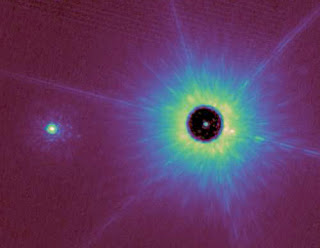
HIP 36277 was observed on the night of 21 February 2024, with a bright object observed to the southeast of the star in both SHARK-NIR and LMIRCam images. This body could also be identified in images from the Gaia space telescope, with similar parallax and proper motion values, which demonstrates physical association with the star. The object is separated from the star by 1.9". The precise size of this object is difficult to calculate, given the uncertainty of the age of the star, but Mesa et al. calculate that if the star is 41 million years old, then it would have a mass of between 16.2 and 73.9 times that of Jupiter (with a median value of 37.8 Jupiter masses), making it most likely a brown dwarf companion to the star (brown dwarfs are objects intermediate to stars and planets in size; they are not large enough to fuse ordinary hydrogen in their cores, but are large enough to fuse the heavier isotope deuterium). However, if the star is about five billion years old, then the body is likely to have a mass about 0.1 times that of our Sun, making it a small M-type (red dwarf) star. 

A second object was also visible in the SHARK-NIR data, but not observed by LMIRCam. This object is to the south of the star, and separated by about 0.0625", which Mesa et al. calculate to be equivalent to about 28.9 AU. Again, the mass of such an object would be dependent on its age, with a 41-million-year-old object having a mass about 7.6 times that of Jupiter, making it a large planet, while at 5 billion years old it would have a mass between 65.9 and 72.1 times that of Jupiter, again indicative of a brown dwarf.

(Top) Final image obtained for HIP 36277 using SHARK-NIR data. This image was obtained by applying a PCA method subtracting 5 principal components. (Bottom) Final image obtained for HIP 36277 using LMIRCam data. In this case, a PCA method subtracting 10 principal components was applied. In both cases, a bright candidate companion is visible southeast from the star. Furthermore, in the SHARK-NIR image, a possible fainter object is visible just south of the star. Mesa et al. (2024).

See also...

Tuesday, 11 October 2016

Understanding the ring system of J1407b.

J1407 (or to give it its full name, 1SWASP J140747.93-394542.6), is a 16 million-year-old K-type orange dwarf star 420 light years from Earth in the Scorpius-Centaurus OB association, in the constellation of Centaurus. In 2007 this star underwent a series of complex eclipses over a period of 56 days, which astronomers eventually concluded were most likely to have been caused by a large planetary companion with an extended ring system and an eccentric orbit, named J1407b, passing in front of the star. Ring systems around planets are thought to be product of the way in which the planets form. As a young planet grows in mass material is pulled from the circumstellar disk (disk of material surrounding the young star from which the planets form) into a circumplanetary disk (disk around the planet). Most of this material eventually accretes onto the planet of is lost back into space, but some can go on to form a system of moons or rings around the planet, the most notable example of this in our own Solar System being the ring system seen around the planet Saturn).
  
In a paper published on the arXiv database at Cornell University Library on 27 September 2016 and accepted for publication in the journal Astronomy & Astrophysics, Steven Rieder of the RIKEN Advanced Institute for Computational Science and Sterrewacht Leiden at Leiden University, and Matthew Kenworthy, also of Sterrewacht Leiden at Leiden University, describe a series of models of the J1407 system and the conclusions about the system drawn from these.

Rieder and Kenworthy assumed that the ring system orbited the planet in the same plane as the planet orbited the star, and that the planet had an average distance from the star of 5AU (i.e. five times the distance at which Earth orbits the Sun), giving it an orbital period of 11 years. The Star was given a mass equivalent to 0.9 times that of the Sun, while the planet was modelled at a series of increments at 20, 40, 60, 80 and 100 times that of Jupiter. Since the planet has never been directly detected it is assumed that the long access of the orbit is directed towards the Earth (eccentric orbits are essentially egg-shaped), which it the most likely explanation of a large companion body escaping detection in the system, with the eclipses occurring at or very close to the planetary perihelion (i.e. the closest point on the orbit to the star, where the planet is moving fastest). The obit of the planet was modelled at eccentricities of between 0.6 and 0.7, meaning that at perihelion it would be between 1.5 and 2.0 AU from the star and moving at a rate of between 27 and 33 kilometers per second.

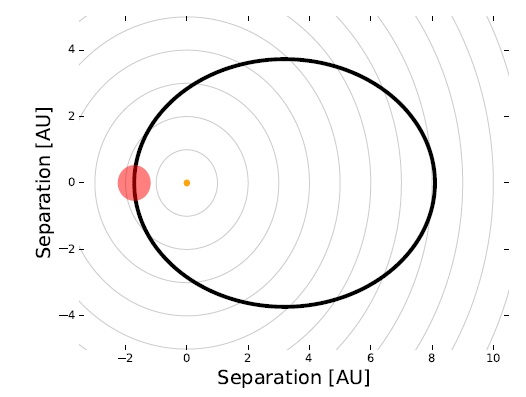
 The orbit of J1407b model B80, with J1407b located at pericentre. The J1407b system (red) is shown to scale for the initial size of the model. The size of the star (orange) is exaggerated by a factor 20. Grey circles indicate the distance to the star in AU, while the black ellipse shows the orbit. Rieder & Kenworthy (2016).

Each model planet was surrounded by a series of 50 rings with an inner edge ranging from 0.26 AU to 0.66 AU. Particles were assumed to start equidistant from each other within each ring, but the radial distance of each particle was then changed by a random amount. Each ring system generated in this way was run through the simulation twice, once with a prograde orbit (i.e. in the same direction as the orbit of the planet) and once in a retrograde orbit (i.e.. in the opposite direction to the orbit of the planer. Particles that travelled beyond 2AU from the planet were assumed to have been lost from the system. The simulation was run for 9000 orbits, equivalent to 500 000 years.

Rieder and Kenworthy found that rings with prograde orbits tended to be disrupted easily in the simulations, with the largest surviving ring system in a prograde orbit being capable of producing an eclipse only 40 days long, far shorter than the observed phenomenon. Ring systems with retrograde orbits, however, fared better, and several simulations were capable of producing eclipses 56 days in length or even longer. This suggests that the eclipses could well be caused by a planet, J1407b surrounded by a series of rings with a retrograde orbit. This is not an unreasonable requirement, as in our own Solar System the panets Venus and Uranus have retrograde rotations, and this has also been obeserved in exoplanet such as WASP-17b. The simulations also suggest that the planet is likely to be large, closer in size to 100 times as massive as Jupiter than 20 times as massive. Such an object would be more likely to be a Brown Dwarf than a planet (Brown Dwarfs are objects to large to be considered planets, but to small to be considered stars; they are thought to be able to fuse deuterium in their cores, but not hydrogen). 

See also...

http://sciencythoughts.blogspot.co.uk/2016/09/faint-companions-discovered-to-two.htmlFaint companions discovered to two planet-hosting stars.                                               Almost all planets orbiting other stars have been discovered by one of two planetary detection techniques: occlusion, on which the planet passes in front of the star, causing the amount of light reaching us from that star to dim ever so slightly on a regular timescale, or radial velocity, in which the gravity of the planet causes the host star to wobble back and...
http://sciencythoughts.blogspot.co.uk/2015/11/the-possibility-of-earth-mass-planet-in.htmlThe possibility of an Earth-mass planet in the habitable zone of the Kepler-68 system.      The Kepler Space Telescope has located many multi-planet systems since its inception, which combined with discoveries made by other planet-hunting missions has enabled scientists to begin to construct models of planetary systems orbiting other stars. This is particularly complicated where not all planets are visible to the space telescope, which is only...
http://sciencythoughts.blogspot.co.uk/2015/11/generating-free-oxygen-in-atmosphere-of.htmlGenerating free oxygen in the atmosphere of exoplanets without the presence of life.           In the past two decades over a thousand planets have been found orbiting stars other than our own, many of which appear to be small rocky planets in the habitable zones of their stars (i.e. the zone in which such a...
Follow Sciency Thoughts on Facebook.

Tuesday, 24 February 2015

When Schotz’s Star passed through the Solar System’s Oort Cloud.


It is estimated that about 30% of impact craters larger than 10 km on the Earth and the Moon have been caused by long period comets originating in the Oort Cloud (the very outermost part of the Solar System, between about 30 AU and about 120 000 AU from the Sun, which is to say between 30 and 120 000 times as far from the Sun as the Earth. In the 1980s it was theorized that the Sun could have an undetected binary companion orbiting in this part of space, which periodically triggered showers of comets to enter the inner Solar System, triggering mass-extinction events on Earth, though since that time it has become apparent that mass extinction events do not show any such regular pattern and astronomers have failed to find any such companion star.

This still leaves the possibility of close encounters with other stars, with such bodies passing through the Oort Cloud and triggering showers of comets to enter the Inner Solar System. It has been calculated that on average 12 stars pass within one parsec (208 000 AU) of the Sun every million years, one star every 9.2 million years coming within 0.25 parsecs (52 000 AU) of the Sun. Previous studies have found four stars which may in the remote future pass through the Solar System’s Oort Cloud; HIP 85605, which may come within 20 800 AU of the Sun in 332 000 years’ time (though this is highly uncertain as HIP 85605 is a poorly understood binary system whose distance and motion are poorly resolved), HIP 89825 (Gliese 710) which may reach 0.27 parsecs (56 160 AU) from the Sun 1 400 000 years in  the future, HIP 63721 which may also reach 0.27 parsecs (56 160 AU) from the Sun in 146 000 years, and HIP 89825 which may come withion 0.36 parsecs (74 260 AU) from the Sun in 1.5 million years.

In a paper published in the Astrophysical Journal Letters on 10 February 2015 and on the arXiv database at Cornell University Library on 16 February 2015, a team of scientists led by Eric Mamajek of the Department of Physics& Astronomy at the University of Rochester describe the results of a study of a newly discovered body, Scholtz’ Star (WISE J072003.20-084651.2) with the Southern African Large Telescope and Magellan Telescopes which suggest that the body may have passed through the Oort Cloud in the past.

Finder chart of 6 6 arcmin² centred on WISE J072-0846 from SuperCOSMOS Sky Surveys. Scholtz 2013.

Sholtz’s Star currently lies about 7 parsecs (light years) from Earth in the constellation of Monoceras. It is an extremely dim Red Dwarf star lying close to the Galactic Plane, and consequently was not discovered until 2013. It has a low tangential velocity (i.e. it appears not to move very much viewed from Earth), which is unusual in so close a star; all stars are constantly in motion, so if a nearby star appears stationary it is probably moving straight towards or straight away from us. A previous study has suggested that this body is in fact a binary system.

Mamajek et al. conclude that Sholtz’s Star is in fact a binary system, comprising two bodies separated by a distance of about 0.8 AU (80% of the distance between the Earth and the Sun). These bodies have masses of 86 and 65 times that of Jupiter respectively, leading Mamajek et al. to conclude that the larger body, WISE J072003.20-084651.2A (when naming bodies in other star systems stars are given upper case letters and planets lower case letters) is an extremely small Red Dwarf star, while the second body, WISE J072003.20-084651.2B, is a Brown Dwarf, a body too small to fuse ordinary hydrogen in its core, but large enough to fuse the heavy hydrogen isotope deuterium. These bodies are estimated to be about 3-10 billion years old, to have originated within the galactic thin disk (expand) and to form part of the Hercules Stream (expand).

Calculations of the motion of Scholtz’s Star suggest that the body reached a closest distance from the Sun of 0.25 parsecs, or 52 000 AU, from the Sun approximately 700 000 years ago. For comparison the current closest known star, Proxima Centuri, is 268 300 AU from the Sun, while the most distant man-made object, Voyager 1, which has been travelling outwards since 1977, is currently 130.6 AU from the Sun. Despite this close proximity Sholtz’s Star would still have been to dim to be seen by the naked eye, though it would have been brighter than ProximaCenturi. However, unlike ProximaCenturi, Sholtz’s Star is highly active, occasionally producing very bright flares, which may have resulted in it becoming dimly naked eye visible for periods of minutes or even hours.

Finder chart of 6 6 arcmin² centred on WISE J072-0846 from WISE w2-band observation.

An approach at 52 000 AU places Sholtz’s Star within the outer part of the Oort Cloud, where it may potentially have encountered and perturbed the orbits of comets orbiting our Sun, though outside the denser Inner Oort Cloud, which extends to 20 000 AU from the Sun and where the majority of such comets are found.Comets orbiting the Sun at a distance of 52 000 would have an orbital period of about 4.2 million years, thus any such bodies perturbed from their orbit’s by the approach of Sholtz’s Star would take about 2.1 million years to reach the Inner Solar System, arriving about 1 400 000 years in the future. It is estimated that in order to cause a major comet flux (in which the number of long period comets reaching the Inner Solar System increases by a factor of 10 or more), then another star would have to come within 10 000 AU of the Sun, so any flux created by the passage of Sholtz’s Star should be quite small compared to the usual rate of cometry bombardment, generated by galactic tidal effects, presenting only a very minor threat to the Earth.

Mamajek et al. also re-examined the poorly known HIP 85605, concluding that it is both brighter and further away than previously estimate. Mamajek et al. conclude that HIP 85605 is currently 60 parsecs (light years) from the Sun, and that its closest approach to our system will come in 2.8 million years’ time, when it will reach a distance of 10 parsecs (light years). This indicates that the flyby by Sholtz’s Star is the closest known encounter with the Solar System by another star at any point in the calculable past or foreseeable future.

See also…

http://sciencythoughts.blogspot.co.uk/2014/10/the-discovery-of-brown-dwarf-companion.htmlThe discovery of a Brown Dwarf companion to the star ζ Delphini.                                       Brown Dwarfs are objects intermediate to stars and planets in size; they are not large enough to fuse ordinary hydrogen in their cores, but are large enough to fuse the heavier isotope deuterium. These objects are thought to...
http://sciencythoughts.blogspot.co.uk/2014/08/emissions-from-comet-c2002-vq94-linear.htmlEmissions from Comet C/2002 VQ94 (LINEAR).                                                C/2002 VQ94 (LINEAR) was discovered by the Lincoln Near-Earth Asteroid Research (LINEAR) team at the Massachusetts Institute of...
http://sciencythoughts.blogspot.co.uk/2014/05/a-small-cold-brown-dwarf-7175-light.htmlA small cold Brown Dwarf, 7.175 light years from Earth.                                                           Brown Dwarfs are curious objects, intermediate between stars and planets. They lack the mass to fuse hydrogen in their cores like true stars, but are massive enough to fuse deuterium (a heavy isotope hydrogen, containing one proton and one neutron in its atomic... 
Follow Sciency Thoughts on Facebook.

Wednesday, 22 October 2014

The discovery of a Brown Dwarf companion to the star ζ Delphini.


Brown Dwarfs are objects intermediate to stars and planets in size; they are not large enough to fuse ordinary hydrogen in their cores, but are large enough to fuse the heavier isotope deuterium. These objects are thought to be quite variable in nature, with the largest and warmest resembling small Red Dwarf stars, but with cooler members of the group being more planet-like, and potentially having solid surfaces, planet-like atmospheres and even ice formation on their surface. Many of the Brown Dwarfs so far discovered are companions to true stars, though they are rarer as companions than both secondary stars and planets, with only a little over a hundred such companions observed since the first discovery in 1995. The larger number of companion stars discovered is easily explained, as such bodies tend to be easily visible, but as the number of planets discovered in other stellar systems has risen steadily it would have been expected that the number of Brown Dwarfs (typically larger, brighter and easier to spot than planets) would have kept pace, yet this has not happened.

In a paper published on the arXiv database at Cornell University Library on 30 September 2014, and accepted for publication in the Monthly Notices of the RoyalAstronomical Society, a team of astronomers led by Robert De Rosa of the Schoolof Earth and Space Exploration at Arizona State University and the School of Physics at the University of Exeter describe the discovery of a Brown Dwarf companion to the star ζ Delphini (Zeta Delphini) by the VAST (Volume-limted A-Star) Survey using the Near InfraRed Imager and Spectrometer (NIRI) and ALTitude conjugate Adaptive optics for the InfraRed (ALTAIR) systems on the Gemini North telescope, with additional observations made by the Canada France Hawaii Telescope and the MMT Observatory.

ζDelphini is an A3V star (a blue-white star considerably more massive than the Sun) 220 light years from Earth in the constellation of Delphinus. It is thought to be about 525 million years old with a mass of about 2.5 times that of the Sun and an effective surface temperature of 8336K (compared to 5778K for the Sun). No debris disk has been found around ζ Delphini (visible debris disks are associated with the early stages of planetary formation, though with an age of 525 million years it would be predicted that any such disk in the system would have dissipated) and the star has not been associated with any young stellar group (group of young stars with similar trajectories and ages, thought to share a common origin).

The new companion is named ζ Delphini B, making the original star ζ Delphini A. It is estimated to be between 40 and 55 times as massive as Jupiter, and to have an effective surface temperature of 1550K. ζ Delphini B is currently 912 AU from ζ Delphini A (i.e. 912 times as far from its parent star as the Earth is from the Sun), though it is thought to have an eccentric orbit with an average distance from the star of 907 AU, and an orbital period of about 10 000 years.

The Gemini/NIRI observation of the ζ Delphinisystem obtained on 2010 June 8 showing the location of the heavily saturated ζ DelphiniA, the substellar companion ζ Delphini B (zet Del B) and the seven background objects (BG 1-7) used in the astrometric analysis (indicated by the arrows). The image has been processed through a median filter to reduce the significant amount of scattered light from ζ Delphini A. The orientation and angular scale are given for reference; note that east and west are reversed in sky maps relative to ground maps as one is looking up rather than down, and that the scale is given in arcseconds (“) – the sky is divided into 360˚ (although only 180˚ is ever visible from any point on the Earth), with each degree (˚) divided into 60 arcminutes (‘) and each arcminute divided into 60 arcseconds. De Rosa et al. (2014).

There are currently three theories as to how a star could come to have a Brown Dwarf companion. The Brown Dwarf could potentially form as part of a large circumstellar disk, in a similar way to a planet, though the formation of a ~50 Jupiter-mass object at a distance of over 900 AU is improbable, both because this would require a remarkable amount of matter at the thin outer-edge of the circumstellar disk and because of the timescales that would be required for the object to coalesce (things tend to move slowly in the outer parts of stellar systems, as all motion is essentially driven by the gravity of the star, and the ζ Delphini system is only thought to be 525 million years old), however this possibility cannot be ruled out as it is possible that ζ Delphini B formed much closer to ζ Delphini A, and has subsequently migrated outwards due to gravitational interactions. Secondly it is thought possible that sometimes young pre-stellar cores can be fragmented, producing two bodies rather than one, though this is thought to be an extremely violent process, resulting in two bodies separated by distances measured in thousands of AU rather than hundreds. Finally it is possible that the two bodies formed separately and that ζ Delphini B was subsequently captured by the gravity of ζ Delphini A, though De Rosa et al. calculate that such an occurrence is unlikely, given the weak gravitational force exerted by the star at 900+ AU distances.

See also…

Brown Dwarfs are curious objects, intermediate between stars and planets. They lack the mass to fuse hydrogen in their cores like true stars, but are massive enough to fuse deuterium (a heavy isotope hydrogen, containing one proton and one neutron in its atomic nucleus), unlike planets. Brown Dwarfs therefore emit light in the infrared part of the spectrum, rather than simply reflecting light like a planet; though Brown Dwarfs within...

The KOI-13 system (Kepler Object of Interest system) comprises a pair of A-type White Dwarf stars 1630 light years from Earth, orbiting each to closely to be well differentiated. The larger of these, KOI-13α, has a mass 2.05 times that of the Sun, the smaller, KOI-13β, has...

 
M Class stars, or Red Dwarfs, are the most abundant stars in the Galaxy, and presumably the Universe. They are small (7.5-60% of the mass of the Sun) and cool (2300-3800 K, compared to 5778 K for our Sun), but can be very long-lived, as they burn their fuel slowly...


Follow Sciency Thoughts on Facebook.

Tuesday, 6 May 2014

A small cold Brown Dwarf, 7.175 light years from Earth.


Brown Dwarfs are curious objects, intermediate between stars and planets. They lack the mass to fuse hydrogen in their cores like true stars, but are massive enough to fuse deuterium (a heavy isotope hydrogen, containing one proton and one neutron in its atomic nucleus), unlike planets. Brown Dwarfs therefore emit light in the infrared part of the spectrum, rather than simply reflecting light like a planet; though Brown Dwarfs within systems with true stars may reflect more light than they emit.


In a paper published in The Astrophysical Journal Letters on 21 April 2014, and on the arXiv database at Cornell University Library on 25 April 2014. Kevin Luhman of the Department of Astronomy and Astrophysics and Center for Exoplanets and Habitable Worlds at The Pennsylvania State University, describes the discovery of an exceptionally small and cool Brown Dwarf 7.175 light years from Earth.

The Brown Dwarf was initially discovered during the Wide-field Infrared Survey Explorer (WISE space telescope) survey, which repeatedly scanned the entire sky at infrared wavelengths between 7 January 2010 and 1 February 2011, showing up as a dim but discernible object moving between frames (a sign of an object close enough that its apparent position is changed by the Earth's motion around the Sun. This prompted follow-up surveys by the Spitzer Space Telescope's Infrared Array Camera on 21 June 2013 and 20 January 2014, which confirmed the existence of the object, which was named WISE 0855–0714 (from the WISE space telescope, plus a set of coordinates). 

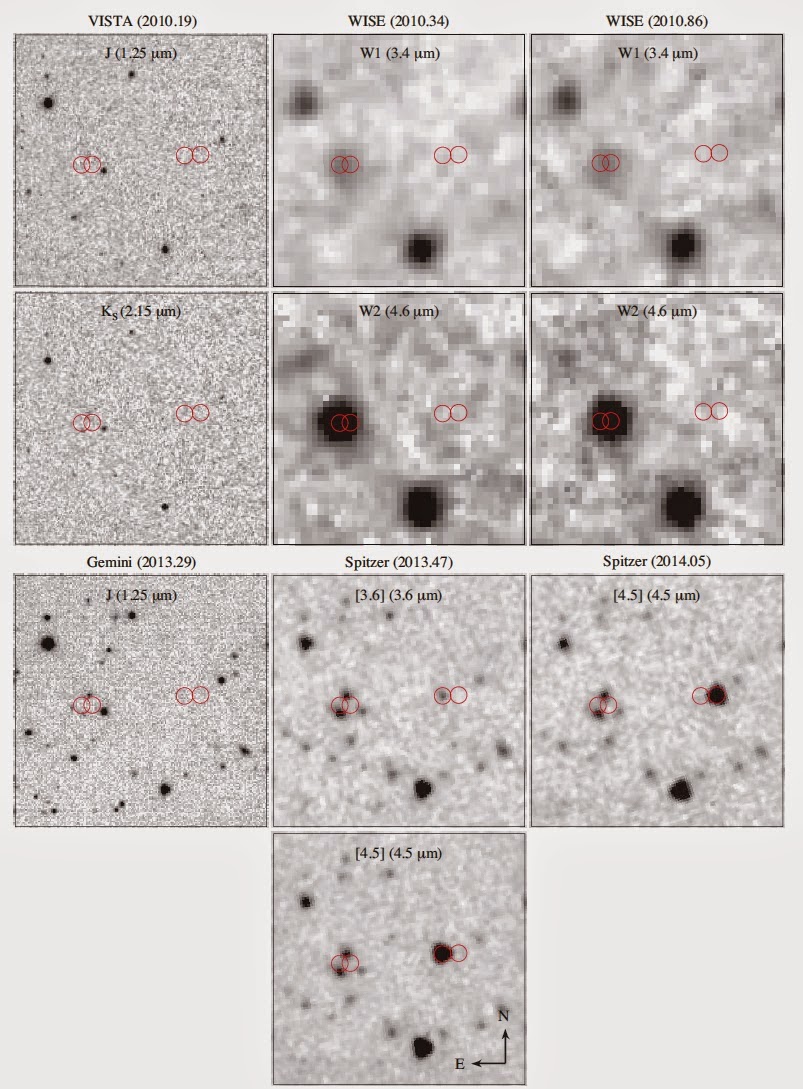
Images of WISE 0855−0714 from VISTA, WISE, Gemini, and Spitzer. In the WISE images, WISE 0855−0714 is a blend of a moving object that dominates at W2 and two stationary sources that likely dominate at W1. The circles indicate the positions of the moving component in the WISE and Spitzer images; it is not detected by VISTA or Gemini. The size of each image is 1′ × 1′. Luhman (2014).


WISE 0855-0714 is calculated to be 7.175 light years from Earth, based upon its parallax (the extent to which it apparently moves in six months due to actual the motion of the Earth). This makes it the fourth closest known object or system to our Solar System, after the Alpha Centauri/Proxima Centauri system (4.364 and 4.277 light years from Earth), Barnard's Star (5.982 light years from Earth) and WISE J104915.57−531906.1 AB (a binary system comprising two Brown Dwarfs also discovered by the WISE space telescope, 6.588 light years from Earth).

It has an estimated surface temperature of just 225–260 K (between -48°C and -13°C) and a mass 3-10 times that of Jupiter (making it possible that it is a giant planet rather than a small Brown Dwarf, though Luhman concludes this is unlikely due to its heat emissions) and is probably between one and ten billion years old. Luhman suggests that the surface of WISE 0855-0714 might have clouds of sulphides, alkali salts and water ice covering half its surface.

Our Solar System's closest Neighbours. Wikipedia/NASA/Pennsylvania State University.

See also...


Follow Sciency Thoughts on Facebook.


Monday, 20 August 2012

A fourth body in the KOI-13 system.

The KOI-13 system (Kepler Object of Interest system) comprises a pair of A-type White Dwarf stars 1630 light years from Earth, orbiting each to closely to be well differentiated. The larger of these, KOI-13α, has a mass 2.05 times that of the Sun, the smaller, KOI-13β, has a mass 1.95 times that of the Sun. In 2011 the Kepler Space Telescope discovered an object (KOI-13.01) orbiting one of these stars every 1.76 days. This object was discovered by the dimming it caused as it passed in front of the star, which meant it was possible to calculate its radius (2.2 times that of Jupiter), but not its mass, leaving scientists unsure whether the object was a very large planet or a Brown Dwarf. In February 2012, a team from the University of Cambridge published a model of the KOI-13 system which suggested that KOI-13.01 was likely to be a super-heated (and therefore super-inflated) Hot Jupiter type planet, with a mass 8.3 times that of Jupiter.

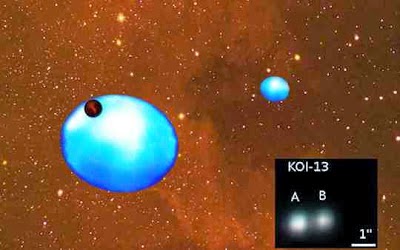
An artists impression of the KOI-13 system. Inset is a telescope image of the stars, scale bar is 1 arc-second. Konkoly Observatory.

In a paper published on the online arXiv database at Cornell University Library on 10 August 2012, and in the journal Astronomy & Astrophysics on 13 August 2012, a team of scientists led by Alexandre  Santerne of the Laboratoire d’Astrophysique de Marseille and Observatoire de Haute-Provence at the Université d’Aix-Marseille & CNRS, detailing the results of a new study of the KOI-13 system using the SOPHIE Spectrograph at the Observatoire de Haute-Provence.  This study used the radial velocity method, which measures the wobble of stars caused by the gravity of objects orbiting around them, to try to determine the mass of KOI-13.01. 

Santerne et al. concluded that KOI-13.01 has a maximum mass of 14.8 times that of Jupiter if it orbits KOI-13α and 9.4 times that of Jupiter if it orbits KOI-13β, supporting the theory that this is a large Hot Jupiter type planet rather than a Brown Dwarf. 

They also found evidence for an extra stellar-mass object within the system, which they name KOI-13γ. This appears to have a mass between 0.4 and 1.0 that of our Sun, and to orbit one of the stars every 65.8 days in an eccentric orbit that does not cross the plane of the star when seen from Earth. KOI-13γ could be potentially the same star as KOI-13.01 if it is towards the smaller end of this mass range, but the most likely scenario that could be modeled was that KOI-13.01 orbits KOI-13α, while KOI-13γ orbits KOI-13β.

See also KOI-13b, a big, hot planet not a Brown Dwarf and Exoplanets on Sciency Thoughts YouTube.

Follow Sciency Thoughts on Facebook.

Sunday, 13 May 2012

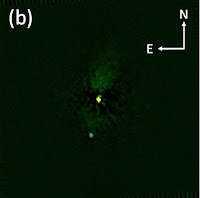
Direct imaging of a Brown Dwarf orbiting the Red Dwarf star 1RXS J235133.3+312720

M Class stars, or Red Dwarfs, are the most abundant stars in the Galaxy, and presumably the Universe. They are small (7.5-60% of the mass of the Sun) and cool (2300-3800 K, compared to 5778 K for our Sun), but can be very long-lived, as they burn their fuel slowly. Since they are the most abundant stars, it is also likely that the majority of planets in the Galaxy orbit Red Dwarfs, making them interesting to scientists studying planets in other stellar systems. It has been demonstrated that smaller stars are less likely to host Hot-Jupiter type planets, but apart from this there do not seem to be any less objects in any other categories orbiting these stars.

In theory a large object orbiting a small (and therefore dim) star at a distance should be detectable by direct imaging; this is in contrast to other planet detection methods, which favor the detection of objects close to their host stars. The Planets Around Low-Mass Stars (PALMS) survey aims to detect such planets using direct observation from Earth-based observatories. In a paper published in the arXiv online database at Cornell University Library on 9 May 2012, and accepted for publication in The Astrophysics Journal, a team of scientist led by Brendan Bowler of the Institute for Astronomy at the University of Hawai‘i describe the discovery of  the first object by the PALMS survey, a Brown Dwarf (an object too small to be a star but too large to be considered a planet) orbiting the Red Dwarf 1RXS J235133.3+312720, directly imaged from the Keck-II Telescope.

1RXS J2355133.3+312720 and its companion. The star is behind a translucent coronagraph. Bowler et al. (2012).

1RXS J235133.3+312720 is about 160 light years from Earth; it has about 45% of the Sun's mass, and an effective surface temperature of about 3520 K. It is thought to be a fairly young object by stellar standards, probably less than 150 million years old, and certainly no more than 500 million years old. The Brown Dwarf obits it at a a distance of 119 AU, and has a mass equivalent to 32 times that of Jupiter. While this is considerably too large to be considered a planet, it does prove that the PALMS survey methodology works in principle.


Follow Sciency Thoughts on Facebook.

Sunday, 1 January 2012

Third body in the AV Canis Minoris system.

AV Canis Minoris is a binary star system in the constellation of Canis Minor; the name implies the 74th variable star in Canis Minor, the star appearing variable as each of the component stars passes in front of the other in our line of sight. It was discovered in 1968 by the German astrophysicist Cuno Hoffmeister, working at the Sonneberg Observatory, and has been largely ignored ever since.


This study revealed that the two primary bodies of the system are an F2-type yellow-white dwarf star (hotter and slightly more massive than our sun) and a G5-type yellow dwarf star (similar to our sun) orbiting one-another every 2.28 days. They also found a smaller third component in the system, which transited the stars every 12 hours; each transit taking 3.3 hours and causing a 2.6% drop in the luminosity of the system. They concluded that this body must be a large Hot Jupiter type planet (a gas giant close to its parent star) or a small brown dwarf (an object large enough to emit more heat than it receives, but to small to fuse hydrogen). They were not able to establish which of the other bodies in the system this object orbited, as the stars are similar in nature and close together, and the orbit of the third body appeared to be highly irregular.

This month Liakos and Niarchis published a new study, along with Dimitris Mislis of the Institute of Astronomy at the University of Cambridge in a paper on the arXiv database, that will also be published in From Interacting Binaries to Exoplanets: Essential Modeling Tools. Proceedings of the IAU Symposium No. 282, 2011. This study used additional observations of the system, combined with improved modeling techniques, and came to the following conclusion.

The object is a Brown Dwarf. It actually emits 2% of the light emitted by the AV Canis Minoris system, although since it is dimmer than the other two objects in the system it does cause a net dimming when it passes between us and them. The object orbits the larger of the two other stars, and probably has a radius 6.4 times that of Jupiter, which would give it a volume of 1098 times that of Jupiter, far to large to be a planet.

The most likely resolution of the AV Canis Minoris system. The Brown Dwarf obits the larger of the two stars, the two stars orbiting their mutual centre of gravity.

Tuesday, 27 September 2011

Just how big is Iota Draconis b?

Iota Draconis is a K-type orange giant star in the constellation of Draconis, 103 light years from Earth. It has an apparent magnitude of 3.31, making it naked-eye visible. In 2002 a paper in The Astrophysical Journal by a team lead by Sabine Frink of the Center for Astrophysics and Space Sciences at the University of California, San Diego reported the discovery of a planet orbiting this star, dubbed Iota Draconis b; 'b' implying the second body in the system if it were capitalized, as 'B', it would imply a second star.

The location of Iota Draconis.

The discovery was made at the Lick Observatory at Mount Hamilton in California, where the researchers were studying variations in the radial velocities of K-type stars through minute variations in the Doppler Shift, with a view to discovering binary systems (the radial velocity is movement directly towards or away from the observer). Since the study was looking at a large number of K-type stars it was considered a possibility that large planets might be detected, but this was not the primary purpose of the study; in 2002 exoplanet discovery was a new field and the equipment available at Lick was at the lower resolution limit for this type of detection.

A visualization of how the mass of a planet effects the radial velocity of a star.

Based upon observations and careful modeling of the possible fluctuations in the radial velocity of Iota Draconis, Frink et al. calculated that the star was orbited by a superjovian (bigger than Jupiter) planet once every 536 days. The planet orbited the star at an average distance of 1.3 AU, that is to say 1.3 × the distance at which the Earth orbits the Sun, but with an eccentricity of 0.70. This means that at its closest the planet is only 0.4 AU from the star, and at its furthest 2.2 AU. The mass of the planet could only be calculated by its effect on the star, i.e. by observing the movement of the star, the astronomers were able to calculate the mass of the planet as a ratio of that of the star. At the time the best guess for the mass of Iota Draconis was about 1.05 times that of our sun, giving a minimum mass for the planet of at least 8.9 × that of Jupiter.

This placed Iota Draconis b in a category of planets know as 'Eccentric Jupiters'; planets with masses comparable to or greater than that of Jupiter with highly eccentric orbits. Such planets are very alien to us, as they do not resemble anything in our solar system, but they are one of the best known groups of exoplanets, since their large masses and eccentric orbits make them relatively easy to detect. In the early days of exoplanet-hunting more than 50% of all planets detected were Eccentric Jupiters.

In 2008 a team lead by Mathais Zechmeister of the Max-Planck-Institut für Astronomie published a paper in the journal Astronomy and Astrophysics in which they describe the results of a more long term study of the radial velocity of Iota Draconis from the Lick Observatory and in addition the Thuringia State Observatory in Germany and the McDonald Observatory in Texas, combined with improved methods for calculating the size of K-type giants. Based upon this they calculated that Iota Draconis b orbits its star every 511 days, slightly less than calculated by Frink et al. They also calculated that the star in the system was somewhat larger than originally thought, between 1.4 and 2.2 × the mass of the sun. Based upon this revised mass Iota Draconis b would have a mass at least 10 × that of Jupiter.

On 22 September this year a team lead by Ellyn Baines of the Remote Sensing Division at the Naval Research Laboratory in Washington DC published a paper on the arXiv database at Cornell University Library, in which they detail further study of the Iota Draconis system, using Georgia State University's Centre for High Angular Resolution Astronomy Array interferometer. Using this data they were able to re-calculate the mass of both the star and planet, and the temperature of the star.

Using this new data Baines et al. were able to derive a far more accurate estimate of the mass of Iota Draconis, at 1.82 × the mass of the sun. Using this mass to calculate the size of Iota Draconis b they came up with a mass of 12.6 × that of Jupiter. This is pushing the limits of what can be comfortably described as a planet; some astronomers consider that objects with masses as low as 10 × that of Jupiter should be considered to be brown dwarfs; the International Astronomical Union sets the limit at 13 Jupiter-masses, within the margin of error for the mass of Iota Draconis b. A brown dwarf is considered to be an object to small to fuse hydrogen in its core, but large enough to fuse deuterium (deuterium is an isotope of hydrogen with a proton, giving it an atomic mass of 2, as opposed to 1 for regular hydrogen). In an object with a mass of 13 × Jupiter then this would be a fairly short-lived process; the object would, assuming it could be sampled directly, be defined as a brown dwarf by the absence of deuterium.

Baines et al. were also able to derive an estimate of the surface temperature of 4545K for Iota Draconis (as opposed to 5778K for our sun). From this the derived an estimate for the positioning of a 'Goldilocks Zone' (i.e. a zone in which planets could support life as we understand it) in the Iota Draconis system. This they estimate at occurring between 6.8 and 13.5 AU - far outside the orbit of Iota Draconis b. This is much further out from the star than Earth is, despite the fact that our sun it hotter; this distance is due to the larger size (diameter) of the star. However it seems unlikely that the Iota Draconis system could host inhabitable planets, since they would need to maintain a stable, not-to-eccentric orbit in a system with a very large planet/small brown dwarf in a very eccentric orbit. Furthermore Iota Draconis is a giant star, a star that has completed its main sequence evolution, used up all its hydrogen fuel and switched to the fusion of other heavier elements, causing it to expand. This expansion would have caused the habitable zone to shift outwards within the system, killing any life which did not have the ability to move its planet, though it is in theory possible that life could have started on a planet after the Goldilocks Zone had shifted out to meet it.

An artists impression of the Iota Draconis system.