Showing posts with label Lemurs. Show all posts

Thursday, 8 March 2018

Cheirogaleus grovesi: A new species of Dwarf Lemur from southeast Madagascar.

Dwarf Lemurs, Cheirogaleus spp., are small tree-dwelling Primates native to Madagascar. They are omnivorous, with a diet comprising mainly of fruit and Insects, and are able to survive lean periods by drawing on a fat reserve in their tails. Until fairly recently all Dwarf Lemurs were thought to belong to a few, morphologically variable species, with wide distributions. However recent genetic studies have shown that the group is made up of a large number of outwardly very similar species which can only reliably be told apart by genetic analysis (cryptic species) each of which has fairly strict environmental requirements and a rather limited range.

In a paper published in the journal Primate Conservation on 27 November 2017, Adam McLain of the Departments of Biology and Chemistry at the State University of New York Polytechnic Institute, Runhua Lei, Cynthia Frasier, Justin Taylor, Carolyn Bailey and Brittani Robertson, all of the Grewcock Center for Conservation and Research at Omaha’s Henry Doorly Zoo and Aquarium, Stephen Nash of Global Wildlife Conservation, Jean Claude Randriamanana of the Madagascar Biodiversity Partnership, Russell Mittermeier, also of Global Wildlife Conservation, and Edward Louis, also of the Center for Conservation and Research at Omaha’s Henry Doorly Zoo and Aquarium and the Madagascar Biodiversity Partnership, describe a new species of Dwarf Lemur from southeastern Madagascar.

The new species is named Cheirogaleus grovesi, in honour of the late British-Australian biological anthropologist, Colin Groves (1942-2017), for his work on primatology, evolutionary biology and taxonomy. The species is on the large side for a Dwarf Lemur, reaching 404 grams in mass, with a body length about 17 cm plus a 27 cm tail. They are reddish brown in colour, with dark patches around the eyes and a lighter underside.

Male Cheirogaleus grovesi in the Andringitra National Park. McLain et al. (2017).

The species was found at altitudes of between 754 and 999  m in tropical forests in the Andringitra and Ranomafana national parks, and the areas surrounding them, and is thought likely to be present in forest fragments between them. The conservation status of the species is unclear; almost all forests in Madagascar are threatened by Human activities, but the species is present in two national parks, which, while not immune from such threats, are better protected than much of the island.

Most new species are described from a holotype, a specimen kept in a museum or university collection. This is important, as future specimens can be referred to this holotype in order to determine if they are the same species; without such a method of defining a species, then it is impossible to establish the conservation status of the species, and grant it any legal protection if deemed necessary. However, while the establishing of a holotype has advantages for the species, it is bad for the individual, which is usually killed. In the case of Primates, and some other Mammals, this is no longer universally considered good practise, and a tissue sample can be used instead, which allows for a genetic comparison to other individuals. In the case of Cheirogaleus grovesi the designated holotype is a small tissue sample taken from a male specimen, plus 0.3 cc of blood taken from the same individual.

See also...

http://sciencythoughts.blogspot.co.uk/2017/11/pongo-tapanuliensis-new-species-of.htmlhttp://sciencythoughts.blogspot.co.uk/2017/01/hoolock-tianxing-new-species-of-hoolock.html
http://sciencythoughts.blogspot.co.uk/2016/10/gorilla-beringei-graueri-grauers.htmlhttp://sciencythoughts.blogspot.co.uk/2015/04/macaca-leucogenys-new-species-of.html
http://sciencythoughts.blogspot.co.uk/2015/03/terrestrial-behaviour-in-borneo.htmlhttp://sciencythoughts.blogspot.co.uk/2015/03/a-new-species-of-titi-monkey-from.html
Follow Sciency Thoughts on Facebook.

Thursday, 6 November 2014

A Pre-Tooth-Combed Primate from the Early Eocene of Tunisia.


The Strepsirhini (Lemurs, Lorises and Galagos) are often considered to be ‘Lower Primates’, surviving representatives of a primitive stock from which the ‘Higher’ Anthropoid Primates (Monkeys and Apes) arose. However they are just as specialized in their way as the Anthropoids, and have a set of adaptations not present in the other group, most notably a specialized ‘tooth-comb’ (specialized set of front teeth used in grooming). Estimates of the age of the group vary, with molecular dating methods suggesting that the most recent common ancestor of all living Strepsirhini lived some time in the Late Cretaceous, while the earliest known fossils of the group date from the Early Eocene, suggesting that either the group has a long ‘fossil gap’ (period when the animals were present but left no fossils) or the ‘molecular clock’ dating method is inaccurate for Strepsihines.

In a paper published in the journal PLoS One on 4 December 2013, a team of French and Tunisian scientists led by Laurent Marivaux of the Laboratoirede Paléontologie at Université Montpellier redescribe Djebelemur martinezi, an Early Eocene Primate that has variously been considered an Adapiforme (an extinct group of Lemur-like Primates lacking a tooth-comb, which includes the ‘Lemurs’ of Europe and North America), or an early Anthropoid.

Djebelemur martinezi was originally described from a left dentary (jawbone) with two preserved molars, from the Natural Park of Djebel Chambi in Tunisia, estimated to be about 50 million years old. Since this time a number of other specimens attributable to the species have become available, including a facial fragment with a partial maxila (upper jaw) and numerous isolated teeth.

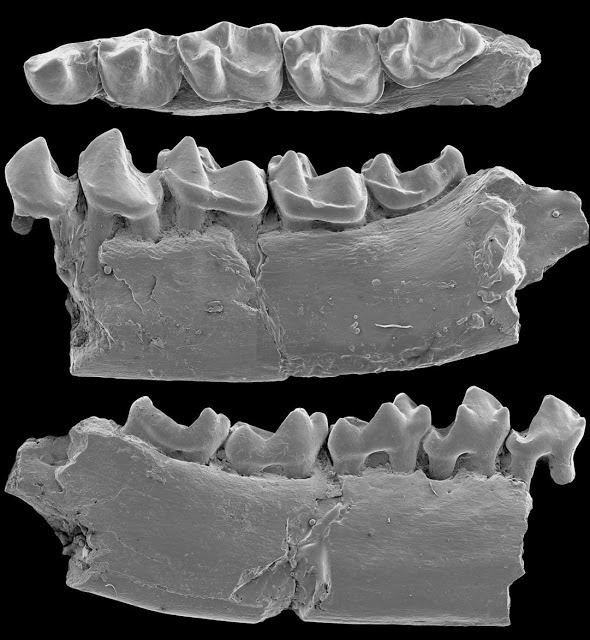
Lower jaw of Djebelemur martinezi from the Djebel Chambi locality.(A) Fragments of right mandible, whichconsists of three isolated pieces found together and reassembled here: the anterior part of the dentary bears the p3 and m1, and alveoli for p4, p2and c, while the posterior part preserves m3 and a portion of the ascending ramus; m2 was found isolated but in the same small calcareous blocktreated by acid processing; (B) photograph of the proximal part of the right mandible (for p4 and p3, note that their mesialalveolus is slightly offset buccallywith respect to their distal alveolus; the single alveolus for p2 is mesiodistally compressed and oblique, while the alveolus for the canine, althoughonly partially preserved, appears slightly larger, suboval, and more lingually positioned with respect to the main axis of the toothrow). (C–G) noncompositelower toothrow with the mandible, canine (reversed), p2 (reversed), and p4, in occlusal (C), lingual(D), frontal (F), and distal (G) views; (H) left p2 in (from left to right) occlusal, buccal, lingual, distal, and mesial views (not reversed); (I) left canine in (from left to right) occlusal, buccal, lingual, distal, and mesial views (not reversed). The 3D representations have been obtained by X-ray mCT surface reconstruction. The crown and roots of teeth of the mandible have beenvirtually delimited by manual segmentation. Marivaux et al. (2014).

Marivaux et al. conclude from this material that Djebelemur martinezi had a primitive tooth-comb apparatus, and that it should therefore be considered an early member of the Strepsihine lineage, though an analysis of its phylogeny suggests that it branched off before the most recent common ancestor of all modern members of the group. This in turn suggests that the Strepsihines are younger than previously thought, probably originating in the early Eocene. If this is the case, then the Strepsihines are considerably younger as a group than the Adapiformes of Europe, and the may have arisen from a small Adapiforme population that reached Africa from Europe, rather than both groups arising from an more ancient African ancestor – which has implications for the origins of Primates as a whole.

Facial fragment of Djebelemur martinezi from the Djebel Chambi locality.(A–E) Left maxilla preserving P3-M3 andalveoli for P2 and C1, in frontal (A), coronal section (cs) through M1 (B), palatal (C), dorsal (D), and lateral (E) views; (F) left P4 in occlusalview. The 3D representations have been obtained by X-ray mCT surface reconstruction. On the maxilla, the crown androots of teeth have been virtually delimited by manual segmentation. Abbreviations: IOF, infraorbital foramen; of, orbital floor; hp, hard palate; pzm,processuszygomaticus maxillae; ra, root apex; jms, jugo-maxillary suture. Marivaux et al. (2014).

Marivaux et al. also tried to reconstruct the diet of Djebelemur martinezi, based upon analysis of tooth wear and the potential shearing force that could be applied by its jaws. Based upon this they conclude that it was probably an insectivore. The shearing force it could apply would be far in excess of that expected for a frugivore (fruit eater) of similar size, falling comfortably within the range for leaf-eaters and a little on the low side for an insect eater; however leaves require an extended digestive tract to process, and at an estimated 80g Djebelemur martinezi is highly unlikely to have been able to do this. The dental wear seen is also more consistent with insectivory than any other diet.

See also…

Bushbabies (Galagidae) are African nocturnal Primates related to Lorises (Lorisidae). Like the Lorises they are solitary nocturnal foragers living in the tree canopy, but while Lorises are slow, deliberate animals, the Bushbabies often move rapidly through the forest, and are capable of leaping from tree-to-tree like Monkeys...

The Omomyids were a group of Palaeocene-Oligocene Primates similar, and probably related to, the modern Tarsiers. They had large, forward facing, eyes and grasping hands and feet with nails instead of claws. Their teeth sugest that they had a diet of fruit and insects, and their skeltel morphology that they lived in trees and that most species were nocturnal. They appeared in the fossill...

Mouse lemurs are the smallest primates. They are nocturnal animals that resemble Tarsiers or Bush Babies, but are true lemurs, all 27 known species belonging to a single genus Microcebus. Like all modern lemurs they are found only in Madagascar (fossil lemurs are known from Africa, Asia and Europe).


Follow Sciency Thoughts on Facebook.

Saturday, 14 January 2012

New Mouse Lemur discovered in Madagascar.

Mouse lemurs are the smallest primates. They are nocturnal animals that resemble Tarsiers or Bush Babies, but are true lemurs, all 27 known species belonging to a single genus Microcebus. Like all modern lemurs they are found only in Madagascar (fossil lemurs are known from Africa, Asia and Europe).

On 24 December 2011 a paper appeared in the Online First form of the journal Primates by a team lead by Ute Radespiel of the Institute of Zoology at the University of Veterinary Medicine in Hanover, in which they describe the discovery of a new species of Mouse Lemur in the Sahafina Lowland Rainforest, close to the Mantadia National Park. The new species has been named as Microcebus gerpi, meaning Gerp's Mouse Lemur; Gerp is in this case not a person, but an abbreviated form of Groupe d'Étude et de Recherche sur les Primates de Madagascar, a Malagasy primate research group who's researchers gathered the material upon which this discovery is based; photographs, measurements and blood samples of individuals that were captured and then released.

Gerp's Mouse Lemur.

At 68 g the new species is big for a Mouse Lemur, it is grayish brown, and darker on the back than the front; a reddish line of fur runs down its spine. It is genetically quite distinct from other known Mouse Lemur species. Little is known of its behavior or ecology, but it is presumed to be endemic to the Sahafina Forrest, which is highly fragmented due to cultivation, suggesting that the species may be threatened by human activity.