Showing posts with label New Species. Show all posts

Wednesday, 9 May 2012

A cryptic species of Ground Frog from southern Chile.

During a series of expeditions to the temperate Nothofagus (Southern Beach) forests near Valdivia City in the Coastal Range of Southern Chile, researchers from the Facultad de Ciencias at the Universidad Austral de Chile found a number of frogs resembling the Rose Ground Frog, Eupsophus roseus, but differing somewhat in reproductive habits. 

In a paper published in the journal Zootaxa on 9 May 2012, three of those researchers, José Nuñez, Felipe Rabanal and Ramon Formas, formally describe the frogs as a new species, Eupsophus altor, or Oncol's Ground Frog.
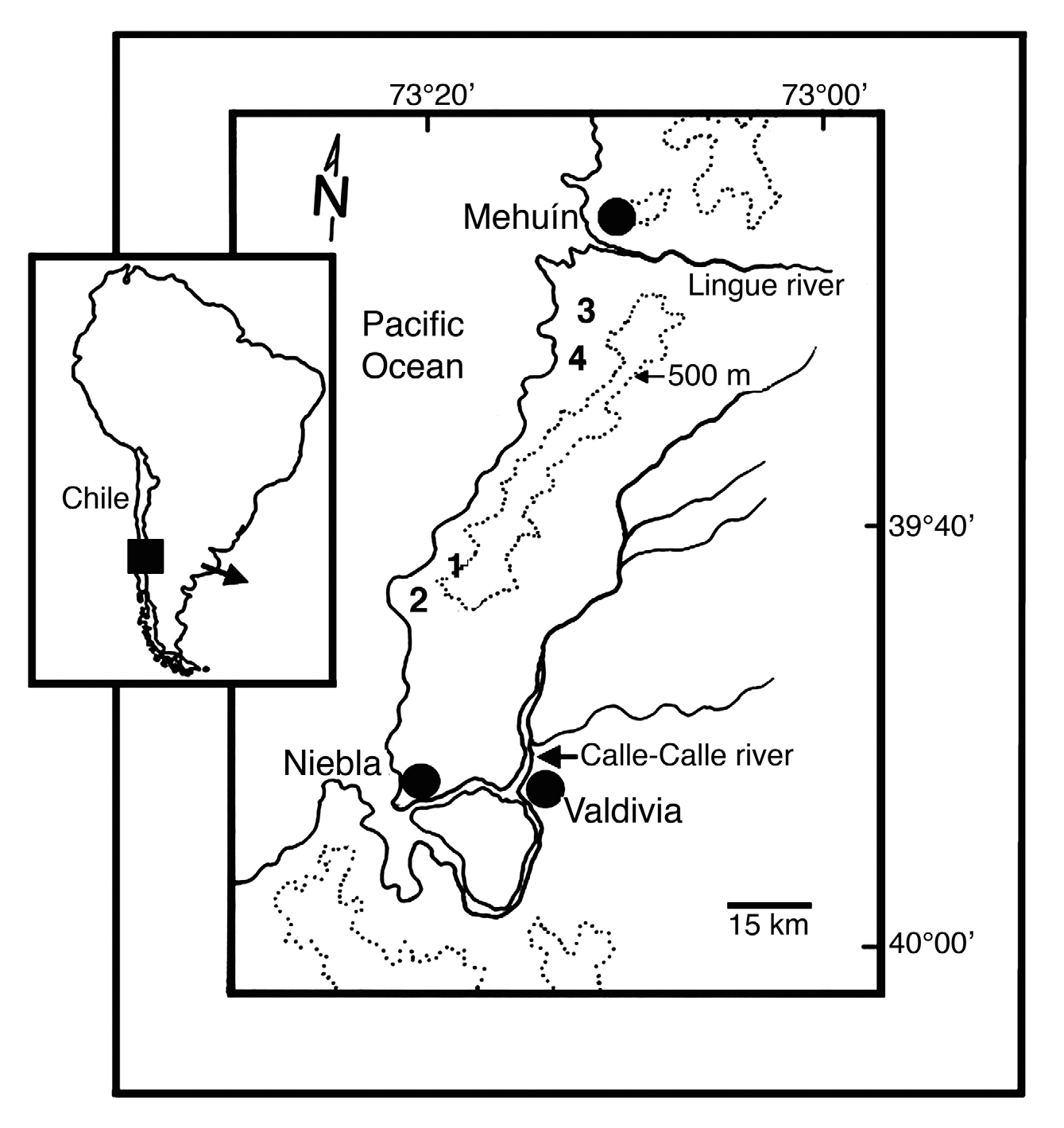
The locations where the new Ground Frog was discovered. (1) Cerro Oncol. (2) Curiñanco. (3) Chan-Chán. (4) Alepue. Nuñez et al. (2012).

Eupsophus altor is a reddish-pink frog with light grey spots, roughly 40 mm in length. It has a longer, higher pitched call than E. roseus, and reproduces in a quite different way. E. roseus, like most amphibians, lays its eggs in pools, where the tadpoles develop. E. altor, in contrast, lays its in moist patches eggs on land, such as underneath logs, and its tadpoles hatch and develop in a terrestrial environment, guarded by the male frog.

(A) Adult male Eupsophus altor. (B) Male with eggs. (C) Male with tadpoles. (D) Male with late-stage tadpoles. Scale bars are 10 mm. Nuñez et al. (2012).

Molecular studies also indicated that Eupsophus altor should be considered a separate species, but this certainly would not have been picked up on without the difference in reproductive behavior, leading Nuñez et al. to consider it a cryptic species (a separate species hidden within an apparently homologous population), and therefore to question the number of other cryptic species might be hidden within amphibian populations around the world.


Follow Sciency Thoughts on Facebook.

Wednesday, 25 April 2012

New species of moth from Yunnan Province.

In May 1992 entomologist Xue Dayong collected a single moth of an unknown species outside Heinitang village in western Yunnan Province, China, near the border with Myanmar. In the intervening 20 years no further specimens of this moth have been found, while the area has suffered steady deforestation due to slash-and-burn agriculture, leading to a distinct possibility that there are no more of these moths to be found.

The effects of slash-and-burn agriculture near Heinitang village. Li et al. (2012).

In the absence of any further material the species has been described from the single specimen in a paper published in the journal Zootaxa on 25 April 2012 by Jing Li, Nan Jiang and Hongxiang Han of the Key Laboratory of Zoological Systematics and Evolution at the Institute of Zoology at the Chinese Academy of Sciences.

The new moth is (tentatively) placed in the genus Heterophleps, though Li et al. are cautious of making a full taxonomic analysis based upon a single specimen. It is given the specific name inusitata, meaning rare. Heterophleps inusitata is a brown larentiine moth with a yellow underside, with a 17 mm forewing (the only measurement given).

Heterophleps inusitata. Li et al. (2012).


Follow Sciency Thoughts on Facebook.

Wednesday, 18 April 2012

New species of Owlfly from Morocco.

Owlflys, or Ascalaphidaens, are members of the Lacewing order Neuroptera, closely related to the Antlions, (Myrmeleontidae). They are flying predatory insects that superficially resemble Dragonflys, though they are not closely related. About 500 species of Owlflys have been described worldwide.

In a paper published in the journal Zootaxa on 17 April 2012, Davide Badano of the Istituto per lo Studio degli Ecosistemi at the Consiglio Nazionale delle Ricerche and Roberto Pantaleoni of the Dipartimento di Protezione delle Piante at the Università degli Studi di Sassari describe a new species of Owlfly from the Anti–Atlas Mountains of Morocco.

The new species is named as Agadirius trojani, Trojan's Agadirfly, in honor of Ilja Trojan, a Czech entomologist who collected the specimen from which the species is described, and Agadir, the capital of the Souss–Massa–Draâ Region, where the fly was discovered. It is an 18 mm hairy black fly, with forewings larger than the hindwings and black fore-parts to the hindwings.

Agadirius trojani, the new species of Owlfly. Badano & Pantaleoni (2012).

The species was described from a single specimen found in a valley near the village of Aït Mansour, where a mountain stream flows through a rocky valley with a stand of Date Palms.

The valley at Aït Mansour where Agadirius trojani was found. Badano & Pantaleoni (2012).

Owlflys are an ancient group, dating back to at least the Jurassic. The larger group to which they belong, the Neuropterans (Lacewings), date back to the Permian, reaching their maximum diversity in the Jurassic, when they appear to have been the most abundant group of flying insects.

Fossil Owlfly larva in amber from the La Toca Amber Mine in the Dominican Republic. 33-40 million years old; Eocene or Oligocene. TerraTreasures and Adventures101.


Follow Sciency Thoughts on Facebook.

Sunday, 8 April 2012

A new species of Semiaquatic Spectacled Lizard from southern Peru.

Spectacled Lizards, or Microteiids, are small lizards from Central and South America related to Teiids (Whiptails) and skinks. They have transparent lower eyelids (hence spectacled) and often show reduction or absence of the limbs, particularly the hind-limbs. The Semiaquatic Lizards of the genus Potamites and Neusticurus are a distinct group within this family, noted for their semiaquatic lifestyle.

On 31 January 2012, in a paper in the journal ZooKeys, Germán Chávez and Diego Vásquez of the Centro de Ornitología y Biodiversidad (CORBIDI), describe a new species of the genus Potamites from two locations in southern Peru.

The new species is named Potamites montanicola (the mountain dwelling Semiaquatic Lizard), and is distinguished from other members of the genus principally by the presence of scattered keeled scales on its dorsal surface; in other members of the genus keeled scales or tubercles are arranged in longitudinal rows.

Potamites montanicola. (A) Male. (B) Female. (C) Juvenile. Chávez & Vásquez (2012).

Potamites montanicola is an approximately 175 mm long (when adult) brown lizard. Mature males have black and blue patterned undersides and darker brown colouration on their backs. The flank has a pair of black eyespots with yellow centers forward and above the first limbs. The underside of the tail is reddish brown. Females and juveniles are plainer brown, though the eyespots are present (but fainter) on mature females.

The lizards were found at two sites in southern Peru, 64 km apart, in the Cordillera de Vilcabamba mountain range and Apurimac river valley, at altitudes between 1570 and 2100 m. One location was a stream with a rocky substrate, the lizards being found both on the rocks and in the water, the other was in a wooded area where the lizards were found on leaf litter and fallen trunks close to a creek.

Map of southern Peru, showing the locations where the lizards were collected. Chávez & Vásquez (2012).

There are two other species of the genus Potamites known from Peru; P. ecpleopus and P. strangulatus. P. strangulatus has two known subspecies, P. s. strangulatus and P. s. trachodus. Both of these are lowland species, not known from above 800 m.

Species of Potamites found in Peru. (A) Potamites montanicola. (B) Potamites strangulatus strangulatus. (C) Potamites ecpleopus. (D) Potamites strangulatus trachodus. All from Chávez & Vásquez (2012). (B & C) Photographed by Alessandro Catenazzi. (D) Photographed by Pablo J. Venegas.


Follow Sciency Thoughts on Facebook.

Monday, 12 March 2012

New species of Skink from northwest New Caledonia.

Skinks are smallish lizards with elongate bodies and reduced legs and necks. They are an ancient and successful group, found throughout the tropical, subtropical and warm temperate regions of the world, though individual species (of which there are over 12 000) may be threatened. Skinks can either lay eggs or bear live young (depending on species) and can be divided into tree-dwelling and ground-dwelling species, though this is an ecological rather than a taxonomic distinction; ground-dwelling species tend to have much more reduced limbs than tree-dwelling species, often being quite snake-like. Most skinks are insectivorous, but some will eat vegetable matter, or small rodents.

On 9 March 2012, in a paper in the journal Zootaxa, a team of biologists led by Ross Sadlier of the Section of Herpetology at the Australian Museum, describe the discovery of a new species of skink from the woodlands of northwest New Caladonia.

The species is described as Caledoniscincus constellatus, the Star-studded Caledonian Skink. It is a brown skink with a yellow underside and a white lateral stripe (stripe along its side), the adults of which are 46-57 mm in length. It is a tree-dwelling species found in Acacia Scrub and Mediterranean Woodland. Reproductive and feeding behavior were not recorded.

Male Star-studded Caledonian Skink, Caledoniscincus constellatus. From Sadlier et al. (2012).

There are two other species of Caladonian Skink with white lateral stripes, both of which share at least part of their range with C. constellatus. C. haplorhinus and C. austrocaledonicus. In C. constellatus the lateral stripe is broad and solid when it reaches the ear opening, but in C. haplorhinus, it is narrow and starting to break up. C. austrocaledonicus does not always have a lateral stripe, and where it does this does not reach the ear. Genetic studies have confirmed these are three separate species.

The heads of (A) C. constellatus, (B) C. haplorhinus, and (C) C. austrocaledonicus, showing the position of the lateral stripe at the head. From Sadlier et al. (2012).

C. constellatus is known only from two sites in the northwest of New Caledonia. These are threatened by deforestation by expanding agriculture and ranching, which fragments the landscape and makes it vulnerable to forrest fires, habitat loss due to nickel mining at the Koniambo Mine, and the harmful effects of the invasive Little Red Fire Ant (Wasmannia auropunctata). If these turn out to be the only places where it lives, then C. constellatus would meet the criteria for inclusion in the Critically Endangered category on the IUCN Red List.

Map of northern New Caledonia, showing the two locations where C. constellatus was found. From Sadlier et al. (2012).

The localities where C. constellatuswas found. (A) Acacia scrubland at Pointe de Vavouto. (B) Mediterranean Forrest on Massif Ouazangou. From Sadlier et al. (2012).

Saturday, 10 March 2012

New species of Catshark from the Galapaagos.

Catsharks, or Dogfish, are small bottom dwelling sharks found in oceans throughout the world.

In a paper published in the journal Zootaxa on 5 March 2012, John McCosker, of the Department of Aquatic Biology at the California Academy of Sciences, Douglas Long, of the Department of Aquatic Biology at the California Academy of Sciences and the Department of Natural Sciences at the Oakland Museum of California, and Carole Baldwin of the Division of Fishes at the National Museum of Natural History at the Smithsonian Institution, report the discovery of a new species of Catshark from the Galapagos Islands, named as Bythaelurus giddingsi, the Galapagos Catshark, or Giddings' Catshark, in honor of underwater filmaker Al Giddings.

The Galapagos, or Giddings', Catshark (Bythaelurus giddingsi). From McCosker, Long & Baldwin (2012).

The Galapagos Catshark grows to slightly over 400 mm in length. Unlike other Catsharks of the genus Bythaelurus, which tend to be plain in colour, or tend to have a single line of spots, Bythaelurus giddingsi is spotted all over, and, unlike most sharks of any type, these spots are not symmetrical but are placed in different positions on different parts of the body.

The sharks were discovered at a depths of between 450 and 600 m between the islands of Darwin and Marchena using the Johnson Sea-Link submersible. They are thought to be indigenous to the Galapagos.

Wednesday, 7 March 2012

New species of Parrotfish from the East Atlantic.

Parrotfish are a form of Wrasse with highly specialized dentition, in which the teeth are tightly packed together to form a sort of beak, used to break off chunks of coral, on which the fish feed. They are brightly coloured and found throughout the tropics, adding to their parrot-like appearance. Parrotfish are sequential hermaphrodites, starting out as females then turning into males later; the timing and trigger for this change varies from species to species.

In a paper published in the journal Zootaxa on 6 January 2012, Luiz Rocha of the Ichthyology Section at the California Academy of Sciences, Alberto Brito of the Departamento de Biología Animal (Ciencias Marinas) at the Facultad de Biología at Universidad de La Laguna and Ross Robertson of the Smithsonian Tropical Research Institute in Balboa, Panamá report the discovery of a new species of Parrotfish from the Eastern Atlantic.

The new fish was first discovered in Cape Verde, where it was noticed that fish previously thought to belong to the same species as Parrotfish in the Caribbean had different colouration. Subsequent genetic studies proved these to be a separate species of fish. This has been named as Sparisoma choati, the West African Parrotfish, or Choat's Parrotfish (in honor of J. Howard Choat, an expert on Parrotfish at James Cook University).

Male Sparisoma choati. From Rocha et al. (2012).

Female Sparisoma choati are a grayish brown to grayish red, paler on the chin and belly, with scattered reddish brown scales on the flanks giving a mottled appearance. The edges of the scales are darker, further contributing to this mottled appearance. Fins are grayish or whitish red, except the dorsal fin which is translucent red, with a black or dark red spot. The eyes are orange.

Female Sparisoma choati. From Rocha et al. (2012).

The male Sparisoma choati are more colourful, with a reddish brown head and forepart of the body, pale underparts, grey cheeks, and grey-green hind-parts, bright green on the belly. The scales are edged in bright green, the caudal (tail) fins are grey, the anal (rear) fins blue, the dorsal fin reddish brown at the front and gray at the back. The pectoral (front) fins are brownish red with a green base and a black spot.

As well as in Cape Verde the fish have been found in São Tomé, and along the African coast from Senegal to Angola.

The distribution of Sparisoma choati (stars), and the related species S. rubripinne (squares) and S. axillare (circles). From Rocha et al. (2012).

Sunday, 4 March 2012

New Spadefoot Toad from southeastern Laos.

Eastern Spadefoot Toads of the genus Leptobrachium are found in India, Southeast Asia, Southern China and the islands of the Sunda Arc. They are related to Horned Toads, Horned Frogs, Spiny Toads, Asian Toads, Mountain Toads, Borneo Frogs and Karin Hill Frogs. Many Eastern Spadefoot Toad species have split coloured irises to their eyes, with the top part of the iris a different colour to the rest of the eye.

I a paper published in the journal Zootaxa on 10 January 2012, a team lead by Bryan Stuart of the North Carolina Museum of Natural Sciences describe a new species of Eastern Spadefoot Toad from southeastern Loas, named as Leptobrachium xanthops, the Yellow-eyed Eastern Spadefoot Toad.

Female Leptobrachium xanthops, the Yellow-eyed Eastern Spadefoot Toad. From Stuart et al. (2012).

Leptobrachium xanthops is a stocky dark grey toad 45-57 mm in (adult) length. It is pale on the underside and has a distinctive pale yellow arc across the top part of its eye. It was not observed to make any vocalizations.

Male Leptobrachium xanthops, the Yellow-eyed Eastern Spadefoot Toad. From Stuart et al. (2012).

The toads were discovered in wet evergreen forest on the Dakchung Plateau, in southeastern Laos, at an altitude of 1450-1500 m. All were found within 15 m of wide, fast flowing rocky streams. Stuart et al. speculate that they are probably also present in other upland areas of southern Laos, and adjacent areas of Vietnam.

Map of Laos and the surrounding countries showing the area where the toads were found (black star). From Stuart et al. (2012).

Saturday, 25 February 2012

New species of Bat discovered in Vietnam.

Bats are the second largest group of mammals, with about 1240 known extant species; 20% of all named mammal species are bats. They are at their most diverse in the tropics, and tend to be small, which makes it likely that there are many more species yet to be discovered, though it is also likely that many of these unnamed bats may be at risk due to habitat loss.

In a paper in the February edition of the Journal of Mammalogy a team of scientists lead by Vu Dinh Thong of the Institute of Ecology and Biological Resources in Hanoi describe the discovery of a new species of Leaf-nosed Bat from Vietnam.

The new species has been named as Hipposideros griffini, or Griffin's Leaf-nosed bat (in Vietnamese Dơi nếp mũi Grip-phin) in honour of the late Donald Redfield Griffin of Rockefeller University in New York, a noted bat researcher.

Griffin's Leaf-nosed Bat, Hipposideros griffini. Thong et al. (2012).

The new bat is not described from newly discovered populations, but rather from populations formerly attributed to another species, Hipposideros armiger (Armiger's Leaf-nosed bat), which it closely resembles, although H. griffini is somewhat smaller, and has a distinct call. DNA analysis confirmed that it was a distinct species, separate from H. armiger and other species of Leaf-nosed Bat.

H. griffini was found at a number of locations, including both primary rainforest, disturbed/secondary rainforest, mountains, karst (eroded limestone terrain), and on an off-shore island, Cat Ba in Ha Long Bay. As such the species seems highly adaptable, and not in any immediate threat due to human activity. Thong et al. suggest that the species is likely to be found in Cambodia, China, Lao People’s Democratic Republic, Myanmar and Thailand as well as in Vietnam, although they are unable to confirm this without further research.

Saturday, 14 January 2012

New Mouse Lemur discovered in Madagascar.

Mouse lemurs are the smallest primates. They are nocturnal animals that resemble Tarsiers or Bush Babies, but are true lemurs, all 27 known species belonging to a single genus Microcebus. Like all modern lemurs they are found only in Madagascar (fossil lemurs are known from Africa, Asia and Europe).

On 24 December 2011 a paper appeared in the Online First form of the journal Primates by a team lead by Ute Radespiel of the Institute of Zoology at the University of Veterinary Medicine in Hanover, in which they describe the discovery of a new species of Mouse Lemur in the Sahafina Lowland Rainforest, close to the Mantadia National Park. The new species has been named as Microcebus gerpi, meaning Gerp's Mouse Lemur; Gerp is in this case not a person, but an abbreviated form of Groupe d'Étude et de Recherche sur les Primates de Madagascar, a Malagasy primate research group who's researchers gathered the material upon which this discovery is based; photographs, measurements and blood samples of individuals that were captured and then released.

Gerp's Mouse Lemur.

At 68 g the new species is big for a Mouse Lemur, it is grayish brown, and darker on the back than the front; a reddish line of fur runs down its spine. It is genetically quite distinct from other known Mouse Lemur species. Little is known of its behavior or ecology, but it is presumed to be endemic to the Sahafina Forrest, which is highly fragmented due to cultivation, suggesting that the species may be threatened by human activity.